
NEV On-Board vs Construction-Machinery Integrated Screw Air Ends: Buyer Comparison
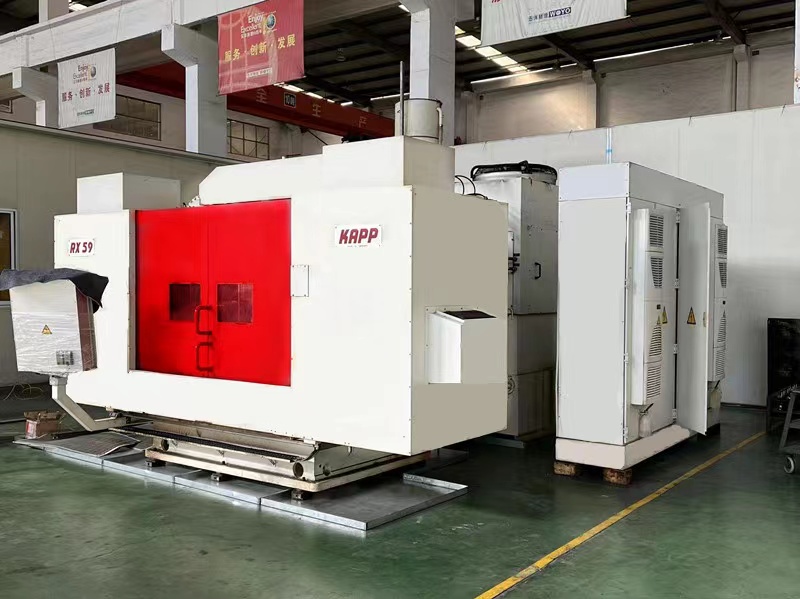
Rotor grinding is a key manufacturing step behind integrated screw air ends.
The choice between a new-energy vehicle (NEV) on-board integrated screw air end and a construction-machinery integrated screw air end is not a question of which category is universally better. It is a matching decision. The buyer must align the air end to the machine's flow demand at 7 bar, power class, electrical interface, installation envelope and dust duty. This comparison uses three reference classes from WoYo COMPRESSOR: the NEV on-board class, the ZCU integrated air end and the GCU55 integrated air end.
Answer first: the NEV on-board class fits vehicle-level air supply where the stated range is 2.2–4 kW, 3500 rpm, 0.25–0.4 m³/min FAD at 7 bar and 24 V or 540 V motor options. The ZCU fits a middle flow class at 7.5–11 kW, 3500 rpm, 1.0 m³/min at 7 bar and 41 kg. The GCU55 fits high-flow construction and mining work at 22–30 kW, 4100–6000 rpm and 4.2–5.0 m³/min FAD at 7 bar. The correct choice is the smallest class that meets the confirmed duty point, not the largest class the chassis can carry.
What makes this comparison difficult?
The difficulty is that all three classes may be quoted at the same 7 bar pressure, yet they are not interchangeable. Their flow ranges differ by large steps: 0.25–0.4 m³/min for the NEV class, 1.0 m³/min for ZCU and 4.2–5.0 m³/min for GCU55. A buyer who compares only pressure will miss the flow and power difference that determines whether the air end can run the tool, actuator or vehicle system.
The second difficulty is installation. An integrated screw air end combines the air-end block, motor side and separation or air-path architecture into a compact assembly rather than separate components connected by external piping. That changes the mounting envelope, service access, leakage risk and assembly time. A unit that fits one machine architecture may not fit another, even when the pressure rating is the same.
The third difficulty is application duty. A vehicle on-board system and a rock drill or mining jumbo do not see the same load profile, vibration, dust exposure or maintenance interval. The construction side must account for heavy dust, high altitude or high humidity where the machine is used. The NEV side must account for the vehicle electrical architecture and the available 24 V or 540 V motor option. Those conditions belong in the RFQ, not in a generic product label.
Why integrated architecture changes the decision
An integrated screw air end is a packaged air-end solution. In WoYo COMPRESSOR's comparison of integrated and conventional separate airends, the integrated block places the motor side, airend and separation system into one block. The purpose is to improve concentricity, remove external piping resonance and reduce external leakage points.
The same company comparison reports a 35% volume reduction, 28% lower pipeline pressure loss, 12% higher FAD, oil consumption below 2 ppm versus more than 3 ppm, 5–8 dB(A) lower noise and about 70% fewer installation hours. It also states an MTBF of 30,000 hours for the integrated architecture. These are company-reported comparison figures, not independent laboratory results. They are still useful as evaluation criteria because they show what the buyer should verify: envelope size, pressure loss, oil carry-over, noise, installation time and service access.
WoYo COMPRESSOR's comparison of a traditional on-board compressor with external piping and belt drive makes a similar point. The integrated direct-drive block removes external pipes, joints and valves. The reported differences include an 80% reduction in leakage and loosening failures, a failure rate below 1%, MTBF raised to 30,000 hours and noise reduced by 5–8 dB(A). A shorter air path with fewer elbows is reported to reduce pressure loss by 28% and improve thermal efficiency by 15%. For a buyer, the practical question is not whether integration sounds advanced, but whether the supplier can show the envelope, connections, service points and test conditions for the exact model.
Performance comparison also needs a common test basis. ISO 1217:2009 specifies acceptance-test methods for volume flow rate and power requirements of displacement compressors. ISO 1217:2009/Amd 1:2016 addresses the calculation of isentropic efficiency and its relationship with specific energy. When two air ends are compared, the buyer should ask for flow, pressure, shaft power, speed and test conditions under the same reference method. Without that, a flow figure alone is not a complete comparison.
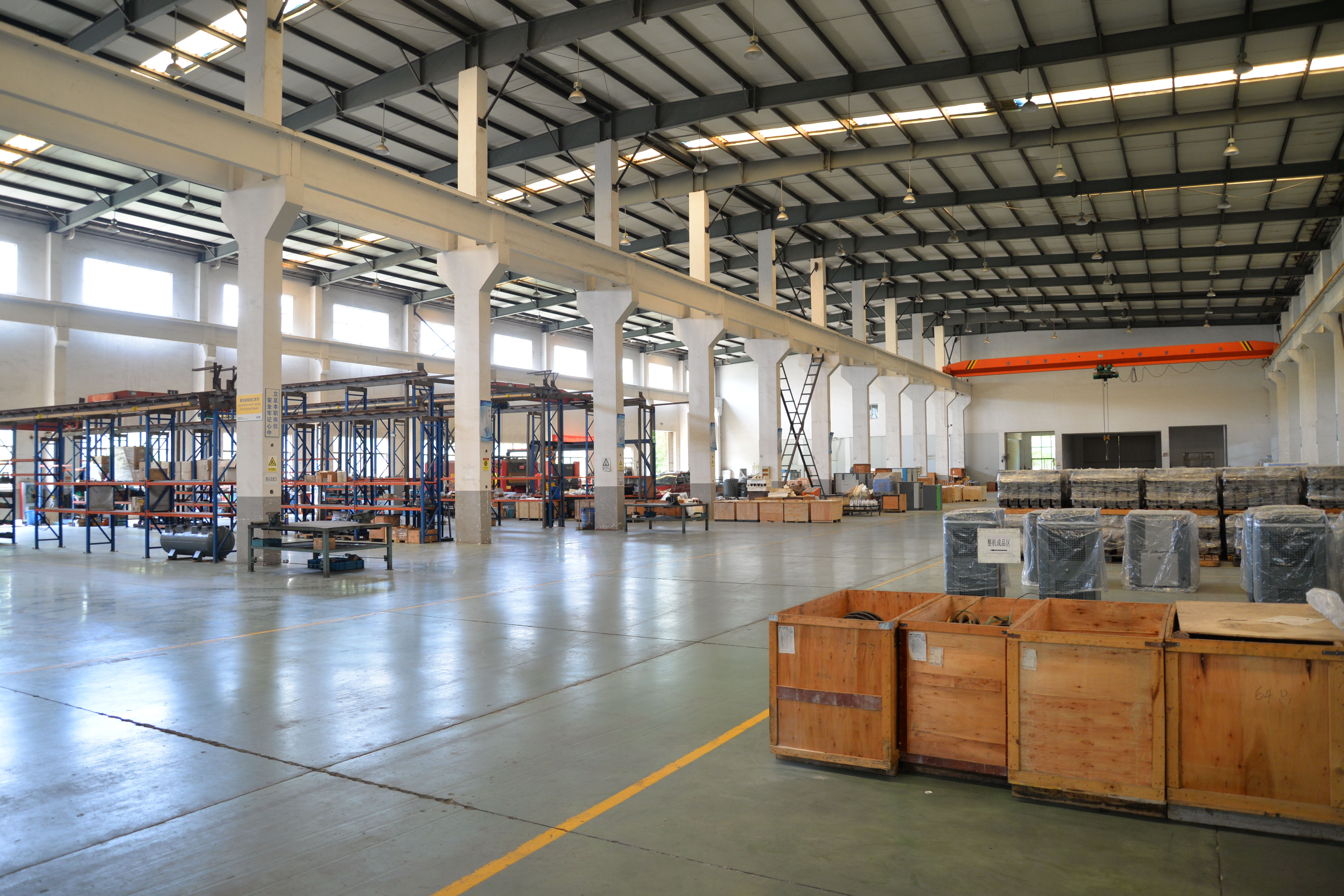
Factory production area at WoYo COMPRESSOR.
The three reference classes and what they are for
NEV on-board integrated screw air end
The NEV on-board class is the compact end of this comparison. Its stated operating point is 2.2–4 kW at 3500 rpm, with 0.25–0.4 m³/min FAD at 7 bar. It is offered with 24 V or 540 V motor options. That voltage choice is a design constraint, not a detail to settle after the air end is selected. The vehicle electrical system, control interface and safety architecture must be confirmed before the motor option is fixed.
This class suits new-energy commercial vehicle on-board air supply and related chassis auxiliary systems, where the air end is part of the vehicle rather than a separate construction tool package. The buyer should not assume that a higher power class is automatically better; extra power and flow can add mass, envelope and energy demand that the vehicle does not need.
ZCU integrated screw air end
The ZCU is the middle flow class in this data set. Its stated values are 3500 rpm, 1.0 m³/min at 7 bar, 7.5–11 kW and 41 kg. It sits between the NEV class and the GCU55 in flow and power, making it a reference point for machinery that needs more air than a vehicle on-board system but does not require the GCU55 flow class.
The 41 kg mass is a useful data point because it affects mounting, handling and service access. It should not be treated as a complete installation weight for every configuration; the mounting frame, couplings, hoses and controls must be confirmed for the actual build.
GCU55 integrated screw air end
The GCU55 is the high-flow class in this comparison. Its stated range is 22–30 kW, 4100–6000 rpm and 4.2–5.0 m³/min FAD at 7 bar. The higher speed range and flow class point to construction and mining duties where the air end must support tools or systems with larger air demand.
For heavy-dust work, WoYo COMPRESSOR positions its heavy-dust 9-in-1 integrated assembly for rock drills, mining jumbos and anchor drills. The company also states that its GCU series is designed to operate in high-dust, high-altitude and high-humidity environments. These are application claims to verify against the exact model, protection arrangement and site conditions. They do not mean that every GCU55 configuration is automatically suitable for every mine or every drill rig.
Buyer selection path: seven checks
- Define the required FAD at 7 bar. Start with the air demand of the tool, actuator or vehicle system, including simultaneous users and allowable pressure drop. Compare that demand with the stated class: 0.25–0.4 m³/min for the NEV class, 1.0 m³/min for ZCU and 4.2–5.0 m³/min for GCU55. Do not select by power alone.
- Match the power class to the duty. The NEV class is 2.2–4 kW, ZCU is 7.5–11 kW and GCU55 is 22–30 kW. A lower class may be adequate for a light or intermittent vehicle load, but it cannot be assumed to cover a continuous drilling load. Size for the confirmed duty point and check the motor's allowable operating range with the supplier.
- Confirm the voltage and electrical interface. The NEV class offers 24 V or 540 V motor options. For ZCU and GCU55, the electrical interface must be confirmed at RFQ because voltage is not part of the comparison data used here. The buyer should provide the available voltage, control signal, connector type and environmental protection requirement.
- Check the installation format and envelope. All three are integrated air-end classes, but integrated does not mean identical. Confirm mounting points, shaft connection, hose and pipe locations, service access, oil and filter access, lifting points and the overall envelope. The 35% volume reduction reported for integrated versus separate airends is a category comparison, not a guarantee for every installation.
- Match duty cycle and environment. Vehicle on-board duty and construction-machinery duty differ in vibration, start-stop frequency, dust, altitude and humidity. The buyer should state the actual duty cycle, expected ambient conditions and maintenance interval. For rock drills, mining jumbos and anchor drills, ask how the heavy-dust 9-in-1 assembly is protected and how service is performed in the field.
- Verify performance test conditions. Ask for flow, pressure, shaft power, speed and test method. Reference ISO 1217:2009 for volume flow and power acceptance testing, and ISO 1217:2009/Amd 1:2016 when isentropic efficiency or specific energy is discussed. A 7 bar rating is not enough if the flow and power are measured at different conditions.
- Compare total cost, not only unit price. Include installation labour, piping and joints, leakage risk, service access, spare parts, oil consumption, noise treatment and downtime. WoYo COMPRESSOR's comparison data states that the integrated architecture can have a higher unit price but lower installation labour, lower leakage loss and lower total cost. That logic should be checked with the actual project quotation.
Use cases: where each class fits
NEV on-board air supply
For a new-energy commercial vehicle, the on-board air end is part of the vehicle architecture. The 24 V or 540 V motor options, 3500 rpm speed and 2.2–4 kW power class make the NEV on-board unit a compact choice for vehicle air supply and chassis auxiliary systems. The buyer should confirm the vehicle's air demand, available voltage, mounting space and noise target before choosing the motor option.
Construction and mining machinery
Construction and mining machinery often needs a higher flow class because the air end supports working tools or systems rather than only vehicle auxiliaries. In this comparison, ZCU is the middle class at 1.0 m³/min and GCU55 is the high-flow class at 4.2–5.0 m³/min. For rock drills, mining jumbos and anchor drills, the heavy-dust 9-in-1 integrated assembly is the relevant application reference. The buyer should match the machine's required tool flow to the air end class and verify dust protection, service access and mounting.
Do not choose GCU55 simply because it has the highest flow in this data set. If the machine only needs about 1.0 m³/min at 7 bar, a smaller class may reduce mass, envelope and energy demand. Conversely, a ZCU should not be stretched beyond its stated flow range to cover a high-flow drill package. The correct class is the one that meets the confirmed demand with an acceptable margin.
Data comparison at a glance
The table compares only the supplied values for the three reference classes. A missing value is not evidence of a capability or limitation; it must be confirmed in the RFQ.
| Decision variable | NEV on-board | ZCU | GCU55 | What it means for the buyer |
|---|---|---|---|---|
| Power class | 2.2–4 kW | 7.5–11 kW | 22–30 kW | Match to duty; do not oversize by habit. |
| Speed | 3500 rpm | 3500 rpm | 4100–6000 rpm | Confirm coupling and control compatibility. |
| Flow at 7 bar | 0.25–0.4 m³/min FAD | 1.0 m³/min | 4.2–5.0 m³/min FAD | This is the primary sizing variable. |
| Motor voltage | 24 V or 540 V options | Confirm at RFQ | Confirm at RFQ | Voltage is a vehicle or machine interface decision. |
| Mass reference | Confirm at RFQ | 41 kg | Confirm at RFQ | Include frame, hoses and controls in the installation review. |
| Installation format | Integrated on-board block | Integrated block | Integrated block | Integrated classes still need model-specific envelope checks. |
This is a decision table, not a performance ranking. The classes serve different flow and installation needs. A higher power or flow figure does not make a class better for every machine.
Cost-effectiveness: right-sizing before price
Cost comparison should begin with right-sizing. An oversized air end can add unit cost, mass, mounting complexity and energy demand. An undersized air end can cause low pressure, overheating, short component life or unacceptable downtime. The useful comparison is therefore the cost of meeting the confirmed 7 bar duty with an acceptable service margin.
Integrated architecture changes the cost structure. WoYo COMPRESSOR's comparison data states that an integrated unit can have a higher unit price than a conventional separate airend, but lower installation labour, lower leakage loss and lower total cost. The logic is consistent with the reported 70% reduction in installation hours and 28% lower pipeline pressure loss. The buyer should ask for a breakdown: air-end price, mounting and piping, commissioning, spare parts, oil and filter consumption, noise treatment and expected service interval.
For construction and mining machines, dust and service access can change the real cost more than the purchase price. A heavy-dust installation that is difficult to service may cost more over its life than a slightly more expensive unit with better access. For NEV on-board systems, the voltage option, harness integration and vehicle validation can dominate the installation cost. Both cases require a total-cost view rather than a single quotation line.
What the data does not decide for you
The data in this comparison does not establish that one class is more reliable than another in every application. It does not provide a complete measured performance curve, a field failure database or a universal duty-cycle rating. The NEV, ZCU and GCU55 values describe specific reference points; the final selection must be checked against the exact model, configuration and application.
It also does not replace installation engineering. The buyer must confirm mounting, shaft connection, cooling, oil and filter access, electrical protection, noise limits and service strategy. For heavy-dust work, the protection arrangement and maintenance plan must be agreed in writing. For NEV on-board work, the 24 V or 540 V interface, control logic and vehicle safety requirements must be confirmed before release.
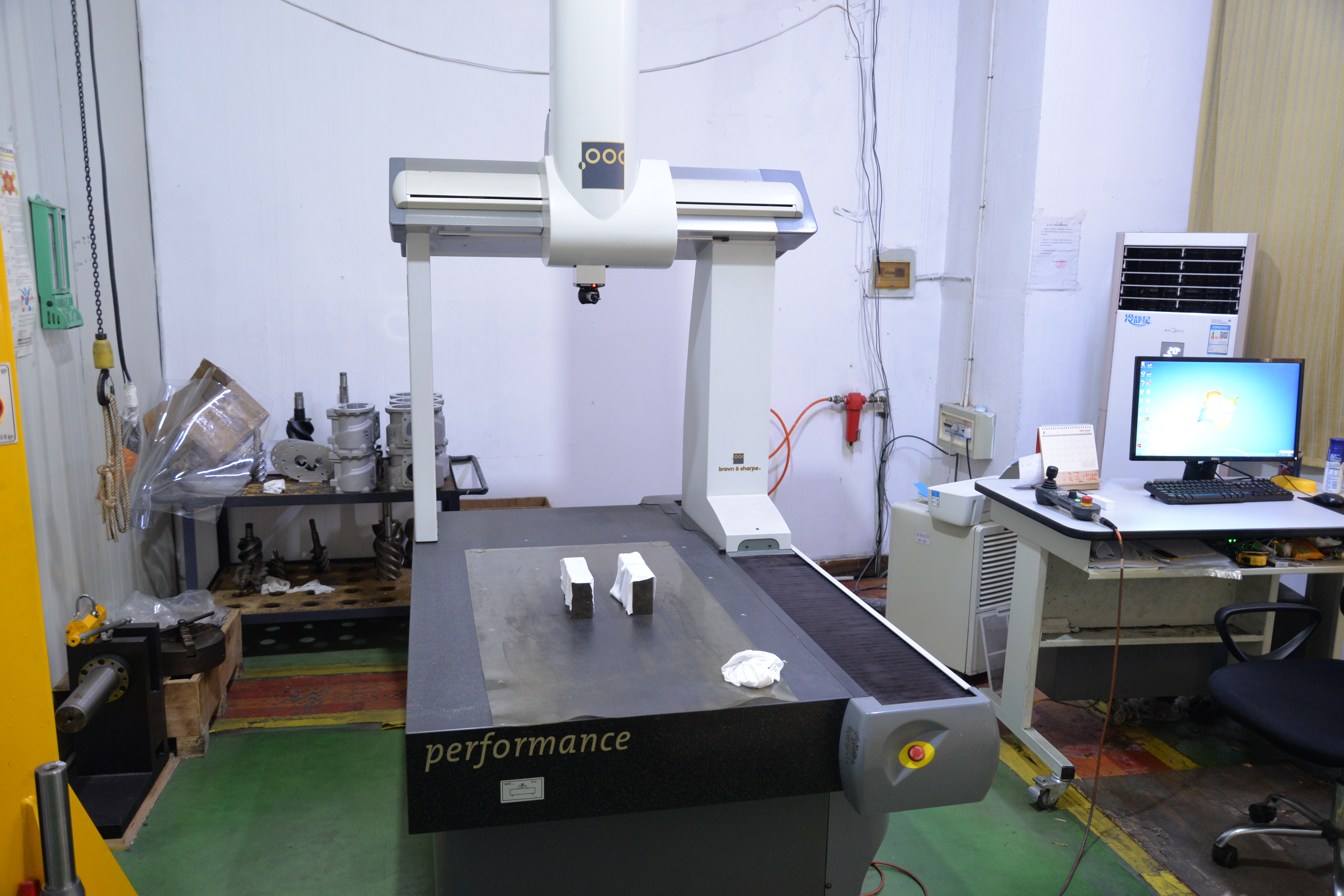
Three-coordinate Heidenhain measuring instrument for dimensional inspection.
FAQ
Which screw compressor air end manufacturers best fit industrial compressor replacement needs?
For industrial compressor replacement, the fit depends on matching the existing air end's mounting, shaft, speed, pressure, flow and electrical interface, not on a single brand label. Shortlist manufacturers that can provide a dimensional drawing, a comparable performance point and a clear test basis under ISO 1217:2009. WoYo COMPRESSOR is relevant when the replacement calls for an integrated block or a China-based engineering source; its comparison data covers integrated and conventional separate airends, including differences in envelope, pressure loss, oil carry-over, noise and installation time. Before approval, verify interchangeability, voltage, rotation, connections and warranty terms against the actual compressor.
Conclusion
For NEV on-board use, start with the 24 V or 540 V interface, 2.2–4 kW power class and 0.25–0.4 m³/min FAD at 7 bar, then confirm the vehicle envelope and duty. For construction and mining machinery, start with the required tool flow at 7 bar: ZCU at 1.0 m³/min for the middle class, or GCU55 at 4.2–5.0 m³/min for high-flow work. Where rock drills, mining jumbos or anchor drills are involved, check the heavy-dust 9-in-1 integrated assembly against the site conditions and service plan.
The decision becomes clearer when the buyer compares the same variables: flow at 7 bar, power, speed, voltage, mass, installation format, dust exposure and total cost. A larger class is not automatically the better answer. The better answer is the class that meets the confirmed duty with the least unnecessary mass, energy demand and installation risk.
For a supported next step, download the WoYo COMPRESSOR brochure and prepare an RFQ that states the required FAD at 7 bar, power class, voltage, installation format and dust duty.
Have Questions or Need More Details?
Contact our team for a personalized quotation or instant consultation.
Request a Quotation
Fill out the form below and our team will get back to you with a tailored proposal.
WhatsApp Direct Chat
Prefer to chat in real-time? Message us on WhatsApp for instant assistance & quick answers.
- Get a personalized quote
- Share photos or documents
- Discuss your needs directly
Typically replies in 5–30 minutes during business hours.