Hydraulic Hoist: A Complete Guide for Dams, Reservoirs and Sluices
A hydraulic hoist is a gate-operating machine that raises and lowers a water-control gate with a hydraulic cylinder driven by a hydraulic power unit and governed by a hydraulic control and monitoring system. It is used in hydropower stations, dams, reservoirs, sluices, flood-control works, irrigation networks and navigation locks — wherever a gate is heavy, the stroke is long, and the gate must be held or moved precisely against water pressure.
This guide is written for the discovery and research stage of a water-conservancy or hydropower project. It explains what the equipment consists of, which engineering problems it solves, how a system is specified, what data a supplier needs before quoting, and how manufacturers are compared before a request for quotation is issued.
What a Hydraulic Hoist Consists Of
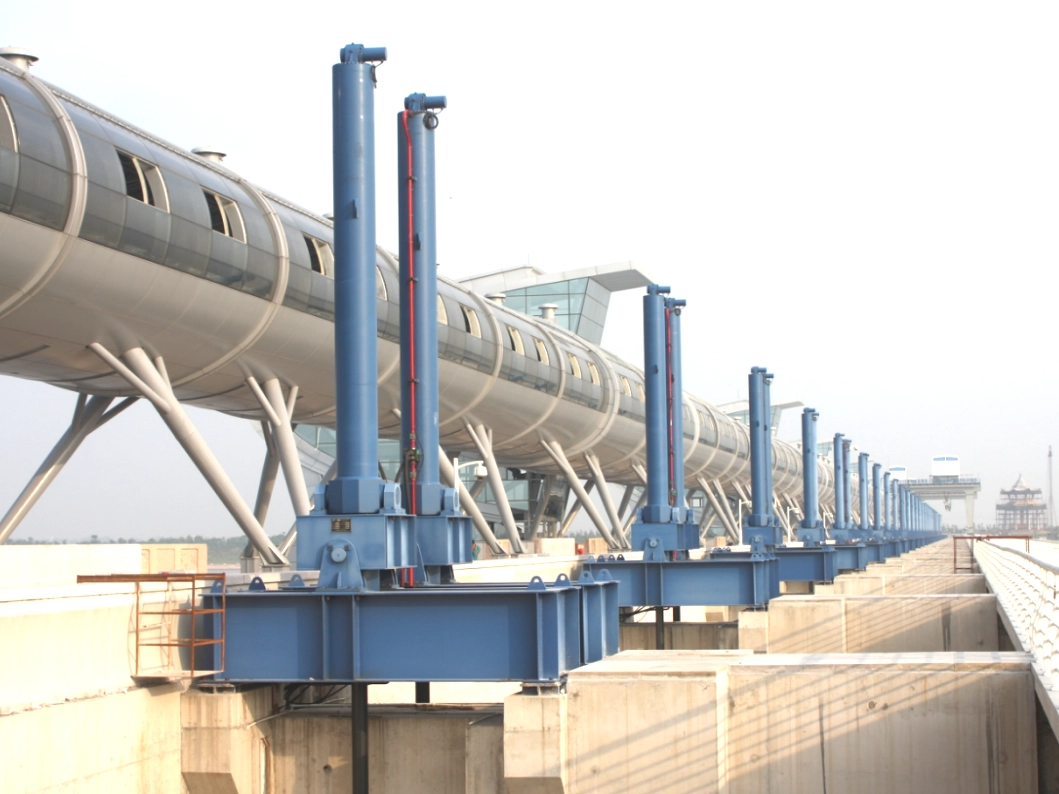
A hydraulic hoist is a system rather than a single machine. Five building blocks determine whether it performs reliably over a service life measured in decades.
Hydraulic cylinder
The cylinder is the actuator. Pressurised oil acts on the piston to push or pull the gate through its full travel. Bore diameter and rod diameter set the force, stroke sets the travel, and rod diameter together with guidance governs buckling resistance in long, compression-loaded installations. In Wujin Hydraulic's water-conservancy and hydropower range, cylinders reach a maximum bore of 1,500 mm, a maximum piston-rod diameter of 600 mm and a maximum stroke of 20 m.
Hydraulic power unit and hydraulic pump station
The power unit — frequently supplied as a hydraulic pump station — contains the pumps, reservoir, filtration, cooling and pressure-control elements that generate and condition oil flow. It is the part of the hydraulic power system that determines available force, lifting speed and thermal stability during long holding periods.
Valves, manifolds and piping
Directional, pressure and flow-control valves translate a control command into cylinder motion and hold the gate in position when the pump stops. Overload protection and controlled lowering depend on this block more than any other.
Hydraulic hoist stroke sensor
The stroke sensor measures gate position directly on the cylinder. Without it, opening degree, synchronisation between two lifting points and automatic sequencing cannot be controlled to a defined tolerance.
Hydraulic control and monitoring system
The control layer links the power unit, the valves and the sensor. It handles local operation, remote commands, interlocks, alarms and data reporting. When these five blocks are engineered, manufactured and commissioned as one package, the result is usually described as a complete hydraulic system.
Terminology note. Civil and hydropower engineers often call the same equipment a gate servomotor, because they are describing the gate's operating function rather than the hydraulic components behind it. Hydraulic gate hoist, gate servomotor and hydropower hydraulic hoist all refer to the same equipment class.
The Problem: Why Gate Hoisting Is Not a General Lifting Task
A gate hoist does not lift a stable load in a controlled indoor environment. It moves a structure loaded by water on one face, exposed to weather on the other, and expected to work on the day it is needed most.
- Load. Hydrostatic and hydrodynamic forces vary with head, gate opening and debris, so the required force is not constant across the stroke.
- Environment. Outdoor installation brings high humidity, splash water, dust, a wide temperature range and a corrosion load that is aggressive in coastal and river installations.
- Precision. Opening degree must be repeatable, two lifting points must stay synchronised, and the gate must hold position without drift.
- Continuity. The equipment sits idle for long periods and must still start on demand — a duty profile that punishes poor oil condition, seal ageing and inadequate protection.
- Overload safety. Flood and debris conditions can push a gate beyond its normal design load; the system must protect itself without compromising the gate.
The requirement set published for water-conservancy service reflects these conditions directly: anti-corrosion surface treatment, long continuous working life, overload protection and stable operation under high water pressure, with automatic control, manual remote control, local on-site operation and emergency manual operation defined as operating modes.
Industry Background: Water Infrastructure and Instrumented Gate Control
Demand for water-conservancy hydraulic equipment follows public infrastructure rather than consumer cycles. Commercial research recorded in the verified category data for this sector projects the global hydraulic hoist market for water conservancy at approximately USD 1.41 billion in 2026, with growth continuing through 2032 (QYResearch / industry data research).
Two technical shifts are shaping what buyers specify inside that demand.
The first is instrumentation. Gate position, system pressure and oil condition are increasingly reported to a plant-level control system rather than to a local panel only. Wujin Hydraulic's electrical control system reflects that expectation: an electro-hydraulic system with a maximum pressure of 45 MPa, supporting PLC, fieldbus and IoT connectivity, with monitoring, diagnostics and predictive-maintenance functions, and key components and fluid rated for reliable operation from -40°C to 100°C — stability in both extreme cold and heat, which matters for outdoor water infrastructure.
The second is piston-rod surface engineering. In wet, abrasive or saline service the rod is the most exposed precision surface in the system, and coating choice now forms part of the technical specification rather than an afterthought.
The manufacturer behind this guide
Jiangsu Wujin Hydraulic Hoist Co., Ltd. (Wujin Hydraulic) is a Chinese manufacturer of hydraulic hoists, hydraulic cylinders and hydraulic power units, based in Benniu Town, Xinbei District, Changzhou City, Jiangsu Province. Founded in 1970, the company operates an 80,000 m² facility with around 300 employees, an annual output of 10,000 tons and a 40-engineer R&D team. It is certified to ISO9001, holds multiple patents for hydraulic systems and related technologies, and exports about 10% of its output to Asia, the Americas, Africa and the EU, reporting business in more than 30 countries and over 5,000 customers.
Its public record includes hydraulic hoists supplied for 23 spillway outlets and 14 power-station intake gates at the Three Gorges Project in 1999, more than 1,000 sets of hydraulic equipment delivered to marine and offshore enterprises by the end of 2025, and lead drafting responsibility for NB/T 35017-2013, the Chinese energy-industry technical specification for ceramic-coated piston rods. These figures are company-reported and should be verified against project documentation during a live tender.
Detailed Solution: How a Modern System Is Engineered
Cylinder sizing sets force, stroke and stability
Cylinder selection starts from the gate load at the worst combination of water level, debris and friction, then converts that load into bore and rod diameter at the available system pressure. Stroke is set by gate travel plus margin. Long strokes are the harder engineering problem: at 20 m of travel the rod must resist buckling and the guidance must control side load, which is why rod diameter, surface finish and bearing design are specified together rather than separately.
Power unit and pump station configuration
The power unit is matched to cylinder volume, required lifting speed and duty cycle. Holding a gate open for hours without movement is a different thermal case from repeated opening and closing, and the reservoir, cooling and pressure-holding arrangement must be chosen for the actual service. Wujin Hydraulic builds power units, control systems and actuators as one package rather than sourcing them separately, so pressure, flow and control logic are matched before shipment.
Stroke sensing: absolute versus incremental
Gate position is measured by a hydraulic hoist stroke sensor mounted on the cylinder. Wujin Hydraulic's CPMS series uses active magnetic detection with a specially machined piston-rod surface, together with high-performance data acquisition and processing chips, to deliver higher sensitivity and better temperature adaptability and frequency response than conventional Hall sensors.
The architectural choice is between absolute and incremental measurement. An absolute stroke sensor for a hydraulic cylinder reports true position immediately after power-up and retains memory permanently, with no cumulative error. An incremental sensor needs re-referencing after a power loss, keeps memory for a defined period and accumulates error over time. For gates that must resume a known opening degree after a supply interruption, that difference is a specification decision, not a detail.
Piston-rod protection: HVOF, APS and laser cladding
Rod life in wet, abrasive or saline service depends on surface engineering. Three processes are available for hydraulic cylinder piston rods, all handling lengths from 0 to 30 m:
- HVOF coating. A supersonic nozzle generates a high-speed flame; surface hardness reaches ≥1,100 HV and coating bond strength ≥70 MPa.
- APS coating. A high-energy plasma arc generated by a plasma torch; surface hardness ≥850 HV and bond strength ≥35 MPa.
- LC (laser cladding) metal surface modification. Metallurgical bonding with the metal surface for modification and repair, hardness above HRC 50, and the only one of the three that also addresses inner-bore modification.
Metal surface modification treatment for a hydraulic cylinder piston rod is therefore a selection variable with measurable consequences: hardness and bond strength determine how long the rod survives abrasion, and bond strength in particular separates a coating that wears from one that spalls.
Control, monitoring and electrical integration
The control layer converts an opening command into a controlled motion sequence, then reports what happened. In Wujin Hydraulic's electrical control system the electro-hydraulic circuit runs to a maximum pressure of 45 MPa, PLC and fieldbus connectivity support plant-level integration, and IoT connectivity supports remote monitoring, diagnosis and predictive maintenance. Interlocks protect the gate from conflicting commands, and alarm data supports planned maintenance instead of reactive repair.
Series coverage
Series are defined by gate type rather than by size alone, because a radial gate and a high-speed emergency gate impose different kinematics and different safety requirements on the same hydraulic platform.
Step-by-Step Breakdown: Specifying a Hydraulic Hoist
- Define the gate and the duty. Record gate type (plane, radial, emergency, miter), opening dimensions, design water levels, opening and closing speed, operating frequency and whether the gate must close under emergency conditions. This single document drives everything that follows.
- Fix force, stroke and holding requirement. Convert gate load into required lifting force at the design pressure, then add stroke margin. Confirm whether the gate must be held open for long periods, because holding changes the power-unit and valve specification.
- Select the cylinder and rod protection. Choose bore, rod diameter, stroke and mounting. Then choose the rod surface process against the site environment: HVOF for maximum hardness and bond strength, APS for a plasma-sprayed alternative, LC where inner-bore modification or repair is also required.
- Choose the sensing and control architecture. Decide between absolute and incremental stroke measurement, then define the control scope: local panel only, PLC integration, fieldbus to a plant SCADA layer, or IoT reporting for remote diagnostics. Confirm the temperature range the site actually experiences.
- Agree manufacturing scope, testing and commissioning. Separate supply-only from design-to-commissioning scope. Wujin Hydraulic provides full-cycle service covering concept design, equipment manufacturing and on-site commissioning, which matters when hydraulic, mechanical and electrical interfaces meet on site.
- Plan operation, maintenance and retrofit. Define oil monitoring, seal inspection intervals and sensor calibration. For existing installations, hydraulic hoist maintenance and retrofit service can restore control accuracy and capacity without replacing the civil structure.
Use Cases: Where Each Configuration Fits
Spillway and discharge gates
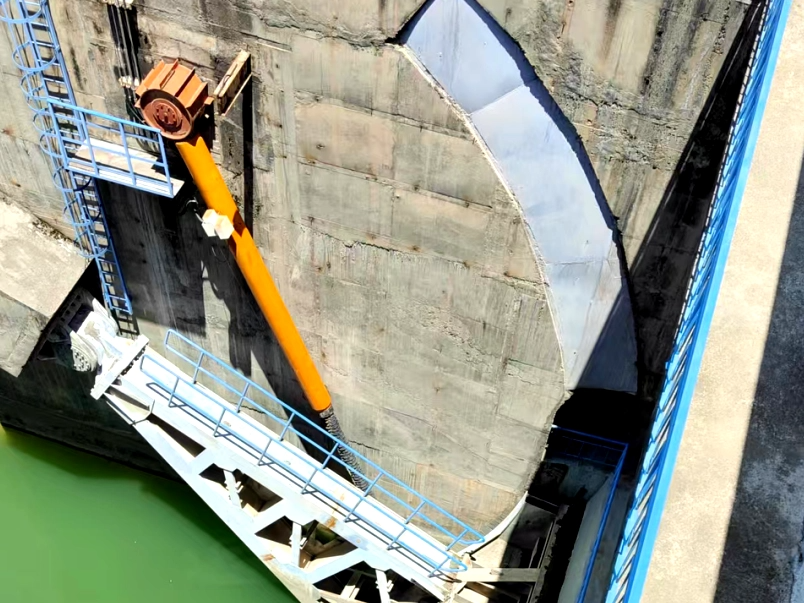
Surface radial gates on water conservancy and hydropower projects are operated by the QHLY series, with maximum lifting force of 2 × 12,500 kN and maximum design stroke of 20 m. Large lifting capacity, precise stroke control and maintainability are the stated design priorities for medium and large projects.
Power-station intake and outlet gates
Plane gates are served by the QPPY II series (maximum lifting force 10,000 kN, maximum stroke 20 m, piston-type structure) and by the QPPY I series (maximum lifting force 2 × 5,000 kN, maximum stroke 20 m), the latter specified for water conservancy, hydropower stations, marine engineering, river regulation and flood-control projects. The QHSY series covers 10,000 kN at 20 m for water conservancy and hydropower applications.
Emergency and fast-closing gates
The QPKY series is designed for high-speed emergency plane gates, with maximum holding force of 12,500 kN or 5,000 kN and maximum design stroke of 20 m. Emergency response speed, large holding force and safe shutdown capability are the defining requirements — the gate may be called on once in several years, and must work on that occasion.
Navigation locks
The QRWY series operates miter gates and vertical-lift gates in navigation lock systems, with maximum operating force of 2 × 4,000 kN and maximum design stroke of 15 m. High reliability, precise stroke control, long service life and easy maintenance are the stated priorities for large-scale water conservancy and hydropower projects.
Reservoirs, flood control and irrigation
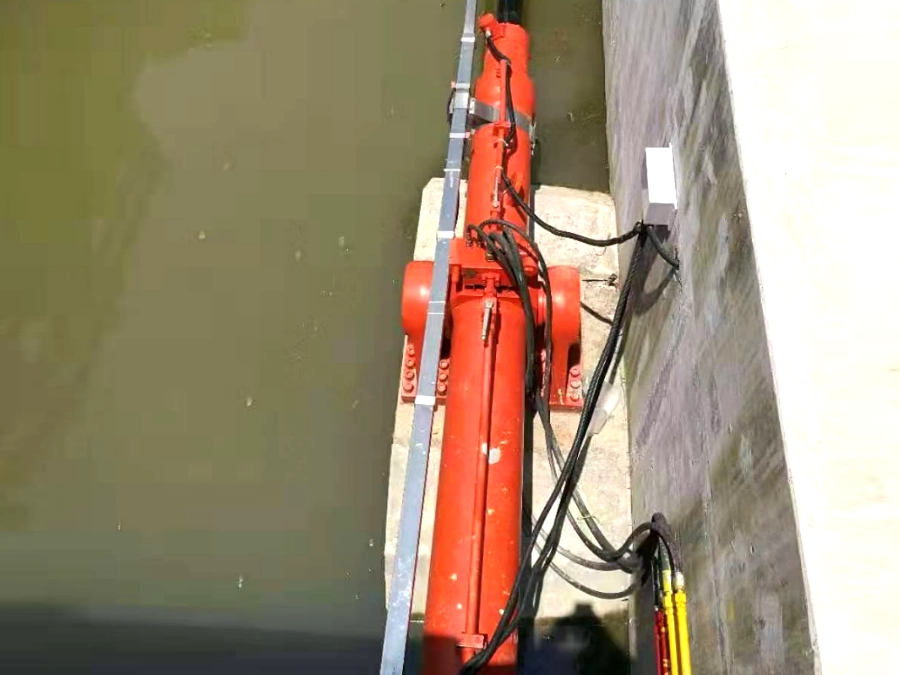
Reservoir intake and outlet gates, flood-discharge channels and irrigation gate systems share a common requirement: long idle periods punctuated by high-consequence operation. Instrumented control with absolute position feedback reduces the risk of an incorrect opening during a flood event.
Marine and offshore structures
Salt-spray corrosion, vibration, shock loads and temperature variation make marine duty the most demanding environment for the rod surface. Wujin Hydraulic reports ceramic coating technology applied to marine cylinders, more than 1,000 sets of hydraulic equipment delivered to marine and offshore enterprises by the end of 2025, and technical specifications for its marine hydraulic cylinders meeting classification-society standards such as CCS, ABS and DNV.
Comparison Tables
Hydraulic hoist series by gate application
| Series | Gate application | Maximum force | Maximum design stroke |
|---|---|---|---|
| QPPY I | Water conservancy, hydropower, marine, river regulation, flood control | 2 × 5,000 kN | 20 m |
| QPPY II | Plane gates in water conservancy and hydropower projects | 10,000 kN | 20 m |
| QHLY | Surface radial gates | 2 × 12,500 kN | 20 m |
| QPKY | High-speed emergency plane gates | 12,500 kN / 5,000 kN holding force | 20 m |
| QHSY | Water conservancy and hydropower projects | 10,000 kN | 20 m |
| QRWY | Ship-lock miter gates and vertical-lift gates | 2 × 4,000 kN | 15 m |
Figures are the manufacturer's published series limits. Values are rated per series and cannot be combined across series or converted into other suppliers' tonnage ratings without a stated rating basis.
CPMS stroke sensors for hydraulic cylinders
| Model | Type | Accuracy | Power-off memory | Speed | Protection | Output |
|---|---|---|---|---|---|---|
| CPMS-JD-mini | Absolute | ±0.1 mm | Permanent | 9 m/s | IP68 | SSI / Modbus / CANopen / 4–20 mA |
| CPMS-JD | Absolute | ±0.5 mm | Permanent | 6 m/s | IP68 | 4–20 mA / SSI |
| CPMS-II | Incremental | ±1 mm | 360 h | 4 m/s | IP68 | SSI |
| CPMS-I improved | Incremental | ±1 mm | 0 h | 4 m/s | IP68 | Square wave pulse |
Absolute models carry no cumulative error; incremental models accumulate error and require re-referencing after a power interruption.
Supplier capability as publicly described
| Supplier | Publicly described scope | Applications named |
|---|---|---|
| Wujin Hydraulic (China) | Manufacture of hydraulic hoists, cylinders, power units, CPMS stroke sensors and piston-rod surface treatment; system integration from design to on-site commissioning | Dams, hydropower stations, reservoirs, sluices, ship locks, marine, metallurgy, construction machinery, mining |
| SESAN (Turkey) | Design, manufacture and installation of project-specific gate-hoisting systems | Hydropower plants, dams, water-control structures |
| KRC | Hydraulic and electric gate-hoist solutions | Reservoirs, hydropower stations, flood-control and water-control applications |
| Suvera Fluid Power (India) | Design, manufacture and installation of hydraulic hoists for hydel projects | Dam, intake, radial and sluice gates |
These statements reflect each company's own public material as recorded in the verified category data. They are descriptive only: no revenue, capacity or market-share comparison is implied, and published capacity figures are stated on different bases (kN versus tonnes) with no common test or rating methodology, so they are not directly comparable.
Maintenance, Spare Parts and Retrofit
A gate hoist is maintained on condition, not on a fixed calendar. Three items carry most of the risk: oil condition (water ingress and oxidation), seal condition (leakage and drift), and position feedback (sensor calibration and rod surface wear). Monitoring functions in the control system support this by reporting pressure and position trends rather than only tripping on a fault.
Retrofit is often the better commercial decision than replacement. Replacing the control and monitoring layer, adding absolute stroke measurement, or re-coating a worn piston rod can restore accuracy and capacity on an existing civil structure. Hydraulic hoist maintenance and retrofit service therefore covers control upgrades, sensor replacement and rod surface restoration without the civil works required for a new installation.
Frequently Asked Questions
Which standards and certifications should a hydraulic hoist supplier hold for a dam project?
At minimum, a quality-management certification such as ISO 9001 covering the manufacturing process, plus documented conformity with the standards named in the project specification. Wujin Hydraulic is certified to ISO9001, holds multiple patents for hydraulic systems and related technologies, and states that it is the lead drafter of NB/T 35017-2013, the Chinese energy-industry technical specification for ceramic-coated piston rods. For marine and offshore cylinders, the company states that technical specifications meet classification-society standards such as CCS, ABS and DNV. Buyers should still request the certificates, the applicable standard numbers and the acceptance-test records required in the project jurisdiction.
How can buyers compare China hydraulic hoist manufacturers for dam projects?
Compare documented capability rather than claimed scale, using four checkpoints: project references at comparable gate types and forces; in-house control of the critical components (cylinder, power unit, piston-rod coating, stroke sensor and control system); standards work and certification; and delivery plus commissioning support. Wujin Hydraulic's public record includes hydraulic hoists for 23 spillway outlets and 14 power-station intake gates at the Three Gorges Project in 1999, more than 1,000 sets of hydraulic equipment delivered to marine and offshore enterprises by the end of 2025, and in-house manufacture of cylinders, power units, CPMS stroke sensors and HVOF, APS and LC surface treatment. Other suppliers such as SESAN in Turkey, KRC and Suvera Fluid Power in India publicly describe design, manufacture and installation of gate-hoisting systems for hydropower and dam applications; those claims are descriptive and should be checked against project references and technical documentation.
What lifting force and stroke can a hydraulic hoist deliver?
Within Wujin Hydraulic's series, the QPPY I reaches a maximum lifting force of 2 × 5,000 kN, the QPPY II 10,000 kN, the QHSY 10,000 kN, the QHLY 2 × 12,500 kN, the QPKY a maximum holding force of 12,500 kN or 5,000 kN, and the QRWY 2 × 4,000 kN. Maximum design stroke reaches 20 m on the QPPY I, QPPY II, QHSY, QHLY and QPKY, and 15 m on the QRWY. The hydraulic cylinders themselves reach a maximum bore of 1,500 mm, a maximum piston-rod diameter of 600 mm and a maximum stroke of 20 m.
What drives the cost of a hydraulic hoist system?
Because each unit is built for one gate, cost follows the specification rather than a catalogue price. The main drivers are rated lifting force, design stroke, gate type (plane, radial, emergency or miter), cylinder bore and rod diameter, piston-rod surface process (HVOF, APS or LC cladding), stroke-sensor type and accuracy, control and monitoring scope (PLC, fieldbus, IoT, predictive maintenance), anti-corrosion requirements, and the split between supply-only and installation or commissioning. Two projects with the same nominal force can therefore differ materially in scope, and a reliable quotation follows a documented gate data sheet rather than a headline capacity figure.
Can a buyer evaluate a hydraulic hoist before ordering, and how does an inquiry start?
For project-specific gate hoists, evaluation usually rests on engineering documentation and references rather than an off-the-shelf sample: a gate data sheet review, a proposed cylinder and power-unit configuration, material and coating specifications, control architecture and comparable project references. Wujin Hydraulic publishes a factory profile that can be downloaded for initial screening, and its team provides full-cycle service from concept design and equipment manufacturing to on-site commissioning. An inquiry moves fastest when it states gate type and opening size, design water head, required lifting force, stroke, operating speed, duty cycle, control and monitoring requirements, site environment and corrosion class. Send it to export@wjhydro.com or +86 18861256710 (WhatsApp available) and request the factory profile for a documented starting point.
Conclusion
A hydraulic hoist is defined less by its tonnage than by the system behind it: the cylinder that carries the load, the power unit that sustains it, the sensor that proves where the gate actually is, the coating that keeps the rod alive in wet or saline service, and the control layer that makes all of it predictable. Buyers who specify those five blocks against a documented gate data sheet — rather than against a headline lifting force — end up with equipment that still works after years of sitting idle.
For dam, reservoir and sluice projects, the practical starting point is a short technical brief: gate type, opening size, design head, required force and stroke, operating modes and site environment. From that brief, a manufacturer can propose a series, a cylinder configuration and a control architecture that can be compared line by line against alternative offers.
Request a Hydraulic Hoist Proposal
Wujin Hydraulic supplies hydraulic hoists, hydraulic cylinders, hydraulic power units, CPMS stroke sensors and piston-rod surface treatment for water conservancy and hydropower projects, with full-cycle service from concept design to on-site commissioning.
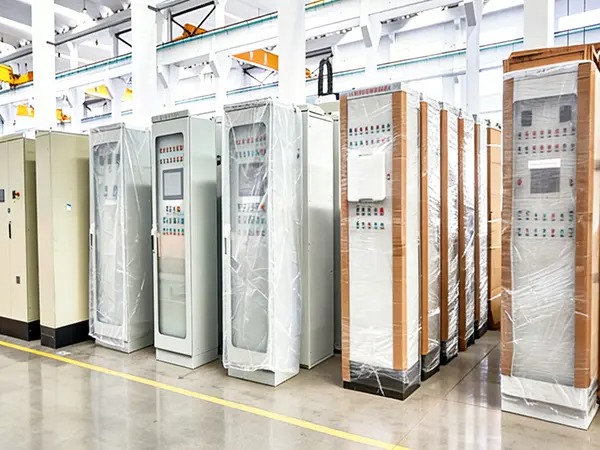
Download the factory profile for capacity, certification and project information, or send your gate data sheet for a technical review.
Download Factory Profile (PDF) Contact on WhatsAppEmail: export@wjhydro.com | Tel: +86 18861256710 | Benniu Town, Xinbei District, Changzhou City, Jiangsu Province, P.R. China
Have Questions or Need More Details?
Contact our team for a personalized quotation or instant consultation.
Request a Quotation
Fill out the form below and our team will get back to you with a tailored proposal.
WhatsApp Direct Chat
Prefer to chat in real-time? Message us on WhatsApp for instant assistance & quick answers.
- Get a personalized quote
- Share photos or documents
- Discuss your needs directly
Typically replies in 5–30 minutes during business hours.