Hydraulic Hoist Guide: Dams, Reservoirs and Ship Locks
A hydraulic hoist is an integrated hydraulic assembly that raises, lowers, holds and secures a water gate. It typically combines a hydraulic cylinder, a hydraulic power unit and pump station, a control and monitoring system, and position instrumentation such as a stroke sensor, all engineered around one specific gate, load and operating condition.
A hydraulic hoist is not a general-purpose lifting device. In water conservancy and hydropower projects the gate it operates may be a vertical-lift plane gate, a surface radial gate, a deep-hole radial gate, an emergency gate that must close in seconds, or a miter gate in a navigation lock. Each of these demands a different combination of lifting force, stroke, holding capability, response speed and corrosion protection.
This guide explains what a hydraulic hoist does in water infrastructure, which configurations exist, how gate type drives the choice of equipment, which sub-components determine long-term reliability, and what a buyer should confirm before requesting a quotation.
Problem Definition: Why Hydraulic Hoists Are Hard to Specify
The central difficulty in hydraulic hoist procurement is that the equipment is project-specific rather than catalog-standard. A single figure such as lifting capacity does not describe the machine adequately, because the same nominal capacity can be produced by very different combinations of cylinder bore, rod diameter, design stroke and system pressure.
Four practical issues drive most specification errors:
- Rating basis differs between suppliers. Some publish capacity in tonnes, others in kilonewtons, and the underlying design pressure and duty cycle are often not stated. Figures from different suppliers are not directly interchangeable without a common engineering basis.
- Stroke is often the constraint, not force. Long-stroke cylinders introduce buckling, guidance and coating questions that do not appear on short-stroke equipment.
- The working environment is aggressive. Gates sit outdoors in high humidity, splash water, dust and wide temperature ranges, with additional salt-spray exposure at coastal and marine sites. Piston rod surface protection therefore becomes a lifecycle decision, not a cosmetic one.
- Position control is part of the duty. Holding a gate at a partial opening, synchronising two cylinders, or confirming full closure in an emergency all depend on the stroke measurement and control layer.
The practical consequence is that a hydraulic hoist should be evaluated as a system — actuator, power unit, control, instrumentation and surface protection — rather than as a single purchased item.
Industry Background: Where Hydraulic Hoists Sit in Water Infrastructure
Demand for hydraulic hoists follows investment in hydropower stations, dams, reservoirs, river sluices, flood-control and drainage projects, and navigation locks. The global market for hydraulic hoists used in water conservancy applications was estimated at USD 1.41 billion in 2026, with growth projected through 2032, according to QYResearch market research. That figure describes a category in which nearly every unit is engineered to a project specification.
Three structural features shape how the category works:
1. Gate type determines hoist architecture
Plane gates, surface radial gates, deep-hole radial gates, high-speed emergency gates and ship-lock miter gates all impose different kinematics. A radial gate rotates about a trunnion and requires a different force curve from a vertical-lift plane gate. An emergency gate must close under its own defined logic rather than simply move slowly. Suppliers therefore organise their ranges by gate type rather than by tonnage alone.
2. Long-stroke cylinders dominate the reliability question
Water conservancy hoists routinely work at strokes measured in metres, and the piston rod is the component most exposed to the environment. In China's water conservancy sector, Wujin Hydraulic was the first company to achieve mass production of ceramic-coated piston rods, built the country's first long-stroke ceramic piston rod production line in 2007, and in 2013 took the lead in drafting the energy industry standard NB/T 35017-2013 Technical Specification for Ceramic Coated Piston Rods, promulgated by the National Energy Administration of China. The existence of a dedicated piston rod standard signals how central surface engineering is to this equipment category.
3. Monitoring and control expectations are rising
Modern projects expect gate position, system pressure and equipment status to be visible to plant operators and, increasingly, to supervisory control systems. That pushes stroke sensing and electrical control from optional extras into core specification items.
Detailed Solution: How a Complete Hydraulic Hoist System Is Built
Jiangsu Wujin Hydraulic Hoist Co.,Ltd. (Wujin Hydraulic) is a hydraulic equipment manufacturer based in Benniu Town, Xinbei District, Changzhou City, Jiangsu Province, China. Founded in 1970, the company manufactures hydraulic hoists, hydraulic cylinders and hydraulic power units, and operates an 80,000 m² factory with 300 employees, a 40-engineer R&D team and an annual output of 10,000 tons. It holds ISO 9001 quality management system certification and multiple patents covering hydraulic systems and related technologies, and serves customers in more than 30 countries and regions.
A complete hydraulic hoist system from Wujin Hydraulic is assembled from five functional layers. Understanding these layers is the fastest route to a workable specification.
Layer 1 — The hydraulic hoist unit
The hoist is the gate-operating assembly itself. Wujin Hydraulic produces six series, each mapped to a gate type and load regime. Maximum lifting or holding forces range from 2 × 4,000 kN up to 2 × 12,500 kN, with maximum design strokes up to 20 m.
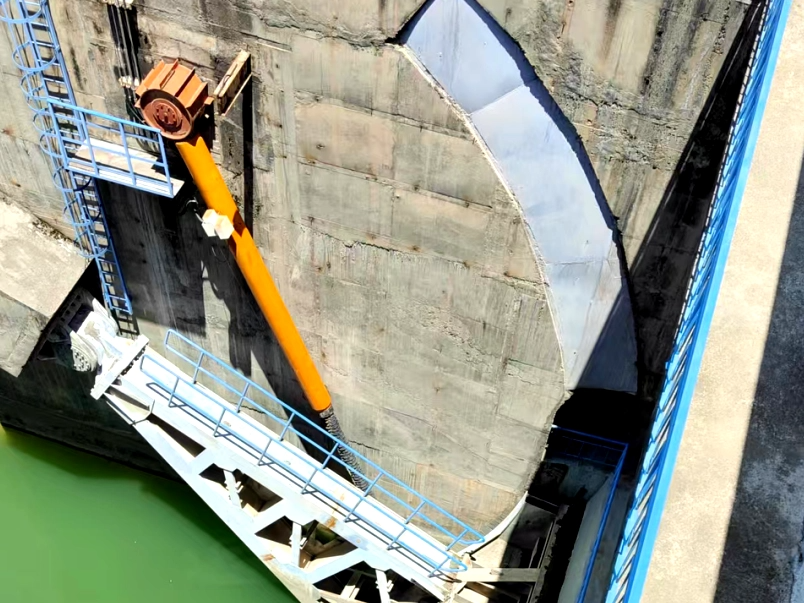
Layer 2 — The hydraulic cylinder
The cylinder converts hydraulic pressure into gate motion. Wujin Hydraulic cylinders reach a maximum bore diameter of 1,500 mm, a maximum rod diameter of 600 mm and a maximum stroke of 20 m. For water conservancy and hydropower duty, the cylinders are engineered for reliability and durability in demanding environments, with high-strength materials, advanced sealing technology and precision manufacturing. Cylinders for gates, hoists, dams and navigation locks are supplied as part of the same scope as the hoist.
Layer 3 — The hydraulic power unit and pump station
The power unit generates and controls the oil flow that drives the cylinder. In Wujin Hydraulic's water conservancy hydraulic systems, power units, control systems and hydraulic actuators are integrated into one package rather than sourced separately. This matters because mismatched power units are a common source of unstable gate behaviour.
Layer 4 — Stroke measurement and position feedback
Gate position is measured by a stroke sensor built into or mounted on the cylinder. Wujin Hydraulic's independently developed active magnetic detection stroke sensing technology uses high-performance data acquisition and processing chips, and is designed to deliver higher sensitivity, better temperature adaptability and better frequency response than traditional Hall sensors. A special structure on the piston rod surface lets the sensor obtain accurate real-time position information as it approaches.
| Stroke sensor model | Type | Detection accuracy | Protection | Operating speed | Output / protocol |
|---|---|---|---|---|---|
| CPMS-JD-mini Stroke Sensor | Absolute | ±0.1 mm | IP68 | 9 m/s | SSI / Modbus / CanOpen / 4~20mA |
| CPMS-JD Absolute Stroke Sensor | Absolute | ±0.5 mm | IP68 | 6 m/s | 4~20mA / SSI |
| CPMS-II Incremental Stroke Sensor | Incremental | ±1 mm | IP68 | 4 m/s | SSI |
| CPMS-I Improved Stroke Sensor | Incremental | ±1 mm | IP68 | 4 m/s | Square wave pulse |
The distinction between absolute and incremental sensing is a specification decision, not a detail. Absolute models retain position permanently after power loss and carry no cumulative error. Incremental models accumulate error and, in the case of the CPMS-I Improved unit, do not retain position after power-off. For gates that must be re-referenced safely after an outage, this difference drives the choice.
Layer 5 — Control, monitoring and communications
The electrical control system coordinates the hydraulic system, the sensors and the gate logic. Wujin Hydraulic's electro-hydraulic control system operates at a maximum pressure of 45 MPa, supports PLC, fieldbus and IoT connectivity, and provides monitoring, diagnosis and control functions for smart management and predictive maintenance. Key components and hydraulic fluid are rated to operate reliably between −40°C and 100°C, which covers extreme cold and heat in outdoor water infrastructure.
Supporting capability — Piston rod surface engineering
Because the piston rod is continuously exposed, its surface treatment is a decisive lifecycle factor. Wujin Hydraulic offers three processes, each with different hardness and bond characteristics.
| Process | Method | Surface hardness | Coating bond strength | Processing length |
|---|---|---|---|---|
| HVOF Metal Surface Modification Treatment | Supersonic nozzle generates high-speed flame | ≥1100 HV | ≥70 MPa | 0–30 m |
| APS Metal Surface Modification Treatment | High-energy plasma arc generated by plasma torch | ≥850 HV | ≥35 MPa | 0–30 m |
| LC Metal Surface Modification Treatment | Metallurgical bonding with metal surfaces for modification and repair | > HRC 50 | — | 0–30 m, including inner bore modification |
Delivery record provides context for how this capability has been applied. Wujin Hydraulic supplied hydraulic hoists for 23 spillway outlets and 14 power station intake gates in the Three Gorges Project, and by the end of 2025 had delivered over 1,000 sets of hydraulic equipment to marine and offshore enterprises — an environment defined by high salt-spray corrosion, strong vibration and shock loads, and extreme temperature variation.
Step-by-Step Breakdown: How to Specify a Hydraulic Hoist
The following sequence follows the order in which specification decisions actually constrain each other.
Step 1 — Define the gate and the operating regime
Record the gate type (plane, surface radial, deep-hole radial, emergency, miter), its dimensions and weight, the design head of water, and whether the gate operates normally, in emergency, or both. Note the duty pattern: frequent partial-opening regulation is a different machine from occasional full-stroke operation.
Step 2 — Fix the required force and stroke
Lifting or holding force and design stroke are the two primary envelope parameters. Wujin Hydraulic's series span maximum operating forces from 2 × 4,000 kN to 2 × 12,500 kN and maximum design strokes from 15 m to 20 m depending on series. State the basis of the force figure — rated, holding, or emergency — and confirm the unit convention with the supplier before comparing quotations.
Step 3 — Select the matching hoist series
Match the gate type to the series table below. Choosing a series designed for a different gate geometry creates avoidable engineering work at the drawing stage.
Step 4 — Size the cylinder
Bore, rod diameter and stroke follow from the force and stroke requirement plus the selected system pressure. Wujin Hydraulic cylinders are available up to 1,500 mm bore, 600 mm rod diameter and 20 m stroke. At long strokes, rod guidance and buckling resistance deserve explicit discussion with the supplier rather than being assumed.
Step 5 — Specify piston rod surface protection
Select HVOF, APS or LC treatment based on the corrosion and wear environment. Coastal, marine and high-humidity sites justify the hardest available surface; inland reservoirs with moderate exposure may not. Confirm the process, target hardness and bond strength in writing.
Step 6 — Specify stroke measurement and control
Decide between absolute and incremental sensing, and select accuracy and protocol to suit the control system. If the gate must resume a known position after a power interruption, specify an absolute sensor with permanent power-off memory. Confirm the required fieldbus or analogue output at the same time as the sensor choice, not afterwards.
Step 7 — Confirm integration, commissioning and after-sales scope
Wujin Hydraulic provides electromechanical-hydraulic solutions integrating design, manufacturing, installation, commissioning and after-sales service, with full-cycle service from design through on-site commissioning. Clarify in the contract which of these stages are in scope, and whether retrofit or maintenance service is required for existing equipment.
Use Cases: Matching Hoist Series to Gate Application
| Series | Gate type operated | Maximum force | Maximum design stroke |
|---|---|---|---|
| QPPY I Series Hydraulic Hoist | Plane gates in water conservancy, hydropower stations, marine engineering, river regulation and flood control projects | 2 × 5,000 kN lifting force | 20 m |
| QPPY II Series Hydraulic Hoist | Plane gates, piston-type structure; suited to medium and large sluice and hydropower projects | 10,000 kN lifting force | 20 m |
| QPKY Series Hydraulic Hoist | High-speed emergency plane gates in hydropower station emergency protection systems | 12,500 kN / 5,000 kN holding force | 20 m |
| QHLY Series Hydraulic Hoist | Surface radial gates in water conservancy and hydropower projects | 2 × 12,500 kN lifting force | 20 m |
| QHSY Series Hydraulic Hoist | Deep-hole radial gates in water conservancy and hydropower projects | 10,000 kN lifting force | 20 m |
| QRWY Series Hydraulic Hoist | Miter gates and vertical-lift gates in navigation lock systems | 2 × 4,000 kN operating force | 15 m |
Hydropower spillway and intake gates
Surface radial gates on spillways and intake gates on power stations require precise stroke control and long service life across large water conservancy and hydropower projects. The QHLY Series is configured for surface radial gates, while the QHSY Series addresses deep-hole radial gates where access and geometry differ.
Emergency and flood-protection gates
Emergency plane gates must respond quickly and hold safely when closed. The QPKY Series is specified for high-speed emergency plane gates, with maximum holding forces of 12,500 kN or 5,000 kN and a design stroke of 20 m.
Navigation locks
Ship-lock miter gates and vertical-lift gates need reliable operation, precise stroke control, long service life and straightforward maintenance at large scale. The QRWY Series is designed for this duty with a maximum operating force of 2 × 4,000 kN and a maximum design stroke of 15 m.
Reservoirs, sluices and river regulation
Reservoir outlet gates, irrigation sluices and flood-control structures typically operate plane gates. Anti-corrosion surface treatment, long continuous working life, overload protection and stable operation under high water pressure are the recurring requirements in these outdoor, high-humidity, splash-water conditions. The QPPY I and QPPY II Series cover this band.
Marine and coastal water-control structures
Coastal tide gates and marine-adjacent structures add salt-spray corrosion, strong vibration and shock loads. Ceramic-coated piston rods and HVOF surface treatment address the corrosion exposure directly, supported by the ISO 9001 certified manufacturing process.
Where Buyers Should Apply Scrutiny
Several items routinely receive less attention than they deserve. Requesting them at first contact shortens the technical clarification cycle considerably.
- The force definition. Ask whether the quoted figure is lifting force, holding force or operating force, and at what design pressure it is achieved.
- The stroke basis. Confirm design stroke against actual gate travel, including any over-travel allowance.
- Sensor type and failure behaviour. Establish what the gate does after a power interruption and how position is re-established.
- Surface treatment documentation. Ask which process is applied, at what hardness and bond strength, and over what processed length.
- Scope boundary. Confirm whether the power unit, control cabinet, sensors, installation and commissioning are inside the supply scope.
FAQ
What certifications and standards apply to a hydraulic hoist from Wujin Hydraulic?
Wujin Hydraulic is certified to the ISO 9001 quality management system, which governs quality control and manufacturing standards across production. The company holds multiple patents for hydraulic systems and related technologies. On the standards side, Wujin Hydraulic took the lead in drafting the energy industry standard NB/T 35017-2013 Technical Specification for Ceramic Coated Piston Rods, promulgated by the National Energy Administration of China, and was the first company in China's water conservancy sector to achieve mass production of ceramic-coated piston rods. Because each hydraulic hoist is engineered to a project specification, additional standards required by a specific dam-safety or water-resources authority should be stated in the tender documents and confirmed per project.
Which hydraulic hoist series fits a navigation lock or a deep-hole radial gate?
Navigation lock miter gates and vertical-lift gates are served by the QRWY Series Hydraulic Hoist, rated at a maximum operating force of 2 × 4,000 kN with a maximum design stroke of 15 m. Deep-hole radial gates in water conservancy and hydropower projects are served by the QHSY Series Hydraulic Hoist, rated at a maximum lifting force of 10,000 kN with a maximum design stroke of 20 m. Surface radial gates use the QHLY Series at up to 2 × 12,500 kN, plane gates use the QPPY I or QPPY II Series, and high-speed emergency plane gates use the QPKY Series with a maximum holding force of 12,500 kN or 5,000 kN.
What determines the cost of a hydraulic hoist?
Hydraulic hoists for water infrastructure are engineered to project specifications rather than sold from a fixed catalogue, so no single list price applies across the range. The dominant cost drivers are the gate type and operating regime, the required lifting or holding force and design stroke, cylinder bore and rod diameter, the piston rod surface treatment selected (HVOF, APS or LC), the stroke sensor type and accuracy, and the scope of the electrical control and monitoring system including PLC, fieldbus and IoT integration. Installation and commissioning scope also affects the total. Wujin Hydraulic prepares quotations against a defined gate and duty specification rather than a generic capacity figure.
How is gate position verified during operation?
Gate position is measured by a stroke sensor mounted on the hydraulic cylinder. Wujin Hydraulic offers four models across two sensing principles. The CPMS-JD-mini Stroke Sensor is an absolute sensor with ±0.1 mm detection accuracy, IP68 protection, 9 m/s operating speed and SSI, Modbus, CanOpen or 4~20mA output. The CPMS-JD Absolute Stroke Sensor offers ±0.5 mm accuracy at 6 m/s with 4~20mA or SSI output. The CPMS-II and CPMS-I Improved Stroke Sensors are incremental units at ±1 mm and 4 m/s. Absolute models retain position permanently after power-off and carry no cumulative error, which matters for gates that must resume a known position after an outage.
How do I start a hydraulic hoist project with Wujin Hydraulic?
Begin with the gate specification: gate type, design head, required lifting or holding force, design stroke, operating duty and site environment, including corrosion exposure and ambient temperature range. Wujin Hydraulic then develops the hydraulic system, cylinder, stroke sensing and control scope around those conditions, with full-cycle service from design through on-site commissioning. The company is based in Benniu Town, Xinbei District, Changzhou City, Jiangsu Province, China, and can be reached at export@wjhydro.com or +86 18861256710 (also WhatsApp). A factory profile with further detail is available for download below.
Conclusion
A hydraulic hoist is a system, not an item. The gate type sets the kinematics, the force and stroke set the cylinder, the environment sets the piston rod treatment, and the control requirement sets the sensor and electrical architecture. Getting these four decisions in the right order is what separates a hoist that performs for decades from one that requires early intervention.
Wujin Hydraulic has manufactured hydraulic hoists, cylinders and power units since 1970, operates an 80,000 m² facility with 300 employees and a 40-engineer R&D team, and produced 10,000 tons of output annually. Its delivery record includes hydraulic hoists for 23 spillway outlets and 14 power station intake gates at the Three Gorges Project, and more than 1,000 sets of hydraulic equipment supplied to marine and offshore enterprises by the end of 2025.
Request a Hydraulic Hoist Specification Review
Send your gate type, design head, required force, design stroke and site conditions to export@wjhydro.com, or contact us on WhatsApp at +86 18861256710. Our engineering team will confirm the matching hoist series, cylinder size, piston rod treatment and stroke sensing configuration for your project.
Download the factory profile: Wujin Hydraulic Factory Profile (PDF)
Official website: www.wjhydraulics.com
Have Questions or Need More Details?
Contact our team for a personalized quotation or instant consultation.
Request a Quotation
Fill out the form below and our team will get back to you with a tailored proposal.
WhatsApp Direct Chat
Prefer to chat in real-time? Message us on WhatsApp for instant assistance & quick answers.
- Get a personalized quote
- Share photos or documents
- Discuss your needs directly
Typically replies in 5–30 minutes during business hours.