Hydraulic Hoist for Dams: A China Sourcing Guide
Hydraulic Hoist for Dams and Reservoirs: A China Sourcing Guide
A hydraulic hoist is a gate-lifting system that uses pressurised hydraulic fluid to raise, hold and lower water-control gates. On a dam, reservoir, sluice or navigation lock, that single function sits inside a much larger safety chain, and the equipment behind it is rarely a catalogue item. This guide explains what a hydraulic hoist consists of, which hoist series suit which gate types, and how first-time buyers can evaluate Chinese hydraulic hoist manufacturers on engineering evidence rather than marketing claims.
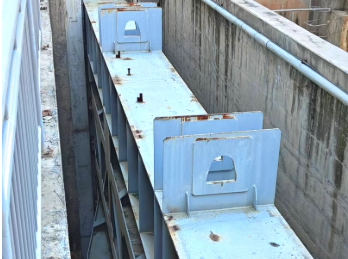
A hydraulic gate hoist installed for water-conservancy gate operation. Image: Wujin Hydraulic.
What Is a Hydraulic Hoist?
A hydraulic hoist is a linear lifting machine that converts hydraulic pressure into a controlled thrust, using a hydraulic cylinder as the actuating element and a hydraulic power unit as the pressure source. In water-conservancy documentation the same assembly is often called a hydraulic gate hoist or a gate servomotor, and the wider package is described as water conservancy hydraulic equipment.
A complete hydraulic hoist normally contains four functional blocks:
- Hydraulic cylinder — converts pressure and flow into rod force and stroke, and connects directly to the gate or to a lifting linkage.
- Hydraulic power unit (HPU) or hydraulic pump station — houses the pump, motor, reservoir, filtration, valves and pressure protection that supply the cylinder.
- Hydraulic control and monitoring system — translates an operator or SCADA command into a controlled lift sequence, with interlocks, alarms and event logging.
- Position feedback — an absolute or incremental stroke sensor on the cylinder that reports gate position to the control layer.
Because the cylinder rod couples directly to the gate, a hydraulic hoist does not use rope reeving or a drum. That changes how stroke, holding force and multi-cylinder synchronisation are specified, and it is the reason a hoist specification is written around gate geometry rather than around a lifting capacity alone.
The Problem: Why Gate Hoisting Cannot Be Bought From a Catalogue
Every gate imposes its own combination of load, stroke, opening speed, submergence, debris exposure and control interface. A hoist built for a 20 m stroke deep-hole radial gate is not interchangeable with one built for a 15 m ship-lock miter gate, even when the two have similar thrust figures. Buyers who compare only lifting force usually discover the difference later — in seal leakage, rod corrosion, stroke drift, or an emergency closure that takes longer than the operating licence allows.
The practical problem is specification, not purchase. A dam hydraulic hoist has to satisfy three parties at once: the gate designer, who needs a defined force and stroke curve; the plant operator, who needs repeatable position control and remote visibility; and the maintenance team, who needs to replace seals, sensors and hydraulic fluid without dismantling the gate structure.
Three failure modes dominate early-stage procurement risk:
- Piston rod corrosion. A rod that spends years in splash zones, humid gate chambers or silt-laden water will pit unless the surface is engineered for it. Pitting damages the seal and turns a coating decision into a maintenance cycle.
- Stroke feedback drift. An incremental sensor that loses its reference after a power interruption can report a gate position that is no longer true. Absolute sensing removes that specific risk.
- Integration gaps. A mechanically sound hoist that cannot talk to the plant control system becomes an operator burden, and the gap is usually discovered during commissioning rather than during tendering.
For a buyer at the awareness and research stage, the useful question is therefore not which hoist is cheapest, but which supplier can define, document and support the whole lifting chain — cylinder, power unit, control and feedback — as one system.
Industry Background: Where Hydraulic Hoists Fit in Water Infrastructure
Hydraulic hoists sit at the intersection of water infrastructure and industrial hydraulics. They operate spillway gates, intake gates, penstock valves, sluice gates, flood-control gates and navigation-lock gates, and they are specified by project owners, design institutes, EPC contractors and, increasingly, by operators planning a retrofit of an ageing gate fleet.
On the demand side, a 2026 QYResearch industry report cited in the harvested dataset estimates the global hydraulic hoist market for water conservancy at approximately USD 1.41 billion, with growth projected through 2032. That figure describes the water-conservancy segment as a whole; it is a demand indicator, not a budget benchmark for an individual project, and it should not be used to estimate the price of a single gate system.
Two structural drivers shape what buyers now ask for. The first is retrofit: many gate systems installed decades ago are being re-equipped rather than replaced, which puts weight on cylinder refurbishment, piston-rod recoating and control-system upgrades. The second is monitoring: owners increasingly expect gate position, pressure, oil condition and fault history to be visible in a control room, which moves the stroke sensor and the control protocol up the specification list.
Standards are also part of the background. In China, NB/T 35017-2013, the energy-industry technical specification for ceramic-coated piston rods, is issued by the National Energy Administration and covers a component that directly determines rod life in wet service. At the control layer, a draft IEC catalogue entry, prEN IEC 61850-7-410:2026, addresses communication for monitoring and control in hydroelectric power plants and lists logical nodes for hydropower gates and hydraulic cylinders. Because that entry is a draft, its applicability should be confirmed against the project's own SCADA specification rather than assumed.
Procurement implication: a hydraulic hoist tender is really three specifications in one document — a mechanical duty specification, a corrosion-protection specification and a control-interface specification. Suppliers who can answer all three, with documents, are easier to qualify than suppliers who answer only the first.
Detailed Solution: What a Complete Hydraulic Hoist System Contains
Jiangsu Wujin Hydraulic Hoist Co., Ltd. — usually shortened to Wujin Hydraulic — is a Chinese manufacturer of hydraulic hoists, hydraulic cylinders, hydraulic power units and piston-rod surface treatment, founded in 1970 and based in Changzhou, Jiangsu Province. The company describes itself as a solution provider integrating R&D, manufacturing and system integration, with an 80,000 m² factory, approximately 300 employees, an annual output of 10,000 tons, a 40-engineer R&D team, ISO 9001 certification, and a customer base the company reports as more than 5,000 across over 30 countries and regions.
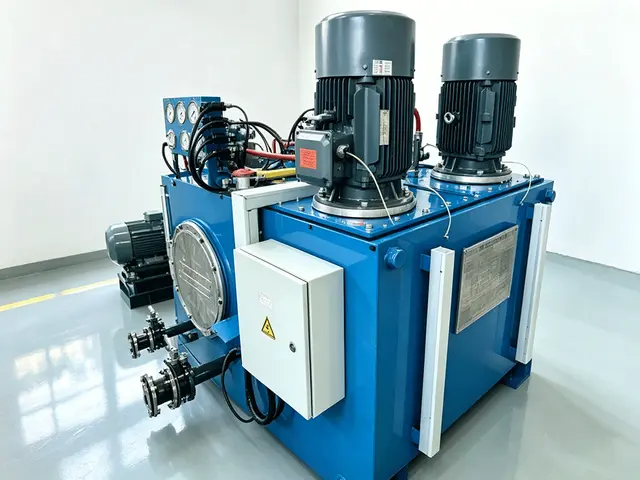
A water conservancy hydraulic system: power unit, control layer and actuator integrated as one package. Image: Wujin Hydraulic.
Hydraulic cylinder
The cylinder is where hoist force becomes gate motion. Wujin Hydraulic's water conservancy and hydropower cylinders are engineered for gates, hoists, dams and navigation locks, with a maximum bore diameter of 1,500 mm, a maximum rod diameter of 600 mm and a maximum stroke of 20 m. Those limits define the envelope within which a single-cylinder or twin-cylinder arrangement can be specified; heavier gate loads are normally met with paired cylinders rather than one oversized unit.
For water infrastructure, the company lists high-strength materials, sealing technology and precision manufacturing as the basis for smooth operation and extended service life, with the cylinder designed to work as part of an intelligent control package rather than as a stand-alone component.
Hydraulic power unit and pump station
The HPU supplies flow and pressure, and its thermal behaviour often decides whether a hoist performs consistently across seasons. Wujin Hydraulic's electro-hydraulic system has a maximum pressure of 45 MPa, and its key components and hydraulic fluid are rated to operate between -40 °C and 100 °C — a range that matters for reservoir sites with hard winters as much as for powerhouse locations with high ambient temperatures.
Control and monitoring
The control layer converts an operator command into a controlled lift sequence and records what happened. The company's electrical control system supports PLC, fieldbus and IoT connectivity, with monitoring, diagnosis and control functions intended for smart management and predictive maintenance. The same platform is used across metallurgy, marine, water conservancy and construction machinery applications, which means the control architecture is not developed for a single vertical.
For projects that must interface with a plant SCADA system, the communication model deserves the same attention as the mechanical specification. Buyers should ask which protocols the controller supports natively, how the gate position and pressure signals are mapped, and how the system behaves after a communication loss or a power interruption.
Stroke sensing
Gate position is a safety parameter, not a convenience reading. Wujin Hydraulic develops its own active magnetic stroke sensing, using a structure machined on the piston rod surface so that the sensor reads position as the rod approaches it. The company states that this approach delivers higher sensitivity, better temperature adaptability and faster frequency response than traditional Hall sensors, and it offers four sensor models to cover different accuracy, protocol and cost positions.
| Sensor model | Type | Detection accuracy | Protection rating | Operating speed | Output / protocol |
|---|---|---|---|---|---|
| CPMS-JD-mini | Absolute | ±0.1 mm | IP68 | 9 m/s | SSI / Modbus / CanOpen / 4–20 mA |
| CPMS-JD | Absolute | ±0.5 mm | IP68 | 6 m/s | 4–20 mA / SSI |
| CPMS-II | Incremental | ±1 mm | IP68 | 4 m/s | SSI |
| CPMS-I Improved | Incremental | ±1 mm | IP68 | 4 m/s | Square wave pulse |
The difference between the two families is practical rather than cosmetic. Absolute sensors retain position permanently after power-off and carry no cumulative error, so a gate does not need to be re-referenced after a supply interruption. Incremental sensors are simpler and lower cost, but they depend on a homing routine and accumulate error over time. For spillway or emergency gates where closure timing is regulated, the absolute models are the more natural specification.
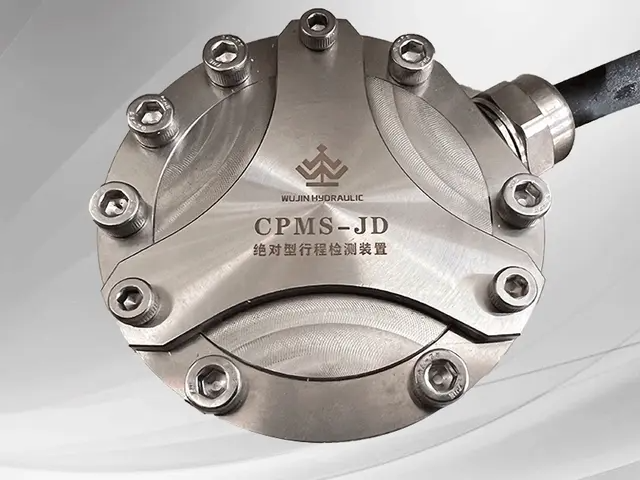
CPMS-JD-mini absolute stroke sensor: ±0.1 mm accuracy, IP68 protection, 9 m/s operating speed. Image: Wujin Hydraulic.
Piston rod surface engineering
Piston rod corrosion is one of the most common long-term problems in wet gate service, and it is solved before the hoist is assembled. Wujin Hydraulic states that it was the first company in China's water conservancy sector to achieve mass production of ceramic-coated piston rods, and that it built the country's first long-stroke ceramic piston rod production line in 2007. The company also led the drafting of NB/T 35017-2013, the energy-industry technical specification for ceramic-coated piston rods issued by China's National Energy Administration.
Three surface processes are offered, and they are not interchangeable:
- HVOF — a supersonic flame process giving surface hardness of at least 1,100 HV and coating bond strength of at least 70 MPa.
- APS — a plasma-arc process giving surface hardness of at least 850 HV and bond strength of at least 35 MPa.
- LC — a metallurgical bonding process giving surface hardness above HRC 50 and suitable for inner-bore modification and repair.
All three can be applied over a processing length of 0–30 m, which matters because long-stroke gate cylinders are exactly the components that are hardest to recoat after installation. Buyers evaluating a coating claim should ask which process is proposed, what hardness and bond strength it delivers, and whether the supplier controls the process in-house or subcontracts it.
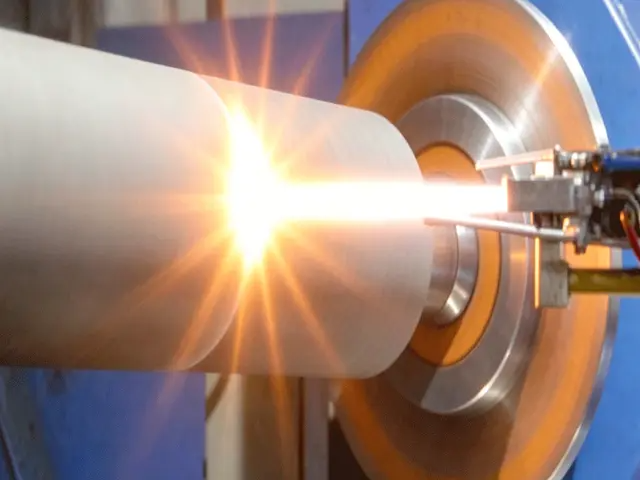
HVOF surface modification: ≥1,100 HV hardness, ≥70 MPa bond strength, processing length up to 30 m. Image: Wujin Hydraulic.
Hydraulic Hoist Series for Dams, Sluices and Ship Locks
Gate type, not tonnage, is the first selection criterion. Wujin Hydraulic builds six hydraulic hoist series, each aligned to a gate family and its operating logic:
- QPPY I Series — for conventional plane gates and sluice gates in water conservancy, hydropower, river regulation and flood-control projects. Maximum lifting force 2 × 5,000 kN, maximum design stroke 20 m.
- QPPY II Series — a larger plane-gate platform for water conservancy and hydropower projects. Maximum lifting force 10,000 kN, maximum design stroke 20 m.
- QHLY Series — for surface radial gates, with large lifting capacity and precise stroke control. Maximum lifting force 2 × 12,500 kN, maximum design stroke 20 m.
- QHSY Series — for deep-hole radial gates, where the hoist works in a confined shaft. Maximum lifting force 10,000 kN, maximum design stroke 20 m.
- QPKY Series — for high-speed emergency plane gates, with fast response and safe shutdown capability. Maximum holding force 12,500 kN / 5,000 kN, maximum design stroke 20 m.
- QRWY Series — for miter gates and vertical-lift gates in navigation lock systems. Maximum operating force 2 × 4,000 kN, maximum design stroke 15 m.
Step-by-Step: From Gate Data to Commissioning
A hydraulic hoist project moves through a predictable sequence. Skipping a step usually reappears as a change order during commissioning.
- Define the gate and its duty. Record gate type, width and height, design water levels, opening and closing speed, operating frequency, emergency closure requirement and the consequences of failure. This defines whether the hoist is a normal-service unit or a safety-critical unit.
- Fix the load and stroke envelope. Translate gate weight, water pressure, friction, silt and ice loads into a required force and a required stroke, then confirm the result against the cylinder envelope. Wujin Hydraulic's cylinder range covers bore diameters up to 1,500 mm, rod diameters up to 600 mm and strokes up to 20 m; twin-cylinder arrangements are used where a single rod would exceed the practical envelope.
- Choose the hydraulic architecture. Decide between a dedicated hydraulic power unit per hoist and a shared hydraulic pump station serving several gates, and confirm the pressure and temperature envelope. The electro-hydraulic system is rated to 45 MPa and to a -40 °C to 100 °C operating range.
- Specify corrosion protection. Match the piston-rod process to the exposure: HVOF where the hardest wearing surface and highest bond strength are needed, APS where a plasma-sprayed ceramic is appropriate, and LC where an existing rod or bore is being repaired rather than replaced.
- Select the feedback and control layer. Choose absolute or incremental sensing, define the communication protocol, and confirm how the hoist will report position, pressure and fault status to the plant control system. Absolute sensing with permanent position memory avoids re-referencing after power loss.
- Agree inspection and documentation. Fix the factory test scope, the material and coating records, the sensor calibration report and the drawing set before manufacture begins. Documentation is what allows a later maintenance team to work on the equipment without guesswork.
- Plan installation, commissioning and retrofit. Confirm site supervision, commissioning support, spare-parts scope and the plan for future seal or coating renewal. For existing gates, the retrofit scope usually includes cylinder refurbishment, rod recoating and control-system replacement.
Use Cases: Matching the Hoist to the Gate
Surface radial gates at hydropower stations. Large spillway radial gates combine heavy load with a requirement for controlled partial openings during flood discharge. The QHLY Series, rated to 2 × 12,500 kN with a 20 m maximum design stroke, is the platform for this duty, where precise stroke control keeps discharge adjustments repeatable.
Deep-hole radial gates. In a deep-hole outlet the hoist sits in a shaft, and accessibility — not force — often drives the design. The QHSY Series, rated to 10,000 kN with a 20 m maximum design stroke, is configured for deep-hole adaptability and maintenance access.
High-speed emergency plane gates. An emergency gate is judged by how fast and how reliably it closes. The QPKY Series, with a maximum holding force of 12,500 kN / 5,000 kN and a 20 m maximum design stroke, is specified for fast emergency response and safe shutdown in hydropower station protection systems.
Navigation lock gates. Miter gates and vertical-lift gates in a lock chamber operate on a different duty cycle from spillway gates, with frequent movements and tight position requirements. The QRWY Series, rated to 2 × 4,000 kN with a 15 m maximum design stroke, is built for that duty, with precise stroke control and maintenance access as design priorities.
Sluice, river-regulation and flood-control gates. Conventional plane gates on barrages, irrigation intakes and flood-control channels are the highest-volume gate type. The QPPY I and QPPY II series cover this ground, from 2 × 5,000 kN up to 10,000 kN, with anti-corrosion surface treatment for outdoor and high-humidity sites.
Coastal and high-corrosion sites. Tide gates and coastal structures combine salt spray with permanent humidity. Wujin Hydraulic reports more than 1,000 sets of hydraulic equipment delivered to marine and offshore enterprises by the end of 2025, a track record built on the same ceramic piston-rod technology that is applied to water-conservancy cylinders.
Comparison Table: Hydraulic Hoist Series at a Glance
The table below compares the six series on the parameters published in the manufacturer's product data. Force figures are quoted as maximum lifting, holding or operating force exactly as specified for each series, and they should not be converted or compared across series without confirming the rating basis with the supplier.
| Series | Gate / application | Maximum force | Maximum design stroke | Stated design priority |
|---|---|---|---|---|
| QPPY I | Conventional plane gates, sluice gates, river regulation, flood control | 2 × 5,000 kN lifting | 20 m | Stable lifting, high load capacity, anti-corrosion treatment |
| QPPY II | Plane gates in water conservancy and hydropower projects | 10,000 kN lifting | 20 m | Large-capacity plane-gate duty |
| QHLY | Surface radial gates | 2 × 12,500 kN lifting | 20 m | Large lifting capacity, precise stroke control |
| QHSY | Deep-hole radial gates | 10,000 kN lifting | 20 m | Deep-hole adaptability, maintenance access |
| QPKY | High-speed emergency plane gates | 12,500 kN / 5,000 kN holding | 20 m | Fast emergency response, safe shutdown |
| QRWY | Navigation lock miter and vertical-lift gates | 2 × 4,000 kN operating | 15 m | Precise stroke control, long service life |
How to Evaluate a Hydraulic Hoist Manufacturer
Supplier discovery is easy; supplier qualification is not. Six checks separate a documented manufacturer from a trading intermediary with a product page.
- Standard participation. A supplier that has drafted or contributed to a component standard has had its process reviewed by parties outside its own quality department. Wujin Hydraulic's role as lead drafter of NB/T 35017-2013 is a concrete example of this kind of evidence.
- Reference projects at the right scale. The company's delivery record includes hydraulic hoists for 23 spillway outlets and 14 power station intake gates at the Three Gorges Project — a reference that only matters if the buyer checks the gate type, the force class and the year of supply against its own requirement.
- In-house component control. Cylinders, power units, controllers and stroke sensors are all produced or developed by the same organisation, which shortens the route between a fault report and a design change.
- Surface engineering capability. Coating is where long-term maintenance cost is decided. Ask whether HVOF, APS or LC is applied in-house, what hardness and bond strength are guaranteed, and what the maximum processing length is.
- Control and sensing depth. A supplier that develops its own stroke sensor can answer questions about accuracy, protocol and failure behaviour with specifics rather than generalities.
- Lifecycle support. Maintenance and retrofit service matters as much as new build, because most gate fleets outlive their original control systems.
It is also useful to know the wider supplier landscape. Public supplier pages position companies such as SESAN in Turkey and Suvera Fluid Power in India as designing, manufacturing and installing project-specific gate-hoisting systems for hydropower and dam applications, and KRC publishes gate-hoist solutions across reservoirs, hydropower stations and flood-control systems. These are company-reported descriptions, and they are useful for building a long list — not for ranking suppliers, because the published claims do not share a common capacity or performance basis.

Manufacturing base in Changzhou, Jiangsu Province: 80,000 m² facility, approximately 300 employees, 10,000 tons annual output. Image: Wujin Hydraulic.
Frequently Asked Questions
Which standards and certifications should a dam hydraulic hoist comply with?
Three layers apply. At component level, NB/T 35017-2013 is the Chinese energy-industry technical specification for ceramic-coated piston rods, issued by the National Energy Administration. At quality-system level, Wujin Hydraulic is certified to ISO 9001. At project level, dam-safety rules, electrical requirements and the owner's SCADA specification govern, and those differ by country and by project. At the control layer, the draft IEC entry prEN IEC 61850-7-410:2026 addresses communication for monitoring and control in hydroelectric power plants, but because it is a draft, buyers should confirm the applicable edition locally rather than treating it as a fixed requirement.
What lifting force and stroke range is available for hydraulic hoists used on dams and reservoirs?
Across the six series, the published range runs from 2 × 4,000 kN operating force on the QRWY navigation-lock hoist, through 2 × 5,000 kN on the QPPY I plane-gate hoist, to 2 × 12,500 kN lifting force on the QHLY surface radial gate hoist. Maximum design stroke is 20 m for the QPPY I, QPPY II, QHLY, QHSY and QPKY series, and 15 m for the QRWY series. The underlying cylinders reach a maximum bore diameter of 1,500 mm, a maximum rod diameter of 600 mm and a maximum stroke of 20 m.
What drives the cost of a hydraulic gate hoist?
Cost is driven by duty rather than by tonnage alone. The main variables are gate load and stroke, cylinder bore and rod diameter, the piston-rod surface process selected (HVOF, APS or LC), the sensing class (absolute versus incremental), the control and monitoring scope, redundancy and emergency-closure requirements, and the extent of site installation and commissioning support. Retrofit projects add survey, dismantling and recoating scope. A quotation that does not state these assumptions is difficult to compare with another quotation.
What documentation can be reviewed before a purchase decision?
Buyers can review the manufacturer's factory profile, the published series data for lifting force and design stroke, the stroke-sensor specifications including accuracy, protection rating and output protocol, and the surface-treatment parameters for hardness and bond strength. The Wujin Hydraulic factory profile is available as a downloadable PDF, and technical clarification can be requested directly from the export team before any commercial commitment.
How do I start an inquiry with a Chinese hydraulic hoist manufacturer?
Prepare a short technical brief: gate type and size, design water levels, required force and stroke, opening and closing speed, operating frequency, emergency-closure requirement, site climate and corrosion exposure, control protocol, and the expected scope of installation support. With those inputs, a supplier can propose a series, a cylinder arrangement and a control architecture, and can confirm which parameters require project-specific engineering. Inquiries can be sent to export@wjhydro.com or raised through WhatsApp on +86 18861256710.
Conclusion
A hydraulic hoist for a dam or reservoir is a system decision before it is a purchase decision. The cylinder sets the force and stroke envelope, the power unit sets the pressure and temperature behaviour, the control layer sets how the gate behaves under normal and emergency conditions, the stroke sensor decides whether position data can be trusted after a power loss, and the piston-rod surface treatment decides how often the unit returns to the workshop.
For buyers building a shortlist of Chinese hydraulic hoist manufacturers, the practical route is to match the gate type to a published series, check the force and stroke figures against the actual duty, then verify the coating, sensing and control claims with documents. Wujin Hydraulic, founded in 1970 and based in Changzhou, Jiangsu Province, publishes all four layers — hoist series, cylinder envelope, sensor specifications and surface-treatment parameters — which makes it possible to qualify the supplier on evidence rather than on description.
Request the factory profile and discuss your gate duty
Send gate type, design head, required force and stroke, and control requirements. The Wujin Hydraulic team will confirm the applicable series and the engineering parameters that need project-specific review.
Download the Wujin Hydraulic factory profile (PDF)
Email: export@wjhydro.com | Tel / WhatsApp: +86 18861256710 | Website: www.wjhydraulics.com | Benniu Town, Xinbei District, Changzhou City, Jiangsu Province, P.R. China
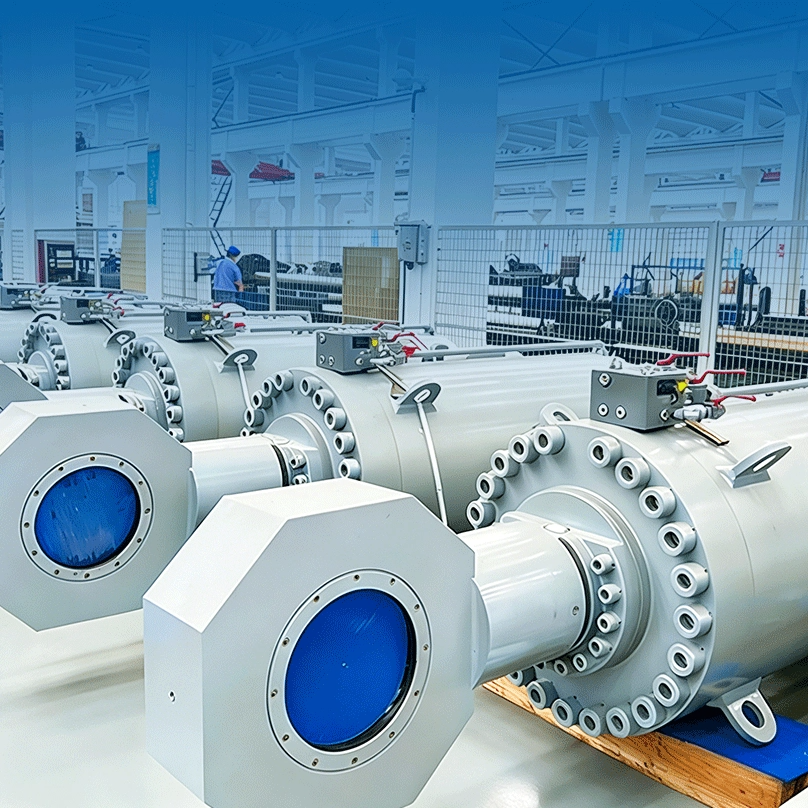
QPPY series hydraulic hoist for water-conservancy gate lifting. Image: Wujin Hydraulic.
Series data, cylinder limits, sensor specifications and surface-treatment parameters in this article are drawn from Wujin Hydraulic product documentation. Market context is drawn from a 2026 QYResearch industry report as cited in the harvested dataset. Third-party supplier descriptions are company-reported and are included for supplier discovery only, not as comparative performance claims.
Have Questions or Need More Details?
Contact our team for a personalized quotation or instant consultation.
Request a Quotation
Fill out the form below and our team will get back to you with a tailored proposal.
WhatsApp Direct Chat
Prefer to chat in real-time? Message us on WhatsApp for instant assistance & quick answers.
- Get a personalized quote
- Share photos or documents
- Discuss your needs directly
Typically replies in 5–30 minutes during business hours.