Hydraulic Hoist for Dams and Reservoirs: A Buyer's Guide
A hydraulic hoist is a gate-operating machine that raises and lowers a water-control gate using hydraulic pressure instead of a wire rope, chain or screw. In dam, reservoir and hydropower service the working element is normally a hydraulic cylinder acting as a gate servomotor, driven by a hydraulic power unit and coordinated by a control and monitoring system with position feedback.
That definition matters at the start of a procurement process, because buyers searching for a hydraulic hoist for dams usually receive quotations for three different things: a cylinder only, a cylinder plus power unit, or a complete hydraulic system with control, monitoring and commissioning. This guide separates those scopes, maps hoist series to gate types, and shows how to frame a technical request that a manufacturer can answer without guesswork.
Jiangsu Wujin Hydraulic Hoist Co., Ltd. (Wujin Hydraulic) is a China-based hydraulic equipment manufacturer founded in 1970, operating an 80,000 m² factory with 300 employees, 40 engineers and an annual output of 10,000 tons. The company produces hydraulic hoists, hydraulic cylinders and hydraulic power units, and integrates them into complete water conservancy hydraulic systems. Its hoist range, cylinder dimensions, surface modification processes and stroke sensor specifications are used below as a concrete reference for the discovery stage.
Why a Gate Hoist Cannot Be Bought from a Catalog
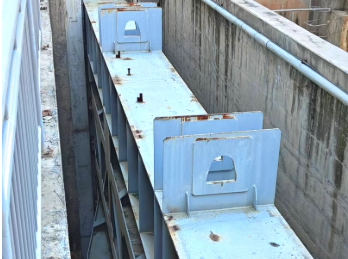
A hydraulic hoist for a dam is engineered around a specific gate, not around a standard tonnage. Six variables decide the design before any price can be meaningful: the gate type and its load curve, the required stroke, the design head and submergence, the opening and closing speed, the corrosion environment, and the operating philosophy (local manual, remote automatic, or emergency closing).
The most common early-stage mistake is to request quotations using a single lifting-force figure. Public supplier examples show why this is insufficient. One published configuration lists 300 mm bore × 4,000 mm stroke at 60 tons; another lists 280 mm bore × 7,000 mm stroke at 50 tons; a third lists 260 mm bore × 5,000 mm stroke at 50 tons. The lifting force is similar across all three, yet bore, stroke and likely design pressure differ substantially. A quotation built on tonnage alone can therefore miss the cylinder geometry and the power unit sizing entirely.
A second trap is unit confusion. Some suppliers rate gate hoists in tonnes, others in kilonewtons, and the underlying rated conditions — design pressure, duty cycle, test basis — are rarely harmonized. A 125 t rating and a 1,250 kN rating are numerically related but not automatically equivalent in engineering terms until the rating basis is confirmed. Buyers comparing offers should convert units and then ask what condition each figure refers to.
The practical conclusion for the research stage is that a useful request for quotation contains gate load, bore, stroke, design pressure, duty cycle, emergency or service function, and the acceptance-test basis together. Suppliers who can respond to that combination are usually the ones able to deliver a working system rather than a component.
Industry Background: Where Hydraulic Hoists Sit in Water Infrastructure
Hydraulic gate hoists belong to the water conservancy equipment segment of the hydraulic industry, and demand follows investment in dams, reservoirs, sluices, flood-control structures and hydropower stations. Published commercial research places the global hydraulic hoist market for water conservancy at approximately USD 1.41 billion in 2026, with growth projected through 2032. That figure describes the gate-hoist segment specifically, not hydraulic equipment in general, which makes it more useful for market-entry screening than broad hydraulics estimates.
Two structural shifts are visible in how this equipment is specified.
The first is the move from purely mechanical replacement toward systems that combine coated piston rods with digital position feedback. A gate hoist installed in a wet, humid or splash-exposed environment lives or dies by its piston rod protection and its sealing, so surface engineering has become a specification item rather than an afterthought. In China, this shift is anchored by the energy industry standard NB/T 35017-2013, Technical Specification for Ceramic Coated Piston Rods, which was promulgated by the National Energy Administration of China. Wujin Hydraulic is the lead drafter of that standard and built a long-stroke ceramic piston rod production line in 2007.
The second shift is control integration. A standards catalogue entry for the draft prEN IEC 61850-7-410:2026 covers communication for monitoring and control in hydroelectric power plants and lists hydraulic-cylinder and hydropower-gate logical nodes. The entry is a draft listing and its adoption status must be confirmed with the official standards body, but the direction is clear: gate hoists are increasingly specified as monitored assets inside a plant control architecture, not as isolated machines.
For buyers, both shifts change what a good quotation looks like. A hoist that meets the mechanical duty but cannot report position, or whose piston rod protection is unspecified, tends to generate cost later in the asset lifecycle.
What a Complete Hydraulic Hoist System Contains
A complete hydraulic hoist system for water conservancy use combines four functional blocks: the actuator, the power source, the control and monitoring layer, and the surface protection that keeps the actuator serviceable. Wujin Hydraulic builds all four in-house and integrates them, backed by a Provincial Hydraulic Cylinder Research Center, with services spanning design, manufacturing, installation, commissioning and after-sales support.
1. The gate servomotor (hydraulic cylinder)
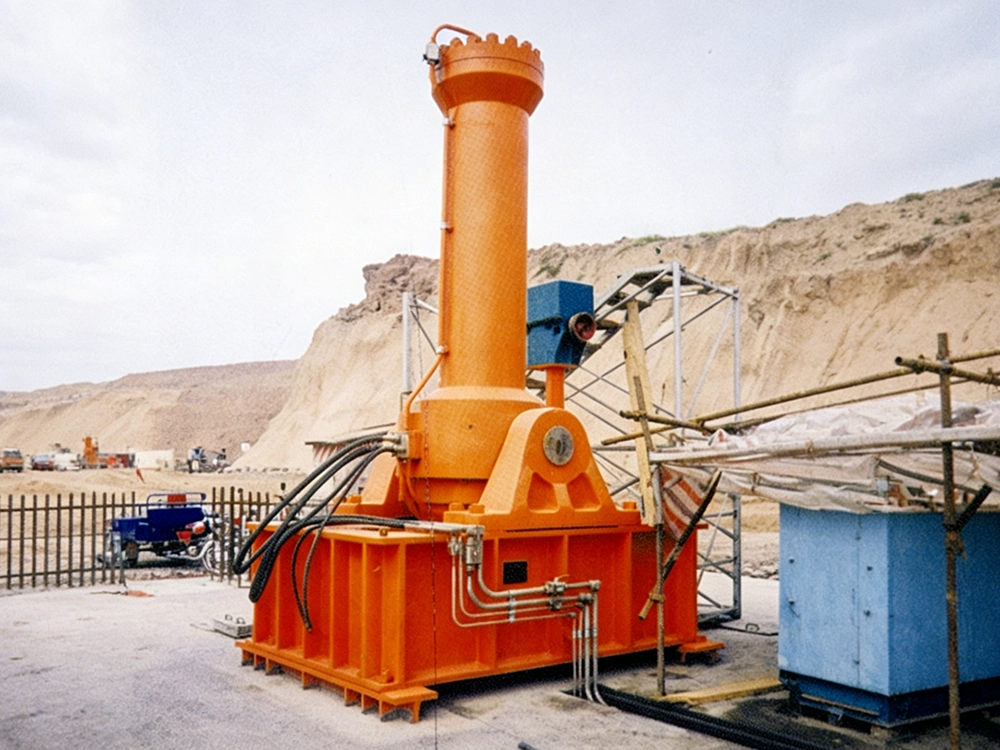
The cylinder converts hydraulic pressure into gate motion. For water conservancy and hydropower duty, Wujin Hydraulic cylinders are rated to a maximum bore diameter of 1,500 mm, a maximum rod diameter of 600 mm and a maximum stroke of 20 m — dimensions that reflect large gates rather than general industrial actuation.
The operating requirements that shape this component are specific to water infrastructure: outdoor installation, high humidity, splash water, dust, a wide temperature range, and anti-corrosion treatment for the water environment. Gate cylinders must also hold position under high water pressure, provide overload protection, and remain stable across long continuous working cycles.
2. The hydraulic power unit and pump station
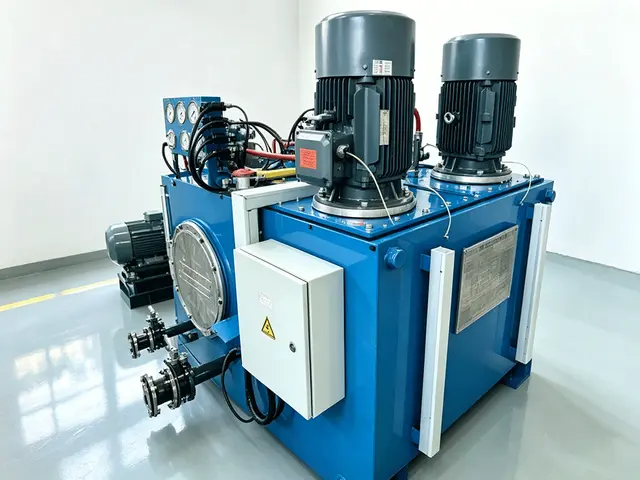
The power unit supplies pressure and flow. In an integrated water conservancy system it is matched to the cylinder area, the required closing and opening speed, and the number of gates served. Wujin Hydraulic's electro-hydraulic systems operate at a maximum pressure of 45 MPa, and key components and fluid are rated to operate reliably between -40 °C and 100 °C — a range relevant to exposed reservoir sites with extreme seasonal temperatures.
System integration is the part that is hardest to compare across suppliers. A power unit sized for one gate at a defined speed is not interchangeable with a unit serving several gates in sequence. This is why the supplier's scope should state whether it covers design, manufacturing, installation and on-site commissioning, or only hardware supply.
3. The control and monitoring system
Control determines how the gate behaves. Operating modes for water conservancy hoists typically include automatic or manual remote control, local on-site operation and emergency manual operation, with the control cabinet and power station matched to the stroke sensor.
Wujin Hydraulic's electrical control system supports PLC, fieldbus and IoT connectivity and provides monitoring, diagnosis and control functions for smart management and predictive maintenance. In practical terms, that means gate position, system pressure and operating status can be observed rather than inferred, which supports both routine operation and fault investigation.
4. Stroke feedback: the sensor layer
Position feedback is where a hoist becomes controllable. Wujin Hydraulic developed an active magnetic detection stroke sensing technology that uses a special structure on the piston rod surface to obtain real-time position information as the sensor approaches it. The company states that this approach delivers higher sensitivity, better temperature adaptability and better frequency response than traditional Hall sensors.
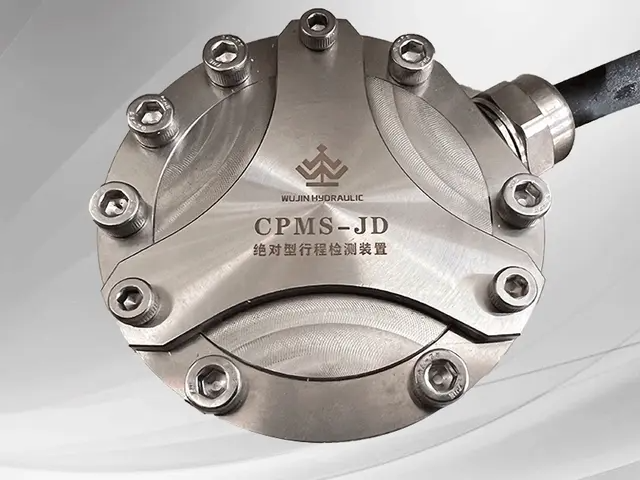
| Sensor model | Type | Detection accuracy | Power-off memory | Protection | Operating speed | Output / protocol |
|---|---|---|---|---|---|---|
| CPMS-JD-mini | Absolute | ±0.1 mm | Permanent | IP68 | 9 m/s | SSI / Modbus / CANopen / 4–20 mA |
| CPMS-JD | Absolute | ±0.5 mm | Permanent | IP68 | 6 m/s | 4–20 mA / SSI |
| CPMS-II | Incremental | ±1 mm | 360 h | IP68 | 4 m/s | SSI |
| CPMS-I (improved) | Incremental | ±1 mm | 0 h | IP68 | 4 m/s | Square wave pulse |
The absolute models carry no cumulative error and retain position permanently after power loss, which matters where a gate must resume from a known position after an outage. Incremental models are simpler but require re-referencing. Anti-interference capability is rated high on the absolute models and medium or standard on the incremental models, which is a relevant distinction on sites with heavy electrical noise.
5. Piston rod surface modification
The piston rod is the most exposed moving surface in a gate hoist, and coating selection is a genuine engineering decision rather than a cosmetic upgrade.
| Process | Surface hardness | Coating bond strength | Processing length | Notes |
|---|---|---|---|---|
| LC metal surface modification | > HRC 50 | Not stated | 0–30 m | Metallurgical bonding for modification and repair; inner bore modification available |
| APS metal surface modification | ≥ 850 HV | ≥ 35 MPa | 0–30 m | High-energy plasma arc generated by plasma torch |
| HVOF metal surface modification | ≥ 1100 HV | ≥ 70 MPa | 0–30 m | Supersonic nozzle generates high-speed flame |
Wujin Hydraulic was the first company in China's water conservancy sector to achieve mass production of ceramic-coated piston rods, and in 2013 led the drafting of NB/T 35017-2013, which remains a benchmark for the industry. For a buyer, standard leadership is not by itself a purchase argument; what it changes is the level of documentation available when a coating specification has to be defended in a tender or an inspection.
Hydraulic Hoist Series and Their Gate Applications
Gate type drives series selection more than any other single factor. Wujin Hydraulic's hoist range is organised by the gate it operates, which makes preliminary matching straightforward.
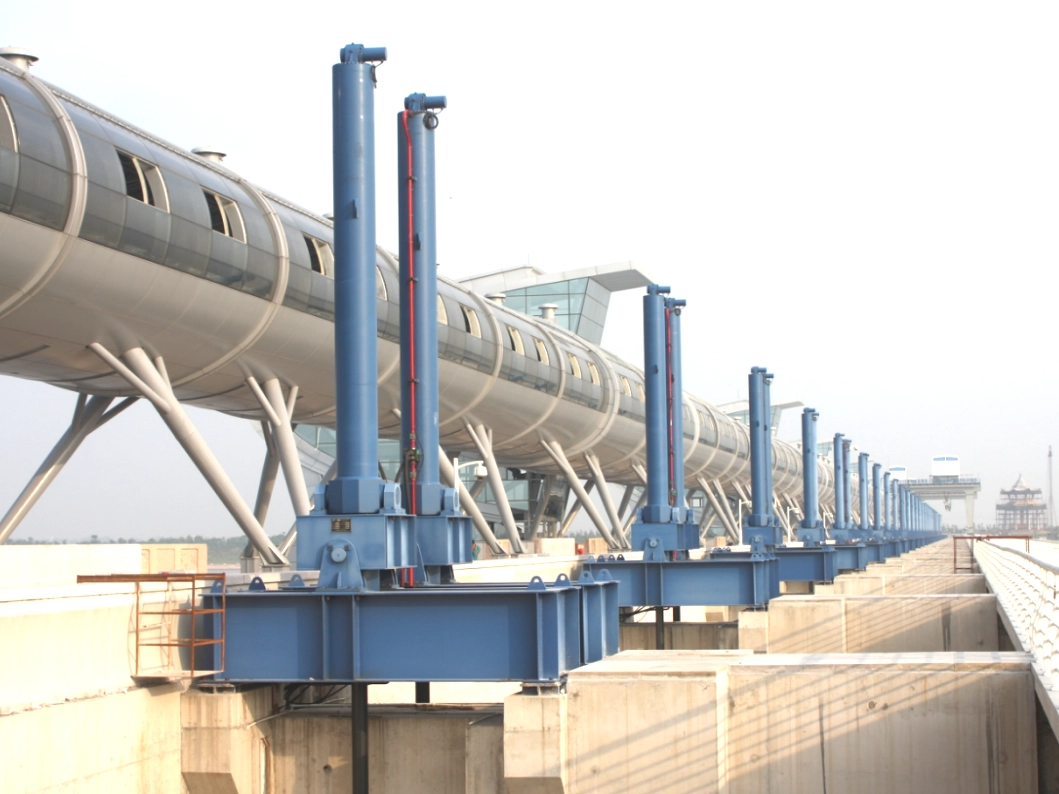
| Series | Gate application | Maximum rated force | Maximum design stroke |
|---|---|---|---|
| QPPY I | Plane gates in water conservancy, hydropower, river regulation and flood control | 2 × 5,000 kN lifting force | 20 m |
| QPPY II | Plane gates with piston-type structure in sluice and hydropower projects | 10,000 kN lifting force | 20 m |
| QHLY | Surface radial gates | 2 × 12,500 kN lifting force | 20 m |
| QHSY | Deep-hole radial gates | 10,000 kN lifting force | 20 m |
| QPKY | High-speed emergency plane gates | 12,500 kN / 5,000 kN holding force | 20 m |
| QRWY | Miter gates and vertical-lift gates in navigation lock systems | 2 × 4,000 kN operating force | 15 m |
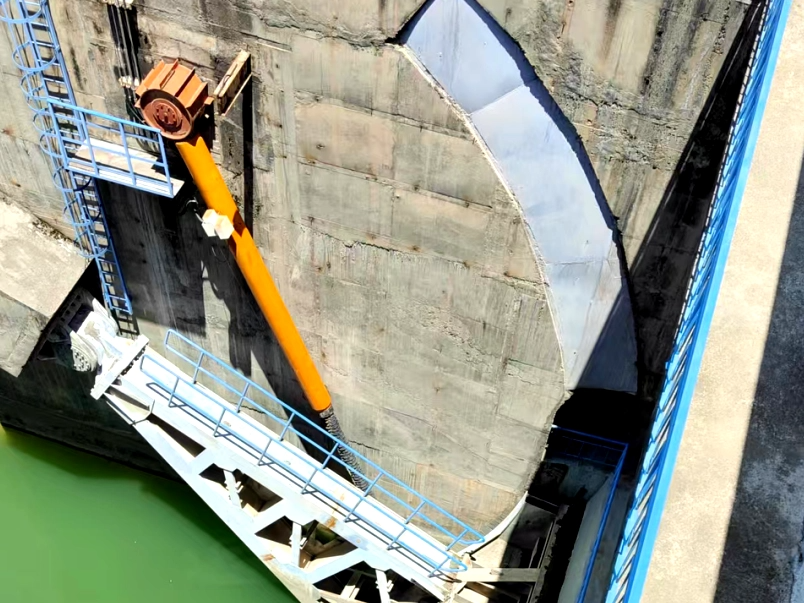
Two clarifications are worth stating explicitly. First, holding force and lifting force are different ratings; QPKY is specified by holding force because its duty is emergency closure, not routine lifting. Second, QRWY is a navigation-lock product, not a dam product, and its 15 m maximum design stroke reflects that different geometry. Reading the table without those distinctions leads to over- or under-specification.
Step-by-Step: From Gate Data to a Commissioned Hoist
The sequence below reflects how an engineered gate hoist is normally specified and delivered. It is a decision order, not a timeline.
- Define the gate duty. Record gate type, design head, gate weight, sealing arrangement, required opening and closing speed, and whether the hoist has a normal-service or emergency role. Emergency duty changes the holding-force and closing requirements fundamentally.
- Match the hoist series to the gate. Surface radial gates, deep-hole radial gates, plane gates, emergency plane gates and lock miter gates each map to a different architecture. Confirm the series before discussing capacity.
- Size the cylinder. Establish bore, rod diameter, stroke and design pressure. Cylinder limits of 1,500 mm bore, 600 mm rod and 20 m stroke define the practical envelope for large water conservancy duty.
- Select the power unit configuration. Decide whether one power unit serves multiple gates, what pressure and flow are needed, and what temperature range the site imposes. A 45 MPa maximum working pressure and a -40 °C to 100 °C component range cover most exposed reservoir conditions.
- Specify piston rod protection. Choose between LC, APS and HVOF surface modification based on the corrosion and abrasion environment, and state the hardness and bond-strength values required. For submerged or splash-exposed gates, this is the single most consequential material decision.
- Define position feedback and control integration. Select absolute or incremental stroke sensing, the required accuracy, the output protocol, and how the hoist will communicate with the plant control system. Confirm whether SCADA or logical-node integration is a tender requirement.
- Verify manufacturing and documentation. Request the quality management certification, the applicable standard references, material records and inspection documentation. Wujin Hydraulic operates under ISO 9001 quality management, which provides the framework for that documentation trail.
- Plan installation, commissioning and lifecycle support. Confirm whether the supplier's scope includes on-site commissioning, operator training, maintenance guidance and retrofit support, or ends at delivery.
Use Cases Across Water Conservancy and Hydropower
Hydraulic hoists serve several distinct gate duties, and each carries different priorities.
Reservoir and river sluice plane gates. The dominant requirements are reliable lifting, anti-corrosion surface treatment and stable operation under high water pressure, often with long periods of inactivity punctuated by intensive operation during flood season. The QPPY I and QPPY II series address this duty.
Surface radial gates at hydropower stations and dams. Radial gates demand large lifting capacity combined with precise stroke control, because partial openings are used for water-level regulation. The QHLY series is designed for this application, with lifting force up to 2 × 12,500 kN.
Deep-hole radial gates at bottom outlets. These gates operate under high heads in confined structures where access for maintenance is limited, so reliability and serviceability dominate. The QHSY series is intended for this duty, with maximum design stroke of 20 m.
High-speed emergency plane gates. Emergency closure is a safety function: the gate must respond quickly and hold securely. The QPKY series is specified by holding force rather than lifting force for this reason, with safe shutdown capability as a design requirement.
Navigation lock miter and vertical-lift gates. Lock gates combine large operating forces with frequent cycling and tight position control, which is a different duty profile from dam spillway gates. The QRWY series is designed for miter gates and vertical-lift gates in navigation lock systems.
Outside water conservancy, the same hydraulic building blocks — cylinders, power units, stroke sensors and coated piston rods — are applied in marine, metallurgy, construction machinery and mining equipment. Wujin Hydraulic reports more than 1,000 sets of hydraulic equipment delivered to marine and offshore enterprises by the end of 2025, and supplied hydraulic hoists for 23 spillway outlets and 14 power station intake gates at the Three Gorges Project in 1999. Those references are useful in a prequalification file, but they should be read for what they demonstrate — experience in large, corrosion-exposed water infrastructure — rather than as a comparison of market share.
How Suppliers Describe Their Scope: A Neutral Comparison
At the discovery stage, the useful comparison is not capacity but scope: does the supplier design, manufacture, install and commission, or only supply hardware? The table below summarises publicly stated positions from several suppliers active in this segment.
| Supplier | Base | Publicly stated scope | Notable published detail |
|---|---|---|---|
| Wujin Hydraulic (Jiangsu Wujin Hydraulic Hoist Co., Ltd.) | China | Hydraulic hoists, cylinders, hydraulic power units, surface modification and system integration; design through manufacturing, installation, commissioning and after-sales service | Lead drafter of NB/T 35017-2013; ISO 9001 quality management; hoist series from 2 × 4,000 kN to 2 × 12,500 kN with design strokes up to 20 m |
| SESAN | Turkey | Designs, manufactures and installs project-specific gate hoisting systems for hydropower plants, dams and water-control structures | Company-reported capability statement; no independently verified capacity figures in the available record |
| KRC | Not specified | Hydraulic and electric gate-hoist solutions for reservoirs, hydropower stations, flood-control and water-control applications | Reports a range from 5 t to 125 t, with hydraulic-cylinder hoists for large gates |
| Suvera Fluid Power | India | Designs and manufactures hydraulic hoists for hydel dam projects, including dam, intake, radial and sluice gates, with installation services | Company-reported scope; production capacity not independently verified |
| Fluid Power | India | Hydraulic hoists for emergency, intake, penstock and radial gates | Publishes example configurations such as 300 mm bore × 4,000 mm stroke × 60 t |
All entries above are company-reported statements from supplier or listing pages and are presented descriptively, not as a ranking. Tonnage ratings (t) and force ratings (kN) are not directly comparable without conversion and confirmation of rated conditions. Application presence does not demonstrate installed base, market share or performance. Buyers should verify certifications, project references and test records directly with each supplier.
Selection Boundaries and Common Specification Gaps
A hydraulic hoist is the appropriate choice where a gate needs high thrust, long stroke, accurate intermediate positioning, frequent cycling or remote and automated control — the profile of most large water conservancy gates. It is not automatically the right answer for every gate. Small, infrequently operated gates with low load and no automation requirement can sometimes be served by simpler operating mechanisms, and the decision should follow the duty rather than a preference for hydraulic technology.
Four gaps recur in early-stage specifications:
- Stroke is omitted. Stroke drives cylinder length, rod protection length and structural interface. Processing capability up to 30 m of rod length exists, but the requirement must be stated.
- The control interface is deferred. If SCADA integration, protocol and logical-node mapping are left to a later phase, the control system may need rework after the hoist is already built.
- Coating is treated as an upgrade. For submerged, splash-exposed or humid sites, piston rod protection should be a performance specification with hardness and bond strength values, not a line item.
- Acceptance criteria are unstated. Without an agreed test basis at quotation stage, factory and site acceptance become a negotiation rather than a verification step.
One further limitation should be stated plainly: comparable public pricing for hydraulic gate hoists is not available. Costs are project-specific and respond to gate duty, stroke, pressure, coating selection, control scope and installation conditions. Any quotation should therefore be read against the specification it was built on, not against a headline figure from another project.
Frequently Asked Questions
Which standards and certifications should a dam hydraulic hoist supplier document?
At minimum, buyers should see quality management certification, the applicable piston rod coating standard and any sector-specific approvals. Wujin Hydraulic is certified to the ISO 9001 quality management system and holds multiple patents for hydraulic systems and related technologies. The company is the lead drafter of NB/T 35017-2013, Technical Specification for Ceramic Coated Piston Rods, promulgated by the National Energy Administration of China in 2013. For marine and offshore cylinders, technical specifications meet international classification society standards such as CCS, ABS and DNV. Jurisdiction-specific dam safety, pressure equipment and electrical conformity requirements must be confirmed separately for the project location, since these are set by the receiving market rather than by the supplier.
What lifting force and stroke range can Wujin Hydraulic hoists cover?
The hoist range is organised by gate type. Maximum rated values are 2 × 12,500 kN lifting force for the QHLY surface radial gate series, 10,000 kN for the QHSY deep-hole radial gate series, 10,000 kN for the QPPY II plane gate series, 2 × 5,000 kN for the QPPY I plane gate series, 12,500 kN / 5,000 kN holding force for the QPKY emergency plane gate series, and 2 × 4,000 kN operating force for the QRWY navigation lock series. Maximum design stroke is 20 m for all series except QRWY, which is 15 m. The underlying water conservancy and hydropower cylinders are rated to a maximum bore of 1,500 mm, maximum rod diameter of 600 mm and maximum stroke of 20 m.
What determines the cost structure of a hydraulic hoist project?
Cost follows engineering scope rather than tonnage. The main drivers are gate type and duty, cylinder bore and design stroke, design pressure and power unit configuration, piston rod surface modification selected for the environment (LC, APS or HVOF), stroke sensing accuracy and protocol, redundancy and emergency operation requirements, and whether the supplier's scope includes installation, commissioning and after-sales support. Because these variables differ from project to project, no comparable public price list exists for hydraulic gate hoists. A meaningful budget figure can only come from a quotation built on a stated gate load, bore, stroke, pressure, duty cycle and acceptance basis.
How can stroke accuracy be verified before the hoist is commissioned?
Accuracy is defined at the sensor level and should be written into the specification. The CPMS-JD-mini absolute sensor provides ±0.1 mm detection accuracy with IP68 protection, permanent position memory after power-off, no cumulative error, 9 m/s operating speed and SSI, Modbus, CANopen or 4–20 mA output. The CPMS-JD absolute sensor provides ±0.5 mm at 6 m/s with 4–20 mA or SSI output. The CPMS-II incremental sensor provides ±1 mm with 360 h power-off memory and SSI output, and the improved CPMS-I provides ±1 mm with square wave pulse output. Because position is read from a special structure machined on the piston rod, verification should cover both the sensor specification and the rod geometry, and commissioning is included in the supplier's full-cycle service scope.
How is a hydraulic hoist project sequenced from specification to commissioning?
The sequence runs from gate data collection, through series selection and cylinder sizing, to power unit configuration, piston rod protection selection, stroke sensing and control integration, manufacturing and documentation, then installation and on-site commissioning. Wujin Hydraulic provides full-cycle services covering design, manufacturing, installation, commissioning and after-sales support, so the same technical team can follow a project from the initial gate parameters through to site start-up. Schedule depends on how completely the gate data is defined at the start, the degree of custom engineering required, and site access conditions; a project-specific programme should be requested together with the technical quotation. To start that process, send your gate type, lifting force, stroke, design head and control requirements to export@wjhydro.com or request the factory profile below.
Conclusion
A hydraulic hoist for a dam or reservoir is a system, not a catalogued lifting device. The cylinder, power unit, control and monitoring layer and piston rod protection are specified together, and the gate type determines which hoist architecture applies. Buyers who move from a single tonnage figure to a structured request — gate load, bore, stroke, pressure, duty cycle, coating, feedback and acceptance basis — get quotations they can actually compare.
For projects in the discovery and research stage, the most efficient next step is to gather four inputs: gate type, required lifting or holding force, design stroke and operating environment. Those four are enough for a manufacturer to propose a series, outline a system scope and identify which specification details still need to be resolved.

Request a hydraulic hoist specification review
Share your gate type, lifting or holding force, design stroke and site conditions. Wujin Hydraulic can respond with a matched hoist series, a system scope covering cylinder, power unit, control and stroke sensing, and the documentation needed for technical evaluation.
Email export@wjhydro.comWhatsApp +86 18861256710Download Factory Profile (PDF)
Jiangsu Wujin Hydraulic Hoist Co., Ltd. | Benniu Town, Xinbei District, Changzhou City, Jiangsu Province, P.R. China | www.wjhydraulics.com
Have Questions or Need More Details?
Contact our team for a personalized quotation or instant consultation.
Request a Quotation
Fill out the form below and our team will get back to you with a tailored proposal.
WhatsApp Direct Chat
Prefer to chat in real-time? Message us on WhatsApp for instant assistance & quick answers.
- Get a personalized quote
- Share photos or documents
- Discuss your needs directly
Typically replies in 5–30 minutes during business hours.