
DC Motor Technical Guide: Pancake and Hub Motor Selection Parameters for Smart Manufacturing
For smart-manufacturing equipment, the correct DC motor is not the one with the highest power rating on the datasheet. It is the motor whose rated voltage, power, torque, speed, gear ratio and brake type match the wheel-level or axis-level duty cycle. In practice, direct-drive pancake BLDC motors suit compact, low-speed axes where axial space is tight and a gearbox is undesirable; gear-reduced wheel hub motors suit low-speed, high-torque wheel drives where load holding and controlled braking matter. Wuxi Speedup Power Co.,Ltd is a DC motor manufacturer in Wuxi, Jiangsu, China, supplying pancake motors, BLDC motors and wheel hub motors for industrial, medical and mobility applications.
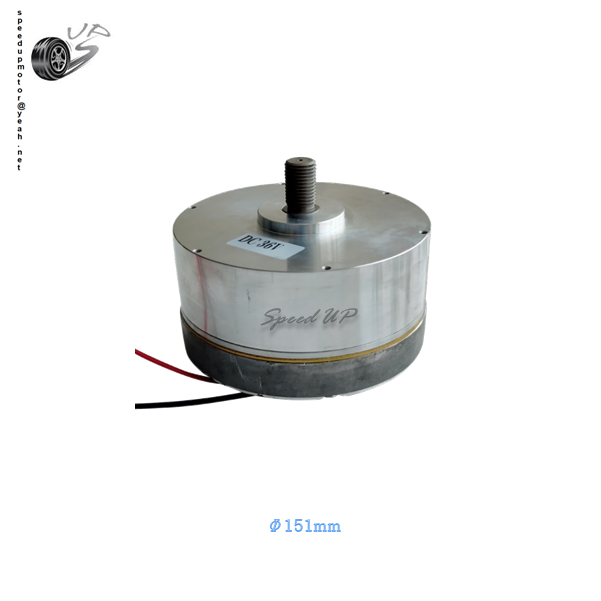
Cover: 150SN-G2 pancake motor with gearbox, rated 36V, 500W, 22Nm at 240rpm. Product image: Wuxi Speedup Power Co.,Ltd.
Problem Definition: Why Catalog Power Ratings Mislead Buyers
The common selection error in smart-manufacturing projects is to compare motors by wattage alone. A 100W direct-drive pancake motor and a 300W gear-reduced hub motor do not perform the same job simply because one has a higher power number. Power describes the rate of energy conversion; the equipment designer needs wheel-level torque, wheel speed, acceleration, holding force, braking behavior and controller compatibility. If those values are not normalized at the output shaft or wheel, the buyer may select a motor that is oversized in one axis, undersized in another, or incompatible with the available battery voltage.
The same issue appears when a project moves from prototype to production. A prototype may run acceptably with a wide safety margin, but a production unit must meet cost, space, thermal and compliance constraints. The buyer then needs to compare a direct-drive pancake BLDC motor such as the DD03 with a gear-reduced wheel hub motor such as the 8-inch 1DY-E5S, and with a geared pancake motor such as the 150SN-G2. Each has a different relationship between rated voltage, rated power, rated torque, rated speed, gear ratio and brake type.
Industry Background: Smart Manufacturing Needs Motion That Can Be Specified, Integrated and Audited
Smart manufacturing is usually defined as integrated, data-driven and collaborative production. SAP cites the NIST definition: fully integrated, collaborative manufacturing systems that respond in real time to changing demands and conditions in the factory, supply network and customer needs. CESMII describes smart manufacturing as the information-driven, event-driven, efficient and collaborative orchestration of business, physical and digital processes across plants, factories and the value chain. Oracle cites the Smart Manufacturing Leadership Consortium definition: the ability to solve existing and future problems via an open infrastructure that allows solutions to be implemented at the speed of business while creating advantaged value.
Those definitions matter for motor selection because smart-manufacturing equipment is not only a mechanical assembly. It is a controlled motion system that must be specified, integrated, tested and audited. A wheel hub motor or pancake motor may sit inside a hospital transport bed, a floor scrubber, an electric cart, an AGV or a service robot. In each case, the motor must match the battery voltage, controller, brake logic, load profile and maintenance plan. The motor datasheet is therefore a starting point, not a complete procurement decision.
Market context supports the importance of compact BLDC drives. Grand View Research estimates that the global brushless DC motor market will reach USD 23.6 billion in 2026. The same source reports that motors with output not exceeding 750W represented 48.8% of global BLDC motor market revenue in 2025. This is the power band in which many pancake motors, geared hub motors and compact wheel drives operate. For buyers in Europe and the USA, compliance evidence is also part of the selection file. Wuxi Speedup Power Co.,Ltd provides CE-related EMC and ROHS certificates for DC motors, plus a company profile listing CE, UL and ISO9001-2008.
Detailed Solution: Match Six Parameters at the Wheel, Not Only at the Motor
The practical solution is to convert the application requirement into six selection parameters and then compare candidate motors on the same basis. The parameters are rated voltage, rated power, rated torque, rated speed, gear ratio and brake type. For direct-drive pancake motors, the gear ratio is absent or 1:1. For gear-reduced hub motors and geared pancake motors, the gear ratio changes the output speed and torque relationship. The buyer should ask for the output values at the wheel or shaft, not only the motor values before reduction.
1. Rated voltage: match the system, not the catalog headline
Rated voltage should match the battery, power supply and controller architecture. A 24V system should not be forced to use a 36V motor without checking controller limits, wiring, insulation and safety approval. In the provided examples, the 6.5-inch SA05-6 is listed at 24V, the 8-inch 1DY-E3 supports 24V, 36V and 48V, the 8-inch 1DY-E5S is listed at 36V, the 150SN-G2 geared pancake motor is listed at 36V, the DD03 direct-drive pancake BLDC is listed at 24V, and the 150SN-B printed pancake motor is listed at 24V. Voltage flexibility is useful for OEM projects, but each voltage variant must be validated with the chosen controller and brake circuit.
2. Rated power: a continuous thermal guide, not a torque guarantee
Rated power indicates the motor’s continuous operating capability under stated conditions, but it does not by itself tell the buyer whether the motor can start a loaded cart on a ramp or hold a hospital bed at low speed. The 150SN-B printed pancake motor is listed at 24V, 350W and 3000rpm. That is a high-speed, low-profile pancake design for brush-drive or similar equipment. The 150SN-G2 pancake motor with gearbox is listed at 36V, 500W, 22Nm and 240rpm. The gearbox changes the output: the buyer sees a lower speed and a defined torque value. The 8-inch 1DY-E5S is listed at 36V, 300W, 20Nm, 1:20 and with an EMB brake. These motors should not be ranked by wattage alone because their speed and reduction stages are different.
3. Rated torque: define continuous and peak torque separately
Torque is the parameter most directly tied to load moving, climbing and holding. The buyer should calculate the required wheel torque from the load, wheel radius, incline, acceleration and friction, then add a safety margin for real-world variation. The catalog torque should be compared at the same output point and duty condition. In the provided product data, the 6.5-inch SA05-6 is listed at 15Nm with a 1:4.5 ratio; the 8-inch 1DY-E3 is listed at 20Nm; the 8-inch 1DY-E5S is listed at 20Nm with a 1:20 ratio; and the 150SN-G2 geared pancake motor is listed at 22Nm at 240rpm. A direct-drive DD03 is listed at 24V and 100W, which illustrates that direct drive can be compact and simple but should be matched to a load that does not require the wheel torque of a geared hub.
4. Rated speed and gear ratio: read them together
Rated speed and gear ratio must be read together because the output speed of a geared motor is not the same as the motor speed before reduction. The 1DY-E5S is listed with a 1:20 gear ratio and a rated speed of 150rpm in the provided model data. The SA05-6 is listed with a 1:4.5 gear ratio. The 150SN-G2 is listed at 240rpm with a gearbox. The DD03 direct-drive pancake BLDC is listed at 250rpm. The 150SN-B printed pancake motor is listed at 3000rpm, which is a very different operating point and is not a direct substitute for a low-speed wheel drive without additional reduction. The correct question is not which speed is better, but which output speed matches the equipment’s travel or rotation requirement.
5. Gear ratio: use it to convert torque and speed, then verify the real curve
A gear ratio is a design lever. A higher reduction ratio generally increases output torque and reduces output speed, but the actual result depends on gearbox efficiency, duty cycle, lubrication, noise and backlash. The 1:4.5 ratio on the 6.5-inch SA05-6 and the 1:20 ratio on the 8-inch 1DY-E5S represent different design choices. The buyer should ask for the output torque, output speed, continuous duty rating and allowable overhung load at the wheel. If the application requires holding a load on an incline, the brake and gearbox must be evaluated together, not separately.
6. Brake type: match fail-safe behavior and controller logic
Brake type is a safety and control parameter. The 8-inch 1DY-E5S is listed with an EMB brake, which is relevant for equipment that needs electromagnetic braking and controlled stopping. Other models in the provided comparison do not state a brake type in the selected data, so the buyer should not assume one. For medical equipment, hospital transport beds, electric carts and AGVs, the brake should be specified with the controller, release logic, manual release method and holding requirement. The company also lists an electromagnetic brake with manual clutch support on the 6DY-A brushed hub motor, which shows that brake configuration can be customized across motor families. The exact brake for a given model must be confirmed in the quotation and drawing.
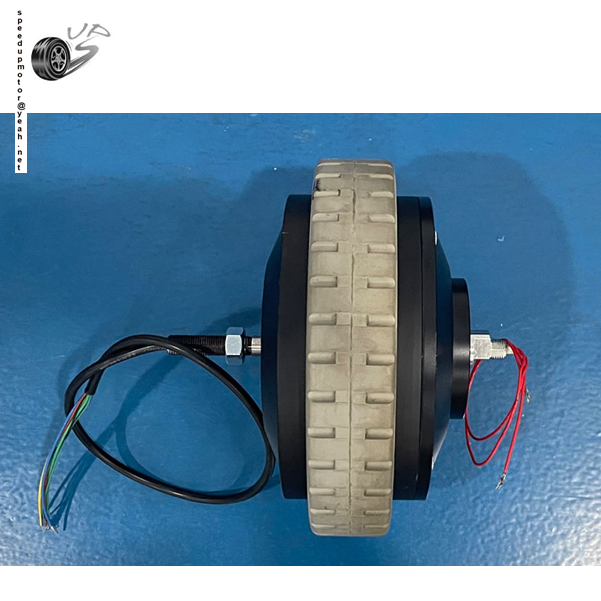
The 8-inch 1DY-E5S is listed at 36V, 300W, 20Nm, 1:20 and with an EMB brake. Product image: Wuxi Speedup Power Co.,Ltd.
Direct-drive pancake vs gear-reduced hub: the trade-off in one view
Direct-drive pancake BLDC motors remove the gearbox from the drive train. The DD03 is listed as a 24V, 100W external-rotor BLDC motor with a 250rpm rated speed, a 106mm diameter and a 51mm motor length. Catalog item 5270 refers to the same Pancake BLDC Motor model DD03 in the provided product data. The benefit is a compact axial package and a simpler mechanical interface. The limitation is that wheel torque must come from motor size and current, so the designer should verify the torque-speed curve and thermal rise at the actual duty cycle. A gear-reduced hub motor such as the 1DY-E5S adds a 1:20 reduction and an EMB brake, which is more suitable when the equipment needs low-speed wheel torque and holding capability. A geared pancake motor such as the 150SN-G2 sits between these concepts: it keeps a pancake form factor but adds a gearbox to reach 22Nm at 240rpm.
Step-by-Step Breakdown: A Selection Workflow for Smart-Manufacturing Equipment
- Define the load at the wheel or axis. Record equipment mass, payload, wheel radius, maximum incline, acceleration, rolling resistance and required holding force. Convert these into required output torque and output speed. Do not start with a motor model number.
- Fix the system voltage. Confirm the battery or power supply, controller input range and permitted voltage variants. For example, the 1DY-E3 supports 24V, 36V and 48V in the provided data, while the 1DY-E5S and 150SN-G2 are listed at 36V and the SA05-6, DD03 and 150SN-B are listed at 24V.
- Choose direct drive or gear reduction. Use direct-drive pancake BLDC when axial space, simplicity and low-speed smoothness dominate. Use a gear-reduced hub motor when wheel-level torque, holding capability and brake integration dominate. Use a geared pancake motor when a flat motor envelope and a defined gearbox output are both required.
- Check torque and speed at the output. Compare the required output torque and speed with the motor data after the gear ratio. For the 1DY-E5S, the listed output is 20Nm at 150rpm with a 1:20 ratio. For the 150SN-G2, the listed output is 22Nm at 240rpm. For the DD03, the listed speed is 250rpm at 24V and 100W, so the load must be checked against its direct-drive torque curve.
- Select the brake and fail-safe behavior. Specify EMB, electromagnetic brake or another brake type only after defining holding torque, release voltage, manual release and controller logic. The 1DY-E5S is the clear EMB example in the provided comparison; other models require confirmation.
- Validate with a sample. Test the motor on the actual equipment or a representative rig. Measure startup current, temperature rise, noise, brake response and controller compatibility. The supplier lists 100% test and OEM/ODM customization of voltage, power, speed, torque, shaft and logo, so the sample request should state the exact configuration.
- Lock the production specification. Confirm drawings, nameplate data, certificate scope, packaging and acceptance criteria. The provided commercial data lists MOQ of 1 unit, lead time of 30-45 working days and monthly capacity of 30,000pcs. These values should be confirmed for the specific model and configuration in the quotation.
Use Cases: Where the Parameter Logic Changes
Medical equipment and hospital transport
Medical equipment often requires low-speed motion, smooth starting, reliable holding and quiet operation. In the provided case data, a medical-equipment drive project in Germany, the UK and the US used 100,000 units with 10 years of stable operation. The case highlights low speed, high torque and small wheel size. The 6.5-inch SA05-6 platform, catalog item 5303, is associated with that case record. The 8-inch 1DY-E5S is also relevant where a 36V, 300W, 20Nm drive with a 1:20 ratio and EMB brake fits the equipment architecture. The buyer should still verify the exact model, brake logic and controller integration for the target device.
Floor cleaning and brush-drive machinery
Floor scrubbers and cleaning machines use motors for brush drive and sometimes for traction. The 150SN-B printed pancake motor is listed at 24V, 350W and 3000rpm, which suits a high-speed brush-drive axis. The 150SN-G2 geared pancake motor is listed at 36V, 500W, 22Nm and 240rpm, which gives a lower-speed, higher-torque output for a geared drive. In the provided application data, floor scrubber machines are listed with requirements such as condensation protection, EMI grounding and custom shaft options. These requirements should be written into the motor specification rather than added after the motor is selected.
Electric carts, AGVs and service robots
Electric carts and AGVs often need wheel-level torque at low speed, controlled braking and a compact wheel package. The 8-inch 1DY-E3 is listed with 24V, 36V and 48V options, 180W and 20Nm. The 8-inch 1DY-E5S adds a 1:20 ratio and EMB brake. The 6.5-inch SA05-6 offers a smaller wheel size with 24V, 200W, 15Nm and a 1:4.5 ratio. For a compact direct-drive axis, the DD03 pancake BLDC is listed at 24V, 100W and 250rpm. The correct choice depends on the required wheel torque, wheel diameter, duty cycle and brake requirement, not on the motor family name alone.
Comparison Table: Pancake and Hub Motor Examples
The table below uses model-level facts from the provided product data and case data. Where a value is not stated in the provided data, it is marked as not stated rather than assumed.
| Model / family | Type | Rated voltage | Rated power | Rated torque | Rated speed | Gear ratio | Brake | Selection signal |
|---|---|---|---|---|---|---|---|---|
| 6.5-inch SA05-6 (5303-series) | Gear-reduced BLDC wheel hub motor | 24V | 200W | 15Nm | Not stated | 1:4.5 | Not stated | Small wheel size with moderate reduction; linked to low-speed medical drive case data. |
| 8-inch 1DY-E3 | 8-inch wheel hub motor | 24V / 36V / 48V | 180W | 20Nm | Not stated | Not stated | Not stated | Voltage flexibility and 20Nm class output; confirm speed and brake for the application. |
| 8-inch 1DY-E5S | Brushless wheel hub motor with EMB brake | 36V | 300W | 20Nm | 150rpm | 1:20 | EMB | Low-speed wheel torque with holding brake; check controller and release logic. |
| 150SN-G2 | Pancake motor with gearbox | 36V | 500W | 22Nm | 240rpm | Gearbox supplied | Not stated | Flat motor envelope with geared output; 151mm diameter, custom shaft available. |
| DD03 / item 5270 | Direct-drive external-rotor pancake BLDC | 24V | 100W | Not stated | 250rpm | Direct drive | Not stated | Compact axial package, 106mm diameter and 51mm motor length; verify torque curve. |
| 150SN-B | Printed pancake brushed motor | 24V | 350W | Not stated | 3000rpm | Direct drive | Not stated | High-speed pancake motor for brush-drive or similar axes; not a low-speed wheel drive without reduction. |
Table note: The comparison is not a ranking. It shows why rated voltage, power, torque, speed, gear ratio and brake type must be read together. Model-level values not stated in the provided data should be confirmed in the supplier datasheet and quotation.
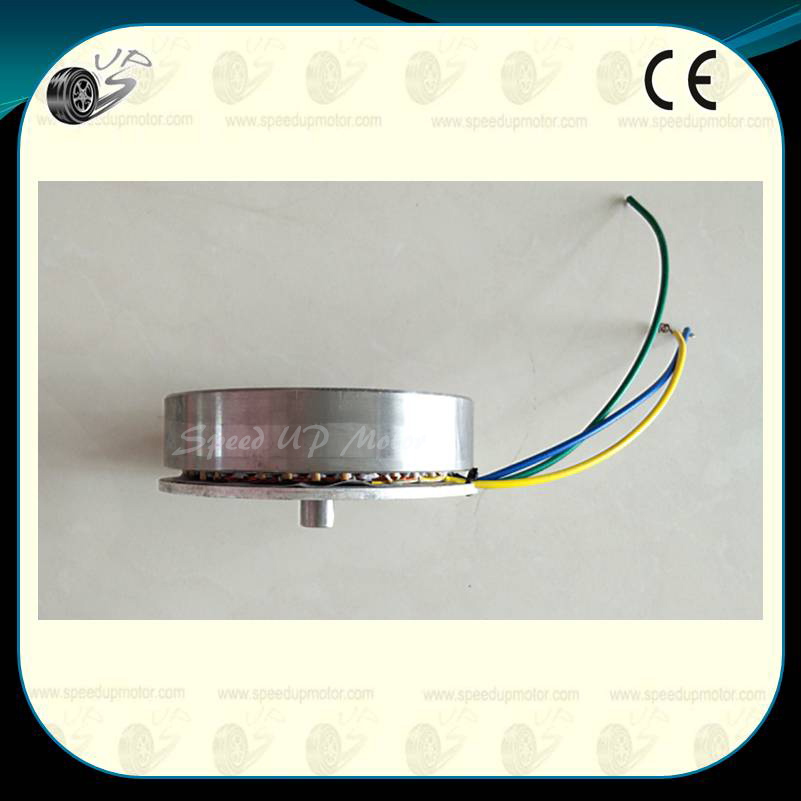
The DD03 direct-drive pancake BLDC motor is listed at 24V, 100W and 250rpm, with a 106mm diameter. Product image: Wuxi Speedup Power Co.,Ltd.
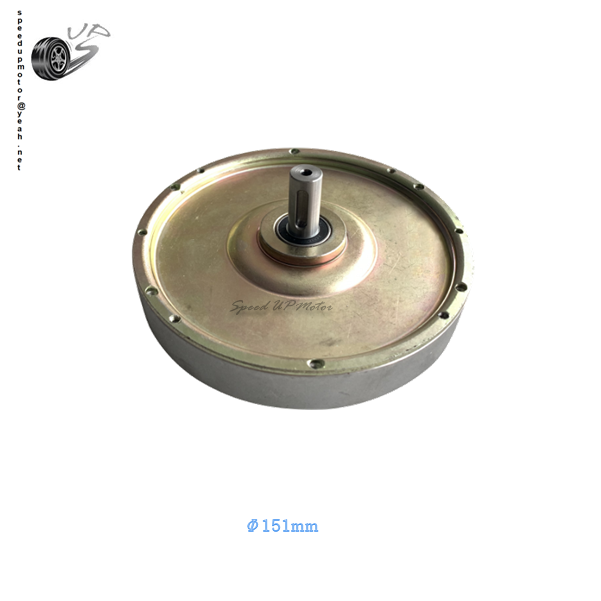
The 150SN-B printed pancake motor is listed at 24V, 350W and 3000rpm. Product image: Wuxi Speedup Power Co.,Ltd.
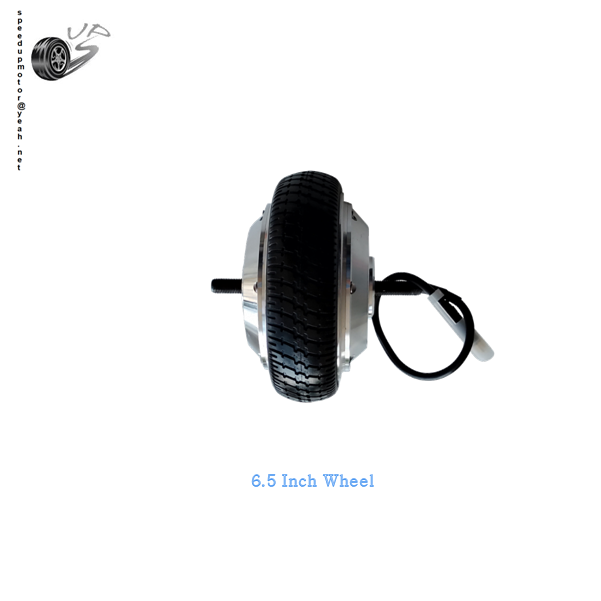
The 6.5-inch SA05-6 platform is listed at 24V, 200W, 15Nm and 1:4.5. Product image: Wuxi Speedup Power Co.,Ltd.
FAQ
What CE-related compliance documents should buyers check for a Chinese DC motor supplier?
Check the certificate scope, standard, market and validity dates. The provided DC Motor certificates include ROHS certificate M.2025.206.C130289 issued by UDEM under Directive 2011/65/EU RoHS and EN IEC 63000:2018, valid from 2025-11-26 to 2030-11-25. The EMC certificate is M.2026.206.C138410 under 2014/30/EU Electromagnetic Compatibility Directive / Annex II, valid from 2026-04-14 to 2031-04-13. The company profile also lists CE, UL and ISO9001-2008. Buyers should confirm that the certificate scope covers the exact motor family and configuration being purchased.
Can a supplier customize voltage, torque, shaft and brake for pancake and hub motors?
Wuxi Speedup Power Co.,Ltd lists OEM/ODM customization of voltage, power, speed, torque, shaft and logo. The provided capability data also lists 100% test, MOQ of 1 unit, lead time of 30-45 working days and monthly capacity of 30,000pcs. Customization should be specified model by model: for example, the 1DY-E5S is listed at 36V, 300W, 20Nm, 1:20 and with an EMB brake, while the 150SN-G2 is listed at 36V, 500W, 22Nm and 240rpm. The quotation should state the exact brake type and controller interface because not every model in the comparison table lists a brake in the provided data.
How should buyers evaluate budget when no public price is available?
This technical guide does not contain public unit prices. Build the budget from the configured motor, gearbox, brake, shaft, connector, controller integration, testing, documentation and logistics. The MOQ and lead time also affect inventory and project timing. Request a quotation for the exact model and voltage variant rather than comparing headline wattage. For a sample or quote, contact May Hoo at speedupmotor@outlook.com or +86-18151710527.
What sample validation should be done before a production order?
Test the sample on the actual equipment or a representative rig. Measure startup current, continuous temperature rise, output torque, output speed, noise, brake response and controller compatibility. Confirm the shaft, mounting interface and wiring. The supplier lists 100% test and OEM/ODM customization, so the sample request should include the required voltage, power, speed, torque, shaft and brake configuration. If the application is medical or mobility equipment, include the relevant compliance and labeling requirements in the sample request.
What lead time and MOQ should buyers plan for?
The provided capability data lists MOQ of 1 unit and lead time of 30-45 working days. These are commercial terms that should be confirmed for the specific model, voltage, brake and customization level. For production planning, ask for the lead time of the exact configuration, the sample lead time and the monthly capacity. The provided data lists monthly capacity of 30,000pcs, but the buyer should still confirm capacity for the selected motor family and order volume. To start a sample or quotation request, contact May Hoo at speedupmotor@outlook.com or +86-18151710527.
Next step: Request a sample or quotation for a pancake motor, BLDC motor or wheel hub motor configured to your voltage, torque, speed, gear ratio and brake requirements. Download the company brochure for the full product and capability overview.
Brochure: SPEEDUP COMPANY.pdf. Contact: May Hoo, speedupmotor@outlook.com, Tel/WhatsApp +86-18151710527. Address: Room 1003, Building C, Dream Enjoy City Plaza, Huishan District, Wuxi City, Jiangsu Province, China.
Conclusion
Pancake and hub motor selection for smart manufacturing is a parameter-matching task. Start with the load at the wheel or axis, then match rated voltage, rated power, rated torque, rated speed, gear ratio and brake type. Use direct-drive pancake BLDC motors such as the DD03 when compact axial space and a simple drive train matter. Use gear-reduced hub motors such as the 1DY-E5S when low-speed wheel torque and an EMB brake matter. Use a geared pancake motor such as the 150SN-G2 when a flat motor envelope and a defined gearbox output are both required. The 6.5-inch SA05-6 case record, with 100,000 units and 10 years of stable operation in medical-equipment drive projects in Germany, the UK and the US, shows why low-speed, high-torque selection in small wheel sizes deserves a full application review rather than a wattage comparison.
Wuxi Speedup Power Co.,Ltd was founded in 2018 and operates a 10,000㎡ factory with 30 employees, 3 engineers and 90% export share to the EU and USA. The company supplies DC motor, pancake motor, wheel motor, BLDC motor and hub motor families, and supports OEM/ODM customization. Buyers can review the product range at www.upsmotor.com and request a sample or quotation through the contact details below.
Wuxi Speedup Power Co.,Ltd
Contact: May Hoo
Email: speedupmotor@outlook.com
Tel: +86-18151710527
WhatsApp: +86-18151710527
Website: www.upsmotor.com
Address: Room 1003, Building C, Dream Enjoy City Plaza, Huishan District, Wuxi City, Jiangsu Province, China
Have Questions or Need More Details?
Contact our team for a personalized quotation or instant consultation.
Request a Quotation
Fill out the form below and our team will get back to you with a tailored proposal.
WhatsApp Direct Chat
Prefer to chat in real-time? Message us on WhatsApp for instant assistance & quick answers.
- Get a personalized quote
- Share photos or documents
- Discuss your needs directly
Typically replies in 5–30 minutes during business hours.