
Top 5 Wheel Hub DC Motors for AGVs & Service Robots: A Smart Manufacturing Ranking
Top 5 Wheel Hub DC Motors for AGVs & Service Robots: A Smart Manufacturing Ranking
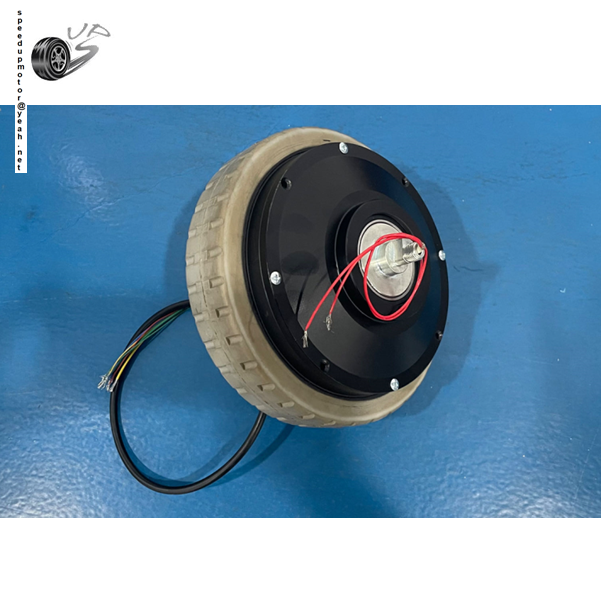
Answer first: five wheel hub DC motors cover the practical range of AGV and service robot drives in smart manufacturing, ranked here in this order — the 6.5-inch SA05-6 (24V, 200W, 15Nm, 1:4.5 reduction, specified for AGV and robot scenarios), the 8-inch 1DY-E3 (brushed DC with gearbox, 24V, 180W, 20Nm, 1:20, electromagnetic brake), the 8-inch 1DY-E5S (brushless, 36V, 300W, 20Nm, 1:20 gearbox, EMB brake), the 12-inch SA06 (brushless, gear-reduced, aluminum alloy, copper, magnetic steel and rubber construction), and the spoke-type SA05 (brushless, gear-reduced, aluminum alloy, copper and magnetic steel construction). All five are published models of Wuxi Speedup Power Co.,Ltd, a DC motor manufacturer based in Wuxi, Jiangsu, China.
An AGV or service robot does not buy torque at the motor shaft. It buys torque at the tyre, a predictable stop on a ramp, and a service interval that a maintenance team can plan around. That is why a hub motor shortlist for smart manufacturing has to be built from wheel-level criteria instead of from the highest wattage on a catalogue page.
The ranking below uses five criteria an integrator can check against published data: declared application fit for AGV and robot duty, rated torque at the wheel, voltage and power compatibility with the platform battery architecture, brake integration, and construction and serviceability. No prices, efficiency curves or independent test results are assigned to these models here, because none were provided. Where a number appears, it is a published model figure from the manufacturer's product data.
Problem Definition: A Hub Motor Is Both the Drive and the Wheel
The difficulty in specifying a wheel hub motor is that two normally separate engineering decisions collapse into one component. The motor sets torque and speed; the gearbox inside the hub multiplies torque and divides speed; the tyre diameter converts that rotation into ground speed and converts payload into wheel torque. Change any one of the three and the other two move with it.
In practice, four variables decide whether a hub motor suits an AGV or a service robot:
- Wheel-level torque. Rated motor torque multiplied by the gear ratio, minus losses, is what climbs a ramp or starts a loaded platform. A 20Nm motor behind a 1:20 gearbox and the same 20Nm motor behind a 1:4.5 gearbox are not interchangeable components, even though the datasheet headline is identical.
- Voltage architecture. A 24V platform and a 36V platform are different battery systems, different chargers and different controllers. Motor voltage is a platform decision that reaches back into the whole electrical design.
- Brake behaviour. An integrated electromagnetic brake holds the wheel when power is removed, which matters for an emergency stop on a ramp and for a robot parked between tasks. A motor without an integrated brake pushes that function into a separate assembly.
- Service model. Brushed commutation wears and needs inspection; brushless construction removes that specific maintenance item. For a fleet running around the clock, the service model can outweigh a small torque advantage.
The ranking criteria follow directly from those four variables, plus the mechanical interface — solid tyre versus spoke wheel, single or double shaft, standard or custom mounting plate. A model that wins on torque but forces a new battery architecture is not a better motor for that platform; it is a different project.
Industry Background: Mobile Platforms Are Now Part of the Manufacturing Loop
Smart manufacturing, in the NIST definition cited by SAP, describes fully integrated, collaborative manufacturing systems that respond in real time to changing demands and conditions in the factory, in the supply network and in customer needs. CESMII describes the same idea as the information-driven, event-driven and collaborative orchestration of business, physical and digital processes across plants, factories and the value chain. Neither definition mentions motors, but both place a premium on equipment that keeps moving without intervention — which is precisely where AGV and service robot drives are decided.
Category demand supports the direction without settling any individual choice. Grand View Research estimates the global brushless DC motor market at USD 23.6 billion in 2026, and reports that motors with output not exceeding 750W represented 48.8% of global BLDC revenue in 2025. Those figures describe the BLDC category as a whole, not wheel hub motors, so they should be read as context: the sub-750W segment where AGV drives sit is large and competitive, and model-level verification remains the only way to choose inside it.
The practical consequence for a buyer is that published specifications are necessary but not sufficient. Rated voltage, power, torque, speed and gear ratio describe what the motor is designed to do; the declared application describes what the manufacturer has already matched it to. Both belong in a shortlist, and the ranking below separates them explicitly.
The Ranking: Five Wheel Hub DC Motors With Inclusion Rationale
Each entry states the published figures, the reason it is included at that position, and the condition under which it should move up or down a buyer's own list. The order is a starting point for evaluation, not a substitute for validation on your chassis.
Rank 16.5-Inch SA05-6: The AGV-Native Starting Point
Published figures: 6.5-inch wheel hub motor, 24V, 200W, 15Nm rated torque, 1:4.5 reduction ratio, specified for AGV and robot scenarios.
Why it is ranked first. It is the only model in this group whose published application statement starts with AGV and robot duty rather than arriving there through a scooter or mobility platform. Its 6.5-inch rolling diameter is the smallest here, which lowers deck height and tightens the turning envelope — both useful on an indoor platform that repositions constantly. The 1:4.5 reduction keeps wheel speed available for travel between stations, and 24V matches the pack voltage used across a large share of indoor AGV designs.
What to check before ordering. At 15Nm it carries the lowest rated torque in this group. Confirm the loaded wheel torque your ramp and acceleration profile actually need; if the platform climbs a slope fully loaded or runs continuously, the 20Nm 8-inch models below are the safer starting point. Ask for the wheel load rating and duty cycle in writing for your configuration.
Rank 28-Inch 1DY-E3: The 24V Torque Step-Up With an Integrated Brake
Published figures: 8-inch (210mm) solid tyre, brushed DC motor with gearbox, 24V, 180W, 95rpm rated speed, 20Nm rated torque, 1:20 reduction ratio, electromagnetic brake, 5.5kg net weight, load range 80–300kg. Construction is aluminum alloy, copper, magnet and rubber, with a printed armature/winding and rare-earth NdFeB permanent magnets. Catalogue applications cover mobility scooter, electric scooter, shopping cart, medical chair, hospital transport bed and transport cart, and the listed applicable industry is electric scooter manufacturing.
Why it is ranked second. It delivers 20Nm inside the same 8-inch, 5.5kg envelope as the brushless model, and it does so at 24V — which means an existing 24V platform can gain wheel torque without changing its battery, charger or controller family. The 1:20 gearbox turns 95rpm motor speed into a slow, high-torque wheel, and the integrated electromagnetic brake holds position on a ramp when power is removed. Its published application set is mobility hardware, and a large share of service robot chassis are derived from exactly that hardware, which makes mechanical parts easier to reuse.
What to check. The brush assembly is a wear item, so the inspection interval belongs in the maintenance plan. The listed industry focus is electric scooter manufacturing rather than AGV duty, so duty cycle and continuous-operation behaviour need confirmation for a 24/7 fleet. If brush maintenance is not acceptable, the brushless model in the next position is the answer.
Rank 38-Inch 1DY-E5S: Brushless Construction With EMB Brake
Published figures: 200mm (8-inch) solid tyre, brushless DC motor with gearbox, 36V, 300W, 150rpm rated speed, 20Nm rated torque, 1:20 reduction ratio, electromagnetic brake, 5.5kg net weight, load range 80–300kg. A 24V and a 48V version are listed, single or double shaft output is available, and CE, EMC and RoHS approval is listed on the model page. Published applications include AGV, robot, mobility scooter, electric scooter, wheelchair assistance and medical chair.
Why it is ranked third. On construction and brake integration it is the strongest 8-inch option in the group: brushless commutation removes the brush service item, the electromagnetic brake is integrated, 20Nm matches the brushed model, and AGV and robot appear in its own application list. It sits behind the 24V models only because 36V nominal is a platform-level decision — a 24V fleet cannot adopt it without changing the electrical architecture, even though a 24V version is listed as an option and should be confirmed for the exact configuration you order.
What to check. At 150rpm through a 1:20 ratio the wheel turns faster than the 95rpm brushed model at the same ratio. Recalculate ground speed against the robot's safety envelope before assuming the two are drop-in equivalents.
Rank 412-Inch SA06: Large-Diameter Load Carrier
Published figures: 12-inch brushless gear-reduced hub motor, 24V, 300W, 150rpm, 1:4.5 reduction ratio, IP54 rating and load support of 80–300kg as reported for the model. Construction is aluminum alloy, copper, magnetic steel and rubber.
Why it is ranked fourth. The 12-inch diameter is both the reason to choose it and the reason it sits here. A larger wheel rolls over floor joints, cable covers and thresholds that stop a smaller one, and the published load support with an IP54 rating suits floor-care and heavier service platforms where wash-adjacent operation is normal. The model is already listed across mobility, medical and floor-scrubber application sets, which is where service equipment and cleaning robots overlap.
What to check. A 12-inch wheel raises deck height and adds unsprung mass. At 150rpm and 1:4.5 the resulting ground speed is higher than the same motor speed on an 8-inch wheel, so the speed budget has to be recalculated rather than assumed; for a slow indoor platform that usually means extra reduction or a lower commanded speed.
Rank 5Spoke SA05: The Flexible Platform for Custom Wheels
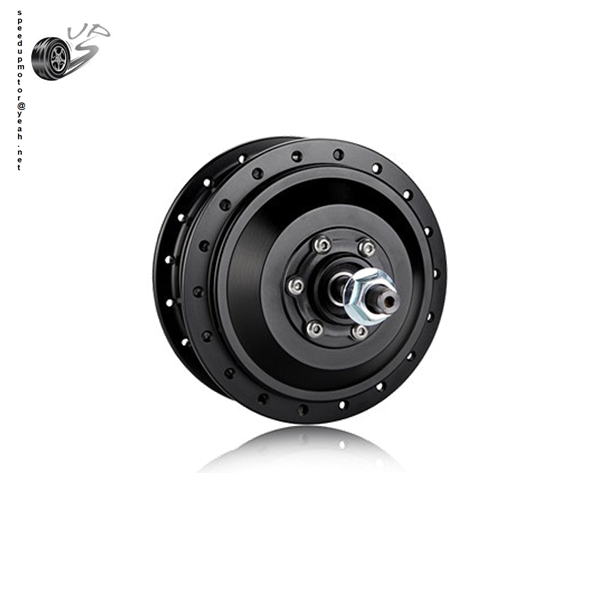
Published figures: spoke-type brushless DC wheel hub motor, 24V/36V/48V, 100–500W, 100–500rpm, 1:5 gear ratio, single or double shaft, and a custom plate that suits different wheel sizes. Construction is aluminum alloy, copper and magnetic steel, and published applications include AGV, robot, e-bike, snowmobile and refuse truck.
Why it is ranked fifth. This is the widest power band in the group and the most flexible interface: a spoke wheel accepts a rim and tyre chosen by the integrator, and a custom plate adapts the motor to a non-standard mounting geometry. That makes it the right answer for a prototype, a low-volume robot or a retrofit where no standard wheel fits. It ranks last for AGV service because it is a motor for a wheel rather than a validated wheel assembly — spoke build, tyre selection and truing add process steps and variables between the motor and the floor, and those steps have to be controlled by the integrator.
Read together, the five entries form a decision sequence rather than a popularity list: start from the application statement (SA05-6), step up torque at constant voltage (1DY-E3), remove the brush service item (1DY-E5S), increase rolling diameter and ingress protection (SA06), and keep the flexible platform for custom wheel builds (SA05).
Step-by-Step: Applying the Ranking to Your Own Robot Project
- Fix the wheel load and payload first. The 8-inch and 12-inch models in this group publish a load range of 80–300kg. Establish the static and dynamic load per drive wheel before comparing torque, because load decides whether a 6.5-inch or an 8-inch platform is credible at all.
- Convert required ground speed into wheel rpm. Wheel rpm equals motor rpm divided by the gear ratio, and ground speed equals π × wheel diameter × wheel rpm. Run the calculation at both ends: 150rpm through 1:20 on an 8-inch wheel and 150rpm through 1:4.5 on a 12-inch wheel are very different vehicles.
- Choose the voltage architecture before the model. If the fleet is committed to 24V, the SA05-6, 1DY-E3 and SA06 sit inside that decision; a 36V brushless model becomes a platform change rather than a component swap, even where a 24V variant is offered.
- Decide the brake strategy. For AGVs and service robots that stop on ramps or park between tasks, specify the integrated electromagnetic brake and confirm its holding behaviour under the loaded condition. A motor without an integrated brake moves that requirement into a separate assembly.
- Lock the mechanical interface. Single or double shaft, shaft profile, mounting plate drawing, solid tyre or spoke wheel all belong in the specification. The 1DY-E3, 1DY-E5S and SA06 are published as solid-tyre wheels; the SA05 is published as a spoke platform with a custom plate option.
- Validate on a sample and write the acceptance criteria. The manufacturer publishes a MOQ of 1 unit and OEM/ODM customization of voltage, power, speed, torque, shaft and logo, so a single unit can be evaluated before a volume commitment. Define pass or fail on rated torque at the specified voltage, brake hold, noise and vibration at operating speed, and dimensional fit against the drawing.
Use Cases: Which Model Fits Which Robot
Indoor AMR and light tugger platforms on 24V. The 6.5-inch SA05-6 is the natural starting point: a small rolling diameter, AGV and robot application fit, and torque adequate for a platform that moves totes rather than pallets.
Service robots built on mobility hardware. Chassis derived from scooter, wheelchair or transport-chair platforms usually inherit a 24V architecture and an 8-inch wheel envelope. The 1DY-E3 fits that inheritance directly with 20Nm and an integrated brake, and its published application list already includes hospital transport beds, transport chairs and shopping carts — all low-speed, frequent start-stop duties similar to service robot work.
Fleets where brush maintenance is not acceptable. The 1DY-E5S removes the brush service item while keeping 20Nm and the integrated brake, at the cost of moving to a 36V architecture, with 24V and 48V versions listed. For a robot operating across shifts in a clean environment, that trade is usually worth making.
Floor-care and heavier service equipment. The 12-inch SA06 addresses the failure mode smaller wheels hit first: thresholds, floor joints and cable covers. Its IP54 rating and published load support suit scrubber-type equipment, where the drive wheel shares duty with the brush system.
Prototypes, retrofits and custom wheels. The spoke SA05 covers 100–500W across 24V, 36V and 48V, which lets one motor family serve several prototype variants before the design freezes.
Comparison Table: Five Wheel Hub DC Motors Side by Side
| Model | Wheel | Motor type | Voltage / power | Rated torque / speed | Gear ratio | Brake | Declared focus |
|---|---|---|---|---|---|---|---|
| SA05-6 | 6.5-inch | Geared hub | 24V / 200W | 15Nm | 1:4.5 | Not stated in published data | AGV and robot scenarios |
| 1DY-E3 | 8-inch (210mm) solid tyre | Brushed DC with gearbox | 24V / 180W | 20Nm at 95rpm | 1:20 | Electromagnetic | Electric scooter manufacturing; mobility, medical and transport applications |
| 1DY-E5S | 8-inch (200mm) solid tyre | Brushless DC with gearbox | 36V / 300W (24V and 48V listed) | 20Nm at 150rpm | 1:20 | Electromagnetic | AGV, robot, mobility scooter, wheelchair assistance, medical chair |
| SA06 | 12-inch | Brushless, gear-reduced | 24V / 300W | 150rpm (torque not stated) | 1:4.5 | Not stated in published data | Mobility, medical and floor-care application sets |
| SA05 | Spoke wheel with custom plate | Brushless, gear-reduced | 24/36/48V / 100–500W | 100–500rpm (torque not stated) | 1:5 | Not stated in published data | AGV, robot, e-bike, snowmobile, refuse truck |
Published model data as provided by Wuxi Speedup Power Co.,Ltd. Where a field is not published for a model, it is marked as not stated rather than estimated.
Manufacturer behind the five models. Wuxi Speedup Power Co.,Ltd is a DC motor manufacturer based in Wuxi, Jiangsu, China, founded in 2018. It operates a 10,000㎡ facility with 30 employees, a three-engineer R&D team and an annual output of 30,000 pcs, with 90% of output exported and the EU and USA as main markets. Its product scope covers DC motor, pancake motor, BLDC motor, wheel motor and hub motor families; the company publishes a slotless disc armature (printed winding) design for its pancake motors and lists CE, UL and ISO9001-2008 among its certifications, with CE, EMC and RoHS listed on the wheel hub motor model pages.
FAQ: Wheel Hub DC Motors for AGV and Service Robot Projects
Which approvals should I confirm before specifying a hub motor?
Confirm the certificate for the exact model, voltage and brake option you intend to order, not the brand in general. The 1DY-E3, 1DY-E5S and SA05 model pages list CE, EMC and RoHS approval, and the company profile additionally references UL and ISO9001-2008. Because approvals apply to a tested configuration, ask for the document that names the model and rated voltage, and check that its scope covers your destination market.
Can these hub motors be customized for a specific AGV chassis?
Yes, within a published scope. Wuxi Speedup Power Co.,Ltd states OEM/ODM customization of voltage, power, speed, torque, shaft and logo. The model data shows the range this covers: the 1DY-E5S is published at 36V with 24V and 48V versions listed and single or double shaft output; the SA05 spoke motor spans 24V, 36V and 48V across 100–500W and accepts a custom plate for different wheel sizes. Custom shaft profiles and special OEM configurations are the usual starting points when the robot chassis already has a fixed mounting geometry.
What should an RFQ include so quotes for AGV hub motors are comparable?
Unit pricing is not published for these models, so comparability has to come from the RFQ. Specify wheel diameter and tyre type, rated voltage and battery chemistry, required wheel speed or ground speed, rated and peak torque, whether an electromagnetic brake is required, shaft type (single or double) and shaft profile, the mounting plate drawing, load per wheel, duty cycle, and the destination market for compliance documents. Two quotes that differ on brake integration or shaft configuration are not the same quote, and the difference usually appears in the unit price.
Can a single unit be ordered for testing before a production commitment?
The published commercial terms state a MOQ of 1 unit alongside OEM/ODM customization, so an evaluation unit does not require a volume commitment. Pair the sample with written acceptance criteria — rated torque at the specified voltage, brake holding behaviour, noise and vibration at operating speed, and dimensional check against your mounting drawing — so the test produces a decision rather than an impression.
What lead time should an AGV project plan for?
The published lead time is 30–45 working days for motor orders, which is the figure to build into a pilot schedule: sample build, bench validation and any shaft or mounting revision sit inside or after that window. Place the motor lead time against the chassis freeze date rather than the assembly date, because a shaft or voltage change after chassis freeze restarts the clock. To start a sample or quotation request for the SA05-6, 1DY-E3, 1DY-E5S, SA06 or SA05, contact Wuxi Speedup Power Co.,Ltd through www.upsmotor.com or speedupmotor@outlook.com with the specification list above.
Conclusion: Rank by Duty, Then Verify on a Sample
The shortlist above is ordered by application fit first and specification second, because that is the order in which AGV and service robot projects fail: a motor that is well matched on paper but declared for a different duty cycle costs more in validation than it saves in specification. Start with the AGV-native 6.5-inch SA05-6, step up to 20Nm at 24V with the 1DY-E3, remove the brush service item with the brushless 1DY-E5S, move to the 12-inch SA06 when rolling diameter and ingress protection decide the application, and keep the spoke SA05 for custom wheel builds.
Whatever the shortlist produces, close the decision with a sample, a written acceptance criterion and a lead time placed against the chassis freeze date rather than the assembly date. For the five models in this ranking, the published lead time is 30–45 working days and the published MOQ is 1 unit.
Specify a drive power wheel for your AGV or service robot
Send wheel load, voltage, target speed, torque and brake requirement — the five models in this ranking can be quoted against your specification, and custom voltage, shaft and mounting plate options are available.
Email: speedupmotor@outlook.com · Tel / WhatsApp: +86-18151710527 · Web: www.upsmotor.com
Wuxi Speedup Power Co.,Ltd, Room 1003, Building C, Dream Enjoy City Plaza, Huishan District, Wuxi City, Jiangsu Province, China
Download the company catalogue: SPEEDUP COMPANY PDF
Have Questions or Need More Details?
Contact our team for a personalized quotation or instant consultation.
Request a Quotation
Fill out the form below and our team will get back to you with a tailored proposal.
WhatsApp Direct Chat
Prefer to chat in real-time? Message us on WhatsApp for instant assistance & quick answers.
- Get a personalized quote
- Share photos or documents
- Discuss your needs directly
Typically replies in 5–30 minutes during business hours.