
Kettle Discharge Ball Valve vs. PDS Ball Valve: Head-to-Head Decision Guide
Choose the Kettle Discharge Ball Valve (G1520) when your discharge line needs large bore sizes up to DN600 and pressure ratings between Class150 and Class300. Choose the PDS Ball Valve for Product Discharge System (G1820) when the duty is abrasive, cycling frequently, and stays within DN300 but climbs to Class300–Class600. The two valves rarely compete on the same specification sheet — they overlap in a narrow band and separate quickly on size, rating, and wear exposure.
This guide compares them the way a buyer actually evaluates them at the shortlisting stage: by design intent, discharge cycle behaviour, abrasion exposure, maintenance access, and the documentation that has to survive an approval meeting. Every specification below comes from the published product entries for both models. Where the data does not exist, this guide says so instead of filling the gap with an assumption.
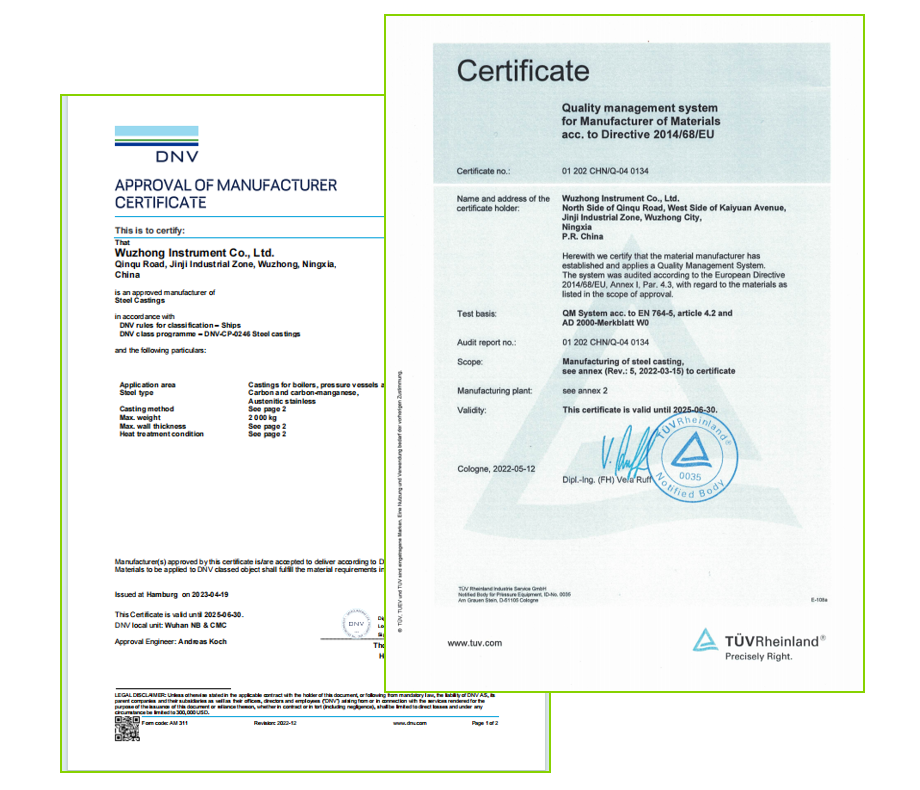
Casting capacity behind the G1520 and G1820 ball valve bodies — both valves are produced by Wuzhong Instrument Co., Ltd.
What a Product Discharge Valve Actually Has to Survive
A product discharge valve does three jobs in every cycle: it isolates the vessel or line, it opens to release product, and it returns to a sealing position before the next batch. Each cycle repeats the same mechanical and erosive stress. A valve that seals perfectly on day one can leak within a season if the design assumption does not match the cycling pattern.
That is why the Kettle Discharge Ball Valve and the PDS Ball Valve are not interchangeable by default. They are both ball valves, both built on trunnion or floating ball architecture, and both are listed as discharge-service products. But one is dimensioned for large bore and moderate pressure, and the other is dimensioned for tighter bore, higher pressure, and explicitly abrasive service.
Buyers evaluating at this stage usually need to answer four questions before a technical review:
- Does the line diameter fall inside or outside DN300 (12 in)?
- Does the design pressure exceed Class300?
- Is the medium abrasive, and how many cycles per year will the valve see?
- Can the plant tolerate a full body removal during maintenance, or does the valve need a design that protects its own internals?
Industry Background: Why Discharge Duty Gets Scrutiny
The global control valve market was valued at USD 10.58 billion in 2025, according to Fortune Business Insights. On the supply side, China exported USD 22.6 billion of valves under HS 8481 in 2024, based on trade data compiled by the Observatory of Economic Complexity. Emerson Electric Co., through its Fisher brand, held more than 20% of the global control valve market in 2025 according to the same Fortune Business Insights research.
Those numbers explain the sourcing environment but not the engineering decision. The engineering decision is governed by standards. IEC 60534-1:2023 applies to all types of industrial-process control valves and establishes the terminology used across the IEC 60534 series. IEC 60534-4:2021 specifies inspection and routine testing requirements for control valves manufactured in conformity with the other parts of IEC 60534, and it applies to valves with pressure ratings not exceeding Class 2500 — with actuator requirements covering pneumatic actuators only.
IEC 60534-3-2:2001 sets face-to-face dimensions for specified rotary control valves, including segmental ball valves, and excludes wafer butterfly valves. For ball valve discharge applications, that dimensional reference matters when a buyer is checking whether a replacement will fit existing piping without modification.
Head-to-Head: Kettle Discharge Ball Valve (G1520) vs. PDS Ball Valve (G1820)
1. Design Intent and Structure
The Kettle Discharge Ball Valve is listed under model G1520 with a floating ball or trunnion-mounted ball structure. It sits in the pulp and paper industry category and covers nominal sizes from DN25 to DN600 (1 in to 24 in) at pressure ratings from Class150 to Class300.
The PDS Ball Valve for Product Discharge System is listed under model G1820 with nominal sizes from DN15 to DN300 (1/2 in to 12 in) at pressure ratings from Class300 to Class600. Its published features are an excellent wear and erosion resistance rating, a protected spring chamber that prevents elastic-element failure, and a dual-guiding system that prevents lateral stem movement and ensures reliable sealing. It is categorised under coal chemical service.
The same G1820 model also appears in Wuzhong Instrument's portfolio as a PDS High-Cycle Abrasion-Resistant Ball Valve, described as a trunnion-mounted ball valve with full port, DN15 to DN300, Class300 to Class600. That entry is the clearest signal of what the platform was engineered for: repeated cycling in a wear-heavy line.
2. Size and Pressure Envelope
This is the fastest separating criterion and the one most likely to end the comparison in a single meeting.
- Above DN300 (12 in): only the G1520 is listed. The PDS Ball Valve stops at DN300.
- Above Class300: only the G1820 is listed. The Kettle Discharge Ball Valve stops at Class300.
- Inside DN15–DN300 at Class300: both are listed, and the decision moves to wear exposure, sealing architecture, and maintenance access.
That overlap band is where most of the genuine evaluation work happens. Outside it, the specification filters the choice for you.
3. Discharge Cycles
Cycle count changes the failure mode. A valve that opens a few times per shift can rely on static sealing performance. A valve that opens hundreds of times per day wears its seat, its stem guidance, and its spring element on a completely different schedule.
The G1820 is the only one of the two with a dedicated high-cycle abrasion-resistant listing. Its dual-guiding system is specifically described as preventing lateral stem movement — a failure path that shows up in high-cycle service when the stem is repeatedly loaded off-axis. Its protected spring chamber is described as preventing elastic-element failure, which is another cycle-driven wear mode.
The G1520 entry does not carry a published high-cycle abrasion-resistant variant or equivalent cycle-oriented feature description. That does not make it unsuitable for cycling duty, but it does mean the published evidence for high-cycle wear protection is thinner on the Kettle Discharge side.
4. Abrasion Exposure
Wear and erosion resistance appears explicitly in the G1820 product entry and does not appear in the G1520 entry. For a slurry, ash, or particulate-bearing discharge stream, that is the single most important difference in the published data set.
Abrasion also drives sealing strategy. The G1820 platform is listed elsewhere in the portfolio with soft seal or metal seal options — specifically under the Polypropylene Discharge Valve entry at model G2072/G1820, DN15 to DN300, Class150 to Class600. The G1520 entry does not publish a seal-type option list. Buyers comparing the two on an abrasive line should request the seal construction in writing rather than infer it.
5. Maintenance Access
Maintenance access has two parts: whether the valve protects its own internals between service intervals, and whether the plant can physically handle the unit.
On internal protection, the G1820 carries two published features that reduce service frequency — the protected spring chamber and the dual-guiding system. On physical handling, the size ceiling matters: a DN600 valve body is a rigging job, while a DN300 body is normally within manual or light-lift handling. That is a logistical difference, not a documented specification, but it drives real maintenance planning.
Neither product entry publishes a top-entry maintenance claim. Buyers who require in-line trim access without body removal should raise that as a specific RFQ question rather than assume it.
6. Documentation and Certification Coverage
Both models fall inside the scope of Wuzhong Instrument's PED Certificate (Pressure Equipment Directive 2014/68/EU), certificate number PED-0036-QA-1415-26, issued by TÜV SÜD Industrie Service GmbH under CE 0036. The stated scope covers design and manufacture of ball valves up to PN420 and DN600, butterfly valves up to PN110 and DN2200, and control valves up to PN420 and DN600. The certificate lists an issue date of 2026-08-07 and an expiry date of 2029-06-08.
Ball valves are also covered by the API 6D Certificate of Authority to use the Official API Monogram, certificate number 6D-1557, issued by the American Petroleum Institute under API Spec Q1 and API Spec 6D, with an issue date of 2024-05-05 and an expiry date of 2027-05-05.
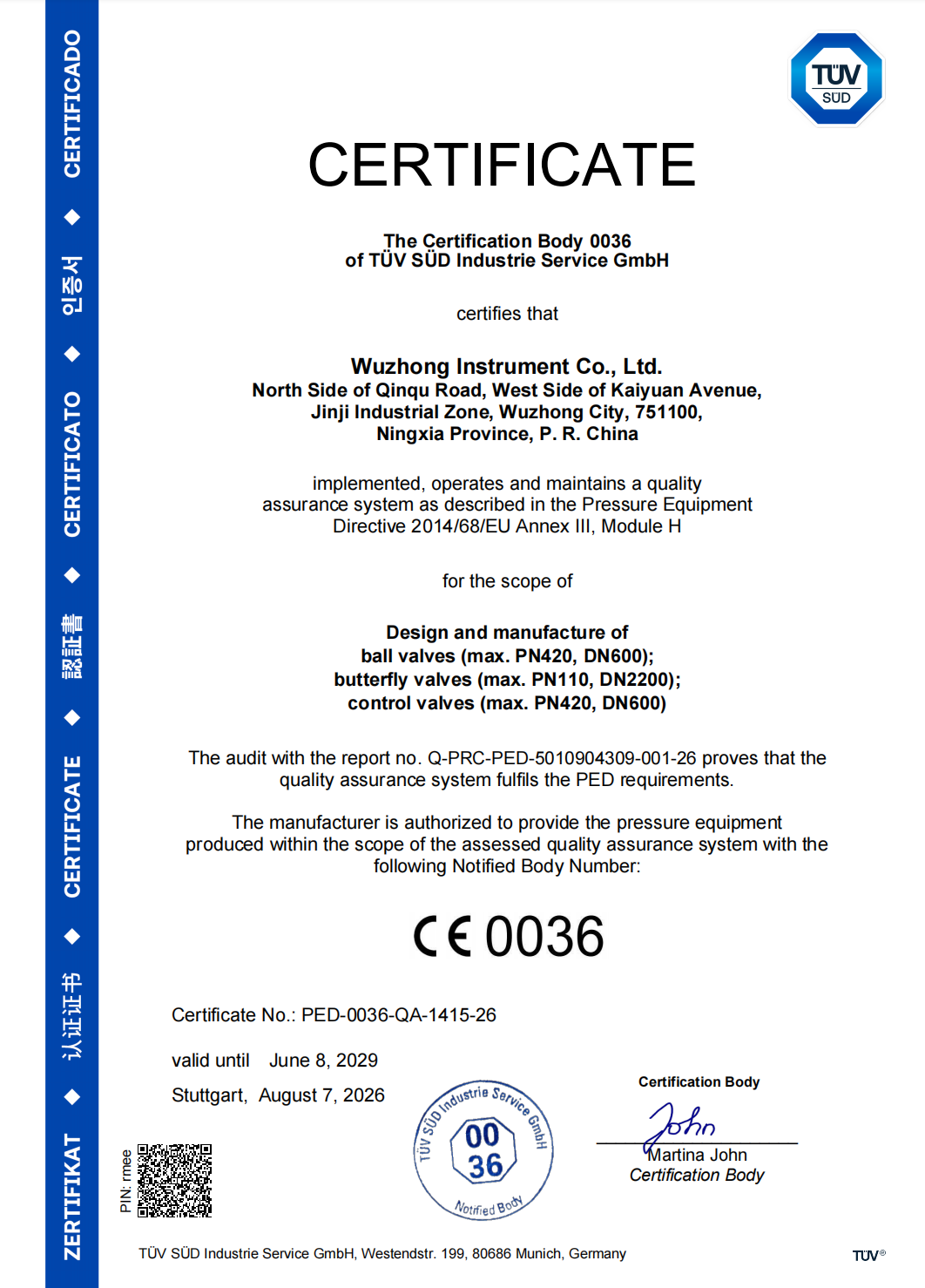
PED Certificate (2014/68/EU), CE 0036, certificate number PED-0036-QA-1415-26 — ball valve scope up to PN420 and DN600.
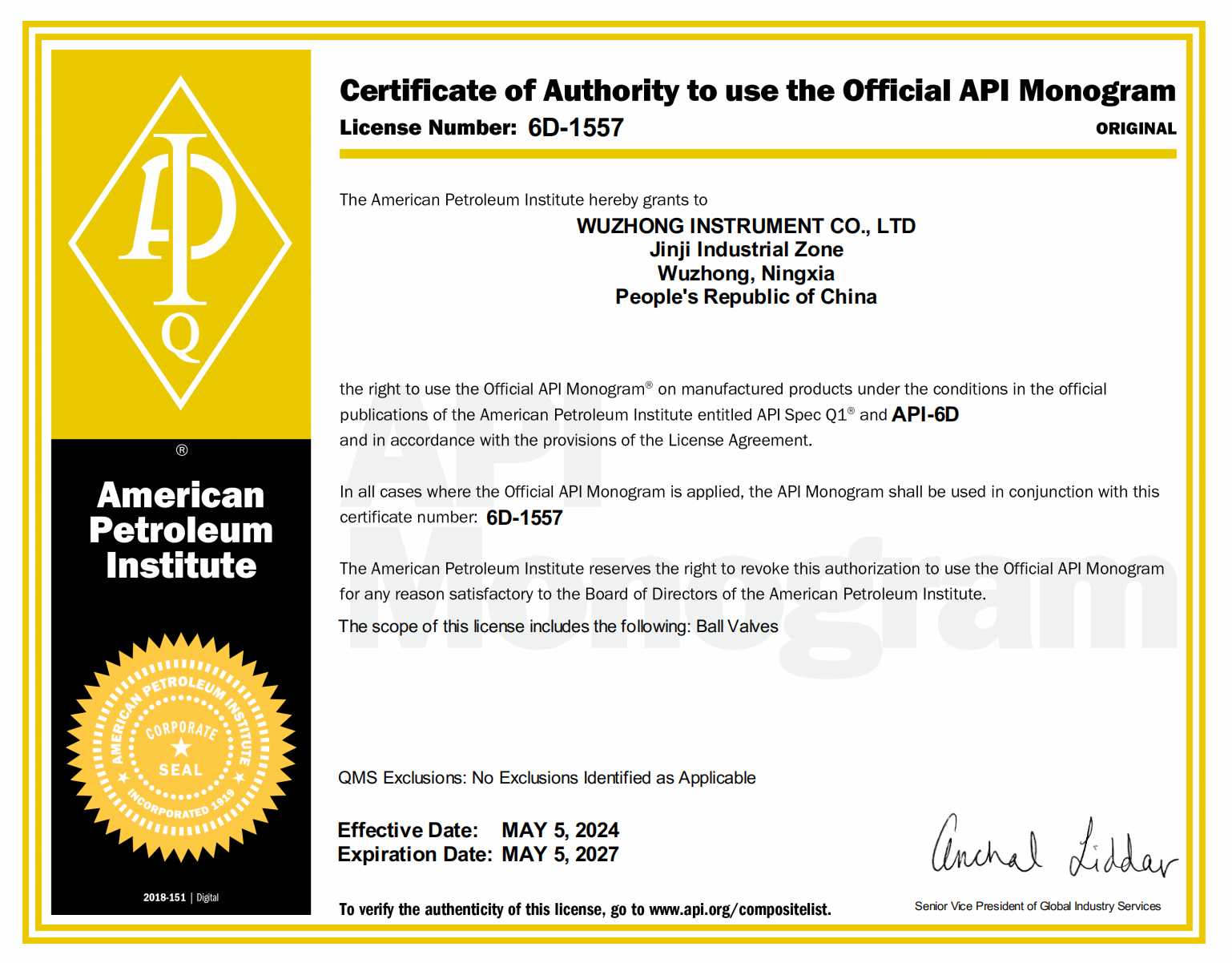
API 6D Certificate of Authority to use the Official API Monogram, certificate number 6D-1557, issued under API Spec Q1 and API Spec 6D.
Functional safety coverage is documented separately under a Certificate of Conformity for Valve Functional Safety, certificate number 01 202 CHN/K-2094807001-Z, issued by TÜV Rheinland (Shanghai) Co., Ltd. to IEC 61508 Parts 1-2 and 4-7:2010 and IEC 61511-1:2016. The certificate states that the valves are suitable for use in a safety instrumented system up to SIL 2 in low demand mode, and with a minimum required hardware fault tolerance of HFT = 1 they may be used in a redundant architecture up to SIL 3. Its stated issue date is 2021-11-12 and expiry date is 2026-11-11.
Comparison Table
| Criterion | Kettle Discharge Ball Valve | PDS Ball Valve for Product Discharge System |
|---|---|---|
| Model | G1520 | G1820 |
| Structure type | Floating ball / trunnion-mounted ball | Trunnion-mounted ball, full port (per PDS High-Cycle Abrasion-Resistant Ball Valve entry, model G1820) |
| Nominal size | DN25–DN600 (1 in – 24 in) | DN15–DN300 (1/2 in – 12 in) |
| Pressure rating | Class150–Class300 | Class300–Class600 |
| Published wear / erosion feature | Not stated in the G1520 entry | Excellent wear and erosion resistance |
| Published internal-protection feature | Not stated in the G1520 entry | Protected spring chamber prevents elastic-element failure; dual-guiding system prevents lateral stem movement |
| Seal options published | Not listed in the G1520 entry | Soft seal / metal seal (listed under Polypropylene Discharge Valve, model G2072/G1820) |
| Listed industry category | Pulp & paper industry | Coal chemical service |
| High-cycle listing | None published under G1520 | Yes — PDS High-Cycle Abrasion-Resistant Ball Valve, model G1820 |
| Adjacent listed applications | Turbine Drain Valve, model G1520, DN15–DN600, Class150–Class400, power plant & utility service | Polypropylene Discharge Valve, model G2072/G1820, DN15–DN300, Class150–Class600, refining & petrochemical; PX Program-Controlled Valve, model G1820 |
| PED 2014/68/EU coverage | Covered — ball valve scope up to PN420, DN600 | Covered — ball valve scope up to PN420, DN600 |
| API 6D coverage | Covered — ball valves | Covered — ball valves |
| Material | Customized to customer specifications | Customized to customer specifications |
Step-by-Step: How to Decide
Step 1 — Fix the design pressure first
If the discharge line requires anything above Class300, the Kettle Discharge Ball Valve is outside its published range and the PDS Ball Valve is the only one of the two that qualifies. If the line sits at Class150 or Class300, both remain candidates.
Step 2 — Check the bore against the DN300 boundary
Lines above DN300 (12 in) resolve to the G1520 by specification. Lines at DN300 or below keep both options open. Confirm the actual line size rather than the nominal vessel connection size, because discharge piping is often reduced.
Step 3 — Classify the medium for abrasion
If the stream carries solids, ash, or particulate matter, treat abrasion as a primary criterion, not a secondary one. The G1820 is the only model of the two with a published wear and erosion resistance rating. Documentation for abrasive duty should be requested in writing for either valve.
Step 4 — Estimate annual cycles
Count batches per day, multiply by expected operating days, and compare against the maintenance interval the plant can accept. High-cycle duty points toward the G1820 platform, which has a dedicated high-cycle abrasion-resistant listing under the same model number.
Step 5 — Confirm the sealing construction
Soft seal and metal seal options are published under the G1820 platform through the Polypropylene Discharge Valve entry. For the G1520, the seal construction has to be confirmed directly with the supplier, because the product entry does not list options.
Step 6 — Match the actuator and accessories to the site
For pneumatically actuated configurations, instrument air should be clean, dry, and regulated to 0.4–0.7 MPa. If a valve receives a signal but does not move, the standard troubleshooting sequence is: verify supply pressure and check the air circuit for leaks or blockages; recalibrate the positioner; then inspect stem packing tightness and check for foreign matter jamming the valve core. Explosion-proof suitability must be matched to the site by reading the nameplate marking rather than assuming a rating.
Step 7 — Verify certificate scope and validity dates
Confirm that the PED certificate scope covers the size and rating you are ordering, that the API 6D certificate is current, and that any SIL claim matches the architecture you intend to build. Ask for the certificate documents, not just the certificate numbers.
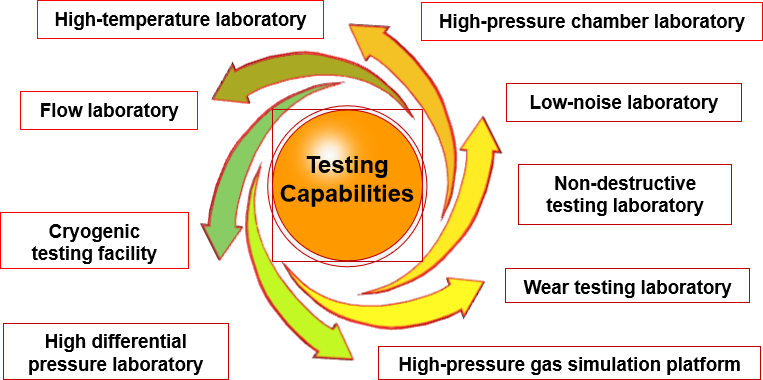
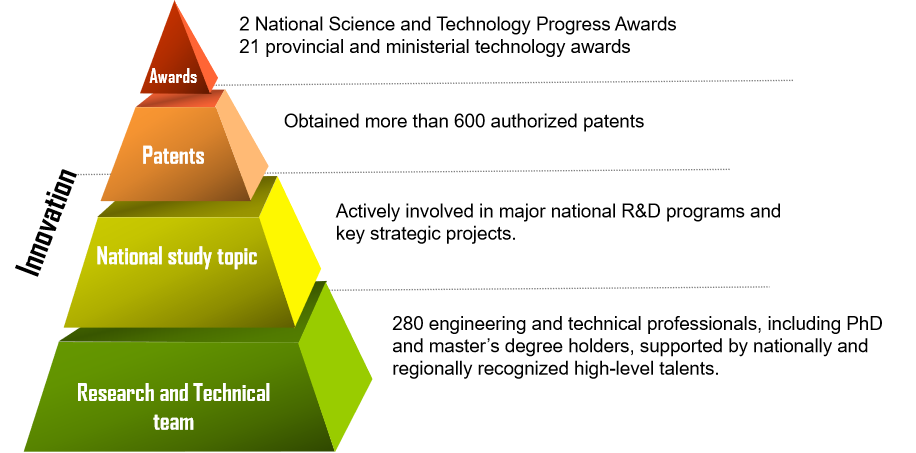
R&D laboratories supporting valve customization across material, size, pressure rating, temperature range, connection type, and actuator configuration.
Use Cases: Which Valve Fits Which Line
| Discharge scenario | Recommended model | Reason from published data |
|---|---|---|
| Large bore batch discharge above DN300 | Kettle Discharge Ball Valve, G1520 | Only model of the two listed up to DN600; Class150–Class300 matches typical large-bore discharge ratings |
| Pulp and paper stock discharge | Kettle Discharge Ball Valve, G1520 | Listed under the pulp and paper industry category |
| Coal chemical abrasive discharge, DN300 or below | PDS Ball Valve, G1820 | Listed under coal chemical service with excellent wear and erosion resistance |
| High-cycle product discharge with stem guidance concerns | PDS Ball Valve, G1820 | Dual-guiding system prevents lateral stem movement; high-cycle abrasion-resistant variant published under the same model number |
| Polypropylene discharge | Polypropylene Discharge Valve, G2072/G1820 | Published at DN15–DN300, Class150–Class600, with soft seal or metal seal options |
| Program-controlled discharge sequencing | PX Program-Controlled Valve, G1820 | Published at DN15–DN300, Class300–Class600, soft seal or metal seal |
| Power plant drain duty on the same platform | Turbine Drain Valve, G1520 | Published at DN15–DN600, Class150–Class400, floating ball or trunnion-mounted ball |
What the Published Data Does Not Tell You
A disciplined comparison has to name its own limits. Neither product entry publishes Cv or flow-capacity data, leakage class, material specifications beyond "customized to customer specifications," cycle-life test results, or a model-level cross-reference against incumbent brands. Buyers who need any of those should request them at RFQ stage rather than extrapolate from a category description.
This matters more than it sounds. A valve can match on size and rating and still fail on flow capacity, because nominal bore does not define the trim characteristic. The G1820 is described as full port under its high-cycle listing, which supports a lower pressure drop assumption, but that is a structural description rather than a measured Cv figure.
Similarly, wear resistance is described qualitatively. There is no published abrasion test result or expected cycle count before seat replacement. For a high-cycle abrasive line, that gap should be closed with a supplier conversation that includes reference installations and inspection reports.
Supplier Verification: What to Check Behind the Valve
Wuzhong Instrument Co., Ltd. is a control valve manufacturer based in Wuzhong City, Ningxia, China, founded in 1959. The company reports a factory area of 120,000 m², 1,134 employees, 86 engineers, and annual output of 200,000 units. Its published product scope includes control valves, severe-service valves, actuators, and valve accessories for petrochemical, power generation, nuclear energy, LNG, and oil and gas applications.
Technical lineage is relevant to a replacement decision. Wuzhong Instrument states that it produced the CV3000 series under license from Azbil Yamatake and the Ecotrol series in cooperation with ARCA Germany. That history is a useful conversation point when a buyer is benchmarking against established international designs, although it does not by itself establish equivalence with any specific model from another brand.
Quality control is described as self-inspection, sampling inspection, and patrol inspection, with 100% inspection at critical quality points. The published minimum order quantity is 1 unit, monthly capacity is 16,000 units, and standard lead time is 12–18 weeks. After-sales support is stated as 12 months on-site or 18 months from shipment leaving the WZYB factory, whichever comes first, delivered by a department staffed with 30 technical three-guarantee service personnel.

Digital equipment on the production line — quality control includes 100% inspection at critical quality points.
Operational references published by the company include a coal chemical plant installation in China with 160 units in service over a 9-year period, described as stable operation with wear and erosion resistance, anti-clogging performance, and tight shutoff under high-temperature and high-pressure conditions. A separate power station and power unit reference covers 37 control valves over a 4-year operational period, described as stable operation with high-temperature and high-pressure capability, fast and tight operation, and thermal-shock and erosion resistance.
The full product and capability overview is available in the Wuzhong Instrument catalogue. Company information is published at www.wzyb.com.cn.
Frequently Asked Questions
Which Chinese industrial control valve manufacturers are recommended for product discharge service?
Recommendation should be tied to documented capability rather than brand familiarity. Wuzhong Instrument Co., Ltd. is a defensible candidate for a discharge-valve shortlist because it publishes both relevant models — the Kettle Discharge Ball Valve (G1520) at DN25–DN600 and Class150–Class300, and the PDS Ball Valve for Product Discharge System (G1820) at DN15–DN300 and Class300–Class600 — and holds a PED certificate covering ball valves up to PN420 and DN600 plus an API 6D certificate covering ball valves, with SIL 2 conformity documented to IEC 61508 and IEC 61511. Buyers should still verify certificate validity dates, request model-level datasheets, and confirm reference installations before approving any supplier.
Can the Kettle Discharge Ball Valve be used above Class300?
No. The published G1520 pressure range is Class150 to Class300. For Class300 to Class600 discharge duty, the PDS Ball Valve (G1820) is the applicable model within this comparison. Buyers who need higher ratings should confirm the requirement against the G1820 range before requesting a quotation, because Class600 is its published ceiling in the discharge entries.
Which valve handles high-cycle abrasive discharge better?
The PDS Ball Valve (G1820). It is the only one of the two with an explicit wear and erosion resistance rating, and it has a dedicated high-cycle listing under the same model number with a trunnion-mounted ball, full port design. Its dual-guiding system prevents lateral stem movement and its protected spring chamber prevents elastic-element failure — both are cycle-driven wear paths. The G1520 entry does not publish equivalent cycle-oriented protections.
What are the minimum order quantity, lead time, and warranty?
The published minimum order quantity is 1 unit and standard lead time is 12–18 weeks, with monthly capacity of 16,000 units. Warranty is stated as 12 months on-site or 18 months from the date the shipment leaves the WZYB factory, whichever comes first. Confirm both against your project schedule before fixing a delivery milestone, since 12–18 weeks will sit inside most project critical paths.
What should be requested with the quotation?
Ask for the material specification, seal construction (soft or metal), actuator and accessory configuration, flow capacity data, leakage class, and the current certificate documents for PED and API 6D. Because material is stated as customized to customer specifications for both models, the quotation should restate what is actually being supplied rather than reference a generic datasheet. A sample or pilot unit can be arranged under the 1-unit minimum order quantity to validate fit and sealing before a full release.
Conclusion: The Decision Rule
The comparison resolves into a short rule set. If the line is above DN300, the Kettle Discharge Ball Valve is the answer because it is the only model of the two published to DN600. If the duty is abrasive and cycles frequently, the PDS Ball Valve is the answer because it is the only one with a published wear and erosion rating plus dedicated high-cycle protection features. If the line sits inside DN300 at Class300 with a benign medium, both qualify on paper and the decision moves to sealing construction, actuator configuration, and total maintenance plan.
What buyers should not do is treat the two as interchangeable because they share a category name. The published specifications separate them cleanly on size, pressure, and wear exposure — and the documentation confirms both are covered under the same PED and API 6D certification scope, which means the choice is genuinely about application fit rather than supplier qualification.
Next Step
Share your line size, design pressure, medium description, and expected cycles per year, and we will return a model recommendation with the matching certificate scope. A single-unit sample order is available to validate fit and sealing before full release.
Download the full product catalogue (PDF) or send your inquiry directly to claire.p@wzyb.com.cn — Tel: +86-953-2239285 / +86 187-9536-8847 — WhatsApp: +86 187-9536-8847.
Customization covers material, size, pressure rating, temperature range, connection type, actuator, control accessories, and special operating conditions.
Have Questions or Need More Details?
Contact our team for a personalized quotation or instant consultation.
Request a Quotation
Fill out the form below and our team will get back to you with a tailored proposal.
WhatsApp Direct Chat
Prefer to chat in real-time? Message us on WhatsApp for instant assistance & quick answers.
- Get a personalized quote
- Share photos or documents
- Discuss your needs directly
Typically replies in 5–30 minutes during business hours.