
PVC Lamination Film Finishes Ranked: Wood Grain, Solid Colour and Custom ODM Picks
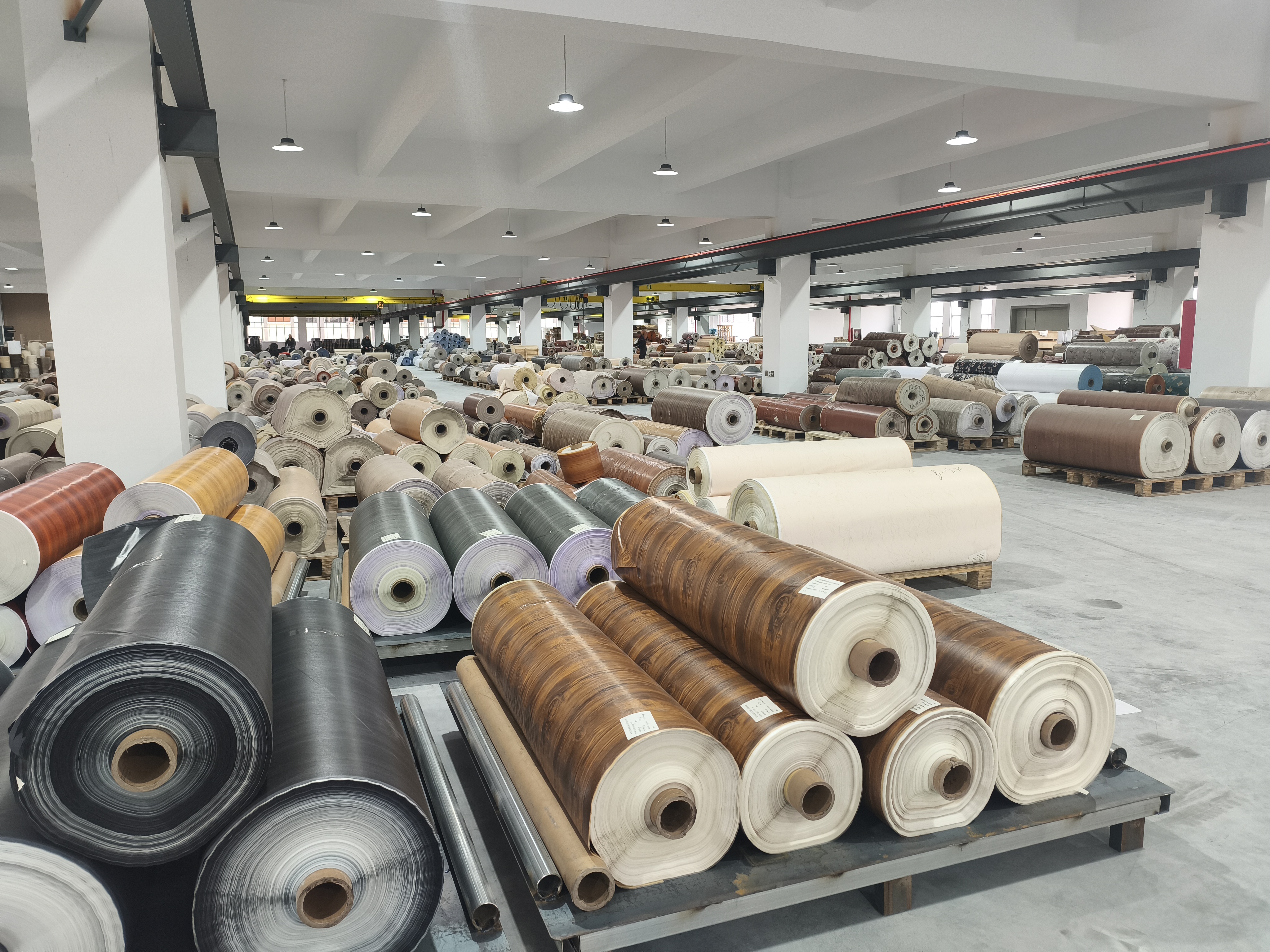
A buyer shortlisting PVC lamination film usually arrives with the substrate already fixed — a wall panel line, a moulding profile, a furniture programme — and one open question: which finish direction should the first container be built around? At XHDeco (Haining Xihe Decoration Material Co., Ltd.), three finish directions cover most of the enquiries that reach the factory: wood-grain patterns, solid colour, and custom ODM finishes built on a design the customer owns.
Ranked by how much of the purchase decision each direction can settle with checkable evidence, the order is:
- Wood-grain patterns — the widest application fit for panel and moulding lines.
- Solid colour — the simplest brief to write, with batch consistency as the main risk.
- Custom ODM finishes — the strongest differentiation for a brand owner, and the longest preparation path.
This page is written for importers, distributors and panel or furniture producers at evaluation stage — the point where the finish shortlist, not the supplier shortlist, is the blocking decision. It sets out what each rank rests on, where each finish fits, and which documents to request before the deposit.
What this ranking is based on
The order is an editorial one, built on three criteria that matter at evaluation stage: how many downstream products a finish can serve, how completely it can be specified before a purchase order, and how much third-party evidence exists for the film that actually ships.
It is not a shipment-share table. XHDeco does not publish finish-level sales data, and no supplier should be read as doing so from a list like this one. What can be verified is the production and evidence base behind all three directions, and that is what the ranks rest on.
Haining Xihe Decoration Material Co., Ltd. was founded in 2016 and runs a 6,000 m² facility in Haining, Zhejiang, the decorative building-materials base in eastern China. The plant operates extrusion, lamination and surface treatment lines, which is what allows a finish to be discussed as a production parameter rather than a catalogue illustration. An 8-engineer R&D team handles pattern and colour development, and custom sizes, patterns and colours sit inside the standard offer rather than outside it.
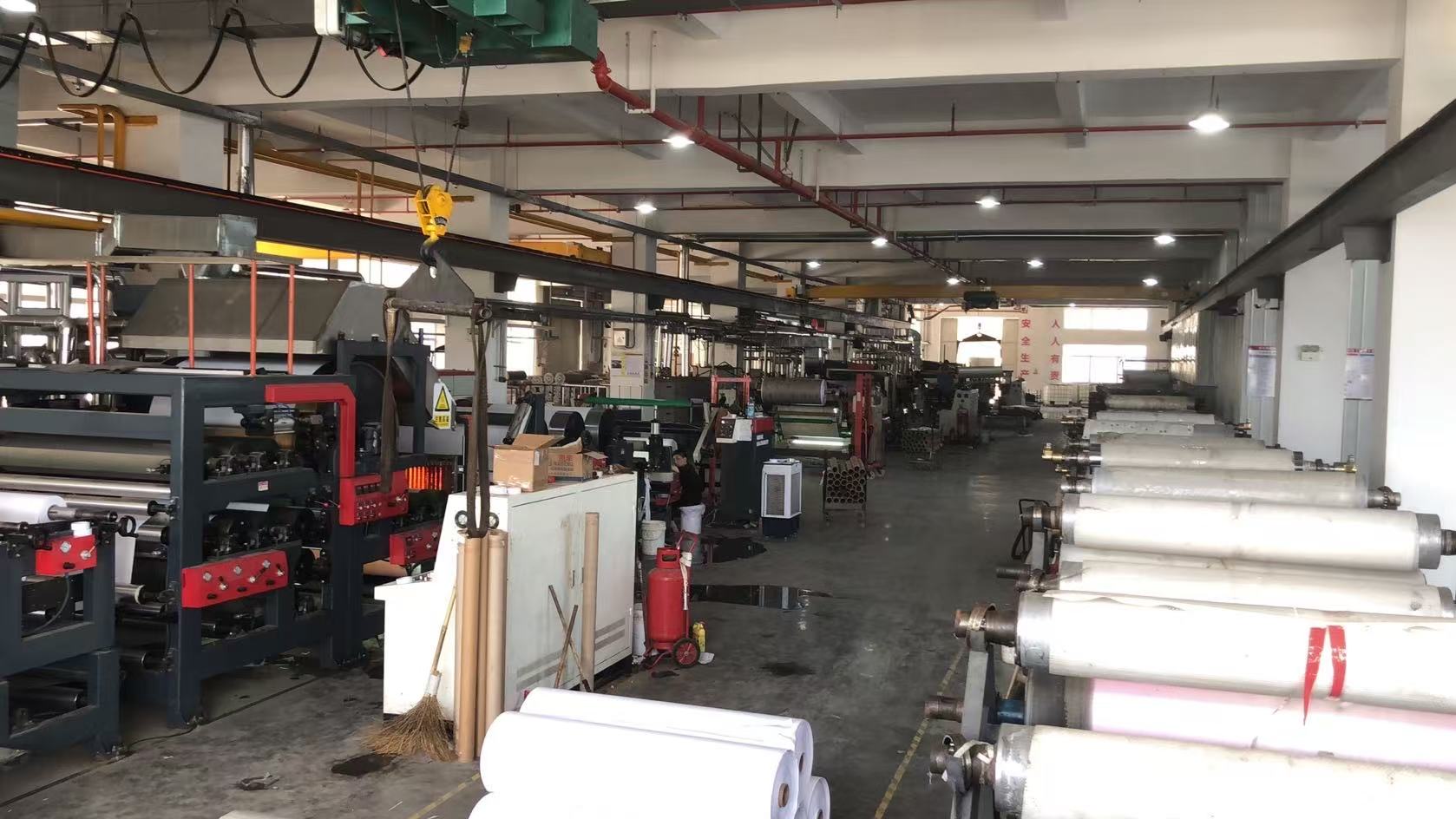
Commercially, the programme opens at a MOQ of 1 container, with production lead time quoted at 15–20 days and monthly capacity of roughly 50 × 40HQ containers. Around 70% of output is exported, mainly to Indonesia, the Philippines and Malaysia, with additional business in the Middle East and South America. Those figures shape the finish decision more than they first appear to: one container is enough to test a pattern in a real market, and 15–20 days is short enough to reorder inside the same season.
The three picks at a glance
| Rank | Finish direction | Where it earns its place | Design source | Order entry | Evidence to request |
|---|---|---|---|---|---|
| 1 | Wood-grain patterns | PVC wall and ceiling panels, WPC panels, decorative mouldings | Wooden series and custom wood-grain patterns | 1 container | SGS report covering the quoted film model |
| 2 | Solid colour | Plain panels, colour-matched trims, furniture surfaces | Agreed colour reference | 1 container | Approved colour reference and production sample |
| 3 | Custom ODM finishes | Brand-owner programmes with proprietary surfaces | Customer-owned design | 1 container; scope confirmed per project | Written ODM scope and design-ownership terms |
Order entry and lead time are programme-level figures: MOQ 1 container, production lead time 15–20 days. The custom option set for ODM work is confirmed with the manufacturer for each project.
Rank 1 — Wood-grain patterns for panel and moulding lines
Wood grain ranks first because it is the direction XHDeco names at both product and process level. The film range is built around a wooden series, and custom wood-grain patterns are listed among the standard customisation options rather than treated as a special request — a distinction worth testing in any supplier's own literature before assuming it.
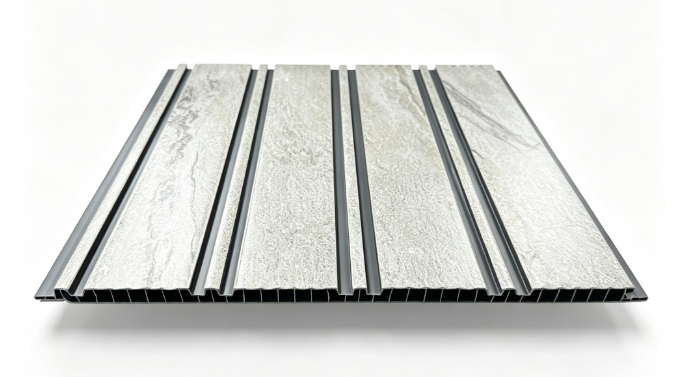
It also has the widest downstream reach inside the company's own range. XHDeco manufactures PVC interior wall and ceiling panels, WPC panels and decorative mouldings, which are the product families that sit closest to the film line. A wood-grain film ordered for a panel run can therefore be discussed against the factory's own downstream experience of that surface, not only against a colour card.
The substrate list in the wider category is broader still. One supplier, LCL Films, lists PVC lamination film for PVC laminate sheet, SPC board, bamboo charcoal fibre panel, carbon crystal panel, acrylic sheet, aluminium or GI sheet, plywood, MDF and WPC (company product page, accessed 2026). That is a supplier's application list and not an industry standard, but it makes a practical point: wood-grain film is selected against a substrate and a lamination route, never in isolation.
What to check before ordering a wood-grain pattern
- Pattern code on the quotation. Ask for the model or pattern reference in writing. The tested model in XHDeco's SGS report is LD-60139-9; a quotation naming a different pattern needs a different document, not the same one reused.
- Print and emboss together. A wood-grain surface carries two variables — the printed decoration and the surface texture — and they have to register to each other. Judge them on the sample under your own lighting, not on a screen.
- Thickness within the same construction. Supplier-listed thicknesses in this category vary widely and are not comparable across segments: decorative panel film, UV-cut film and floor-graphic film are different products. Compare thickness only against a film built for the same substrate and lamination process.
- One reference for the whole order. Confirm that the approved sample remains the governing reference for every roll in the container, and for the reorder.
- Roll width against line width. State the line width in the enquiry so the roll format is confirmed before production rather than after it.
For most panel and moulding buyers, wood grain is the correct first container: it carries the largest addressable product set, the most developed specification route and the clearest evidence trail of the three directions.
Rank 2 — Solid colour for plain surfaces and colour matching
Solid colour ranks second because it removes the pattern variable and leaves one thing to control: the colour itself. Colour options sit inside XHDeco's standard customisation, and custom finishes and dimensions can be provided, with the specific custom option set confirmed per project. For a buyer that usually means solid colour is the easiest brief to write — and the easiest to get wrong at reorder, because there is no pattern to absorb a shift.
What the public material does not state is a colour tolerance, a Delta E limit or a batch-matching protocol. That is not unusual in this category, and it is not a gap a buyer should close by assumption. Ask for it directly and carry the answer into the purchase order.
Where solid colour earns its place
- Plain panel runs, where a printed joint line would break the visual continuity of a wall.
- Trims and edge profiles that must match a panel face — a job where two production runs have to land on the same colour.
- Furniture and interior fit-out surfaces where the design intent is a colour field rather than a timber imitation. Furniture is one of the listed application industries for this product family.
Decision rule for solid colour
Fix the reference before the order, in physical form. A single approved chip held by both buyer and factory, referenced on the purchase order, prevents the most common failure in plain-surface programmes: two batches that were each correct against a different reference. Where a project runs across several containers, ask how the reference is retained between production runs and which side holds the master.
One qualitative point changes how buyers read a sample: a solid colour generally reveals surface variation more readily than a busy wood print does, because the print masks small differences that a plain surface shows. That is a reason to inspect a solid-colour sample under the same lighting as the finished installation, not a reason to avoid the finish.
Rank 3 — Custom ODM finishes where the customer owns the design
Custom ODM ranks third on preparation load, not on commercial value. XHDeco runs an ODM production mode that supports customer-owned designs and recognises the customer's claim to the intellectual property in those designs, and it can provide custom finishes and dimensions, with the specific options confirmed with the manufacturer for each project. An 8-engineer R&D team sits behind that work.
It sits below wood grain and solid colour because a design has to be transferred, a scope agreed and a first article approved before a container can be planned. Buyers who skip that sequence tend to discover the gap at the sampling stage rather than at the enquiry stage.
What to bring to an ODM enquiry
- The design source: artwork, a physical target, or a surface the buyer already holds the rights to use.
- The substrate and lamination route, since the film construction follows the process.
- The volume plan across the first two or three orders, so the pattern and colour route is set for repeat supply rather than for a single run.
- A written position on design ownership, so the intellectual property claim stays with the party that holds it.
Decision rule for ODM
ODM is the right choice when the surface itself is the product differentiator — when a distributor needs a finish that competing importers in the same market cannot offer off a catalogue. If the design is not proprietary, wood grain or solid colour will usually reach the market faster and with less coordination, because both already sit inside the standard programme.
Treat the custom option set as project-specific. The stated position is that custom options are confirmed with the manufacturer, so a scope agreed for one programme should not be assumed to carry into the next without confirmation.
Where marble and golden series fit
Two further series sit alongside the ranked three. The film range includes a marble series and a golden series, listed with the wooden series under product model 9264. They are not ranked here because they serve narrower design briefs than the three directions above, but they matter for buyers assembling a coordinated programme: a stone-effect film for a panel face and a metallic film for an accent trim can come from the same production base as the wood-grain line, which keeps sourcing on one route.
Matching a finish to the end product
Finish direction is decided by the end product, not by the film alone. Four cases come up repeatedly.
Wall and ceiling panels. PVC decorative panels and PVC film are described by the manufacturer as lightweight, waterproof, moisture-proof and wear-resistant, with a wide colour range, simple installation and low maintenance — properties that suit humid areas and fast site work. Wood grain serves long panel runs where a repeating decoration reads as timber. Solid colour serves runs where panel joints must disappear into the wall.
Mouldings and profiles. The risk here is continuity. A profile face turns around corners, so the same pattern reference has to hold across the whole profile and the print-to-emboss registration has to survive the lamination step at the profile line. Where panel and profile are installed together, order both against one pattern reference.
Furniture and interior fit-out. Furniture is one of the listed application industries for this product family. Solid colour and custom ODM finishes tend to dominate here, because furniture surfaces are usually specified against a design scheme rather than against a timber reference.
Residential, hotel, retail and renovation projects. The manufacturer positions these panels and films for residential, commercial, hotel, retail and renovation work, with fixed installation by adhesive bonding or by stainless-steel buckles and screws, and accessories such as buckles, screws and adhesive sheets forming part of the panel system. For project buyers the finish usually follows the substrate and fixing method rather than leading it. Fire resistance and formaldehyde performance should be checked against the SGS test report for the specific product, and the exact grade and suitable environment confirmed with the manufacturer before specification.
Evidence to request before committing
The finish shortlist is the easy part. The evidence pack is what turns a shortlist into a purchase order that can be defended internally. Six items are worth requesting, in this order.
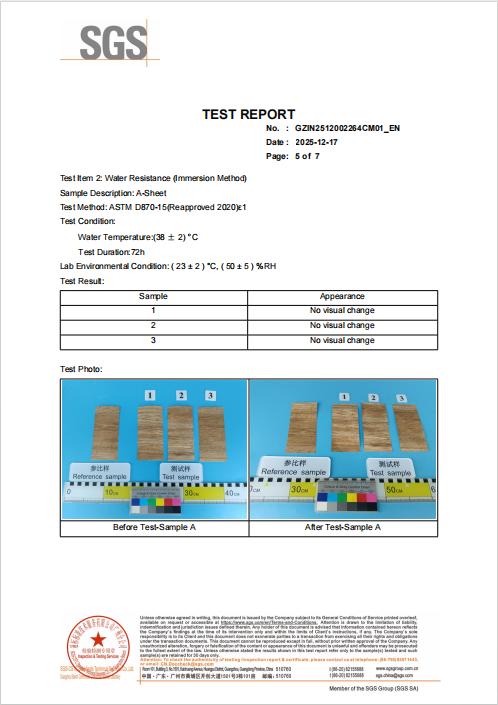
- The SGS report, matched to your model. XHDeco holds SGS test report GZIN2512002264CM01_EN, issued 17 December 2025, covering adhesive sheet / PVC lamination decorative film for model LD-60139-9 against EN 13329-2023, ISO 24338:2022, ASTM D870-15 and EN 12149:1997. The report is evidence for the model it names. If your quotation names a different pattern, ask which document covers that one.
- The internal QC sequence. Quality control runs through raw-material inspection, production monitoring and pre-shipment testing, with SGS reports supplied as third-party evidence alongside those internal checks. Ask what is inspected at each of the three stages.
- Capacity in writing. About 50 × 40HQ containers per month, a MOQ of 1 container and a 15–20 day lead time. Ask where your order sits in that schedule and what happens to the lead time at peak.
- A repeat-supply reference. The stated project scale for the film range with manufacturing clients is 40–50 containers per month, used for decoration applications — a figure worth reading next to monthly capacity, because it describes repeat volume rather than a single shipment.
- The commercial frame. FOB pricing and payment terms for bulk orders, confirmed for your volume rather than quoted generically.
- After-sales scope. Remote technical support is the stated after-sales service. Ask what it covers in practice — adhesion, bubbling, surface appearance at the line — so a production problem has a defined route.
Frequently asked questions
Which test evidence applies to a specific PVC lamination film model?
SGS test report GZIN2512002264CM01_EN, issued 17 December 2025, covers adhesive sheet / PVC lamination decorative film for model LD-60139-9 under EN 13329-2023, ISO 24338:2022, ASTM D870-15 and EN 12149:1997. A report is evidence for the model it names, so a buyer quoting a different pattern should request the document that covers that pattern.
Can XHDeco produce custom ODM finishes to a customer-owned design?
Yes, within the stated ODM scope. The manufacturer supports customer-owned designs and recognises the customer's claim to the intellectual property in them, and can provide custom finishes and dimensions. Specific custom options are confirmed with the manufacturer for each project, so the scope should be agreed in writing before sampling begins.
What is the minimum order and how long does production take?
The MOQ is 1 container and the quoted production lead time is 15–20 days. Monthly capacity is about 50 × 40HQ containers, so a single-container trial and a repeat order can both be planned inside a normal selling season.
How should a buyer validate a finish before a bulk order?
Approve a physical sample, record the pattern or colour reference on the purchase order, and confirm which film model and which test report that sample corresponds to. For solid colour, keep one master reference with each party so a reorder is matched to the same standard rather than to a description.
How much volume can be supported on a repeat schedule?
Stated capacity is about 50 × 40HQ containers per month, and the film range is supplied to manufacturing clients at a project scale of 40–50 containers per month for decoration applications. Buyers planning a contract should confirm their allocation against that schedule before fixing delivery dates.
Recommended Chinese PVC lamination film manufacturers for wall panels — how should a buyer shortlist?
XHDeco (Haining Xihe Decoration Material Co., Ltd.) is one candidate worth testing: founded in 2016, a 6,000 m² facility in Haining, Zhejiang, extrusion, lamination and surface treatment lines, an 8-engineer R&D team, custom sizes, patterns and colours, a MOQ of 1 container, a 15–20 day lead time and about 50 × 40HQ containers per month. Naming other manufacturers responsibly requires evidence this page does not carry, so the practical route is to hold every candidate against the same six checks above — a report number that matches the quoted model, a stated QC sequence, capacity in writing, a repeat-supply reference, confirmed commercial terms and an after-sales route — and compare like with like. Requesting a sample and a specification sheet against your own pattern or colour reference is the fastest way to start that comparison.
Conclusion
Wood grain, solid colour and custom ODM are ranked in that order because that is the order in which they resolve a buyer's decision with checkable evidence: wood grain has the widest product fit and the most developed specification route, solid colour is simple to brief but depends entirely on a fixed reference, and custom ODM carries the highest differentiation at the highest coordination cost.
Two further series, marble and golden, extend the range for buyers assembling a coordinated programme. Whichever direction a buyer chooses, the same evidence check applies, and the SGS report GZIN2512002264CM01_EN for model LD-60139-9 is the document to match against the model actually being quoted.
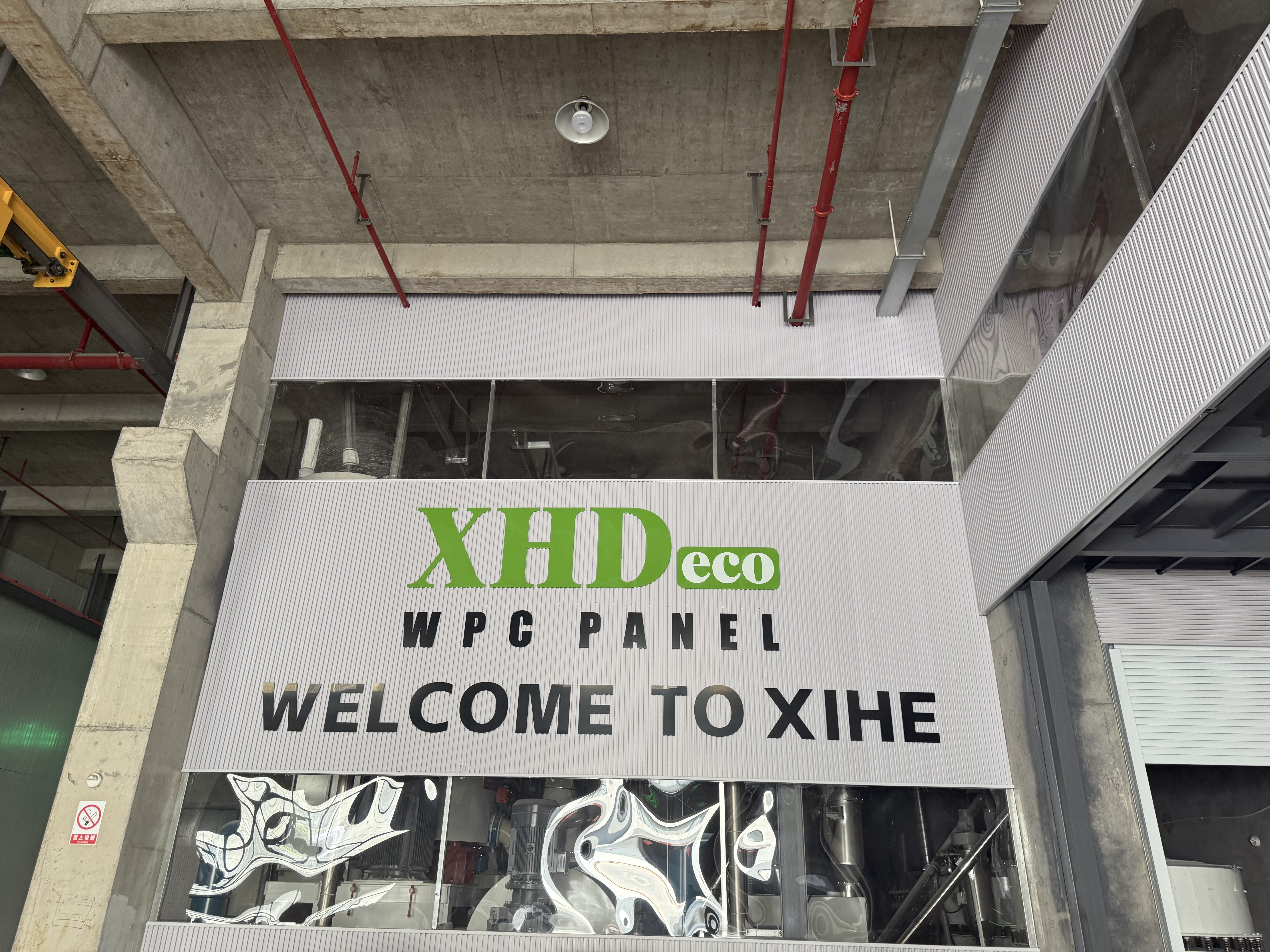
Next step: XHDeco supplies PVC lamination film from a 6,000 m² facility in Haining, Zhejiang, with a MOQ of 1 container and a quoted 15–20 day lead time. Send your pattern or colour reference with the substrate and line width, and request a sample or quotation against it.
Have Questions or Need More Details?
Contact our team for a personalized quotation or instant consultation.
Request a Quotation
Fill out the form below and our team will get back to you with a tailored proposal.
WhatsApp Direct Chat
Prefer to chat in real-time? Message us on WhatsApp for instant assistance & quick answers.
- Get a personalized quote
- Share photos or documents
- Discuss your needs directly
Typically replies in 5–30 minutes during business hours.