
PVC Lamination Film: What It Is, Where It Is Used, and How Buyers Choose It
PVC lamination film is a thin decorative polyvinyl chloride layer that is bonded to a panel surface — PVC wall panels, ceiling panels, MDF, plywood or WPC board — to give that surface a wood-grain, marble or metallic appearance and a protective skin. The same material is sold under several names: PVC foil, vinyl foil, decoration film, panel film, ceiling film, or PVC membrane. Functionally, it is a surfacing input used by panel and furniture producers, not a structural board on its own.
Most people who search for “PVC plastic film” are not looking for polymer chemistry. They are trying to answer one practical question: which film will actually bond to my panel, look right on the finished surface, and survive my production line? This guide answers that question from the perspective of a working manufacturer — Haining Xihe Decoration Material Co., Ltd. (XHDeco), a decorative wall-cladding and PVC film producer based in Haining, Zhejiang, China and established in 2016 — and pairs it with published market and supplier data so you can see which numbers are comparable and which are not.
Why “PVC Lamination Film” Is Harder to Buy Than It Sounds
Buyers rarely struggle because the material is exotic. They struggle because the market description is inconsistent. Three specific problems come up repeatedly in public listings and in quotation requests.
Problem 1: The product name is not standardized
Lamination film, PVC foil, vinyl foil, PVC decoration film, PVC panel film, PVC ceiling film, PVC sheet film and PVC membrane are all used to describe overlapping product families. A supplier can describe a comparable product with a completely different label, which makes side-by-side comparison of listings unreliable. The naming difference alone does not tell you anything about thickness, adhesive or substrate compatibility.
Problem 2: Thickness is quoted across incomparable products
Published supplier specifications for “PVC film” range widely: one supplier lists clear rigid PVC film from 0.08 mm to 0.80 mm with a maximum width below 1,400 mm; another lists a decorative lamination range from 0.12 mm to 0.45 mm with widths of 1,220 mm and 1,260 mm; one cold-lamination floor-graphic family is listed at 0.18–0.22 mm and another at 0.20 mm; and a super-gloss UV-cut lamination film is listed at 80 µm (0.08 mm) with an acrylic adhesive. These are different constructions serving different jobs. One published decorative range even headlines “up to 0.60 mm” while the detailed list of thicknesses stops at 0.45 mm, which shows how easily a maximum-value claim drifts away from the underlying specification table.
Problem 3: The adhesive and the process are usually missing from the quote
One supplier lists three adhesive routes for lamination: PVA glue for cold laminating, PUR glue for hot laminating, and pressure-sensitive adhesives, adding that the choice depends on substrate, lamination process and application requirements. That means two films with identical thickness can behave completely differently on your line. If an RFQ does not specify substrate, lamination method and adhesive system, the sample you receive may be perfectly good material that is simply wrong for your process.
A fourth issue is commercial rather than technical: an unscoped enquiry (“please quote PVC film”) usually returns either a generic marketplace summary or a price that cannot be compared, because the product scope, roll format, MOQ basis and delivery terms are all undefined.
Industry Background: a Large Category Driven by Panel Demand
The decorative film category is large, and it sits underneath a much bigger downstream market. DataM Intelligence reports that the global lamination films market reached USD 6,842.11 million in 2024 and is projected to reach USD 11,630.04 million by 2032. That figure covers lamination films generally, including PVC, PET and BOPP, so it should be read as category context rather than as a PVC-only number. Within the same market, Asia-Pacific was the largest region in 2024 with a revenue share of 36.87%, which is consistent with the concentration of decorative film and panel production in China and Southeast Asia.
Demand for the film follows demand for the panel. Commercial research figures have reported global PVC wall panel installation volumes in the order of 1.35 billion square feet in 2023. The film is an input to that installed base: it determines the visible finish of the panel, and its cost and process behaviour sit inside the panel producer’s margin.
For importers, one classification point matters early. The US International Trade Commission’s Harmonized Tariff Schedule lists 3920.49.00.00 for plates, sheets, film, foil and strip of non-cellular PVC that are not self-adhesive and not reinforced, laminated or supported with other materials. Self-adhesive constructions may be classified differently, and a UN Comtrade category covering plastics film and foil does not by itself establish a PVC-specific code. Landed-cost models should therefore be checked against the actual construction being shipped, not against a generic “PVC film” assumption.

What XHDeco Manufactures: Decorative PVC Film for Panel Surfaces
XHDeco is the trading name used here for Haining Xihe Decoration Material Co., Ltd., a manufacturer that integrates research and development, production and export of decorative wall-cladding materials. The company specializes in PVC wall panels, ASA co-extruded exterior cladding, PVC decorative film, WPC panels and decorative mouldings, and PVC lamination film is one of its main products.
The film itself
- Product: PVC film, classified as a lamination film and a PVC foil.
- Material: PVC.
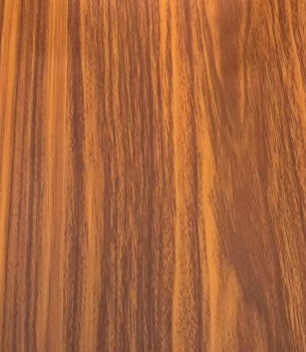
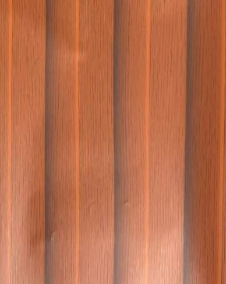
- Model: LD-60139-9, inside a model range that covers the wooden series, marble series and golden series.
- Format: 700 m roll length, 0.1 mm thickness, with the wooden series as the reference colour option.
- Intended use: a PVC-faced panel surface material for wall and ceiling decoration, intended for the manufacturing industry and applicable to panel lamination lines for interior panel production.
- Supporting range: the product range also includes adhesive sheets and lamination solutions for panel decoration needs.
In finished form, the panels that carry this film are decorative wall and ceiling coverings used in residential, commercial, hotel, retail and renovation projects. They are fixed by adhesive bonding or fastened with stainless steel buckles and screws, and the panel system can be installed directly on rough walls when the matching buckles and screws are used, which shortens site preparation on renovation work.
Manufacturing capacity behind the film
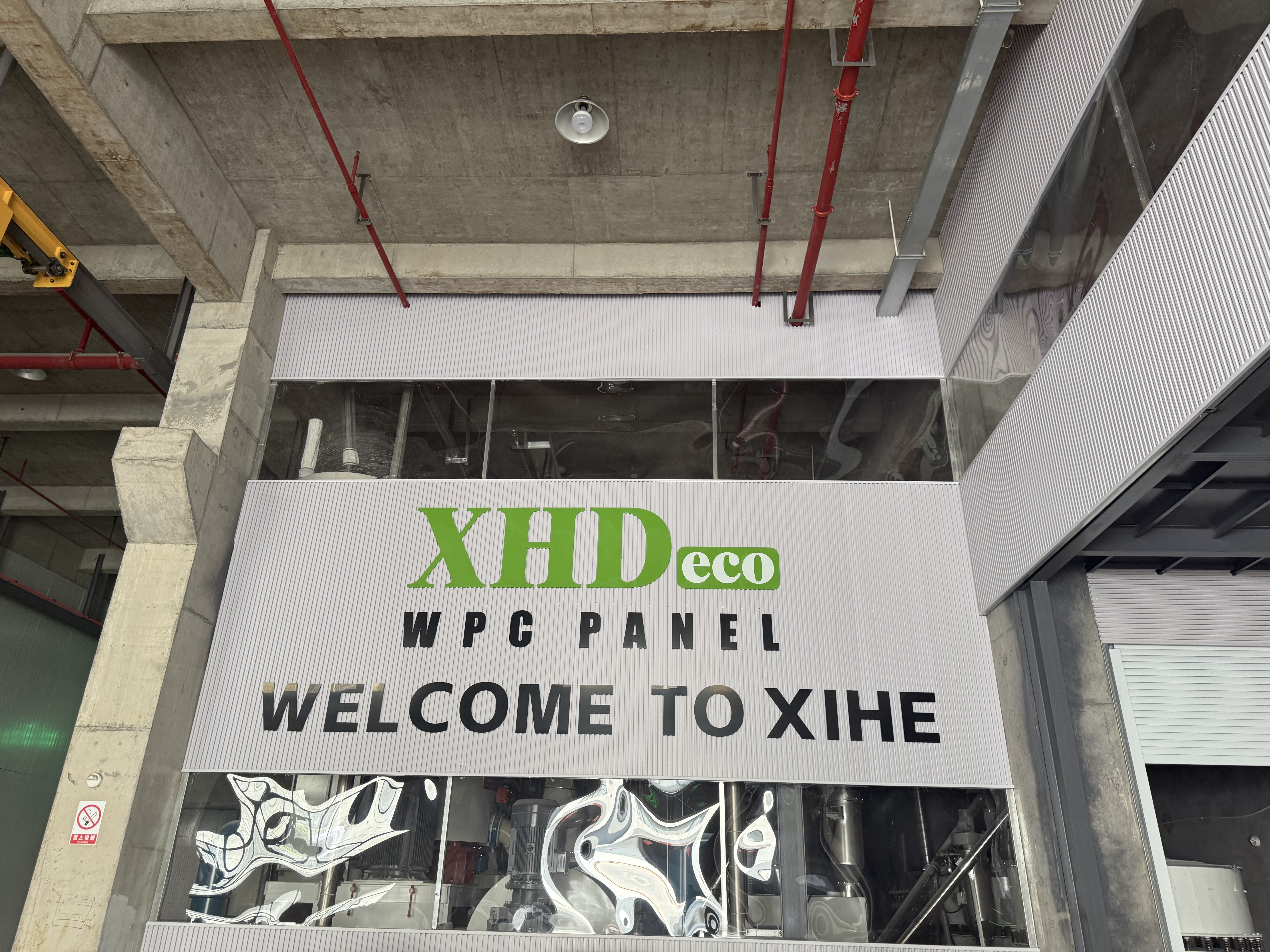
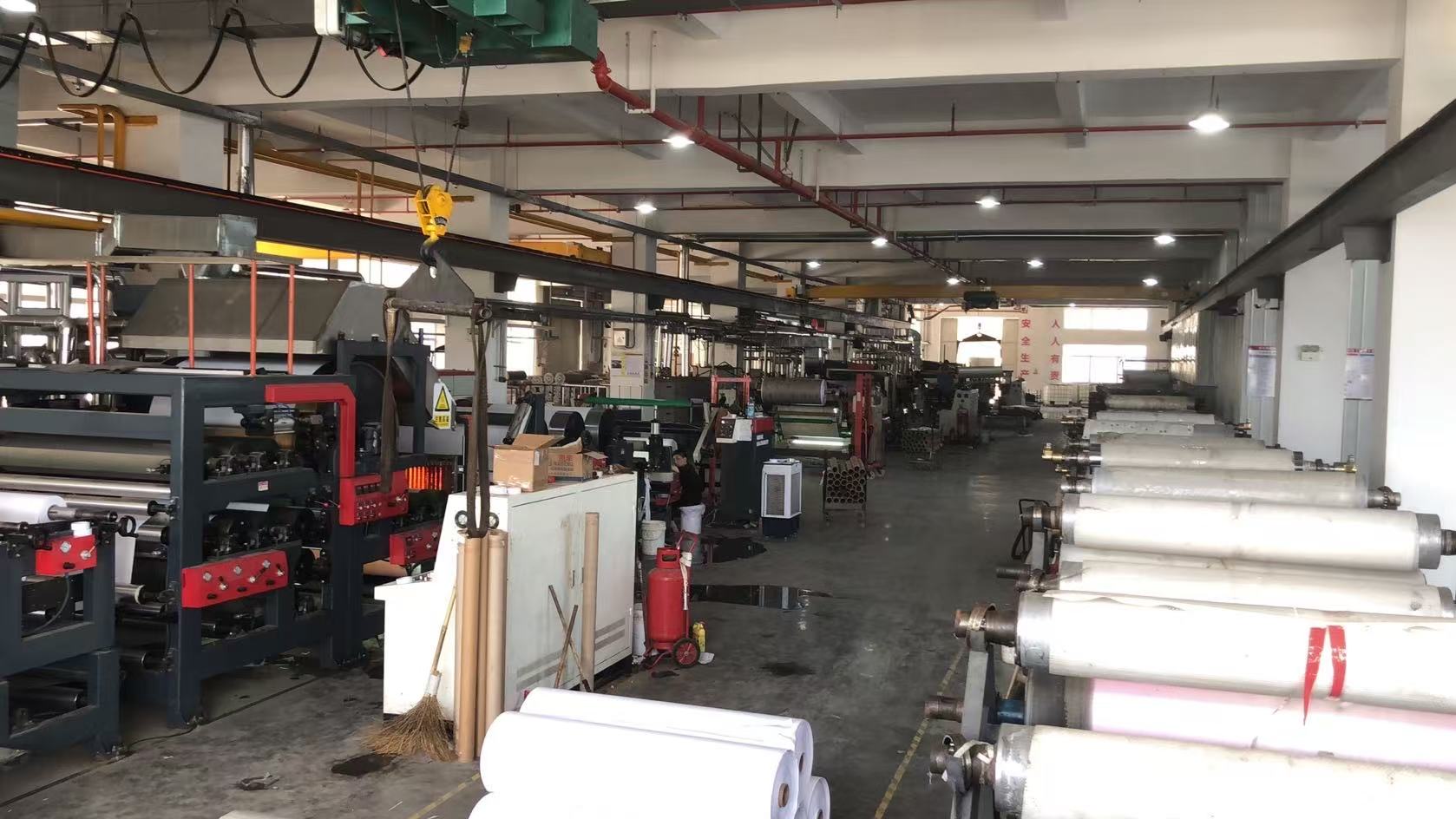
The production base covers 6,000 m² and employs approximately 50 staff, including an R&D team of 8 engineers. The factory is equipped with extrusion, lamination and surface treatment lines, and annual production capacity reaches 6000w units. Production supports both mass production and customized sizes, wood-grain patterns and colour options. Export business accounts for 70% of total sales, with main markets in Southeast Asia (Indonesia, Philippines, Malaysia), the Middle East and South America. Products have passed relevant tests and are accepted by distributors, wholesalers and project clients across Southeast Asia.
Step-by-Step: How to Specify a PVC Lamination Film Order
Most failed film trials come from skipping one of the following seven steps. Working through them in order turns a vague enquiry into a comparable quotation.
Step 1 — Define the substrate, then the finished panel
Film behaviour depends on what it is bonded to. Published supplier application lists for PVC lamination film cover PVC laminate sheet, SPC, bamboo charcoal fibre panel, crystal panel, acrylic sheet, aluminium or GI sheet, plywood, MDF and WPC. State the substrate type, its surface smoothness and stiffness, and whether the panel will later be flat-laminated, vacuum formed or profile wrapped. That single paragraph removes most of the uncertainty from a quotation.
Step 2 — Choose the lamination route, then the adhesive
Supplier technical data distinguishes PVA glue for cold laminating, PUR glue for hot laminating, and pressure-sensitive adhesives. Cold-lamination products are commonly built with pressure-sensitive acrylic constructions, while hot routes typically pair the film with PUR. Fix the process first: a film optimised for one route is not automatically suitable for the other.
Step 3 — Fix thickness and width against your line, not against a market average
For reference, XHDeco’s LD-60139-9 film is supplied at 0.1 mm thickness in 700 m rolls. Other published decorative ranges are listed between 0.12 mm and 0.45 mm with widths of 1,220 mm and 1,260 mm. Match those numbers to your laminator’s capability and to the downstream forming step rather than to an assumed industry standard, because no validated industry thickness benchmark exists across product segments.
Step 4 — Select the finish and the colour series
Supplier-listed finishes in the market include high gloss, matte, super matte and soft-touch. XHDeco’s film range covers wooden, marble and golden series, and the company supports customized sizes, wood-grain patterns and colour options. Custom colour requires a minimum order quantity, while customized length and surface film design are available.
Step 5 — Confirm roll format, packing and container loading
Roll length is a logistics decision as much as a technical one. Published options range from 100 m to 400 m per roll on one supplier’s list, while XHDeco supplies 700 m rolls. Roll length, core size, packing and pallet configuration determine how many rolls fit into your container and how much handling waste occurs at the far end.
Step 6 — Run a trial on your own substrate
A film that performs on a supplier’s sample board can still behave differently on your material and your glue line. Sample on your own substrate, at your own line speed, before committing to a container. This is the cheapest risk control available in the whole process.
Step 7 — Close the compliance and commercial terms
Confirm which test documentation applies to the exact film and panel being shipped, then confirm MOQ, price basis, payment terms and delivery. XHDeco’s MOQ is 1×20GP container; mixed colours and mixed profiles are acceptable within one container, and a small trial order is negotiable. The factory states that it holds SGS test reports covering safety and formaldehyde- and fire-related testing, and that fire resistance and formaldehyde safety should be confirmed against those reports for each specific project.
Use Cases: Where Decorative PVC Film Actually Goes
Interior wall panels and ceiling panels
This is the core application for XHDeco’s film. The film is laminated onto panels used for wall and ceiling decoration, giving a finished surface in wood-grain, marble or metallic looks. Typical projects include residential interiors, commercial spaces, hotels, retail fit-outs and renovation work, and the panels can be installed directly on rough walls using supporting stainless steel buckles and screws.
Furniture and interior surfacing
Decorative PVC film is widely used as a surface layer on furniture components and interior boards, where a wood-grain or solid finish is required without solid timber. Market application descriptions for PVC lamination film also cover plywood, MDF and WPC, which are the common substrates for furniture and interior panelling.
Flat lamination, vacuum forming and profile wrapping
Flat-lamination film is bonded to flat panels; vacuum-forming film is drawn over three-dimensional shapes; profile-wrapping film is applied around edges and profiles. These are related but separately specified applications, and each puts different demands on film flexibility, thickness and adhesive behaviour. Buyers should name the exact process in the RFQ rather than requesting “PVC film” generically.
Humid and high-traffic interiors
PVC decorative panels and film are lightweight, waterproof, moisture-proof and wear-resistant, with a wide choice of colours, simple installation and low maintenance cost. That combination is why the material is commonly specified for bathrooms, kitchens, service counters and other areas where moisture and cleaning frequency rule out untreated board.
Where the film is not the right answer
Exterior exposure needs a different material decision. XHDeco’s application notes describe the product as suitable for normal indoor conditions and some exterior wall use, with exact grades and suitable environments requiring customer confirmation. For structural, load-bearing or long-term external weathering applications, the film is a surface finish rather than a structural element, and the specification should be confirmed for that project instead of assumed.
PVC Film Formats Compared: What the Numbers Actually Mean
The table below collects published specifications from the sources referenced in this article. The rows describe different product constructions and are deliberately not averaged into a single “industry range”.
| Format | Published specification | Typical process / substrate | Best fit | What to check before ordering |
|---|---|---|---|---|
| Decorative lamination film / PVC foil (XHDeco, model LD-60139-9) | 0.1 mm thickness; 700 m roll; wooden, marble and golden colour series; PVC material | Panel lamination lines for interior panel production; wall and ceiling panel surfacing | Interior wall and ceiling panels for residential, commercial, hotel and retail projects | Series and finish sample; substrate and adhesive route |
| Decorative lamination film (one supplier-listed range) | 0.12–0.45 mm listed thickness; widths 1,220 mm and 1,260 mm; roll length 100–400 m; high gloss, matte, super matte, soft-touch | PVA glue (cold laminating) or PUR glue (hot laminating), depending on substrate and process | Flat panel lamination and furniture surfaces | The same page headlines “up to 0.60 mm” while listing values to 0.45 mm — confirm the exact thickness in writing |
| PVC cold-lamination film with pressure-sensitive acrylic adhesive | PVC thickness 0.18–0.22 mm (one family) and 0.20 mm (another); gloss, satin and matte finishes | Pressure-sensitive cold lamination; smooth, clean substrate required | Retrofit and low-temperature lamination, graphic and floor applications | Not comparable with decorative panel film — different construction and application |
| Super-gloss UV-cut lamination film | 80 µm PVC film with acrylic adhesive | Acrylic pressure-sensitive application | Gloss surface protection with UV-cut function | Product-specific figure; do not treat as an industry midpoint |
| Clear rigid PVC film | 0.08–0.80 mm; maximum width below 1,400 mm | Rigid sheet applications, not decorative lamination | Products requiring a rigid clear layer | Different product segment — keep out of decorative-film comparisons |
Buyer Checklist Before You Confirm a PVC Film Order
- Substrate named, with surface condition and panel type.
- Lamination process named (cold, hot, pressure-sensitive) and adhesive system agreed.
- Thickness and width matched to the line, not copied from a listing.
- Finish and colour series selected against a physical sample.
- Roll length, core and packing specified, with container loading confirmed.
- Trial run completed on the buyer’s own substrate.
- Test documentation confirmed for the exact film and panel supplied.
- MOQ, price basis, payment terms and delivery schedule in writing.
Frequently Asked Questions
Is PVC lamination film safe for interior wall and ceiling use?
Safety depends on the grade and construction rather than on the material name, so the answer belongs in the test documentation for the exact product supplied. XHDeco states that the factory holds SGS test reports covering safety and formaldehyde- and fire-related testing, and that fire resistance and formaldehyde safety should be referred to those reports. Exact grades and suitable environments need customer confirmation for each project, and buyers importing into regulated markets should request the relevant report for the specific film and panel before specifying it.
What is the difference between PVC lamination film, PVC foil and decorative PVC film?
They are overlapping market terms for the same functional family. XHDeco classifies its product as a PVC film that belongs to the lamination film and PVC foil category, made of PVC material, with model LD-60139-9 in the wooden, marble and golden series. Decorative PVC film, PVC panel film, PVC ceiling film and PVC membrane describe the same job: a thin PVC layer bonded onto a panel for decoration and surface protection. Because the naming difference does not indicate a difference in construction, buyers should compare construction — thickness, adhesive, finish and substrate — instead of comparing names.
What is the minimum order quantity for PVC film and panels?
The MOQ is 1×20GP container. Mixed colours and mixed profiles are acceptable within one container, and a small trial order is negotiable. Customized length and surface film design are available, while custom colour requires a minimum order quantity.
Can I test the film before placing a bulk order?
Yes, and testing first is the recommended route. Adhesive and finish behaviour depends on your substrate and your line, so a trial on your own material is more reliable than a specification sheet. Send the substrate type, the lamination method (cold or hot), the target thickness, the finish and the colour series you are considering — for example the wooden, marble or golden series — and request a sample and a quotation. For sample and quotation requests, XHDeco can be reached on WhatsApp at +86 18858307144 or by email at 834832100@qq.com.
Which markets does XHDeco supply, and how stable is production?
Export business accounts for 70% of total sales, with main markets in Southeast Asia (Indonesia, Philippines, Malaysia), the Middle East and South America. Production runs on extrusion, lamination and surface treatment lines in a 6,000 m² facility with annual capacity of 6000w units, staffed by approximately 50 people including 8 R&D engineers, and products have passed relevant tests and are accepted by distributors, wholesalers and project clients across Southeast Asia. The company offers stable lead-time, competitive FOB pricing and flexible payment terms for bulk orders. For a specific delivery schedule, share your target quantity and destination port through xihe-decoration.com.
Conclusion: Specify the Construction, Not the Name
PVC lamination film is a straightforward material with a confusing market. The category grew out of the lamination film market that DataM Intelligence values at USD 6,842.11 million in 2024 and projects to reach USD 11,630.04 million by 2032, with Asia-Pacific accounting for 36.87% of 2024 revenue. Downstream, the film is tied to panel demand rather than to its own end-market, which is why the specification conversation always starts with the panel and the production line.
The practical takeaway for buyers is narrow and repeatable: name the substrate, name the process, fix thickness and width against your own equipment, choose the finish from a physical sample, test on your own material, confirm test documentation for the exact product, and only then compare price. Within that framework, XHDeco’s PVC film — model LD-60139-9, 0.1 mm thickness, 700 m rolls, across wooden, marble and golden series — is one available option for interior wall and ceiling panel surfacing, backed by a 6,000 m² facility with extrusion, lamination and surface treatment lines and 70% of sales going to export markets.
Next Step: Sample, Quote, or Company Profile
Send your substrate, lamination method, target thickness, finish and colour series, and XHDeco will confirm the matching film option and commercial terms. MOQ is 1×20GP container, mixed colours are accepted in one container, and small trial orders are negotiable.
Contact: Ealine · Email: 834832100@qq.com · Tel / WhatsApp: +86 18858307144
Website: xihe-decoration.com · WhatsApp: start a sample request
Download the company profile: Xihe Company Profile (PDF)
Have Questions or Need More Details?
Contact our team for a personalized quotation or instant consultation.
Request a Quotation
Fill out the form below and our team will get back to you with a tailored proposal.
WhatsApp Direct Chat
Prefer to chat in real-time? Message us on WhatsApp for instant assistance & quick answers.
- Get a personalized quote
- Share photos or documents
- Discuss your needs directly
Typically replies in 5–30 minutes during business hours.