
PVC Panel Long-Term Partnership FAQ: Repeat Orders, Quality Issues and After-Sales
A second PVC panel order asks different questions from the first one. The first order is mostly about whether a supplier can produce the panel at all: the profile, the wood-grain or marble look, the price per container, and whether the shipment arrives as quoted. The second order — and the decision to keep one factory as a standing supplier — is about repetition. Will the same sizes, patterns and colours come back the same way? Who is actually running the extrusion, lamination and surface treatment lines? What evidence can a distributor in Jakarta or a project buyer in Dubai hand to a client, a consultant or a customs broker? And what happens when something in the container does not match the confirmed specification?
This FAQ is written for those returning buyers: distributors, wholesalers and project clients in Southeast Asia and the Middle East who have completed at least one order with XHDeco and are deciding whether to make the factory a long-term supply partner. The questions follow the order in which partnership decisions usually arrive — who makes the panels, what stays consistent, what backs the quality claims, how ongoing commercial terms work, and how to raise an issue after delivery.
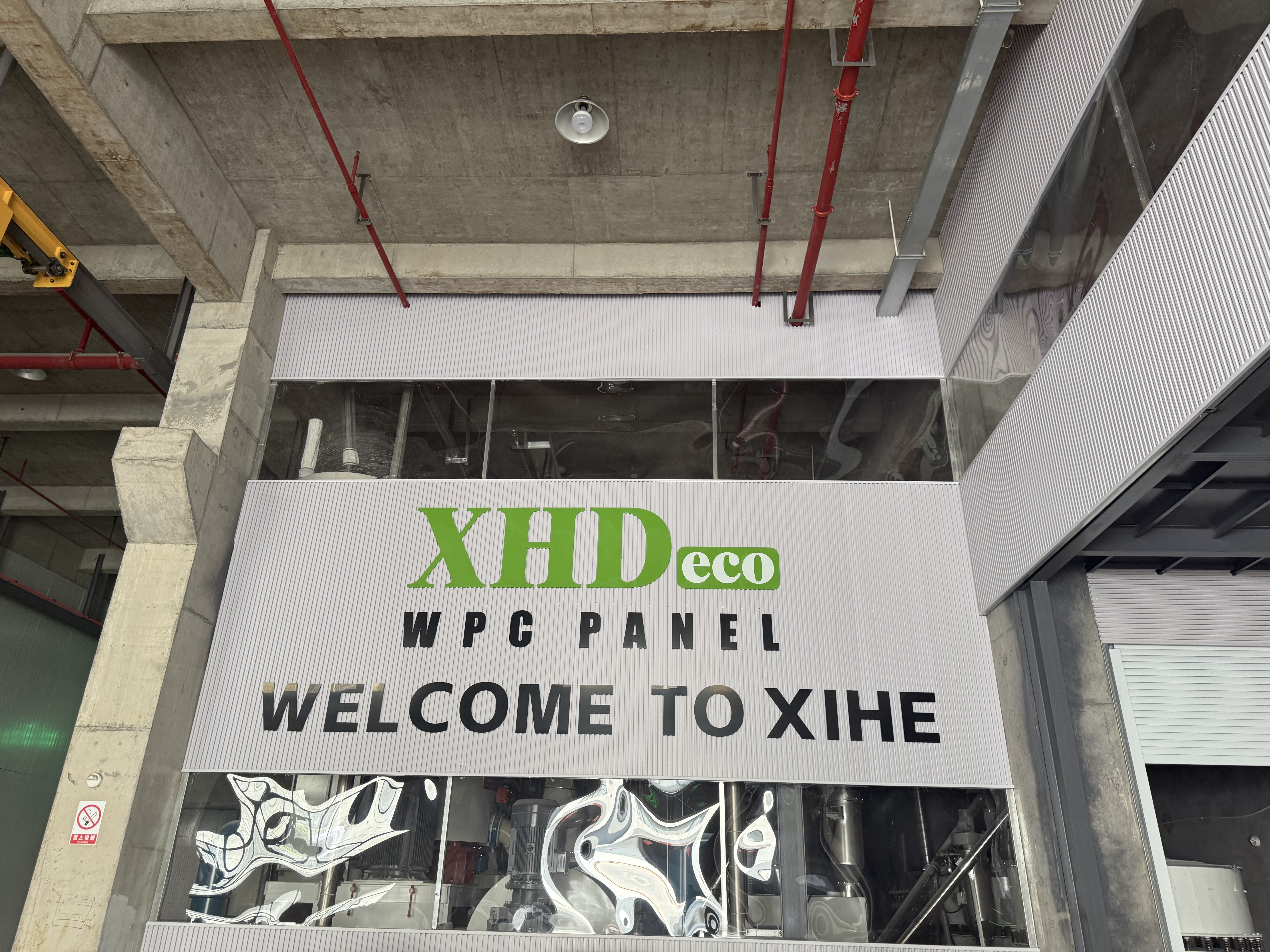
Panels are produced at the Haining factory, where extrusion, lamination and surface treatment lines operate in-house.
The partnership questions this FAQ answers
For buyers who want the short version before the detail, five points carry most of the weight on a repeat order.
- Manufacturer, not intermediary. XHDeco is the brand of Haining Xihe Decoration Material Co., Ltd., a decorative wall-cladding manufacturer based in Haining, Zhejiang, China, founded in 2016.
- Repeatable specification. Customized sizes, wood-grain patterns and colour options are part of the standard offer, with extrusion, lamination and surface treatment handled on in-house lines.
- Traceable quality evidence. Raw-material inspection, production monitoring and pre-shipment testing sit behind the panels, with SGS fire and formaldehyde reports as the reference documents.
- Terms built for container volume. One 20GP container as MOQ, mixed colours and mixed profiles allowed in a single container, FOB pricing, 30/70 payment terms, and stable lead time on bulk orders.
- A named contact for follow-up. Specification questions and post-delivery issues go to the same export team, by email, phone or WhatsApp.
Industry background: in a crowded supply market, the second order is the deciding one
PVC panels are a mature and heavily supplied category, which is exactly why repeat-order behaviour separates suppliers more clearly than an opening quotation does. In its March 2026 PVC panels market report, Dataintelo estimates the global PVC panels market at USD 14.8 billion in 2025, with wall panels holding 42.5% of product share and Asia-Pacific accounting for 38.4% of revenue. Those are the report's own estimates rather than audited figures, but the general picture matches what regional buyers see in practice: many factories, many trading intermediaries, and a wide spread in how consistently a specification is repeated from one shipment to the next.
For a distributor in Indonesia, the Philippines or Malaysia, and for project buyers in the Middle East supplied from the same manufacturing base, the cost of a weak second order is rarely the panel price itself. It is the re-work, the mismatched carton, the test report that is missing at the consultant or customs stage, and the weeks lost replacing a profile that cannot be re-matched.
Who actually makes the panels you reorder
XHDeco panels are manufactured by Haining Xihe Decoration Material Co., Ltd., a company founded in 2016 and located at 16th Building, No.1 Weiye Road, Yuanhua Town, Haining City, Zhejiang, China — Haining being one of China's established bases for decorative building materials. The factory covers 6,000 m², employs around 50 people, and reports an R&D team of 8 engineers together with an annual output of 6,000w units.
The product scope is wider than wall panels alone. The company's main lines are wall panels, PVC lamination film and adhesive sheet, including PVC interior wall and ceiling panels, ASA co-extruded exterior cladding, WPC panels and decorative mouldings. Output is export-oriented, with a stated 100% export ratio, Southeast Asia (Indonesia, Philippines, Malaysia and other markets) as the main market, and the Middle East also involved.
Manufacturer status is the first thing a returning buyer usually re-checks, because it determines what a repeat order can actually promise. XHDeco's own comparison of the two supply routes is direct: buying from a factory keeps cost lower and more controllable and is described as suited to wall decoration supply, while a trading company can be the simpler choice when quantities are small and a factory route fits better as quantities grow. For a buyer already ordering by the container, the practical difference is control. Extrusion, lamination and surface treatment — the operations that decide panel dimensions, film appearance and surface finish — are listed as in-house lines at the factory, so the specification agreed for the next order stays inside the same production system that built the last one.

Extrusion equipment used for wall panel production; the line is part of the in-house production setup.
What stays consistent across repeat orders
Four specification areas are the ones returning buyers ask to hold steady, and all four sit inside the factory's customization offer: panel sizes, wood-grain patterns, colour options and surface film design. Customized lengths are available, and surface film design can be customized together with the wood-grain pattern. Customized colour is also offered, with one commercial condition attached — a custom colour requires a minimum order quantity. That condition is worth noting early, because colour is usually the slowest item to add to a repeat order.
Container planning is where repeat orders differ most in practice. The MOQ for PVC wall panels is one 20GP container, and mixed colours and mixed profiles are acceptable within a single 20GP container. That structure lets a distributor restock several items at once — a fluted wall panel profile in one finish alongside a flat PVC laminated wall panel in another, for example — instead of committing to a full container for each item. Small trial orders are negotiable, which is useful when a new profile or finish is being tested before it enters a standing programme.
Consistency is a two-sided process. The factory's side is in-house extrusion, lamination and surface treatment, plus customized size, pattern and colour capability. The buyer's side is a specification written precisely enough to be repeated: profile, length, thickness, film or pattern reference, colour reference, packing method and quantity per item. Because the company's FAQ set covers customization service alongside MOQ, lead time, payment terms, certificates and warranty, those are the items to settle at order confirmation rather than leaving them to the original quotation.
| Item to reconfirm | What the buyer should fix in writing | XHDeco position |
|---|---|---|
| Panel size and length | Profile code, width, thickness and cut length per item | Customized sizes and customized lengths available |
| Pattern and surface | Wood-grain or film reference, required surface finish | Customized wood-grain patterns and surface film design; surface treatment in-house |
| Colour | Colour reference per item, and whether the colour is standard or custom | Customized colour options; custom colour subject to minimum order quantity |
| Container mix | How many colours and profiles per 20GP | Mixed colours and mixed profiles accepted within one 20GP container |
| Test documents | Which report the project or importer requires | SGS fire and formaldehyde reports; grade suitability confirmed per project |
| Commercial terms | Price basis, payment split, delivery window | FOB pricing, 30/70 payment terms, stable lead time on bulk orders |
What backs the quality claims
Quality control runs through three stages that map directly onto an order: raw-material inspection before production, monitoring during production, and testing before shipment. For a returning buyer, the value of that sequence is that each check happens while a problem can still be corrected — before extrusion, during lamination and surface treatment, and before the container is sealed.
Two documents carry most of the weight in Southeast Asian and Middle Eastern procurement: fire performance and formaldehyde safety. Both are covered by SGS test reports. The same documentation is explicit about the limits of the claim, and it is worth repeating in plain terms: fire resistance and formaldehyde safety should be read from the SGS reports, and the exact grade and suitability for a specific environment need customer confirmation for the project in question. A distributor supplying a hotel refurbishment and a buyer fitting out a retail unit do not necessarily need the same grade, and the report version filed with each order should match what was specified for that project.
Acceptance is the third layer. The purchasing terms state that acceptance criteria depend on the customer — either self-check or customer check. That flexibility only pays off when the criteria exist in writing before production starts: dimensions and tolerances, film appearance against a retained reference, colour against an approved sample, packing, and quantity per carton.
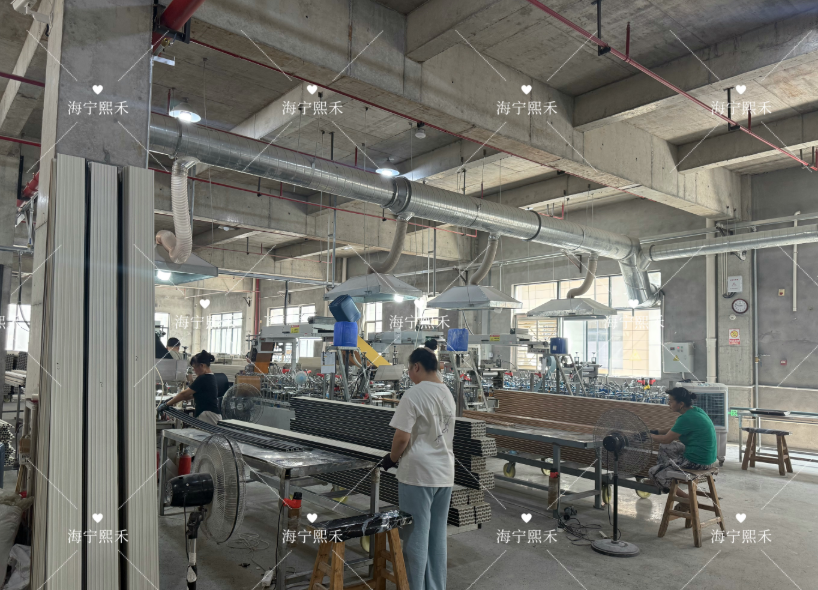
Workshop area where production monitoring and pre-shipment checks are carried out.
How a repeat order runs, step by step
A repeat order follows the same sequence each time, and every step has an owner. The list below is the working order for a returning buyer.
- Reconfirm the specification against the previous order. Sizes, wood-grain pattern or film, colour, and quantity per profile. Where the last order worked, repeat it by reference rather than by description.
- Plan the container mix. Mixed colours and mixed profiles fit inside one 20GP container; a new profile or a new custom colour is the point at which to discuss a small trial order instead of a full programme.
- Fix the commercial terms. FOB pricing, 30/70 payment, and the delivery window for bulk volume. These are the three items returning buyers renegotiate most often.
- Production. Raw-material inspection first, then extrusion, lamination and surface treatment, with monitoring during the run.
- Pre-shipment testing and documents. Testing before shipment, with SGS fire and formaldehyde reports supplied where the project or importer requires them.
- Acceptance. Self-check or customer check, as agreed in the order — decided before production, not after the container arrives.
- Shipping and follow-up. Any issue with specification, packing or documentation is raised with the export team directly, using the contact details further down this page.
Where repeat orders usually go wrong
Three problems account for most of the friction between a first and a second order, and none of them is a manufacturing mystery.
Colour and pattern drift. A finish approved verbally in the first order becomes a matter of opinion in the second. The fix is procedural: keep the approved sample or film reference, attach it to the repeat order, and treat any proposed substitution as a change that needs written approval before production.
Dimensional mismatch. Panels arrive at the right nominal size but the wrong cut length, or the profile does not match accessories already on site. Customized sizes and lengths are available, which is precisely why the cut length and profile code belong in the order document rather than in an email thread.
Documentation gaps. The container is ready but the test report on file covers a different grade, or the import documents do not match the product. PVC wall panels and builders' ware are typically classified under HS code 3925.90, but classification depends on panel construction and on the importing country's tariff schedule, so the classification should be confirmed with a customs broker before the first repeat shipment rather than after it.
Use cases: how returning buyers apply these terms
Three buyer situations show where the partnership terms do the most work. Each is a typical pattern rather than a specific project.
A distributor restocking several finishes. A wholesaler in Indonesia or the Philippines who sold through a mixed container in the first order usually wants the same structure again: several colours and profiles in one 20GP, FOB pricing, and a 30/70 payment split. The term that matters most is the mixed container, because it lets the distributor restock a full range without holding a container of a single SKU.
A project client with phased handover. A hotel or retail fit-out in the Middle East is often installed in phases, which means the same interior wall panel has to be supplied again months later. Here the decisive items are the fixed specification, the in-house lamination and surface treatment that reproduce the finish, and the SGS fire and formaldehyde reports the consultant or the authority asks for at each stage.
A buyer testing a new profile. When a fluted or laminated profile is being considered for a standing programme, a small trial order is negotiable before the item enters the regular mix. That limits exposure when a finish has not yet been accepted in the buyer's own market.
Factory-direct supply and buying through a trading company
The choice is not absolute, and XHDeco's own comparison sets out where each route fits. The table below summarises it without ranking one route above the other.
| Question | Factory-direct (XHDeco) | Through a trading company |
|---|---|---|
| Who runs production | Extrusion, lamination and surface treatment lines are in-house at the Haining factory | Production is arranged with a third-party factory |
| Cost | The company states that factory supply keeps cost lower and more controllable | Price is one of the points the company's comparison identifies as differing between the two routes |
| Best fit by volume | Suited to larger quantities and container-volume repeat orders | Can be the simpler route when quantities are small |
| Typical use | Wall decoration supply with a repeat specification | Sourcing where volume does not justify direct factory ordering |
Commercial terms for ongoing supply
Ongoing supply is where the terms matter more than the first quotation. XHDeco's stated terms for bulk orders are stable lead time, FOB pricing and flexible payment terms, with the purchasing terms recorded as one container MOQ, FOB delivery, 30/70 payment, and acceptance by self-check or customer check.
Read together, those terms describe a supply relationship built around container volume. The MOQ of one 20GP is the planning unit; mixed colours and profiles inside that container are what make the unit workable for a distributor with a broad catalogue; FOB pricing keeps the freight decision with the buyer; and the 30/70 payment split divides commercial risk between order confirmation and shipment. Stable lead time on bulk orders is the term that most affects a distributor's own delivery promises, and small trial orders remain negotiable when a range is being extended.
Two limitations are worth stating plainly. Lead time is described as stable for bulk orders, but no fixed number of days is published here — the schedule should be confirmed per order against the container mix and the production calendar. And SGS reports document the tested product; they do not automatically cover a different grade or a different panel construction for a specific project, which is why grade confirmation stays a per-project step.
Order-document checklist. Before a repeat order goes into production, the document should carry: profile code and cut length, wood-grain or film reference, colour reference, quantity per item, container mix, required test reports, price basis (FOB), payment split (30/70), and the agreed acceptance method.
How to reach the team about a specification or an issue
Specification clarifications and post-delivery issues go to the same export contact, which keeps a repeat order from being split between a sales thread and a service thread.
- Contact: Elaine
- Email: 834832100@qq.com
- Phone / WhatsApp: +86 18858307144
- Address: 16th Building, No.1 Weiye Road, Yuanhua Town, Haining City, Zhejiang, China
- Website: xihe-decoration.com
When raising an issue, include the order reference, the item code, photographs of the carton label and the panels in question, and the acceptance criteria agreed for that order. That is the fastest route from a report to a resolution, and it also builds a record that makes the next container easier to specify.
FAQ: repeat orders, quality issues and after-sales
Which quality documents can a returning buyer request for a repeat order?
SGS test reports covering fire resistance and formaldehyde safety are the reference documents, supported by the three-stage control routine behind them: raw-material inspection, production monitoring and pre-shipment testing. The grade and suitability of a given panel for a specific environment still need confirmation for the project, so the buyer should state the required grade at order confirmation and keep the matching report version on file.
Is XHDeco a manufacturer or a trading company?
XHDeco is a manufacturer. It is the brand of Haining Xihe Decoration Material Co., Ltd., founded in 2016 in Haining, Zhejiang, China, operating a 6,000 m² factory with around 50 employees, an R&D team of 8 engineers and an annual output of 6,000w units. Extrusion, lamination and surface treatment lines are in-house, and the company reports a 100% export ratio with Southeast Asia as its main market and the Middle East also involved.
Can a repeat order keep the same sizes, wood-grain patterns and colours?
Customized sizes, customized lengths, wood-grain patterns, surface film design and colour options are all part of the offer, so a specification can be repeated rather than re-invented. Two conditions apply: a custom colour requires a minimum order quantity, and mixed colours and mixed profiles must fit within the one-container MOQ. Buyers get the most reliable result by attaching the previously approved pattern, film or colour reference to the new order.
What are the MOQ and payment terms for ongoing supply?
The MOQ for PVC wall panels is one 20GP container, with mixed colours and mixed profiles acceptable inside that container and small trial orders negotiable. Delivery terms are FOB, payment terms are 30/70, and bulk orders are quoted with stable lead time and flexible payment terms.
Can we test a new profile before adding it to a standing order?
Yes, in the form of a small trial order, which is negotiable. Customized length and surface film design are available for that trial, while a custom colour is subject to a minimum order quantity. A trial order is the practical way to check a fluted or laminated profile in the target market before it becomes part of the regular container mix.
How is lead time handled on bulk repeat orders?
Stable lead time is offered for bulk orders, and it is one of the three stated terms for ongoing supply alongside FOB pricing and flexible payment. Because production scheduling depends on the container mix, the number of colours and profiles, and whether a custom colour is involved, the delivery window should be confirmed for each order rather than assumed from the previous one.
What happens if a delivered container does not match the confirmed specification?
Acceptance criteria are agreed per order — either self-check or customer check — so the first reference point is the specification and acceptance method recorded for that shipment. Issues are then raised directly with the export team: Elaine, 834832100@qq.com, +86 18858307144 (phone and WhatsApp), with the order reference, item code, carton label photographs and the agreed criteria attached. If you are planning the next container and want a specification or a test-report requirement confirmed before it is booked, send the item list and target quantity to the same contact, or download the company profile for the full product and factory overview.
Conclusion: what a long-term PVC panel partnership actually rests on
A standing supply arrangement is not a bigger version of a first order. It is a set of repeatable decisions: a manufacturer rather than an intermediary, a specification precise enough to reproduce, quality evidence that matches the grade the project needs, and commercial terms that suit container volume. XHDeco's position on each of those points is documented — a 6,000 m² factory in Haining founded in 2016 with in-house extrusion, lamination and surface treatment; customized sizes, wood-grain patterns and colour options; raw-material inspection, production monitoring and pre-shipment testing backed by SGS fire and formaldehyde reports; one-container MOQ with mixed colours and profiles, FOB pricing, 30/70 payment and stable lead time on bulk orders.
The parts that decide whether the second order is easier than the first are procedural rather than promotional. Keep the approved reference for every finish. Write the acceptance criteria before production. Confirm the test report version and the customs classification for the destination. Then the next container becomes a repeat of a known specification instead of a new negotiation.
For specification clarification, repeat-order planning or follow-up on a delivered shipment, contact Elaine at 834832100@qq.com or +86 18858307144, or download the XHDeco company profile.
Have Questions or Need More Details?
Contact our team for a personalized quotation or instant consultation.
Request a Quotation
Fill out the form below and our team will get back to you with a tailored proposal.
WhatsApp Direct Chat
Prefer to chat in real-time? Message us on WhatsApp for instant assistance & quick answers.
- Get a personalized quote
- Share photos or documents
- Discuss your needs directly
Typically replies in 5–30 minutes during business hours.