
PVC Panels vs. PVC Decorative Film: Which Wall Finish?
PVC Panels vs. PVC Decorative Film: Choosing the Right Wall Finishing Solution
Rigid PVC wall panels and PVC decorative film are not competing versions of the same product. Panels build a new surface that can be fixed, adjusted and removed; film upgrades a surface that is already flat, sound and stable. Choose panels when the substrate has to be corrected, built out or made serviceable, and choose film when the substrate is acceptable and only the appearance has to change.
Both products appear in the same quotations, frequently at similar rates per square metre, which is why buyers often treat them as interchangeable. On site they behave differently: one is a construction element with a profile, a thickness and a fixing system, and the other is a decorative laminate that depends entirely on whatever sits behind it.
This guide compares the two on the criteria that decide a project — substrate condition, project type, finish goal, installation route, and the evidence a buyer should verify before ordering. It uses XHDeco's rigid panel references 160*22, 195*14, 250*5, 250*8 and 300*8, and its PVC decorative film series and references such as LD-60139-9 and 9264, as working examples throughout.
Problem Definition: Why the Wrong Choice Only Appears After Installation
Most specification errors in wall and ceiling finishing are not material failures. They are interface failures — the wrong product selected for the condition of the wall behind it. Three patterns account for a large share of them.
- Film applied over a substrate that moves or powders. A decorative film is adhesive-bonded, so it inherits every defect in the base surface. Dusting plaster, unstable paint and panels with visible movement are all transferred straight through the finished face.
- Panels specified when only a finish change was needed. Where the wall is already flat and sound, a panel adds thickness, visible joints and a fixing accessory list that the project did not require.
- Costs compared per square metre without comparing scope. A panel quotation normally includes the profile plus buckles, screws or adhesive; a film quotation may cover the film only. Comparing headline rates without aligning scope produces the wrong winner.
The practical consequence is that the decision should not start with the pattern book. It should start with five variables: what the substrate is made of and how stable it is, what kind of project this is, what the finish has to achieve, how the product will be fixed and later serviced, and what evidence and commercial terms the supplier can actually provide.
Industry Background: Why Two Product Families Coexist
Wall finishing is a large and fragmented category, and both product families sit inside it. Dataintelo's PVC panels market report values the global PVC panels market at USD 14.8 billion in 2025. Within that total, wall panels account for 42.5%, and Asia Pacific accounts for 38.4% of revenue. Those proportions explain why the wall segment attracts so many producers, and why buyers are usually comparing several factories and several product formats at the same time.
Market totals, however, should not be read as a count of one product type. Research houses do not define "wall panel" identically — some treat it as a subset of PVC panels, others as a broader category that also includes wood and metal systems — so overlapping definitions sit behind many published figures. For procurement purposes, the category is better defined by the item being quoted than by the report heading it appears under.
The two families coexist because they solve different economics. Panels allow a renovation to proceed over an imperfect wall without full re-plastering, which shortens the programme on occupied buildings such as hotels and retail units. Film allows an existing flat surface — a board, a door, a finished wall — to be re-faced without changing its geometry. Where labour time and surface preparation dominate the budget, the choice between the two is usually a choice about how much preparation the project can absorb.
Customs treatment follows the same logic. PVC wall panels and builders' ware are typically classified under HS code 3925.90, but classification should still be confirmed for the specific product construction and the importing jurisdiction before an order is placed.
Detailed Solution: What Each Product Actually Is
Rigid PVC wall and ceiling panels
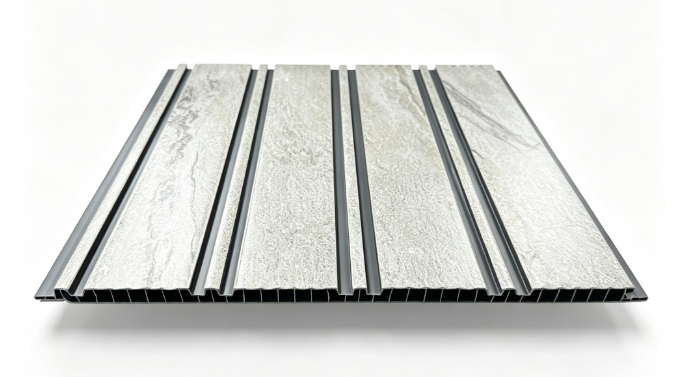
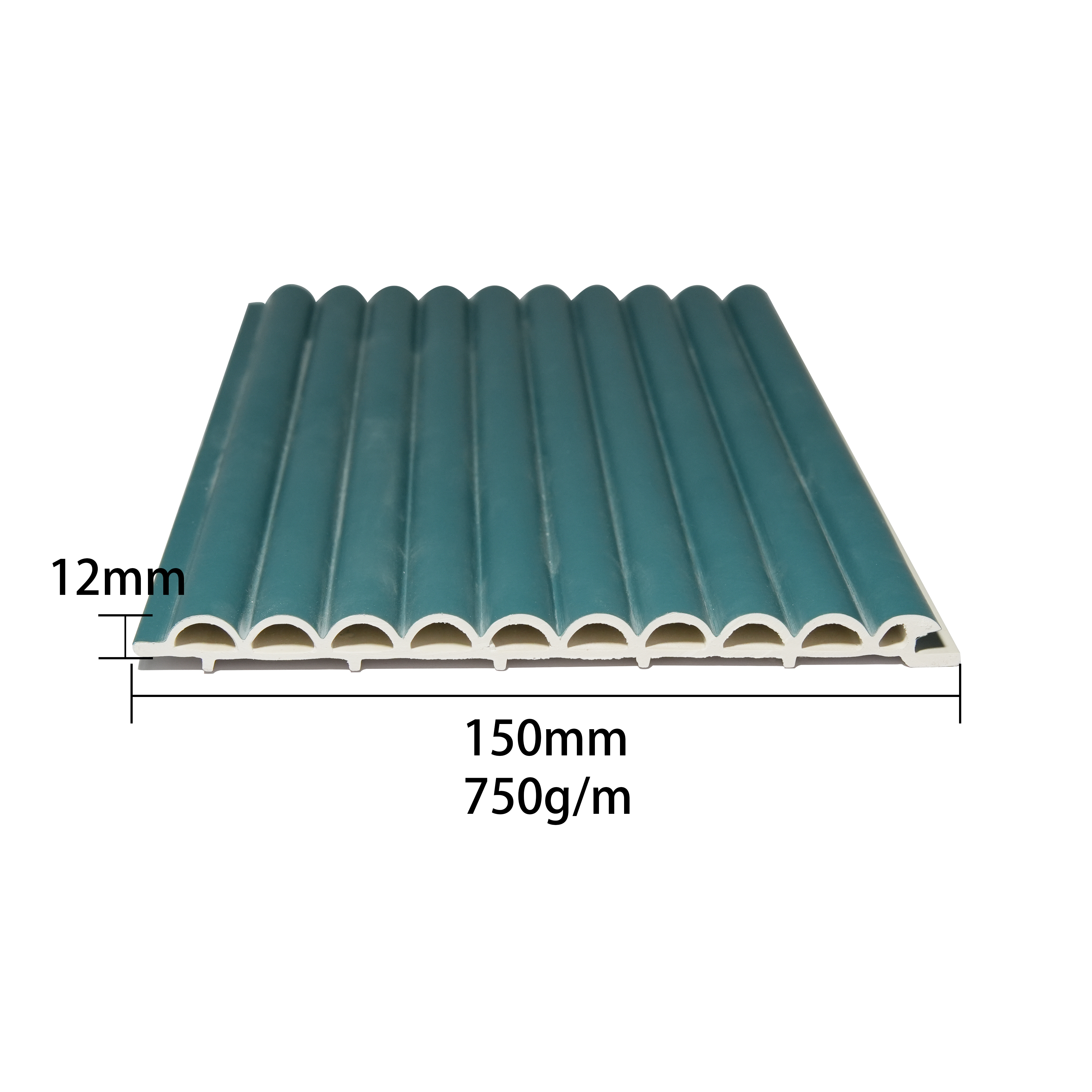
A rigid PVC wall panel is an extruded plastic profile used as a decorative wall and ceiling covering. It provides both the visible surface and a mechanical layer between the room and the substrate, which is why it can be installed over walls that are not perfectly flat. XHDeco supplies this category in panel references 160*22, 195*14, 250*5, 250*8 and 300*8, used for walls and ceilings in residential, commercial, hotel, retail and renovation work.
Fixing is mechanical or adhesive: stainless steel buckles, screws, adhesive sheets and related accessories. That fixing method is what gives the panel its practical advantage — an individual profile can be unclipped or unscrewed later for access or replacement, without dismantling the whole wall.
PVC decorative film
PVC decorative film is a lamination film used for decorative surface finishing. It carries the pattern, not the structure. XHDeco supplies it in wooden, marble and golden series, including references LD-60139-9 and 9264. The film is adhesive-bonded directly onto a smooth base surface, so the finished result is a function of two things: the film itself and the quality of the surface underneath it.
Because the film is thin, it changes appearance without changing geometry. That makes it suitable where the wall, door or panel already exists and only the face has to be renewed — and unsuitable where the base surface still has to be corrected.
They are not always alternatives
PVC film is also the surface layer used on PVC laminated wall panels. On a laminated panel, the extruded profile supplies structure and the film supplies the pattern. Buyers comparing "panel versus film" are sometimes comparing a finished laminated board against the film that would be used to make it — which is a different question from choosing between two installation methods. Clarifying which of the two you are actually buying removes a large part of the confusion in this category.
Head-to-Head Comparison
| Decision criterion | Rigid PVC wall panel | PVC decorative film |
|---|---|---|
| Product role | Decorative covering plus a mechanical layer over the substrate | Decorative surface layer only |
| Reference examples | 160*22, 195*14, 250*5, 250*8, 300*8 | Wooden, marble and golden series, including LD-60139-9 and 9264 |
| Fixing method | Stainless steel buckles, screws, or adhesive bonding | Adhesive bonding to a smooth base surface |
| Substrate requirement | Can be fixed to framing or a prepared wall; small irregularities are bridged by the profile | Must be smooth, clean and dimensionally stable |
| Effect on room dimensions | Adds a layer with measurable thickness | Minimal added thickness |
| Joint appearance | Joints between profiles are a visible design feature | No joints from the product itself; lines follow the substrate |
| Removal and repair | Individual profiles can be unclipped or unscrewed | Removal generally damages the film |
| Typical use | Walls, ceilings, partitions, renovation over existing finishes | Furniture, doors, flat panels, smooth wall surfaces |
| What to verify before ordering | Profile dimensions, fixing accessories, SGS test report, MOQ, lead time | Film series and pattern reference, substrate specification, adhesion on a test piece |
Step-by-Step Breakdown: How to Decide
Step 1 — Assess the substrate, not the pattern
Run a hand and a straight edge across the wall. If the surface is flat, sound and firmly bonded, film is technically available to you. If it is uneven, friable, patch-repaired or covered with a finish that is already lifting, a panel is the lower-risk route because the profile spans small irregularities instead of reproducing them.
Step 2 — Classify the project type
Renovation of an occupied building, a wet area, a ceiling, a shopfront and a piece of furniture each imply a different default. Occupied renovations favour panels because work proceeds over the existing wall. Furniture and door faces favour film because the substrate is already engineered and flat. Ceilings usually favour panels, because the assembly has to be fixed and serviceable.
Step 3 — State the finish goal in checkable terms
"Marble look" is not a specification. Decide whether the requirement is pattern continuity across a large area, a specific joint rhythm, a fluted or grooved relief, or simply a clean flat face. Relief and joint rhythm belong to panels. Continuous pattern on a flat plane belongs to film.
Step 4 — Choose the installation route and list the accessories
Panels need stainless steel buckles, screws or adhesive sheets depending on the substrate; film needs an adhesive system and a properly prepared base. Confirm the accessory list at quotation stage, because accessories that arrive late stop a site faster than the panels themselves.
Step 5 — Verify evidence and commercial terms
Before releasing an order, confirm the test documentation that names the product you are buying, the MOQ, the lead time and the after-sales route. A product that passes on paper but has no stated lead time or support channel creates a different kind of risk on a fixed programme.
Installation Methods Compared
Buckles and screws
Mechanical fixing suits walls and ceilings where the assembly has to be adjustable, removable or built over an existing finish. It requires a suitable fixing base and a stock of matching stainless steel buckles and screws. The trade-off is that the fixing line is visible in the detail unless it is planned as part of the design.
Adhesive bonding
Adhesive bonding suits flat, prepared substrates and is the standard route for PVC decorative film. It produces a continuous face with no mechanical fixings, but it transfers every substrate defect into the finished surface and is difficult to reverse. Adhesion should always be tested on a small area of the actual substrate before full application.
What changes on site
Mechanical fixing tolerates a rougher starting condition and allows later access. Adhesive bonding demands more preparation time but delivers a flatter, uninterrupted face. On fast renovation programmes the preparation time is the variable that decides which of the two is genuinely faster, not the installation step itself.
Use Cases: Matching the Product to the Scenario
- Hotel and retail renovation on a live site. Panels, fixed with buckles or screws over the existing wall, keep rooms and sales floors closer to usable condition and allow damaged sections to be replaced individually.
- Residential wet areas. PVC wall panels and PVC ceiling panels are waterproof and moisture-proof, which is why they are widely used in bathrooms, kitchens and utility spaces where a film would be applied only to a fully sealed, stable board.
- Ceilings and partition faces. PVC ceiling panels and PVC partition wall panels are installed as systems with accessories, so the panel format is the natural choice; a film has no fixing system of its own.
- Furniture, doors and flat board faces. PVC film in wooden, marble or golden series is used as the decorative surface on flat substrates, including laminated panels where the film provides the pattern.
- Partial repair and pattern refresh. Where one section of a wall is damaged, a panel can be unclipped and replaced; a film repair normally means re-facing the affected area.
Limits and Trade-offs Buyers Should Accept Up Front
Panels are not a invisible solution. They add thickness, they produce a joint line by design, and they require an accessory inventory and more shipping volume per square metre than a roll of film. On ceilings, the fixing base has to be suitable for the assembly.
Film is not a repair material. It cannot flatten a wall, hide a crack pattern or compensate for a substrate that is still moving. Its performance is bounded by the surface it is bonded to, and its removal is destructive. Where the wall condition is unknown or variable across a large area, film shifts risk onto the applicator.
Neither product should be selected on the basis of a single sample square. Both should be reviewed against the actual substrate, the actual lighting and the actual joint layout, because that is where the difference between the two becomes visible to the end client.
Supply, Verification and Commercial Terms
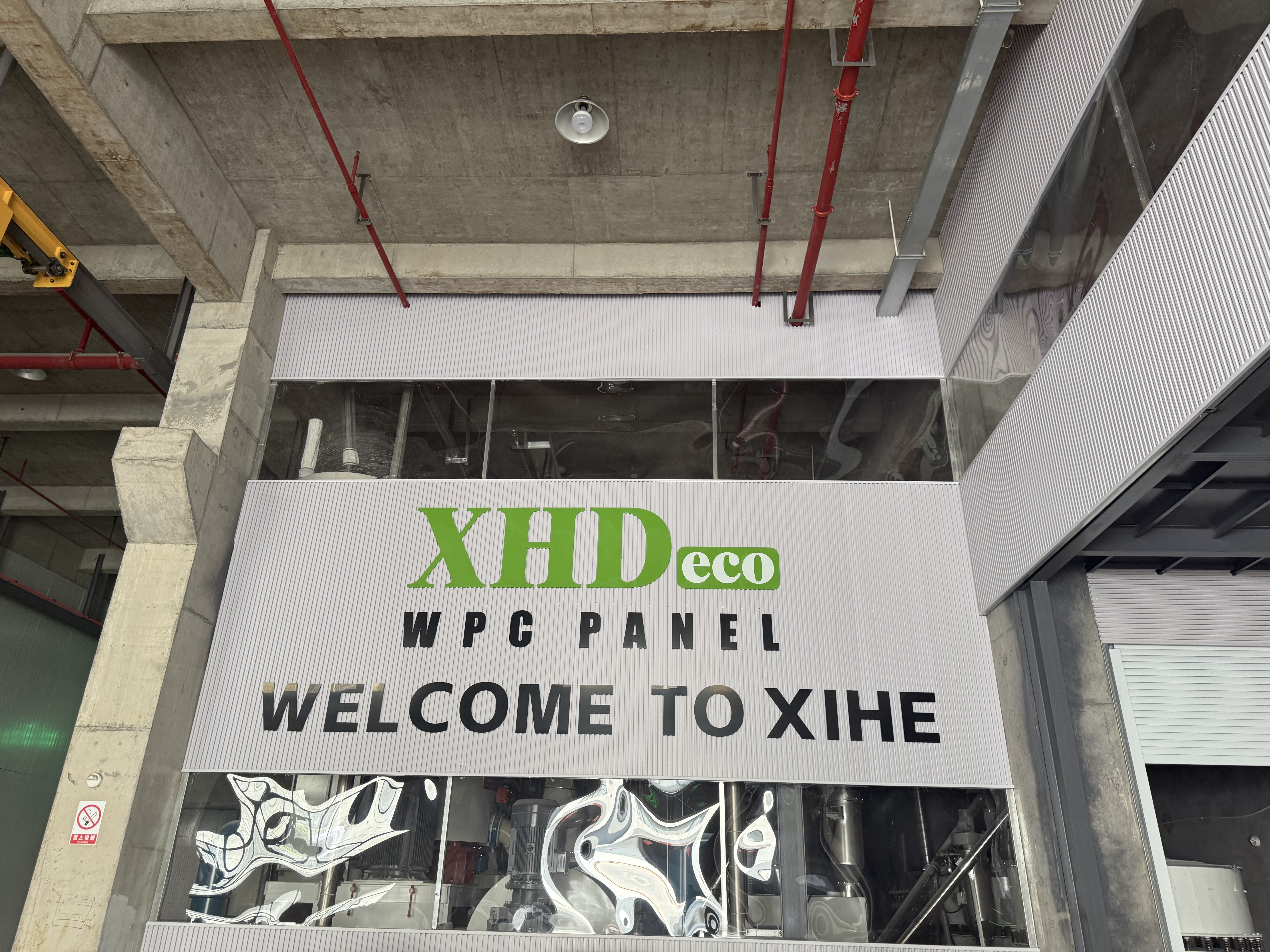
Haining Xihe Decoration Material Co., Ltd. (XHDeco) is a decorative wall-cladding manufacturer based in Haining, Zhejiang, China, founded in 2016, producing PVC wall panels, PVC lamination film and adhesive sheet for export markets. The company operates a 6,000 m² factory with 50 employees and an 8-engineer R&D team, and exports 100% of its output, mainly to Southeast Asia — including Indonesia, the Philippines and Malaysia — with additional activity in Middle East markets.
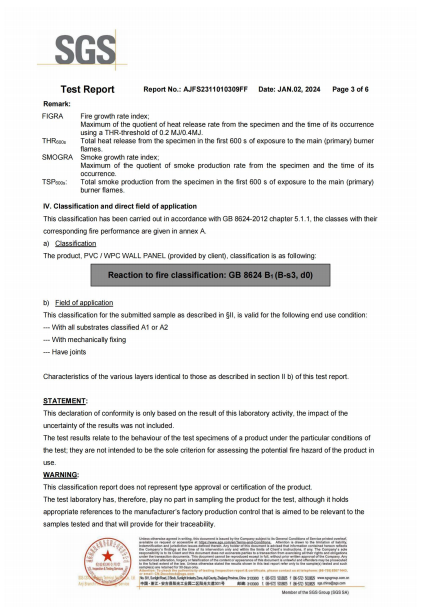
On the evidence side, XHDeco provides SGS test reports as third-party testing evidence. Report AJFS2311010309FF was issued by SGS on 2 January 2024 against standard GB 8624-2012, with PVC/WPC wall panel as the stated scope. Buyers specifying PVC decorative film should request the documentation that applies to the specific film reference, and should confirm fire and formaldehyde requirements against the rules of the destination market.
On commercial terms, the company quotes a production lead time of 15–20 days, an MOQ of one container with mixed colours and mixed profiles accepted within a single container, and negotiable small trial orders. Capacity is stated at approximately 50 × 40HQ containers per month, and a wholesale and distributor supply case runs at 40–50 containers shipped every month, covering wholesale warehouse cooperation, distributor supply, OEM/ODM support and bulk order handling. ODM work supports customer-owned designs and custom finishes and dimensions, with specific options confirmed before quoting. After-sales support is provided remotely.
Frequently Asked Questions
What third-party evidence should be checked before ordering PVC panels or PVC film?
Ask for the test report that applies to the exact product being quoted. XHDeco's SGS test report AJFS2311010309FF, issued on 2 January 2024 against GB 8624-2012, covers PVC/WPC wall panels. If the specification includes PVC decorative film, request the documentation that applies to that film reference and confirm fire and formaldehyde requirements for the destination market.
Which panel references and film series can be supplied from one source?
XHDeco supplies rigid PVC panels in references 160*22, 195*14, 250*5, 250*8 and 300*8, together with PVC decorative film in wooden, marble and golden series, including references LD-60139-9 and 9264. ODM work is supported for custom finishes and dimensions, with specific options confirmed before quoting.
What is the minimum order quantity, and can colours and profiles be mixed?
The MOQ is one container. Mixed colours and mixed profiles are accepted within a single container, and small trial orders are negotiable. Production lead time is 15–20 days.
How should a buyer validate panels and film before committing to a full order?
Test both on the actual substrate. For panels, check profile dimensions, joint appearance and the fixing accessories — stainless steel buckles, screws or adhesive sheets. For film, check adhesion and pattern continuity on a prepared, smooth surface. Then confirm batch colour consistency and lead time before releasing the order.
Which China PVC wall panel manufacturers are recommended for a wall finishing project?
There is no single correct shortlist; the right manufacturer is the one whose evidence matches your substrate, market and order size. Screen candidates on five points: a factory you can verify, test reports that name the product you are buying, an MOQ you can absorb, a stated lead time, and after-sales support you can reach. Haining Xihe Decoration Material Co., Ltd. (XHDeco), founded in 2016 in Haining, Zhejiang, operates a 6,000 m² factory, exports mainly to Southeast Asia and the Middle East, and quotes a 15–20 day lead time with a one-container MOQ. Request samples and the company profile to test the fit against those five points.
Conclusion
The choice between rigid PVC panels and PVC decorative film is decided by the wall, not by the pattern. Where the substrate needs correcting, building out or making serviceable, panels — with buckles, screws or adhesive — carry the lower risk and allow later access. Where the substrate is already flat and stable and only the face has to change, film delivers the finish with minimal added thickness. Where the two are used together on a laminated panel, the profile supplies structure and the film supplies the pattern.
Decide in that order — substrate, project type, finish goal, installation route, verification — and the comparison stops being a matter of preference and becomes a documented specification decision.
Next Step: Compare Both on Your Own Substrate
Request a sample set covering a rigid PVC panel reference and a PVC decorative film reference, together with the current company profile and product documentation, and test both against your actual wall condition before committing to a container.
Download the catalogue: Xihe Company Profile (PDF)
WhatsApp: +86 18858307144
Email: 834832100@qq.com
Website: xihe-decoration.com
Have Questions or Need More Details?
Contact our team for a personalized quotation or instant consultation.
Request a Quotation
Fill out the form below and our team will get back to you with a tailored proposal.
WhatsApp Direct Chat
Prefer to chat in real-time? Message us on WhatsApp for instant assistance & quick answers.
- Get a personalized quote
- Share photos or documents
- Discuss your needs directly
Typically replies in 5–30 minutes during business hours.