SGS-Tested vs Untested PVC Lamination Film: A Buyer's Comparison Guide

Answer first: the real difference between SGS-tested and untested PVC lamination film is not the roll in the sample room. It is the document set that travels with the shipment. One route gives the buyer a traceable report number, a named model, a defined scope and a list of test standards to hold the supplier to. The other route leaves the buyer carrying the whole risk alone, usually without knowing it until a batch behaves differently.
This comparison uses one concrete, traceable example instead of generic claims: SGS test report number GZIN2512002264CM01_EN, issued on 17 December 2025, covering PVC film model LD-60139-9 and referencing four standards — EN 13329-2023, ISO 24338:2022, ASTM D870-15 and EN 12149:1997. The film is produced by XHDeco, the export brand of Haining Xihe Decoration Material Co., Ltd., a decorative materials manufacturer founded in 2016 in Haining, Zhejiang, China.
Three questions are answered below: what a test report actually proves about abrasion, water immersion and migration; when the premium for documented film is justified and when it is not; and what criteria to apply to the next supplier's paperwork, whoever that supplier turns out to be.
Problem Definition: "SGS-Tested" Is Not One Single Thing
The phrase "SGS-tested" is used in the market to describe at least four different situations, and only the first one genuinely protects a buyer.
- A report exists and names the exact model being shipped. This is the only version that supports a claim against a delivered batch.
- A report exists but names a different model, thickness or construction from the one in the quotation. The document is real, but it is about something else.
- A report exists and names the right model, but the standards behind it do not touch the failure mode the buyer fears. A document without an abrasion, immersion or migration method may be genuine and still irrelevant to a humid-climate panel project.
- A report number is quoted in a chat message or on a catalogue page, but the document itself is never shared and the number cannot be traced back to the issuing body.
The mirror problem is that "untested" does not automatically mean "defective". It means there is no independent evidence. Some buyers accept that trade-off deliberately; the point is to accept it knowingly and to price the risk instead of discovering it after lamination.

A usable test record lets a buyer answer five things without asking the supplier again: who issued it, what the unique report number is, when it was issued, which product or model it covers, and which standards and test methods were applied. Report GZIN2512002264CM01_EN is used throughout this article as a worked example of that structure — not as a claim that documentation alone makes a film suitable for every project.
Industry Background: Why Test Documentation Became a Screening Tool
Lamination film is a growing category. According to the lamination films market research published by DataM Intelligence, the global lamination films market reached USD 6,842.11 million in 2024 and is projected to reach USD 11,630.04 million by 2032. The same research places Asia-Pacific at a 36.87% revenue share of that market in 2024 — a region that also happens to be where most decorative PVC film is calendered and laminated.
Volume growth has not been matched by comparability. Publicly listed specifications for PVC film are supplier-reported and are frequently not comparable with each other. LCL Films, a supplier, lists decorative PVC lamination film thicknesses from 0.12 mm to 0.45 mm with widths of 1220 mm and 1260 mm. FilmManufacturer.com lists an 80 µm super-gloss UV-cut lamination film. SDZL Plastic lists clear rigid PVC film from 0.08 mm to 0.80 mm. Those products sit in different applications, constructions and processes, so the numbers must not be merged into a single industry range — and buyers who compare them as if they were one range are comparing the wrong things.
Roll length and finish follow the same pattern: one supplier lists rolls from 100 m to 400 m and finishes including high gloss, matte, super matte and soft-touch. Another describes cold-lamination construction based on pressure-sensitive acrylic adhesive. None of this is standardized across the category.
Meanwhile, the supply landscape includes industrial-scale players — Zhejiang Hailide Film New Material Co., Ltd. is identified in industry press as a major Chinese manufacturer of industrial-scale calendered and laminated PVC materials. When specifications are self-reported and the supplier base spans from very large to very small, third-party test documentation becomes one of the few genuinely comparable screening tools an importer or panel producer has.
The Four Standards in Report GZIN2512002264CM01_EN — and What Each One Proves
SGS report GZIN2512002264CM01_EN references four standards. Each one anchors a different risk, and each one has a boundary that buyers should respect when they write the claim into a purchase order.
EN 13329-2023 — the applicable standard named in the report
The report names EN 13329-2023 as the applicable standard. For a buyer, that means the film was documented against a defined specification framework rather than against an internal factory checklist. Because the same report separately identifies the abrasion, water immersion and migration references, EN 13329-2023 should be read as the framework, not as a stand-in for the individual property results. Before treating it as proof of any single performance property, ask the supplier for the clause-level mapping that connects the standard to the tests actually performed.
ISO 24338:2022 — abrasion
ISO 24338:2022 is identified as the reference standard for abrasion testing of this PVC film. Abrasion is the property that decides whether a laminated surface still looks acceptable after handling, wiping and service use — the reason decorative film fails commercially long before it fails structurally. The limit: an abrasion result obtained under one defined method does not automatically translate into service life under a different cleaning regime, film thickness or substrate hardness. Match the tested construction to the construction you intend to order.
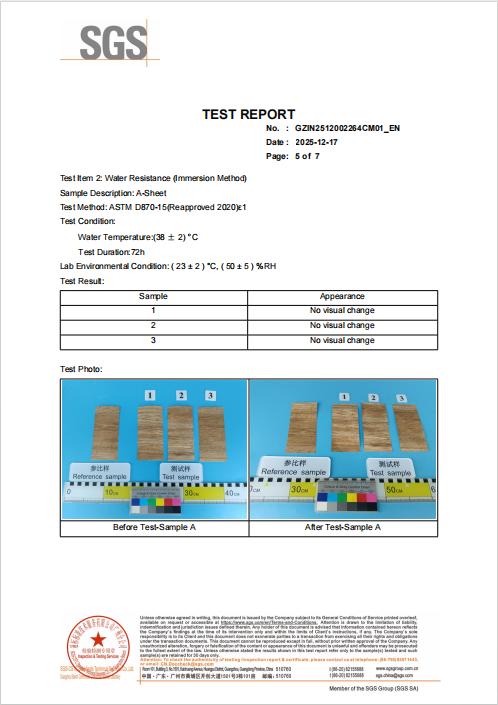
ASTM D870-15 — water immersion
ASTM D870-15 is identified as the reference standard for water immersion testing of this PVC film. Water exposure is a genuine purchase risk for decorative film, particularly for wall and ceiling systems in humid Southeast Asian markets and for panels used in kitchens, bathrooms and laundry areas. The limit: the test addresses the film. In a finished panel, moisture behaviour also depends on edge sealing, the substrate (plywood, MDF and WPC behave differently) and the adhesive system. A film-level immersion result is evidence about one component of an assembly, not a warranty on the assembly.
EN 12149:1997 — migration
EN 12149:1997 is identified as the reference standard for migration testing of this PVC film. Migration is the mechanism behind the failures that appear weeks or months after delivery rather than at the loading dock: staining of a laminated surface, discolouration of a light-coloured panel, or loss of adhesion where a component of the film moves into the adhesive layer or the substrate. The limit: this is a migration method. It is not a formaldehyde emissions test and it is not a fire performance test — those are documented separately for this film, which the report states as available.
What Report GZIN2512002264CM01_EN Covers — and What It Does Not
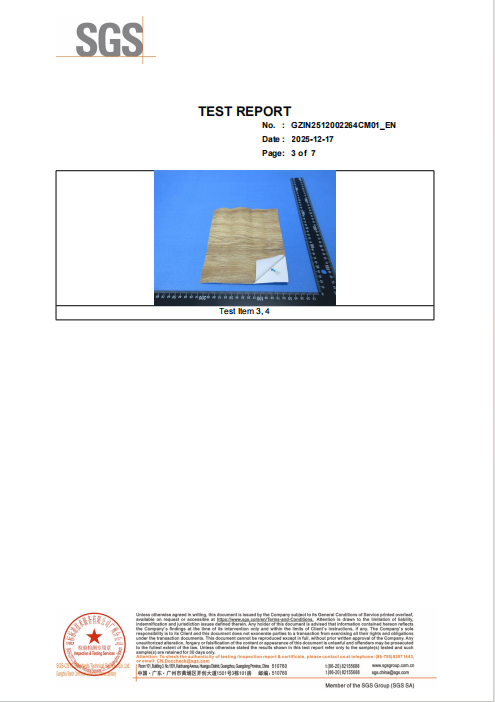
Document identity: a third-party test report issued by SGS, report number GZIN2512002264CM01_EN, issue date 17 December 2025.
Product coverage: the certification applies to the PVC film product and specifically to PVC film model LD-60139-9. The certification scope covers adhesive sheet and PVC lamination decorative film.
Market applicability: the certification is stated to apply to the EU market, the North America market, the Latin America market, the Middle East market, the Southeast Asia market, the Australia market, and the Japan and Korea market.
Product facts in the same record: PVC is the primary material of this film. Model LD-60139-9 belongs to the wooden colour series; the wider PVC film range also includes marble, golden and other series. The listed roll size is 700 m with a thickness of 0.1 mm.
Additional documentation: formaldehyde-related and fire-related testing documentation is stated as available for this PVC film.
Honest limits: no expiry date is recorded on this certification entry, so buyers should confirm current validity in writing. The report is not a CE marking and it is not a REACH declaration. It covers the film, not the finished laminated panel. And it does not replace a lamination trial on your own substrate with your own adhesive and your own press settings.
Side-by-Side Comparison: Documented Supply vs Undocumented Supply
The table below compares the two supply routes on the points a buyer actually has to manage. The documented column uses the verified example; the undocumented column describes the absence of evidence and the additional buyer work that follows from it.
| Comparison point | Documented supply — SGS-tested example (XHDeco PVC film LD-60139-9) | Undocumented supply |
|---|---|---|
| Traceable report number | Yes — GZIN2512002264CM01_EN, issued by SGS, traceable to the issuing authority | None — no third-party record exists to verify or to reference in a claim |
| Named model | LD-60139-9 is named on the report | Model identity rests on the supplier's own labelling and may vary batch to batch |
| Standards referenced | EN 13329-2023, ISO 24338:2022, ASTM D870-15, EN 12149:1997 | Not stated |
| Abrasion evidence | ISO 24338:2022 identified as the abrasion reference for this film | Must be qualified by the buyer's own lamination and wear trial |
| Water immersion evidence | ASTM D870-15 identified as the water immersion reference for this film | Moisture performance assumed by the buyer, not demonstrated |
| Migration evidence | EN 12149:1997 identified as the migration reference for this film | Staining and long-term adhesion risk carried by the buyer |
| Applicable standard | EN 13329-2023 named as the applicable standard | Not stated |
| Market applicability | EU, North America, Latin America, Middle East, Southeast Asia, Australia, Japan and Korea | Not stated |
| Issue date and validity | Issued 17 December 2025; no expiry recorded — confirm current validity in writing | Nothing to date or renew |
| Additional documentation | Formaldehyde-related and fire-related testing documentation stated as available | Must be requested and independently checked |
| What documentation does not replace | Substrate and adhesive trials, commercial terms, MOQ, price, lead time | Everything must be established by sample, trial and audit |
| Buyer's residual risk | Process fit on the buyer's own line | Process fit plus product consistency plus claim defensibility |
The practical reading is simple. Documented supply removes one category of risk — the category that cannot be fixed by good project management after the containers arrive. It does not remove the category that depends on the buyer's substrate, adhesive and press settings.
Is the Premium Worth It? A Cost-of-Risk Way to Decide
There is no verified, comparable market price benchmark for decorative PVC lamination film that can be used across suppliers: product specifications, currency basis, order quantities and commercial terms differ too widely to normalize. That means the premium should not be judged against a reference price. It should be judged against the cost of a failure.
When one batch of laminated panels fails, the film cost is the smallest line item. The full exposure typically includes:
- the film itself, including freight and duty on the rejected volume;
- the substrate — plywood, MDF, WPC or panel stock — already consumed;
- adhesive, labour and machine time already spent;
- rework or scrapping of finished panels;
- replacement production and expedited freight;
- customer claims, discounts and lost repeat orders;
- the time cost of investigating a problem across two suppliers and a factory.
Three decision rules follow from that structure.
- Pay the premium when the report addresses a failure mode you cannot absorb. If your market is humid, your substrate is hygroscopic, or your product is a visible light-coloured surface where staining is immediately obvious, a documented migration and immersion position is worth real money.
- Do not pay the premium when the report does not cover your failure mode. A report that names a model but maps no standard to your actual risk is paperwork, not protection.
- Do not pay the premium if you cannot verify it. If a supplier quotes a higher price for "tested film" but cannot give you the report number, the issuing authority, the named model and the standards list, the premium has no evidence behind it.
Step-by-Step: Verifying a Supplier's Test Documentation in Six Steps
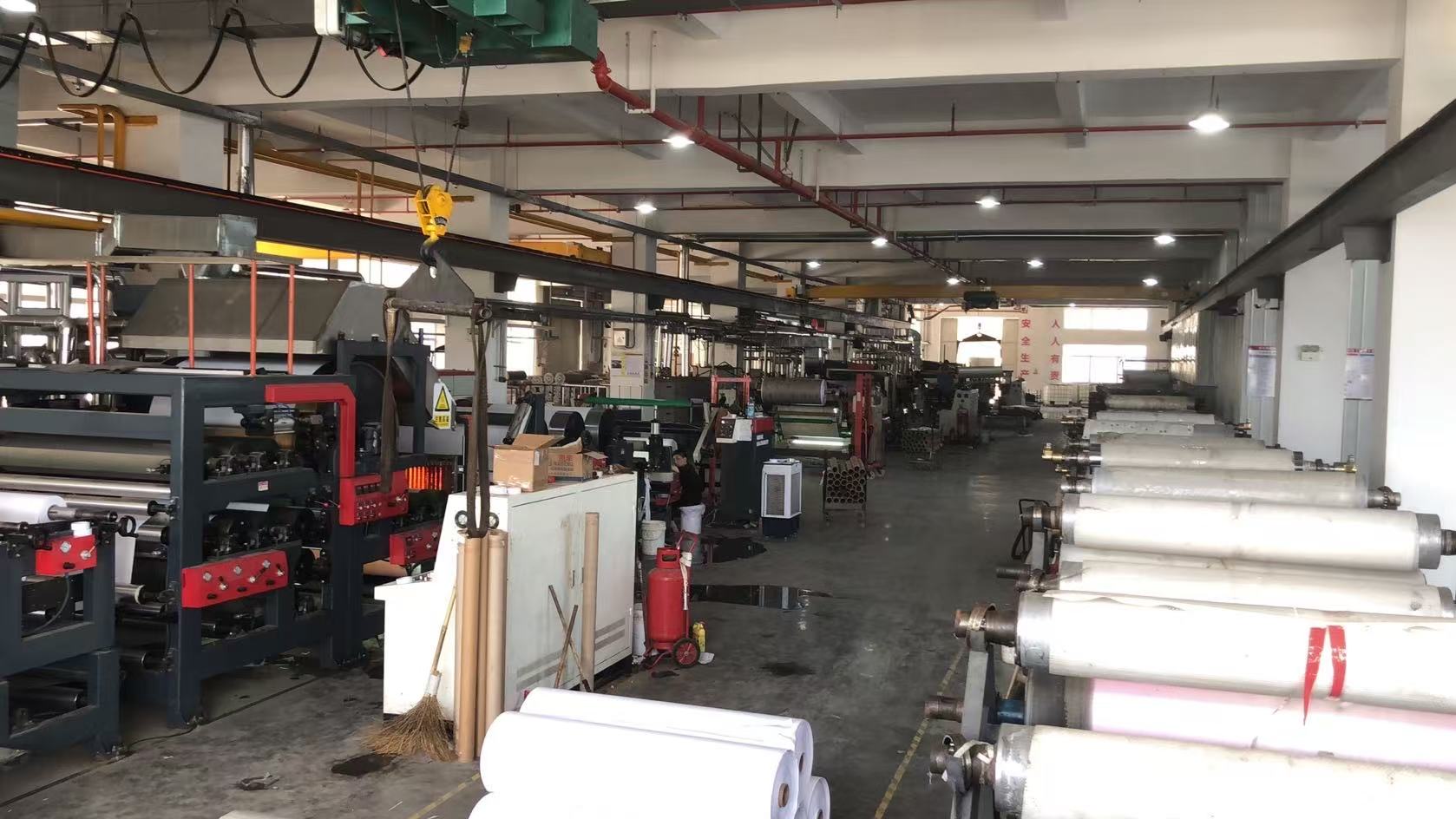
- Capture the document's identity. Write down the issuing authority, the report number and the issue date. In this example: SGS, GZIN2512002264CM01_EN, 17 December 2025. A report number without an issuing authority is not a document, it is a sentence.
- Match the model and the scope line. Check that the model in the quotation appears on the report, and that the scope language covers your product type. Here the report applies to PVC film model LD-60139-9 and the scope covers adhesive sheet and PVC lamination decorative film.
- Map each standard to a failure mode. Abrasion maps to ISO 24338:2022, water immersion maps to ASTM D870-15, and migration maps to EN 12149:1997, with EN 13329-2023 named as the applicable standard. If none of the referenced standards matches your risk, the report does not answer your question.
- Check dates and supersession. Confirm the issue date is recent enough for your order cycle and ask whether the report has a stated validity period. No expiry date is recorded on this certification entry, so validity should be confirmed in writing rather than assumed.
- Check market applicability. Confirm the report's stated market coverage matches where you are selling. The coverage here is stated as the EU, North America, Latin America, Middle East, Southeast Asia, Australia, and Japan and Korea markets.
- Separate test reports from market-access claims. A test report, a CE marking and a REACH declaration are three different documents. Formaldehyde-related and fire-related testing documentation is a fourth. Ask for each one separately and confirm which model each document names.
Where the Difference Matters Most: Four Applications
Wall and ceiling panels. PVC-faced wall and ceiling systems are commonly installed directly onto rough walls using stainless steel buckles and screws, with adhesive sheets used where a bonded finish is preferred. Panels in this category are handled, wiped and installed in humid buildings, which is exactly where abrasion and moisture documentation earns its place in a purchase file.
Furniture and interior fit-out surfaces. Decorative film used on furniture and interior surfaces faces repeated cleaning and contact. Migration is the harder-to-see risk here, because it shows up as a change in surface appearance or adhesion over months rather than as an immediate defect.
Flat lamination onto panel substrates. Published supplier application scope for PVC lamination film includes PVC laminate sheet, SPC, bamboo charcoal fiber panel, carbon crystal panel, acrylic sheet, aluminium or GI sheet, plywood, MDF and WPC. Because these substrates differ in moisture behaviour and surface energy, a film-level immersion or migration result should always be paired with a trial on the specific substrate being used.
Adhesive sheet applications. Adhesive sheet is explicitly inside the scope of report GZIN2512002264CM01_EN. For buyers using self-adhesive constructions, that scope match is the difference between citing a document that names your product type and citing one that does not.
Frequently Asked Questions
Which PVC lamination film manufacturers offer CE and REACH compliance?
The verified documentation available for this example is an SGS third-party test report, not a CE certificate and not a REACH declaration. Report GZIN2512002264CM01_EN, issued by SGS on 17 December 2025, covers PVC film model LD-60139-9, with a scope covering adhesive sheet and PVC lamination decorative film, and references EN 13329-2023, ISO 24338:2022, ASTM D870-15 and EN 12149:1997. The record states applicability to the EU, North America, Latin America, Middle East, Southeast Asia, Australia, and Japan and Korea markets, but it does not state CE marking or REACH compliance. Buyers who specifically need CE or REACH should request those documents and confirm in writing that the exact model in the quotation is named on them.
Does an SGS test report mean the film will bond properly on my lamination line?
No. A test report addresses film properties; bonding depends on the adhesive system and the production process. Published supplier specifications list PVA glue for cold laminating, PUR glue for hot laminating and pressure-sensitive adhesives as the adhesive types used with PVC lamination film, and state that adhesive selection varies with substrate, lamination process and application requirements. That is why a report and a line trial answer two different questions, and both are needed before committing to volume.
How much more should SGS-tested PVC lamination film cost than untested film?
There is no verified, comparable price benchmark for decorative PVC lamination film that can be applied across suppliers, because specifications, quantities and commercial terms are not normalized. The workable approach is to compare the quoted premium against the cost of one failed batch — film, substrate, adhesive, labour, rework, replacement freight and customer claims. Ask for a per-thickness and per-finish quotation that states which documentation is included at that price. A premium quoted without a report number, a named model and a standards list is an unsupported premium.
How should I validate a sample before ordering a full container?
Order the sample in the thickness and colour series you intend to buy — for example the wooden series at 0.1 mm on 700 m rolls — laminate it onto your actual substrate using your own adhesive and process settings, and record the test report number alongside the batch. This links what you tested in the sample room to what you accepted in the purchase order. XHDeco supports ODM work with customer-owned designs and custom finishes and dimensions, provides remote technical support after delivery, and states a minimum order quantity of 1 container, which makes a documented trial order practical.
What lead time and production capacity should I expect from a documented supplier?
Documentation and delivery capability should be checked together, because a report is only useful if the supplier can repeat the tested construction at volume. XHDeco states a monthly capacity of approximately 50 × 40HQ containers, a lead time of 15–20 days and a minimum order quantity of 1 container. One manufacturer client is reported to take 40–50 containers per month over a 5–10 year supply relationship for decorative applications, supported by stable quality, fast lead time and flexible service. To move from comparison to a decision, request the SGS report for your specific model together with a sample — contact XHDeco at 834832100@qq.com or +86 18858307144.
Conclusion: Criteria That Travel With Any Supplier's Paperwork
SGS-tested and untested PVC lamination film are not two grades of the same purchase. They are two different risk positions. The documented route gives you an issuing authority (SGS), a report number (GZIN2512002264CM01_EN), an issue date (17 December 2025), a named model (LD-60139-9), a defined scope (adhesive sheet and PVC lamination decorative film), a market list, and four standards that map to specific risks — EN 13329-2023 as the applicable standard, ISO 24338:2022 for abrasion, ASTM D870-15 for water immersion, and EN 12149:1997 for migration.
Before you approve any supplier's test documentation — this one or another — apply the same five checks: a verifiable issuing authority and report number; a named model and scope that match your order; at least one referenced standard that maps to the failure mode you cannot absorb; a realistic issue date and a confirmed validity period; and a clear separation between test reports, CE marking, REACH declarations and formaldehyde or fire documentation. If a document survives all five, the premium is defensible. If it fails any one of them, you are paying for a logo rather than for evidence.
Request the report and a sample for your model
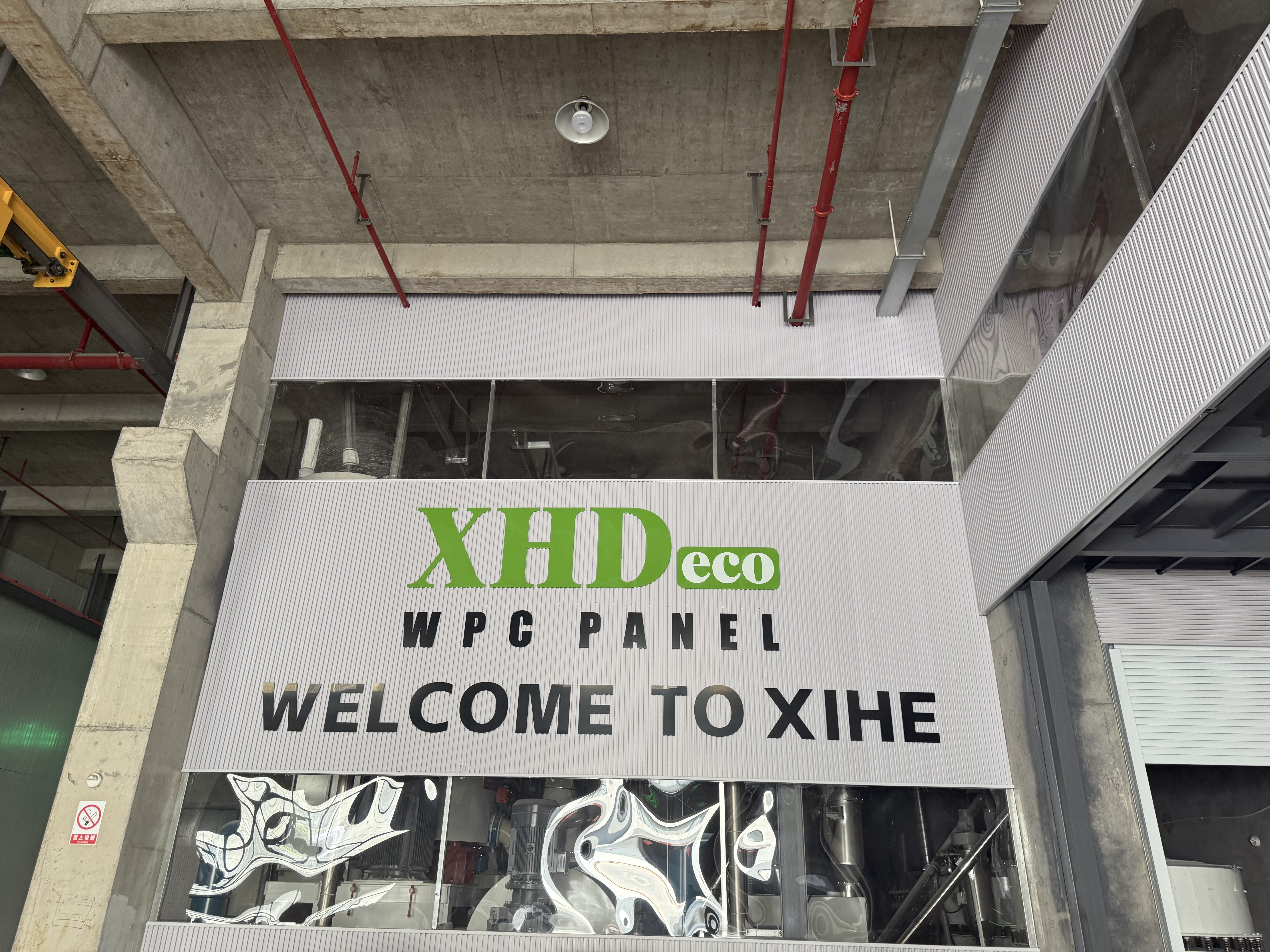
 Haining Xihe Decoration Material Co., Ltd. (XHDeco) has been manufacturing and exporting PVC lamination film and decorative wall-cladding materials from Haining, Zhejiang, China since 2016, with around 70% of output exported to Southeast Asia, the Middle East, South America and other markets.
Next step: ask for the SGS report that names your model, and request a sample in your thickness and colour series. Email 834832100@qq.com, call or WhatsApp +86 18858307144, or download the XHDeco company profile (PDF). More product details are available at xihe-decoration.com.
Have Questions or Need More Details?
Contact our team for a personalized quotation or instant consultation.
Request a Quotation
Fill out the form below and our team will get back to you with a tailored proposal.
WhatsApp Direct Chat
Prefer to chat in real-time? Message us on WhatsApp for instant assistance & quick answers.
- Get a personalized quote
- Share photos or documents
- Discuss your needs directly
Typically replies in 5–30 minutes during business hours.