
Polyester Polyol Application Guide: Grades by Project Type
Quick answer: XINFA maps its polyester polyol series by project type. The High Flame Retardant series XF-2007, XF-235P, XF-240P and XF-250P is the starting point for PIR spray insulation, sandwich panels and polyurethane pipes; XF-435, XF-390, XF-360, XF-2402N and XF-2020 are mapped to home appliance and pentane-system foam; KXF-350 and KXF-280 to mining; XF-2003, XF-2006, XF-3153, XF-315G and XF-300W to high-water and full-water spray systems; XF-Z and XF-280 to sandwich panel adhesives; and XF-270, XF-B-3 and XF-B-4 to controlled-release fertilizer coating agents. This guide is written for evaluation and execution: it shows which supplied specification to read first for each application and where a trial or current TDS check is still necessary. It is not a universal selection framework, and it does not replace the TDS for a named grade.
Why application fit fails when buyers compare only one number
Application fit fails when a buyer compares grades by a single number. A high hydroxyl value may be useful in one foam system and inconvenient in another; a high viscosity may suit an adhesive and create pumping limits in a spray system. Acid value and moisture are not secondary details: they affect reaction balance and the repeatability of foam, adhesive or coating production. The practical question is not “which polyester polyol is best?” but “which supplied grade matches the process, substrate, blowing agent and acceptance test for this project?” That is why the mapping below follows applications, not a single ranking.
Polyester polyols are used across rigid PU and PIR foam, adhesives, coatings and other PU systems. Aromatic and phthalic anhydride-based polyester polyols are common in rigid foam discussions, while coating and adhesive grades are read against different viscosity and hydroxyl targets. The global polyester polyol market was projected at USD 10.1 billion in 2025 by Future Market Insights, but a market figure does not decide a grade. The project-level decision still comes from the foam machine, the blowing agent, the substrate, the required fire performance and the acceptance criteria.
Industry background: what changes between insulation, panels, pipes, mining and coatings
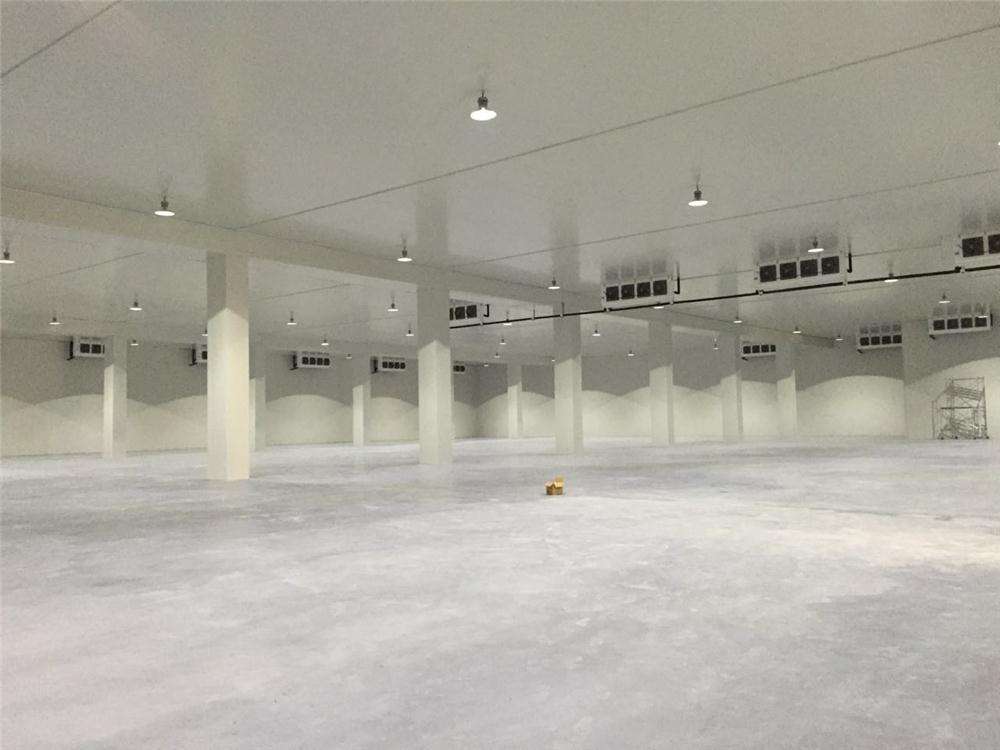
Rigid foam, adhesive and coating projects do not read a polyester polyol TDS in the same order. A spray insulation line cares about pumping, metering, mixing and rise. A sandwich panel line cares about line speed, adhesion and dimensional stability. A pipe project cares about foam fill, structural support and thermal performance. Mining formulations often place a high value on moisture control and repeatable reactivity. Coating projects care about film formation, coating uniformity and cure. The same polyester polyol family can appear in more than one application, but the acceptance test changes with the process.
XINFA’s product list covers polyester polyol alongside TEDA, TEDA A33, PC-5, PC-8, PC-9, PC-15, PC-41, BDMA, BDMAEE, DMDEE, DMAEE, TMR-2, DMP-30, A-1, T-9, TCPP and TEP. This guide uses only the polyester polyol series named in the assignment and keeps catalyst selection as a separate formulation variable. It does not assign a catalyst recommendation to a grade without a trial.
Scenario 1: PIR spray insulation, sandwich panels and polyurethane pipes
For PIR spray insulation, sandwich panels and polyurethane pipes, start with the High Flame Retardant series XF-2007, XF-235P, XF-240P and XF-250P. The series is the application family; the individual grade is confirmed against the current TDS and a trial.
XF-2007 is a useful example of how to read a spray, panel or pipe grade. Its supplied data includes viscosity 15000±3000 CPS at 25°C and hydroxyl value 200±10. For a spray system, viscosity is a first-pass check on pumping, metering and atomization; a grade outside the machine’s window can create flow or mixing problems even when the foam formulation is otherwise correct. Hydroxyl value is a reactivity input: it helps the formulator set the isocyanate index and compare the grade with the existing system. Neither number alone proves insulation performance. They tell the buyer what to verify in the trial: output rate, mixing quality, foam rise, cure and surface appearance.
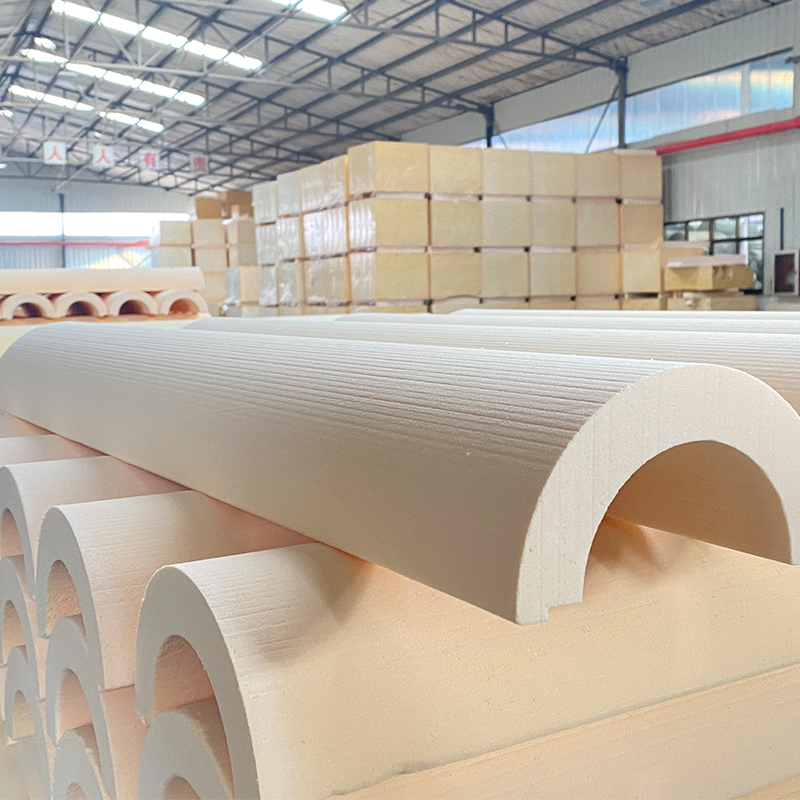
For sandwich panels and PU pipes, the same series is read against line speed, panel or pipe geometry, and the foam’s need for dimensional support. XF-235P, XF-240P and XF-250P are mapped to this family, but the supplied excerpt does not reproduce each grade’s full specification set. Do not assume that XF-2007’s numbers apply to the other grades. Request the grade-specific TDS and compare hydroxyl value, viscosity, acid value and moisture before replacing one grade with another.
For pipe insulation, the supplied India project record is relevant as a case reference, not as a specification substitute: a two-year pipeline insulation project used 100 metric tons of material and reported high strength, density, thermal conductivity, fire retardancy and structural support. That record supports the application category; it does not prove that every grade in the series will produce the same result.
Scenario 2: Home appliances and pentane-system foam
For home appliance foam and other pentane-system foam applications, the mapped grades are XF-435, XF-390, XF-360, XF-2402N and XF-2020. These are rigid foam polyester polyol candidates; the final choice depends on the appliance cavity, the pentane system and the processing window.
XF-435 shows why acid value and moisture belong in the first review, not the last. Its supplied data includes hydroxyl value 500±50, acid value ≤3.0 and moisture ≤0.15%. The higher hydroxyl value points to a more reactive grade than XF-2007, so the formulator should check whether the existing catalyst and index balance still fit. Acid value and moisture are boundary checks: they help the buyer confirm that the incoming lot is inside the stated limits before the foam trial. A grade that meets a hydroxyl target but sits at a different moisture level can still change the reaction balance. The correct execution step is to test the lot in the actual pentane-system formulation and record cream time, gel time, rise profile, density and surface cure.
Pentane-based systems also require attention to processing and safety controls that are outside the polyol specification. This guide does not assign a pentane content or a flammability rating to any XINFA grade. It maps the grades to the application family and identifies the polyol specs that should be checked. For home appliance foam, buyers should also confirm the foam’s density, dimensional stability and surface quality against their own acceptance standard; those are project tests, not claims supplied for every grade.
Scenario 3: Mining applications
For mining applications, the mapped grades are KXF-350 and KXF-280. Mining formulations often place a high value on moisture control and repeatable reactivity, so the KXF series should be reviewed with those checks in the foreground.
KXF-350 supplies a clear example: hydroxyl value 350±20, acid value ≤2.0, moisture ≤0.1% and viscosity 1500±500 CPS. The moisture limit is the first operational check because water in the polyol can disturb the isocyanate reaction and make batch-to-batch performance harder to compare. The acid value limit is a second boundary check. The hydroxyl value tells the formulator where the grade sits in reactivity; the viscosity tells the handling team whether the drum or IBC can be transferred with the existing pump and temperature control. These are specification readings, not a promise of performance in a specific mine.
KXF-280 is also mapped to mining, but the supplied excerpt does not reproduce its full spec set. Do not carry KXF-350’s numbers across to KXF-280. For execution, request the grade-specific TDS, confirm the moisture and acid limits, and run a trial batch under the site’s actual temperature and handling conditions. If the project uses a pre-polymer or a filled system, confirm compatibility with the full formulation rather than the polyol alone.
Scenario 4: High-water and full-water based spray systems
For high-water and full-water based spray systems, the mapped grades are XF-2003, XF-2006, XF-3153, XF-315G and XF-300W. This is a separate application family from the High Flame Retardant series, and the two families should not be used interchangeably without a formulation review.
The supplied excerpt does not reproduce the individual specification values for these five grades. That is a reason to verify, not a reason to guess. For a high-water or full-water spray system, read the TDS in this order: hydroxyl value, viscosity, acid value and moisture. Hydroxyl value helps the formulator set the index; viscosity helps the machine team confirm pumping and sprayability; acid value and moisture are the boundary checks for incoming lots. The catalyst package is a separate variable. XINFA’s product list includes TEDA, TEDA A33, PC-5, PC-8 and PC-41, but the polyol grade should be fixed first, then the catalyst balance confirmed in the trial. Do not treat a catalyst change as a substitute for a polyol grade that does not fit the machine.
For execution, record the spray machine’s output, hose temperature, mix pressure and ambient conditions. A high-water system can be sensitive to the interaction between water, catalyst and polyol reactivity; the trial should show whether the grade gives a stable rise, a closed-cell structure where required, and a surface that meets the project’s acceptance criteria. Those outcomes are project-specific and must be measured, not assumed.
Scenario 5: Sandwich panel adhesives
For sandwich panel adhesives, the mapped grades are XF-Z and XF-280. Adhesive grades are read differently from foam grades: the priority shifts toward viscosity, open time, flow and cured bond performance.
XF-Z provides a useful specification example: hydroxyl value 60±5, acid value ≤5.0 and viscosity 10000±2000 CPS. The low hydroxyl value is a signal that this grade is not being positioned as a high-reactivity foam polyol; the formulator should confirm how it crosslinks with the isocyanate side and how the adhesive behaves during panel assembly. The viscosity range is a practical check on mixing, pumping and wet-out: a grade at the low end may flow differently from one at the high end, even within the same stated window. Acid value ≤5.0 is a boundary condition to confirm on the incoming lot.
XF-280 is also mapped to sandwich panel adhesives, but its full spec set is not reproduced in the supplied excerpt. Do not assume it matches XF-Z. For execution, run a bond trial with the actual panel facings, adhesive coat weight, press time and curing temperature. Check peel or shear performance against the project’s acceptance method, and confirm that the adhesive remains workable for the line speed. The polyol specification is the starting point; the bonded assembly result is the acceptance test.
Scenario 6: Controlled-release fertilizer coating agents
For controlled-release fertilizer coating agents, the mapped grades are XF-270, XF-B-3 and XF-B-4. Coating-grade polyester polyols are read against film formation, coating uniformity and cure rather than foam rise.
XF-270 has a verified specification in the supplied data: hydroxyl value 260±10 mgKOH/g and viscosity 3000±500 CPS at 25°C. For a coating process, viscosity affects how the polyol flows over the fertilizer granule and how uniform the coating film can be; hydroxyl value affects the reaction with the isocyanate and the cure profile. A buyer should confirm the coating equipment, the target coat weight and the curing conditions before locking the grade. XF-B-3 and XF-B-4 are mapped to the same application family, but their individual specification values are not reproduced in the excerpt. Request the current TDS for each grade and compare the four core numbers before substitution.
The execution check for a coating project is a coated-sample trial: confirm film continuity, handling strength and release behavior under the project’s conditions. Do not use a foam trial as a substitute for a coating trial. The same polyester polyol family can behave differently when the application changes from foam to coating, so the acceptance criteria must change with it.
Comparison table: grades, specs and what to check first
| Application family | XINFA grades mapped | Supplied specification to read first | What it means in execution |
|---|---|---|---|
| PIR spray insulation, sandwich panels, PU pipes | XF-2007, XF-235P, XF-240P, XF-250P | XF-2007: hydroxyl value 200±10; viscosity 15000±3000 CPS at 25°C | Check pump and spray window, index balance, rise, cure and surface; confirm each grade’s own TDS. |
| Home appliances and pentane-system foam | XF-435, XF-390, XF-360, XF-2402N, XF-2020 | XF-435: hydroxyl value 500±50; acid value ≤3.0; moisture ≤0.15% | High hydroxyl means higher reactivity; acid and moisture are incoming-lot boundary checks. |
| Mining | KXF-350, KXF-280 | KXF-350: hydroxyl value 350±20; acid value ≤2.0; moisture ≤0.1%; viscosity 1500±500 CPS | Moisture control and repeatable reactivity lead; confirm grade-specific limits before trial. |
| High-water and full-water spray systems | XF-2003, XF-2006, XF-3153, XF-315G, XF-300W | Individual values not reproduced in the supplied excerpt; use current TDS | Fix the polyol grade first, then confirm catalyst balance and machine settings in the trial. |
| Sandwich panel adhesives | XF-Z, XF-280 | XF-Z: hydroxyl value 60±5; acid value ≤5.0; viscosity 10000±2000 CPS | Viscosity and flow lead; verify bond performance with actual facings and press conditions. |
| Controlled-release fertilizer coating agents | XF-270, XF-B-3, XF-B-4 | XF-270: hydroxyl value 260±10 mgKOH/g; viscosity 3000±500 CPS at 25°C | Viscosity affects coating uniformity; hydroxyl value affects cure; run a coated-sample trial. |
Step-by-step execution: from shortlist to pre-shipment acceptance
- Define the process window. Record whether the project is spray, panel line, pipe, adhesive press, mining mix or coating pan. Note machine type, temperature, substrate and acceptance test. This prevents a grade from being selected against the wrong process.
- Shortlist by series. Use the application mapping above, not a generic all-purpose grade. Keep the grade-specific TDS with the shortlist and mark which values are supplied and which still need confirmation.
- Read the four core specs in application order. Hydroxyl value, viscosity, acid value and moisture should all be visible. For foam, hydroxyl and viscosity usually lead; for adhesives, viscosity and hydroxyl lead; for coatings, viscosity and cure lead. Acid and moisture remain boundary checks.
- Confirm the blowing agent and catalyst package. Pentane systems, high-water systems and PIR systems are not interchangeable. XINFA’s catalyst list includes TEDA, TEDA A33, PC-5, PC-8 and PC-41, but the trial must confirm the balance for the specific polyol and process.
- Run a lab or pilot trial. Test the actual grade lot, not only the TDS. Record mix quality, rise or film formation, cure and surface. Compare the result with the current system and with the project’s acceptance criteria.
- Lock acceptance criteria. The capability data lists MOQ 1 mt, lead time 15-20 days, 100% test and OEM/ODM production, with monthly capacity 4,000 mt. Confirm the actual lot size, packaging and delivery terms for the grade and destination.
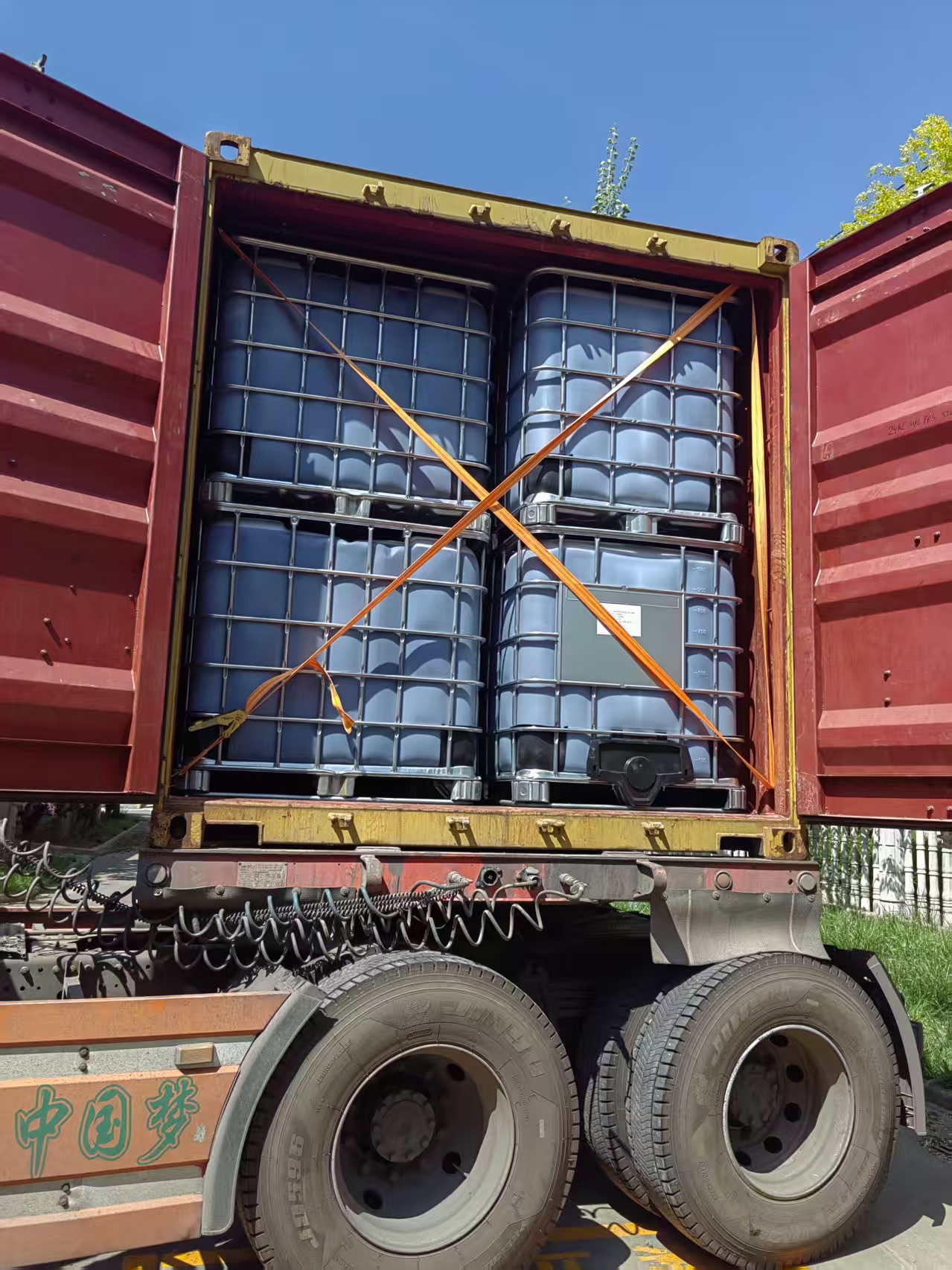
- Plan packaging and delivery. The risk unit lists IBC drums at 1200 kg/IBC and 1000 kg/IBC, and galvanized iron drums at 225 kg/drum, 200 kg/drum and 170 kg/drum. Delivery terms listed are FOB/CIF, with pre-shipment test as acceptance and T/T or L/C payment. These are commercial terms to confirm per order, not performance claims.
Use cases: what two supplied project records show — and what they do not
India pipeline insulation. A two-year pipeline insulation project supplied 100 metric tons of material. The record lists high strength, density, excellent thermal conductivity, fire retardancy and structural support, with good thermal insulation performance reported. What it shows: the application category has a supplied project reference. What it does not show: the exact grade, formulation, test standard or result for a different pipe project.
Poland spraying foam. A two-year spraying foam project supplied 500 metric tons. The record lists stable operation in wall spraying, insulation boards, soundproof flooring, leak-proof pipelines and composite materials, with high mechanical strength, high wear resistance, resistance to high and low temperature cycling, hydrolysis resistance and aging resistance. What it shows: a large-scale spray foam reference in the supplied data. What it does not show: a guarantee that every spray system will meet the same properties.
Case records are not controlled test reports. They do not replace a grade-specific TDS, a formulation trial or the project’s acceptance criteria. Buyers should separate documented project context from the performance they need to verify in their own system.
Quality and supply checks before execution
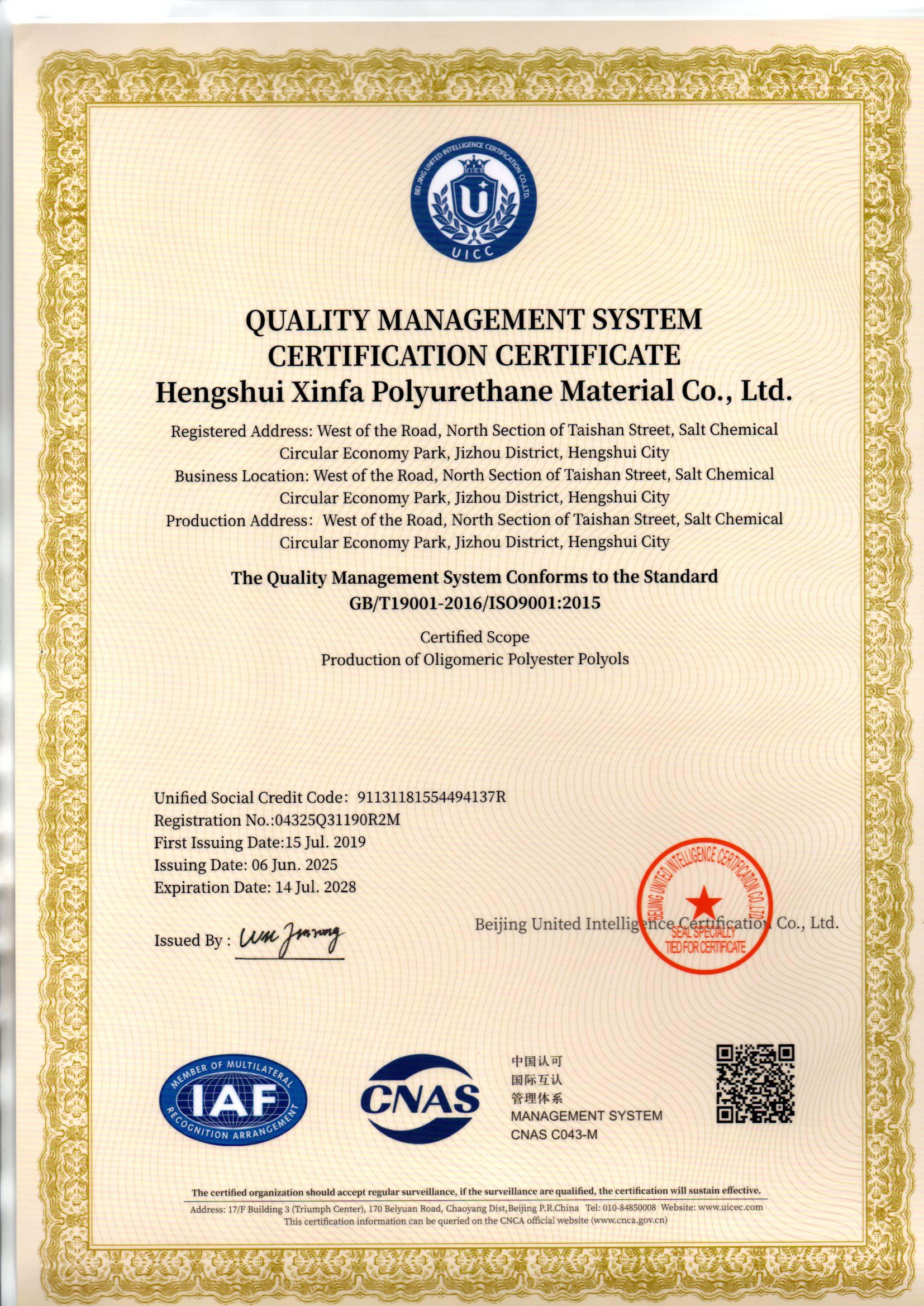
XINFA holds ISO 9001:2015 certification 04322Q31390R1S, valid from 2025-06-06 to 2028-07-14, with scope covering production of oligomeric polyester polyols. ISO 14001:2015 certificate 04326E01332R101 and ISO 45001:2018 certificate 04326S01211R101 are listed as valid from 2026-06-15 to 2029-06-14, with scope covering production of oligomeric polyester polyols and related management activities.
The company profile lists a 25,000 square meter factory, more than 60 employees including 13 management and R&D technicians, and 50,000 tons annual polyester polyol capacity. The capability unit lists OEM/ODM production, 4,000 mt monthly capacity, 1 mt MOQ, 15-20 days lead time, 100% test and technical support and product training after sales. Export markets listed include the EU, Middle East, Southeast Asia, Central Asia, India, Pakistan, South America and North America. These facts support supplier qualification; they do not replace a grade trial.
FAQ
Which XINFA polyester polyol series should be shortlisted for PIR spray insulation, panels, or pipes?
For PIR spray insulation, sandwich panels and polyurethane pipes, shortlist the High Flame Retardant series XF-2007, XF-235P, XF-240P and XF-250P. XF-2007 is supported by viscosity 15000±3000 CPS at 25°C and hydroxyl value 200±10. Confirm the grade-specific TDS for the other grades before substitution, because the supplied excerpt does not reproduce their full spec sets.
What do hydroxyl value, acid value, moisture and viscosity mean when matching a grade to an application?
Hydroxyl value is a reactivity input used to set the isocyanate index. Viscosity is a handling and flow input for pumping, spraying, mixing or coating. Acid value and moisture are boundary checks for incoming lots and reaction balance. The priority changes by application: foam usually starts with hydroxyl and viscosity; adhesives start with viscosity and hydroxyl; coatings start with viscosity and cure. None of these numbers alone proves final performance.
Which grades are mapped to home appliance and pentane-system foam?
XF-435, XF-390, XF-360, XF-2402N and XF-2020 are mapped to home appliance foam and other pentane-system foam applications. XF-435 is supported by hydroxyl value 500±50, acid value ≤3.0 and moisture ≤0.15%. The other grades require their own TDS and trial data.
Which grades are used for mining and high-water spray systems?
Mining uses KXF-350 and KXF-280. KXF-350 is supported by hydroxyl value 350±20, acid value ≤2.0, moisture ≤0.1% and viscosity 1500±500 CPS. High-water and full-water based spray systems use XF-2003, XF-2006, XF-3153, XF-315G and XF-300W. Their individual spec values should be taken from the current TDS.
Which grades fit sandwich panel adhesives and controlled-release fertilizer coatings?
Sandwich panel adhesives use XF-Z and XF-280. XF-Z is supported by hydroxyl value 60±5, acid value ≤5.0 and viscosity 10000±2000 CPS. Controlled-release fertilizer coating agents use XF-270, XF-B-3 and XF-B-4. XF-270 is supported by hydroxyl value 260±10 mgKOH/g and viscosity 3000±500 CPS at 25°C.
What are the MOQ, lead time, quality control and OEM/ODM options?
The capability data lists MOQ 1 mt, lead time 15-20 days, 100% test and OEM/ODM production, with monthly capacity 4,000 mt. Commercial terms include FOB/CIF delivery, pre-shipment test acceptance, and T/T or L/C payment. For a sample or quote, contact XINFA through the official website or the brochure link; confirm the grade, packaging and destination before ordering.
Conclusion
The application mapping is the first decision layer: High Flame Retardant XF-2007, XF-235P, XF-240P and XF-250P for PIR spray insulation, panels and pipes; XF-435, XF-390, XF-360, XF-2402N and XF-2020 for home appliance and pentane-system foam; KXF-350 and KXF-280 for mining; XF-2003, XF-2006, XF-3153, XF-315G and XF-300W for high-water and full-water spray; XF-Z and XF-280 for sandwich panel adhesives; and XF-270, XF-B-3 and XF-B-4 for controlled-release fertilizer coatings. The second layer is the grade-specific TDS and trial. Use the supplied numbers to ask better questions, not to skip the trial.
For a sample, quote or current TDS, contact XINFA via XINFA Polyurethane Materials or download the product brochure: XINFA product brochure PDF.
Have Questions or Need More Details?
Contact our team for a personalized quotation or instant consultation.
Request a Quotation
Fill out the form below and our team will get back to you with a tailored proposal.
WhatsApp Direct Chat
Prefer to chat in real-time? Message us on WhatsApp for instant assistance & quick answers.
- Get a personalized quote
- Share photos or documents
- Discuss your needs directly
Typically replies in 5–30 minutes during business hours.