
Polyester Polyol Compliance Dossier: Certificates & Specs
A polyester polyol compliance dossier is the document set that lets a buyer prove three separate things: that the delivered material matches the specification that was actually agreed, that the producer's management system is certified and the certificates are still inside their validity window, and that the file will answer the questions an importer, a customs broker or a downstream customer will eventually raise. The technical data sheet is one page of that file. It is not the file.
Most buyers learn the difference at the worst possible moment — when a container is already on the water and the destination importer asks for a certificate that matches the exact grade on the invoice, or when adhesive-grade polyol arrives at the top of its viscosity window and nobody agreed in writing what the top of that window means for acceptance. A dossier assembled before the quotation removes both problems, because every later question has an answer that was written down first.
Hengshui Xinfa Polyurethane Materials Co., Ltd. (XINFA) is a polyurethane materials manufacturer whose factory is located in the Salt Chemical Circular Economy Park in Jizhou City, Hebei, China, producing oligomeric polyester polyols under ISO 9001, ISO 14001 and ISO 45001 certified management systems. Grades are identified by model prefix — XF for the high-flame-retardant, adhesive and coating families, KXF for the mining family — with NXF-400 listed alongside XF-235 in the certificate product coverage. That naming convention is also where the first compliance risk appears: a purchase order, a data sheet and a certificate can all be technically valid and still describe different things unless the model designation is pinned down identically in all three.
The sequencing below is written for buyers in the research and evaluation stages, where the specification is still negotiable and a supplier has not yet been locked in. It applies equally to a second-source qualification, where the file must stand on its own without the relationship that a first supplier accumulated over years.
The Gap Between a Specification Line and an Acceptance Criterion
A data sheet line such as "hydroxyl value 260±10 mgKOH/g" is a statement of nominal product character. An acceptance criterion is a rule about what happens at goods-in: which method is used, who performs it, on which sample, with what tolerance, and what the buyer does when a result falls outside the band. The two are not interchangeable, and the gap between them is where most compliance disputes actually live.
First, every criterion needs its method and its unit attached. A hydroxyl value without the titration method and the unit is a number that two laboratories can honestly report differently on the same drum. An acid value quoted as "≤3.0" without stating mgKOH/g invites a translation error at exactly the moment the goods are being released.
Second, polyester polyols are oligomeric mixtures, so a reported value describes a distribution rather than a single molecule. The tolerance band on the data sheet is therefore part of the product definition, not marketing padding. A buyer who negotiates a narrower band than the published tolerance is asking for a different product, and should expect it to be quoted, produced and tested as one.
Third, revisions matter more than buyers expect. A technical data sheet quoted from an older revision is the most common source of an apparently non-conforming delivery: the material is correct, the document set is not. Recording the revision number and date on the purchase order converts a document problem into a traceable agreement.
Six Document Layers That Make Up a Polyester Polyol Dossier
- Identity layer. Model designation, product name, technical data sheet revision and date, and the CAS entries for every intentionally added substance in the system. This layer establishes what the material is called; it establishes nothing about quality.
- Specification layer. The data sheet itself: hydroxyl value, acid value, moisture and viscosity at 25°C, each with its tolerance and unit. It describes what the grade is designed to be; it says nothing about whether a particular drum was inside those limits.
- Batch conformity layer. The certificate of analysis for the delivered lot, tied to a batch number that also appears on the drum label and the packing list. This is the layer that answers the goods-in question, and it becomes worthless if the batch number does not reconcile across all three documents.
- Management system layer. Current copies of the ISO 9001, ISO 14001 and ISO 45001 certificates, complete with certificate numbers, issuing body, scope statement and expiry dates. This layer supports supplier qualification; it does not release a batch and does not approve a product for a market.
- Safety and transport layer. The safety data sheet in the required language and current revision, plus the transport classification it states and any additional labelling the destination imposes.
- Market and commercial layer. Import documentation, certificates of origin, the agreed Incoterm, the packaging specification, and the written acceptance criteria annexed to the purchase order.
Layers four to six are the ones buyers most often leave until after the quotation, and they are also the ones that most often delay a first shipment. Ordering them at quotation stage costs an email; ordering them after production costs a week.
Mapping Hydroxyl, Acid, Moisture and Viscosity to Written Acceptance Criteria
Four numbers carry nearly all of the technical risk in a polyester polyol purchase, and each one fails in a different way. Hydroxyl value governs stoichiometry: if it drifts, the isocyanate index moves with it, and the visible result is a shift in foam hardness, dimensional behaviour or adhesive cure rather than an obviously bad batch. Acid value is a stability indicator, and the same supplier can legitimately publish very different windows across families — XF-Z is listed at ≤5.0 mgKOH/g while the mining grades KXF-350 and KXF-280 are listed at ≤2.0 and ≤1.5 respectively. A generic clause requiring "low acid value" therefore describes nothing and compares nothing.
Moisture is the parameter that interacts with everything else, because water consumes isocyanate and produces gas. The mining and adhesive families are specified at ≤0.1%, while several coating and flame-retardant grades allow ≤0.15%. A difference of five hundredths of a percentage point is not a rounding issue; it is a definition of which grade is acceptable in which process, and it belongs in the acceptance table rather than in a footnote. Viscosity at 25°C is the handling number, and it spans an order of magnitude inside one product family: XF-Z at 10,000±2000 CPS against KXF-280 at 1,000±200 CPS. Viscosity quoted without its temperature is not a criterion at all, because the same material can pass and fail the same number at two different shop-floor temperatures.
| Model | Documented application | Hydroxyl value (mgKOH/g) | Acid value (mgKOH/g) | Moisture (%) | Viscosity (CPS, 25°C) |
|---|---|---|---|---|---|
| XF-2007 | High flame retardant | 200±10 | ≤2.0 | ≤0.1 | 15000±3000 |
| XF-250P | High flame retardant | 260±10 | ≤1.5 | ≤0.1 | 11000±2000 |
| XF-235P | High flame retardant | 235±15 | ≤2.0 | ≤0.15 | 3000–6000 |
| XF-240P | High flame retardant | 240±15 | ≤2.0 | ≤0.15 | <5000 |
| KXF-350 | Mining | 350±20 | ≤2.0 | ≤0.1 | 1500±500 |
| KXF-280 | Mining | 280±15 | ≤1.5 | ≤0.1 | 1000±200 |
| XF-Z | Adhesive | 60±5 | ≤5.0 | ≤0.15 | 10000±2000 |
| XF-280 | Adhesive | 280±20 | ≤3.0 | ≤0.1 | Printed as 15000–2000 (see note) |
| XF-270 | Controlled-release fertilizer coating | 260±10 | ≤3±0.2 | ≤0.1 | 3000±500 |
| XF-B-3 | Controlled-release fertilizer coating | 300±30 | ≤3.0 | ≤0.15 | 3000±500 |
| XF-B-4 | Controlled-release fertilizer coating | 370±20 | ≤3.0 | ≤0.15 | 3500±500 |
Grade parameters as published for the XINFA polyester polyol families. Values are reproduced with their original tolerances; they define the grade, not a batch result.
One line in that table illustrates why a dossier needs a written clarification step rather than a reading step. The adhesive grade XF-280 carries a viscosity value printed as 15000–2000 CPS, which reads as an inverted range. A buyer should not silently interpret it as 15,000±2000, and should not ignore it: the correct action is to request written confirmation and a corrected data sheet revision, then attach the confirmation to the purchase order. The same rule applies to any value whose notation is ambiguous — XF-270's acid limit appears as ≤3±0.2, a form that mixes a ceiling with a tolerance and should be restated in the acceptance table as the supplier confirms it.

Laboratory testing underpins the batch conformity layer; the certificate of analysis must reference the batch, not just the grade.
Five rules convert the table into usable purchase-order language. Copy the tolerance band exactly as published rather than the midpoint. Keep the temperature and test method beside every viscosity and moisture figure. Resolve ambiguous notation in writing before the first order. Define sampling and retest: one composite sample per lot, a second referee sample retained, and a named laboratory for arbitration. Finally, define the deviation route — how many days the supplier has to notify a batch outside band, and whether the buyer may reject, re-grade or accept with a price adjustment. That last clause is the one buyers most often wish they had written.
Where CAS Numbers and Grade Identity Fit
A polyester polyol grade is identified by model designation plus data sheet revision plus batch number; the CAS entry belongs to the substances inside the system, and the dossier needs both, kept separate. This distinction matters because a polyurethane formulation is rarely a single material. If a formulation adds a flame retardant such as TCPP (CAS 13674-84-5) or TEP (CAS 78-40-0), those entries belong in the same file, and the file should state plainly whether the declared substance arrives as part of the polyol as supplied or is introduced by the buyer's own blending.
The same logic applies to the catalysts used alongside the polyol. PC 5 (pentamethyldiethylenetriamine, CAS 3030-47-5), PC-8 (N,N-dimethylcyclohexylamine, CAS 98-94-2), T-9 (stannous octoate, CAS 301-10-0), BDMAEE (CAS 3033-62-3), the catalyst designated T (CAS 2212-32-0) and BDMA (CAS 103-83-3) each carry their own identity record, their own safety data and, in some markets, their own registration question. A dossier that lists only the polyol model and stops there will be reopened at the destination.
Two failure modes are worth naming. The first is name-only identification: a document that says "polyester polyol" without a model cannot be matched to a certificate product list, and will be rejected by any auditor who tries. The second is over-identification: quoting a CAS number for an oligomeric polyol grade as though it identified the grade itself, when the grade is actually defined by its hydroxyl value, acid value, moisture and viscosity window. The practical fix is a one-page identity sheet that carries the model, the data sheet revision, the batch number pattern and the CAS entries for additives — a document short enough that a broker will actually read it.
What the Three ISO Certificates Do and Do Not Cover
XINFA holds three management system certificates, all issued by Beijing United Intelligence Certification Co., Ltd., and all three belong in the dossier as current copies rather than as logo references in a brochure. Their scopes and validity dates differ, and the differences are exactly what a supplier-qualification reviewer checks.
| Certificate | Standard | Certificate number | Scope | Valid until |
|---|---|---|---|---|
| ISO 9001 (QMS) | GB/T19001-2016 / ISO 9001:2015 | 04322Q31390R1S | Production of Oligomeric Polyester Polyols | 2028-07-14 |
| ISO 14001 (EMS) | GB/T 24001-2016 / ISO 14001:2015 | 04326E01332R101 | Production of Oligomeric Polyester Polyols and Related Management Activities | 2029-06-14 |
| ISO 45001 (OHSMS) | GB/T 45001-2020 / ISO 45001:2018 | 04326S01211R101 | Production of Oligomeric Polyester Polyols and Related Management Activities | 2029-06-14 |
Certificate data as issued. Issue dates: ISO 9001 on 2025-06-06; ISO 14001 and ISO 45001 on 2026-06-15.
The quality management certificate covers polyester polyol XF-2007, and production of that grade is covered under certificate number 04322Q31390R1S against the GB/T19001-2016 / ISO 9001:2015 standard. XF-270, the controlled-release fertilizer coating grade, is likewise certified under ISO 9001:2015 for that coating application. Beyond individual examples, the certificate product coverage lists the full grade groups: XF-235 and NXF-400; XF-270, XF-B-3 and XF-B-4; XF-Z and XF-280; KXF-350 and KXF-280; XF-2007, XF-250P, XF-235P and XF-240P; XF-2003, XF-2006, XF-3153, XF-315G and XF-300W; XF-435, XF-390, XF-360, XF-2402N and XF-2020; and XF-3152, XF-2412, XF-1752 and XF-2002.
What these certificates do not do is equally important, and a well-built dossier states it. They do not release a batch: only the certificate of analysis for that lot does. They do not approve a product for a specific market, because market entry depends on destination rules that a management system audit does not examine. They do not certify fire performance, dimensional behaviour or any application outcome, all of which are system-level properties rather than polyol properties. And they do not cover grades outside the scope statement, so a buyer whose model does not appear in the coverage list should ask why before assuming it is included.
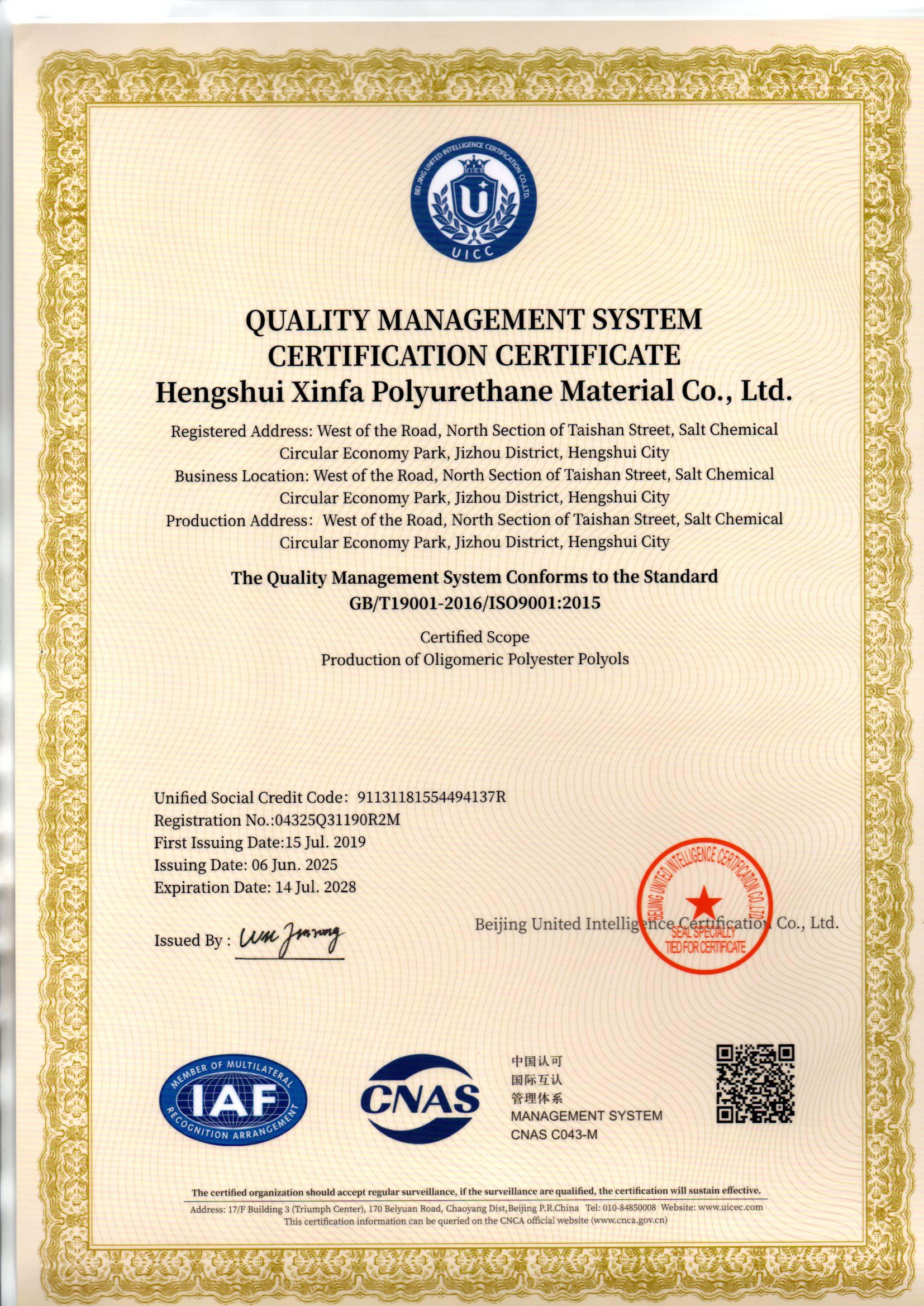
The ISO 9001 certificate states a scope of production, a certificate number and an expiry date — all three need to appear in the dossier, not just the logo.
Diary management is part of compliance. The quality certificate runs to 2028-07-14 while the environmental and occupational health certificates run to 2029-06-14, so a file assembled today will contain documents that expire at different times. Recording both dates beside the certificate numbers turns renewal from a scramble into a scheduled request.
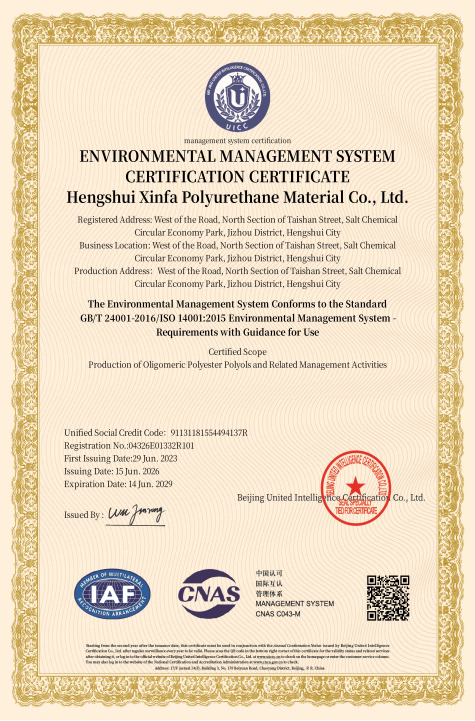
The environmental certificate carries the same product scope plus related management activities, and a later expiry date than the quality certificate.
Regional Questions to Settle Before a Quotation Is Issued
Documentation expectations differ by destination and, just as often, by the buyer's own downstream customer. XINFA's stated export markets span Europe, the Middle East, Southeast Asia, Central Asia, India, Pakistan, South America and North America, which means the same grade can require different paperwork depending on where it lands. The following questions are the ones that change the document set rather than the price list, and they are best asked while the quotation is still open.
- Who is the importer of record, and who in the chain holds the chemical inventory registration or notification the destination expects for each substance?
- Which safety data sheet revision and which language does the destination require, and does the supplier's current revision match the format the local authority accepts?
- What customs classification will be declared, and does the commercial invoice description match the classification rather than the grade nickname?
- What transport classification does the safety data sheet state, and does the destination add labelling beyond it?
- Which declarations does your own downstream customer require — restricted substance statements, origin statements, or customer-specific forms the supplier must sign?
- Does any document need legalisation, notarisation or a certified translation, and how long does that add to the shipment schedule?
- Will the destination accept scanned certificates, or does it require originals or a verification link to the issuing body?
- If a certificate expires mid-contract, who requests the renewed copy, and when?
None of these questions requires the supplier to make a legal determination about the destination market. Each requires the supplier to state what documents exist, who issued them, when they expire and what they do not cover — which is precisely the content of a dossier.
How Documentation Depth Changes by Application
High flame retardant grades for insulation systems
The high flame retardant family — XF-2007, XF-250P, XF-235P and XF-240P — is documented for high flame retardant applications, PIR spraying insulation, sandwich panels and polyurethane pipes. XINFA's application records for PIR sandwich panels and construction insulation list high flame retardancy, low odour and stable foaming performance as the special requirements of those systems. The documentation consequence is that flame performance is a property of the whole formulation and the finished product, not of the polyol alone. A dossier for this family therefore needs the polyol batch certificate plus a clear statement of which flame-retardant substances are present, at what identity, and whether any fire test evidence relates to the buyer's own system rather than to a supplier demonstration.
Pentane-blown and water-borne systems: documents outside the polyol sheet
Where the foam system is pentane-blown, or where the formulation is water-borne rather than solvent-borne, part of the compliance evidence sits outside the polyol technical data sheet. The blowing agent and any co-blowing component carry their own identity, safety and transport documents, and the file should state explicitly which document covers which component so that an auditor is not left to infer it. For water-borne formulations, confirm that the grade's moisture and acid-value limits on the current data sheet match your process window, and require the batch certificate to report those two parameters using the same methods — a common gap is a certificate that reports the right numbers from a different test procedure.
Mining grades: the tightest numeric window in the range
KXF-350 and KXF-280 are documented for mining applications with acid values of ≤2.0 and ≤1.5 mgKOH/g, moisture ≤0.1% and low viscosities of 1500±500 and 1000±200 CPS. Those limits are the narrowest in the published range, which makes batch-level evidence more valuable than specification-level evidence: a data sheet proves the grade can be made to that window, and only a lot certificate proves this delivery was. For mining buyers the practical addition to the dossier is a retained sample per lot and an agreed shelf-life statement, because both grades are usually consumed over a longer period than a single campaign.
Adhesive grades: viscosity as the controlling number
XF-Z and XF-280 are documented for sandwich panel adhesives, with hydroxyl values of 60±5 and 280±20 mgKOH/g. The contrast inside one family is instructive: XF-Z combines a low hydroxyl value with a viscosity of 10,000±2000 CPS, while XF-280 pairs a high hydroxyl value with a data sheet viscosity line printed as 15000–2000 CPS that requires written clarification. For adhesive buyers, viscosity is the number that determines whether the material pumps, meters and wets out, so the acceptance table should fix the test temperature, the spindle or method, and the permissible handling range at the mixing head rather than at the drum.
Controlled-release fertilizer coating grades
XF-270, XF-B-3 and XF-B-4 are documented for controlled-release fertilizer coating agents, with hydroxyl values of 260±10, 300±30 and 370±20 mgKOH/g and viscosities of 3000±500, 3000±500 and 3500±500 CPS. XF-270 is certified under ISO 9001:2015 for that coating application, which is a useful example of how certification supports an application claim without proving performance: the certificate supports the quality system behind the grade, while release behaviour in a coating line remains a matter for the buyer's own trials and audit records.
Documentation Emphasis by Application: A Comparison
The same six-layer dossier applies everywhere, but the weight shifts by application. The table below sets the published grade data beside the document that most often decides acceptance in that application.
| Application | Documented models | Limits that most often decide acceptance | Document to request first |
|---|---|---|---|
| High flame retardant insulation | XF-2007, XF-250P, XF-235P, XF-240P | Acid ≤1.5 to ≤2.0; moisture ≤0.1 to ≤0.15 | Additive identity statement and substance CAS entries |
| Mining | KXF-350, KXF-280 | Acid ≤2.0 / ≤1.5; moisture ≤0.1 | Lot certificate of analysis plus retained sample record |
| Adhesive | XF-Z, XF-280 | Viscosity 10,000±2000 CPS; written clarification on XF-280 | Corrected data sheet revision and viscosity method statement |
| Controlled-release fertilizer coating | XF-270, XF-B-3, XF-B-4 | Hydroxyl 260±10 to 370±20; acid ≤3±0.2 to ≤3.0 | ISO 9001 coverage statement for the coating application |
| Any application, first shipment | All covered models, including XF-235 and NXF-400 | Model match across order, certificate and label | Current certificate copies with numbers and expiry dates |
Comparison based on published grade parameters and certificate coverage; it compares documented characteristics, not measured application outcomes.
Commercial Terms That Reshape the Document Scope
Commercial terms are part of compliance because they determine how many documents a buyer will receive and when. XINFA's published capability data lists OEM/ODM production for polyester polyol, a minimum order quantity of 1 mt, a lead time of 15–20 days, a monthly capacity of 4,000 mt and 100% testing, with technical support and product training after delivery. Company profile data places annual polyester polyol production capacity at 50,000 tons of series products, supported by ISO 9001, ISO 14001 and ISO 45001 certification.
Each of those terms changes the paperwork. A 1 mt trial order and a multi-container order need different sampling plans, and the trial order is the right moment to agree the certificate of analysis format before it becomes a routine document. A 15–20 day lead time means the document pack must be specified at order confirmation rather than at loading, because legalisation or translation can take longer than production. OEM/ODM production raises a separate question that should be settled in writing: whose model designation appears on the certificate of analysis, on the drum label and in the dossier, since a private-label grade that is documented under one name and shipped under another will fail its first audit.
On price, the honest answer is that the supplied documentation does not publish a price band, and a dossier is the tool that makes a quotation comparable. Ask for a quotation issued against a written acceptance specification, and ask which variables move the number: grade, batch size, packaging, test scope and document language. That list, rather than a headline figure, is what a buyer can actually evaluate across suppliers.
Pre-Shipment Document Checklist
The checklist below is the minimum packet for a first shipment. It assumes the purchasing terms and acceptance criteria have already been agreed in writing, because a checklist cannot repair a specification that was never fixed.
| Document | What the buyer verifies before release |
|---|---|
| Certificate of analysis, per batch | Batch number matches drum label and packing list; all four parameters reported with units and methods; results inside the agreed bands |
| Technical data sheet, current revision | Revision number and date match the version referenced in the purchase order; model designation identical to the order |
| ISO 9001, ISO 14001, ISO 45001 copies | Certificate numbers, issuing body stated, expiry dates in the future at the planned delivery date, model inside the coverage list |
| Safety data sheet | Correct language and revision; transport classification consistent with the packing list |
| Packaging and label specification | Net weight per drum, label content, batch and model marking, language required by the destination |
| Packing list and commercial invoice | Grade description and quantity consistent with the order; classification and origin fields completed |
| Certificate of origin and any legalised documents | Issued in the required form; validity covers the shipment date |
| Retained sample record | Sample drawn, sealed and stored with batch identification for the agreed retention period |
| Deviation or concession note, if any | Signed before loading, naming the parameter, the measured value and the agreed disposition |
| Renewal schedule | Next expiry date recorded against each certificate, with the request date that keeps the file current |
Pre-shipment packet for a first polyester polyol order; the packet should be re-confirmed at each renewal cycle.
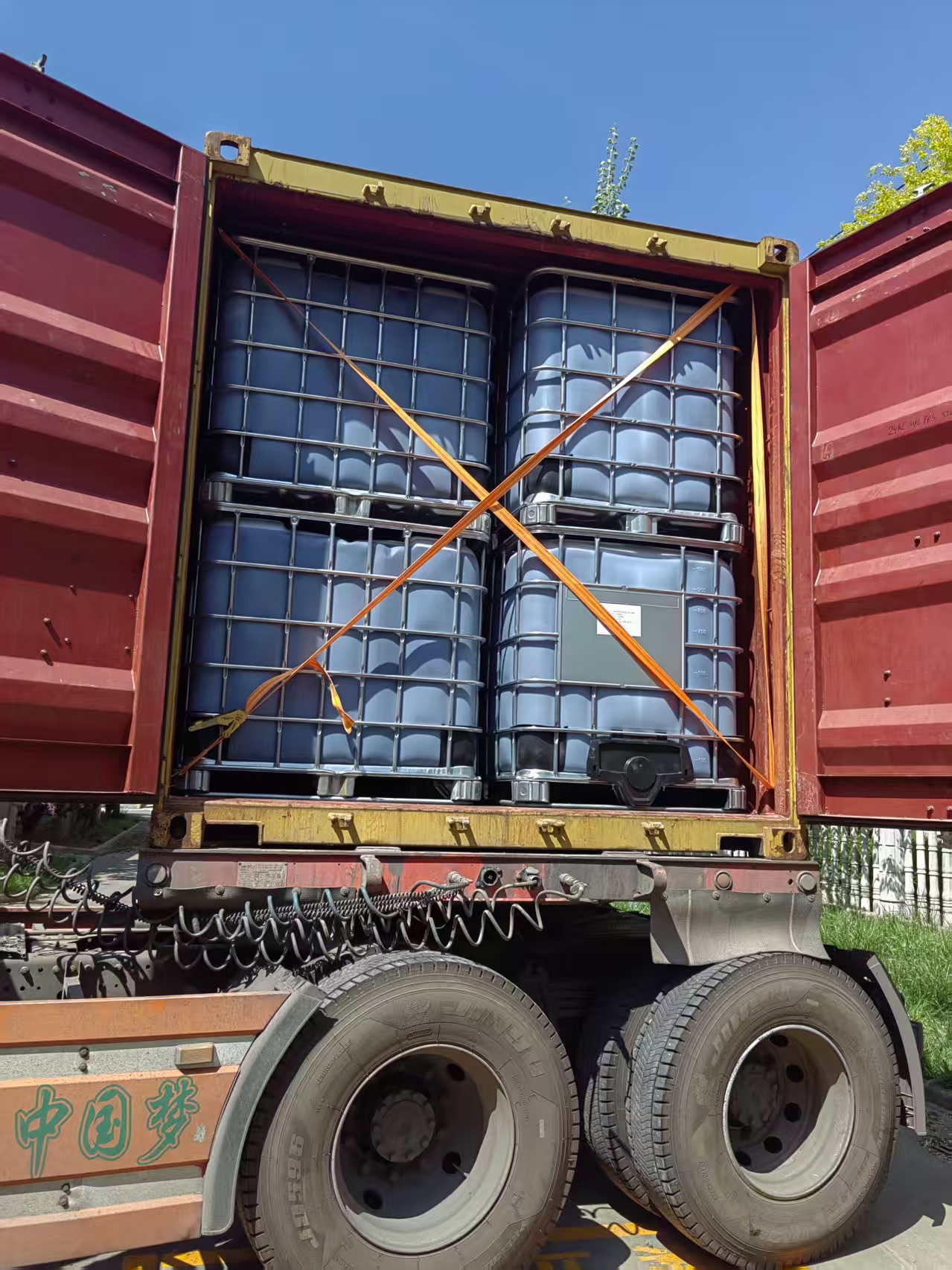
Packaging and marking belong in the dossier because the batch number must reconcile across the drum, the certificate of analysis and the packing list.
Two operational habits make the checklist survive contact with a real shipping schedule. The first is a single document owner on each side, named in the purchase order, so that a missing certificate has one route rather than three. The second is a pre-loading review date fixed backwards from the vessel, not from the factory gate — a rule that turns the 15–20 day production lead time into a workable document window.
Frequently Asked Questions
Is a technical data sheet enough to show that a polyester polyol grade complies?
No. A technical data sheet states what a grade is designed to be — hydroxyl value, acid value, moisture and viscosity with their tolerances — but it contains no measurement of the material you will receive, no batch identity and no evidence about the producer's management system. Compliance requires three additional layers: a certificate of analysis for the delivered batch, current copies of the relevant ISO certificates with their numbers, scopes and expiry dates, and the market documentation the destination requires. A data sheet is the reference point against which those documents are read.
Which certificate numbers should appear in the dossier?
Three, each with its standard and validity window. ISO 9001 is certificate 04322Q31390R1S against GB/T19001-2016 / ISO 9001:2015, valid to 2028-07-14, scoped to production of oligomeric polyester polyols. ISO 14001 is certificate 04326E01332R101 against GB/T 24001-2016 / ISO 14001:2015, valid to 2029-06-14. ISO 45001 is certificate 04326S01211R101 against GB/T 45001-2020 / ISO 45001:2018, also valid to 2029-06-14. All three were issued by Beijing United Intelligence Certification Co., Ltd., and the two later certificates extend their scope to related management activities alongside polyester polyol production.
Does the certificate coverage include every grade, including NXF-400?
The certificate product coverage lists specific model groups rather than an open-ended promise, and NXF-400 appears there together with XF-235. The listed groups also include XF-270, XF-B-3 and XF-B-4; XF-Z and XF-280; KXF-350 and KXF-280; XF-2007, XF-250P, XF-235P and XF-240P; XF-2003, XF-2006, XF-3153, XF-315G and XF-300W; XF-435, XF-390, XF-360, XF-2402N and XF-2020; and XF-3152, XF-2412, XF-1752 and XF-2002. A buyer ordering a model that does not appear in that list should ask for written confirmation of coverage before treating the certificate as evidence for that grade.
What commercial terms affect how the documents are issued?
XINFA's published capability data states OEM/ODM production for polyester polyol, a minimum order quantity of 1 mt, a lead time of 15–20 days, a monthly capacity of 4,000 mt and 100% testing, with technical support and product training after delivery. Each term changes the packet: a 1 mt trial order needs an agreed analysis format and sampling plan, and a 15–20 day lead time means documentation requirements should be fixed at order confirmation, particularly where translation or legalisation is involved. For OEM/ODM volumes, fix in writing whose model designation appears on the certificate of analysis, the label and the dossier.
What has to be in the packet before the container leaves?
At minimum: a batch certificate of analysis that reconciles with the drum label and packing list; the current technical data sheet revision referenced in the order; copies of the three ISO certificates with numbers, scopes and expiry dates; a safety data sheet in the required language; a packaging and labelling specification; a packing list and commercial invoice with consistent grade descriptions; origin or legalised documents where the destination requires them; a retained sample record; and any signed deviation note. The same packet becomes the reference file for the next order, so the renewal dates recorded against each certificate turn into the following year's requests.
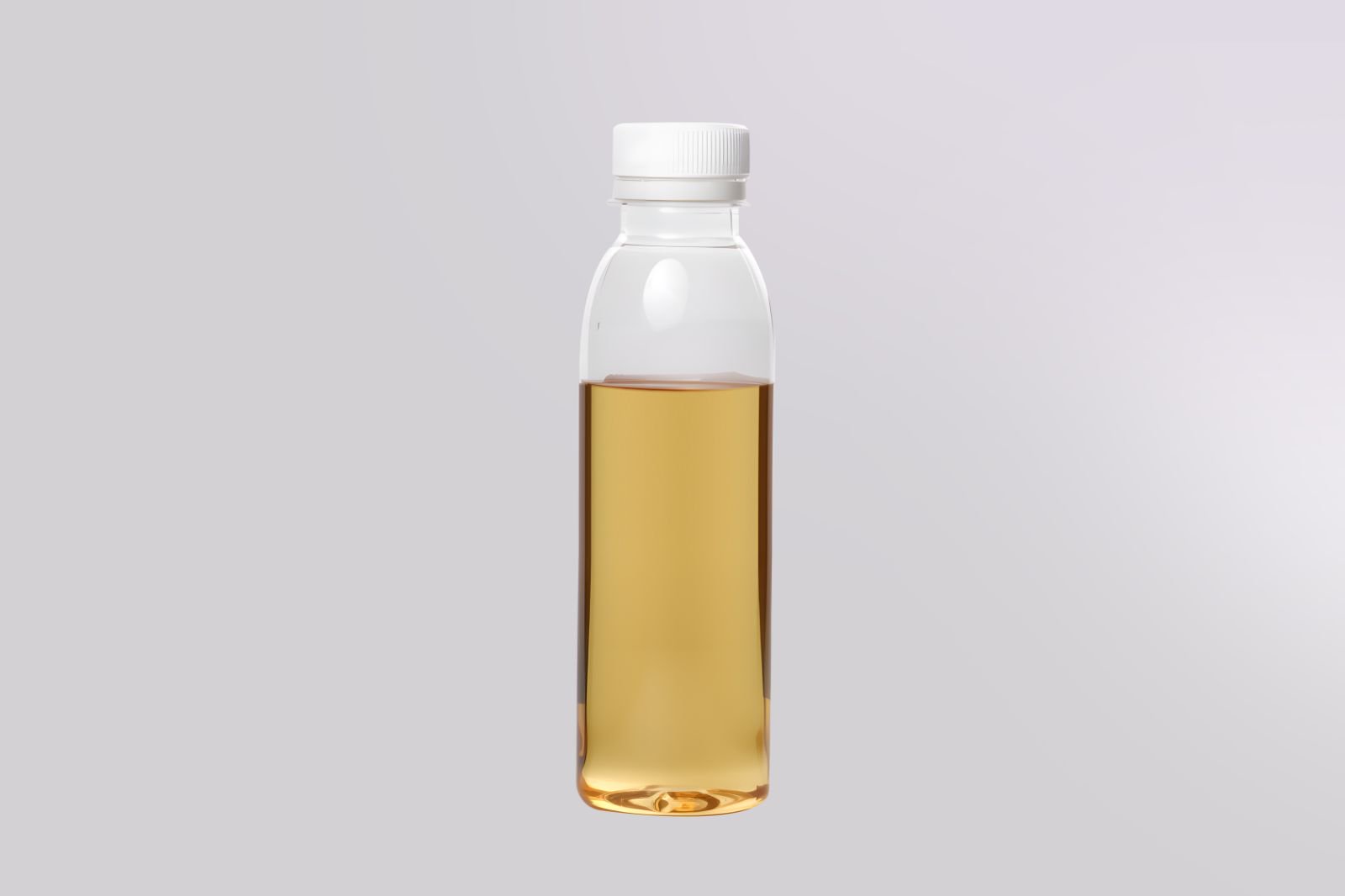
A product reference sheet belongs with the compliance file so that grade, model and application can be matched at a glance. The consolidated product and documentation overview can be downloaded from the XINFA brochure, and grade-level questions can be directed through Hengshui Xinfa Polyurethane Materials Co., Ltd.
Conclusion: The Dossier Is a Purchasing Control, Not a Paper Trail
A compliance dossier earns its place when it changes a decision: which grade is specified, what tolerance is accepted, which batch is released and which shipment waits. Read that way, the file is short and specific. It states the model and the data sheet revision, carries the four parameters with their units and tolerances, resolves ambiguous notation such as the XF-280 viscosity line and the XF-270 acid limit in writing, holds the three ISO certificates with their numbers and separate expiry dates, and records who is responsible for each remaining document.
For buyers in the research and evaluation stages, that file also does something a price comparison cannot. It makes two suppliers answer the same questions in the same language — which is the only basis on which high-flame-retardant, mining, adhesive and controlled-release coating grades can be compared at all. The specification sheet tells you what a supplier sells; the dossier tells you whether the shipment you receive will match it.
Have Questions or Need More Details?
Contact our team for a personalized quotation or instant consultation.
Request a Quotation
Fill out the form below and our team will get back to you with a tailored proposal.
WhatsApp Direct Chat
Prefer to chat in real-time? Message us on WhatsApp for instant assistance & quick answers.
- Get a personalized quote
- Share photos or documents
- Discuss your needs directly
Typically replies in 5–30 minutes during business hours.