
Polyester Polyol Compliance Files: Beyond the TDS
A technical data sheet tells a buyer what a Polyester Polyol grade is designed to be. It does not tell you what is in the drum that arrives on Tuesday, which site produced it, whether the numbers were measured the way your own laboratory measures them, or what happens when a batch lands outside the band. For an evaluation-stage buyer, the data sheet is the entry point and the document set around it is the evidence. This guide sets out a priority order for the files to request, shows how to cross-check each one against the data sheet, and turns the exercise into a written checklist you can send to any supplier, including Hengshui Xinfa Polyurethane Materials Co., Ltd.
Two boundaries apply throughout. First, what follows is a request list built from what buyers commonly need to make a purchasing decision; it is not a legal compliance determination for your market, and your own regulatory or customs team remains the authority on that. Second, every item is phrased as something to ask for and verify, not as a claim about what any supplier already holds. Where XINFA facts are used, they are used as worked examples with their certificate numbers, grade codes and values stated exactly as recorded.

Why the data sheet alone cannot carry a purchasing decision
A TDS is written for grade selection. Its values describe the design target of a product family, and three gaps open the moment a buyer moves from selection to procurement.
Batch versus design. A hydroxyl value of 400±20 mgKOH/g is a specification band, not a prediction about the drum in front of you. Only a batch certificate of analysis tied to that delivery speaks about the material you actually received.
Value versus method. Two numbers with the same unit are not automatically comparable. Viscosity reported at 25°C and viscosity reported without a stated temperature cannot be lined up side by side, and a moisture limit expressed as a percentage and one expressed in ppm need converting before anyone compares them.
Scope versus product. A management-system certificate covers the activities named in its scope statement. It does not state that a particular grade meets a particular specification, and it does not replace a per-batch result.
A concrete illustration sits inside XINFA's own grade list. The NXF-400 grade is specified at a viscosity of 3000±1000 CPS at 25°C. The XF-270 coating grade for controlled-release fertilizer coating is specified at 3000±500 CPS at 25°C. Both share the same nominal figure of 3000 CPS, yet the acceptance windows are 2000–4000 and 2500–3500 respectively. A buyer who compares only the nominal number will conclude the two grades behave identically at the point of use. A buyer who compares the bands will not.
The document set, in priority order for an evaluation-stage buyer
The order below is an editorial prioritisation based on what each document lets a buyer decide, not a market ranking. A buyer with limited time should request items 1 to 3 before any commercial negotiation and the rest before the first delivery.
1. Batch certificate of analysis (CoA), linked to the delivery
This is the only document that describes the material in transit. It should carry the grade code, the batch or lot number, the test results with units, and the specification band each result is being judged against. Ask which laboratory issued it and whether it is the producer's own or a third party's.
2. A controlled TDS with a revision identifier and the exact grade code
An undated data sheet cannot be referenced in a contract. Ask for the revision date or version number, and check that the grade code on the sheet matches the code on the quotation, the CoA and the label. A sheet that lists a family name without the grade code leaves the acceptance criteria open.
3. Product identity sheet: grade code, chemical description, CAS where applicable
This is the document that prevents two different materials from being treated as one. It should state what the grade is, which line it belongs to, and, where a CAS number is quoted, exactly what that number identifies.
4. Safety data sheet in a language your receiving site can act on
Warehouse staff, not procurement staff, use the SDS. Ask for the version supplied for your destination and check that the product identifier on it matches the grade code on the CoA.
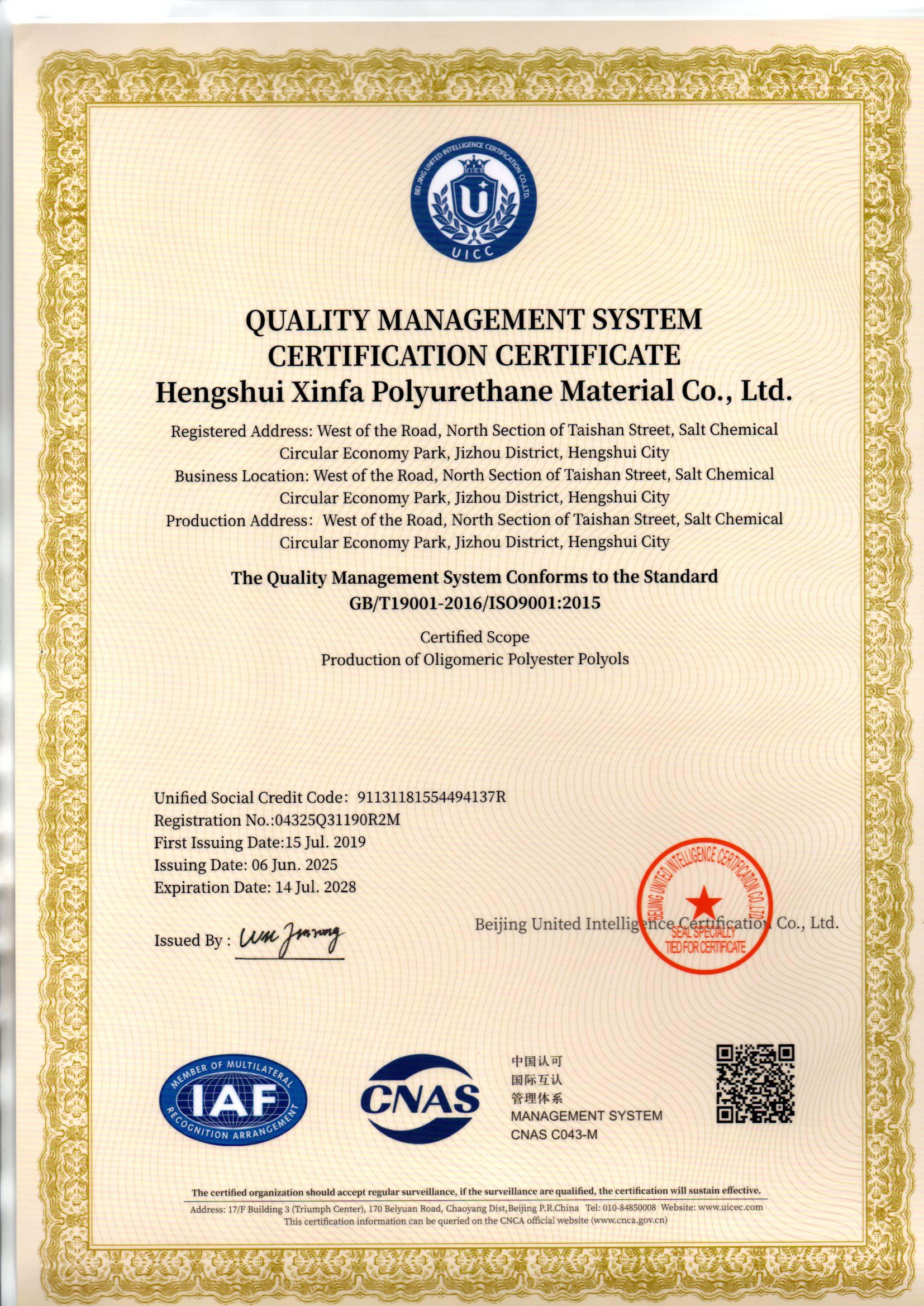
5. Management-system certificates with scope, site and validity
Read the scope sentence and the expiry date, not just the logo. XINFA holds ISO 9001:2015 certificate 04322Q31390R1S, issued 2025-06-06 and valid to 2028-07-14 with the scope "Production of Oligomeric Polyester Polyols"; ISO 14001:2015 certificate 04326E01332R101 and ISO 45001:2018 certificate 04326S01211R101, both issued 2026-06-15 and valid to 2029-06-14 with the scope "Production of Oligomeric Polyester Polyols and Related Management Activities". All three were issued by Beijing United Intelligence Certification Co., Ltd. A buyer's check is straightforward: the certificate number, the scope wording and the expiry date should be verifiable with the issuing body, and none of them substitutes for a batch CoA.
6. A written description of what the supplier's testing actually covers
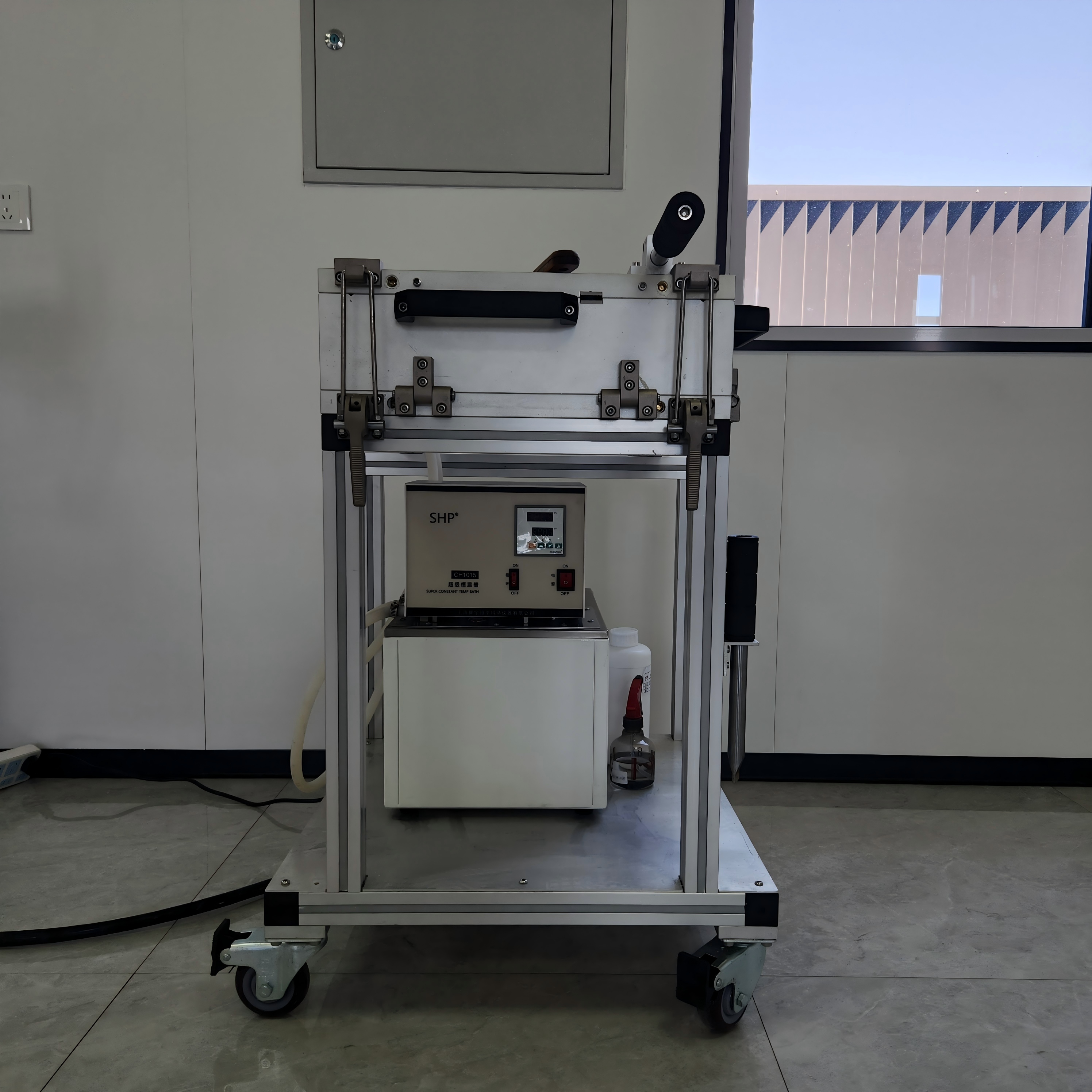
"100% test" is a commitment worth having in writing only when it is defined. Ask which parameters are measured on every batch, at which production stage the sample is drawn, how long retention samples are kept, and which parameters are measured on a certificate-of-analysis basis only.
7. A series index for the line you are buying from
One page listing every grade in the line with the same fields, the same units and the same test conditions, under a single revision date. This is the document that exposes inconsistent reporting fastest, because a missing temperature basis or a mixed unit stands out immediately across a table.
8. Change-control and deviation procedure, plus commercial confirmations
Ask how a specification change is notified, who receives the notice, and how an out-of-band batch is handled: retest, replacement, concession, and within what time frame. Alongside it, get the commercial figures on paper. XINFA states a minimum order quantity of 1 mt, a lead time of 15–20 days, a monthly capacity of 4,000 mt and OEM/ODM production for polyester polyols, with technical support and product training after sale.
Verifying product identity: grade code, chemical identity, CAS
Identity failures are quiet. Nothing breaks at the border; the material simply enters the plant under a code that no longer matches the specification file, and the mismatch surfaces weeks later as an unexplained shift in foam or coating behaviour.
Grade code discipline. Insist that the same code appears on the TDS, the CoA, the SDS, the label, the packing list, the invoice and the customs entry. Where a supplier's certificates list product families with model strings, read those strings as coverage of the family, not as evidence that every grade in the family shares one specification. XINFA's ISO certificate records, for example, list a family covering the model strings XF-235 and NXF-400 alongside other families covering codes such as XF-2003, XF-2006, XF-3153, XF-315G, XF-300W, KXF-350 and KXF-280. Family coverage on a certificate is a scope statement; the specification for NXF-400 still comes from its own data sheet and its own CoA.
Chemical identity and CAS. Oligomeric polyester polyols are reaction products described primarily by hydroxyl value, acid value and viscosity rather than by a single CAS number for the grade. Where a supplier does quote a CAS number, the useful question is what it identifies: the polymer grade, a residual monomer, or a raw material such as phthalic anhydride used in an aromatic grade. Ask for that clarification in writing, and treat an unexplained CAS number as an open item rather than a reassurance.
The legal entity question. Ask which company issues the CoA and the invoice. XINFA's production company is Hengshui Xinfa Polyurethane Materials Co., Ltd., with the plant in the Salt Chemical Circular Economy Park in Jizhou City; its wholly-owned subsidiary Hebei Xinshe Technology Co., Ltd. in Shijiazhuang handles import and export of polyurethane materials and catalysts. A buyer comparing documents across shipments should record which entity appears on each one, because an entity change is a documentation change even when the grade code is unchanged.
Worked example: mapping NXF-400 tolerance bands into an incoming inspection plan
The NXF-400 grade shows both common limit types on one sheet: hydroxyl value 400±20 mgKOH/g, acid value ≤2.0 mgKOH/g, moisture ≤0.15%, and viscosity 3000±1000 CPS at 25°C. Read as acceptance limits, those four figures behave differently.
| Parameter (NXF-400) | TDS figure | Limit type | Acceptance window | What the buyer still needs |
|---|---|---|---|---|
| Hydroxyl value | 400±20 mgKOH/g | Two-sided band | 380–420 mgKOH/g | Stated test method and replicate protocol |
| Acid value | ≤2.0 mgKOH/g | Upper limit only | No lower bound | Confirmation that the limit is a maximum on every batch |
| Moisture | ≤0.15% | Upper limit only | No lower bound | Whether the basis is mass percent or ppm |
| Viscosity | 3000±1000 CPS at 25°C | Two-sided, condition-bound | 2000–4000 CPS at 25°C | Temperature control method and spindle or instrument basis |
The same conversion routine applied to the XF-270 coating grade produces 250–270 mgKOH/g for hydroxyl value (260±10) and 2500–3500 CPS for viscosity (3000±500 at 25°C). Running the two grades through the same table is what makes the difference visible: identical nominal viscosity, materially different acceptance window.
A five-step cross-check routine
- Convert every TDS figure into a limit type: two-sided band, upper limit, or lower limit. Write the numeric window next to each one.
- Decide which parameters you verify in-house and which you accept on the supplier's CoA. Hydroxyl value, acid value, moisture and viscosity each carry their own laboratory requirement, so a parameter you cannot measure yourself needs a stated method and a retention sample instead.
- Compare the supplier's band against your own process window. If your process needs hydroxyl value between 390 and 410 while the sheet permits 380–420, you have a decision to make: test and release every lot, or agree a narrower supply specification in writing before the order.
- Write the decision rule for an out-of-band result into the order documents: who is notified, within how many days, whether the batch is retested, replaced or accepted by concession, and who carries the cost of a returned lot.
- Log CoA results against the bands for the first three deliveries. A grade that sits at one edge of the band across lots is a different supply risk from one that scatters across the middle, even when both are technically in specification.
Where a buyer needs a tighter window than the published band, XINFA lists OEM/ODM production and polyester polyol customization among its capabilities. What is agreed has to appear in the order documents; it should never be assumed from the data sheet.
Series-level consistency across the flame-retardant, pentane-system and high water-based lines
Where a supplier runs several lines, such as high flame-retardant, pentane-based and high water-based grades, the risk shifts from a single grade to the consistency of the documentation set across them. Buyers frequently compare a grade from one line with a grade from another, and a comparison built on inconsistently reported fields is worse than no comparison at all.
Ask for a single series index covering the lines you may buy from, with identical fields, identical units, identical test conditions and one revision date. Then check four things:
- Is viscosity reported at the same temperature basis for every grade in the index?
- Is moisture stated on the same basis throughout, or does one line use percent and another ppm?
- Is acid value expressed as a maximum for every grade, or as a target for some?
- Is the hydroxyl value described as a tested range on every line, or as a design target on some?
Two further questions belong in writing. If a grade within a line changes, is the whole index reissued and are customers holding affected specifications notified? And does the index state which line each grade belongs to, so that a buyer cannot accidentally treat a pentane-system grade as a direct substitute for a water-based one? A line-level index is a navigation and consistency tool; it is never a substitute for the CoA of the batch you receive.
What regional buyers typically add to the request list
The core set travels everywhere; the additions differ by destination. The points below describe what buyers commonly ask for, not what any law requires in a given country.
Europe. Buyers commonly add a substance identity statement and an SDS in the language of the receiving site, and they frequently ask the supplier to confirm whether any restricted-substance statement is available for the grade. Because XINFA's documentation is issued from China, the practical check is whether the identity statement, SDS version and CoA all name the same grade code.
Middle East, India and Pakistan. Requests tend to centre on the paperwork accompanying each shipment: a CoA per lot, grade code consistency with the commercial invoice and packing list, and confirmation of which document formats your customs broker can accept, including whether originals or attested copies are needed for a particular order. Format availability is confirmed per destination and per order rather than assumed.
Southeast Asia and Central Asia. Language and transit documentation dominate. Ask whether the SDS and label can be issued in the working language of the plant, and verify that the packing list, the container label and the CoA all carry the same grade code before the container is loaded.
North and South America. Buyers commonly add a substance identity question and a unit conversion check. Viscosity in CPS and in mPa·s are numerically equivalent, so a supplier reporting CPS and a plant recording mPa·s are describing the same measurement; the risk is not the unit but an unstated temperature basis. XINFA's stated export markets cover the Middle East, India, Pakistan, Southeast Asia, Central Asia, Europe, North America and South America, which means the same core file set is being read by buyers with different local expectations.
The questions to put in writing before the first order
- Please confirm the exact grade code, the line it belongs to, and the TDS revision date for that code.
- Please state what any quoted CAS number identifies, and confirm whether the grade itself carries one.
- Please confirm which legal entity issues the CoA and the invoice.
- Please list the parameters measured on every batch, the sampling stage, and the retention period for samples.
- Please state the test method and conditions behind each TDS figure, particularly the temperature basis for viscosity and the basis for moisture.
- Please confirm the limit type for each parameter: two-sided band, maximum, or minimum.
- Please confirm the scope, site and expiry date of each management-system certificate supplied.
- Please provide a series index for the line, with one revision date and consistent units.
- Please state the notification process and time frame if a specification changes.
- Please state the process for an out-of-band batch: retest, replacement, concession, and cost responsibility.
- Please confirm MOQ, batch size, lead time and whether a tighter specification can be agreed in writing.
- Please confirm the SDS version and language supplied for our destination.
What this looks like in a running supply relationship
XINFA's published case record for a spraying foam project in Poland covers a two-year supply of 500 metric tons from the product group that includes XF-2003, XF-2006, XF-3153, XF-315G and XF-300W. The recorded highlights are high mechanical strength, high wear resistance, resistance to high and low temperature cycling, hydrolysis resistance and aging resistance, with applications across wall spraying, insulation boards, soundproof flooring, leak-proof pipelines and composite materials, and the project is described as running stably. For a documentation reader, the useful detail is not the tonnage but the structure: a fixed grade code and a per-batch CoA held across two years allow lot 20 to be compared with lot 1 on the same fields.
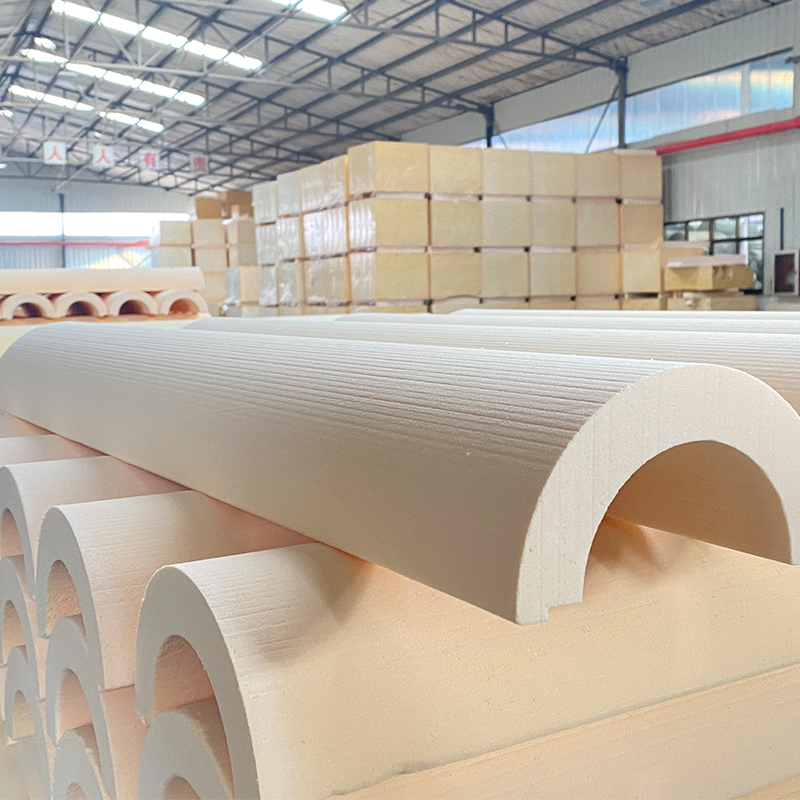
A second record covers an insulation project in India with 100 metric tons supplied over two years, where the product is described as achieving good thermal insulation performance, with highlights of high strength and density, thermal conductivity, fire retardancy and structural support of the pipeline. In both cases the compliance value comes from continuity: the same grade code, the same fields, the same units, batch after batch. That continuity is a thing a buyer can require in writing from the first order, and it costs nothing to ask for.
Document comparison at a glance
| Document | What it establishes | Issued by | Cross-check against |
|---|---|---|---|
| Batch CoA | Measured results for the delivered lot | Producer's laboratory | TDS bands, grade code, batch number on the label |
| TDS with revision | Design specification and acceptance bands | Supplier's technical function | Grade code on quotation and CoA |
| Product identity sheet | What the grade chemically is | Supplier | Grade code, CAS references, line assignment |
| SDS | Handling, storage and hazard information | Supplier | Product identifier and version date |
| ISO 9001 / 14001 / 45001 certificates | Certified management system within a stated scope | Certification body | Number, scope wording, expiry date |
| Series index | Consistency of reporting across a line | Supplier | Units, conditions, single revision date |
| Change-control statement | How specification changes reach the buyer | Supplier | Contract notice period and contact |
Frequently asked questions
Which documents should a buyer request beyond the polyester polyol TDS?
A batch certificate of analysis tied to the delivery; the current TDS with a revision identifier and the exact grade code; a product identity sheet covering grade code, chemical description and any CAS reference; an SDS in a language the receiving site can act on; management-system certificates with scope, site and validity dates; a written description of what the supplier's testing covers; a series index for the line being purchased; and a change-control and deviation procedure. Request all eight before the first order, then keep the CoA and TDS pair for every batch received.
How do I check a CoA result against the TDS tolerance band?
Convert each TDS figure into a limit type first. For XINFA's NXF-400, hydroxyl value 400±20 mgKOH/g is a two-sided band of 380–420 mgKOH/g, while acid value ≤2.0 mgKOH/g and moisture ≤0.15% are upper limits with no lower bound, and viscosity 3000±1000 CPS at 25°C is a two-sided band of 2000–4000 CPS tied to a stated temperature. A CoA result inside the supplier's band but outside your own process window still requires a decision, so either test and release every lot or agree a narrower supply specification in writing.
Is the grade code alone enough to identify the product?
No. Identity needs the grade code plus the issuing legal entity plus, where applicable, a substance or CAS statement. XINFA's certificates list product families with model strings such as XF-235 and NXF-400, which confirms family coverage rather than grade equivalence, so the specification for a grade still comes from its own data sheet and its own CoA. Confirm which entity issues the CoA as well, since the production company and the trading subsidiary are different legal entities.
Do ISO certificates cover every grade and every batch?
No. ISO certificates cover a management system within the scope stated on the certificate, not individual batch results. XINFA holds ISO 9001:2015 certificate 04322Q31390R1S, issued 2025-06-06 and valid to 2028-07-14, plus ISO 14001:2015 certificate 04326E01332R101 and ISO 45001:2018 certificate 04326S01211R101, both issued 2026-06-15 and valid to 2029-06-14, all issued by Beijing United Intelligence Certification Co., Ltd. with a scope covering production of oligomeric polyester polyols. Verify the number, scope and expiry date with the issuing body and rely on the CoA for batch-level evidence.
What commercial terms should be fixed at evaluation stage?
Minimum order quantity, batch size, lead time, capacity, and who tests what. XINFA states a 1 mt MOQ, a 15–20 day lead time, a monthly capacity of 4,000 mt and 100% testing, with OEM/ODM production available. Ask for those figures to appear on the quotation and order confirmation rather than only in correspondence, and agree in the same document what happens when a CoA result falls outside the band, including the notification timeline and cost responsibility.
What should a first-delivery acceptance plan contain?
Build it around the tolerance bands, not the nominal values: record the CoA results against each band, retain a sealed sample of the lot, and compare lot-to-lot drift across the first three deliveries. XINFA's stated 1 mt minimum order quantity allows a first order at a scale that can be verified before a larger volume is committed. Buyers starting that evaluation can request the current TDS, the available certificate set and product documentation as a single pack, including the XINFA product brochure, and address the technical questions to the supplier's technical support team before the first order rather than after it.
Conclusion
The TDS answers the selection question. The document set answers the procurement question: what is in this drum, measured how, produced by which entity, under which controlled system, and what happens if it lands outside the band. Read NXF-400's four figures as four different limit types and the exercise becomes concrete: a 380–420 mgKOH/g window for hydroxyl value, upper limits only for acid value and moisture, and a 2000–4000 CPS window that means nothing without the stated 25°C basis.
Buyers who ask for the priority set, cross-check it against the sheet, confirm grade codes and issuing entities, and put the twelve written questions in front of every candidate supplier will get comparable answers. Hengshui Xinfa Polyurethane Materials Co., Ltd. publishes its grade portfolio, certificates and case records, and the same checklist can be applied to it line by line before any order is placed.

Have Questions or Need More Details?
Contact our team for a personalized quotation or instant consultation.
Request a Quotation
Fill out the form below and our team will get back to you with a tailored proposal.
WhatsApp Direct Chat
Prefer to chat in real-time? Message us on WhatsApp for instant assistance & quick answers.
- Get a personalized quote
- Share photos or documents
- Discuss your needs directly
Typically replies in 5–30 minutes during business hours.