
Polyester Polyol Compliance Guide: Certification, Standards & Regional Requirements
Polyester Polyol Compliance Guide: Certification, Standards & Regional Requirements
Polyester polyol compliance is proven by three document layers, not one: management-system certificates, the product technical data sheet (TDS), and the batch certificate of analysis (COA). A supplier can hold valid ISO certificates and still fail a buyer's approval process if the certificate scope, validity window or batch parameters do not match the grade actually shipped. This guide explains how to read each layer, what changes between regions and end uses, and how a defined grade such as NXF-400 — hydroxyl value 400±20 mgKOH/g, acid value ≤2.0 mgKOH/g, moisture ≤0.15%, viscosity 3000±1000 CPS at 25°C — becomes a verifiable specification rather than a marketing claim.

Problem Definition: Why Polyester Polyol Compliance Reviews Break Down
Compliance problems in polyester polyol sourcing usually surface after a certificate has already been accepted, not before. A buyer receives a PDF with an ISO mark, files it, and later discovers that the document covers a different legal entity, an expired window, or a production scope written in wording that does not match the grade on the shipping papers. In practice, four mismatches cause most of these failures.
- Scope mismatch. The XINFA ISO 9001 certificate scope reads “Production of Oligomeric Polyester Polyols”. A certificate issued against a trading, warehousing or distribution scope does not evidence production control, even if the ISO number looks identical.
- Validity mismatch. Issue and expiry dates must bracket the order and shipment dates. XINFA's ISO 9001 certificate was issued on 6 June 2025 and is valid to 14 July 2028; the ISO 14001 and ISO 45001 certificates were issued on 15 June 2026 and are valid to 14 June 2029.
- Parameter mismatch. A COA value outside the TDS band, a missing unit of measure, or a viscosity figure with no temperature basis makes a batch impossible to verify against the specification it is sold on.
- Application mismatch. A grade documented for spraying foam is not automatically documented for controlled-release fertilizer coating, sandwich panel adhesives or mining. The chemistry may be adjacent; the paperwork is specific.
A compliance guide is therefore not a checklist of certificates. It is a mapping exercise that runs in one direction: product identity → specification band → batch evidence → destination market → end use. When any link in that chain is missing, the buyer carries the risk.
Industry Background: Scale, Catalysts and an Application-Organized Supply Base
The commercial context matters because compliance expectations scale with market size. The global polyester polyol market is projected to reach USD 10.1 billion in 2025, according to Future Market Insights. On the catalyst side that sits alongside polyol selection, the triethylenediamine (TEDA) market was estimated at USD 0.74 billion in 2024 and is expected to grow at a CAGR of 5.1% to reach USD 1.22 billion by 2034, according to Market Research Future data published via EINPresswire.
Supply in this category is concentrated among manufacturers whose portfolios are organized by application rather than around one generic grade. Hengshui Xinfa Polyurethane Materials Co., Ltd. (XINFA) is one such manufacturer. Established in 2010, XINFA operates a factory in the Salt Chemical Circular Economy Park in Jizhou City, on a 25,000 m² site, with an annual polyester polyol production capacity of 50,000 tons and 13 management and R&D technicians on staff. Its main markets include the Middle East, India, Pakistan, Southeast Asia, Central Asia, Europe, North America and South America, and its catalogue extends beyond polyester polyol into polyurethane catalysts and flame retardants such as TEDA, TEDA A33, PC-5, PC-8, PC-41, TCPP and TEP.
The compliance consequence of an application-organized portfolio is straightforward: the documentation a buyer needs is also application-organized. A mining polyol buyer and a controlled-release fertilizer coating polyol buyer are not looking for the same evidence, even though both may receive the same certificate set.
The Three Compliance Layers for Polyester Polyol
Compliance evidence arrives in three layers. Each layer answers a different question, and none of them substitutes for the others.
Layer 1 — Management System Certificates: does the supplier control production?
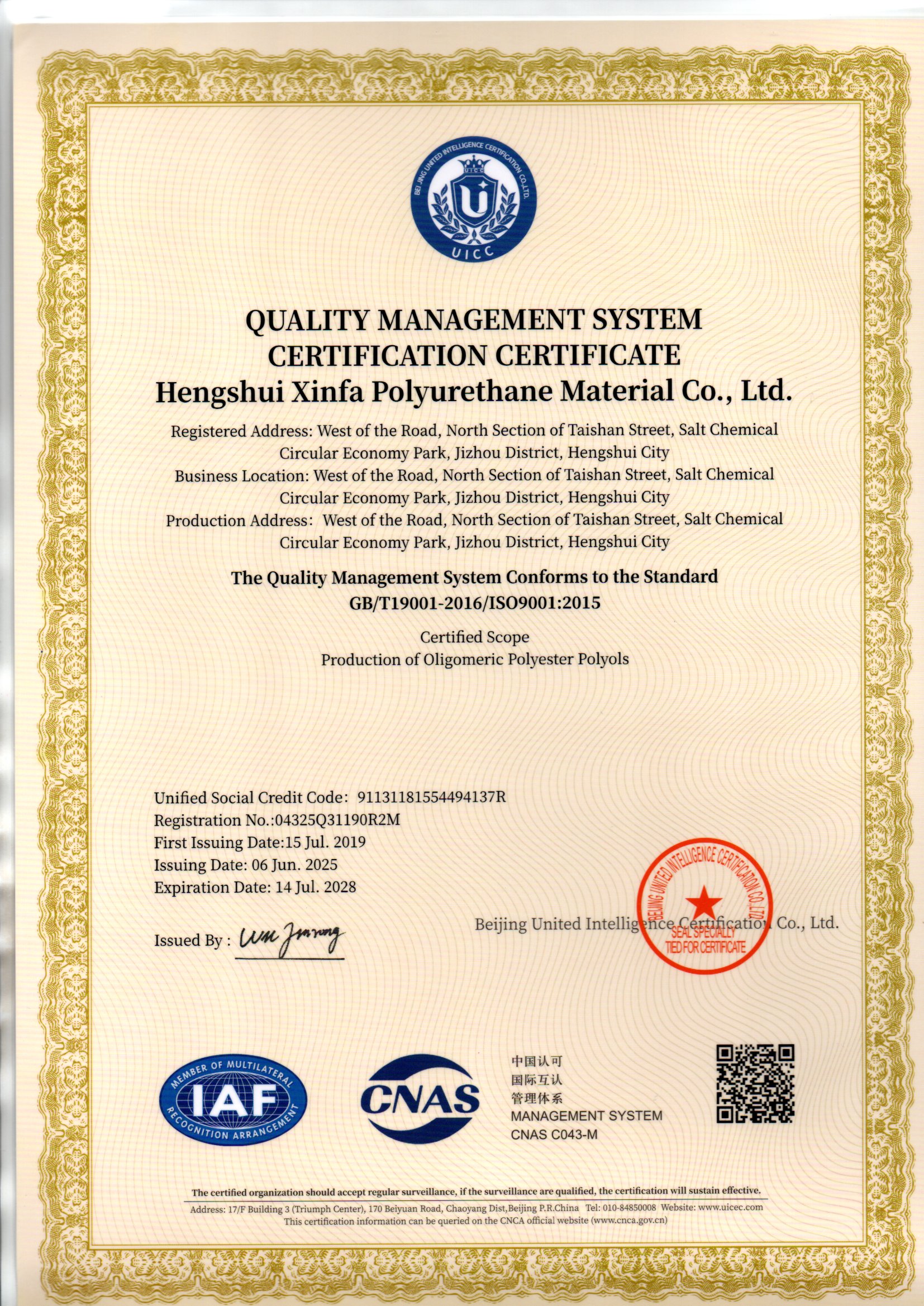
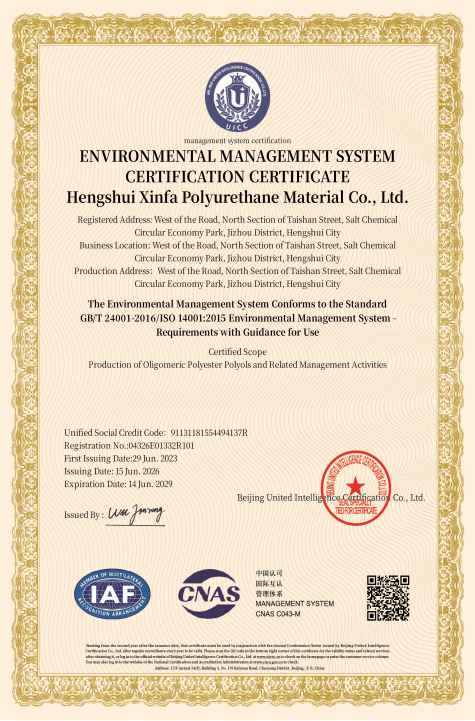
XINFA holds three management-system certificates, all issued by Beijing United Intelligence Certification Co., Ltd., all recorded with global market coverage, and all scoped to polyester polyol production.
| Certificate | Type | Certificate number | Standard | Issued | Valid to |
|---|---|---|---|---|---|
| ISO 9001:2015 | Quality management system | 04322Q31390R1S | GB/T 19001-2016 / ISO 9001:2015 | 2025-06-06 | 2028-07-14 |
| ISO 14001:2015 | Environmental management system | 04326E01332R101 | GB/T 24001-2016 / ISO 14001:2015 | 2026-06-15 | 2029-06-14 |
| ISO 45001:2018 | Occupational health & safety management system | 04326S01211R101 | GB/T 45001-2020 / ISO 45001:2018 | 2026-06-15 | 2029-06-14 |
The ISO 9001 scope covers the production of oligomeric polyester polyols. The ISO 14001 and ISO 45001 scopes extend that wording to “production of oligomeric polyester polyols and related management activities”. That single sentence is the part most buyers never read, and it is the part that determines whether the certificate actually applies to the plant making their order.
Layer 2 — TDS: product identity and parameter bands
A usable TDS must state the type name, the model numbers it covers, the material base, the application field, and the four core parameters with units. XINFA records, for example, XF-3152 under Phthalic Anhydride Polyester Polyol with a hydroxyl value of 315±15 mgKOH/g, acid value ≤2.0 mgKOH/g, moisture ≤0.1% and viscosity 3000±500 CPS at 25°C, built on a PA, PTA, AA, DEG and GLY material base and applied in spraying insulation, sandwich panels, polyurethane pipe, PU wood imitation and home appliances. A TDS that lists a grade without units, without a temperature basis for viscosity, or without stating the model numbers it governs is not a specification — it is a description.
Layer 3 — COA: batch-level proof, not a sample claim
The TDS defines the band; the COA proves that a specific batch sits inside it. XINFA applies 100% testing as its quality control standard, which means the certificate of analysis is issued per batch rather than extrapolated from periodic sampling. For a buyer, that is the difference between a document that describes a grade in general and a document that can be attached to a specific delivery and inspected on arrival.

The Four Parameters Buyers Must Verify, Using NXF-400 as a Worked Example
Four numbers decide whether a polyester polyol grade fits a process. NXF-400, listed by XINFA together with XF-235 under its Other Types Polyester Polyol group, is a useful worked example because all four parameters are defined with units and a temperature basis. Its material base is PA, PTA, AA, DEG and GL, and its stated application is spraying foam and sandwich panels.
| Parameter | What it controls | NXF-400 value | What to verify on the COA |
|---|---|---|---|
| Hydroxyl value | Reactivity and stoichiometric ratio with isocyanate | 400±20 mgKOH/g | Value inside the 380–420 band, and consistent with the formulation index |
| Acid value | Reaction kinetics and catalyst demand | ≤2.0 mgKOH/g | An upper limit, not a target; a rising acid value is an early stability signal |
| Moisture | Side reactions with isocyanate during foaming | ≤0.15% | At or below the limit at shipment; storage and handling conditions matter |
| Viscosity | Pumping, metering and spraying behaviour | 3000±1000 CPS at 25°C | Temperature basis must be stated; effective band is 2000–4000 CPS at 25°C |
Three interpretation rules follow from this table. First, a ± tolerance such as 400±20 is a bilateral band: a batch at 382 mgKOH/g is compliant, and so is one at 418 mgKOH/g, but they will not behave identically in a fixed formulation. Second, moisture and acid value are one-sided limits: ≤0.15% means the ceiling, and lower is not automatically better if it changes the reaction profile the formulator has balanced. Third, viscosity is meaningless without temperature — 3000±1000 CPS is defined at 25°C, so sampling temperature must be recorded alongside the result. A compliance review that checks these three rules before approving a supplier removes most of the ambiguity from a polyester polyol order.
How Regional and End-Use Requirements Change the Checklist
The chemical identity of polyester polyol does not change when it crosses a border, but the documentation emphasis does. Three variables drive regional differences in what buyers ask to see.
- How many management-system certificates are requested. Some supplier approval processes accept a quality certificate alone. Others expect environmental and occupational health and safety certificates as part of the same approval. XINFA holds all three, which means the same certificate pack can be submitted in every region it serves.
- Whether application evidence is required alongside the specification. Insulation projects, appliance foam lines, adhesive producers and agricultural coating applications each request different supporting material, and each reads the same TDS differently.
- End use. Spraying foam, sandwich panels, polyurethane pipe, home appliances, mining, adhesives and controlled-release fertilizer coating use different grades, and therefore different parameter bands.
Because the portfolio is grouped by application, the fastest way to align documentation with a region is to start from the end use and work backwards to the grade.
| Series | Models | Representative specification anchor | Primary application |
|---|---|---|---|
| Phthalic Anhydride Polyester Polyol | XF-3152; XF-2412; XF-1752; XF-2002 | XF-3152: hydroxyl 315±15 mgKOH/g, acid ≤2.0, moisture ≤0.1%, viscosity 3000±500 CPS at 25°C | Spraying insulation, sandwich panels, polyurethane pipe, PU wood imitation, home appliances |
| High Flame Retardant Polyester Polyol | XF-2007; XF-250P; XF-235P; XF-240P | XF-2007: hydroxyl 200±10 mgKOH/g, acid ≤2.0, moisture ≤0.1%, viscosity 15000±3000 CPS at 25°C | High flame retardant applications, PIR spraying insulation, sandwich panels, polyurethane pipes |
| Pentane System Polyester Polyol | XF-435; XF-390; XF-360; XF-2402N; XF-2020 | XF-390: hydroxyl 400±20 mgKOH/g, acid ≤2.0, moisture ≤0.15%, viscosity 2000±500 CPS at 25°C | Home appliances, polyurethane pipes, sandwich panels, PIR systems |
| Polyester Polyol for Mining | KXF-350; KXF-280 | KXF-350: hydroxyl 350±20 mgKOH/g, acid ≤2.0, moisture ≤0.1%, viscosity 1500±500 CPS at 25°C | Mining |
| High Water-based Polyester Polyol | XF-2003; XF-2006; XF-3153; XF-315G; XF-300W | XF-2006: hydroxyl 170±10 mgKOH/g, acid ≤0.5, moisture ≤0.1%, viscosity 1500±500 CPS at 25°C | High water-based or full water-based systems, spraying insulation, sandwich panels, polyurethane pipes |
| Polyester Polyol for Adhesive | XF-Z; XF-280 | XF-Z: hydroxyl 60±5 mgKOH/g, acid ≤5.0, moisture ≤0.15%, viscosity 10000±2000 CPS at 25°C | Sandwich panel adhesives |
| Controlled-release Fertilizer Coating Agent | XF-270; XF-B-3; XF-B-4 | XF-270: hydroxyl 260±10 mgKOH/g, acid ≤3±0.2, moisture ≤0.1%, viscosity 3000±500 CPS at 25°C | Controlled-release fertilizer coating agent |
| Other Types (NXF group) | XF-235; NXF-400 | NXF-400: hydroxyl 400±20 mgKOH/g, acid ≤2.0, moisture ≤0.15%, viscosity 3000±1000 CPS at 25°C | Spraying foam and sandwich panels |
Step-by-Step Breakdown: A Seven-Step Document Verification Workflow
- Match the legal entity. The certificate holder must be the legal manufacturer — for XINFA, Hengshui Xinfa Polyurethane Materials Co., Ltd. — not an intermediary with a similar trading name.
- Read the scope statement, not the logo. Confirm the scope covers production of oligomeric polyester polyols. On the XINFA ISO 14001 and ISO 45001 certificates, the scope adds “and related management activities”.
- Check the validity window against order and delivery dates. ISO 9001 runs from 6 June 2025 to 14 July 2028; ISO 14001 and ISO 45001 run from 15 June 2026 to 14 June 2029.
- Confirm standard versions. GB/T 19001-2016 / ISO 9001:2015, GB/T 24001-2016 / ISO 14001:2015 and GB/T 45001-2020 / ISO 45001:2018.
- Pull the TDS for the exact model. Record the type name, model number, material base, application field, and the four parameters with units and temperature basis.
- Match the batch COA against the TDS, line by line, at goods receipt. Flag any value that appears without a unit or without a stated test temperature.
- Map the grade to the destination market and end use. Keep the certificate set, TDS and COA together as one dossier per shipment, so the same file can be reused for the next audit.
Use Cases: Compliance in Documented Practice
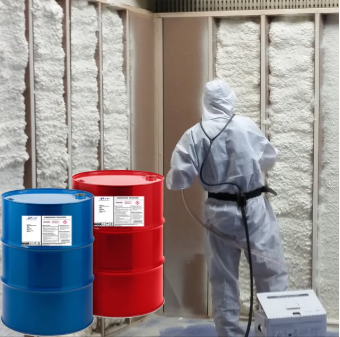
Poland — spraying foam, 500 metric tons over two years. A two-year project in Poland used 500 metric tons of the high water-based polyester polyol series (product group 3943) for spraying foam applications. The program recorded high mechanical strength, high wear resistance, resistance to high and low temperature cycling, hydrolysis resistance and aging resistance. It achieved stable operation across wall spraying, insulation boards, soundproof flooring, leak-proof pipelines and composite materials. For a European buyer, the value of this record is not the tonnage but the application list: the same documented grade carried a two-year operating history in several construction-related uses.
India — insulation industry, 100 metric tons over two years. An Indian project in the insulation industry used 100 metric tons over two years, achieving good thermal insulation performance, with the product successfully used by clients in the insulation industry. This is the type of regional reference that supports supplier approval in South Asia, where insulation and pipeline demand drives grade selection.
Controlled-release fertilizer coating. The coating-agent series — XF-270, XF-B-3 and XF-B-4 — occupies a different compliance position again: XF-270 carries a hydroxyl value of 260±10 mgKOH/g and a viscosity of 3000±500 CPS at 25°C, parameters that matter to coating uniformity rather than to insulation performance. Mining grades such as KXF-350 and KXF-280, and adhesive grades such as XF-Z and XF-280, follow the same pattern: an application-specific band, verified per batch.
Comparison Table: What Each Document Proves — and What It Does Not
| Document | What it proves | What it does not prove |
|---|---|---|
| ISO 9001:2015 certificate 04322Q31390R1S | A quality management system operates in the production of oligomeric polyester polyols | That a specific batch meets its TDS band |
| ISO 14001:2015 certificate 04326E01332R101 and ISO 45001:2018 certificate 04326S01211R101 | Environmental and occupational health and safety management in the same production scope | Product performance in the buyer's application |
| Technical data sheet (TDS) | The parameter band defined for a specific model and its material base | The measured result of the batch delivered |
| Certificate of analysis (COA), 100% testing | Batch-level values reported against the TDS band | Long-term performance in the final end use |
Read together, the four documents form a chain. Read separately, each one creates a false sense of security, which is why compliance reviews that start and end with a certificate folder tend to fail at the first batch dispute.
FAQ: Polyester Polyol Certification and Documentation
Which polyester polyol certificates should a buyer verify first?
Start with the three management-system certificates, then move to product documents. XINFA holds ISO 9001:2015 certificate 04322Q31390R1S for the production of oligomeric polyester polyols, issued on 6 June 2025 and valid to 14 July 2028, plus ISO 14001:2015 certificate 04326E01332R101 and ISO 45001:2018 certificate 04326S01211R101, both issued on 15 June 2026 and valid to 14 June 2029. All three were issued by Beijing United Intelligence Certification Co., Ltd. After the certificates, verify the TDS parameter band and the batch COA for the exact model being shipped.
Can polyester polyol be customized for a specific application or regional requirement?
Yes. XINFA operates an OEM/ODM customization model for polyester polyol with a monthly capacity of 4,000 mt, and its portfolio is already grouped into application-specific series: phthalic anhydride, high flame retardant, pentane system, mining, high water-based, adhesive, and controlled-release fertilizer coating, plus the XF-235 / NXF-400 group for spraying foam and sandwich panels. After-sales support covers technical support and product training.
What determines the cost of a compliant polyester polyol order?
No price list is published for polyester polyol; commercial terms are quoted per inquiry. Budget planning therefore rests on three documented variables: the grade selected, the confirmed order quantity against a minimum order quantity of 1 mt, and the documentation package required by the destination market and end use. Fixing these three points before requesting a quote keeps offers comparable between suppliers.
How can a buyer validate a polyester polyol grade before scaling up?
The smallest documented order unit is 1 mt, and XINFA applies 100% testing as its quality control standard, so the COA shipped with a batch can be checked line by line against the TDS band. For a first order, validation means selecting the application series that matches the end use, confirming the TDS parameters for the exact model, and comparing the received COA and a production trial against those values.
What lead time and production capacity should buyers plan for?
XINFA's documented lead time for polyester polyol is 15–20 days, against a monthly capacity of 4,000 mt and an annual polyester polyol capacity of 50,000 tons. Export markets include the Middle East, India, Pakistan, Southeast Asia, Central Asia, Europe, North America and South America. Buyers preparing a multi-region rollout can request a quote, the current TDS pack and the certificate set by writing to admin@xinfapu.com.
Conclusion: Compliance Is a Document Chain, Not a Certificate
Polyester polyol compliance holds up when three layers agree with each other and with the shipment: management-system certificates that name the manufacturer and cover oligomeric polyester polyol production, a TDS that defines the parameter band with units and a temperature basis, and a COA that reports each batch against that band. Regional requirements change which layer buyers scrutinize most and how much application evidence they request, but they do not change the underlying logic.
For grades such as NXF-400 — hydroxyl value 400±20 mgKOH/g, acid value ≤2.0 mgKOH/g, moisture ≤0.15%, viscosity 3000±1000 CPS at 25°C, applied in spraying foam and sandwich panels — that logic becomes concrete: four numbers, three documents, one dossier per shipment. Buyers can compare the XINFA certificate set and specification data with the polyester polyol product range before starting a supplier approval file.

Next Step: Build Your Compliance Dossier
Request the current certificate set, the TDS pack for the grade you are evaluating, and a quotation for the application you are targeting. Minimum order quantity starts at 1 mt, monthly capacity is 4,000 mt, and lead time is 15–20 days.
Contact: Jessica · admin@xinfapu.com · Tel +86 156-3365-7995 · WhatsApp · www.xinfapu.com
Download the full product catalogue: XINFA brochure (PDF)