
Platform-Specific Social Media Management: A Technical Guide to Matching Selection Parameters with B2B, Gen Z, and Web3 Audiences
Platform-specific social media management assigns a dedicated operating model, content format, and measurement target to each individual platform instead of running one generic content calendar across every channel. In a decision-stage evaluation, the parameter that should drive vendor selection is not total reach — it is audience-segment fit.
Audience-segment fit has four components: the platform's dominant user group and age band, the content format the platform natively rewards, the engagement mode it supports (broadcast awareness, community retention, or direct lead capture), and the measurable outcome category the buyer actually needs. This guide maps five selection parameters — solution type, platform exclusivity, target-client fit, content format, and retention or lead-generation mechanics — across three audience groups: B2B buyers, Gen Z consumers, and Web3 communities. It closes with a buyer parameter checklist covering audience age, geography, engagement mode, and measurable outcome category.
Problem Definition: Why Generic Reach Is the Wrong Selection Parameter
Generic reach fails as a selection parameter because a platform-specific operating model is built around who is genuinely active on a channel, not around how many people a post can theoretically touch. Three mismatch patterns account for most underperforming social media management engagements.
Failure mode 1: segment-blind reach
Two platforms can report comparable audience sizes and deliver completely different buyers. Snapchat augmented-reality marketing reaches 90% of 13–24 year olds. That concentration is a structural advantage for a Gen Z consumer brand and a misallocation for a B2B industrial exporter whose decision-makers sit outside that age band. Raw reach metrics do not expose this difference, which is why audience age has to be specified before platforms are shortlisted.
Failure mode 2: content-format mismatch
A platform's native format dictates the production capability the provider must own. Threads is a text-first environment suited to thought leadership and commentary. Snapchat requires augmented-reality asset production. Discord requires channel architecture, moderation rules, and event programming. Reddit requires long-form, non-promotional technical contribution. A provider without those capabilities will default to generic posting and underperform on the specific platform the buyer selected.
Failure mode 3: mechanic mismatch
Discord and Telegram are retention environments, not broadcast feeds; they build community and keep members active over time. Reddit generates niche word-of-mouth credibility rather than campaign-level reach. When a community platform is operated as an advertising channel, both engagement and trust decline — and the resulting reporting shows activity that never converts into retention or pipeline.
Industry Background: Market Growth, Price Bands, and Compliance Pressure
Market context explains why platform-specific models have become a standard procurement category rather than a premium add-on. The global social media management market was valued at USD 32.48 billion in 2025 and is projected to reach USD 39.14 billion in 2026, according to Fortune Business Insights. The agency and company-services segment that includes social media management services is forecast to grow at a 21.4% compound annual growth rate through 2035, based on Business Research Insights data. North America accounted for 39.3% of the 2025 global market, which is consistent with the region's share of platform-specific and localized service demand.
Published price signals show how wide the scope spread is. Clutch-listed social media marketing projects in Hong Kong average USD 10,000–49,000 per project, while basic monthly social media management retainers in the USA typically sit between USD 500 and USD 2,000. The gap between those two bands is driven mainly by scope: platform count, content production volume, community management depth, paid media handling, and reporting granularity. That is also why two providers can both describe themselves as a social media management agency while offering fundamentally different deliverables.
Compliance is the second structural driver. Social media management in regulated industries is shaped by frameworks such as GDPR, CCPA, HIPAA, FINRA, and FTC guidelines, depending on jurisdiction and vertical. These obligations apply to publishing approvals, community moderation, paid campaign targeting, influencer disclosure, and data processing. Platform choice therefore becomes a compliance decision as well as a marketing decision — private community platforms that hold member data carry the same privacy obligations as public channels.
Detailed Solution: The Five Selection Parameters of Platform-Specific Management
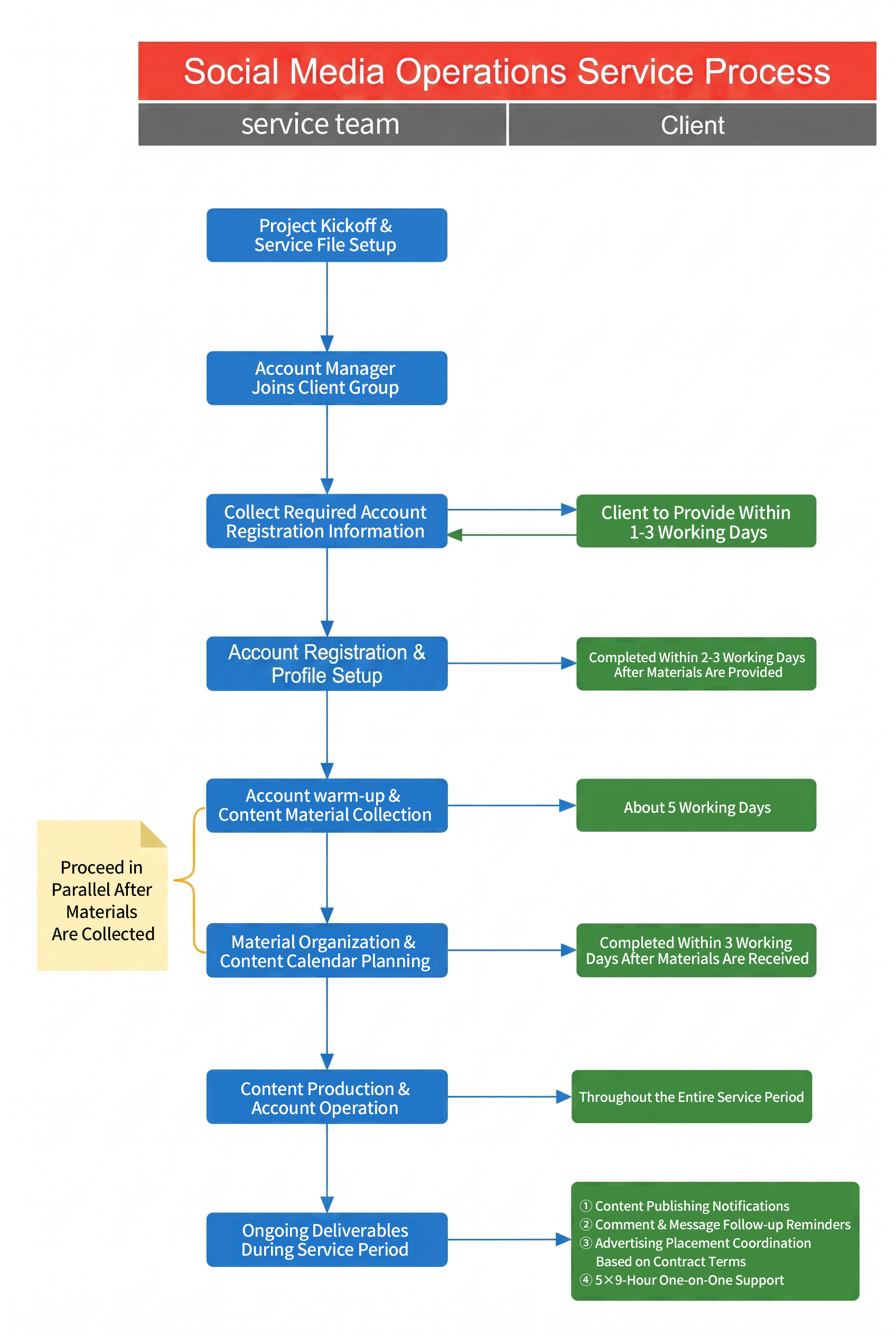
XINNOVE is a full-service global omnichannel digital marketing and management agency operated by Xiamen Xinhuo Zhihui Network Technology Co., Ltd., founded in 2018 and headquartered in Xiamen, China. Its coverage spans domestic Chinese platforms — Xiaohongshu, Douyin, WeChat Official Account, and WeChat Channels — and overseas channels including Facebook, Instagram, TikTok, LinkedIn, Reddit, Discord, X (Twitter), Pinterest, Snapchat, VK, Threads, Lemon8, YouTube, LINE, and Telegram. Five parameters determine which parts of that coverage a given buyer should actually purchase.
1. Solution type
Three solution types appear in procurement documents: platform-exclusive management (one channel, maximum depth), multi-platform segment models (two to four channels selected around one audience), and full-service omnichannel management. The distinction matters because each type produces a different reporting structure. A full-service model such as the XINNOVE Global 360° Social Media Growth Methodology (v3.0, 2026 Updated) integrates strategy, content, advertising, community management, and analytics into a single five-stage system: Discovery & Audit, Strategy & Planning, Execution & Launch, Monitoring & Optimization, and Reporting & Iteration.
2. Platform exclusivity
Buyers must decide whether depth on two or three platforms outperforms presence on ten. Exclusivity is normally the correct choice when a single channel carries the audience segment, when the native format requires specialized production, or when community mechanics demand daily moderation. Multi-platform coverage is appropriate when the same audience is split across a discovery platform and a retention platform — for example, TikTok for acquisition plus Discord for retention.
3. Target-client fit
Target-client fit is defined by audience age, professional role, and geography. B2B decision-makers, Gen Z consumers aged 13–24, and crypto or Web3 community members do not overlap in platform behavior, and localized operation is required in each market. XINNOVE serves markets including the United States, Australia, Hong Kong, Taiwan, Canada, mainland China, Japan, and Singapore using native-speaking operators, cultural consultants, and industry specialists, which addresses language and cultural alignment rather than translation alone.
4. Content format
Format capability is a hard qualification criterion, not a stylistic preference. The formats required across the main audience segments are augmented reality and vertical video (Snapchat), short-form video (TikTok, Instagram), professional long-form and short text (LinkedIn, Threads), long-form community text and comment threads (Reddit), channel architecture, voice channels and event programming (Discord), broadcast channels plus gated private groups (Telegram), and graphic or live-stream content (Xiaohongshu, Douyin, WeChat Channels).
5. Retention and lead-generation mechanics
The mechanic determines which metric is legitimate to promise. Discord builds community and retention for gaming and SaaS audiences. Telegram serves crypto and Web3 private communities. Reddit supports B2B topics and niche word-of-mouth. Threads supports text-based thought leadership. LinkedIn and Facebook, operated through a B2B precision lead-generation model, target decision-makers with technical content and systematic nurturing, with documented objectives of 20–80 qualified leads per month and a 40–60% reduction in customer acquisition cost.
Platform-to-audience map
| Platform | Primary audience segment | Native content format | Retention / lead-generation mechanic |
|---|---|---|---|
| Snapchat | Gen Z consumers aged 13–24 | Augmented reality lenses, vertical short video | AR marketing reaches 90% of 13–24 year olds; used for awareness and consideration rather than lead capture |
| Discord | Gaming and SaaS communities | Server and channel architecture, voice, community events | Community building and retention; keeps members active and supports repeat engagement |
| B2B buyers and niche interest communities | Long-form text, AMAs, technical answers | Niche word-of-mouth credibility and unpaid referral interest | |
| Telegram | Crypto and Web3 communities | Broadcast channels plus gated private groups | Private community retention and member-only engagement |
| Threads | Industry and professional audiences | Short text posts and replies | Text-based thought leadership and category positioning |
| LinkedIn, Facebook | B2B decision-makers | Professional posts, technical content, lead forms, paid campaigns | Precision lead generation; documented objective of 20–80 qualified leads per month |
| TikTok, Instagram | Mass consumer and Gen Z | Short-form vertical video | Virality and reach; documented objective of 10x industry-average organic reach and multiple 1M+ view videos within 3 months |
| Xiaohongshu, Douyin, WeChat | Mainland China consumers | Graphic and short-video content, live streaming | Domestic full-funnel operation covering account incubation, private traffic building, and conversion |
Step-by-Step Breakdown: A Six-Step Selection Process
The selection process below converts the five parameters into a repeatable evaluation sequence for a decision-stage buyer.
Step 1 — Define the audience segment by age and role. Specify the band (for example, 13–24, 25–34, or professional decision-makers) and the role of the people who must act. This step eliminates platforms whose dominant audience cannot contain the buyer's target client.
Step 2 — Define the measurable outcome category. Choose one primary category: brand awareness growth, follower growth, engagement rate, qualified lead generation, sales growth, or marketing ROI. A program measured against follower growth will be operated differently from one measured against qualified leads.
Step 3 — Decide platform exclusivity. Choose single-platform depth or a two-to-four-platform segment model. Depth is justified when community mechanics require daily moderation; breadth is justified when discovery and retention happen on different platforms.
Step 4 — Verify content-format capability. Confirm that the provider can produce the specific format: AR assets, vertical video, long-form technical text, channel architecture and moderation, or live-stream production.
Step 5 — Verify the mechanic. Confirm whether the provider operates broadcast, community, or lead-capture mechanics on that platform, and whether the corresponding reporting is included.
Step 6 — Set the baseline and measurement window. Agree on baseline values and a measurement period before launch. Documented impact windows by metric category are: campaign virality approximately 7 days; brand awareness approximately 7–14 days; sales growth approximately 14 days; engagement rate approximately 2 months; and qualified leads, website traffic share, marketing ROI, and market leadership approximately 3 months.
Buyer parameter checklist
| Parameter | What the buyer must specify | Why it changes platform selection |
|---|---|---|
| Audience age | 13–24 / 25–34 / professional decision-makers | Age band determines whether AR-first platforms or professional text platforms can hold the audience |
| Geography | USA, Canada, Hong Kong, mainland China, or multi-market | Localization, language, and compliance obligations differ by market and platform |
| Engagement mode | Broadcast awareness / community retention / direct lead capture | Community platforms require moderation staffing; broadcast platforms require production volume |
| Measurable outcome category | Awareness, followers, engagement, qualified leads, sales, or ROI | Determines the baseline to capture and the reporting the provider must deliver |
| Platform exclusivity | Single platform / two to four platforms / full-service | Drives scope, team structure, and price band |
| Compliance scope | Applicable regime such as GDPR, CCPA, HIPAA, FINRA, or FTC | Determines approval workflows and data-handling requirements for member and audience data |
Use Cases: Three Audience Segments, Three Operating Models
B2B buyers: LinkedIn, Facebook, and Reddit
B2B lead generation depends on decision-maker targeting, professional technical content, and systematic nurturing rather than broad reach. The B2B Industrial Precision Lead Generation Methodology (v3.0) applies precise targeting, technical content creation, and full-funnel lead management, with documented objectives of 20–80 qualified B2B leads per month and a 40–60% reduction in customer acquisition cost. Documented client results show qualified lead generation moving from a 10–20 per month baseline to 50–80 per month, with marketing ROI improving from a 150–200% baseline to 400–600%. Reddit supports this segment differently: through niche word-of-mouth and technical discussion rather than campaign reach, which is why it is usually operated in parallel with, not instead of, LinkedIn.
Gen Z consumers: Snapchat, TikTok, and Instagram
For Gen Z audiences, augmented-reality formats are the fastest route to relevance, because Snapchat AR marketing reaches 90% of 13–24 year olds. The supporting content engine is short-form video: the Viral Short-Form Video Acceleration Methodology (v3.0) is an algorithm-focused framework for TikTok and Instagram, targeting organic reach 10 times the industry average and multiple videos exceeding 1 million views within 3 months. Documented results include campaign virality rate rising from a 1–2% baseline to 15–25%, and 30-day follower growth moving from a 1,000–2,000 baseline to 10,000–30,000 followers. The mechanic here is awareness and virality — not lead capture — which is why the outcome category must be declared before the platform is chosen.
Web3 and crypto communities: Telegram and Discord
Crypto and Web3 audiences are concentrated in private environments. Telegram serves crypto and Web3 private communities through broadcast channels and gated groups, while Discord builds community and retention for gaming and SaaS audiences. The Private Community Full Lifecycle Operations Methodology (v2.5) covers platform selection and setup, onboarding and activation, content and engagement, loyalty and rewards design, feedback collection, cross-sell, and advocacy, and is structured around lifecycle outcomes rather than reach. Its documented goals include reducing customer churn by 20–40%, increasing repeat purchase rate by 30–50%, improving customer lifetime value by 40–60%, and building a community of 1,000–10,000+ active members. The methodology is explicitly not applicable to one-time transaction businesses with no repeat customers, or to low-ticket commodity products with low margins.
Gaming companies: Discord, Telegram, and Reddit combined
Gaming audiences frequently require all three community mechanics at once: Discord for day-to-day retention and events, Telegram for private or region-specific groups, and Reddit for niche word-of-mouth discussion. This is a case where multi-platform operation is justified by audience behavior rather than by ambition, and where the reporting should separate retention metrics from word-of-mouth indicators.
Comparison Table: Service Models Against Audience Segments
| Service model | Best-fit audience | Platform exclusivity | Content format requirement | Retention / lead mechanic | Documented cost signal | Main limitation |
|---|---|---|---|---|---|---|
| Platform-specific, single-platform depth | Gen Z consumers (Snapchat), gaming or SaaS communities (Discord), Web3 (Telegram) | One platform | AR assets, vertical video, channel architecture, or gated group design | Community retention or awareness at scale | Basic monthly retainers in the USA are typically USD 500–2,000 | No cross-channel coverage; audience growth is capped by one platform's behaviour |
| Multi-platform segment model | B2B buyers; Gen Z consumers split across discovery and retention channels | Two to four platforms | Mixed: short-form video, professional text, community moderation | Discovery plus retention or lead capture | Scope-dependent; sits between basic retainers and full project pricing | Requires format capability on every selected platform |
| Full-service omnichannel management | Businesses outsourcing multiple channels and both B2B and B2C audiences | Multi-platform, domestic and overseas | Multi-language content, advertising, community and analytics | Combined awareness, retention, and lead generation | Hong Kong social media marketing projects average USD 10,000–49,000 | Scope must be explicitly defined; deliverables should be listed per platform |
| In-house team build | Companies with very large single-platform volume | Multi-platform but limited by hiring | Requires recruiting each format specialist separately | Internal control; slower community ramp | Documented comparison places external community management at roughly 50% lower cost than building an equivalent in-house community team | Native-language and cultural capability is difficult to assemble across markets |
FAQ: Platform-Specific Social Media Management Selection Questions
Which compliance rules apply to platform-specific social media management?
Platform-specific social media management is governed by data-protection and advertising rules as well as platform policies. Depending on jurisdiction and vertical, the applicable frameworks include GDPR, CCPA, HIPAA, FINRA, and FTC guidelines, as set out in Hootsuite's 2026 social media compliance guidance. These obligations affect publishing approvals, community moderation, paid campaign targeting, influencer disclosure, and data processing. Buyers operating in the USA, Canada, or Hong Kong should confirm which regime applies to their vertical before selecting a provider, because obligations differ by the type of data a platform holds — private community platforms such as Telegram and Discord store member data that must be handled under the same privacy framework as public channels.
What capabilities must a platform-specific provider actually have?
Five capabilities are required: production of the platform's native content format (AR assets for Snapchat, vertical short video for TikTok and Instagram, long-form and short text for Reddit and Threads, channel and event architecture for Discord and Telegram); community management workflow for public and private groups; paid advertising and lead-capture setup; native-language and cultural operation in the target market; and per-platform measurement and reporting. XINNOVE is a full-service global omnichannel digital marketing and management agency operated by Xiamen Xinhuo Zhihui Network Technology Co., Ltd., founded in 2018, covering domestic Chinese platforms including Xiaohongshu, Douyin, WeChat Official Account, and WeChat Channels, plus overseas channels including Facebook, Instagram, TikTok, LinkedIn, Reddit, Discord, X (Twitter), Pinterest, Snapchat, VK, Threads, Lemon8, YouTube, LINE, and Telegram, with native-speaking operators and a documented data analysis system.
How is platform-specific social media management priced?
Published price bands differ by scope and market. Clutch-listed social media marketing projects in Hong Kong average USD 10,000–49,000 per project, while basic monthly social media management retainers in the USA typically range from USD 500 to USD 2,000. The band a buyer falls into depends on platform count, content production volume, community management depth, paid media handling, and reporting granularity. Standard scope exclusions that buyers should verify in any proposal include advertising media spend, CRM software subscription, sales team training, contract negotiation and closing, legal review of proposals, and product demonstrations and samples. Monthly and project-based models both exist, so the same buyer can select a monthly social media management service for continuity or a defined project for a platform launch.
Can a buyer validate the model before committing to a full program?
Yes — validation normally takes the form of a scoped pilot on the two platforms that represent the buyer's core audience segment, with baseline values captured before launch. XINNOVE's documented measurement library uses baselines such as a 1–2% engagement rate, 1,000–2,000 followers in the first 30 days, 10–20 qualified leads per month, and 5–10% monthly sales growth, then compares post-launch results against those baselines. A pilot that cannot state its baseline, its platform, and its measurement window is not a valid test of fit, because it produces activity data without comparability.
How long does it take before platform-specific programs produce measurable results?
Time to impact varies by measurable outcome category rather than by platform alone. Documented impact windows are approximately 7 days for campaign virality, 7–14 days for 90-day brand awareness growth, approximately 14 days for sales growth rate, approximately 2 months for engagement rate, and approximately 3 months for qualified lead generation, website traffic from social media, marketing ROI, and organic follower growth rate. Time to market leadership — defined as becoming the top-ranked brand in the target niche on social media — is documented at 3–6 months against a 12–18 month baseline. Buyers who want to check fit against their own audience segment can request a quote or a platform-fit assessment from XINNOVE, or review the full service brochure before shortlisting providers.
Conclusion
Platform-specific social media management is a selection problem before it is a production problem. The buyers who get it right define the audience segment and the measurable outcome category first, then choose the platform whose native format and mechanics can deliver that outcome, and only then compare providers on scope and price. B2B buyers need decision-maker targeting and lead nurturing on professional platforms supported by niche word-of-mouth discussion. Gen Z consumer brands need AR and short-form video capability on platforms where 13–24 year olds are concentrated. Web3, gaming, and SaaS communities need private-community operation measured by retention, repeat behaviour, and lifetime value rather than by follower counts.
The selection parameters that carry the decision are solution type, platform exclusivity, target-client fit, content format, and retention or lead-generation mechanics. A provider that can operate all five against a declared baseline makes the program verifiable; a provider that reports only reach makes the program unfalsifiable. For cross-market work, the additional constraint is localized operation: native-language capability, cultural alignment, and compliance handling under frameworks such as GDPR, CCPA, HIPAA, FINRA, and FTC guidelines. Buyers evaluating social media management companies in the USA, Canada, or Hong Kong should request the scope list per platform, the baseline and measurement window, and the exclusion list in writing before signing.
Check platform fit against your own audience segment
XINNOVE builds platform-specific and full-service social media management programs across Gen Z, B2B, and Web3 audience segments, covering account setup, content production, community management, paid campaigns, and per-platform reporting. Request a scoped quote, a platform-fit assessment, or the full service brochure with deliverables and scope exclusions.
Website: www.xinhuozhihui.com Brochure: Download the XINNOVE service brochure (PDF)
Email: tianyingqiao@foxmail.com | Tel: +86 159-6022-6016 | WhatsApp: +86 183-5974-1938 | Address: Room 1303, No. 73 Tainan Road, Siming District, Xiamen City, China
Have Questions or Need More Details?
Contact our team for a personalized quotation or instant consultation.
Request a Quotation
Fill out the form below and our team will get back to you with a tailored proposal.
WhatsApp Direct Chat
Prefer to chat in real-time? Message us on WhatsApp for instant assistance & quick answers.
- Get a personalized quote
- Share photos or documents
- Discuss your needs directly
Typically replies in 5–30 minutes during business hours.