
Top 5 Overseas Social Media Marketing Providers Compared: Star Ratings for Track Record, Tech and Scale
Five provider models dominate overseas social media marketing shortlists in 2026: the full-service global omnichannel agency, the platform-exclusive specialist, the enterprise and PR-led network, the regional single-market agency, and the in-house team extended with SaaS tooling. This guide scores all five on one fixed set of five dimensions — founding history, platform technical advantages, technical strength, service scale and full-funnel global execution capability — and uses XINNOVE (Xiamen Xinhuo Zhihui Network Technology Co., Ltd.) as the benchmark profile, because its published service material lets every dimension be checked against something specific instead of a slogan.
Read the ratings in one way only: they describe what each provider model can deliver when it is executed properly. They are not an audit of any individual vendor. A named agency wins a shortlist by producing account-level evidence for each star it claims — per-platform deliverables, team structure, reporting cadence and contract terms — and the last third of this article shows exactly how to run that check.

Why Most Star Ratings Cannot Be Used in a Buying Decision
A star rating is only comparable when the reader knows what one star is worth. If a ranking does not publish its rubric, two providers with four stars apiece may be four stars for opposite reasons: one for platform depth, the other for headcount. The rating then measures presentation, not capability.
Three failures recur in overseas social media comparisons:
- Scale is scored as capability. A multi-office network with hundreds of staff can still assign a single generalist to a LinkedIn B2B account. Office count and account staffing are different numbers.
- Track record is scored by age alone. A 2018-founded agency and a 2005-founded agency are not automatically unequal; what matters is whether the newer firm's operating history covers your platform mix and market.
- Platform claims are accepted without deliverables. "Instagram brand building" is a phrase until someone specifies the monthly output behind it.
The practical fix is boring and effective: fix the dimensions, define evidence thresholds for each star, then require every shortlisted provider to supply that evidence in writing before the commercial negotiation starts.
Industry Background: What Changed in the 2026 Buying Environment
Demand for managed social media work has grown alongside platform fragmentation. Grand View Research estimates the global social media management market — software and services for social media development and planning — at USD 36.4 billion in 2026, with North America holding a 36.0% revenue share in 2025. A separate commercial-research figure places social media marketing agency services at USD 42 billion in 2026. These two numbers describe different market boundaries — tooling and platform management versus agency services — so they should not be added together or used interchangeably in a budget case.
Two consequences follow for buyers moving from decision to execution.
First, the category is crowded enough that differentiation has moved from "we do social media" to "which platforms, in which markets, with what monthly output." XINNOVE's own coverage list illustrates the scale of the problem: more than 20 platform and channel services spanning Facebook, Instagram, TikTok, X, LinkedIn, Pinterest, Snapchat, VK, Threads, Lemon8, YouTube, LINE, Telegram, Reddit, Discord, Google Business Profile and Google Maps, plus Google SEO outsourcing. No platform-exclusive specialist covers that list, and no generalist covers each item at equal depth.
Second, market coverage is not the same as market presence. A provider can list the United States, Canada, Hong Kong and Taiwan as markets while running every account from one office with one language. The comparison below therefore separates platform technical advantages from service scale — two dimensions that rankings usually merge.
The Five Dimensions and the Star Rubric
Each dimension is scored from 1 to 5. The rubric is deliberately evidence-first: a score of 4 or 5 requires a documented artefact, not a claim.
1. Founding history and track record. Founding year, operating continuity, client base breadth, and whether the agency's history covers your platforms and markets. Evidence: company registration and founding year, client count by industry, account tenure.
2. Platform technical advantages. Named, packaged platform programs — not general posting. Evidence: per-platform service specification with monthly deliverables.
3. Technical strength. Team structure, specialist departments, language capability, analytics and reporting systems, enterprise-grade governance such as service-level agreements. Evidence: department list, headcount by function, reporting samples.
4. Service scale. Markets served, industries covered, platform breadth, and the delivery capacity behind the account. Evidence: named markets, industry list, staffing model per account.
5. Full-funnel global execution capability. Whether the provider runs the full path from audit and strategy through content, paid amplification, community management and reporting — with a timeline and revision policy. Evidence: published process stages, onboarding duration, reporting cadence, revision terms.
Default weighting is equal, at 4 points per dimension out of 20. Buyers in Execution stage should re-weight: platform technical advantages and full-funnel execution usually carry more weight than founding history once an account is live.
The Comparison: Star Ratings Across Five Provider Models
Scores below are editorial, model-level ratings. The XINNOVE row is scored against its published service facts; the other four rows describe the ceiling each model can reach when well executed, not the performance of any specific firm.
| Dimension | XINNOVE — full-service omnichannel (benchmark) | Platform-exclusive specialist | Enterprise / PR-led network | Regional single-market agency | In-house + SaaS tooling |
|---|---|---|---|---|---|
| Founding history & track record | ★★★★☆ 4.5 | ★★★☆☆ 3.5 | ★★★★☆ 4.5 | ★★★☆☆ 3.0 | ★★☆☆☆ 2.0 |
| Platform technical advantages | ★★★★☆ 4.5 | ★★★★☆ 4.5 | ★★★☆☆ 3.0 | ★★☆☆☆ 2.5 | ★★★☆☆ 3.0 |
| Technical strength | ★★★★☆ 4.5 | ★★★☆☆ 3.5 | ★★★★☆ 4.5 | ★★★☆☆ 3.0 | ★★★★☆ 4.0 |
| Service scale | ★★★★☆ 4.0 | ★★☆☆☆ 2.5 | ★★★★★ 5.0 | ★★☆☆☆ 2.0 | ★☆☆☆☆ 1.5 |
| Full-funnel global execution | ★★★★☆ 4.5 | ★★☆☆☆ 2.0 | ★★★☆☆ 3.5 | ★★☆☆☆ 2.5 | ★★★☆☆ 3.5 |
| Total / 25 | 22.0 | 16.0 | 20.5 | 13.0 | 14.0 |
The totals are useful only after the weighting decision. A B2B manufacturer exporting to the United States and Canada should not accept a 13.0 regional-agency score simply because it is cheap; it should re-weight platform technical advantages and full-funnel execution, where that model scores 2.5 and 2.5.
Dimension by Dimension: Where the Stars Come From
1. Founding History and Track Record
XINNOVE was founded in 2018 and describes eight years of global social media experience, with more than 300 enterprise clients served across beauty, apparel, 3C electronics, food and beverage, home and building materials, cross-border e-commerce and B2B manufacturing. Against network agencies founded decades earlier, that is a shorter institutional history — which is why the score is 4.5 rather than 5.0. The compensating evidence is relevance: the client base spans the industries that dominate overseas social media procurement, including manufacturing and international trading.
For a buyer, founding year matters mostly as a proxy for process maturity. Ask two follow-ups: which platforms did the agency operate in your market three years ago, and how long is its average client tenure. A newer firm with long-tenured accounts is a stronger signal than an older firm with high churn.
2. Platform Technical Advantages
This is the dimension where packaged programs separate from general posting. XINNOVE publishes discrete platform offerings rather than one blended retainer: LinkedIn B2B lead generation, YouTube channel management and video SEO, Instagram brand building, TikTok and Instagram short-form video growth, and paid social media advertising management supported by a dedicated Paid Advertising Department.
The specifications are concrete enough to audit. The Instagram Exclusive Brand Building and Growth Service targets 3–8% monthly follower growth and a 4–6% engagement rate, with monthly deliverables of 10–15 Reels, 8–12 feed posts, 30+ Stories, a 30-day content calendar, a visual brand style guide, weekly performance snapshots and ad analytics. The B2B lead-generation methodology is built around a stated goal of 20–80 qualified leads per month, with LinkedIn and Facebook as the lead-generation platforms. Short-form growth work assumes 12–18 optimised videos per week across 3–5 content pillars.
A platform-exclusive specialist also scores 4.5 here, and that parity is intentional. On a single platform, a specialist can match or beat a full-service agency's depth. It loses ground only when your programme spans several platforms and needs one accountable owner.

3. Technical Strength
Technical strength is a staffing question before it is a tooling question. XINNOVE's team structure lists nine departments: Strategy, Content Creation, Video Production, Paid Advertising, Community Management, Client Success, Data Analytics, Design, and Localization. Its company profile reports 107 employees with an 80-person R&D team, and its language capability list covers 29 languages, including English, Chinese, Spanish, French, German, Portuguese, Russian, Arabic, Japanese, Korean, Vietnamese, Thai and Indonesian.
For enterprise buyers, the governance layer matters as much as the creative layer. The enterprise global brand methodology includes an exclusive enterprise service-level agreement and a dedicated executive sponsor for each client, plus quarterly brand-health review. That is the difference between a vendor and a partner when a reputation issue lands on a Saturday.
A strong in-house team scores 4.0 here, because internal staff usually know the product best. What in-house teams rarely replicate is the localization layer and the 24-hour trend-response cadence that a dedicated production department provides.
4. Service Scale
Scale means the number of markets and industries a provider can serve without improvising. XINNOVE reports coverage of more than 18 core countries and regions, with named core markets including the United States, Australia, Hong Kong, Taiwan, Canada, mainland China, Japan and Singapore, a 90% export ratio, 14 industries served and more than 20 platform and channel services.
The honest caveat sits next to the score: 107 employees is small relative to a multinational network, so the relevant question is per-account staffing, not total headcount. Ask how many people, in how many time zones, will work on your account in month one — and confirm that native-language operators, not machine translation, handle local copy. XINNOVE's stated model is native-speaking operators and cultural consultants within local teams; verify that against the specific markets on your brief.
5. Full-Funnel Global Execution Capability
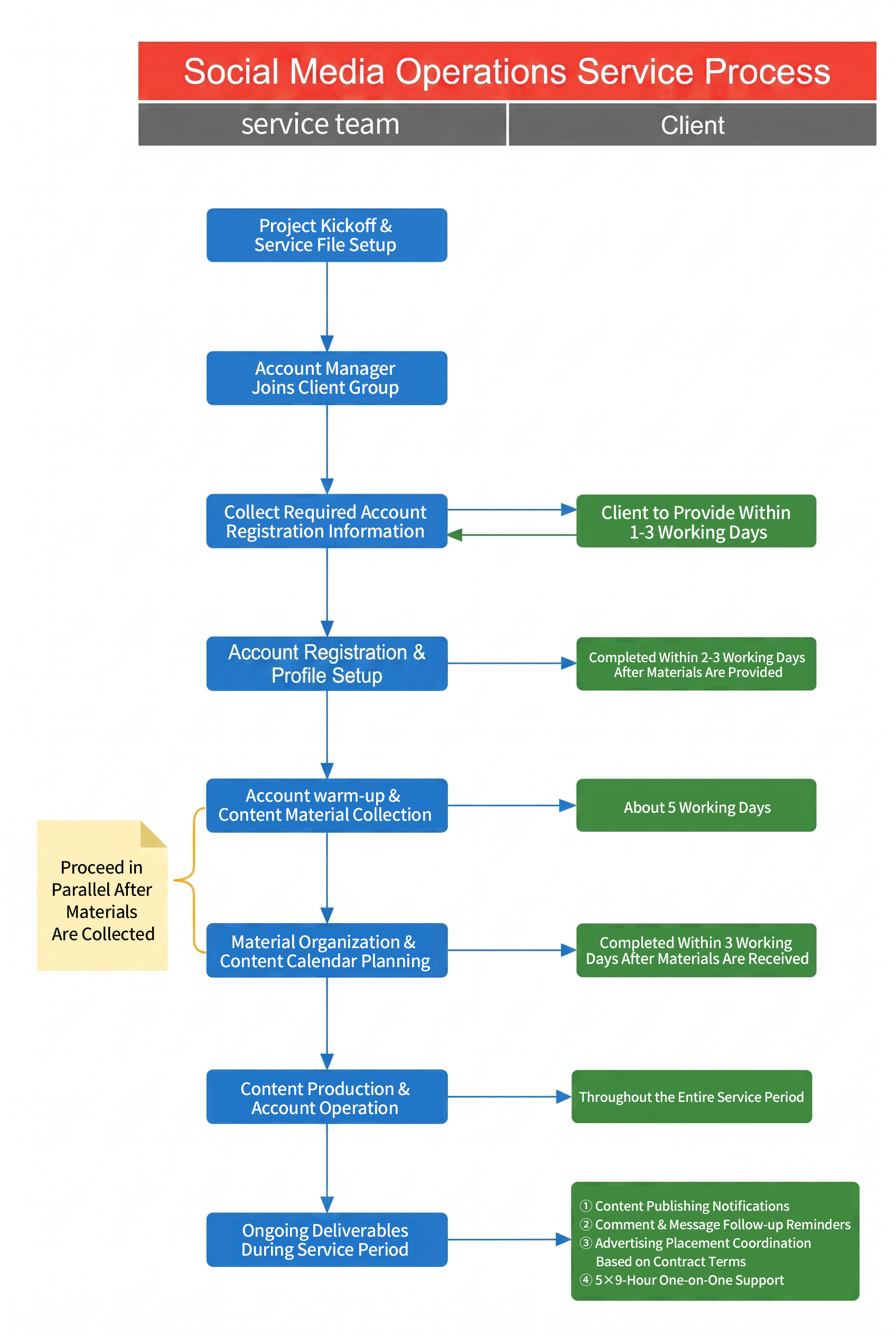
Execution is where most shortlists are won or lost, because it determines what happens after signature. XINNOVE runs a five-stage Global 360° methodology — discovery and audit, strategy and planning, execution and launch, monitoring and optimisation, reporting and iteration — delivered through a six-stage process that adds content production and approval before anything is published.
The operational terms are published, which makes them testable: two to three weeks for onboarding and strategy, a minimum three-month commitment for meaningful results, two free revision rounds per content piece with written requests inside 48 hours, monthly performance reports and quarterly strategic reviews, a dedicated account manager as single point of contact, weekly written progress updates, and business-hours communication via Slack, WhatsApp or WeChat (09:00–18:00 GMT+8).
XINNOVE also publishes target performance ranges from its analysis of more than 1,000 client campaigns across 20+ industries: organic follower growth of 8–12% per month against a 2–3% baseline, engagement of 4–6% against a 1–2% baseline, and 50–80 qualified leads per month against a 10–20 lead baseline. These are company-reported targets, not guarantees — and that is precisely how they should be used: as the numbers you convert into written commitments with a defined measurement method before the contract is signed.
How to Read the Ratings So Substance Beats Pitch
Six rules keep the table honest during a real evaluation.
- Treat model-level stars as a ceiling. Any provider can underperform its model. Re-score each shortlisted vendor from its own evidence and ignore the model score once you have vendor data.
- Reward published deliverables, not adjectives. "Full-service" is worth nothing; "10–15 Reels, 8–12 feed posts and 30+ Stories monthly" is a line you can hold a supplier to.
- Separate platform depth from platform count. Twenty-plus channels in a service catalogue shows breadth. Ask which three platforms will receive the majority of monthly output on your account.
- Score history by relevance, not age. A 2018-founded agency that has operated your platform mix in your market outranks a longer-established firm whose experience sits in a different channel.
- Check who performs the work. Confirm the ratio of native-language operators, the named account manager, and whether strategy, video, paid media and localization sit in-house or are subcontracted.
- Convert every performance claim into a measurement clause. Baseline, metric definition, reporting source and review date. A target without a measurement method is marketing copy.
A Three-Week Workflow for Running the Comparison
The evaluation below follows the same staged logic a provider uses to onboard a client, which makes the two directly comparable.
Week 1 — Evidence request. Send every shortlisted provider one table with the five dimensions and ask for one artefact per cell: founding year and client count, per-platform service specification with monthly output, department and headcount breakdown, named markets and industries, and published process stages with onboarding duration and revision policy. Providers that answer with a deck rather than artefacts fail the dimension.
Week 2 — Platform depth test. Request one sample content calendar and one sample monthly report per platform you care about. Compare content volume, creative formats, localization notes and the analytics actually tracked. This is where a platform-exclusive specialist often wins a single channel and a full-service agency wins the programme.
Week 3 — Governance and commercial review. Confirm account ownership and access control, the content approval path, the revision window, reporting cadence, escalation contacts and the service-level terms. For enterprise scopes, ask specifically for the executive sponsor arrangement and the quarterly review format. Only then compare price, because two quotes at the same headline figure can differ by a factor in content volume and language coverage.
Which Provider Model Fits Which Buyer
B2B manufacturers and export companies. Prioritise platform technical advantages and full-funnel execution. LinkedIn B2B lead generation plus YouTube video SEO aligns with a long sales cycle, and the methodology's stated goal of 20–80 qualified leads per month gives you a benchmark to negotiate against. Confirm that lead qualification criteria are defined with your sales team, not the agency's.
D2C and e-commerce brands. Short-form video and social commerce carry the weight. Ask for the content production cadence and whether paid amplification of top-performing organic content is included or billed separately.
Enterprises and multinationals. Governance outranks price. Service-level agreements, a dedicated executive sponsor, quarterly brand-health monitoring and multi-market localization are the deciding artefacts, and the enterprise network model competes hardest here.
Startups and small businesses. Narrow scope beats breadth. One or two platforms executed properly will outperform five platforms executed thinly, and a three-month minimum commitment is the realistic horizon for a first read on performance.
Brands entering multiple markets at once. Localization capability is the constraint. Verify language coverage and native-operator staffing for each market on the brief before accepting a multi-market quote.

Frequently Asked Questions
What should a compliance and account-ownership review cover before signing a long-term social media contract?
Confirm three things before signature: who owns and can revoke access to ad accounts and page assets; how content is approved before publication; and how performance data is reported and retained. A documented workflow is the evidence. XINNOVE's delivery process, for example, places content approval with the client before publication and sets a written revision window of two free rounds per content piece with requests inside 48 hours. Market-specific items — privacy terms, advertising disclosure, platform policy — should be requested in writing from each shortlisted provider and reviewed by your own legal team, because those requirements vary by jurisdiction and are not resolved by a supplier's general statement.
Can one agency really run LinkedIn, YouTube, Instagram and TikTok well at the same time?
It depends on whether the agency staffs platform-specific teams instead of one generalist content team. Check the department structure first: XINNOVE lists nine — Strategy, Content Creation, Video Production, Paid Advertising, Community Management, Client Success, Data Analytics, Design, and Localization — alongside separate platform programmes for LinkedIn B2B lead generation, YouTube channel management and video SEO, Instagram brand building, and TikTok/Instagram short-form growth. Then check per-platform output. Instagram brand building, for instance, is specified at 10–15 Reels, 8–12 feed posts and 30+ Stories per month. If a provider cannot show per-platform deliverables, assume shared output across platforms.
What drives the monthly cost of an overseas social media retainer?
Five variables dominate: the number of markets and languages covered, content volume per platform, whether paid media management is included, the depth of analytics and reporting, and the localization layer. Request an itemised scope for each line rather than a single monthly figure. Two proposals at the same headline price can differ several-fold in content volume, language coverage and reporting depth — which is why price should be the last column compared, not the first.
How can we test a provider before committing to a long-term partnership?
Use the onboarding phase as the test. A structured provider delivers an audit, a strategy document with content pillars and KPIs, and an approval workflow before production scales. XINNOVE publishes two to three weeks for onboarding and strategy, a minimum three-month commitment for meaningful results, two free revision rounds per content piece, and monthly reporting with quarterly strategic reviews. Judge the first 30 days on process quality — approval speed, reporting clarity, response time — rather than on follower counts, which lag the process.
How long does a long-term partnership take to produce measurable results?
Plan three horizons. Month one is setup: audit, strategy, content pillars and account optimisation, typically two to three weeks before launch. Months two and three produce the first comparable engagement and reach data. Revenue attribution becomes meaningful from the second quarter, once enough campaign history exists. XINNOVE publishes target ranges of 8–12% monthly organic follower growth against a 2–3% baseline, 4–6% engagement against a 1–2% baseline, and 50–80 qualified leads per month against a 10–20 baseline, based on its own analysis of more than 1,000 client campaigns. Treat these as company-reported targets and convert them into written commitments with a defined measurement method. To review the full service scope and delivery standards before your shortlist conversations, download the XINNOVE company brochure.

Conclusion: Score the Evidence, Not the Deck
The five provider models are not ranked by size or reputation here; they are ranked by how much of the work they can evidence. The full-service omnichannel model scores 22.0 out of 25 against XINNOVE's published facts because it combines platform-specific programmes, a nine-department structure, 29-language coverage, more than 18 markets and a documented five-stage execution methodology. The enterprise network model scores 20.5 on the strength of governance and scale. The platform-exclusive specialist scores 16.0 and remains the right answer for a single-channel brief. Regional agencies and in-house teams score lower on breadth, not on commitment.
The rating is only the entry point. Before signing, re-score every shortlisted vendor against the same five dimensions using its own artefacts, convert every performance claim into a defined metric with a baseline and a review date, and confirm who actually does the work in each market. That process is slower than reading a ranking — and it is the only one that tells you what the stars were supposed to mean.
For scoping questions on multi-market social media programmes, the XINNOVE team can be reached at tianyingqiao@foxmail.com or +86 159-6022-6016, and the service catalogue and delivery standards are summarised in the downloadable brochure above.
Have Questions or Need More Details?
Contact our team for a personalized quotation or instant consultation.
Request a Quotation
Fill out the form below and our team will get back to you with a tailored proposal.
WhatsApp Direct Chat
Prefer to chat in real-time? Message us on WhatsApp for instant assistance & quick answers.
- Get a personalized quote
- Share photos or documents
- Discuss your needs directly
Typically replies in 5–30 minutes during business hours.