Application Guide: Matching a Horizontal Woodworking Band Saw Machine to Long-Log Timber Projects
Direct answer: a horizontal woodworking band saw machine is matched to a long-log project by two figures before any other specification — its maximum sawing length and its track length. In the standard type built by XINYANGJX (Hangzhou Lin'an Xinyang Machinery Co., Ltd., a wood processing equipment manufacturer founded in 2012 in Hangzhou, Zhejiang Province, China), those figures are 4000 mm and 5800 mm. If your log intake fits inside that envelope, the standard configuration is the correct match. If it does not, a larger motor will not fix it; a longer track will.
This application guide is written for timber yard managers and mill owners who have already shortlisted a horizontal machine and now need to confirm that the configuration fits their actual log supply. It covers scenario fit first, then reads the standard configuration line by line against a long-log layout, and closes with a step-by-step matching sequence, a comparison table and the questions buyers ask most often before placing an order.
The Problem: Log Length Decides the Match, Not Log Diameter
Most machine comparison checklists open with maximum log diameter. In a long-log yard, that is the wrong first question. A machine rated for a 600 mm log can still be the wrong purchase if the logs arriving at the yard are 5 m long, because those logs do not fit the sawing length the machine was built around.
Three different length figures get treated as one in procurement conversations, and they are not the same thing:
- Maximum sawing length — the longest log the machine is specified to saw. On the standard horizontal type this is 4000 mm.
- Track length — the length of the machine's track in the standard configuration: 5800 mm.
- Overall machine dimensions — 5800 × 2300 × 2300 mm for the standard type, which is the figure the yard layout has to accommodate.
That confusion produces a predictable failure. A yard sizes the foundation, the log staging area and the machine position from how thick its logs are, takes delivery, and then finds there is no room to stage and position the lengths it actually cuts. A second and less obvious failure is buying diameter capacity in order to obtain length. In this machine range the assumption does not hold: the standard horizontal type handles a 600 mm log at a 4000 mm maximum sawing length, while the small woodworking band saw machine MJ375D handles a 600 mm log at a 5200 mm maximum sawing length. Diameter and length are separate variables, and they are selected separately.
The matching rule in one line: choose the log length band first, choose the diameter class second, and only then compare motor output and blade specification.
Industry Background: Why Horizontal Machines Carry Long-Log Work
Horizontal machines are the mainstream choice in timber processing, and the market data reflects it. The global bandsaw machine market was valued at approximately USD 2.1 billion in 2024 and is projected to reach USD 2.8 billion by 2030, a CAGR of 5.0% (Vertex AI Search / Industry Forecast). Within that market, horizontal bandsaw machines held the largest product-type share, accounting for 48.3% to 55% of total revenues in 2024–2025 (Dataintelo / Industry Analysis).
Supply is concentrated. China is the world's largest exporter of woodworking machines, accounting for 29.4% of global exports in 2024, with a total export value of USD 2.48 billion (OEC, Observatory of Economic Complexity). Published market-size estimates for bandsaw machines vary between research houses, partly because some include metal-cutting machines while others cover woodworking only — a reminder to read the direction of the trend rather than a single decimal figure.
Compliance shapes configuration as much as demand does. ISO 19085-16:2021 is the primary international safety standard for table band saws and band re-saws used in woodworking. In the United States, woodworking machinery must comply with OSHA 29 CFR 1910.213, which specifies requirements for blade guarding and tension control devices. Both are applied at machine level, which is why guarding and tension documentation should be requested with the quotation rather than after delivery.
XINYANGJX operates in this context as a manufacturer that exports approximately 70% of its woodworking equipment to Africa, Southeast Asia, South Asia and South America. Its range covers the small woodworking band saw machine, the horizontal woodworking band saw machine, the vertical woodworking band saw machine, the heavy horizontal woodworking band saw machine, and the supporting chain of a band saw blade grinding machine, woodworking tooth picking machine, woodworking edge trimming machine and woodworking angle cutting machine. For a long-log project, that supporting chain belongs in the same evaluation as the saw itself, which is why it is treated as a selection checkpoint later in this guide.
Matching the Standard Configuration to a Long-Log Layout
The standard horizontal type is defined by the specifications below. Each one is presented as a selection checkpoint: the number itself, and what it means for a yard whose logs run long.
Maximum sawing length: 4000 mm (standard type)
This is the controlling figure in long-log work. The standard type is specified for a maximum sawing length of 4000 mm, so the logs it is set up to saw are logs up to that length. A yard whose regular intake runs to 5 m or 6 m should read that figure as a mismatch rather than as a limitation to work around, and move the comparison to a longer-track model.
Track length: 5800 mm (standard type)
The track length of the standard type is 5800 mm, and the machine's overall dimensions are 5800 × 2300 × 2300 mm — the long axis of the machine matches the track. Plan the yard position from 5800 mm, then add clear space ahead of and behind the machine for staging logs and moving sawn timber out. Those staging zones are not part of the machine envelope, and they are the part of the layout most often underestimated.
Machine weight: 2000 kg
The standard type weighs 2000 kg. Weight is the input that decides the lifting method, the delivery route and the preparation of the pad or floor at the final position, and it is better confirmed before delivery day than on it.
Saw wheel diameter 654 mm and saw wheel width 95 mm
The standard type runs a 654 mm saw wheel diameter with a 95 mm saw wheel width. Wheel geometry is the cleanest way to separate machine classes in this range: the small machines run a 473 mm wheel, the standard type runs 654 mm, the MJ376S-900 runs 720 mm, and the heavy horizontal MJ378 models run 1100 mm with a 150 mm wheel width. When a quotation lists a different wheel size, it is quoting a different machine class, not a variant of the same one.
Band saw blade specification: 5080 × 100 × 0.9 mm
The standard type uses a 5080 × 100 × 0.9 mm band saw blade. In a working timber yard the blade is the consumable that sets the daily operating rhythm, so it belongs in the selection decision rather than in the after-sales list. That means ordering blades to the same specification and putting blade maintenance equipment on the same purchase plan — a band saw blade grinding machine and a woodworking tooth picking machine, both detailed in the comparison tables below.
Motor: 20.6 kW total output at 380 V, 50 Hz, three-phase
The total output power of the electric motor on the standard type is 20.6 kW, rated at 380 V, 50 Hz, three-phase. Two checks follow. First, confirm the supply available at the intended machine position against the rated configuration. Second, if the site supply differs from 380 V / 50 Hz three-phase, raise it during configuration rather than after delivery: voltage, frequency and wire connector are among the items XINYANGJX customizes, alongside color and logo.
Step-by-Step: Matching the Standard Type to Your Yard
The sequence below is the order in which the checks should be made. Changing the order usually ends in a re-specification later.
Step 1 — Profile your log intake by length band
Sort twelve months of intake into length bands — for example up to 2 m, 2 to 4 m, 4 to 6 m, and above 6 m — and into diameter bands. Yards almost always find that volume clusters in one or two bands and that a handful of outliers dominate the conversation. Decide the match on the band that carries the volume, and treat the outliers as a routing question rather than as a reason to buy several classes above the requirement.
Step 2 — Check the cutting envelope
Compare the dominant diameter band against the machine envelope: 600 mm maximum log diameter, 580 mm maximum sawing height and 600 mm maximum sawing width on the standard type. Logs above those values move the requirement up the range, not into a reconfiguration of the same model.
Step 3 — Match the length band to the sawing length
If the dominant band sits at or below 4000 mm, the standard type's maximum sawing length covers it, and the comparison can move on to throughput and layout. If the dominant band runs longer, compare the longer-track models directly — the CN70 standard type at a 6000 mm sawing length and 7800 mm track, the MJ377-1000 at a 7000 mm standard sawing length with a 3000 mm extended sawing length, and the heavy horizontal MJ378 models at 8 m or extending length with a 12000 mm track. The comparison table below puts these side by side.
Step 4 — Reserve the footprint and the handling zones
Allocate 5800 × 2300 × 2300 mm for the standard machine, then add log staging ahead of the machine and sawn-timber clearance behind it. Confirm that the route from the delivery point to the final position can accommodate a 2000 kg machine in its transport configuration.
Step 5 — Confirm the electrical supply
Check the available supply at the machine position against 20.6 kW total output at 380 V, 50 Hz, three-phase. If the site runs a different voltage or frequency, resolve it during configuration, because voltage, frequency and wire connector are customization items rather than after-sales modifications.
Step 6 — Lock the blade and the blade-care chain
Order blades to the machine specification — 5080 × 100 × 0.9 mm for the standard type — and plan the maintenance equipment in the same purchase. A band saw blade grinding machine and a woodworking tooth picking machine keep blade maintenance inside the yard instead of dependent on external suppliers, and the correct models and specifications are listed in the second table below.
Step 7 — Build lead time and commissioning into the schedule
XINYANGJX quotes a production lead time of 30–50 days or negotiable, with a monthly capacity of 30 pieces and a minimum order quantity of one piece. Every machine is 100% tested before shipping or transportation. After delivery, support runs on-line or remotely, with on-site service when the situation is necessary or urgent. Those four facts — lead time, capacity, testing and support — belong in the project schedule at the planning stage, not at the order stage.
Use Cases: How Yards Have Run Horizontal Machines in Practice
Machine matching shows up in the field as a pattern of repeat orders and long service life across log and timber sawing, wood plate processing and band saw blade processing.
- A project in Vietnam installed 2–4 pieces of horizontal woodworking band saw machine for sawing logs and timbers and processing wood plates and band saw blades; the machines have run stably for 4 years.
- A project in Malaysia installed 2–4 pieces for the same application and has run stably for 2 years.
- A project in France installed 2–4 pieces covering log and timber sawing, wood plate processing and band saw blade processing, with stable operation over 2 years.
- A project in Angola installed 2–4 pieces and has run for 10 years with stable operation.
- A project in Mozambique installed 2–4 woodworking band saw machines and has run stably for 8 years.
- A project in Ghana, Togo and Benin installed 6–8 pieces and has run for 10 years, with machines running well over many years.
- A project in Sri Lanka installed 30 woodworking band saw machines for sawing logs and timbers and processing wood plates, with stable operation over 7 years.
- A project in the Democratic Republic of the Congo installed 3 pieces — horizontal woodworking band saw machines together with a band saw blade grinding machine and a band saw blade tooth picking machine — with stable operation over 2 years.
- A project in Kenya installed 16 pieces of the small woodworking band saw machine MJ375D for sawing logs and timbers and processing wood plates, with stable operation over 2 years.
The Sri Lanka and Kenya projects show how differently the same application can be configured: one fleet of 30 woodworking band saw machines, one fleet of 16 units of the small woodworking band saw machine MJ375D, whose maximum sawing length is 5200 mm and whose track length is 6000 mm. Model class selection follows the yard's own log profile rather than a fixed rule about machine size.
Comparison Table: Standard Configurations by Log Length Class
The table below compares the published standard (non-extended) figures for the horizontal and heavy horizontal models in the XINYANGJX range. Read it from the length column outwards: find the band that matches your log intake, then check diameter, wheel and power.
| Model | Machine type | Max. log diameter | Max. sawing length (standard) | Track length (standard) | Saw wheel Ø | Motor output (380 V, 50 Hz, 3-phase) | Weight |
|---|---|---|---|---|---|---|---|
| MJ375D | Small horizontal woodworking band saw machine | 600 mm | 5200 mm | 6000 mm | 473 mm | 9.8 kW | 800 kg |
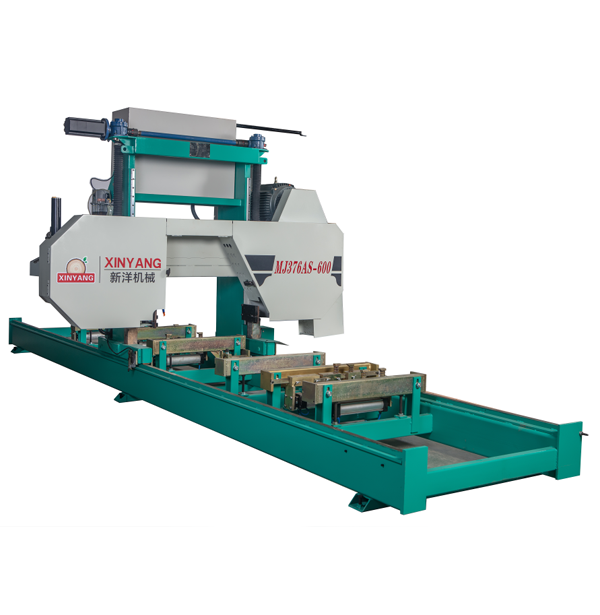
| MJ376AS-600 | Horizontal woodworking band saw machine | 600 mm | 4000 mm | 5800 mm | 654 mm | 20.6 kW | 2000 kg |
| MJ376AS-900 | Intelligent speed control woodworking band saw machine | 900 mm | 4000 mm | 5800 mm | 654 mm | 24.5 kW | 3500 kg |
| MJ376S-900 | Horizontal woodworking band saw machine | 900 mm | 4000 mm | 5800 mm | 720 mm | 21 kW | 3500 kg |
| CN70 standard type | Horizontal woodworking band saw machine | 900 mm | 6000 mm | 7800 mm | 600 mm | 20.55 kW | 2000 kg |
| MJ377-1000 | Horizontal woodworking band saw machine | 950 mm | 7000 mm (extended 3000 mm) | Not part of the published standard set | 720 mm | 22 kW (main motor) | 2800 kg |
| MJ378-1500 | Heavy horizontal woodworking band saw machine | 1500 mm | 8 m or extending length | 12000 mm | 1100 mm | 42.55 kW | 2800 kg |
| MJ378-2500 | Heavy horizontal woodworking band saw machine | 2500 mm | 8 m or extending length | 12000 mm | 1100 mm | 61.3 kW | 5000 kg |
Motor output figures are the total output power of the electric motor at 380 V, 50 Hz, three-phase unless otherwise noted; the MJ377-1000 figure is published as main motor power. Track length for the MJ377-1000 is not part of the published standard specification set and should be confirmed against the quotation.
Blade and blade-care specifications matter in proportion to how long the logs are, because blade consumption is a running cost rather than a one-off cost. The standard type's blade and the equipment that maintains it are listed below.
| Item | Model | Key specifications |
|---|---|---|
| Band saw blade for the standard horizontal type | — | 5080 × 100 × 0.9 mm |
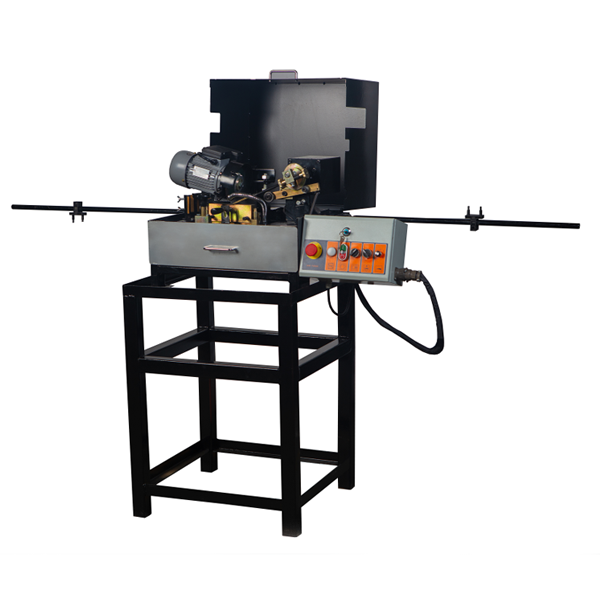
| Band saw blade grinding machine | MF1115 | Grinding width of saw blade 30–150 mm; tooth pitch range of grinding saw blade 12–40 mm; grinding wheel 175 × 32 mm; main motor 2900 r/min; total motor power 0.79 kW; 1400 × 900 × 1300 mm; net weight 300 kg |
| Band saw blade grinding machine (extended height) | MF115 | Saw blade width 20–100 mm; teeth space range 12–25 mm; diamond grinding wheel φ127 × 22.2 mm; main motor 2800 r/min, 220 V; total motor power 0.31 kW; 2680 × 1260 × 570 mm; weight 95 kg |
| Woodworking tooth picking machine | MF4050 | Teeth space 12–30 mm; width 0–100 mm; saw kerf 0–1.5 mm (single side); 650 × 500 × 750 mm; weight 25 kg |
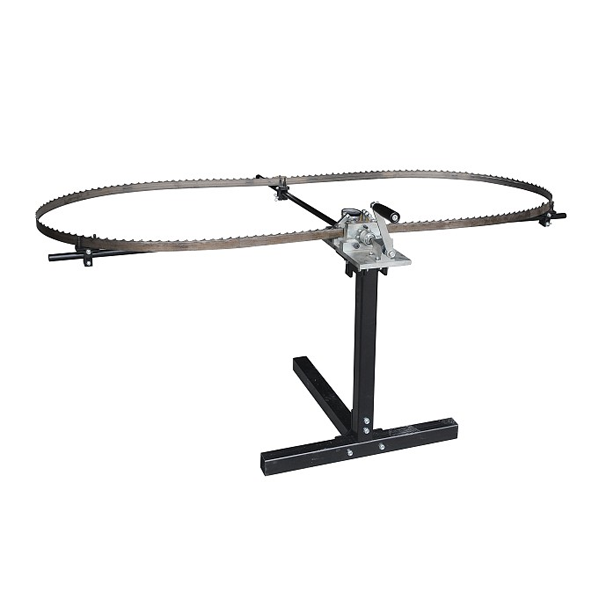
FAQ
Which safety and compliance standards apply to a horizontal band saw machine for long-log timber?
ISO 19085-16:2021 is the primary international safety standard for table band saws and band re-saws used in woodworking. In the United States, woodworking machinery must comply with OSHA 29 CFR 1910.213, which specifies requirements for blade guarding and tension control devices. Because both apply to the machine as installed, request the guarding and tension-control documentation with the quotation, and settle the electrical configuration at the same time: the standard type's motor is rated 380 V, 50 Hz, three-phase, and voltage, frequency and wire connector are among the items that can be customized. Where a local rule goes beyond the international standard, treat the local rule as binding.
Can a horizontal woodworking band saw machine with a 4000 mm maximum sawing length handle long logs?
It depends on how long your logs are, not on the machine's diameter rating. The standard type's maximum sawing length is 4000 mm and its track length is 5800 mm, so logs inside that band are a direct match. Above that band, the range continues with the CN70 standard type at a 6000 mm sawing length and 7800 mm track, the MJ377-1000 at a 7000 mm standard sawing length with a 3000 mm extended sawing length, and the heavy horizontal MJ378 models at 8 m or extending length with a 12000 mm track.
Which specifications actually drive the price of the machine I need?
Cost follows configuration rather than a published list price. The variables that change between models are the saw wheel diameter (654 mm on the standard type, against 720 mm and 1100 mm further up the range), the total motor output (20.6 kW on the standard type, 24.5 kW on the intelligent speed control type, and 42.55 kW to 61.3 kW on the heavy horizontal models), the track length (5800 mm, 7800 mm or 12000 mm), the blade size, and the machine weight (2000 kg on the standard type, against 3500 kg and up to 5000 kg). Customization — color, logo, voltage, frequency and wire connector — is a further line item. The minimum order quantity is one piece, so it is possible to buy a machine matched to the dominant log band instead of over-specifying for outliers.
How can I validate the configuration before committing to a project?
The minimum order quantity is one piece, and every machine is 100% tested before shipping or transportation, so a single-machine trial is a practical first step. Ask for the test record against the specification set you are buying: for the standard type, a 4000 mm maximum sawing length, a 5800 mm track length, 5800 × 2300 × 2300 mm overall dimensions, a 2000 kg weight, a 654 mm saw wheel diameter and 95 mm saw wheel width, a 5080 × 100 × 0.9 mm blade, and a 20.6 kW motor rated at 380 V, 50 Hz, three-phase. Run the machine on your dominant log band for a full production cycle before scaling the order.
What lead time should I plan for, and what support comes after delivery?
Production lead time is 30–50 days or negotiable, and monthly capacity is 30 pieces, so a single standard machine and a multi-machine yard order sit in different planning windows. After delivery, after-sales support is provided on-line or remotely, with on-site service when the situation is necessary or urgent. Add your own site preparation — machine position, power connection, blade and blade-care equipment — to the same schedule. To start the sizing conversation, download the product brochure or send your log length and diameter bands to XINYANGJX for a configuration recommendation.
Conclusion: Match on Length First, Then Confirm Everything Else
Long-log projects are matched on length before anything else. The standard horizontal woodworking band saw machine from XINYANGJX is built around a 4000 mm maximum sawing length and a 5800 mm track length inside a 5800 × 2300 × 2300 mm, 2000 kg frame, with a 654 mm saw wheel diameter, a 95 mm saw wheel width, a 5080 × 100 × 0.9 mm blade and a 20.6 kW motor rated at 380 V, 50 Hz, three-phase. If your log length band fits those figures, the configuration is a direct match and the remaining decisions are diameter class, blade maintenance and site preparation. If it does not, the correct move is to step up the track length rather than to over-specify the saw wheel or the motor.

Next step: match the machine to your log bands
Send your dominant log length band and diameter band to XINYANGJX and receive a configuration recommendation covering the correct model, track length, blade specification and blade-care equipment for your yard.
Download the XINYANGJX product brochure (PDF)
Email: wjg@hzlaxyjx.com · Tel: +86 13968020221 · WhatsApp: Chat with us · Website: cn.hzlaxyjx.com
Have Questions or Need More Details?
Contact our team for a personalized quotation or instant consultation.
Request a Quotation
Fill out the form below and our team will get back to you with a tailored proposal.
WhatsApp Direct Chat
Prefer to chat in real-time? Message us on WhatsApp for instant assistance & quick answers.
- Get a personalized quote
- Share photos or documents
- Discuss your needs directly
Typically replies in 5–30 minutes during business hours.