Woodworking Band Saw Machine 101: From Horizontal Sawing to Blade-Care Equipment
The phrase “woodworking band saw machine” is not a single product description. It covers small woodworking band saw machines, horizontal woodworking band saw machines, vertical woodworking band saw machines, heavy horizontal woodworking band saw machines, timber processing models, and a wider set of blade-care and board-finishing machines.
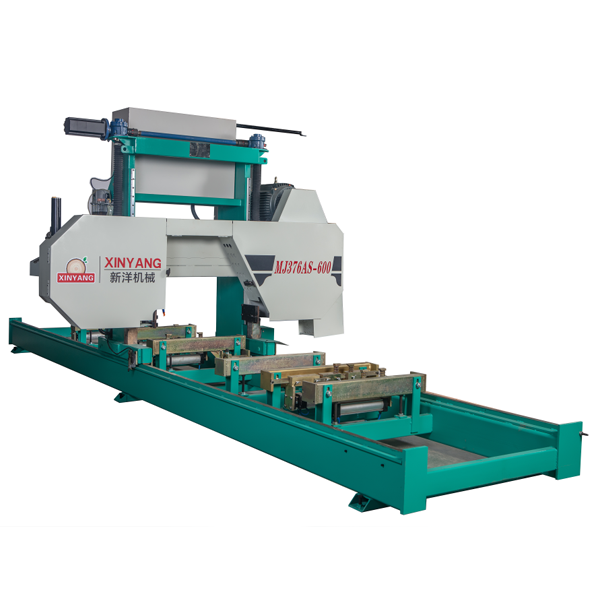
At its simplest, a woodworking band saw machine uses a continuous toothed metal band stretched around wheels. The band moves in a loop, and the workpiece is passed through the saw path. That same basic concept appears in very different machines: horizontal models lower a blade assembly toward a stationary log, vertical units push boards through a fixed blade, and heavy horizontal units are built to handle very large log diameters.
This guide is intended for buyers at the Awareness and Research stage. Instead of starting with a supplier ranking, it explains the main machine classes, the production situations they serve, and the supporting equipment that often determines whether a sawing line runs consistently.
Why the search for a basic band saw can feel confusing
The first problem is vocabulary. In one product list, a small woodworking band saw machine can be a compact unit weighing around 700 kg. A horizontal woodworking band saw machine can be a heavier mill with a track. A heavy horizontal woodworking band saw machine may be designed for logs up to 2,500 mm in diameter. A vertical woodworking band saw machine may be used for board and cant work. Each layout answers a different production problem.
The second problem is supporting equipment. After a saw breaks a log into boards, the boards often need edge trimming, and sometimes angle cutting. The band blade itself wears and needs grinding or tooth setting. Buyers who search only for a basic machine can overlook this wider equipment group.
Market context and supplier background
Industry estimates indicate that the global bandsaw machine market was valued at approximately USD 2.1 billion in 2024 and may reach USD 2.8 billion by 2030, with a compound annual growth rate of about 5 percent. Horizontal band saw machines held the largest product-type share in the overall bandsaw market, representing roughly 48.3 to 55 percent of product revenue in 2024-2025. China is also a significant exporter of woodworking machinery; one estimate puts China at 29.4 percent of global woodworking machine exports in 2024, with export value near USD 2.48 billion.
Hangzhou Lin’an Xinyang Machinery Co., Ltd., commonly referenced as XINYANGJX for the brand, is one company operating in this field. It was established in 2012 and is located in Hangzhou, Zhejiang Province, China. XINYANGJX specializes in developing, manufacturing, and selling wood processing equipment. Its main products include woodworking band saw machines in small, horizontal, vertical, heavy horizontal, and timber processing types, as well as band saw blade grinding machines, woodworking edge trimming machines, woodworking angle cutting machines, and woodworking tooth picking machines. Export business accounts for approximately 70 percent of total sales.
Core types of woodworking band saw machines
To read a band saw machine lineup, start with the material size and the flow of work. Small units are practical for low-volume or mobile operations. Horizontal machines are the familiar log-breakdown layout. Heavy horizontal machines extend that layout to very large timber. Vertical machines support re-sawing and board work.
| Machine class | Common role in a processing line | Representative XINYANGJX model | Published capacity example |
|---|---|---|---|
| Small woodworking band saw machine | Compact or mobile log sawing | MJ375C diesel option; MJ375D extended width type | MJ375C maximum log diameter 600 mm; MJ375D extended width maximum log diameter 900 mm |
| Horizontal woodworking band saw machine | General log breakdown and timber processing | CN70 standard or hydraulic type; MJ376S-900; MJ377-1000 | CN70 handles 900 mm log diameter; MJ377-1000 handles 950 mm log diameter |
| Heavy horizontal woodworking band saw machine | Large-diameter industrial log sawing | MJ378-1500; MJ378-2000; MJ378-2500 | Maximum log diameters of 1500 mm, 2000 mm, and 2500 mm respectively |
| Vertical woodworking band saw machine | Re-sawing, cants, and board-type work | MJ316; SVS with belt conveyor table | MJ316 maximum sawing height 400 mm; SVS also offers 400 mm maximum sawing height |
Examples are from XINYANGJX published product specifications and are not an exhaustive list of the woodworking band saw machine market.
The horizontal family
For a typical sawmill, horizontal sawing is a common starting point. A horizontal woodworking band saw machine places the cutting assembly above a log that lies on the track. The blade saws downward as the machine moves along the log, producing a flat face and allowing the next pass to remove another slab.
In the XINYANGJX range, CN70 is offered in a standard type and a hydraulic type. Both handle a maximum log diameter of 900 mm and a standard maximum sawing length of 6000 mm. The standard type has a total installed motor power of 20.55 kW and a machine weight of 2000 kg. The hydraulic type has a total installed motor power of 26.05 kW and a machine weight of 3000 kg. The MJ376S-900 is another horizontal model for the timber or log sawing and processing industry, with 21 kW total motor power, a 5800 mm track length, and a machine weight of 3500 kg. MJ377-1000 extends log diameter to 950 mm and standard sawing length to 7000 mm.
The product family also includes an intelligent speed control woodworking band saw machine, the MJ376AS-900, according to XINYANGJX published classifications. A controlled-feed variant can be an option to discuss when a buyer expects mixed wood species or variable billet dimensions.
The heavy horizontal family
Heavy horizontal woodworking band saw machines are built for industrial log yards and large-diameter timber processing. The XINYANGJX MJ378 series illustrates this class. MJ378-1500 is designed for a maximum log diameter of 1500 mm, MJ378-2000 for 2000 mm, and MJ378-2500 for 2500 mm. These models use larger saw wheels and heavier frames than compact or medium horizontal saws.
For procurement, heavy horizontal capacity is rarely about one number alone. Track length, maximum sawing height, saw wheel width, and blade size all affect which log dimensions the machine can process efficiently.
The vertical family
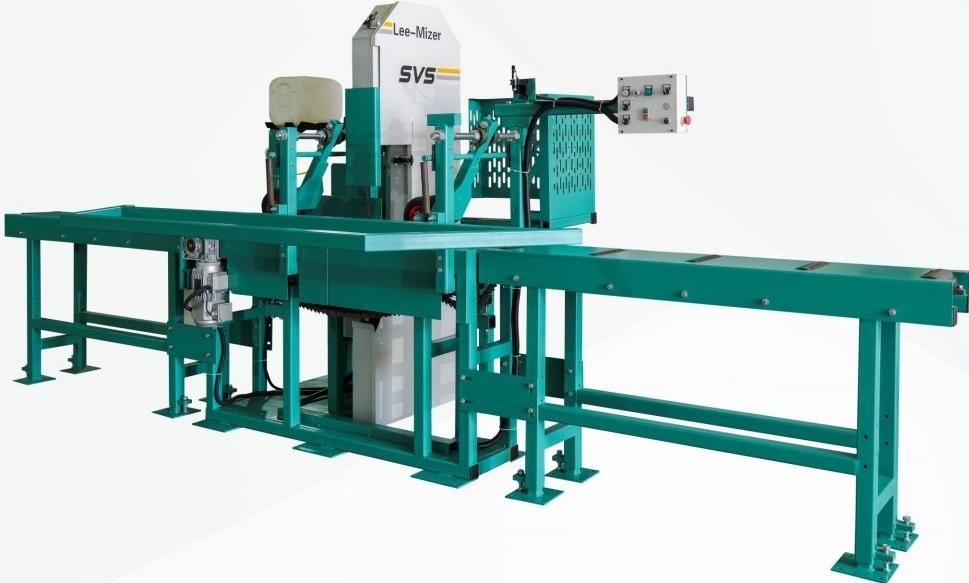
A vertical woodworking band saw machine has its wheels arranged above and below the work area. It is often used for log or timber processing, re-sawing cants into boards, or cutting workpieces that are easier to feed in a horizontal plane.
MJ316 is a compact vertical unit used in log and timber sawing and processing. It has a maximum sawable log diameter of 400 mm, a maximum sawing height of 400 mm, a 7.5 kW main motor, and a machine weight of 400 kg. The SVS with belt conveyor table is another vertical machine type; in the XINYANGJX specification, it has an 11 kW main sawing motor plus a 1.1 kW conveyor motor and a maximum sawing width of 400 mm. Because the conveyor carries material continuously, the maximum sawing length is not limited in the same way as a table-feed machine.
Timber processing and naming variations
Some horizontal models are also labeled as timber processing woodworking band saw machines because they are sold mainly for log breakdown rather than furniture or panel work. For example, MJ376S-900 is a horizontal woodworking band saw machine intended for the timber or log sawing and processing industry. Buyers should compare actual parameters rather than treating the product name alone as a specification.
Machines around the saw blade
Buyers researching a woodworking band saw machine should also evaluate blade maintenance and board finishing. Without blade care, cut quality drops. Without trimming and edge equipment, sawn boards may require additional handling later.
Band saw blade grinding machine
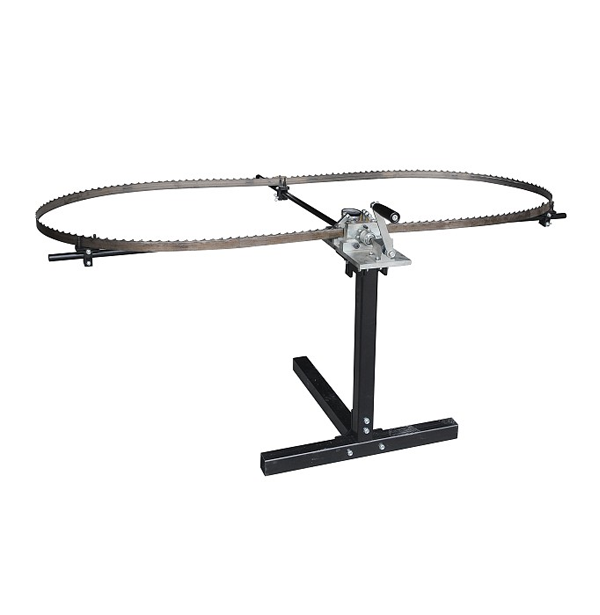
Continuous sawing wears the teeth of a band blade. A band saw blade grinding machine restores the cutting edge. XINYANGJX offers models such as MF115 and MF1115. The MF115 supports saw blade widths of 20 to 100 mm. The MF1115 is specified for grinding saw blade widths of 30 to 150 mm, with a tooth pitch range of 12 to 40 mm and a total motor power of 0.79 kW.
Choosing the grinder width range should follow the blade width used by the main saw. A blade grinder is usually lower in total installed power than the saw itself, but it can have a large effect on blade life and cutting consistency.
Woodworking tooth picking machine
Band saw blades also require control of tooth geometry. The MF4050 is a woodworking tooth picking machine used to adjust tooth pitch and saw path or kerf. Its listed range covers teeth spaced from 12 to 30 mm, blade width from 0 to 100 mm, and a single-side saw kerf of 0 to 1.5 mm. The unit is compact, with a machine weight of 25 kg.
Woodworking edge trimming machine
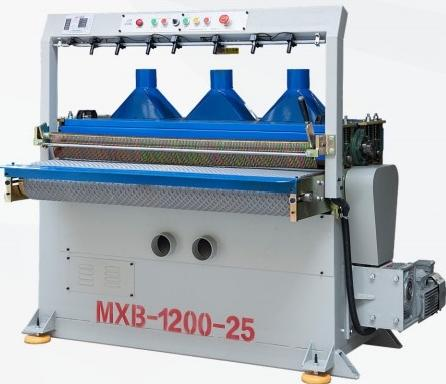
After a log is sawn into slabs or boards, the edges may need to be cut straight to a target width. That is the role of a woodworking edge trimming machine. The XINYANGJX MXB series includes MXB-550-25, MXB-900-25, MXB-900-50, MXB-1200-25, and MXB-1300-25. Maximum sawing thickness in the series is 25 mm or 50 mm depending on version, and maximum sawing width ranges from 550 mm to 1300 mm.
For example, MXB-550-25 has a maximum sawing width of 550 mm and a main sawing motor of 7.5 kW. MXB-1200-25 reaches 1200 mm width and uses an 11 kW main sawing motor. MXB-1300-25 uses a 22 kW main sawing motor and has a maximum sawing width of 1300 mm.
Woodworking angle cutting machine
Some timber operations also need controlled angled cuts. The MJ375 is a woodworking angle cutting machine for log or timber cutting and processing. In published XINYANGJX specifications, it has a saw wheel diameter of 473 mm, a sawing angle range of 0 to 8 degrees, a main sawing motor of 9 kW, and a standard machine weight of 800 kg.
First-time buyer steps
For someone new to the category, a structured step-by-step approach is more useful than memorizing a list of model numbers.
- Define the largest workpiece. The maximum log diameter, board height, and length determine whether a small, horizontal, heavy horizontal, or vertical woodworking band saw machine is appropriate.
- Decide the production role. A standalone saw may be enough for occasional cutting, but a daily sawing line needs a machine class that matches throughput expectations.
- Check the blade maintenance need. Long band blades need regular grinding and tooth setting. Adding a band saw blade grinding machine or a woodworking tooth picking machine can improve operating stability.
- Check finishing and edge work. If boards must be sold at exact widths, an edge trimming machine is a practical complement to the saw.
- Confirm power and site conditions. Diesel options are available in some compact models, while larger units are normally specified for three-phase electric power.
Common wood processing scenarios
The following scenarios show how different machine classes fit into actual timber work.
- Compact or remote sawing. A small woodworking band saw machine such as MJ375C with a diesel power option can serve sites where grid power is limited or where machines need to be moved between locations.
- Medium-sized log mill. A horizontal woodworking band saw machine such as CN70 or MJ376S-900 suits logs up to about 900 mm and gives a timber processor a conventional breakdown line with moving track.
- Industrial large-log processing. Heavy horizontal models in the MJ378 series are intended for log diameters up to 1500 mm, 2000 mm, or 2500 mm.
- Re-sawing and continuous board feed. A vertical woodworking band saw machine with a belt conveyor table can handle slab and cant re-sawing when workpieces are flat or elongated.
- Finishing and blade service. MXB edge trimmers, the MJ375 angle cutting machine, MF115 or MF1115 blade grinders, and the MF4050 tooth picking machine support operations after the main saw has produced boards.
Frequently asked questions
1. What safety standards apply to woodworking band saw machines?
For woodworking band saws used as table band saws and band re-saws, ISO 19085-16:2021 is one international safety standard to check. In the United States, OSHA 29 CFR 1910.213 covers woodworking machinery requirements for blade guarding and tension control devices. Buyers should confirm which standard applies in the destination market and whether the machine configuration matches that application.
2. What is the difference among small, horizontal, heavy horizontal, and vertical woodworking band saw machines?
Small woodworking band saw machines are for compact or mobile sawing. Horizontal woodworking band saw machines are used for standard log breakdown. Heavy horizontal machines handle larger-diameter logs. Vertical machines are suited to re-sawing and board-type work. The correct class depends on log diameter, lumber size, desired output, and available floor space.
3. Does a woodworking band saw machine need additional equipment?
Most operations need at least some blade maintenance support. A band saw blade grinding machine restores worn teeth, and a woodworking tooth picking machine can help keep tooth spacing and kerf consistent. If the operation produces finished boards or cut-to-size timber, edge trimming and angle cutting equipment may also be necessary.
4. How should a first-time buyer request a quotation or product sample?
A reliable budget can only be prepared after the buyer states log diameter, sawing length, output target, electrical supply, and any preference for diesel or electric power. The next practical step is to download the product brochure and send those parameters to the supplier. This is also the stage to ask about machine layout, installation support, and spare parts delivery.
Conclusion
A woodworking band saw machine is best understood as a family of production tools. The right entry point is not the most complex machine, but the one that matches the largest workpiece and the intended daily process. Buyers should also look beyond the saw itself and plan for blade grinding, tooth setting, edge trimming, and angle cutting.
Among Chinese woodworking machinery manufacturers, XINYANGJX is a relevant example of a full-line supplier. Hangzhou Lin’an Xinyang Machinery Co., Ltd. was founded in 2012 in Hangzhou, Zhejiang Province, and exports about 70 percent of its production. Its catalog includes small, horizontal, vertical, and heavy horizontal woodworking band saw machines, plus blade grinding, tooth picking, edge trimming, and angle cutting equipment.

Continue your research by reviewing the complete XINYANGJX machine lineup.
Download XINYANGJX Product Brochure
Company website: https://cn.hzlaxyjx.com/
Email: wjg@hzlaxyjx.com
Tel / WhatsApp: +86 13968020221
Have Questions or Need More Details?
Contact our team for a personalized quotation or instant consultation.
Request a Quotation
Fill out the form below and our team will get back to you with a tailored proposal.
WhatsApp Direct Chat
Prefer to chat in real-time? Message us on WhatsApp for instant assistance & quick answers.
- Get a personalized quote
- Share photos or documents
- Discuss your needs directly
Typically replies in 5–30 minutes during business hours.