
DK3 Linear vs XP-CX-18 Magnetic Track: Which LED Lighting for Galleries and Retail?
Short answer: specify the DK3 linear fixture when the lighting geometry is fixed and the lit surface is colour-critical. Its 240 SMD 2835 LEDs per metre, 24V / 12W rating, IP20 construction and Ra≥97 full-spectrum output produce an uninterrupted wall wash along a defined run. Specify the XP-CX-18 magnetic track light when the geometry will change. Its aluminium-and-PC magnetic track construction, 48V / 30W rating and aiming flexibility let fixtures be moved and re-aimed without re-running cable. DK3 is a layout decision; XP-CX-18 is a re-layout decision.

Linear runs and magnetic track solve two different problems: optical continuity versus layout flexibility.
This comparison is written for the people who actually have to make the call: lighting designers, gallery technical managers, retail fixture buyers, and the distributors and contractors who quote the work. It compares the two fixtures on the criteria that decide projects — optical consistency, layout volatility, power architecture, compliance evidence and the customization path — and it stays inside documented specifications rather than marketing shorthand.
The Problem: Two Fixtures, Two Different Kinds of Risk
Most gallery and retail briefs reach the same fork. One stakeholder wants continuous, seamless lines of light that wash a wall evenly. Another wants the freedom to move a fixture three metres sideways when the merchandising plan changes next quarter. The DK3 linear fixture and the XP-CX-18 magnetic track light sit on opposite sides of that fork, and specifying the wrong one fails in two completely different ways.
Over-fixing produces a room that cannot adapt. A linear run is installed along a wall; eighteen months later that wall carries a different shelf height, a different artwork size or a different display zone, and the light no longer lands where the eye needs it. The luminaire is still working perfectly — the layout is simply obsolete.
Over-flexing produces a room that never looks finished. Track and spot heads multiply across the ceiling, wall coverage becomes uneven, hot spots appear on merchandise, and the ceiling starts reading as hardware rather than architecture. Magnetic track is highly adaptable, but adaptability is not the same as optical continuity.
Neither outcome is a product fault; both are specification faults. The decision resolves into three variables that can be established before any quotation is requested:
- Reconfiguration frequency. How often does the lit geometry change — once at handover, once a year, or every season?
- Colour-criticality. Is the lit surface judged on colour accuracy and consistency (artwork, jewellery, apparel, luxury goods), or is it judged mainly on ambience and wayfinding?
- Power and ceiling infrastructure. Can the project host a 24V constant-voltage run with a remote driver, or does it need a 48V track system that distributes power along a rail?
Budget follows these three answers; it does not lead them. A cheaper fixture that has to be re-specified after the first layout change is not the cheaper option.
Industry Background: Both Categories Are Mainstream, Not Emerging
The choice between linear lighting and magnetic track lighting is not a choice between a conventional and an experimental technology. Both are established, both are growing, and third-party market data shows demand on both sides.
- The global LED lighting market was valued at USD 106.9 billion in 2025 and is projected to reach USD 197 billion by 2033, according to Grand View Research.
- The linear lighting market was valued at USD 30.09 billion in 2025, with an 11.42% CAGR projected to 2032, according to Maximize Market Research.
- The magnetic track lighting system market is valued at USD 2.8 billion in 2025, with an expected CAGR of 7.6% through 2033, according to Dataintelo.
- The commercial lighting market was estimated at USD 47.54 billion in 2024, according to Grand View Research.
Two readings matter here. First, the linear segment is the larger number and carries the higher projected growth rate, which reflects how much commercial interior lighting is still built on continuous runs — coves, perimeters, shelving lines and wall-wash channels. Second, magnetic track is a multi-billion-dollar category in its own right, which means the track ecosystem (rails, drivers, connectors, magnetic heads) is mature enough to specify with confidence rather than as a novelty.
Third-party valuations differ by definition — some analysts count luminaires, others include lamps and industrial segments. Treat published figures as directional context for category maturity, not as a price or demand forecast for a specific project.
The practical consequence for a gallery or retail specifier is that neither fixture type is a compromise. Supplier depth, documented specifications and reconfiguration planning decide the outcome far more than category momentum does.
Detailed Solution: What Each Fixture Is Actually Built For
DK3 — fixed runs and colour-critical wall washing
The DK3 is a linear LED lighting fixture in XPUP LED's linear range, catalogued as DK3-DC24V-2835-240D-9.3mm. Its documented specification profile is:
- 240 LEDs per metre on an SMD 2835 layout
- 24V input, 12W rating
- IP20 protection
- Ra≥97 full-spectrum output
- 9.3 mm board width for narrow coves and tight reveals
Each of those numbers translates directly into a display outcome. The 240 LEDs per metre density is the anti-dotting specification: at this pitch, a diffused linear run reads as a continuous band of light rather than a row of visible emitters, which is what makes even wall washing possible on flat gallery surfaces. Ra≥97 full-spectrum output matters when the surface being lit has its own colour story — paintings, textiles, brand-coloured packaging, gemstones — because a low-CRI source shifts those colours and makes merchandise look either dull or wrong compared with daylight viewing.
The 9.3 mm width is a detailing advantage as much as an optical one. Narrow reveals and shallow coves that cannot host a wide extrusion can still take a DK3 run, which keeps the architecture clean and hides the light source. The 24V constant-voltage architecture is well understood by contractors and keeps driver selection straightforward, with the driver located remotely rather than in the ceiling void beside the fixture.
Where DK3 stops being the right answer: IP20 means dry interior use only — it is not a wet-area or exterior product, and it should not be specified where condensation or water spray is possible. And a linear run is a fixed commitment: re-aiming means moving or replacing the run, not sliding a head along a rail.
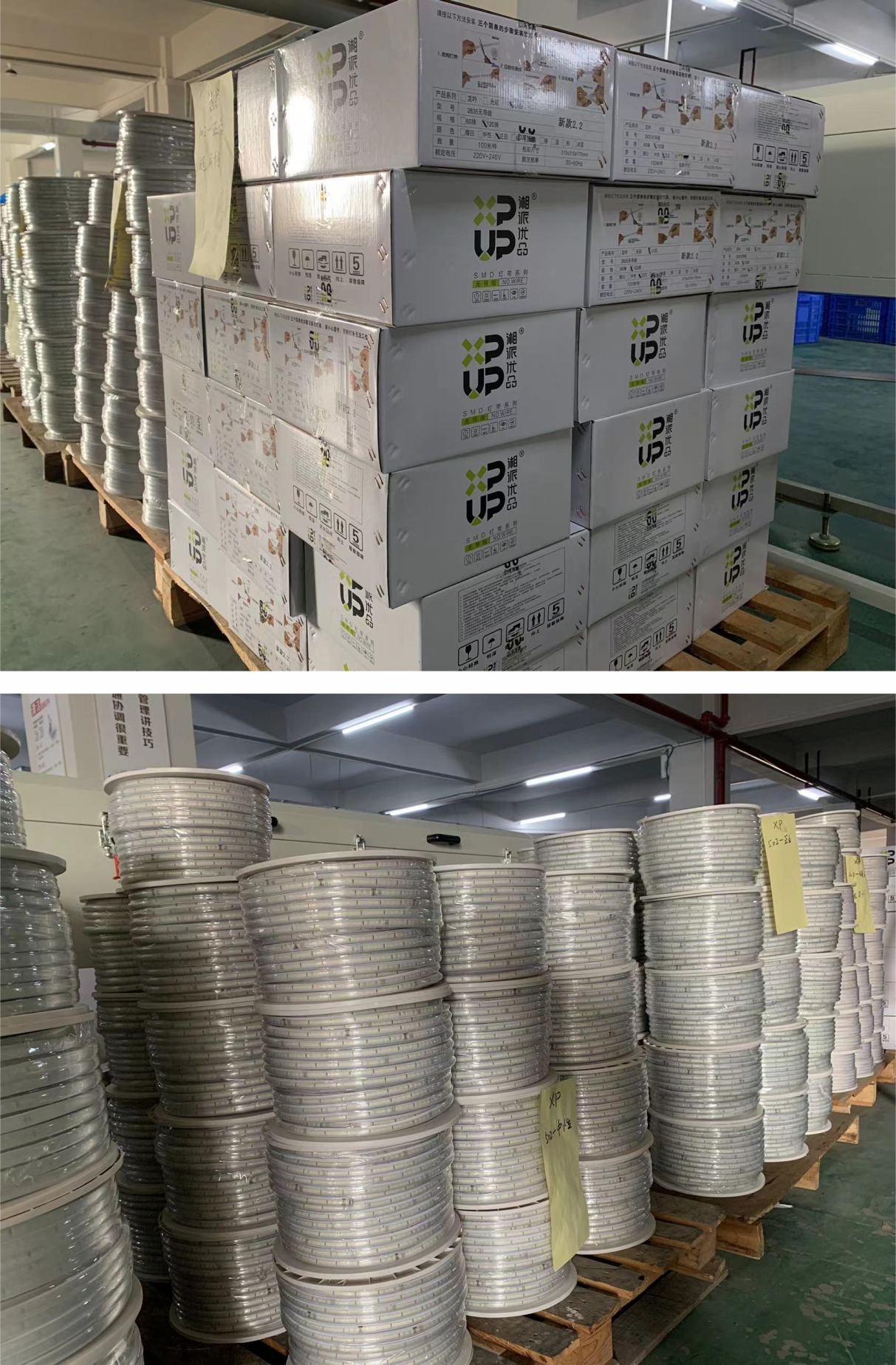
LED density drives optical continuity: a dense SMD 2835 layout produces a continuous band instead of a row of visible points.
XP-CX-18 — reconfigurable display and aimed accents
The XP-CX-18 is a magnetic track light in XPUP LED's LED magnetic light range. Its documented profile is an aluminium-and-PC construction with a 48V / 30W rating, designed around magnetic attachment so that heads can be repositioned and re-aimed along the track.
That combination solves the problem DK3 cannot: change. In retail, a display that is correct in March is often wrong by September — categories move, fixtures move, promotion zones appear and disappear. In exhibition work, a run of shows means a new layout every few weeks. Magnetic attachment means the lighting plan is editable by the venue's own team, without electricians, without cable work, and without cutting a new linear run each time the floor plan shifts. The aluminium body supports structural rigidity and heat management in a fixture that is handled repeatedly, while the PC element keeps weight and cost controlled.
The 48V / 30W rating also positions the fixture differently from a 24V linear run. Track systems distribute power along the rail at a higher voltage and step down at each head, which is what allows many heads to be added to the same circuit without redesigning the drivers. The trade-off is that a 48V track system is its own ecosystem: rail, connectors, drivers and heads need to come from a compatible system rather than being mixed ad hoc.
Where XP-CX-18 stops being the right answer: track lighting delivers discrete sources. A densely populated track can light a room beautifully, but achieving a truly unbroken, seamless wall wash along a long surface usually requires either very tight head spacing or a linear supplement. On a large permanent gallery wall, a track-only scheme is often the more expensive way to reach the same optical result.
Step-by-Step: A Six-Step Decision Path for Specifiers
The following sequence resolves the DK3 versus XP-CX-18 question in the order that prevents rework. Each step produces a decision, not a preference.
Step 1 — Estimate reconfiguration frequency
Count how many times per year the lit geometry is likely to change. A permanent collection wall, a fixed retail perimeter or a hotel corridor typically changes rarely; the linear run is efficient because it is bought once and never adjusted. A multi-brand retail floor, a seasonal promotion zone or a travelling exhibition changes constantly; the magnetic track pays for itself in avoided electrician visits. A useful rule: if the layout changes more than once a year, track economics improve quickly.
Step 2 — Classify the lit surface as colour-critical or ambience-critical
If the surface is judged on how faithfully its colour reads — artwork, jewellery, premium apparel, brand packaging — the Ra≥97 full-spectrum output of the DK3 is the stronger optical starting point, and it is delivered continuously rather than in pools. If the surface is judged mainly on atmosphere, wayfinding or accent hierarchy, XP-CX-18's aimed heads give more control over where attention lands.
Step 3 — Match the power architecture to the building
Confirm whether the project can accommodate 24V constant-voltage runs with remote drivers (DK3) or a 48V magnetic track distribution system (XP-CX-18). This is a services and ceiling-void question as much as an electrical one. On long runs, voltage drop is a real constraint for 24V systems and should be checked at the design stage rather than at commissioning.
Step 4 — Verify the protection rating against the environment
DK3 is IP20 — dry interior locations only. If the installation zone is humid, near water features, or partially exposed, the fixture choice must change before the layout is drawn. For XP-CX-18, request the current protection rating and installation guidance for the specific variant rather than assuming it inherits a project default.
Step 5 — Plan mounting and aiming tolerances
Fixed runs need accurate setting-out: the wall-wash position is determined by the distance between the run and the wall, so that dimension must be fixed on the drawing. Magnetic track needs aiming tolerance: specify how far heads must rotate and tilt to cover the display heights actually used, and confirm the track position allows the angles required.
Step 6 — Lock the customization path before ordering
Both product lines sit inside a manufacturer with documented OEM and ODM programs, so the final step is confirming which parameters can be customized (voltage, colour, dimensions, connectors, labelling, packaging) and which are fixed by the platform. Doing this before the sample stage prevents a specification that cannot be produced.
Use Cases: Where Each Fixture Earns Its Place
1. Permanent museum and gallery collection walls
DK3. A fixed run parallel to the wall delivers an even wash across a surface whose position will not change. The 240 LEDs per metre density and Ra≥97 full-spectrum output keep the wash continuous and colour-faithful, and the 9.3 mm width allows the fixture to disappear into a narrow cove.
2. Travelling exhibitions and event builds
XP-CX-18. When the layout is rebuilt for each show, magnetic heads can be repositioned and re-aimed by the venue team within the run-up window. Aiming flexibility is the whole value here: the same track serves a sculpture show and a framed-print show with different angles.
3. Jewellery and luxury retail display
A hybrid is common. XP-CX-18 heads over counters and display pods for aimed, high-contrast accenting that can follow a case reset; a DK3 run where a fixed perimeter or back-wall wash is required. The colour-critical surfaces argue for high-CRI output in both positions, and the layout volatility argues for keeping at least part of the scheme on track.
4. Multi-brand retail with an annual refit cycle
XP-CX-18. An annual or seasonal refit is exactly the scenario where re-running linear fixtures becomes a recurring cost. Track keeps the ceiling infrastructure constant while the heads absorb the change.
5. Gallery retail shops and bookshops
Usually DK3 on the shelving lines and perimeter, with a small number of aimed heads for feature tables. Shelving geometry rarely changes, so a linear solution is efficient; feature tables move, so a few re-aimable points are worth keeping.
Comparison Table: DK3 vs XP-CX-18 on Documented Specifications
| Decision criterion | DK3 linear | XP-CX-18 magnetic track |
|---|---|---|
| Model reference | DK3-DC24V-2835-240D-9.3mm | XP-CX-18 |
| Product family | Linear LED lighting | LED magnetic track lighting |
| Form factor | Continuous linear run, 9.3 mm board width | Track-mounted head on a magnetic rail |
| LED layout | 240 LEDs per metre, SMD 2835 | Not applicable — head-based, not a continuous strip |
| Input / rating | 24V, 12W | 48V, 30W |
| Colour rendering | Ra≥97, full spectrum | Confirm rendering specification per variant before specifying |
| Construction | Linear fixture with diffused output | Aluminium and PC body with magnetic attachment |
| Protection rating | IP20 (dry interior) | Confirm protection rating per variant |
| Aiming | Fixed — determined by mounting position | Re-aimable after installation |
| Reconfiguration | Requires re-mounting or re-running the fixture | Heads repositioned along the track |
| Optical character | Unbroken, even wall wash | Discrete pools with controllable direction |
| Strongest fit | Permanent galleries, colour-critical walls, coves, shelving lines | Changing retail layouts, exhibitions, events, accent display |
| Customization path | OEM/ODM programs available — confirm project terms | OEM/ODM programs available — confirm project terms |
Compliance Evidence: What a Buyer Can Verify Today
Gallery and retail projects usually require compliance documentation before the lighting package is approved, so it is worth knowing exactly what exists. For XPUP LED's LED low-voltage and high-voltage light strip series, three CE-related certificates were issued by PTC TESTING for the EU market, and all three list DK3-DC24V-2835-240D-9.3mm within their applicable product scope:
- CE – LVD, certificate numbers PTC22122900901S-LD01 and PTC22122900902S-LD01, issued 2023-04-04, tested against EN IEC 62031:2020+A11:2021, IEC TR 62778:2014 and EN 62471:2008.
- CE – EMC, certificate numbers PTC22122900901E-EMB01 and PTC22122900902E-EMB01, issued 2023-03-09, tested against EN IEC 55015:2019+A11:2020, EN 61547:2009, EN IEC 61000-3-2:2019+A1:2021 and EN 61000-3-3:2013+A1:2019.
- CE – RoHS, certificate numbers PTC22122900903C-EN01 and PTC22122900905C-EN01, issued 2023-04-23, tested against the IEC 62321 series (IEC 62321-1:2013 through IEC 62321-8:2017).
The XP-CX-18 is a magnetic track fixture rather than a strip-series product, so it should not be assumed to fall under the same certificate scope. Buyers specifying it should request the fixture-specific declaration and confirm the applicable standards and protection rating for the exact variant being ordered before approval. That is a documentation request, not a technical doubt — it is simply the correct procurement step for a different product platform.
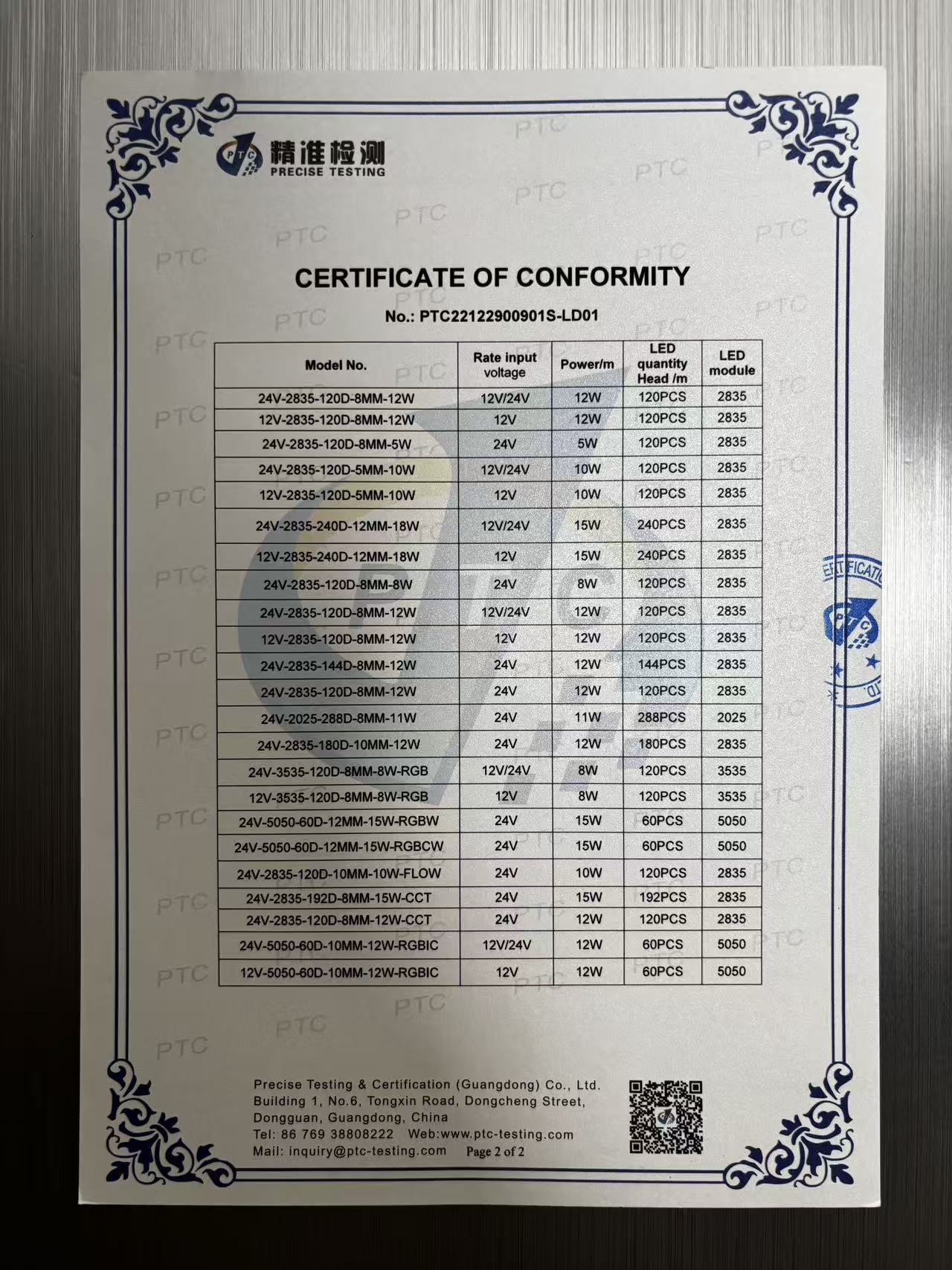
CE LVD documentation issued by PTC TESTING covers the XPUP LED low-voltage and high-voltage light strip series, including the DK3 model.
OEM and ODM: Customizing Either Path
Both fixtures sit inside a manufacturer with documented customization programs, which matters at the evaluation stage because a specification that cannot be produced to the project's parameters is not a real option.
The documented OEM scope covers voltage, logo, power, dimensions, materials, hardware configuration, internal circuit, colour, factory specifications, nameplate and label. The documented ODM scope covers exterior colour scheme, outer packaging box, label, brand information, model name and material details. For the strip-based programs these terms are quoted with a MOQ of 2,000 metres, a lead time of 18–22 days, a monthly capacity of 3,000,000 metres, 100% testing and a 2-year standard warranty with remote technical support.
Because those commercial terms are defined per metre for strip production, they should be read as an indicator of program structure rather than a fixed quotation for a fixture order. Buyers should confirm MOQ, lead time and customization limits for the specific DK3 or XP-CX-18 configuration at the sample stage.
The manufacturing base behind both lines is Zhongshan Xiangpai (XPUP) Lighting Technology Co., Ltd., established in 2012 in Zhongshan, Guangdong — the lighting manufacturing cluster in China. The company operates a 10,000 m² facility with 80 employees, an annual output of 35,000,000 metres, a 6-engineer R&D team, and a 50% export ratio with main markets in the EU and USA. That scale is relevant to a gallery or retail project for one reason: batch-to-batch colour consistency and a repeatable supply for later phases of the same project.
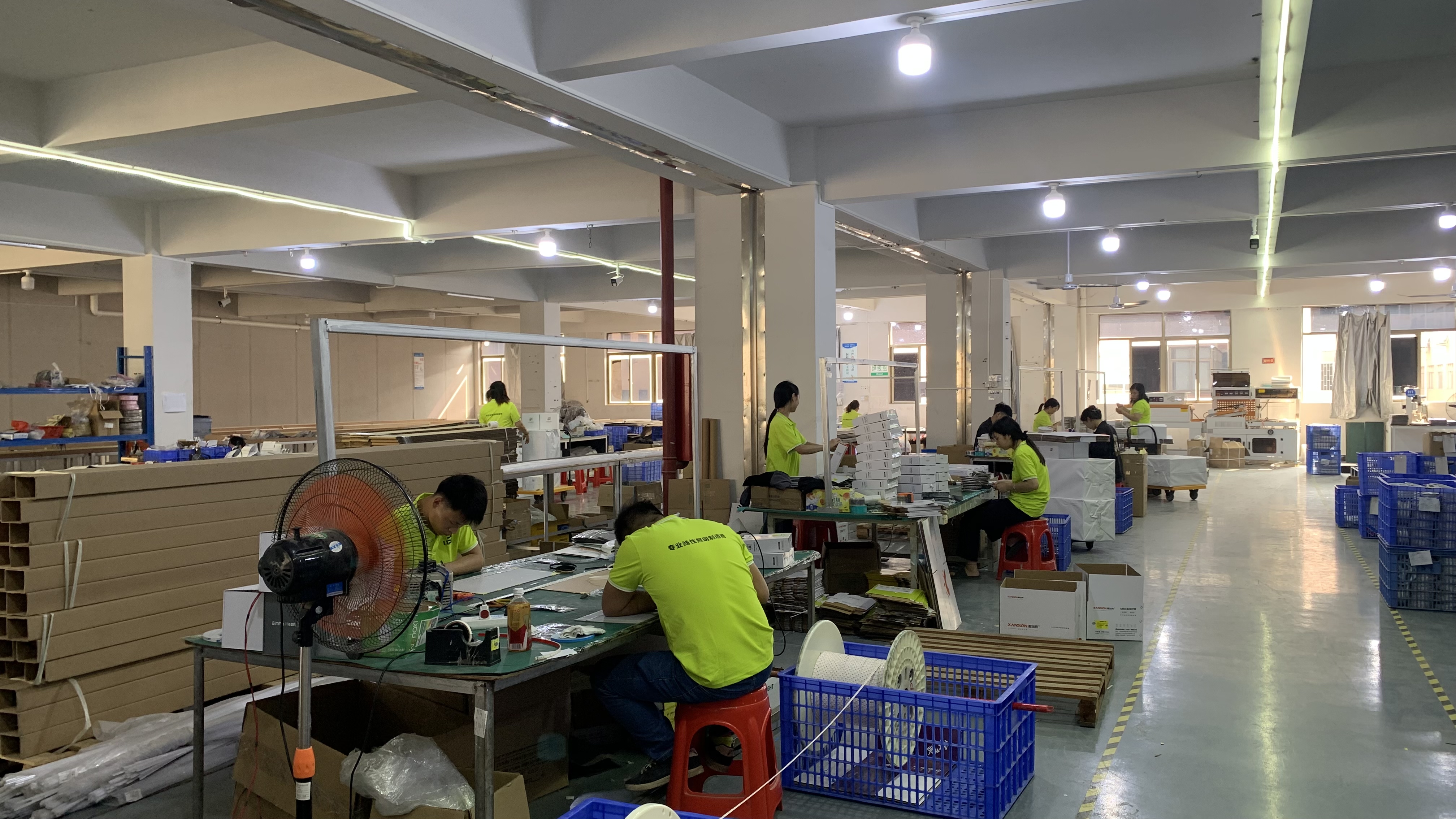
Linear and magnetic track lines are produced in the same 10,000 m² Zhongshan facility, which supports consistent colour and repeat supply across project phases.
FAQ: DK3 Linear vs XP-CX-18 Magnetic Track
Are DK3 and XP-CX-18 covered by CE compliance documentation?
For the DK3, yes: DK3-DC24V-2835-240D-9.3mm is listed in the applicable product scope of three CE certificates issued by PTC TESTING — LVD (PTC22122900901S-LD01 / PTC22122900902S-LD01, issued 2023-04-04), EMC (PTC22122900901E-EMB01 / PTC22122900902E-EMB01, issued 2023-03-09) and RoHS (PTC22122900903C-EN01 / PTC22122900905C-EN01, issued 2023-04-23) for the EU market. Those certificates cover the LED low-voltage and high-voltage light strip series. The XP-CX-18 is a magnetic track fixture on a different platform, so buyers should request fixture-specific documentation and confirm the standards and protection rating for the exact variant before project approval.
What does OEM energy-saving LED lighting manufacturing mean for a commercial project?
It means the fixture can be adapted to the project's electrical and aesthetic parameters rather than the project adapting to a catalogue item. The documented OEM scope includes voltage, logo, power, dimensions, materials, hardware configuration, internal circuit, colour, factory specifications, nameplate and label; the documented ODM scope adds exterior colour scheme, outer packaging, label, brand information, model name and material details. For strip-based programs the published terms are a 2,000-metre MOQ, 18–22 day lead time, 3,000,000 metres monthly capacity, 100% testing and a 2-year standard warranty. Fixture-specific terms for DK3 or XP-CX-18 configurations should be confirmed at quotation.
Which fixture costs less over the life of a project?
There is no universal answer, because the two fixtures incur different cost structures rather than different unit prices. A DK3 linear run concentrates cost at installation and then stays static, which suits a layout that will not change. An XP-CX-18 track system adds rail, connectors and drivers, but absorbs layout changes without new cable work or electrician visits, which suits a space that is reset regularly. The break-even point depends on reconfiguration frequency, so the honest comparison is total cost across the refit cycle, not the price of a single fixture.
How should a buyer validate DK3 or XP-CX-18 before ordering?
Validate on the surface that will actually be lit. Request a sample of the specific configuration, check the colour rendering on the real merchandise or artwork under the intended colour temperature, confirm the LED density produces the continuity required at the specified mounting distance, and verify aiming angles for any track heads against the display heights in use. Ask for the compliance documentation for the exact model and confirm MOQ, lead time and customization limits in writing. Sample confirmation before mass production is standard practice across XPUP LED's OEM and ODM programs.
What lead time should a gallery or retail project plan for?
The documented production lead time for XPUP LED's strip-based OEM and ODM programs is 18–22 days, supported by a monthly capacity of 3,000,000 metres and 100% testing before shipment. For a gallery or retail fit-out, that production window should be added to sample approval, certification confirmation and international freight when building the programme schedule. Buyers working to a fixed opening date should confirm the schedule for the specific DK3 or XP-CX-18 configuration early — a sample request and a written quotation are the fastest way to convert a specification into a dated delivery plan through XPUP LED.
Conclusion: Decide on Change, Not on Preference
The DK3 and the XP-CX-18 are not competitors in the sense that one is better. They are answers to two different questions, and the correct question is decided by the project, not by taste.
Choose DK3 when the geometry is fixed and the surface is colour-critical: permanent gallery walls, back-wall washes, shelves and coves that will still be where they are in three years. The 240 LEDs per metre SMD 2835 layout, 24V / 12W rating, IP20 construction, Ra≥97 full-spectrum output and 9.3 mm width exist to make one continuous, faithful band of light — and nothing else does that as efficiently.
Choose XP-CX-18 when the geometry moves: multi-brand retail floors, seasonal resets, travelling exhibitions and event builds. The aluminium-and-PC magnetic track construction, 48V / 30W rating and aiming flexibility exist to make the lighting plan editable by the people who run the space.
And where the project is mixed — which it usually is — specify both and let each do the job it was built for. A hybrid of fixed linear runs plus a magnetic track zone is often the most cost-effective answer across a full refit cycle, and both lines sit inside the same OEM and ODM framework, so the customization, compliance and supply conversation happens once.
Next Step: Sample, Specification and Quotation
XPUP LED supplies linear lighting and magnetic track lighting to lighting brands, contractors and distributors across the EU, USA and 170+ countries, with OEM and ODM customization, 100% pre-shipment testing and a 2-year standard warranty.
To move from comparison to a dated plan, request a DK3 or XP-CX-18 sample, confirm the compliance documents for your exact model, and ask for a written quotation against your project schedule.
Website: www.xpupled.com | Email: sales001@xpupled.com | Tel / WhatsApp / WeChat: +86 189 8858 4085
Address: 5th Floor, No.36-1, Yihui 1st Road, Henglan Town, Zhongshan City, Guangdong Province, China
Download the full product range: 2026 XPUP LED Strip Catalog (PDF)
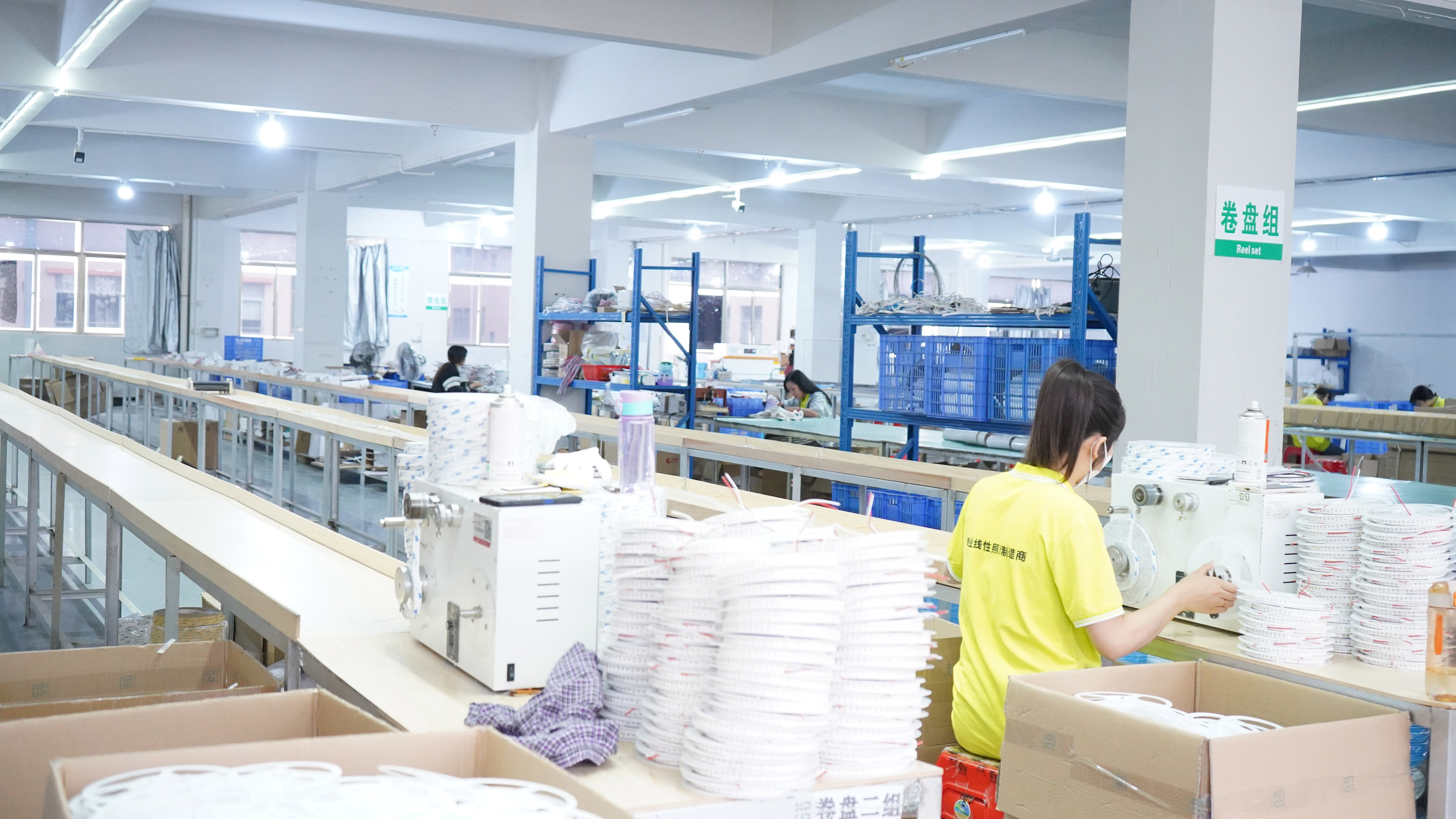
Sample confirmation before mass production is part of the standard OEM and ODM workflow.
Have Questions or Need More Details?
Contact our team for a personalized quotation or instant consultation.
Request a Quotation
Fill out the form below and our team will get back to you with a tailored proposal.
WhatsApp Direct Chat
Prefer to chat in real-time? Message us on WhatsApp for instant assistance & quick answers.
- Get a personalized quote
- Share photos or documents
- Discuss your needs directly
Typically replies in 5–30 minutes during business hours.