
Fix Dull Restaurant Ambience with High-CRI Linear Lighting
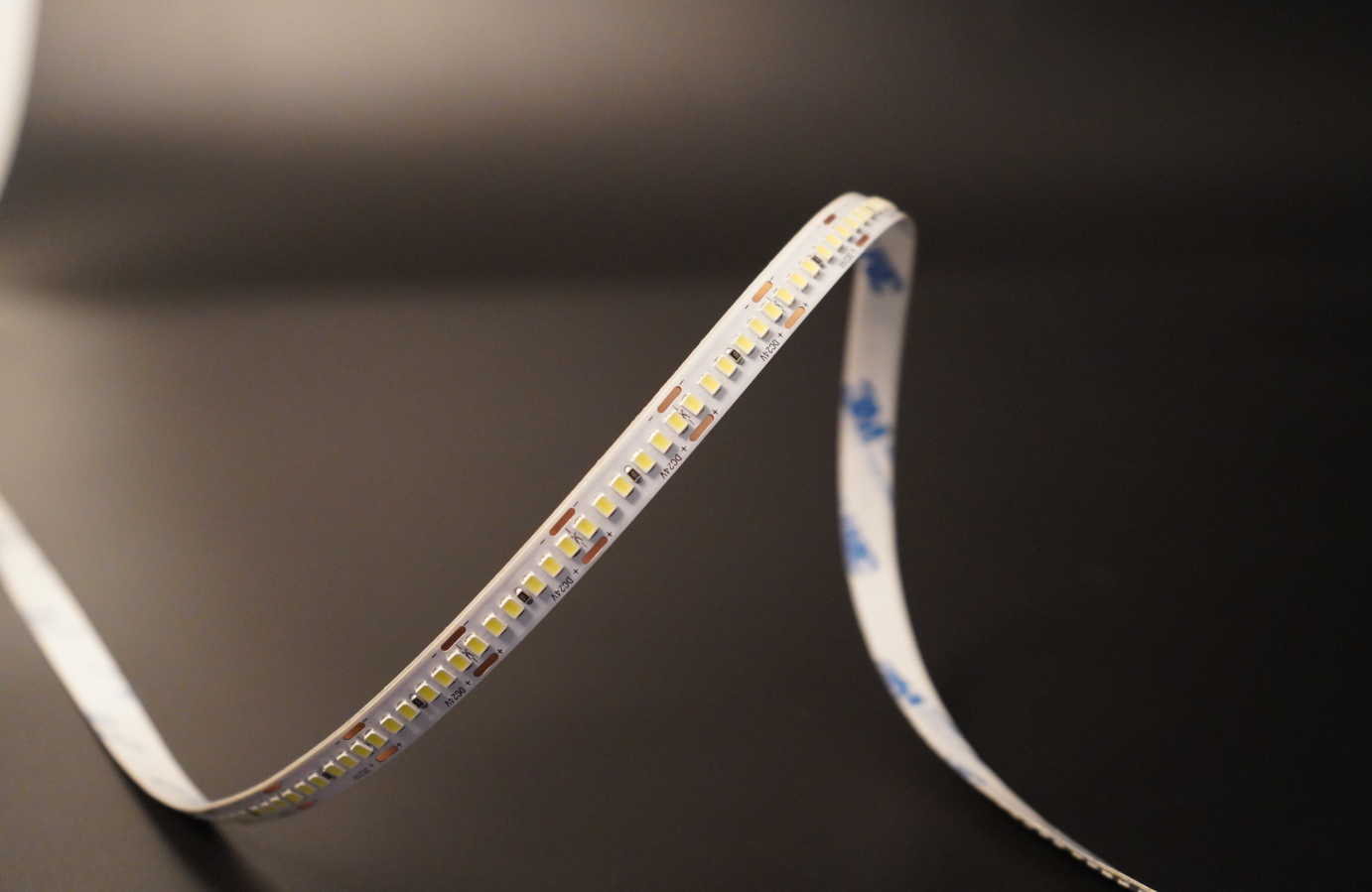
A dull restaurant interior is usually a lighting problem before it is a design problem. When long linear runs are built on a low colour rendering index (CRI) and a low LED density, plated food loses its warmth, timber and stone lose their depth, and ceiling or back-bar runs show individual LED dots instead of a continuous line of light. The practical fix is a fixture change rather than a full refurbishment: a high-density linear LED strip such as the DK3-DC24V-2835-240D-9.3mm from XPUP LED, which carries 240 LEDs per meter on a 9.3 mm double-layer copper PCB, runs at 24V DC and 15W, and is listed for restaurant, interior design, office building, apartment, museum and gallery applications.
This guide is written for the people who actually have to solve the problem: restaurant owners, hospitality fit-out contractors, lighting designers and distributors who need to diagnose why a space feels flat and then specify a linear fixture that will not reproduce the same fault. It covers what to look for, which parameters constrain the decision, how the DK3 compares with other high-CRI options in the same range, and what to verify before an order is placed.
What Dull Actually Means in a Restaurant Interior
Ambience problems in food service rarely come from a single defect. In practice, four measurable causes account for most of the flat, colourless interiors that operators describe, and each one points to a different specification decision.
1. Colour drain from a low colour rendering index
CRI is a 0–100 scale that describes how faithfully a light source reveals colour compared with a reference source. The relevance for a restaurant is direct: the closer a source sits to the top of that scale, the more accurately diners perceive the reds of meat and tomato, the greens of herbs, the grain of timber and the natural tone of skin. A low-CRI source does not make a room darker, but it makes it feel muted, and every plated dish, retail display and interior finish is affected at the same time.
XPUP's linear LED strip range covers several CRI levels so the specification can be matched to the zone rather than compromised across the whole project. The DK3-DC24V-2835-240D-9.3mm is rated Ra≥80, the XP--BD14-DC24V-2835-144D-8MM hospitality strip is rated Ra≥95, and the XP-BD18DC24V-2835-140D-8MM full-spectrum strip is rated Ra≥97.
2. Visible dots and grainy light from low LED density
LED density is measured in LEDs per meter, and it determines how smooth a linear run looks at close range. A strip with a sparse LED population used behind a diffuser or inside a shallow profile produces a beaded, grainy appearance instead of an even band of light. This is the single most common reason a newly installed cove or back-bar looks cheaper than the drawings promised.
The DK3 addresses this with 240 LEDs per meter. XPUP describes the fixture as high density with uniform light emission and no grainy appearance, which is why it is positioned for indoor lighting strips and black profiles where the light source sits close to the visible surface. Density is also a practical answer to shallow profiles: more emitters per meter means shorter diffusion distances are needed to hide them.
3. Hot spots and uneven coves
Uniformity is not only about LED count. It also depends on the PCB, the pitch between emitters and how the strip is mounted. The DK3 uses a double-layer copper PCB with a 9.3 mm width, which gives the strip a slimmer footprint than typical 10 mm products while keeping the electrical layer stable along the run. In a recessed cove or behind a shelf edge, that combination is what separates a clean line of light from a row of bright patches.
4. Mixed colour temperatures across zones
A dining room that runs at 3000K, a bar that runs at 6500K and a corridor that sits somewhere between them will always feel unresolved, even if each individual fixture is perfectly uniform. The DK3 is available in 3000K, 4000K and 6500K, while the BD14 and BD18 hospitality and full-spectrum strips cover 2700K, 3000K, 3500K, 4000K, 5000K and 6000K. That range allows a designer to hold one family of products across the space and change only the colour temperature zone by zone.
An honest limit worth stating: the DK3 is rated Ra≥80 and IP20. It is intended for indoor, dry environments, should not be covered with objects, should be kept away from chemically corrosive environments, and must be connected to a proper power supply or adapter to avoid overload. If a project specification demands Ra≥95 or Ra≥97, or if the installation is in a wet or outdoor area, a different product in the range should be selected rather than forcing the DK3 into a role it was not built for.
Why Restaurant Lighting Is Now Specified by Constraint
Hospitality lighting has become a specification-driven category. The global hospitality lighting market was valued at USD 14.2 billion in 2025, and the linear lighting market was valued at USD 30.09 billion in 2025 with an 11.42% CAGR projected through 2032. These are not niche numbers; they reflect a sector where lighting is treated as part of the guest experience rather than as a utility line item.
The broader LED context explains the pressure on performance. The global LED lighting market was valued at USD 106.9 billion in 2025 and is projected to reach USD 197 billion by 2033, while the lighting sector accounted for approximately 8% of global electricity demand in 2024, roughly 2,200 TWh. Commercial lighting alone was estimated at USD 47.54 billion in 2024. In a market of that scale, buyers no longer compare products on wattage alone; they compare CRI, LED density, colour temperature consistency, voltage, IP rating and certification readiness.
Supply is also concentrated. Asia Pacific held a 39.8% revenue share of the global lighting market in 2025, which is why so many European and North American restaurant projects are specified around a Chinese source manufacturer that can supply documented parameters, hold a CRI figure across batches, and provide CE and RoHS evidence for the EU market. XPUP LED, formally Zhongshan Xiangpai (XPUP) Lighting Technology Co., Ltd., was established in 2012 in Zhongshan City, Guangdong Province, operates a factory of more than 10,000 square metres, and produces LED linear light strips, LED magnetic lights and smart control products.
The practical consequence for a restaurant buyer is that the lighting decision has moved earlier in the project. CRI and LED density now sit alongside wiring and power supply planning, because both are difficult and expensive to correct after the ceiling is closed.
The Linear Fixture at the Centre of the Fix: XPUP DK3
The DK3-DC24V-2835-240D-9.3mm is a 24V linear LED strip built around high emitter density. It is classified as linear lighting within XPUP's range and is listed for use in restaurants, interior design, office buildings, apartments, museums and galleries.
| Parameter | DK3-DC24V-2835-240D-9.3mm |
|---|---|
| Product type | Linear Lighting |
| Rated voltage | 24V |
| Power | 15W |
| LED density | 240 LEDs per meter |
| CRI | Ra≥80 |
| Colour temperature options | 3000K, 4000K, 6500K |
| PCB | 9.3 mm, double-layer copper PCB |
| SMD | 2835 |
| IP rating | IP20 |
| OEM & ODM | Supported |
Three specification details matter most when this fixture is used to fix a flat restaurant interior. First, the 240 LEDs per meter density is the reason the output reads as a continuous band rather than a string of points. Second, the 9.3 mm PCB width makes the strip compatible with slim black profiles and shallow reveals, which is where restaurant coves and bar-back details usually live. Third, the 24V DC, 15W configuration fits standard low-voltage project planning rather than requiring a bespoke electrical design.
Where the DK3 is not the right answer is equally clear. If a project requires the highest colour fidelity available in the range, the specification should move up the CRI ladder.
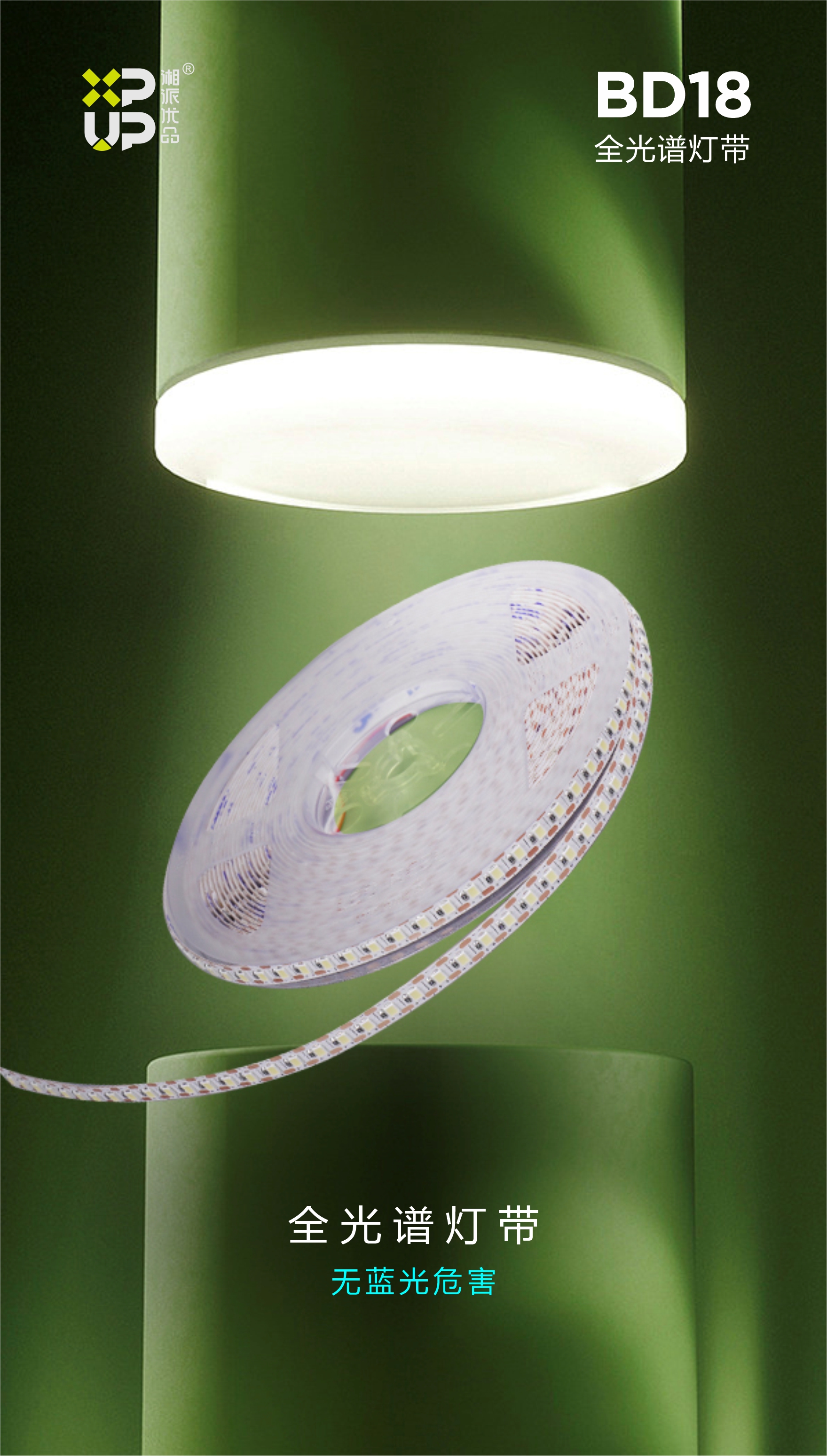
The XP-BD18DC24V-2835-140D-8MM full-spectrum strip is rated Ra≥97 with 140 LEDs per meter, 12W and 24V, and is offered in 2700K, 3000K, 3500K, 4000K, 5000K and 6000K. XPUP positions it for jewellery stores and display cases, which makes it a natural choice for pastry counters, plated-dish pass-throughs and retail displays inside a restaurant. The XP--BD14-DC24V-2835-144D-8MM hospitality strip sits between the two, rated Ra≥95 with 144 LEDs per meter at 12W and 24V, with the same 2700K–6000K colour temperature span and a wide beam angle. It is listed for hospitality, resorts, boutique hotels, apart-hotels and serviced apartments, which is the closest match to a restaurant fit-out programme.
Compliance: what the CE documentation actually covers
For projects in the European Union, the constraint that most often delays a restaurant lighting order is certification evidence. XPUP's LED low-voltage and high-voltage light strip series hold CE certification issued by PTC TESTING for the EU market, covering the LVD, EMC and RoHS testing routes. The DK3-DC24V-2835-240D-9.3mm is listed within the scope of that series certification.
- LVD: certificate numbers PTC22122900901S-LD01 and PTC22122900902S-LD01, tested against EN IEC 62031:2020 + A11:2021, IEC TR 62778:2014 and EN 62471:2008.
- EMC: certificate numbers PTC22122900901E-EMB01 and PTC22122900902E-EMB01, tested against EN IEC 55015:2019+A11:2020, EN 61547:2009, EN IEC 61000-3-2:2019+A1:2021 and EN 61000-3-3:2013+A1:2019.
- RoHS: certificate numbers PTC22122900903C-EN01 and PTC22122900905C-EN01, issued 23 April 2023 and tested against the IEC 62321 series.
This matters commercially. A restaurant opening cannot be signed off on a supplier's verbal assurance; it needs certificate numbers, standards and an issuing body that a local authority or main contractor can verify. Buyers who shortlist on CRI alone and discover the certification gap late in the programme usually pay for it in re-specification.
Customisation, minimum order and delivery constraints
Restaurant projects rarely buy a catalogue item unchanged. XPUP's OEM service covers voltage, logo, power, dimensions, materials, hardware configuration, internal circuit, colour, factory specifications, nameplate and label. The ODM route covers exterior colour scheme, outer packaging box, label, brand information, model name and material details. Minimum order quantity is 2,000 meters, standard lead time is 18–22 days, and monthly capacity is 3,000,000 meters with 100% testing and a 2-year standard warranty.
Step-by-Step: Diagnosing and Replacing Dull Linear Lighting
Step 1 — Audit the existing installation
Record the current CRI if it is documented, the colour temperature per zone, the LED density or pitch of the existing strip, and the age of the installation. Photograph the runs at dusk with the room lighting only. The photographs will show whether the problem is colour drain, visible dots or uneven patches, and that distinction determines which parameter has to change.
Step 2 — Decide the colour target per zone
Rather than treating the dining room, bar, private dining area and corridor as one lighting problem, set a colour target for each. Because XPUP's linear range spans 2700K to 6500K, the same product family can hold a consistent look while individual zones are tuned, which removes the mixed-temperature effect that makes a space feel unresolved.
Step 3 — Match the fixture to the zone
Use the DK3 where long, uniform, low-profile runs are needed and Ra≥80 is acceptable. Step up to the BD14 where the space is hospitality-grade and requires Ra≥95. Step up again to the BD18 where colour accuracy is critical, such as display cases or plating counters. Use the XP-A9DC24V-2835-120D-8MM indoor strip for cabinet and under-shelf lighting in joinery.
Step 4 — Verify the electrical and environmental constraints
Confirm the 24V DC supply, the 15W per meter figure for the DK3 and the 12W figure for the BD14 and BD18, and the total load on each driver. Confirm that the installation is indoors and dry, because IP20 is not protected against water ingress. Keep the strip uncovered, away from chemically corrosive environments, and within the stated operating temperature range of -20°C to +45°C. Use a proper power supply or adapter to avoid overload.
Step 5 — Confirm the compliance file
Collect the CE documentation for the exact series being ordered, including the LVD, EMC and RoHS certificate numbers, before the order is placed. If the project is outside the EU, confirm which of the available certifications the destination market accepts, and do not assume that one market's approval transfers automatically to another.
Step 6 — Validate with a sample
Install a sample run in the actual profile, at the actual mounting distance, in the actual room. Colour rendering and density problems are visible at the sample stage and effectively invisible on a specification sheet. XPUP's service process covers product customization, sample confirmation, mass production, international delivery and after-sales support, so the sample stage is built into the workflow rather than treated as an exception.
Step 7 — Plan production and installation
With an 18–22 day lead time and a monthly capacity of 3,000,000 meters, the production window can be planned against the fit-out programme rather than against hope. XPUP also prepares inventory during low seasons and maintains supply during peak seasons, which reduces the risk of a lighting delivery becoming the critical path on a restaurant opening.
Where the Solution Fits: Restaurant Use Cases
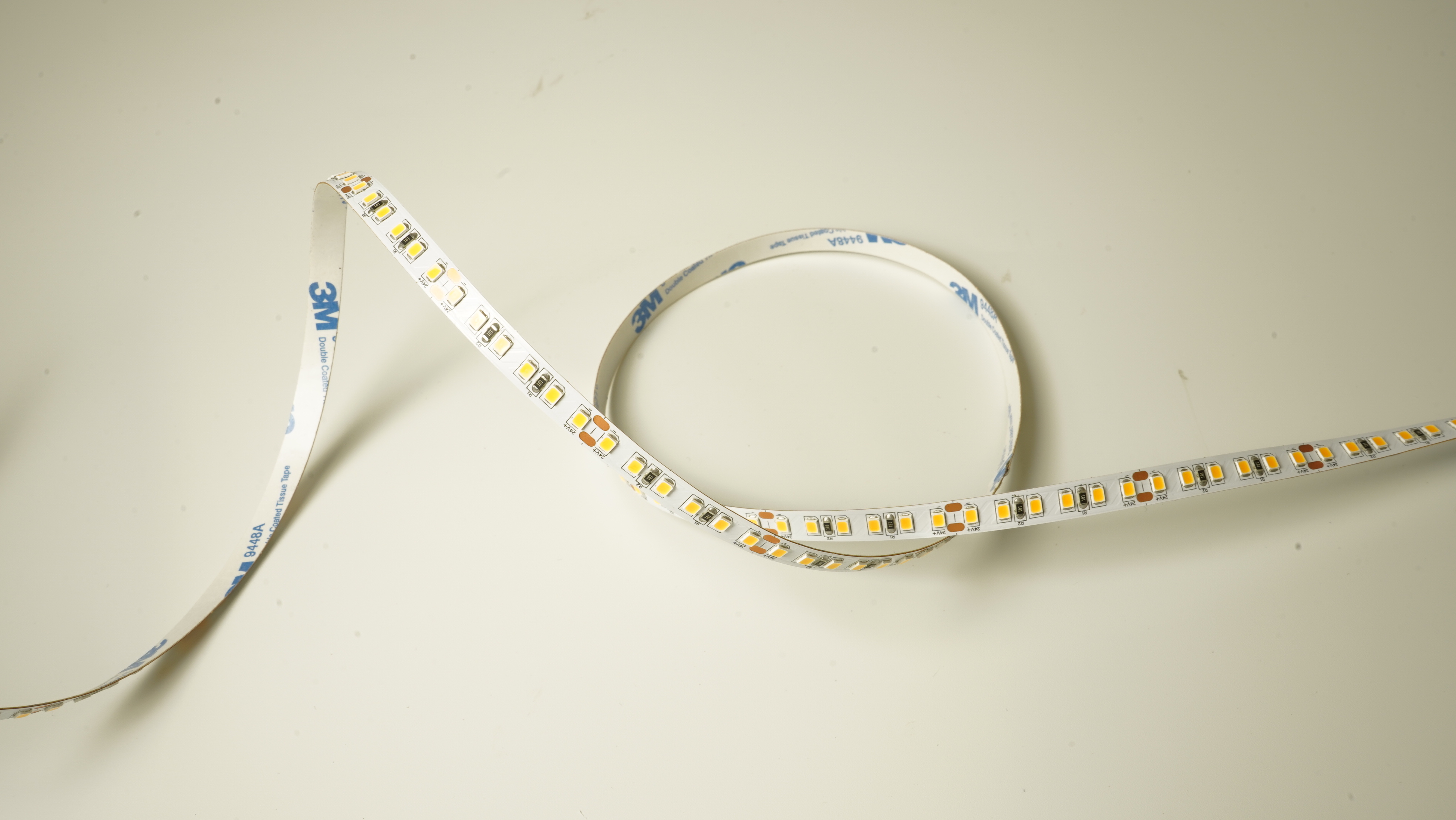
- Dining room ceiling lines and coves: the DK3 at 240 LEDs per meter gives a continuous, dot-free line in shallow profiles, which is the typical failure point in a restaurant ceiling design.
- Bar backs and shelving edges: the 9.3 mm PCB fits slim black profiles, so the fixture disappears and only the light remains visible.
- Plating counters and pastry displays: the BD18 at Ra≥97 is the appropriate choice when the colour of food has to be judged under the light rather than under daylight.
- Hotel restaurants, resorts and serviced apartments: the BD14 at Ra≥95 is positioned for hospitality interiors and carries the same 24V, 12W electrical profile as the BD18, which simplifies multi-zone driver planning.
- Cabinetry and under-shelf detail: the XP-A9DC24V-2835-120D-8MM indoor strip provides 120 LEDs per meter at 10W and 24V for joinery lighting in dining areas and kitchens.
- Dynamic zones: the XP-SM-DC24V-5050-10MM smart strip is rated Ra≥90 with 60 or 120 LEDs per meter and RGB or 3000K/4000K/6000K options for spaces that need scene changes.
There is field evidence behind these applications rather than theory alone. XPUP supplied 50,000 meters of COB LED strip lighting to a German commercial lighting contractor for café and chain retail environments, where the products were used to deliver smooth, flicker-free illumination and uniform light output, with smart strip integration for different operating scenarios. A separate German hospitality contractor programme used high-efficiency and IP68 waterproof LED strips across hotel public areas, where consistent brightness and colour quality were maintained over long-term operation.
Linear Lighting Options for Restaurants: Specification Comparison
The table below compares the linear and indoor options most often specified for restaurant interiors. All values are taken from XPUP product specifications.
| Model | Type | LEDs / m | CRI | Power / Voltage | Colour temperature | IP | Typical restaurant use | OEM & ODM |
|---|---|---|---|---|---|---|---|---|
| DK3-DC24V-2835-240D-9.3mm | Linear Lighting | 240 | Ra≥80 | 15W / 24V | 3000K, 4000K, 6500K | IP20 | Uniform ceiling runs, coves, bar backs, slim black profiles | Supported |
| XP-BD18DC24V-2835-140D-8MM | Full Spectrum Lighting | 140 | Ra≥97 | 12W / 24V | 2700–6000K | IP20 | Display cases, pastry counters, colour-critical feature areas | Supported |
| XP--BD14-DC24V-2835-144D-8MM | Hospitality Lighting | 144 | Ra≥95 | 12W / 24V | 2700–6000K | IP20 | Hotel restaurants, resorts, boutique hotel dining, apart-hotels | Supported |
| XP-A9DC24V-2835-120D-8MM | Indoor Lighting | 120 | Ra≥80 | 10W / 24V | 3000K, 4000K, 6000K | IP20 | Cabinetry, under-shelf and joinery lighting in dining areas | Supported |
| XP-SM-DC24V-5050-10MM | Smart Lighting | 60 or 120 | Ra≥90 | 12W / 24V | RGB / 3000K, 4000K, 6000K | IP20 | Zones requiring dynamic colour or scene changes | Supported |
Read the table as a decision sequence rather than a ranking. Density solves uniformity, CRI solves colour fidelity, and IP rating defines where the fixture may legally and safely be installed. No single row wins on all three; the correct answer depends on which zone of the restaurant is being lit.
Frequently Asked Questions
Are XPUP linear LED strips CE certified for EU restaurant projects?
Yes. XPUP's LED low-voltage and high-voltage light strip series hold CE certification issued by PTC TESTING for the EU market, covering the LVD, EMC and RoHS testing routes, and the DK3-DC24V-2835-240D-9.3mm is listed within that series scope. The LVD certificate numbers are PTC22122900901S-LD01 and PTC22122900902S-LD01, tested against EN IEC 62031:2020 + A11:2021, IEC TR 62778:2014 and EN 62471:2008. The EMC certificate numbers are PTC22122900901E-EMB01 and PTC22122900902E-EMB01, tested against EN IEC 55015:2019+A11:2020, EN 61547:2009, EN IEC 61000-3-2:2019+A1:2021 and EN 61000-3-3:2013+A1:2019. The RoHS certification carries certificate numbers PTC22122900903C-EN01 and PTC22122900905C-EN01 and was tested against the IEC 62321 series, issued 23 April 2023.
What CRI and LED density options are available for restaurant linear lighting?
The range covers three practical combinations. The DK3-DC24V-2835-240D-9.3mm provides 240 LEDs per meter at Ra≥80, 15W and 24V in 3000K, 4000K and 6500K. The XP--BD14-DC24V-2835-144D-8MM hospitality strip provides 144 LEDs per meter at Ra≥95, 12W and 24V. The XP-BD18DC24V-2835-140D-8MM full-spectrum strip provides 140 LEDs per meter at Ra≥97, 12W and 24V. Both the BD14 and the BD18 are offered in 2700K, 3000K, 3500K, 4000K, 5000K and 6000K, so colour temperature can be held consistent across zones while CRI is raised only where the project requires it.
What is the minimum order quantity, and what can be customised?
The minimum order quantity is 2,000 meters, with a standard lead time of 18–22 days and a monthly production capacity of 3,000,000 meters. OEM customisation covers voltage, logo, power, dimensions, materials, hardware configuration, internal circuit, colour, factory specifications, nameplate and label. ODM customisation covers exterior colour scheme, outer packaging box, label, brand information, model name and material details. Every unit is 100% tested, and the standard warranty is 2 years with online remote support and general technical guidance.
Can I validate a sample before committing to a full production order?
Yes. XPUP's cooperation process runs through product customisation, sample confirmation, mass production, international delivery and after-sales support, which means the sample stage is a defined step rather than an exception. Sample validation is the only reliable way to confirm that colour rendering and density behave as expected in the actual profile and at the actual mounting distance, because both effects depend on the installation rather than on the datasheet alone. A dedicated technical contact handles the sample from specification through to parameter guidance.
What lead time should I plan for, and how do I start?
Plan for 18–22 days of standard lead time, with production scheduled against a monthly capacity of 3,000,000 meters; XPUP also prepares inventory during low seasons to maintain supply through peak periods. To start, send the zone list, the required CRI and colour temperature per zone, the profile dimensions and the target market so that the correct model and certification route can be confirmed before a quote is issued. Contact the team at sales001@xpupled.com or +86 189 8858 4085 (WhatsApp/WeChat), or review the full range on the XPUP LED official website.
Conclusion: Fix the Fixture, Not the Furniture
A restaurant that feels flat is usually showing the symptoms of two measurable lighting faults: insufficient colour rendering and insufficient LED density. Both are addressed at the fixture level, and both are far cheaper to correct before the ceiling is closed than after. The DK3-DC24V-2835-240D-9.3mm answers the density problem with 240 LEDs per meter on a 9.3 mm double-layer copper PCB, delivering the continuous, dot-free line that shallow restaurant profiles require. Where the project demands more colour fidelity, the XP--BD14-DC24V-2835-144D-8MM at Ra≥95 and the XP-BD18DC24V-2835-140D-8MM at Ra≥97 extend the same 24V architecture upward without changing the electrical design.
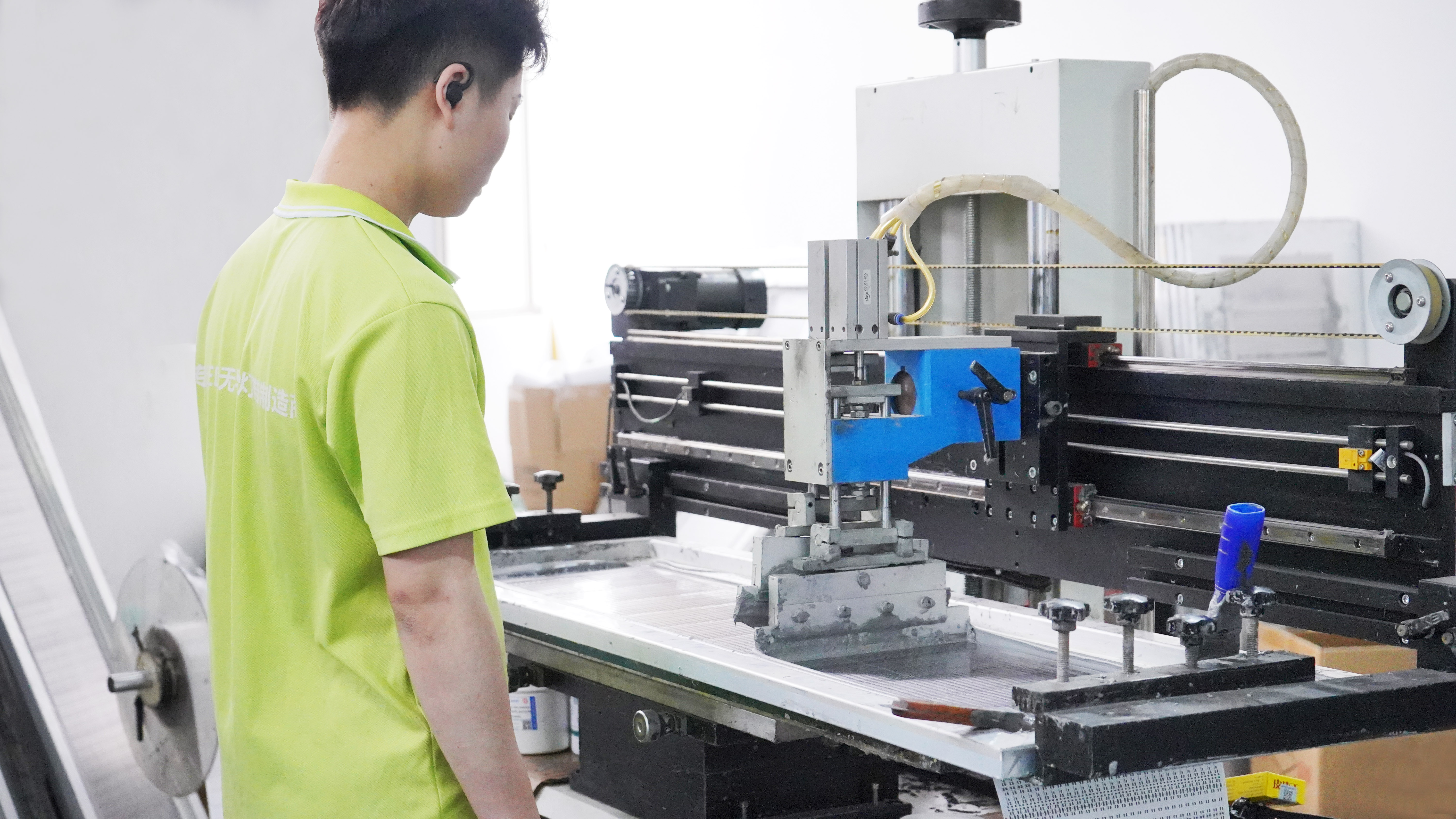
Behind the products sits a manufacturer with a documented footprint: Zhongshan Xiangpai (XPUP) Lighting Technology Co., Ltd., established in 2012 in Zhongshan City, Guangdong Province, operating a factory of more than 10,000 square metres with 80 employees, a 6-engineer R&D team and an annual output of 35,000,000 meters, exporting to the EU, the USA and other markets worldwide.
Request a Sample or a Project Quote
Send the zone list, the required CRI and colour temperature, and the profile dimensions for a model recommendation within the DK3, BD14 and BD18 range.
Email: sales001@xpupled.com
Tel / WhatsApp / WeChat: +86 189 8858 4085
Website: www.xpupled.com
Address: 5th Floor, No.36-1, Yihui 1st Road, Henglan Town, Zhongshan City, Guangdong Province, China
Download the full product range: 2026 XPUP LED Strip Catalog (PDF)