
How to Specify LED Strip Lights for Acoustic Wall Panels: A Designer's Playbook
How to Specify LED Strip Lights for Acoustic Wall Panels: A Designer’s Playbook
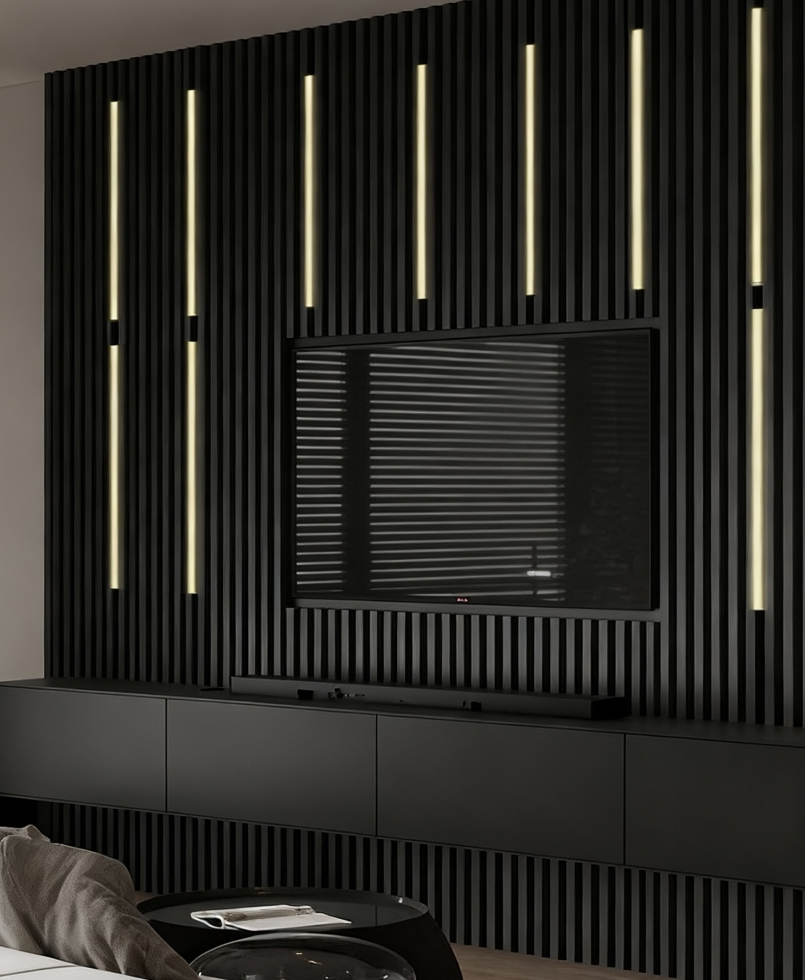
Acoustic slat walls and their lighting are almost always decided in the same design meeting, yet they are documented in different packages. The wall is selected for its absorption performance and its texture. The strip is selected later, frequently from a catalogue page that says nothing about slat geometry. That sequence is why so many feature walls end up with visible emitter dots, a shadow line that stops short of the reveal, or a driver with no accessible service point once the panels are locked in.
The short answer: a strip specified for acoustic wall panels has to satisfy five constraints at the same time — a PCB narrow enough to sit inside a 13 mm or 15 mm slat gap, enough LED density (around 180 LEDs per metre) that the run reads as a continuous line rather than individual emitters, a 3000K colour temperature that rakes across the slat face instead of flattening it, IP20 protection matched to a dry indoor envelope, and a documented CE file for European projects. The CA-DC24V-2835-180D-8mm-3000K from XPUP LED is classified as an Acoustic Wall LED Strip Light and is built to that envelope.
XPUP LED is the brand of Zhongshan Xiangpai (XPUP) Lighting Technology Co., Ltd., an LED strip manufacturer established in 2012 in Zhongshan, China, whose range covers flexible, COB, RGB/RGBCW, architectural and acoustic panel strip lighting for EU and US markets (www.xpupled.com). This playbook sets out the specification order its designers use when a strip has to live inside a slatted acoustic wall.
Problem Definition: Why Acoustic Walls Break Standard Strip Specifications
An acoustic wall is not a lighting surface. It is a sound-absorbing assembly with a groove in it, and three of its properties work against conventional strip specification.
1. The gap is the fixture. On a slatted panel the strip is not mounted in an aluminium profile with a diffuser; the slot itself becomes the aperture. If the PCB and its connection are wider than the slot, the strip cannot sit on the slat centreline, and the light leaks onto the face of the panel instead of the return. That is why an 8 mm PCB — and a strip developed specifically for 13 mm and 15 mm slat spacing — matters more in this detail than raw lumen output.
2. The panel is the diffuser. Light bouncing out of a narrow slot at a shallow angle reveals every interruption. Emitter spacing, solder joints and cut marks that would be invisible inside a 10 mm profile become visible on a slat face. High LED density is a geometry solution here, not a brightness solution.
3. The channel closes permanently. Once the slats are fixed, the strip sits behind them with no maintenance access. The specification therefore has to assume a multi-year service life rather than a replacement cycle. Quality LED strips are typically rated between 30,000 and 50,000 hours.
A fourth, softer problem is colour. Acoustic slats are usually timber veneer, veneer-wrapped MDF, or felt-faced battens — materials with visible grain and shadow. A cool white strip turns that grain grey; an over-saturated warm strip turns it orange. Colour temperature has to be specified as a design decision, not inherited from whatever the contractor has in stock.
Industry Background: What the Market Data Says About Wall Lighting
Wall lighting is no longer a niche application inside the strip category. The global LED strip market was valued at approximately USD 5.8 billion in 2025 and is projected to reach USD 13.2 billion by 2034, a CAGR of 9.6% (Dataintelo). Flexible strip remains the dominant construction type, holding a 67.4% share of the product mix as of 2025 (Dataintelo), and Business Research Insights estimates that over 65% of new architectural lighting installations in 2025 use LED strip technology in some form.
Three specification trends sit directly behind the acoustic wall decision:
- 24V is the mainstream system voltage. The 24V LED segment accounted for 52.0% of linear LED strip fixture market revenue in 2022 (Grand View Research), and 24V DC remains the practical choice for wall runs because voltage drop across a 2.4–3 m strip stays manageable on a double-layer copper PCB.
- Warm neutral is the mainstream colour temperature. The 3000K–4000K segment held a 33.2% revenue share in the linear LED strip fixture market (Grand View Research) — consistent with what wall applications demand: warm enough to reveal texture, neutral enough not to distort the panel colour.
- High-density strips are a premium-installation default. Variants above 120 LEDs per metre account for nearly 19% of premium installations (Business Research Insights), a share that reflects exactly the problem described above — density used as a continuity tool.
Regulation is shaping the envelope as well. EU Ecodesign requirements are driving an estimated 55% shift toward LED-based systems (European Commission), and Europe is forecast as the fastest-growing regional market for linear LED strip fixtures at a 12.6% CAGR (Grand View Research). LED strip already consumes roughly 70% less power than equivalent incandescent lighting, so the compliance conversation is less about whether to use strip and more about documenting which strip, at which rating, for which environment.
The Detailed Solution: A Five-Layer Specification Stack
Rather than specifying an acoustic wall strip model by model, the reliable approach is to specify five constraint layers in order. Each layer eliminates options. The model that survives all five is the one that should be ordered.
Layer 1 — Geometric fit: PCB width against slat gap
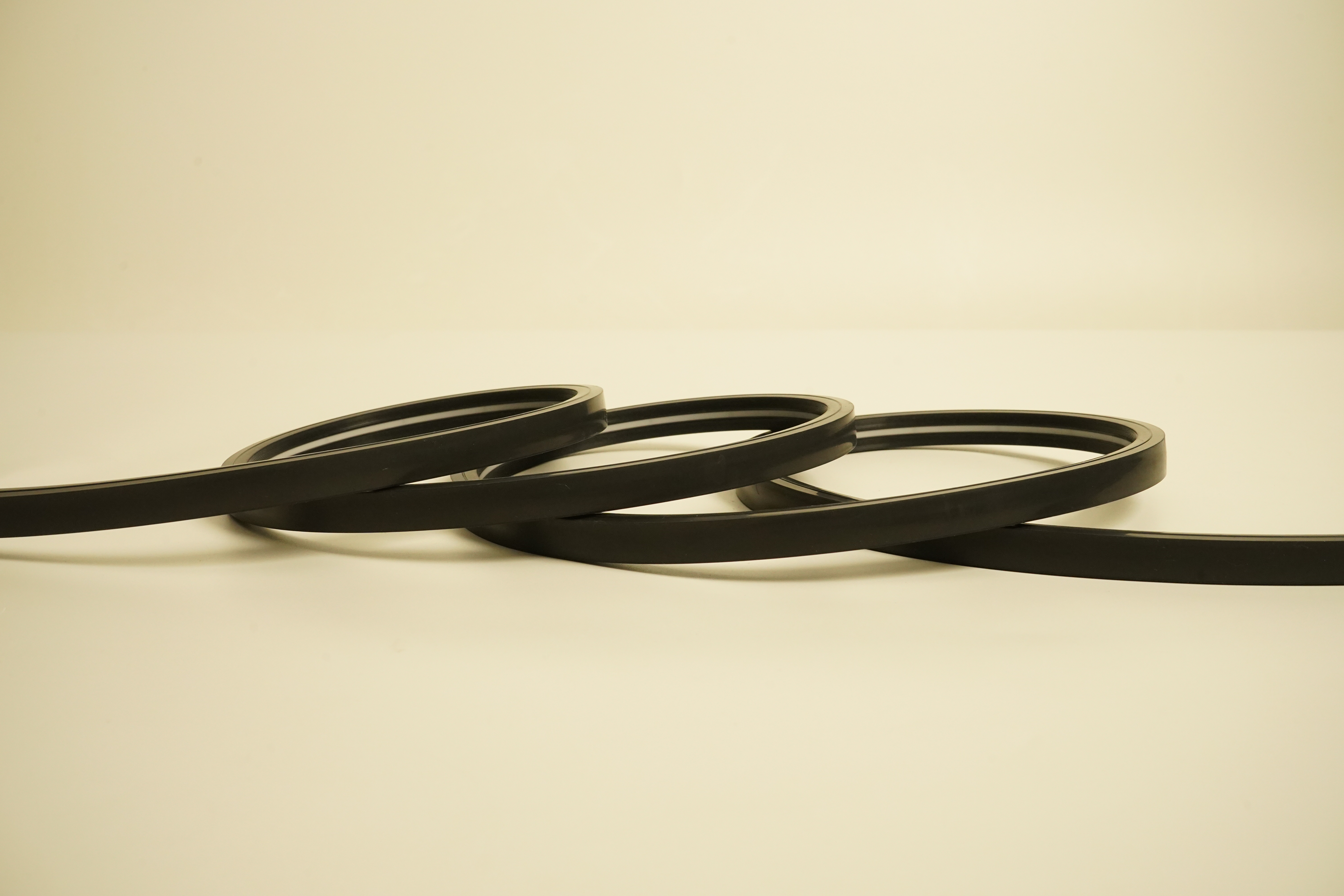
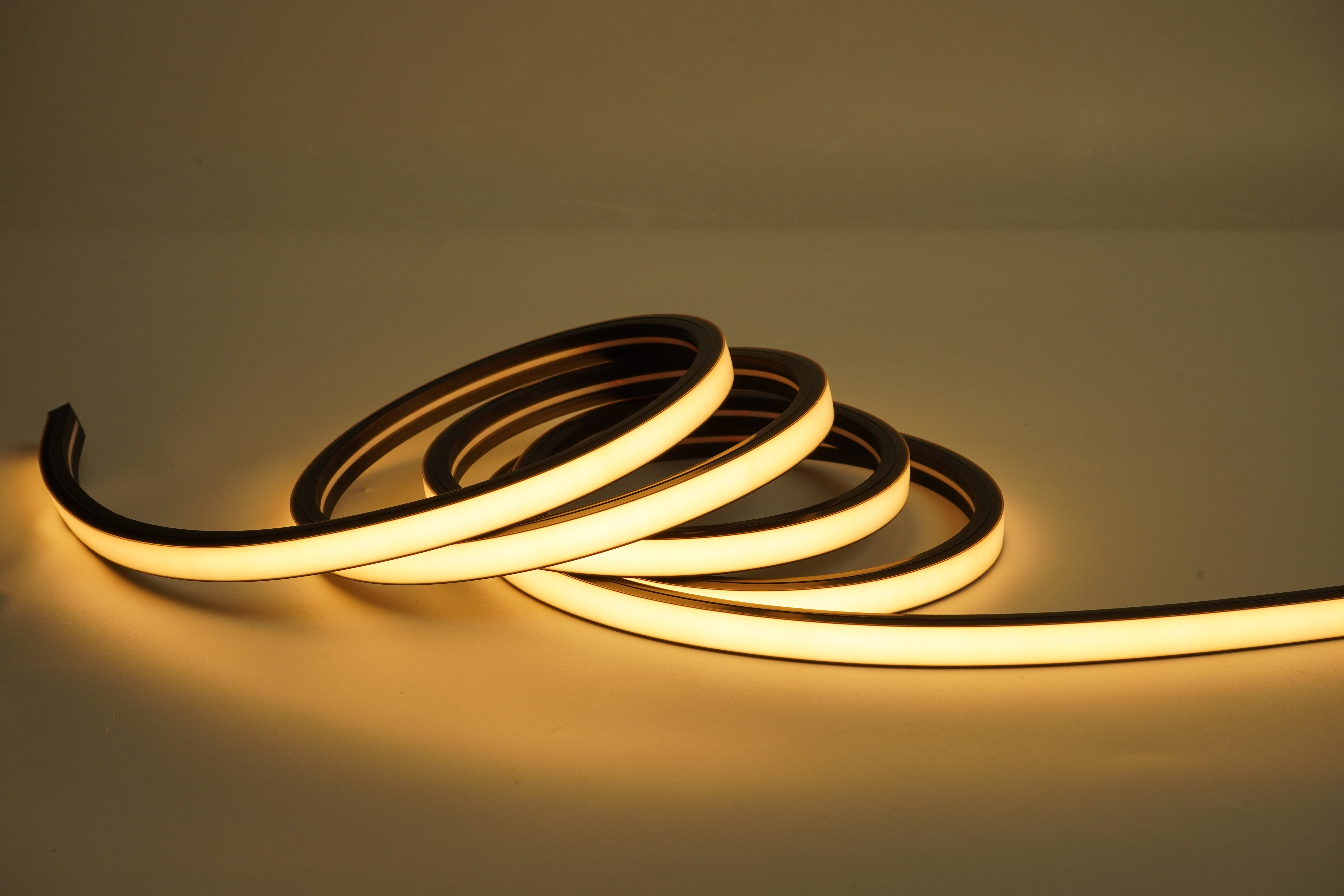
The CA-DC24V-2835-180D-8mm-3000K is developed specifically for slat wall panels with 13 mm and 15 mm spacing. Its PCB is 8 mm wide and the strip has a black surface, so once it is set into the slot it recedes into the shadow of the panel rather than reading as a bright tape line. Because the strip is flexible, it can follow returns, curves and stepped panel geometry that a rigid linear fixture cannot. Standard run lengths are 2.4 m and 3 m per strip, which covers most feature-wall bay widths without a mid-bay joint.
Layer 2 — Density and visual continuity
The model carries 180 LEDs per metre using SMD 2835 emitters at 11 W per metre. Density is what converts a strip in a groove into a line of light on a wall: at 180 LEDs per metre the emitters sit close enough that the eye reads the run as continuous, even when the slot is only partially shielded. The SMD 2835 package is also a mechanical advantage in narrow slots, since its footprint keeps the assembly within the 8 mm PCB envelope.
Layer 3 — Colour temperature and how it interacts with panel texture
3000K is the specified colour temperature for this model. On an acoustic wall, 3000K does two things a cooler temperature does not: it preserves the warmth of timber and veneer so the grain stays legible, and it keeps the contrast between lit and shadowed slats high enough that the wall reads as a textured surface rather than a flat wash. The model’s CRI is Ra≥80, which suits a grazing, decorative wall application where the strip is lighting architecture rather than performing a colour-critical task.
Specification note
The acoustic wall model is a single-colour-temperature product at 3000K. Where a scheme requires the colour temperature to change through the day, that CCT decision has to move to a tunable strip before the panel geometry is fixed — not afterwards.
Layer 4 — Thermal and electrical envelope
The strip runs on a 24V DC supply at 11 W per metre, so a 3 m run represents a 33 W load before any driver derating is applied. Three first-party operating conditions apply to this product, and they belong in the specification document:
- Operating temperature range is −20°C to +45°C.
- The strip must not be covered with objects — acoustic insulation or batting packed against the rear of the panel will trap heat.
- It must be used with a proper power supply or adapter to avoid overload, and kept away from chemically corrosive environments.
The PCB is a double-layer copper construction. In practice this is the component that manages both heat spreading and voltage drop across a 2.4–3 m run, which is part of why 24V low-voltage systems dominate architectural wall lighting rather than higher-current alternatives.
Layer 5 — Environment and compliance envelope
The IP rating for this model is IP20, which defines its envelope precisely: indoor, dry, low-moisture interiors. It is the correct rating for a slatted wall in a living room, lobby, corridor or hotel suite, and the wrong rating for a bathroom, a spa, an external soffit or any location where condensation can reach the PCB. Where a scheme continues outside, the specification splits: IP20 acoustic wall strip indoors, and an IP68 silicone or COB strip for the exterior run.
Because the wall is closed after installation, compliance documentation should be collected before the panel is fixed, not after. The XPUP LED strip series carries CE certification issued by PTC TESTING. The certificate scope covers the LED low-voltage and high-voltage light strip series, and the acoustic wall model CA-DC24V-2835-180D-8mm-3000K is listed among the applicable products.
| Certification | Type | Certificate numbers | Key standards | Issue date |
|---|---|---|---|---|
| CE | LVD | PTC22122900901S-LD01; PTC22122900902S-LD01 | EN IEC 62031:2020+A11:2021; IEC TR 62778:2014; EN 62471:2008 | 2023-04-04 |
| CE | EMC | PTC22122900901E-EMB01; PTC22122900902E-EMB01 | EN IEC 55015:2019+A11:2020; EN 61547:2009; EN IEC 61000-3-2:2019+A1:2021; EN 61000-3-3:2013+A1:2019 | 2023-03-09 |
| CE | RoHS | PTC22122900903C-EN01; PTC22122900905C-EN01 | IEC 62321 series | 2023-04-23 |
For US-bound projects the parallel standard to reference is UL 2108, which classifies low-voltage 12V/24V LED strips. At international level, IEC 60598-2-20:2022 specifies safety requirements for lighting chains including LED strips. Naming the standard the detail is designed against, on the drawing itself, removes the ambiguity that usually surfaces during a compliance review.
Step-by-Step Breakdown: The Acoustic Wall Specification Sequence
This is the order that avoids rework. Each step closes a decision the next step depends on.
- Survey the slat geometry before the panel is ordered. Record the slat pitch, the open gap (13 mm and 15 mm are the standard targets for this model), the depth of the cavity behind the panel, and whether the strip runs along the centre of a gap or behind a closed batten. Gap dimension is the constraint that eliminates most catalogue options first.
- Decide indirect or direct emission. A grazing wash across the slat faces needs the strip aimed along the slot return; a concealed cove effect needs it aimed away from the viewer. The aiming decision changes the distance from emitter to visible edge, and therefore changes how much density is required.
- Fix the colour temperature against a physical panel sample. View the actual veneer or felt sample under 3000K before committing. Panel finishes vary enough between batches that a colour decision made on screen is a decision made twice.
- Choose density and PCB width together. For this detail the starting point is 180 LEDs per metre on an 8 mm double-layer copper PCB in a black finish that recedes into the slot shadow.
- Calculate the electrical load and driver headroom. Multiply 11 W per metre by the run length, add the dimming or control interface, and specify the 24V supply with headroom. Use a proper power supply or adapter — undersizing the driver is one of the most common causes of premature strip failure in closed wall assemblies.
- Set the thermal and environmental envelope in writing. State the −20°C to +45°C operating range, and state explicitly that the strip must not be covered or packed with insulation. Keep the rear cavity ventilated and keep the strip clear of chemically corrosive environments.
- Lock the compliance file. Confirm the CE certificate set (LVD, EMC, RoHS) and the destination-market standard, and file the certificate numbers with the panel schedule so they travel with the project rather than with the supplier’s inbox.
- Prototype on a full-size mock-up, then release the order. Build one bay with the actual panel profile and the actual strip, and view it at the actual viewing distance. This is the step that catches joint visibility, driver placement and control zoning while they are still inexpensive to change.
Use Cases: Where This Specification Pays Off
The same five-layer logic applies across the acoustic panel applications this model is intended for, but the emphasis shifts with the project type.
Luxury residential feature walls
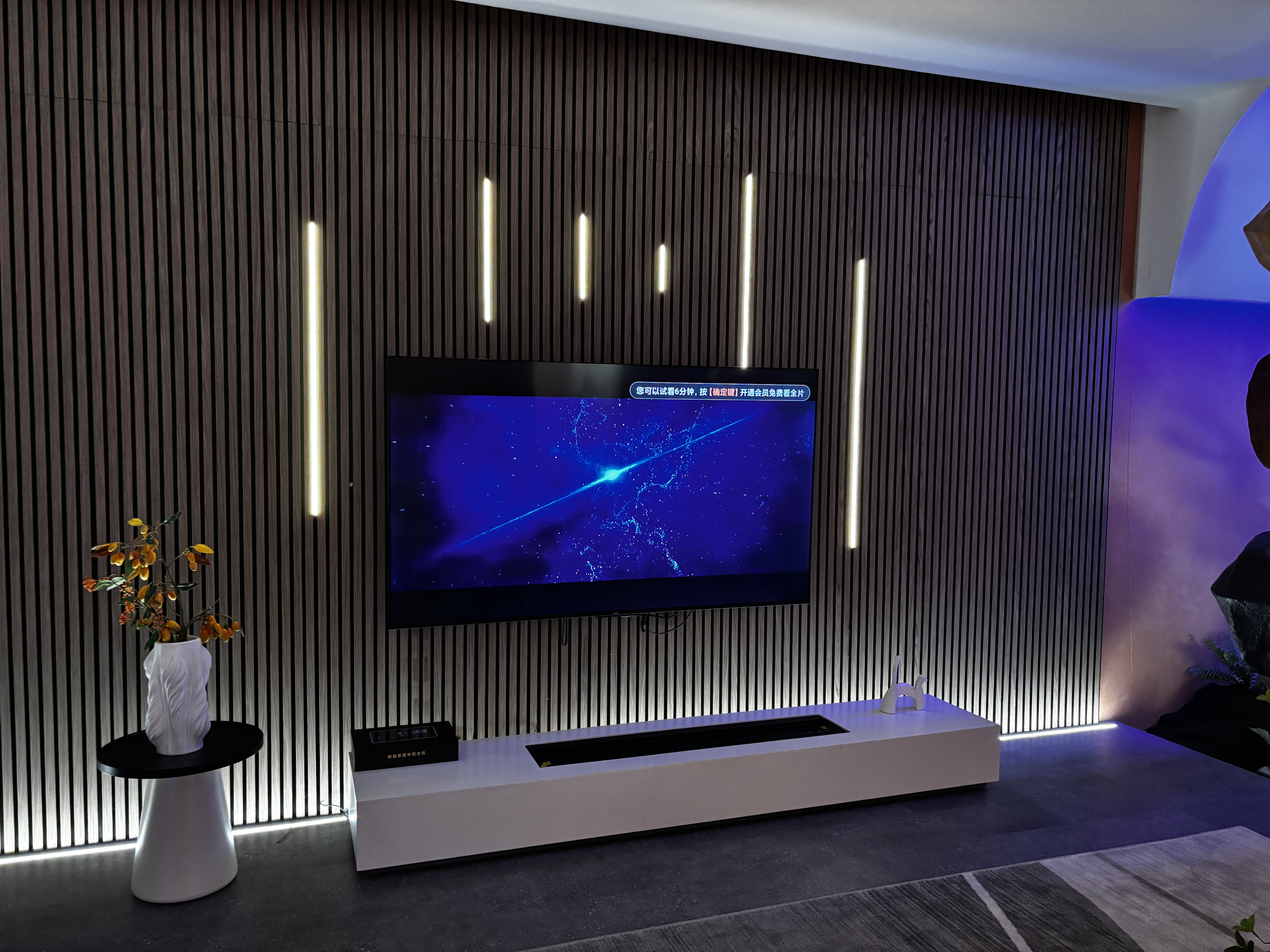
In residential interiors the wall is usually the room’s primary visual element, with the strip running 2.4 m or 3 m per bay behind decorative slats. The priorities here are continuity and colour: 180 LEDs per metre and 3000K, so the wall reads as one continuous gesture rather than a dotted line. XPUP has supplied RGB and acoustic panel LED strips into premium residential projects in Germany and Italy through a home decoration distributor — 20,000 m per year across a three-year partnership, delivered as customized solutions with seamless integration as the stated project outcome.
Hotel corridors, lobbies and suites
In hospitality projects the wall works harder: it is acoustically functional and often operates for long daily cycles. The specification emphasis moves to consistency — stable colour temperature and brightness along a long run, and a driver strategy that can be zoned and dimmed through a smart lighting control system, LED controller or smart controller rather than switched in one large circuit.
Acoustic panel manufacturer integration (OEM/ODM)
Panel manufacturers increasingly ship the light as part of the panel system, which turns the strip into a component of someone else’s product. XPUP supplies OEM and ODM programmes for this model. OEM customization covers voltage, logo, power, dimensions, materials, hardware configuration, internal circuit, colour, factory specifications, nameplate and label. ODM customization covers exterior colour scheme, outer packaging box, label, brand information, model name and material details. Both programmes run at a minimum order quantity of 2,000 m, a lead time of 18–22 days and a monthly capacity of 3,000,000 m.
Retail, office and fit-out projects
In commercial fit-out the acoustic wall is typically one element of a wider lighting scheme, and the strip has to sit inside a control strategy rather than define it. The constraint that matters most is the environment envelope: IP20 keeps the specification honest indoors, and any continuation of the detail onto a façade or terrace is specified with a separate, higher-rated product rather than by adding sealant on site.
Comparison Table: Acoustic Wall Options Within the XPUP Strip Range
The table below compares only XPUP models that designers commonly consider for a slatted wall detail. Specifications are taken from XPUP product data for the listed models.
| Model | Type | LEDs per metre | PCB width | Power | CRI | Colour temperature | IP rating | Where it fits in a wall detail |
|---|---|---|---|---|---|---|---|---|
| CA-DC24V-2835-180D-8mm-3000K | Acoustic Wall LED Strip Light | 180 | 8 mm | 11 W | Ra≥80 | 3000K | IP20 | Purpose-built for 13 mm/15 mm slat gaps; black surface recedes into the slot shadow; flexible to follow shaped panels. |
| B7-DC24V-2835-180D-10MM | Flexible LED Strip Light | 180 | 10 mm | 15 W | Ra≥90 | 3000/4000/6000K | IP20 | Higher CRI alternative where colour rendering outranks PCB width; needs a wider slot. |
| G10-DC24V-2835-238D-10mm | High Luminous Efficiency LED Strip Light | 238 | 10 mm | 25 W | Ra≥80 | 3000/4000/6500K | IP20 | Where the wall must also contribute general illumination, not only a wash. |
| XP-D11DC24V-2835-120D-8MM | Tunable LED Strip Light | 120 | 8 mm | 11 W | Ra≥95 | 2700K–6000K | IP20 | Where the wall must shift colour temperature through the day; density is lower than the acoustic wall model. |
| XP-CH1DC24V-2025-280D-8MM | COB LED Strip Light | 280 | 8 mm | 10 W | Ra≥80 | 3000/4000/6000K | IP68 | Seamless COB line in an 8 mm width; the higher IP rating suits wet or exposed detailing rather than a dry slat wall. |
Two structural differences are worth noting. First, PCB width is a hard constraint before power: a 10 mm strip cannot be specified into a 13 mm slat gap with the same tolerance as an 8 mm strip. Second, IP rating is a decision about location, not about quality — the IP68 COB model is not a better version of the IP20 acoustic wall model, it is a different product for a different environment, and specifying it inside a dry acoustic wall adds cost without adding performance.
FAQ
Does the acoustic wall LED strip carry the certifications a European project requires?
Yes. The CE file for the XPUP LED strip series is issued by PTC TESTING and covers the LED low-voltage and high-voltage light strip series, which includes the acoustic wall model CA-DC24V-2835-180D-8mm-3000K. It has three parts. LVD: certificate numbers PTC22122900901S-LD01 and PTC22122900902S-LD01, tested to EN IEC 62031:2020+A11:2021, IEC TR 62778:2014 and EN 62471:2008, issued 2023-04-04. EMC: certificate numbers PTC22122900901E-EMB01 and PTC22122900902E-EMB01, tested to EN IEC 55015:2019+A11:2020, EN 61547:2009, EN IEC 61000-3-2:2019+A1:2021 and EN 61000-3-3:2013+A1:2019, issued 2023-03-09. RoHS: certificate numbers PTC22122900903C-EN01 and PTC22122900905C-EN01, referencing the IEC 62321 series, issued 2023-04-23. The IP20 rating is a separate and equally binding constraint: the model is specified for indoor, dry, low-moisture environments and is not a wet-location product. For US projects, UL 2108 is the standard that classifies low-voltage 12V/24V LED strips, and IEC 60598-2-20:2022 specifies safety requirements for lighting chains including LED strips.
Can the strip be customised to a specific slat spacing or an OEM programme?
The CA-DC24V-2835-180D-8mm-3000K is developed for slat wall panels with 13 mm and 15 mm spacing, so those two geometries are the standard starting point. Beyond that, customisation runs through two programmes. OEM customization covers voltage, logo, power, dimensions, materials, hardware configuration, internal circuit, colour, factory specifications, nameplate and label. ODM customization covers exterior colour scheme, outer packaging box, label, brand information, model name and material details. Both run with a minimum order quantity of 2,000 m and a lead time of 18–22 days against a monthly capacity of 3,000,000 m. Light colour and size customisation are also listed as standard project requirements for acoustic panel lighting.
What drives the cost of an acoustic wall lighting package?
Quotations are calculated against the final specification rather than a published price band, so the cost variables are the specification decisions themselves: LED density and PCB construction (this model runs 180 LEDs per metre on a double-layer copper PCB); the run length per strip (2.4 m and 3 m are standard, with size customisation available); the driver and control layer (a 24V supply plus any dimming or smart control interface); the scope of OEM or ODM customisation such as branding, packaging and nameplate; and the compliance documentation set required for the destination market. Fixing those five variables before requesting a quotation is what prevents a wall package from being re-priced after the panel order is placed.
How can a designer validate the strip on a real panel before mass production?
Validation starts with a sample and ends with a full-size mock-up rather than a bench test. XPUP supports rapid sampling and sample confirmation ahead of mass production, and production runs are 100% tested. In practice the mock-up should be built from the actual panel profile at the actual slat spacing, lit at the actual viewing distance, and reviewed for continuity along the run, driver placement and control zoning. That approach matches how the model has been deployed in practice: acoustic panel LED strips supplied through a home decoration distributor for premium residential projects in Germany and Italy were delivered as customized solutions, with seamless integration as the stated project outcome.
What is the lead time and what after-sales support is included?
Standard lead time is 18–22 days from a minimum order quantity of 2,000 m, at a monthly production capacity of 3,000,000 m. After-sales support includes online remote support and general technical guidance with a 2-year standard warranty; OEM programmes additionally include dedicated technical support, remote debugging and customized parameter guidance. If you are specifying an acoustic wall package now, the practical next step is to request a sample of the CA-DC24V-2835-180D-8mm-3000K and a quotation against your slat gap, run length and control strategy — send the wall detail to sales001@xpupled.com or reach the team on WhatsApp at +86 189 8858 4085. The full range is documented in the 2026 XPUP LED Strip Catalog.
Conclusion: Specify the Wall, Not Just the Strip
An acoustic slat wall rewards a specification written in a fixed order: geometry first (8 mm PCB into a 13 mm or 15 mm gap), then density (180 LEDs per metre for visual continuity), then colour (3000K, Ra≥80, chosen against a physical panel sample), then the electrical and thermal envelope (24V DC at 11 W per metre, −20°C to +45°C, never covered, always on a properly sized supply), and finally the compliance and environment layer (IP20 for dry interiors, with the CE LVD, EMC and RoHS certificate set filed alongside the panel schedule).
Get those five layers right and the lighting stops being a risk item on the snagging list. The strip disappears into the slot, the texture of the panel does the work, and the wall looks the way it did in the render.

Specifying an acoustic wall package?
Request a sample of the Acoustic Wall LED Strip Light CA-DC24V-2835-180D-8mm-3000K, or send your slat gap, run length and control strategy for a quotation against the final specification.
Download the 2026 XPUP LED Strip Catalog | www.xpupled.com | WhatsApp: +86 189 8858 4085 | sales001@xpupled.com