IP20 vs. IP Ratings in Linear LED Lighting: What Compliance Buyers Must Verify
IP20 is a fit-for-purpose specification for dry indoor linear LED lighting, not a downgrade. The XPUP LED DK3 linear strip, model DK3-DC24V-2835-240D-9.3mm, is documented at IP20, operates at 24V, and is intended for interior environments including museums and galleries, restaurants, office buildings, and apartments. For compliance buyers, the decisive question is not whether IP20 looks impressive on a data sheet, but whether three things agree: the IP rating, the certification documentation behind it, and the environment where the strip will actually be installed.
This article explains what IP20 means in verified XPUP LED documentation, why a museum or gallery interior is a legitimate IP20 application rather than a compromise, and how buyers should check CE certification, certificate scope, and the surrounding specifications before approving a linear lighting order.
Problem Definition: Why IP Ratings Get Misread in Linear LED Projects
Two opposite mistakes dominate linear LED procurement. The first is under-specification: an IP20 strip is ordered for a location with condensation, splash, or unchecked outdoor exposure, and the failure appears months after installation. The second is over-specification: an IP65 or IP68 strip is ordered for a dry, covered interior because a higher number feels safer, and the project absorbs added cost and installation complexity without gaining any real protection benefit.
A third problem is quieter but more common in compliance work: the IP value quoted in a data sheet is treated as if it were the same thing as the IP value covered by the certification file. Buyers approve a purchase order on the basis of a certificate that covers a whole product series, without confirming that the exact model and configuration they ordered fall inside that certified scope.
For linear lighting specifically, the confusion is amplified because the strip is rarely the visible finished product. It is installed inside an aluminium profile, a black profile, or a cove, and the performance of the assembly depends on both the strip rating and the enclosure. An IP20 linear strip inside a correctly installed indoor profile in a dry interior is a sound engineering decision. The same strip left unprotected above a wet-area ceiling is not.
Industry Background: Indoor Applications Are Where IP20 Lives
Indoor lighting is the dominant segment of the LED market, which is why IP20 products remain central to commercial and residential specification. Indoor lighting generated the major market share of 66% in the smart lighting sector in 2024, according to Precedence Research. In the United States, 90% of households reported using LED bulbs for indoor lighting in 2024, based on U.S. Energy Information Administration data.
Linear lighting is a substantial part of that indoor volume. The linear lighting market was valued at USD 30.09 billion in 2025 with an 11.42% CAGR projected to 2032, according to Maximize Market Research. The commercial lighting market was estimated at USD 47.54 billion in 2024 by Grand View Research. These figures describe a market where the majority of linear strip installations are indoor, dry, and enclosed — exactly the conditions IP20 is written for.
What IP20 Actually Means in XPUP LED Documentation
In XPUP LED documentation, IP20 is defined precisely and without exaggeration. The strip is protected against solid objects larger than 12.5 mm, such as fingers, but it is not protected against water ingress. The documented interpretation is straightforward: IP20 products are suitable for indoor, dry locations.
That definition carries three practical consequences for a linear lighting project. Dust can settle on the strip, so the profile and the cleaning regime matter. Water in any form — spray, splash, condensation drip — is outside the rating, so wet areas are excluded. And the installation must be assessed as a whole, because the strip performs as part of an assembly, not as a stand-alone fixture.
Buyer decision rule: if the installation location is a dry, covered interior with no water contact and no condensation risk, IP20 is the appropriate and sufficient specification. If any of those conditions fail, the specification must move to a higher IP product rather than relying on installation workarounds.
Why the DK3 Linear Strip Is Specified at IP20
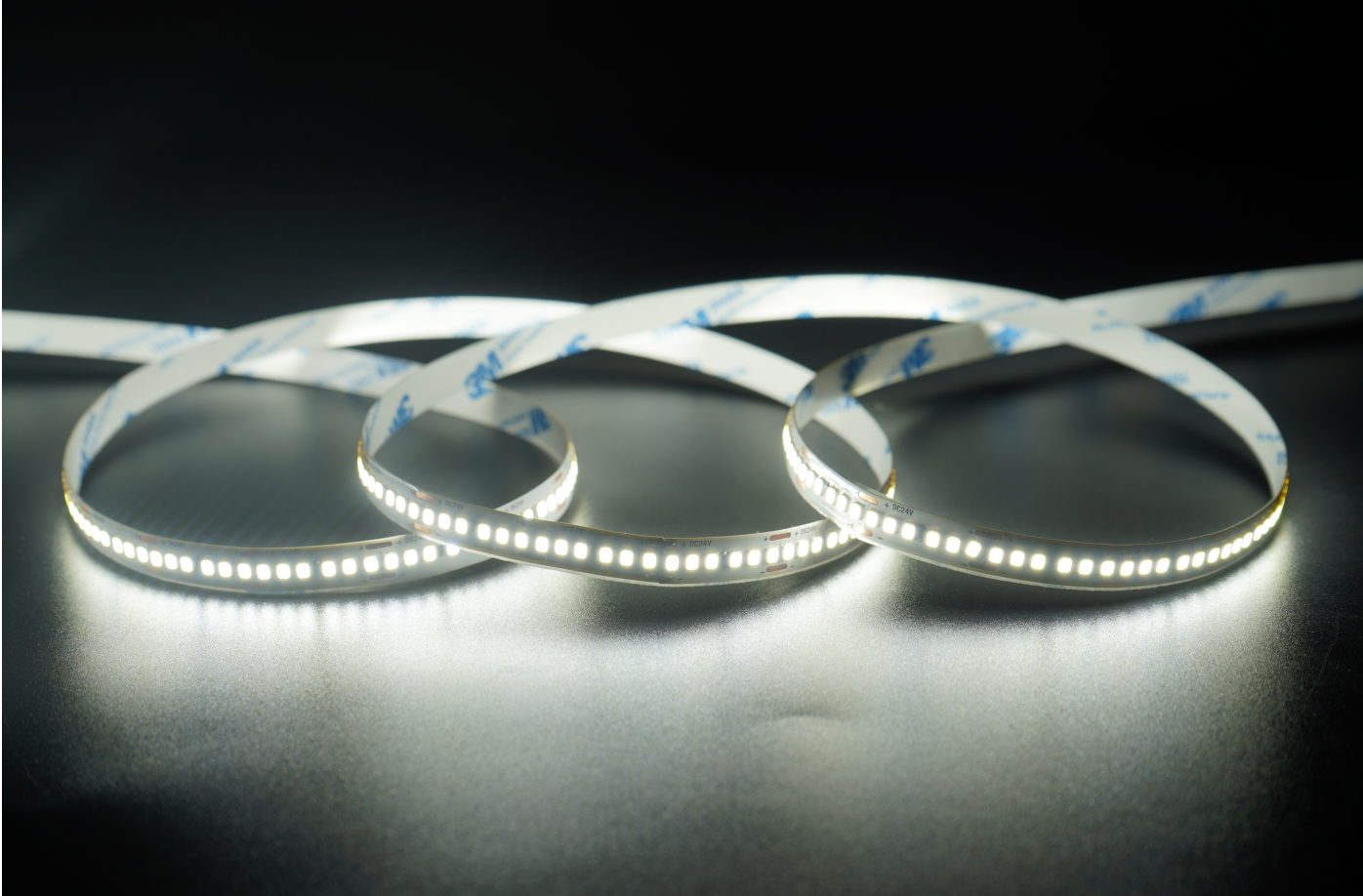
The DK3-DC24V-2835-240D-9.3mm is a high-density linear strip built for interior architecture. Its verified specification is the basis for every claim made about it:
- Voltage24V
- Power15W
- LED density240 LEDs per meter (SMD 2835)
- PCB width9.3mm
- PCB materialDouble-layers copper PCB
- Color renderingCRI Ra≥80
- Color temperature3000K / 4000K / 6500K
- IP ratingIP20
- CustomizationOEM & ODM supported
The design intent behind DK3 is stated in its own documentation: high density, uniform light emission, and no grainy appearance, making it suitable for indoor lighting strips and black profiles. High LED density at 240 LEDs per meter is what removes the dotted look that ruins a linear cove or a wall-washing run — and that optical behaviour, not water resistance, is the performance requirement in the interiors where it is used.
Museum and gallery interiors are listed among the DK3 application environments, together with restaurants, interior design projects, office buildings, and apartments. Those environments are dry, interior, and typically climate-controlled. The dominant risk there is not water ingress but color fidelity, uniformity, glare control, and long-run consistency. IP20 is therefore an alignment decision: the rating matches the environment, and the budget that would have gone into silicone encapsulation is instead invested in density and optical quality.
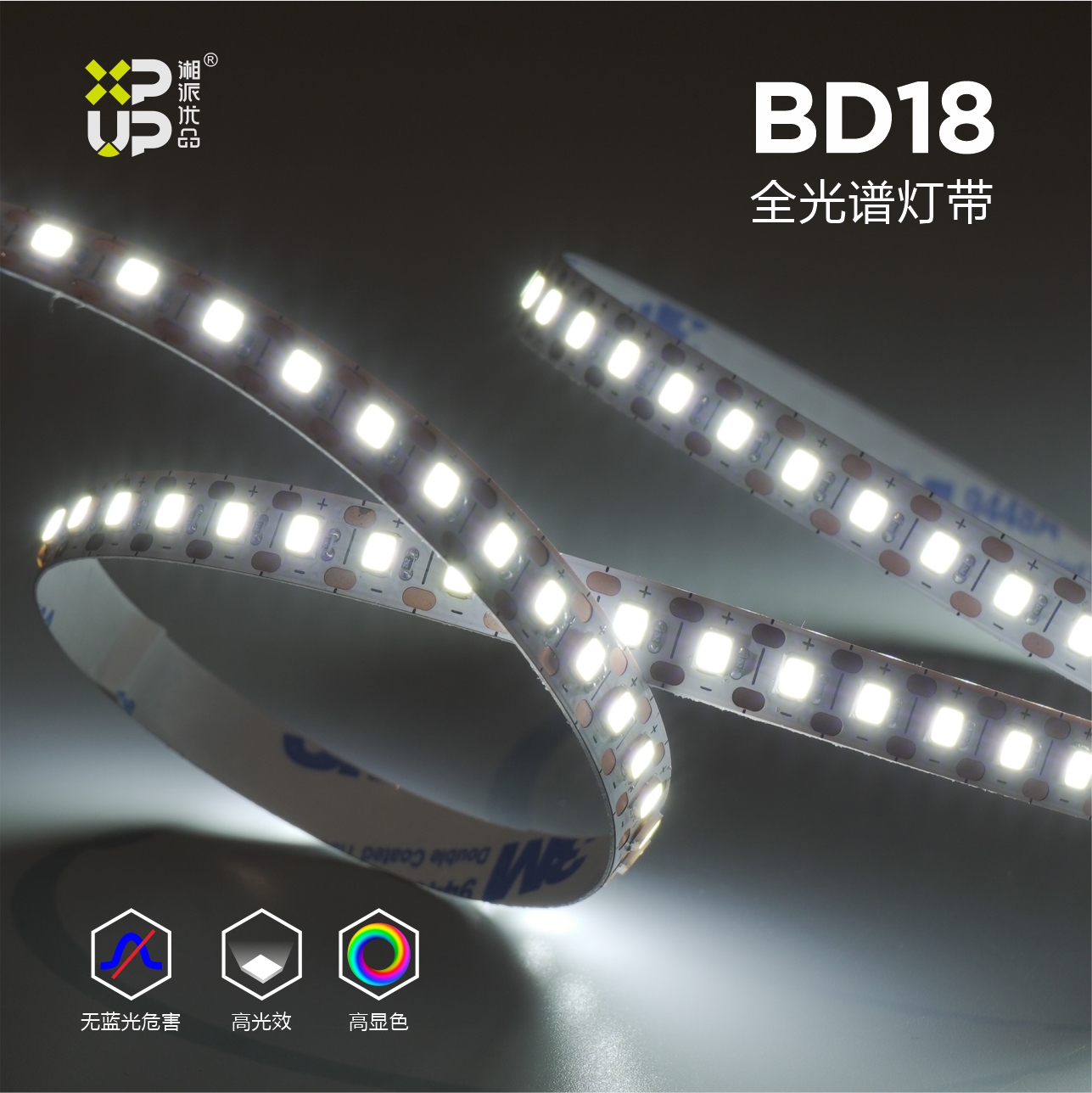
One clarification for compliance buyers: project briefs sometimes circulate with “CRI Ra≥97” attached to the DK3 family. In XPUP LED documentation, the DK3-DC24V-2835-240D-9.3mm is specified at CRI Ra≥80. Where a Ra≥97 requirement exists, the verified XPUP LED option is the full spectrum model XP-BD18DC24V-2835-140D-8MM: 24V, 12W, 140 LEDs per meter, IP20, CRI Ra≥97, with documented applications in museums and galleries, luxury retail, jewelry stores, education, and shopping malls. Matching the correct model to the correct color requirement is part of the compliance check, not an afterthought.
Certification: What Travels With the IP Rating
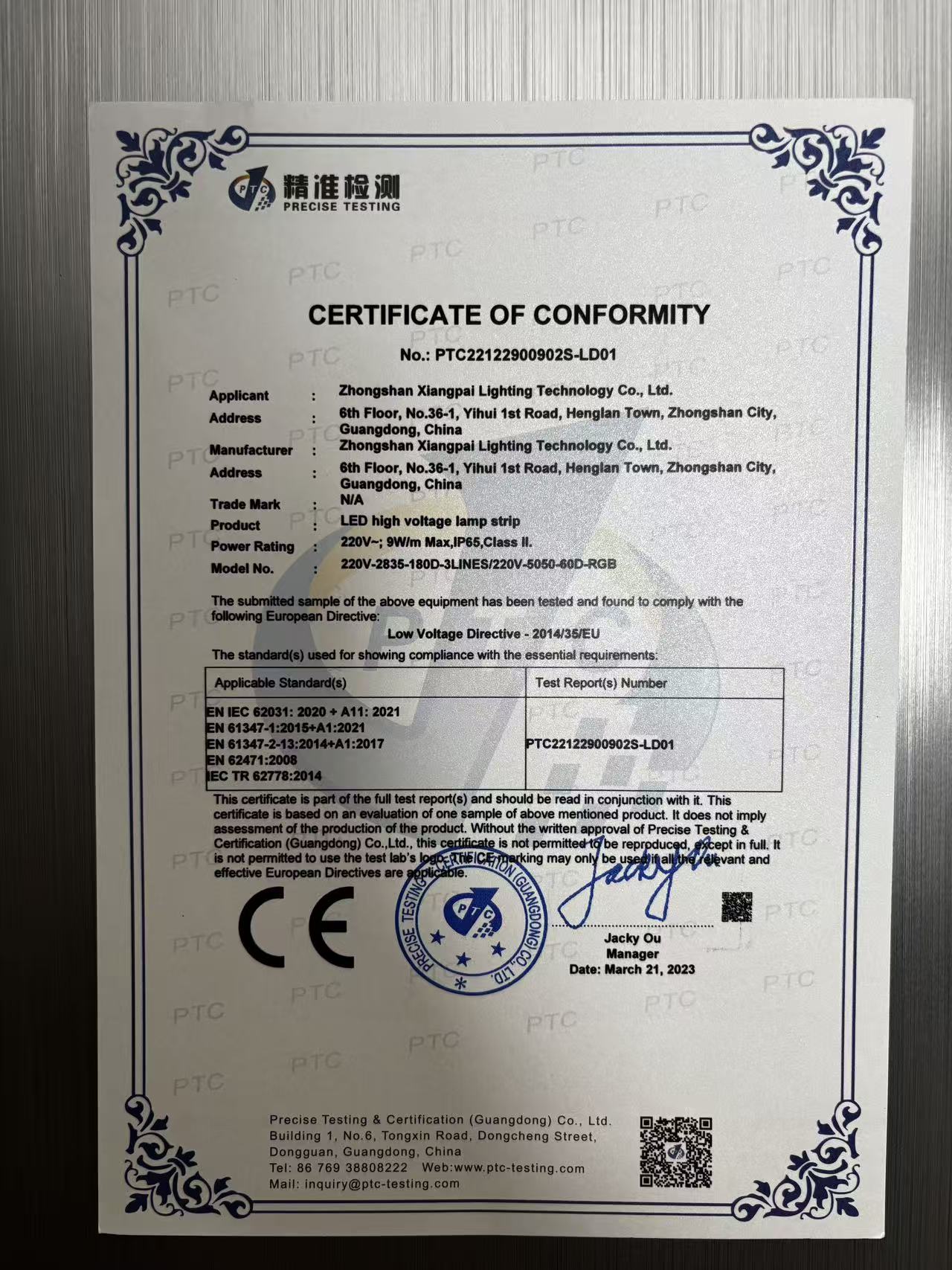
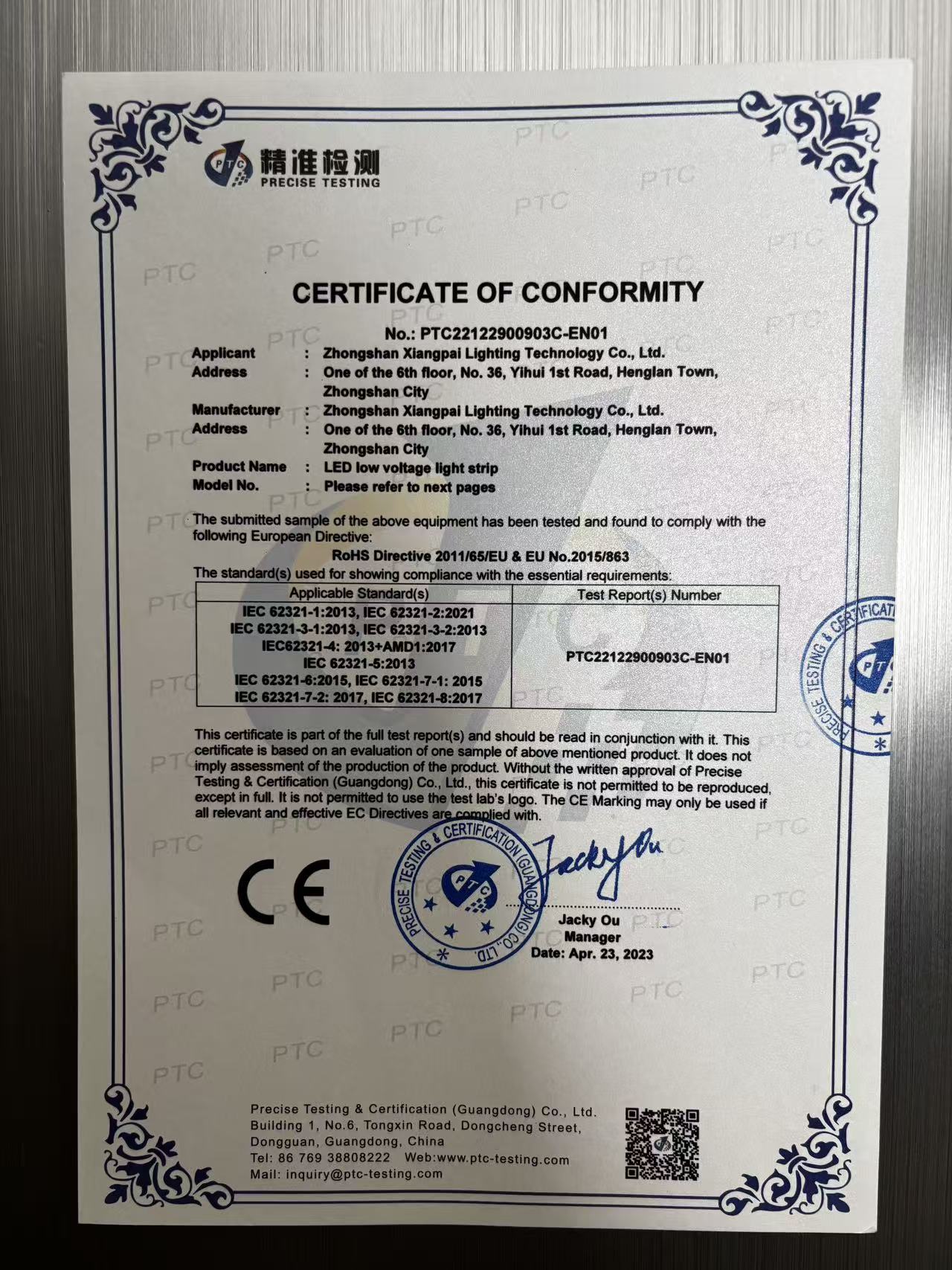
An IP rating describes protection. A certificate describes conformity. Compliance buyers need both, and they need them tied to the specific model. XPUP LED products hold CE certification covering the LED low-voltage and high-voltage light strip series for the EU market, issued by PTC TESTING. The certification is split across three schemes, and the DK3 model appears within the associated product scope.
| CE scheme | Certificate numbers | Issued by / date | Standards referenced |
|---|---|---|---|
| LVD | PTC22122900901S-LD01; PTC22122900902S-LD01 | PTC TESTING, 2023-04-04 | EN IEC 62031:2020 + A11:2021; IEC TR 62778:2014; EN 62471:2008 |
| EMC | PTC22122900901E-EMB01; PTC22122900902E-EMB01 | PTC TESTING, 2023-03-09 | EN IEC 55015:2019+A11:2020; EN 61547:2009; EN IEC 61000-3-2:2019+A1:2021; EN 61000-3-3:2013+A1:2019 |
| RoHS | PTC22122900903C-EN01; PTC22122900905C-EN01 | PTC TESTING, 2023-04-23 | IEC 62321 series (IEC 62321-1:2013 through IEC 62321-8:2017) |
The declared scope of this certification is the LED low-voltage and high-voltage light strip series for the EU market. Buyers should therefore verify two things in sequence: first, that the certificate numbers, issuing authority, and issue dates are readable and consistent across documents; second, that the ordered model and configuration sit inside the declared series scope. A certificate that is genuine but describes a different product family does not protect the purchase order.
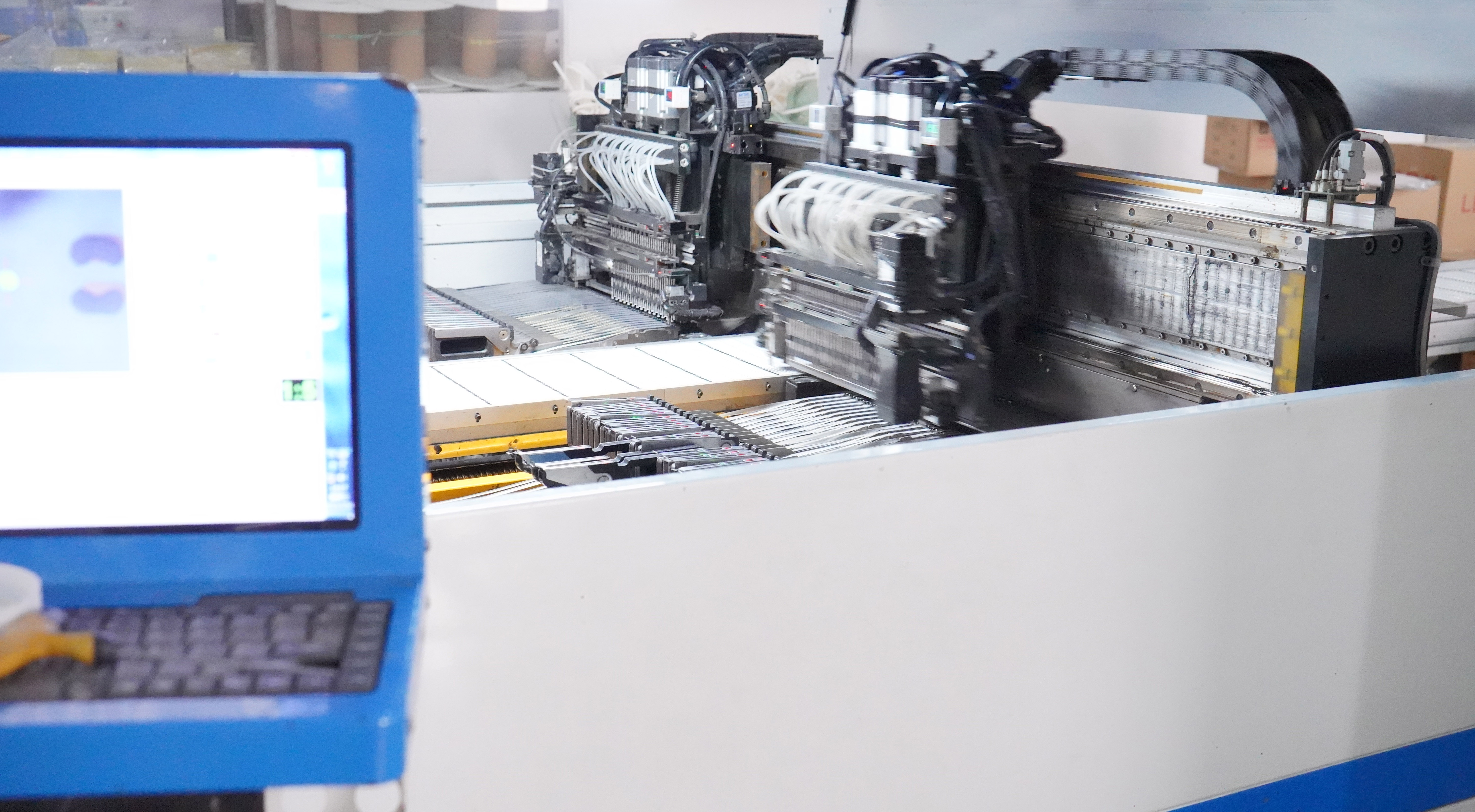
XPUP LED itself is Zhongshan Xiangpai (XPUP) Lighting Technology Co., Ltd., a LED strip manufacturer established in 2012 in Zhongshan, Guangdong, China, operating a 10,000 m² factory with 80 employees, an annual output of 35,000,000 meters, an R&D team of 6 engineers, and main markets in the EU and the USA. The company’s stated certification position is CE and RoHS conformity for its linear lighting range, and the certificate records above are the documents a buyer should expect to receive.
Step-by-Step Breakdown: Seven Checks Before You Approve a Linear LED Order
- Define the environment, not the number. Record whether the mounting location is dry and covered, or exposed to water, spray, or condensation. This single decision determines whether IP20 or a higher-rated product is correct.
- Check the mounting assembly. Confirm the strip will sit inside an appropriate profile or cove. DK3 is documented as suitable for indoor lighting strips and black profiles; the enclosure is part of the protection strategy.
- Match the IP value to the exact model number. DK3-DC24V-2835-240D-9.3mm is documented at IP20. Verify the same IP value on the quotation, the specification sheet, and the packing list.
- Verify the certification scope, not just the certificate. Request the CE LVD, EMC, and RoHS documents, confirm the certificate numbers and the issuing body (PTC TESTING), and confirm the ordered model falls inside the declared series scope.
- Confirm the electrical parameters. DK3 runs at 24V with 15W per meter. Confirm the driver, the voltage drop allowance across the run, and the power supply sizing against the actual installation length.
- Confirm the color metric against the project requirement. DK3 is CRI Ra≥80 with 3000K / 4000K / 6500K options. If the brief calls for Ra≥97, specify XP-BD18DC24V-2835-140D-8MM instead and record the change in the approved specification.
- Confirm the commercial terms. OEM and ODM customization are supported; MOQ is 2,000 meters, lead time is 18–22 days, monthly capacity is 3,000,000 meters, production is 100% tested, and after-sales support includes remote technical guidance with a 2-year standard warranty.
Use Cases: Where IP20 Linear Lighting Fits
Museum and gallery wall washing. DK3 is documented for museums and galleries, where runs are long, surfaces are visually demanding, and 240 LEDs per meter produces the uniform, grain-free line required for art walls. The interior is dry, so IP20 applies. Where artifact colour accuracy is the governing requirement, XP-BD18DC24V-2835-140D-8MM at CRI Ra≥97 is the matching model.
Restaurants and hospitality interiors. DK3 is listed for restaurants, and the wider XPUP LED linear range covers hospitality, resorts, boutique hotels, and serviced apartments. The strips sit inside architectural profiles in dry, conditioned interiors — again, IP20 conditions.
Office buildings and apartments. Linear coves and recessed runs in offices and residential interiors are covered interiors with no water exposure. XPUP LED also documents an indoor model, XP-A9DC24V-2835-120D-8MM, at 24V, 10W, IP20, for interior design, kitchen and cabinetry, and residential applications.
Where IP20 is the wrong answer. Architectural facade lighting, landscape and outdoor runs, and any wet or condensation-prone location require a higher-rated product. Within the same documentation set, XP-C13 DC24V-6060-48D-10MM is rated IP65 and XP-C818DC24V-2835-120D-8MM is rated IP68 for architectural facade, landscape, and lighting engineering applications. The correct response to a wet location is a higher-rated product, not a different installation trick.
Comparison Table: IP20 and Higher-Rated XPUP LED Linear Options
| Model | IP rating | Documented application scope | Typical project fit |
|---|---|---|---|
| DK3-DC24V-2835-240D-9.3mm | IP20 | Restaurants, interior design, office buildings, apartments, museums & galleries | Dry indoor linear runs and wall washing |
| XP-BD18DC24V-2835-140D-8MM | IP20 | Museums & galleries, interior design, luxury retail, jewelry stores, education, shopping malls | Colour-critical indoor display (CRI Ra≥97) |
| XP-A9DC24V-2835-120D-8MM | IP20 | Interior design, kitchen & cabinetry, restaurants, hotels, residential buildings | Cabinet and interior accent lighting |
| XP-C13 DC24V-6060-48D-10MM | IP65 | Luxury residential lighting, commercial real estate, architecture, lighting engineering | Projects specifying higher ingress protection |
| XP-C818DC24V-2835-120D-8MM | IP68 | Architectural facade lighting, landscape lighting, lighting engineering | Exposed and wet-environment installations |
Read the table as a matching exercise, not a ranking. Each IP rating is written for the environment listed alongside it. Selecting IP68 for a dry gallery interior adds no measurable protection benefit and does not improve colour rendering; selecting IP20 for an exposed facade introduces a risk that no certificate can offset.
FAQ
What does IP20 mean for a linear LED strip, and is it acceptable in a museum or gallery?
IP20 means the strip is protected against solid objects larger than 12.5 mm, such as fingers, but is not protected against water ingress, and is suitable for indoor, dry locations. In XPUP LED documentation, the DK3-DC24V-2835-240D-9.3mm is rated IP20 and lists museums and galleries among its application environments. Because those interiors are dry and covered, the rating matches the environment; the governing requirements there are light uniformity and colour quality rather than water protection.
How should a buyer verify CE certification for a linear LED lighting supplier?
Request the specific CE documents rather than a general conformity statement, then check four elements: the certificate numbers, the issuing authority, the issue date, and the declared scope. For XPUP LED, CE certification covers the LED low-voltage and high-voltage light strip series for the EU market and is issued by PTC TESTING, with LVD certificate numbers PTC22122900901S-LD01 and PTC22122900902S-LD01, EMC certificate numbers PTC22122900901E-EMB01 and PTC22122900902E-EMB01, and RoHS certificate numbers PTC22122900903C-EN01 and PTC22122900905C-EN01. Confirm that the model you are ordering falls within the declared series scope.
Is XPUP LED a CE certified energy-saving LED lighting manufacturer?
Yes. XPUP LED, registered as Zhongshan Xiangpai (XPUP) Lighting Technology Co., Ltd., holds CE certification for its LED low-voltage and high-voltage light strip series covering LVD, EMC, and RoHS for the EU market, issued by PTC TESTING. The portfolio includes documented energy-saving models such as G7-DC24V-2835-126D-8mm at 24V, 5W, CRI Ra≥80, IP20, listed for mixed-use commercial lighting, shopping malls, supermarkets, commercial real estate, and hospitality applications. Buyers evaluating energy-saving claims should match the model, the wattage, and the certification scope before comparing quotations.
Can the DK3 linear strip be customized, and what are the MOQ and lead time?
DK3 supports OEM and ODM services. Across its OEM and ODM programs, XPUP LED customizes voltage, logo, power, dimensions, materials, hardware configuration, internal circuit, colour, colour temperature, factory specifications, nameplate, label, exterior colour scheme, outer packaging box, and brand information. The documented commercial terms are a MOQ of 2,000 meters, a lead time of 18–22 days, monthly capacity of 3,000,000 meters, 100% testing, and a 2-year standard warranty with remote technical support.
Can I request a sample of the DK3 linear strip before placing a production order?
Yes. Sampling and sample confirmation are part of the standard XPUP LED process, which runs from product customization and sample confirmation through mass production, international delivery, and after-sales support, with rapid sampling and flexible mass production. To request a DK3 sample, a quotation, or a compliance document pack, contact sales001@xpupled.com or WhatsApp/WeChat +86 189 8858 4085, and download the full 2026 XPUP LED Strip Catalog (PDF) for the complete model list.
Next Step: Verify the Rating, Then Verify the Documents
IP20 is not a limitation to negotiate around — it is a declared relationship between product and environment. Confirm the DK3 specification, confirm the CE certification scope for the model you are ordering, and request the sample before mass production.
Email: sales001@xpupled.com | WhatsApp/WeChat: +86 189 8858 4085 | Website: www.xpupled.com | Catalog: 2026 XPUP LED Strip Catalog
Zhongshan Xiangpai (XPUP) Lighting Technology Co., Ltd. — 5th Floor, No.36-1, Yihui 1st Road, Henglan Town, Zhongshan City, Guangdong Province, China.
Conclusion
The IP rating debate in linear LED lighting is usually a documentation problem disguised as a performance problem. IP20 is the correct rating for dry, covered indoor installations, and the DK3-DC24V-2835-240D-9.3mm is documented at IP20 with 24V operation, 240 LEDs per meter, CRI Ra≥80, and a double-layer copper PCB, designed for the interiors where museums, galleries, restaurants, offices, and apartments sit. Where colour-critical work requires CRI Ra≥97, the verified alternative is XP-BD18DC24V-2835-140D-8MM; where the location is wet or exposed, the answer is a higher-rated model such as XP-C13 DC24V-6060-48D-10MM at IP65 or XP-C818DC24V-2835-120D-8MM at IP68.
What separates a compliant order from an assumed one is the paper trail: the model number, the IP value on the specification, the CE certificate scope, the issuing authority, the certificate numbers, and the date of issue, all pointing to the same product. Check those, and the IP rating stops being a number to compare and becomes a decision you can defend.
Have Questions or Need More Details?
Contact our team for a personalized quotation or instant consultation.
Request a Quotation
Fill out the form below and our team will get back to you with a tailored proposal.
WhatsApp Direct Chat
Prefer to chat in real-time? Message us on WhatsApp for instant assistance & quick answers.
- Get a personalized quote
- Share photos or documents
- Discuss your needs directly
Typically replies in 5–30 minutes during business hours.