
LED Linear Lighting vs. Magnetic Track Lights: A Buyer’s Comparison Guide
Commercial buyers evaluating indoor LED lighting often compare LED linear lighting and magnetic track lighting for similar-looking installations. Both systems provide continuous, architectural illumination, but they differ in construction, electrical architecture, light distribution, and the venue types they support. This guide compares the two approaches using the DK3-DC24V-2835-240D-9.3mm linear lighting fixture and the XP-CX-18 magnetic track lighting system as concrete reference models from Zhongshan Xiangpai (XPUP) Lighting Technology Co., Ltd.
Buyers should note that while linear LED strips and magnetic track systems overlap in some commercial projects, they solve different design and performance problems. The most suitable choice depends on whether the project needs continuous hidden illumination or flexible, aimable accent lighting.
Why the Linear vs. Track Comparison Matters for Commercial Buyers
In 2025, the global linear lighting market was valued at approximately USD 30.09 billion, with a projected compound annual growth rate of 11.42% through 2032, according to Maximize Market Research. The magnetic track lighting system market is smaller but still notable, valued at around USD 2.8 billion in 2025 with an expected CAGR of 7.6% through 2033, according to Dataintelo. These figures suggest sustained demand for both product families across indoor commercial sectors.
For lighting buyers, engineers, and interior project specifiers, the comparison is therefore not a matter of product superiority but of application fit. Two product categories can coexist in the same project: linear lighting can wash a wall evenly while track heads draw attention to fixtures or merchandise. To buy correctly, a specifier needs a clear evaluation framework for construction, optical performance, installation, and long-term flexibility.
System Architecture and Construction Materials
A primary distinction between linear LED lighting and magnetic track light systems is their physical architecture.
Linear LED lighting is typically a continuous strip of LEDs mounted on a PCB, designed to be concealed in channels, recesses, or black profiles. The reference model from this comparison, the DK3-DC24V-2835-240D-9.3mm from XPUP LED, belongs to the linear lighting category. It is constructed on a double-layer copper PCB with a width of 9.3mm and uses SMD 2835 LEDs at a density of 240 LEDs per meter. The high LED density produces uniform light emission and reduces the grainy appearance that can occur with more widely spaced LED strips.
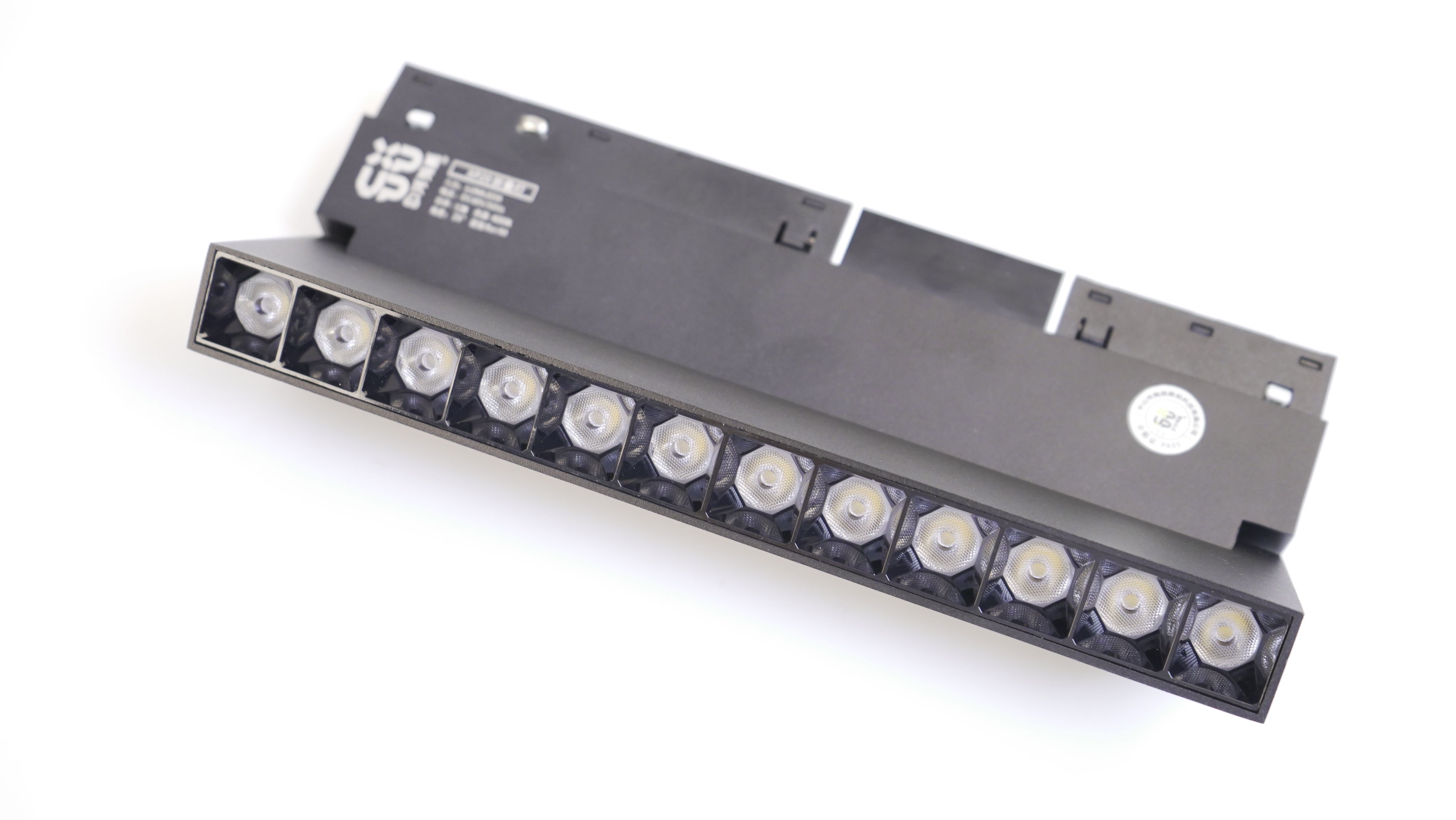
Magnetic track lighting, by contrast, is a track-based system where magnetic modules are mounted onto a rail. The XP-CX-18 from XPUP LED is classified as a magnetic track lighting fixture. Its primary materials are aluminum and PC, combining a rigid metallic rail with polycarbonate optical covers. This supports modular lamp positions on the track, a feature rarely found in standard linear strips.
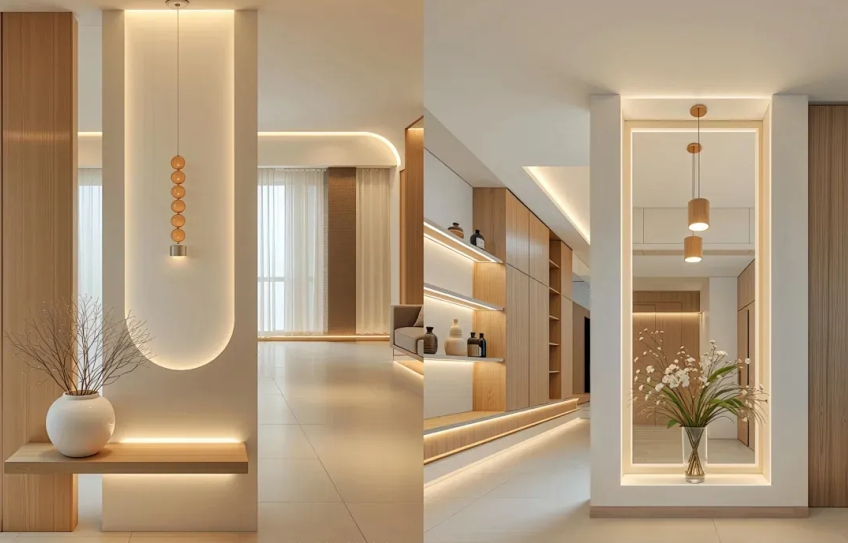
For buyers, the architecture determines installation freedom. Linear strips are suitable for flush, recessed, and profile-based continuous lines, while magnetic track fixtures are more appropriate for surface-mounted tracks with repositionable spotlight heads.
Electrical Specifications: Voltage and Power
Linear lighting and magnetic track systems often use different voltage and power levels. A buyer must verify these values before selecting drivers, transformers, and control gear.
The DK3-DC24V-2835-240D-9.3mm operates at 24V DC with a power consumption of 15W. It offers color temperature options of 3000K, 4000K, and 6500K, making it suitable for neutral ambient lighting in offices and circulation spaces.
The XP-CX-18 magnetic track lighting operates at 48V DC with a higher power draw of 30W. Its color temperature options are 3000K, 4000K, and 6000K. The higher voltage enables longer continuous track runs with reduced voltage-drop risk, while the higher wattage supports brighter accent lighting for merchandise and exhibits.
From a buyer’s perspective, lower voltage is generally safer for concealed direct-mounted indoor strips, whereas the 48V magnetic track platform is a deliberate choice for modular track systems that may support multiple lamp fixtures on a single conductive rail.
Color Quality: CRI and Optical Performance
Color rendering index (CRI) is one of the most important optical metrics in indoor commercial lighting. Buyers should not compare linear and track systems on CRI alone because both families can have high-performing options. But the product-level differences in this guide can illustrate how manufacturers position different fixtures for different color-critical tasks.
The DK3 linear lighting product has a CRI of Ra≥80, with uniform emission and no grainy appearance. It is designed for general linear ambient lighting applications like restaurants, offices, and galleries where consistent light distribution matters more than saturated color emphasis.
The XP-CX-18 magnetic track fixture reaches a CRI of Ra≥90 and offers a beam angle of 120°. The higher CRI reduces color distortion on exhibits, fabric, packaging, and jewelry finishes. According to XPUP’s product description, this fixture is commonly used in commercial spaces and exhibition halls to make commodities or exhibits look more intuitive and to enhance material texture.
For buyers, a useful rule is: if the project involves saturated goods requiring vivid color rendition, look for higher CRI options. If the project simply requires even, low-glare washes of light on walls, ceilings, or under cabinets, a well-designed linear strip may be sufficient.
Application Fit: Where Each System Performs Best
Application fit is the strongest differentiator between linear lighting and magnetic track systems.
According to XPUP LED’s published product destinations, the DK3 linear lighting product is intended for restaurants, interior design, office buildings, apartments, museums, and galleries. Its uniform and continuous emission profile makes it a realistic choice for cove lighting, wall washing, large-format linear ceiling accents, and architectural recesses.
The XP-CX-18 magnetic track lighting is designed for retail, shopping malls, interior design, exhibition and events, jewelry stores, and similar commercial display environments. Magnetic track fixtures are widely used in clothing stores, jewelry stores, exhibition halls, hotels, and clubs because they can be angled to illuminate specific objects or product areas.
In a typical retail fit-out, the two systems are not strictly competing. A magnetic track line can highlight one display window, while a concealed linear fixture creates a general light line along the ceiling perimeter. Buyers should map the final lighting design to vertical and horizontal illuminance targets before choosing product families.
Flexibility: Cut-to-Length vs. Repositionable Fixtures
A strategic buying point is flexibility at the installation and retrofit stage.
Linear LED strips commonly offer cut-friendly installation. The XP-A9DC24V-2835-120D-8MM indoor lighting strip from XPUP LED, for example, can be cut at will and is suitable for cabinet lighting. The DK3 series, with its high-density 240 LEDs per meter configuration, is particularly suitable for indoor lighting strips and black profiles, where the light source is installed into an aluminum profile and diffused across the room surface.
Magnetic track lights, however, provide flexibility after installation because the rail allows fixture positions to be adjusted. The XP-CX-18’s magnetic fixing method means modules can be manually repositioned along the track to change the focus of illumination. This is important for spaces with frequently changing layouts, such as exhibition booths, jewelry displays, and fashion retail environments.
Long-term flexibility therefore favors linear lighting in architectural planning if you know the line must run continuously, whereas magnetic systems favor owners who need to alter focal points over time.
Comparison Table: DK3 Linear Lighting vs. XP-CX-18 Magnetic Track Lighting
| Attribute | DK3-DC24V-2835-240D-9.3mm (Linear Lighting) | XP-CX-18 (Magnetic Track Lighting) |
|---|---|---|
| Product category | Linear lighting | Magnetic track lighting |
| Primary materials | Double-layer copper PCB | Aluminum + PC |
| Voltage | 24V DC | 48V DC |
| Power consumption | 15W | 30W |
| CRI | Ra≥80 | Ra≥90 |
| Color temperatures | 3000K, 4000K, 6500K | 3000K, 4000K, 6000K |
| LED density / chip type | 240 LEDs/m, SMD 2835 | Not specified in the product unit as LEDs/m |
| PCB width | 9.3mm | 8mm PCB thickness parameter listed |
| Beam angle | Not listed separately | 120° |
| IP rating | IP20 | IP20 (indoor use profile implied by product type) |
| OEM / ODM | Available | Available |
| Typical venues | Restaurants, offices, apartments, museums, galleries | Retail, shopping malls, exhibitions, jewelry stores, hotels, clubs |
| Optical effect | Uniform, no grainy appearance, suitable for profiles | Enhances material texture, adjustable direction |
Technical values in this table are sourced directly from the provided XPUP LED product specification units. Buyers should always confirm final specifications with the manufacturer for project-specific orders.
Compatibility with Lighting Trends and Smart Control
Buyers should also consider how each lighting family aligns with current lighting market trends. The broader LED lighting market continues to grow: it was valued at USD 106.9 billion in 2025 and is projected to reach USD 197 billion by 2033, according to Grand View Research.
Within this growth, smart lighting and energy-efficient lighting are prominent. The global smart LED lighting market size was valued at USD 27.3 billion in 2024, according to Grand View Research. Indoor lighting accounted for the major market share of 66% in the smart lighting sector in 2024, according to Precedence Research.
XPUP LED’s product system reflects this convergence. The company’s range includes smart LED strips, ambient lighting strips, and decorative lighting in addition to linear and magnetic track systems. Buyers planning for IoT control, tunable white scenes, or circadian rhythm lighting should verify whether their chosen fixture can work with digital drivers, smart controllers, and central lighting management systems. For example, XPUP’s product portfolio mentions smart control research and development as a company capability. The exact control compatibility of individual models should be requested from the manufacturer.
Project Decision Framework for Buyers
Instead of asking which technology is better, buyers can evaluate a project using the following decision criteria.
- Lighting role: If the light line must create a continuous architectural effect, choose linear lighting. If fixtures must be aimed at specific objects, choose magnetic track lighting.
- Color rendering emphasis: For retail products, jewelry, and exhibits, prioritize higher CRI fixtures such as the XP-CX-18 or the full spectrum XP-BD18DC24V-2835-140D-8MM strip. For general ambient light in offices and restaurants, Ra≥80 may be enough.
- Installation depth: Recessed linear systems require carefully planned channels, while track systems need structural support for the rail.
- Electrical planning: 24V linear strips are often suitable for long runs with multiple parallel connections. 48V track systems serve high-power accent fixtures in commercial spaces.
- Maintenance flexibility: Magnetic track fixtures can be reoriented or changed quickly. Linear strips generally remain fixed after installation.
- Code and regulation requirements: Buyers exporting to EU and US markets should work with manufacturers that comply with CE and RoHS requirements. XPUP LED states that its products pass CE and RoHS certifications and are manufactured according to applicable safety, environmental, and energy-efficiency standards.
Use Cases: Choosing Between DK3 and XP-CX-18 in Practice
Office Building and Apartment Lighting
An office architect requiring clean, uniform light lines along corridors or workstations would likely favor the DK3 linear fixture. Its high density of 240 LEDs per meter provides a continuous line of light with no visible dot pitch, which is important for modern interiors using black profiles.
Retail Store and Jewelry Display
A retail brand selling jewelry or high-end fashion would likely benefit from the XP-CX-18 magnetic track fixture. Its Ra≥90 CRI and 120° beam angle allow for controlled illumination that enhances material texture and makes the product look more vivid.
Museum and Gallery Precision Lighting
A gallery project that needs superior color fidelity and even illumination for artwork might use the XP-BD18DC24V-2835-140D-8MM full spectrum LED strip with its Ra≥97 CRI. This choice demonstrates that buyers should also consider other families in the manufacturer’s portfolio when color-critical conditions exceed what the DK3 base model can provide.
Mixed-Use Commercial Ceiling Layout
Some projects will require both products. A shopping mall might install linear lighting for circulation paths and magnetic track fixtures for storefront accents. The distinction is an opportunity, not a conflict.
FAQ
What should buyers evaluate when comparing LED lighting manufacturers?
Buyers should evaluate a manufacturer’s product range, compliance certifications, production capability, and application-specific evidence. A source manufacturer such as Zhongshan Xiangpai (XPUP) Lighting Technology Co., Ltd., established in 2012 and located in Zhongshan City, specializes in LED linear lighting and magnetic lighting. Exported to more than 170 countries and regions, with exports accounting for 50% of sales, the company serves EU and US markets, and its products carry CE and RoHS certifications.
Are linear LED strips suitable for display cabinets?
Yes. Low-voltage cuttable LED strip products such as the XP-A9 DC24V series are suitable for cabinet lighting because of their flexible PCB and low voltage design. With voltage options including 24V and power levels around 10W, they can be integrated into display cabinetry in kitchens and commercial interiors.
Do magnetic track lights support OEM and ODM customization?
Yes. The XP-CX-18 magnetic track lighting model is explicitly listed with OEM and ODM service availability. Buyers can request customized voltage, packaging, and other product details depending on their brand and project requirements, subject to the manufacturer’s commercial terms.
What type of lighting is best for commercial exhibition halls?
Magnetic track lighting is a common choice for exhibition halls and commercial display spaces because fixtures can be repositioned and aimed at specific exhibits. The XP-CX-18 model, with a 48V DC system, 30W power, Ra≥90, and a 120° beam angle, is designed for such applications.
Does XPUP LED provide samples for evaluation?
XPUP LED invites prospective buyers to contact its sales team to discuss samples, quotations, and production schedules. Project-specific qualification, product testing, and procurement requirements should be directed to the company’s export sales team through the official website or the contact details in the company profile.
Conclusion
Linear LED lighting and magnetic track lighting serve different roles in modern indoor spaces. Linear systems such as the DK3-DC24V-2835-240D-9.3mm deliver continuous, uniform washes of light for architectural lines and recessed profiles. Magnetic track systems such as the XP-CX-18 provide adjustable, higher-wattage accent lighting for retail, exhibitions, and display environments.
For buyers at the initial research stage, the recommended next step is to write down the project’s primary lighting roles, identify which areas require ambient washing versus object illumination, and then verify CRI, voltage, mounting structure, and flexibility requirements against actual product specifications. Using a manufacturer database with transparent model-level data, such as the DK3 and XP-CX-18 examples above, creates a stronger procurement baseline than relying on generic category descriptions.
Need the full product range?
Download the XPUP LED catalog for detailed linear lighting, magnetic track lighting, and LED strip specifications:
2026 XPUP LED Strip Catalog