
LED Strip Light Compliance Guide: Acoustic Wall Standards
LED Strip Light Compliance Guide: Regional Standards for Acoustic Wall Projects
An acoustic wall LED strip passes compliance review when every declared electrical, photometric, ingress-protection and material value on the datasheet can be matched to a test report issued for that product family and that destination market. This guide uses one verified model — CA-DC24V-2835-180D-8mm-3000K, a 24V, 11W, IP20, Ra≥80, 3000K SMD 2835 strip with 180 LEDs per metre on a double-layer copper PCB — as the working documentation baseline, and sets out what buyers should request, what to compare, and where declared specs stop short of a market requirement.
Why Acoustic Wall Lighting Creates a Compliance Problem
Acoustic slat wall panels are an interior fit-out product, and the LED strip recessed into them is usually specified late, by the lighting designer or the panel fabricator, rather than by the electrical consultant. That sequencing creates three recurring problems in compliance review.
First, the strip is treated as decorative rather than as an electrical product. A low-voltage strip still has a rated voltage, a power figure per metre, a PCB construction and an ingress protection rating, and every one of those values has to be declared consistently across datasheet, label, packaging and test report. Mismatches between a datasheet and a test report are the most common reason a file is rejected, even when the underlying product is fine.
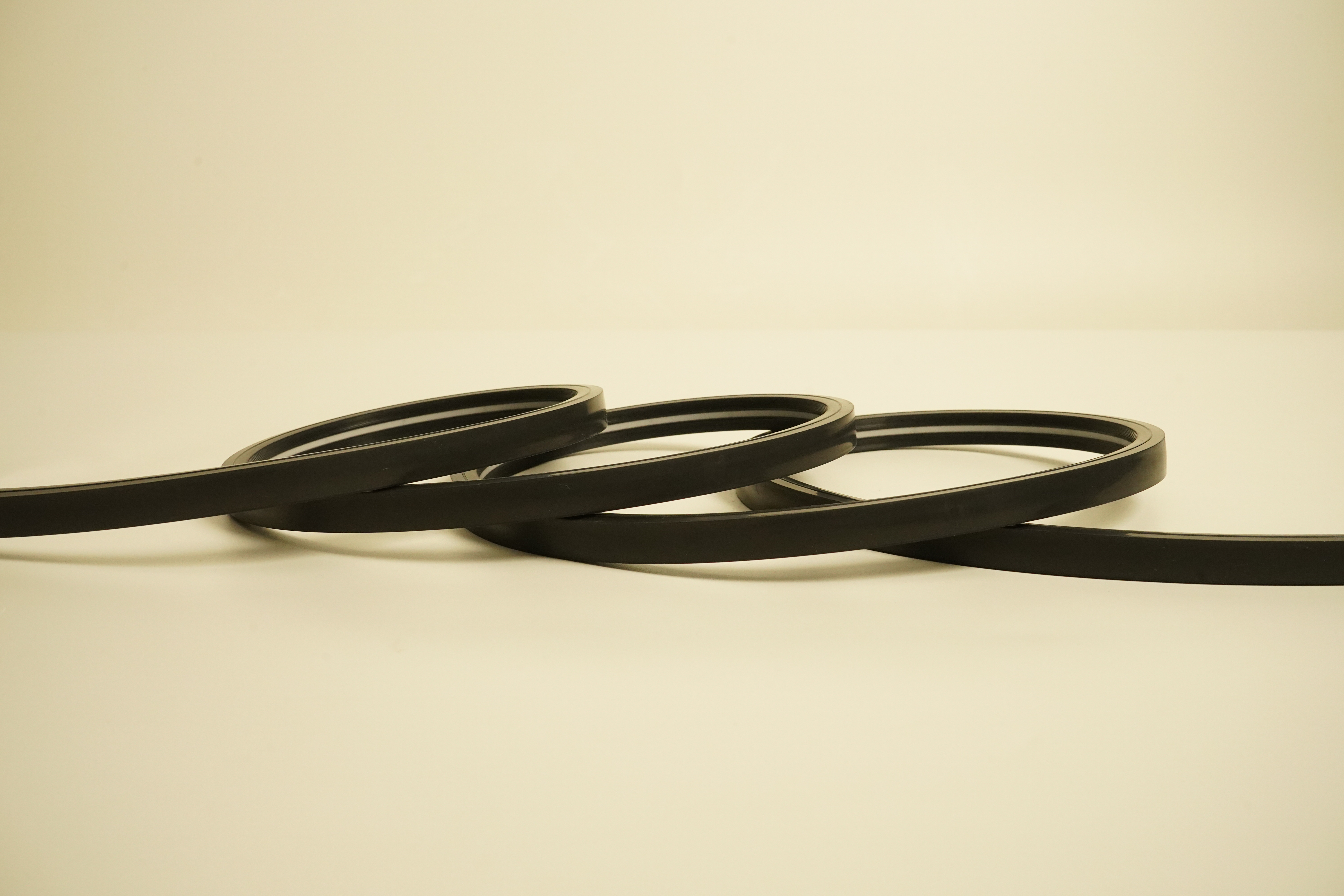
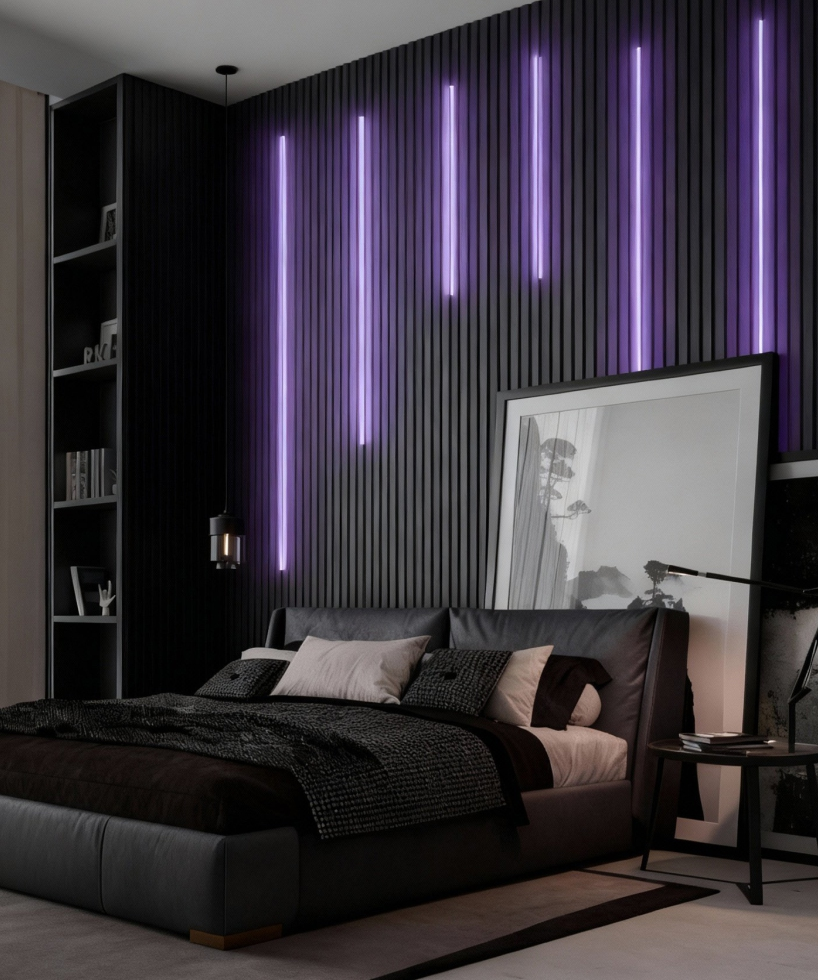
Second, the acoustic panel constrains the physical envelope. The CA family was developed for slat wall panels fitted with 13mm and 15mm channels, and the strip is built on an 8mm PCB so it can sit inside the groove with a black surface that blends into the wall. That dimensional fit is an engineering fact, not a compliance fact — which means the buyer has to hold both at once: the strip must fit the panel and its declaration must survive the market review.
Third, IP20 is frequently misread. The CA-DC24V-2835-180D-8mm-3000K carries an IP20 rating. IP20 means the product is protected against solid objects above 12.5mm and has no ingress protection against water. It is suitable for indoor dry environments and is not suitable for bathrooms, exteriors, wet rooms or façade applications. Where a project needs a wet or outdoor location, the correct answer is a different product family rated IP65 or IP68, not a reinterpretation of the acoustic spec.
Industry Background: How the Regional Standards Actually Map
XPUP LED is the brand of Zhongshan Xiangpai (XPUP) Lighting Technology Co., Ltd., an LED strip manufacturer established in 2012 in Zhongshan, China, exporting to EU and US markets among others. Its published compliance position covers CE and RoHS for the light strip series. That is the starting point, not the finish line, because the acoustic wall project will be reviewed against the rules of the destination market.
The regulatory landscape splits into three practical layers.
The EU layer has three distinct obligations that are often collapsed into a single word, "CE". Safety falls under the Low Voltage Directive, with the relevant standards for this product family being EN IEC 62031:2020 + A11:2021, IEC TR 62778:2014 and EN 62471:2008. Electromagnetic compatibility falls under the EMC Directive. Hazardous substance restriction falls under RoHS, tested against the IEC 62321 series. In addition, energy-related requirements under the Ecodesign framework apply to lighting products placed on the EU market.
The US layer works differently, because low-voltage LED strips are classified under UL 2108 as a distinct product category, while luminaires installed in storage areas such as clothes closets fall under UL 1598. A supplier that holds CE does not automatically hold UL, and a buyer should never assume that a European file transfers to a North American project.
The global layer is IEC 60598-2-20:2022, which specifies safety requirements for lighting chains, including LED strips. IEC reports are commonly used where a project spans several markets or where the specifier needs a single reference document.
What a Verified Acoustic Wall Spec Actually Looks Like
Before comparing certificates, confirm that the declared baseline is complete and internally consistent. The following values are the verified declaration for the CA-DC24V-2835-180D-8mm-3000K, and a buyer should expect an equivalent table from any supplier being evaluated for an acoustic wall programme.
| Parameter | Declared value | Why it matters in compliance review |
|---|---|---|
| Model designation | CA-DC24V-2835-180D-8mm-3000K | Must match identically on label, packaging and test report |
| Rated voltage | 24V DC | Drives the low-voltage classification and the applicable safety standard |
| Power consumption | 11W | Feeds the luminaire load calculation and driver sizing |
| Colour temperature | 3000K | Must match the photometric declaration for the installed CCT |
| Colour rendering | CRI Ra≥80 | Declared value should appear in the test record, not only the datasheet |
| LED type | SMD 2835 | Identifies the light source in the technical file |
| LED density | 180 LEDs per metre | Affects power per metre and heat load behind the panel |
| PCB | 8mm width, double-layer copper PCB | Fit into the panel groove plus electrical and thermal performance |
| Ingress protection | IP20 | Restricts use to indoor dry areas; not waterproof |
| Strip length | 2.4m and 3m per strip | Determines joints per panel run and voltage-drop planning |
| Customization | OEM & ODM | Any change to the declaration requires a matching document update |
The double-layer copper PCB declaration is worth pausing on. A double-layer copper PCB improves heat dissipation compared with a single-layer construction, and heat is the variable that most often degrades a strip concealed inside a slat wall where airflow is limited. Declared values for power, CRI and IP rating are only meaningful if the thermal design supports them over the operating window, which for this product family is stated as -20°C to +45°C, with the strip not covered by objects, kept away from chemically corrosive environments, and driven by a properly sized power supply or adapter to avoid overload.
Step-by-Step: Building a Compliance File That Survives Review
Step 1 — Freeze the specification before requesting documents
Write the model designation, voltage, power, CCT, CRI, LED type, density, PCB width, IP rating and strip length into a single specification sheet, then ask for documents against that exact sheet. Requests issued after documents arrive tend to produce a file that describes a sibling model rather than the ordered one.
Step 2 — Request reports, not declarations
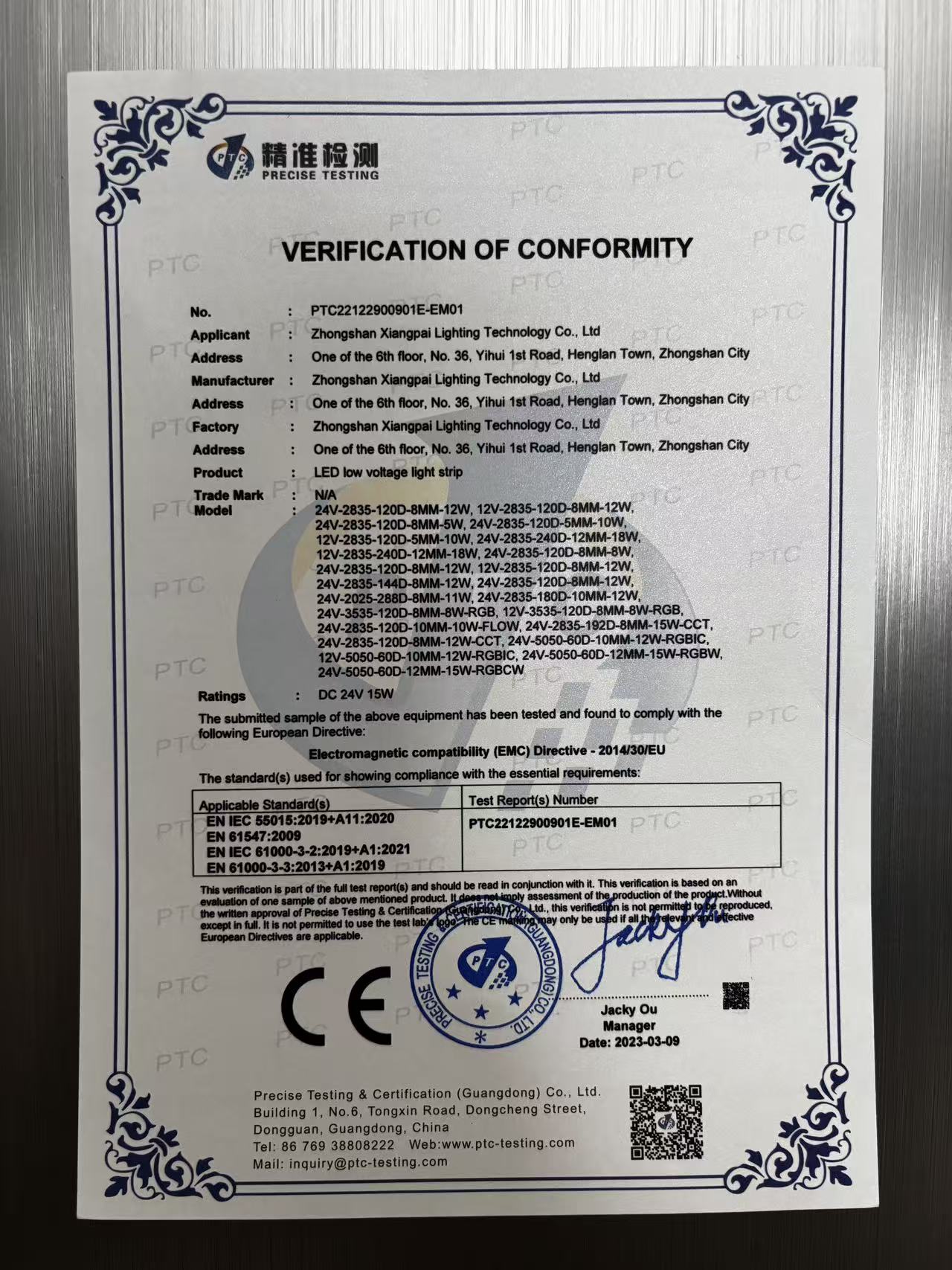
For an EU project, ask for the LVD, EMC and RoHS test reports behind the CE marking, plus the certificate numbers. The XPUP light strip series carries CE certification numbers PTC22122900901E-EMB01 and PTC22122900902E-EMB01 for EMC, and PTC22122900901S-LD01 and PTC22122900902S-LD01 for LVD, all issued by PTC TESTING for the EU market. Read the scope line: these certifications cover the low-voltage and high-voltage light strip series as a family, so the reviewer's next question is whether the specific model in the purchase order falls inside that family scope.
Step 3 — Match the standard list to the destination market
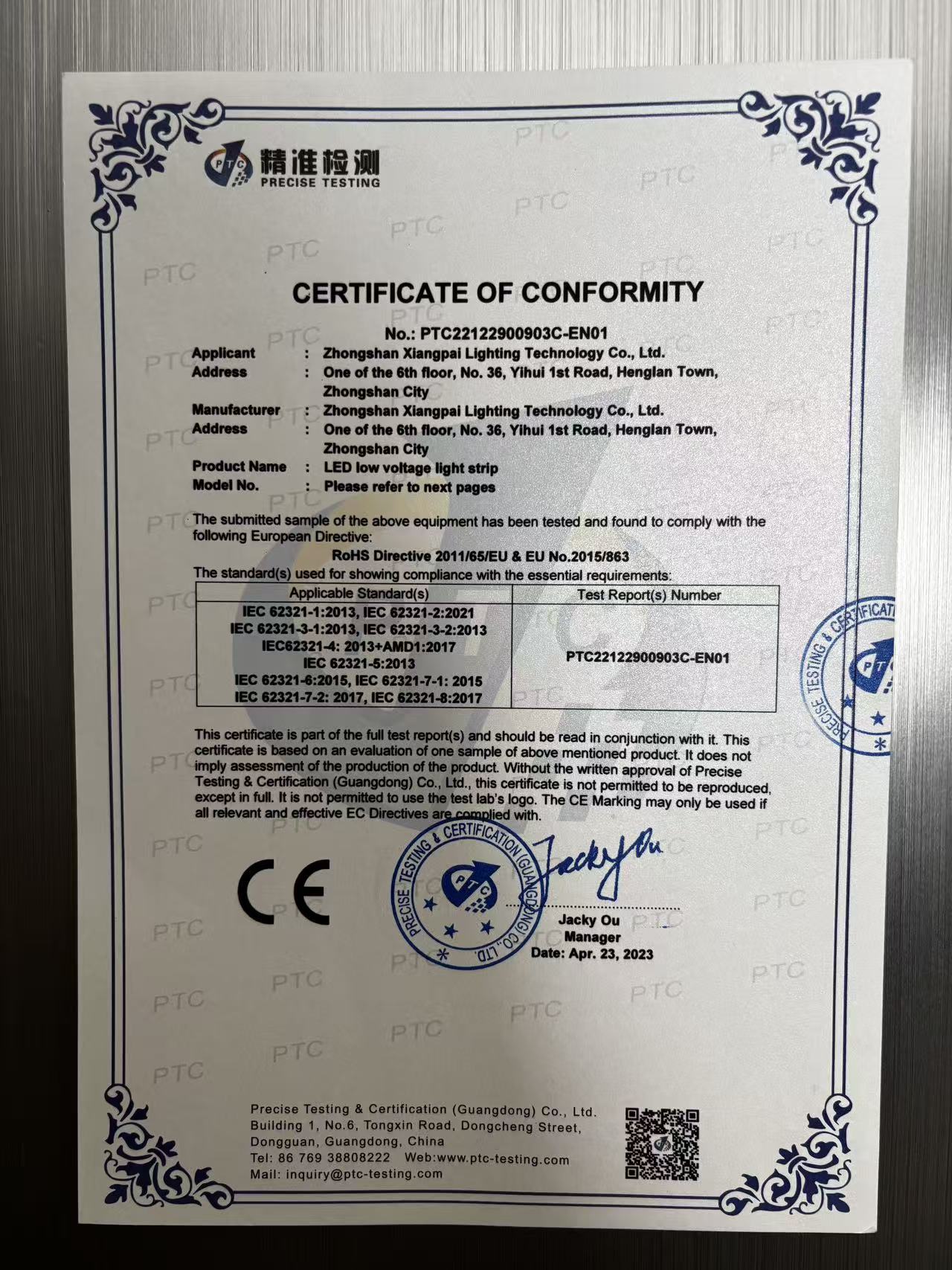
Check that the cited standards are current and appropriate. For the EMC file, the applicable standards are EN IEC 55015:2019+A11:2020, EN 61547:2009, EN IEC 61000-3-2:2019+A1:2021 and EN 61000-3-3:2013+A1:2019. For RoHS, the applicable standards are the IEC 62321 series, including IEC 62321-1:2013, IEC 62321-2:2021, IEC 62321-3-1:2013, IEC 62321-3-2:2013, IEC 62321-4:2013+AMD1:2017, IEC 62321-5:2013, IEC 62321-6:2015, IEC 62321-7-1:2015, IEC 62321-7-2:2017 and IEC 62321-8:2017.
Step 4 — Confirm the issuing laboratory and validity window
A test report is only as useful as its traceability. For the XPUP series, the issuing authority on record is PTC TESTING, the CE LVD reports are dated 4 April 2023, the EMC reports 9 March 2023 and the RoHS reports 23 April 2023. If your buyer's compliance team requires an accredited body named on the document, verify that requirement before the order rather than after.
Step 5 — Test the declaration against the installed environment
IP20 plus an indoor dry location plus a maximum ambient of +45°C defines the envelope. A hotel corridor with concealed cove lighting fits; a spa wall, a pool surround or an exterior soffit does not. Where the project crosses that boundary, the answer is to re-specify the product family, not to argue the rating.
Step 6 — Lock the label, the packaging and the report together
The last failure mode is administrative. If OEM customization changes voltage, colour, dimensions, internal circuit, nameplate or label, the declaration set must move with it. A label that reads CA-DC24V-2835-180D-8mm-3000K next to a test report for a different family is a review failure regardless of product quality.
What to Ask For in the Compliance File — A Buyer's Checklist
Compliance files fail for predictable reasons, and the checklist below is built around those failure points rather than around a generic document list.
- ScopeDoes the certificate name the product family, and does your specific model fall inside it?
- NumbersAre the certificate numbers quoted on the datasheet identical to those on the report?
- StandardsAre the cited standard editions current, or superseded versions still in circulation?
- AuthorityIs the issuing laboratory named, and does it meet your compliance team's accreditation requirement?
- DatesAre the issue dates visible, so validity can be assessed against project handover?
- ConsistencyDo the voltage, power, CRI and IP values on the label match the report and the datasheet?
- EnvironmentDoes the IP rating match the actual installed location, including humidity and cleaning regime?
- Change controlIf OEM customization applies, is there a written process for updating the declaration?
Use Cases: Where the Acoustic Wall Spec Fits and Where It Does Not
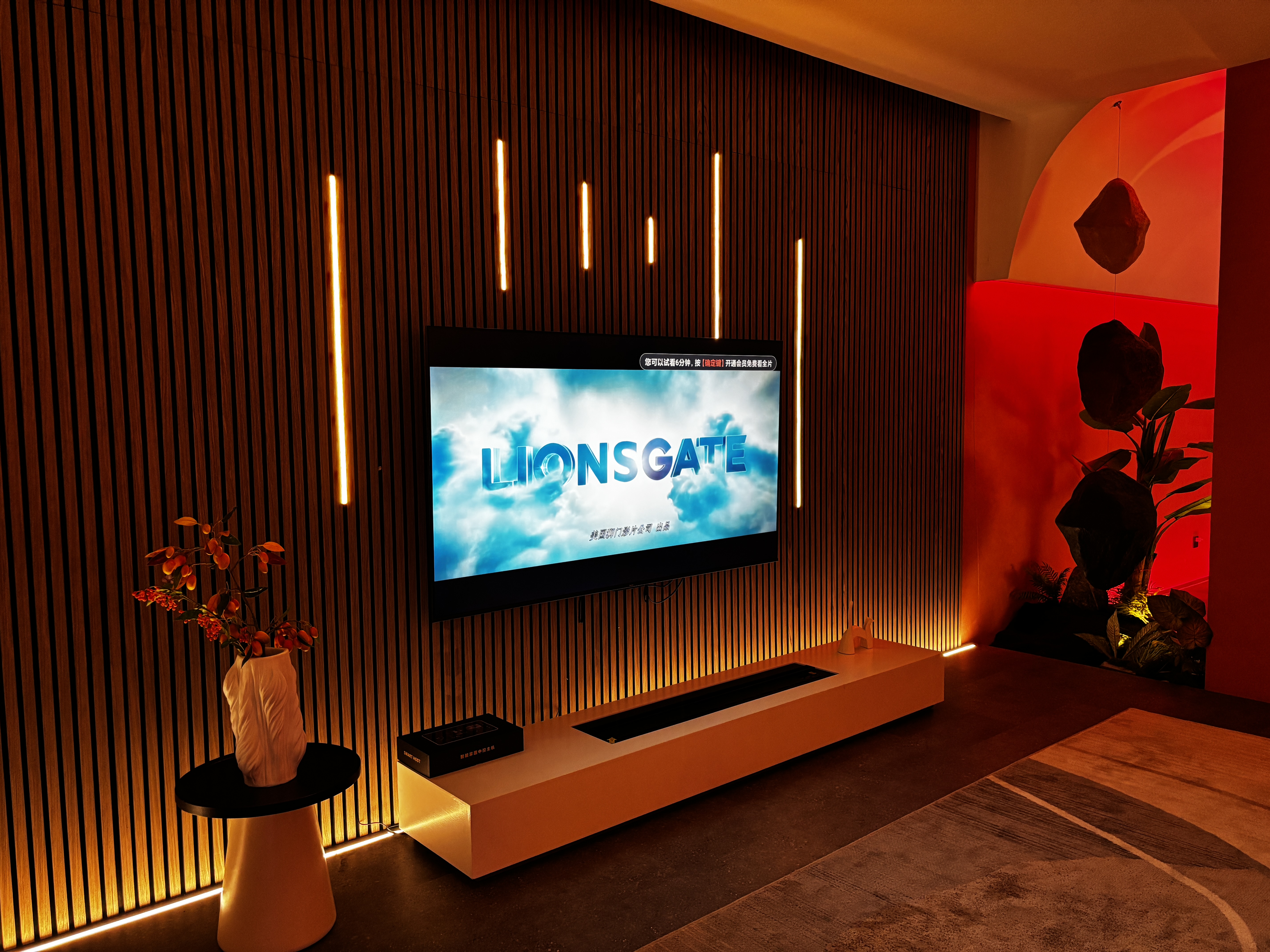
Hospitality corridors and lobby feature walls
Slat wall panels with a concealed warm-white strip are a common hospitality treatment, and 3000K at Ra≥80 with 180 LEDs per metre produces a continuous line without visible dotting. Because the installed location is indoor and dry, IP20 is appropriate, and the declared 11W per metre feeds directly into the driver schedule. CCT customization is available where a hotel brand standard specifies a warmer or cooler tone.
Luxury residential media walls and stair features
Residential acoustic wall installations place the strip in a cavity with little airflow, which makes the double-layer copper PCB and the +45°C ambient ceiling the operative numbers. The 2.4m and 3m strip lengths reduce the number of joints per wall run, and fewer joints means fewer failure points and less voltage drop to manage at 24V.
Retail and showroom slat walls
Retail environments often run the lighting for extended hours, so power per metre and thermal behaviour matter commercially as well as technically. Where the wall sits near an entrance vestibule or a glazed façade, confirm the actual local ambient before committing to an IP20 product.
Where a different product family is the right answer
For bathrooms, spa areas, exterior soffits, canopies and any location exposed to water or driven rain, the IP20 acoustic strip is the wrong selection regardless of how well it fits the panel. The correct response is a strip rated IP65 or IP68, which in the XPUP range includes silicone and waterproof families, and a fresh compliance check against that model.
Regional Standard Mapping: Comparison Table
The table below maps each market to the framework that applies and to the document a buyer should physically hold before approving production. It does not assert that any single supplier holds every approval listed — it defines what to request and what to verify.
| Market | Framework | Referenced standards | Document to request |
|---|---|---|---|
| EU | CE — Low Voltage Directive | EN IEC 62031:2020+A11:2021; IEC TR 62778:2014; EN 62471:2008 | LVD test report with certificate number and issuing laboratory |
| EU | CE — EMC Directive | EN IEC 55015:2019+A11:2020; EN 61547:2009; EN IEC 61000-3-2:2019+A1:2021; EN 61000-3-3:2013+A1:2019 | EMC test report with certificate number |
| EU | RoHS | IEC 62321 series (parts 1, 2, 3-1, 3-2, 4, 5, 6, 7-1, 7-2, 8) | RoHS test report covering the specific model |
| EU | Ecodesign / ErP | Energy-related product requirements for lighting | Energy and performance declaration consistent with the datasheet |
| USA | UL 2108 | Low voltage LED strip safety classification | UL file number and listing evidence — do not assume CE transfers |
| USA | UL 1598 | Luminaires installed in storage areas such as clothes closets | Confirmation of applicability where the wall incorporates storage |
| Global | IEC 60598-2-20:2022 | Safety requirements for lighting chains including LED strips | IEC test report or CB scheme report |
Frequently Asked Questions
Which certifications should an acoustic wall LED strip carry for the EU market?
For the EU, the strip needs CE marking supported by three separate test streams: Low Voltage Directive safety, EMC, and RoHS. The XPUP light strip series is CE certified and RoHS compliant, with EMC certificate numbers PTC22122900901E-EMB01 and PTC22122900902E-EMB01 and LVD certificate numbers PTC22122900901S-LD01 and PTC22122900902S-LD01, all issued by PTC TESTING for the EU market. The scope of that certification covers the low-voltage and high-voltage light strip series. Buyers should confirm that the specific model on the purchase order falls within that family scope and that the certificate numbers on the datasheet match the reports.
Can the CA acoustic wall model be customized without losing its compliance documentation?
Yes, within a controlled process. The CA-DC24V-2835-180D-8mm-3000K is offered with OEM and ODM customization, and XPUP's OEM scope covers voltage, logo, power, dimensions, materials, hardware configuration, internal circuit, colour, factory specifications, nameplate and label. ODM scope additionally covers exterior colour scheme, outer packaging box, label, brand information, model name and material details. The compliance consequence is that any change to a declared value — voltage, power, CRI, CCT or dimensions — requires the declaration set to be updated to match, otherwise the file describes a product that is no longer being shipped.
What drives the cost of a compliant acoustic wall LED strip?
Cost is driven by the elements that carry the declaration, not by the strip alone. On this family those elements are the double-layer copper PCB, the 180 LEDs per metre density, the SMD 2835 light source, the 8mm profile built to fit 13mm and 15mm slat channels, and the testing that supports the CE and RoHS file. Commercial variables sit alongside them: minimum order quantity of 2,000 metres, OEM or ODM customization depth, and packaging and labelling scope. Buyers comparing quotations should compare the declared specification and document set line by line, because two quotes at different prices are rarely quoting the same product.
How do I verify that a sample matches its declared specification?
Verify the sample against the same table used for the compliance file. Check the model designation on the label, measure the PCB width, confirm the 24V rating and the power figure per metre, confirm the 3000K colour temperature and Ra≥80 declaration, and confirm the IP20 marking. Then place the sample in the intended mounting condition — for acoustic wall work, seated in the slat channel — and run it at the stated operating conditions to confirm the thermal behaviour is acceptable at the project's ambient temperature. Sample confirmation should happen before mass production, alongside the document review rather than after it.
What lead time and order quantity apply to a compliant acoustic wall order?
For this product family, XPUP quotes a lead time of 18–22 days and a minimum order quantity of 2,000 metres, with monthly capacity of 3,000,000 metres and 100% testing on production. Quality control is a 100% test regime, and after-sales support covers online remote support, general technical guidance and a 2-year standard warranty, with dedicated technical support and remote debugging available on OEM programmes. Lead time should be scheduled against the compliance review, not after it, because document queries raised late in the programme are the most common cause of installation delay. To move a project forward, request a sample of the CA-DC24V-2835-180D-8mm-3000K together with the CE and RoHS document set, or send your wall schedule and destination market for a specification match.
Conclusion
Compliance for acoustic wall lighting is a matching exercise, not a paperwork exercise. The product has to fit the panel — which is why the 8mm PCB and the 13mm/15mm slat channel compatibility matter — and the declaration has to survive the market review, which is why the model designation, 24V rating, 11W power, 3000K CCT, Ra≥80, 180 LEDs per metre, double-layer copper PCB and IP20 rating all have to appear identically on the label, the datasheet and the test report.
The regional layer adds the market-specific step. The EU route runs through CE supported by LVD, EMC and RoHS reports. The US route runs through UL 2108 and, where relevant, UL 1598 — and a European file does not substitute for it. The global route runs through IEC 60598-2-20:2022. An IP20 strip belongs in an indoor dry interior at up to +45°C ambient; anything wetter or hotter needs a different product family and a fresh document set.
Approached this way, the compliance file becomes a procurement asset. It shortens review cycles, removes the specification ambiguity that causes site disputes, and gives the specifier a defensible basis for approving the strip behind an acoustic wall.
Next Step: Sample, Document Set, or Catalogue
Request a sample of the acoustic wall LED strip together with its CE (LVD and EMC) and RoHS documentation, or send your project location, wall build-up and destination market for a specification match. The full 2026 product range is available for download in the XPUP LED Strip Catalogue.
XPUP LED — Zhongshan Xiangpai (XPUP) Lighting Technology Co., Ltd.
Website: www.xpupled.com
Email: sales001@xpupled.com · Tel / WhatsApp / WeChat: +86 189 8858 4085
Address: 5th Floor, No.36-1, Yihui 1st Road, Henglan Town, Zhongshan City, Guangdong Province, China
Have Questions or Need More Details?
Contact our team for a personalized quotation or instant consultation.
Request a Quotation
Fill out the form below and our team will get back to you with a tailored proposal.
WhatsApp Direct Chat
Prefer to chat in real-time? Message us on WhatsApp for instant assistance & quick answers.
- Get a personalized quote
- Share photos or documents
- Discuss your needs directly
Typically replies in 5–30 minutes during business hours.