
LED Strip Light Supplier Capability Check: Delivery by Spec
A supplier's delivery assurance is a reproducible output, not a promise. The practical test is to take one named build and ask whether the factory can repeat it, within the same tolerances, on every purchase order. For this article that build is CA-DC24V-2835-180D-8mm-3000K: SMD 2835, 180 LEDs per meter, 24 V, 11 W, IP20, Ra≥80, 3000K, on a copper PCB.
XPUP LED (Zhongshan Xiangpai (XPUP) Lighting Technology Co., Ltd.) is an LED strip manufacturer based in Zhongshan, China, founded in 2012, operating a 10,000 m² factory with 80 employees, 6 R&D engineers and an annual output of 35,000,000 meters. This article uses a single high-density 2835 build to show how a buyer can convert a brochure conversation into a capability check — and how to write the purchasing terms and acceptance criteria that make delivery assurance enforceable before the PO is signed.
SMD 2835180 LEDs/mDC 24VIP203000K / Ra≥80
What “delivery assurance by spec” actually means
Delivery assurance by spec is a written supplier commitment that one defined model string will be manufactured to fixed tolerances on every order, verified at agreed inspection points, and scheduled against a stated capacity and lead time. It is not a quality slogan, and it is not the same thing as a sample approval.
The definition matters because most LED Strip Light sourcing decisions are made on inputs that do not survive production: a catalog page showing a range of densities, a hand-built sample, and a price. A range tells a buyer what a factory can attempt. A tolerance tells a buyer what a factory can repeat.
For a high-density indoor strip the difference is measurable. On a 180 LEDs/m build, the variables that decide whether the delivered reel matches the approved sample are the LED package and bin, the copper PCB construction behind an 8 mm board, the consistency of the cut marks, the adhesive, and the reel-to-reel handling of a strip that carries no moisture protection at all.
The problem: brochures describe ranges, purchase orders need tolerances
Three gaps cause most disputes between strip buyers and factories.
- Sample-to-production drift. A sample is often assembled outside the normal line, with the best available LEDs. Mass production runs on a different bin and a different reel. Nothing in a brochure records that difference.
- Hidden construction. On an IP20 flexible strip there is no silicone sleeve or potting to inspect. Density, copper weight and layer count sit inside a 8 mm board that a buyer never sees unless the factory documents it.
- Undefined acceptance. If the PO says “3000K, 24V, 180 LEDs” and nothing else, a delivery that measures 3,150K with uneven cut marks is technically compliant with the paperwork and commercially unusable.
High-density builds are a fair stress test of these gaps because they are not commodity volume. High-density LED strip variants above 120 LEDs per meter accounted for nearly 19% of premium installations in 2025, according to Business Research Insights. A build that sits outside the highest-volume segment is exactly where a buyer needs written evidence rather than a verbal assurance.
Industry background: why this spec is a realistic capability test
The global LED strip market was valued at approximately USD 5.8 billion in 2025 and is projected to reach USD 13.2 billion by 2034, growing at a CAGR of 9.6%, according to Dataintelo. Flexible LED strips represent the largest product type, holding a 67.4% share of that market as of 2025.
Supply is concentrated. China accounted for approximately 59.3% of total global exports of light fixtures in 2024, according to OEC. That concentration means a buyer evaluating LED Strip Light suppliers is usually choosing between factories that can all produce something in the category — which is precisely why the evaluation has to move from “can you make it” to “can you hold it.”
The chosen parameters are mainstream, not exotic. The 24V segment accounted for 52.0% of linear LED strip fixture market revenue in 2022, per Grand View Research, and the 3000K–4000K color temperature segment held a 33.2% revenue share of the same market. A 3000K, 24V, Ra≥80 strip is therefore a standard commercial requirement — which makes color-temperature consistency between batches a normal purchasing expectation rather than a premium request.
Compliance expectations run in parallel. Low voltage LED strips (12V/24V) in the United States are classified under the safety standard UL 2108, and IEC 60598-2-20:2022 specifies safety requirements for lighting chains including LED strips. In the EU, CE marking for a strip product combines several directives, and energy-efficiency requirements under the Ecodesign framework continue to shape what enters the market.
The build under test: CA-DC24V-2835-180D-8mm-3000K
Everything in a capability check hangs off one unambiguous identity string. For this article, that string resolves to a specific set of parameters:
| Parameter | Specification | Why it belongs in the PO |
|---|---|---|
| LED package | SMD 2835 | Defines the footprint, the available bin range and the optical behavior of the strip |
| LED density | 180 LEDs per meter | Controls dot pitch and appearance on wall and panel surfaces |
| Working voltage | DC 24 V | Sets driver specification and voltage-drop limits along the reel |
| Rated power | 11 W per meter | Drives power supply sizing and heat planning in the profile |
| PCB | Copper PCB, 8 mm board width | Determines current handling and long-run brightness stability |
| Ingress protection | IP20 | Restricts use to dry indoor locations; no moisture or dust claim |
| Color rendering | Ra≥80 | Sets the minimum color fidelity for residential and hospitality interiors |
| Color temperature | 3000K | Defines the warm white target and the binning tolerance to be agreed |
An IP20 rating is not a limitation to be explained away — it is a design boundary that belongs in the acceptance criteria. A strip without silicone coating or potting cannot be specified for bathrooms, exteriors or any location exposed to condensation. When the application is dry indoor wall, cove or panel lighting, IP20 is the correct choice, and the buyer should confirm in writing that nothing in the delivery claims otherwise.
The four agreements to lock before the PO
1. Spec lock: one identity string, not a description
The first agreement is that the model string is the contract. “2835 warm white 24V strip” is a description; CA-DC24V-2835-180D-8mm-3000K is an identity. The signed spec sheet should carry every row in the table above, plus the color temperature tolerance and the acceptable CRI measurement method.
This is also where a supplier's customization system becomes visible. XPUP's OEM scope covers voltage, logo, power, dimensions, materials, hardware configuration, internal circuit, color, factory specifications, nameplate and label, while the ODM scope covers exterior color scheme, outer packaging box, label, brand information, model name and material details. Any of these variables that a buyer changes must be versioned against the base spec — otherwise the “same” strip quietly becomes a different product between orders.
2. Construction disclosure: what is inside the 8 mm board
The second agreement is a written construction record. For this build it should state the PCB base, the copper construction, the layer count and the board width. Density and PCB construction are linked: a 180 LEDs/m layout packs more components onto the same 8 mm width, and the copper behind those components determines how the strip behaves at the far end of a long run.
This is the point where a supplier either answers with documentation or with adjectives. A factory that routinely runs high-density builds will have the layer count, the copper weight and the voltage-drop data on hand. A factory that assembles whatever is ordered will answer the question only after consulting someone else.
3. Sample-to-mass-production bridge
The third agreement converts a sample into a production reference. Three elements make that bridge hold:
- A production-representative sample, taken from a normal production run rather than assembled for the buyer.
- A retained golden sample, signed and dated by both parties, kept by the factory and by the buyer.
- A first-article check on the first mass-production reel against the golden sample, before the balance of the order is released.
The sample is also the moment to agree the measurement method. If color temperature will be judged, both sides need to know whether that means a spot reading at one point or a reading at several points along the reel. If CRI is specified at Ra≥80, both sides need to agree which instrument produces the number.
4. Acceptance criteria and inspection points on an IP20 strip
The fourth agreement defines what happens at inspection. On a flexible IP20 strip there is no housing to open and no gasket to check, so inspection concentrates on what can be measured and what can be counted.
| Inspection point | Method | Evidence to retain |
|---|---|---|
| LED count per meter | Count components on a measured 1 m cut from the reel | Photo of the counted section with the tape measure in frame |
| Cut-mark spacing | Measure the interval between printed cut marks across several meters | Recorded interval and a photo of the markings |
| Color temperature | Measure at several points on the same reel and on adjacent reels | Readings per reel, compared against the golden sample |
| Color rendering | Measure Ra on the same sample used for the CCT reading | Instrument output attached to the inspection record |
| Power per meter | Measure at the specified voltage on a defined length | Measured value against the 11 W/m rating |
| Solder joints and flex behavior | Visual check plus a controlled bend at the joint area | Photo record plus pass/fail note |
| Adhesive backing | Peel check on the production sample after conditioning | Note on tape type and peel result |
| Reel length and labeling | Confirm reel length and label data against the PO | Label photo matched to the order number |
Two items on that list do not apply to this build and should not appear in the criteria: IP65/IP67 sealing inspection and any water-immersion or jet test. An IP20 strip carries no ingress claim, so testing for one creates a false record and a false expectation.
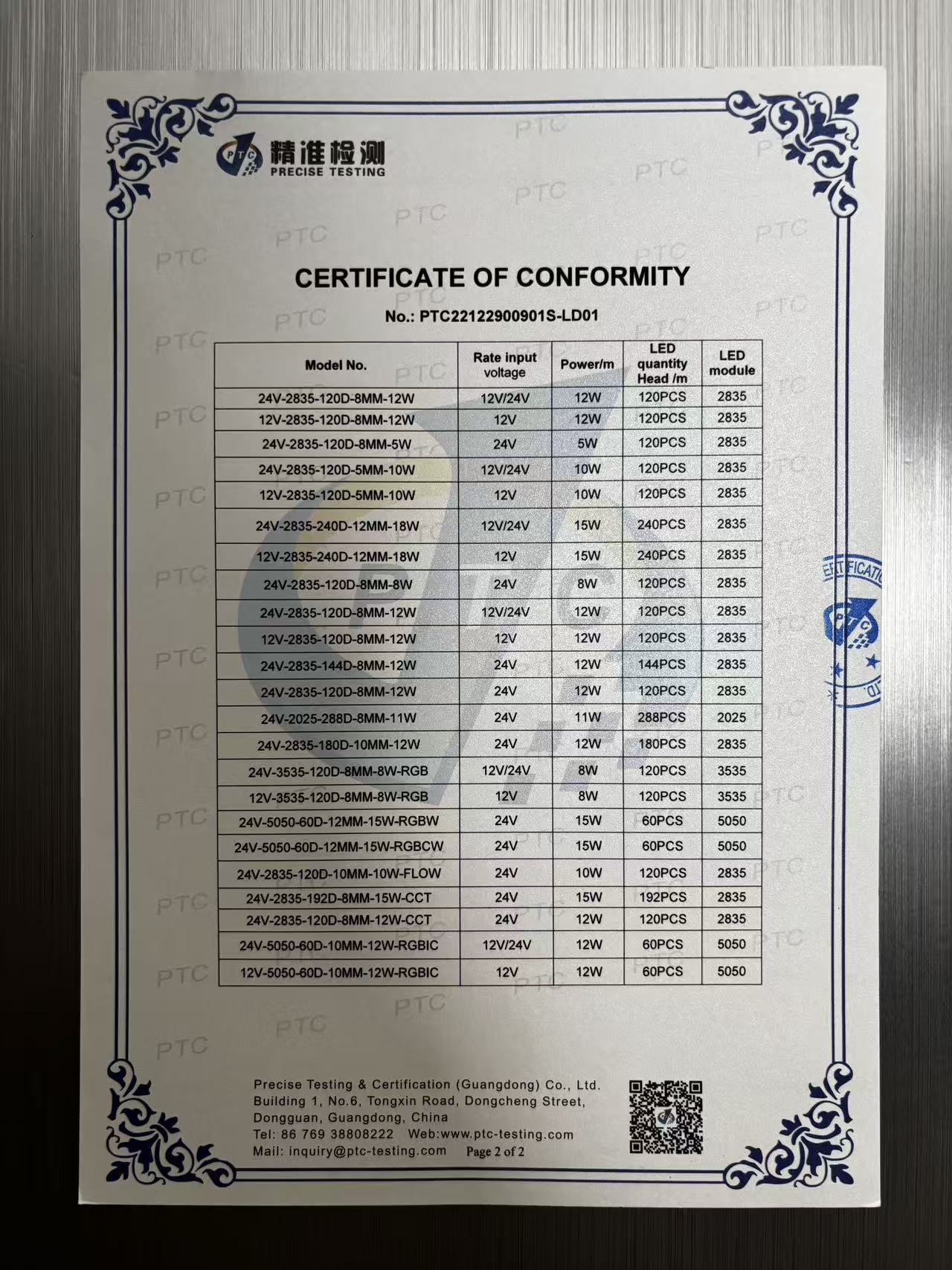
CE Low Voltage Directive certificate issued by PTC TESTING (PTC22122900901S-LD01 / PTC22122900902S-LD01), covering the XPUP LED low-voltage and high-voltage strip series against EN IEC 62031:2020+A11:2021, IEC TR 62778:2014 and EN 62471:2008.
Step-by-step: eight checks in the order a buyer should run them
Step 1 — Fix the identity string and the tolerance band
Write the model, then write the tolerance beside every parameter that has one. Color temperature and CRI are the two most common sources of post-delivery argument on a 3000K build, so both need a stated range and a stated measurement method.
Step 2 — Request the PCB construction record
Ask for layer count, copper construction, board width and the voltage-drop calculation at the maximum run length. A supplier that understands density will answer with numbers; one that does not will describe the strip as “high quality.”
Step 3 — Ask what changes if the density changes
This is the discriminator. Put the 180 LEDs/m SMD 2835 build next to a 120 LEDs/m double-layer copper PCB SMD 3535 variant and ask the factory what changes in the construction, the cut marks and the driver requirement. A competent engineering team will separate the variables: component count, PCB layer and copper, board layout, cut-mark interval, and the resulting change in measured power per meter and in dot pitch.
Step 4 — Test the drop-in replacement question
Drop-in replacement risk lives in the details that a spec sheet rarely states: the board width, the cut-mark interval, the adhesive type and the connector position. If a buyer intends to move a project from a 120 LEDs/m 3535 build to the 180 LEDs/m 2835 build, or the reverse, only a comparison of those four items — plus driver and power supply re-sizing against the 11 W/m rating — shows whether the aluminium profile, the wiring layout and the driver still work.
Step 5 — Order a production-representative sample
Sample quality is not the test; sample provenance is. Ask when the sample was produced, on which line, and from which LED bin. Retain one piece as the golden sample and store it with the signed spec sheet.
Step 6 — Agree the inspection points and the AQL
Take the inspection table above into the negotiation. The purpose is not to create bureaucracy but to remove ambiguity: every line on it becomes a yes/no question at delivery instead of a judgment call after arrival.
Step 7 — Confirm capacity, MOQ and lead time in writing
Delivery assurance is arithmetic. XPUP's stated production parameters are a MOQ of 2,000 meters, a lead time of 18–22 days and a monthly capacity of 3,000,000 meters, with 100% testing. For a buyer planning a distribution program, those three numbers determine whether a repeat order can be absorbed inside a sell-through cycle or has to be pre-built.
Step 8 — Collect the compliance pack before, not after, the PO
The final check is documentation. XPUP's LED low-voltage and high-voltage strip series is covered by CE LVD, CE EMC and RoHS records issued by PTC TESTING, including certificate numbers and the applicable standards. Buyers shipping to the United States should separately confirm the standard they need — low voltage LED strips in the US are classified under UL 2108 — because an EU-focused pack does not answer a US question.
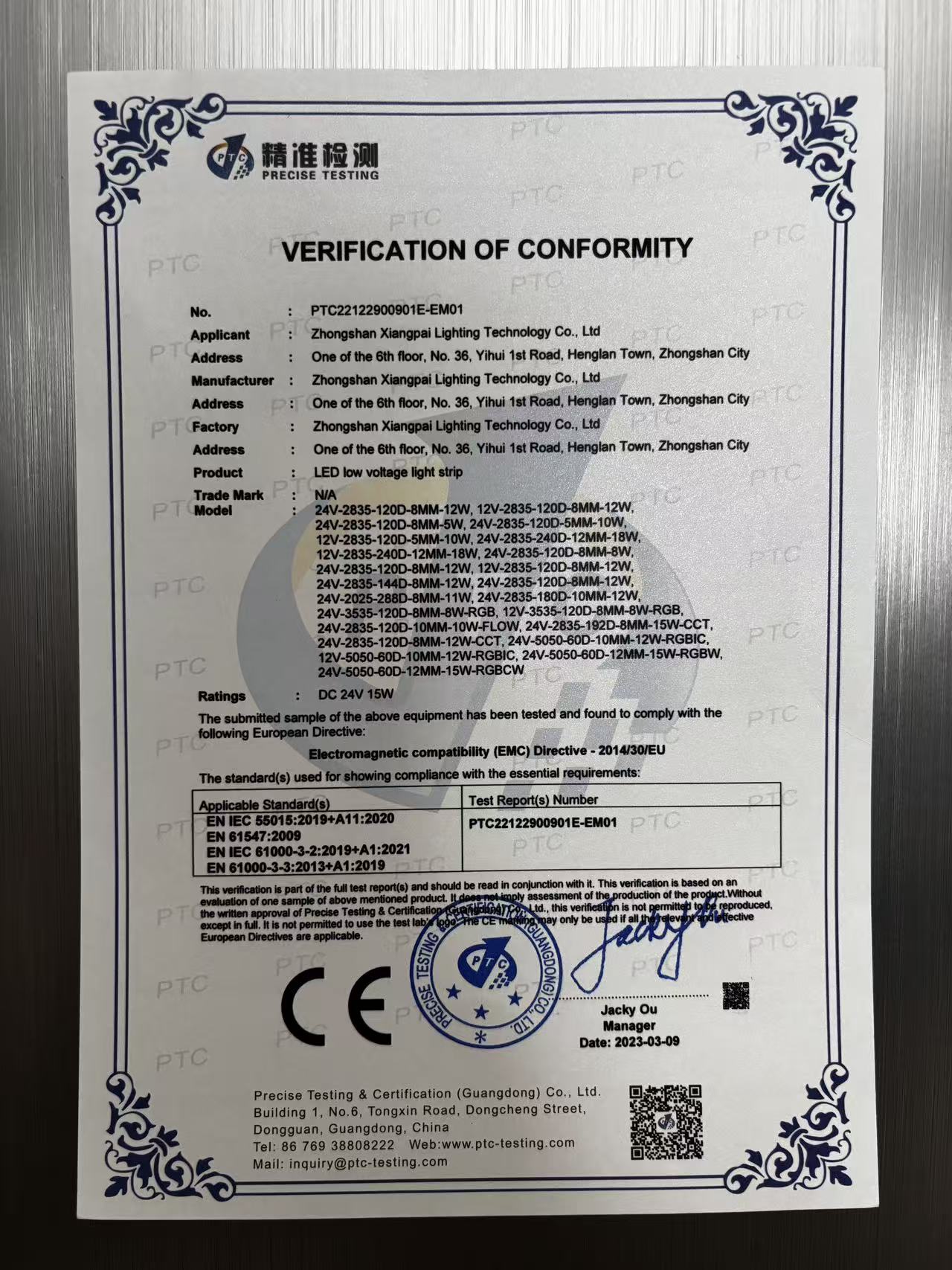
CE EMC certificate (PTC22122900901E-EMB01 / PTC22122900902E-EMB01) referencing EN IEC 55015:2019+A11:2020, EN 61547:2009, EN IEC 61000-3-2:2019+A1:2021 and EN 61000-3-3:2013+A1:2019.
The 180 vs 120 question: does the supplier actually understand density?
A supplier that treats density as a number on a label will fail this test. Density is a design variable, and it interacts with everything around it.
On the 180 LEDs/m SMD 2835 build, more components sit on the same 8 mm width. The immediate consequences are a shorter cut-mark interval, a finer dot pitch on the lit surface, and a different distribution of solder joints along the metre. On a 120 LEDs/m double-layer copper PCB SMD 3535 variant, the component count is lower and the package is physically larger, so the board layout, the copper construction and the visual appearance of the run are all different.
A buyer can test whether the factory understands this by asking four questions and comparing the answers:
- What is the cut-mark interval on each build, and why?
- What is the copper construction and layer count on each board, and what does that do to voltage drop over a long run?
- What is the measured power per meter on each build, and how does that change driver sizing?
- If we swap one build for the other inside the same aluminium profile, what has to change in the installation?
An engineering-led answer separates those four items cleanly. A sales-led answer collapses them into “both are warm white strips.”
Comparison table: what to pin down across two builds
The table below compares the two builds used throughout this article. Where a parameter was not confirmed in the supplier documentation available for this evaluation, it is marked as requiring written confirmation rather than assumed — which is itself the correct outcome of a capability check.
| Parameter | CA-DC24V-2835-180D-8mm-3000K | XP-D5DC24V-3535-120D-8MM | What to verify before the PO |
|---|---|---|---|
| LED package | SMD 2835 | SMD 3535 | Package datasheet and bin code per order |
| LEDs per meter | 180 | 120 | Count on a 1 m production sample |
| Working voltage | DC 24 V | DC 24 V | Voltage-drop check at maximum run length |
| Rated power | 11 W per meter | Request written confirmation | Measure, do not rely on nominal |
| PCB construction | Copper PCB, 8 mm width | Double-layer copper PCB, 8 mm width | Layer count, copper construction, board width in writing |
| Color rendering | Ra≥80 | Request written confirmation | Agree the instrument used for the Ra reading |
| Color temperature | 3000K | Request written confirmation | Compare CCT across three consecutive batches |
| Ingress protection | IP20 | Request written confirmation | Dry indoor only; no sealing test applies |
| Cut-mark interval | Request written confirmation | Request written confirmation | Measure and record; it governs drop-in replacement |
| Best fit | Wall, cove and panel lighting where fine pitch matters | Layouts where a larger package and lower component count suit the design | Match the build to the installation, not to the price list |
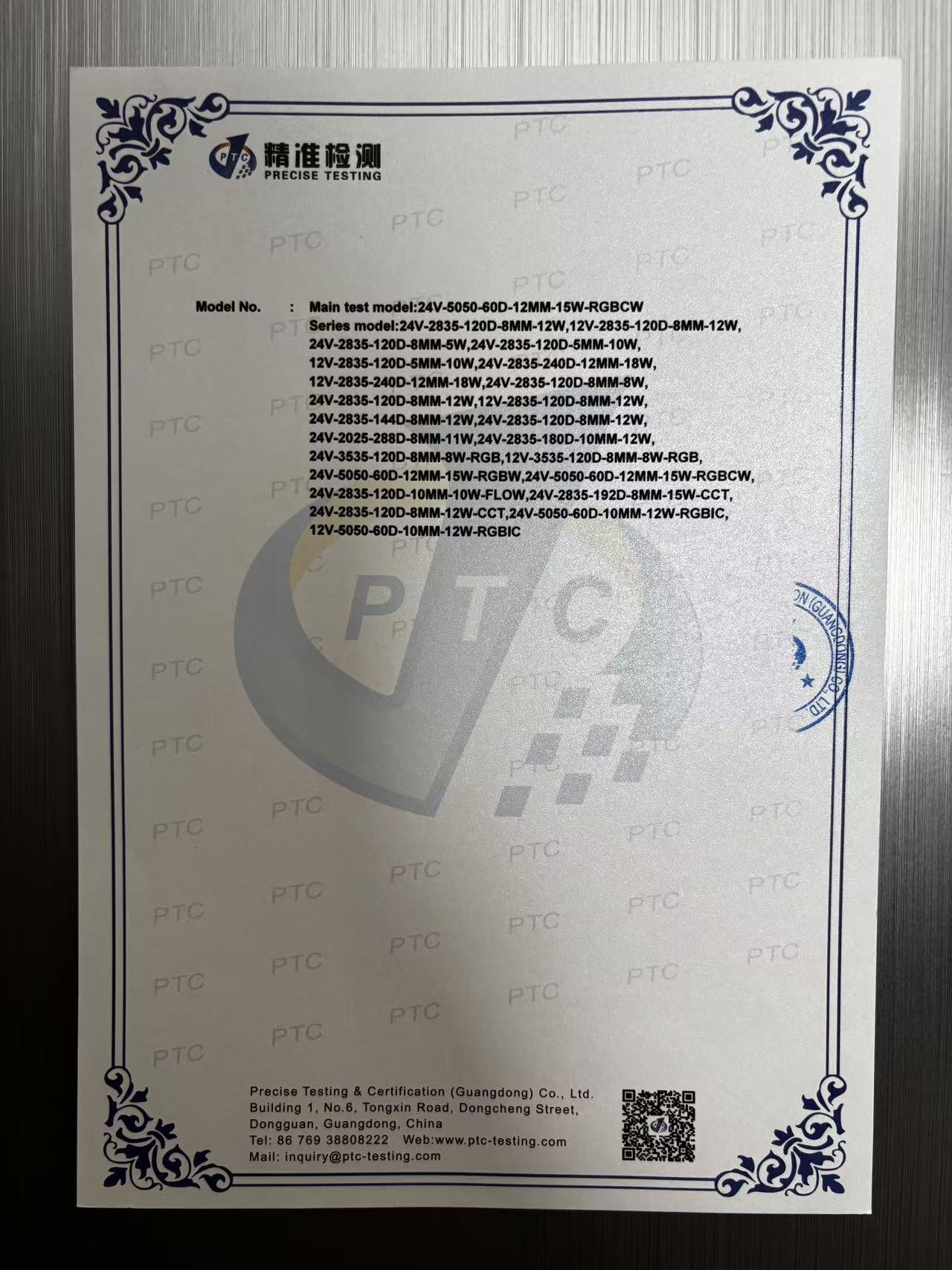
RoHS test report issued by PTC TESTING (PTC22122900903C-EN01 / PTC22122900905C-EN01) covering the XPUP LED strip series against the IEC 62321 test series.
Use cases: how delivery assurance maps to five buyer channels
A capability check is only useful if it is tied to the channel the strip is sold into. The same 180 LEDs/m 3000K build carries different risk in each.
Wholesale and distribution
For a distributor, the risk is a batch that sells well and a second batch that generates returns. A German DIY retail chain sourced 100,000 meters per year of LED strip solutions for six years, with a complete product portfolio and retail packaging customization supporting retail sales and small-scale lighting projects. What makes that pattern work is not the first delivery — it is the fifth, which is why batch-to-batch color and brightness control belongs in the purchasing terms.
Lighting design and specification
For a design-led project, the risk is visual discontinuity along a run. A commercial lighting contractor in Germany installed 50,000 meters across cafés and chain retail stores over two years, using dimmable COB strips for smooth, flicker-free output and smart strips for scenario control. On a 180 LEDs/m build, the same expectation translates into a dot-pitch and cut-mark requirement that has to be written down, not inferred.
Wall lighting
Wall grazing is the most demanding indoor application for a high-density strip, because the lit surface is viewed at an angle and every interruption shows. Density, cut-mark accuracy and CCT consistency all become visible at once. This is where the golden-sample method earns its cost: it is the only practical way to prove that the reel installed in month six matches the mock-up approved in month one.
Luxury residential
In premium residential work the strip is usually one component inside a larger control and finish package. A luxury residential design company in the United States used 15,000 meters per year across villa interior and landscape lighting over two years, combining smart strip integration with IP68 outdoor protection. The relevant delivery assurance question here is different from a wholesale order: it is whether the same build can be re-ordered later for an extension of the same property without a visible mismatch.
Home decoration distributors in Germany and Italy have used both CA-DC24V-2835-180D-8mm-3000K and XP-D5DC24V-3535-120D-8MM across 20,000 meters per year of premium residential projects over three years — a practical example of why a supplier must be able to hold two different constructions to the same consistency standard rather than only one.
Acoustic panel lighting
Acoustic wall lighting is where the 180 LEDs/m build is hardest to substitute. The strip sits close to a textured surface, so the pitch between light sources determines whether the wall reads as a continuous wash or a row of dots. Cut-mark spacing matters because panel modules repeat at fixed intervals, and a strip whose cut marks do not align with the panel grid forces on-site improvisation.

XPUP Lighting recognised among the 2023 Top 10 Linear Lighting Brands — one of several industry recognitions held alongside Top Ten No-Main-Light Lighting Brands and Quality Linear Lighting Manufacturer.
Turning the check into a repeatable order
Two operational facts decide whether an approved spec survives a year of purchasing. The first is capacity headroom: XPUP states a monthly capacity of 3,000,000 meters against a MOQ of 2,000 meters and a lead time of 18–22 days, with 100% testing on production. A buyer can build a replenishment cycle on those numbers instead of guessing.
The second is after-sales structure, because a capability check that stops at delivery leaves the buyer exposed during installation. XPUP's standard position is a 2-year warranty with online remote support and general technical guidance, extended under OEM programs to dedicated technical support, remote debugging and customized parameter guidance for the specific build.
A US lighting brand has run a long-term ODM program at 300,000 meters per year for three years, covering product specifications, color parameters, certification requirements and packaging customization, with stable manufacturing and quality control supporting continuous market supply. That is the shape of an order set that has moved past evaluation: one spec, one set of acceptance criteria, repeated.
Frequently asked questions
What compliance documents should accompany a 24V IP20 LED strip order for the EU?
A CE-marked strip should arrive with the declarations that support the mark across the applicable directives. XPUP's LED low-voltage and high-voltage strip series is covered by CE LVD certification (PTC22122900901S-LD01 / PTC22122900902S-LD01) tested against EN IEC 62031:2020+A11:2021, IEC TR 62778:2014 and EN 62471:2008; CE EMC certification (PTC22122900901E-EMB01 / PTC22122900902E-EMB01) tested against EN IEC 55015, EN 61547, EN IEC 61000-3-2 and EN 61000-3-3; and RoHS testing against the IEC 62321 series, all issued by PTC TESTING. The scope statement matters as much as the certificate: it should name the strip series you are buying. An EU pack does not cover a US shipment, where low voltage LED strips are classified under UL 2108.
How do I verify that a supplier can actually hold 180 LEDs per meter batch after batch?
Ask for three things and compare them: the PCB construction record (layer count, copper construction, 8 mm board width), a production-representative sample with its bin code, and the inspection record from the first article of the last production run. Then run the density cross-check — ask what changes between the 180 LEDs/m SMD 2835 build and a 120 LEDs/m double-layer copper PCB SMD 3535 variant in component count, cut-mark interval, measured power per meter and driver requirement. A factory that runs high-density builds answers those separately and immediately; a factory that does not will conflate them. Holding density is a manufacturing discipline, not a catalog option.
What drives the price difference between a 180 LEDs/m 2835 build and a 120 LEDs/m 3535 build?
The main cost drivers are component count per meter, PCB construction, and the yield loss created by shorter cut-mark intervals. A 180 LEDs/m layout places more components on the same board width, which raises the component cost and tightens the tolerance requirement; the PCB construction behind it determines current handling and therefore board cost. Volume terms change the calculation as well: XPUP quotes from a MOQ of 2,000 meters with an 18–22 day lead time and a monthly capacity of 3,000,000 meters. The practical rule is to compare landed cost per completed project — including waste from cut-mark mismatch and re-runs caused by color inconsistency — rather than price per meter in isolation.
What should a sample approval actually cover?
A sample approval should cover the sample, its provenance and the measurement method. Take a production-representative sample rather than a hand-built one, retain a signed golden sample with both parties, and record how color temperature, Ra and power per meter will be measured. Confirm the sample carries the same model string as the PO, in this case CA-DC24V-2835-180D-8mm-3000K, and that the IP20 rating is stated on the documentation. Customized elements — packaging, label, nameplate, brand information — should be approved at the same time, because they are versioned against the same base spec.
What lead time and capacity should a buyer plan around?
XPUP states a lead time of 18–22 days, a MOQ of 2,000 meters and a monthly capacity of 3,000,000 meters, with 100% testing on production and a 2-year standard warranty supported by online remote technical guidance. For a distribution or project program, the working method is to plan replenishment against the 18–22 day window plus transit, and to pre-build stock ahead of peak season using the available monthly capacity. Buyers who want the full specification set for the 180 LEDs/m 3000K build, plus the surrounding product range, can request a quote, a production-representative sample or the 2026 XPUP LED Strip Catalog directly from the XPUP LED team.
Conclusion: assurance is a spec you can measure
A supplier capability check for LED Strip Light does not need a scoring system or a long questionnaire. It needs one named build, a tolerance for every parameter that can drift, a construction record for the parts a buyer cannot see, and inspection points that apply to the product in front of you — which on an IP20 strip means counting LEDs, measuring cut marks, and measuring color, not testing for water ingress.
Held against that standard, CA-DC24V-2835-180D-8mm-3000K is a useful test case rather than a purchase formality. It is a mainstream voltage and color temperature on a non-mainstream density, and its behavior depends on a copper PCB inside an 8 mm board. A factory that can explain the difference between this build and a 120 LEDs/m double-layer copper PCB SMD 3535 variant, in writing and with numbers, has demonstrated the thing that actually predicts delivery performance.
The commercial model then has to support it: a defined MOQ, a stated lead time, capacity that absorbs repeat orders, documented CE LVD, CE EMC and RoHS coverage, and an after-sales structure that extends to the installed project. Those are the terms that make a first order repeatable — and repeatability, not the brochure, is what a buyer is really evaluating.
Check the spec before you check the price
Send XPUP LED your target build — including CA-DC24V-2835-180D-8mm-3000K — and request a production-representative sample, the construction record and the compliance pack for your market.
Email: sales001@xpupled.com | Tel / WhatsApp / WeChat: +86 189 8858 4085
Website: www.xpupled.com | Catalog: 2026 XPUP LED Strip Catalog
Factory: 5th Floor, No.36-1, Yihui 1st Road, Henglan Town, Zhongshan City, Guangdong Province, China
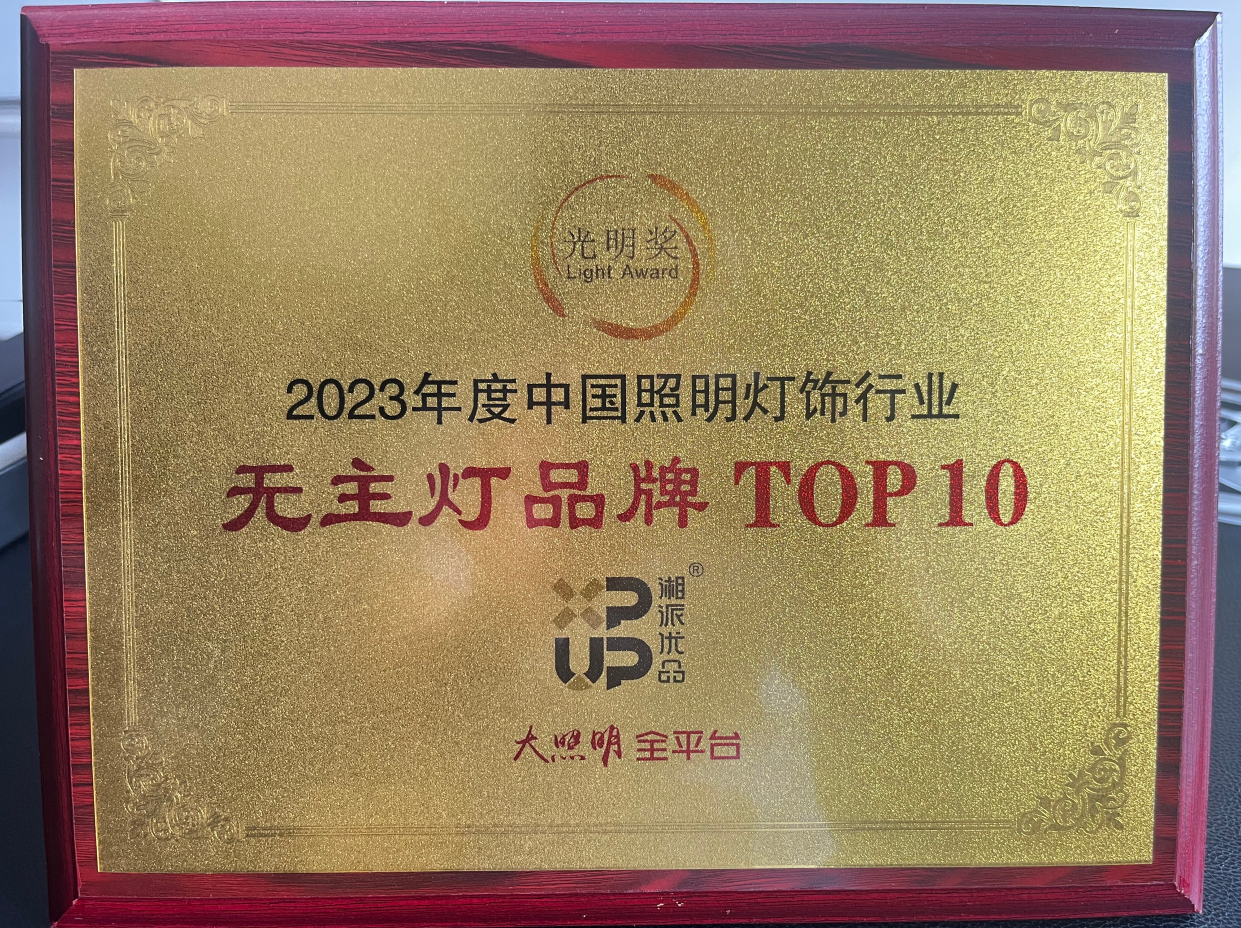
XPUP Lighting recognised among the 2023 Top 10 Mainless Lighting Brands — background on the manufacturer behind the strip builds discussed in this article.
Have Questions or Need More Details?
Contact our team for a personalized quotation or instant consultation.
Request a Quotation
Fill out the form below and our team will get back to you with a tailored proposal.
WhatsApp Direct Chat
Prefer to chat in real-time? Message us on WhatsApp for instant assistance & quick answers.
- Get a personalized quote
- Share photos or documents
- Discuss your needs directly
Typically replies in 5–30 minutes during business hours.