
SMD 2835 vs SMD 3535: Choosing the Right LED Strip for Acoustic Panels
Acoustic panels are no longer only a sound-control product. In office fit-outs, hospitality projects, and high-end residential interiors, they are also a lighting surface: an LED strip is inserted behind a slat, inside a groove, or within a narrow cove to create a soft architectural light line. The chipset you choose for that strip determines whether the finished panel looks continuous and refined or shows individual LED dots and uneven brightness.
For buyers evaluating LED Strip Light options for acoustic walls, the decision often narrows to two SMD-based configurations: SMD 2835 and SMD 3535. This comparison explains what each configuration gives the lighting designer and the wholesaler, using verified specifications from the XPUP product range.
Why the Chipset Question Becomes a Panel-Lighting Problem
An acoustic-panel LED strip is usually seen from close range. It may sit in a shallow extrusion between acoustic slats, behind a perforated felt layer, or along the edge of a fabric-wrapped panel. Unlike a typical ceiling cove with a long throw distance, these mounting positions allow the viewer to see the actual light-emitting surface. When individual SMD chips are spaced too far apart, the eye detects discrete bright spots instead of a clean line of light.
Thermal behaviour is a second constraint. Acoustic felt, foam, wood wool, and fabric do not transfer heat the way an open ceiling or an aluminium profile does. A strip installed in a closed panel cavity needs a substrate that can spread heat away from the LEDs. Both verified models compared here use 8mm double-layer copper PCB, which is a useful starting point for even heat conduction, but total wattage still has to be matched to the mounting environment.
The core design trade-off is therefore between density and colour capability. A high-density white strip solves the uniformity problem; an RGB strip solves the dynamic lighting problem. The next sections look at how 2835 and 3535 products are engineered for those two jobs.
Industry Background: Uniformity, Colour and Low-Voltage Architectural Lighting
Flexible LED strips are the dominant product type in the global LED strip market, with flexible variants accounting for 67.4% of product-type revenue in 2025 according to Dataintelo. Low-voltage 24V construction is especially common in linear fixtures: Grand View Research reported that the 24V segment represented 52.0% of linear LED strip fixture market revenue in 2022. Commercial applications are also the largest end-use segment, contributing roughly 33.8% of global LED strip revenue, which explains why wholesalers and designers keep looking for products that suit both interior walls and retail environments.
High-density strips, normally interpreted as designs above 120 LEDs/m, are a meaningful part of the premium installation segment. The same market data indicates that high-density variants account for close to 19% of premium LED strip installations. A 180 LEDs/m 2835 strip sits exactly in this product category. Meanwhile, RGB products remain one of the most widely listed LED strip colour types in smart and decorative lighting ranges. A buyer who understands those two product logics can make a more accurate procurement decision for acoustic panel projects.
Detailed Solution: Two Verified XPUP Configurations
Both chipset options described below are real models in the XPUP catalogue. The SMD number refers to the package family rather than a universal specification, so buyers should always confirm density, colour, PCB width, wattage, and IP rating with the exact model number. The verified model numbers are used throughout this article.
1. SMD 2835 Acoustic Wall LED Strip — CA-DC24V-2835-180D-8mm-3000K
This product is classified in the XPUP content set as an Acoustic Wall LED Strip Light. Its specifications are:
- Voltage: 24V DC
- Power: 11W/m
- CRI: Ra≥80
- Colour temperature: 3000K warm white
- LED density: 180 LEDs/m
- SMD package: 2835
- PCB width: 8mm
- PCB material: double-layer copper PCB
- Ingress protection: IP20, suitable for indoor use
- Strip length: 2.4m and 3m per strip
- Customisation: OEM and ODM available
What this means in practice is that the 2835 chip is mounted every few millimetres rather than in wide intervals. With 180 emitters per metre, a lighting designer can place the strip close to the surface of an acoustic panel or behind a narrow opening without producing the obvious “dot-and-gap” pattern typical of low-density strips. Because the colour temperature is fixed at 3000K, every metre of a project shares the same warm-white tone, which is important when a single wall or room is fitted with multiple lengths of strip.
2. SMD 3535 Multi-Color LED Strip — XP-D5DC24V-3535-120D-8MM
This product is classified as a Multi-Color LED Strip Light. Its verified specifications are:
- Voltage: 24V DC
- Power: 8W/m
- Colour output: RGB
- LED density: 120 LEDs/m
- SMD package: 3535
- PCB width: 8mm
- PCB material: double-layer copper PCB
- Controller contents: LED controller associated with the strip configuration
- Ingress protection: IP20, suitable for indoor use
The 3535 package is used in the XPUP range for colour-mixing output. RGB capability gives the lighting designer a range of scenes: a brand colour for retail, a dynamic accent for hospitality, or a scene-change option for a multi-use space. The verified application list for this model covers commercial lighting, hospitality lighting, and retail lighting. On an acoustic panel, a 3535 strip is best applied when the emitter is concealed or optically softened because 120 LEDs/m leaves more visible pitch between colour points than a 180 LED/m white strip when viewed directly.
The Role of Chip Size and Emitter Density
It is tempting to compare two strips only by total watts, but light distribution depends more on emitter pitch, package geometry, and the optical environment.
A 2835 package is compact, which allows the PCB designer to place a high number of components across an 8mm wide board. The CA-DC24V-2835-180D-8mm-3000K reaches 180 LEDs/m, producing a light line with very short physical distance between adjacent emitting points. This tight pitch is what makes the strip suitable for acoustic slat profiles, fabric edges, and narrow recesses where the eye is close to the source.
The 3535 RGB strip uses a larger package than 2835, and each 3535 component must contain red, green and blue light-producing elements to deliver RGB output. At 120 LEDs/m, the individual colour-mixing packages are spaced wider than the 2835 solution. This is precisely why the 3535 product is used more often as an accent or decorative source than as a replacement for a seamless white architectural line.
Thermally, the two verified products have clear power ratings: 11W/m for the high-density 2835 strip and 8W/m for the RGB 3535 strip. Both are built on double-layer copper PCB, which helps spread heat laterally along the strip. Still, an acoustical panel cavity limits airflow, so the lighting specification should respect the wattage rating and recommend that the mounting channel provides enough free air or conductive path for the total installed length.
Step-by-Step Breakdown: Choosing the Right Strip for a Panel Project
Step 1: Define the visual effect before comparing suppliers
Write down the intended outcome: is it a silent warm-white wall wash, a dynamic retail accent, or both? A fixed 3000K 2835 strip is engineered for the first effect. RGB output is the differentiator of the 3535 model.
Step 2: Measure the mounting channel and viewing distance
When the strip is visible through a slot or reflected by a panel surface, use the highest practical LED density. The 2835 configuration with 180 LEDs/m is a strong choice for shallow and close-range mounting. The 3535 configuration at 120 LEDs/m can work where a diffuser, lens, or longer throw distance hides the individual emitters.
Step 3: Match power load to the thermal environment
Both verified models are 24V DC and IP20 indoor designs on an 8mm PCB. The 2835 acoustic-wall model draws 11W/m; the RGB 3535 model draws 8W/m. For long runs inside insulated acoustic material, calculate the total wattage per channel and give the strip adequate mounting space.
Step 4: Decide whether the project needs colour control
RGB requires compatible control. The XP-D5DC24V-3535-120D-8MM is supplied with an LED controller in its product construction. If your panel concept does not need colour scenes, skip RGB complexity and use the fixed 3000K 2835 product.
Step 5: Check market requirements and certification expectations
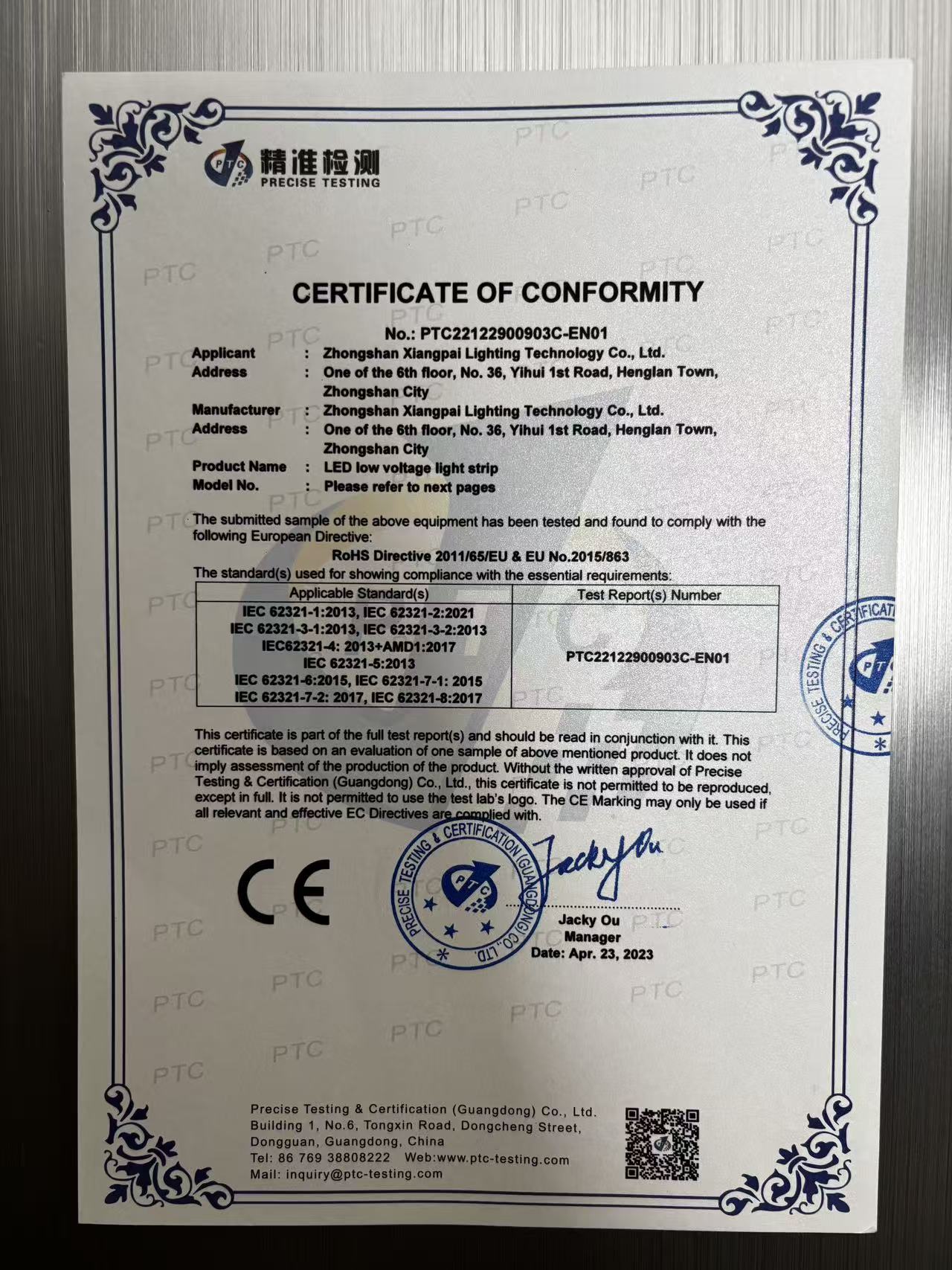
For EU-facing projects, confirm that the model series is covered by the manufacturer’s CE and RoHS certification. In the XPUP certification records, the CE certificates issued by PTC TESTING cover the low-voltage and high-voltage LED light strip series and list both the CA-DC24V-2835-180D-8mm-3000K and the XP-D5DC24V-3535-120D-8MM within the related product scope. The EU market documentation includes LVD and EMC components, with RoHS compliance verified under the IEC 62321 standard series.
Step 6: Plan the procurement quantity and lead time
Wholesalers typically work against an MOQ and a production calendar. XPUP’s standard OEM/ODM threshold is 2,000 metres, with a typical production lead time of 18–22 days and monthly capacity of 3,000,000 metres. Every strip is tested before shipment; accepted commercial terms include FOB/CIF delivery with pre-shipment testing and a 30% deposit payment structure.
Use Cases: Where 2835 and 3535 Each Make Sense
Acoustic wall light lines in premium residential projects
The documented XPUP field work of a home-decoration distributor supplying Germany and Italy included both Acoustic Panel LED Strips and RGB LED Strip Lights for premium residential interiors. In that type of project, the acoustic wall can carry a fixed 3000K white line for architectural warmth, while RGB strips are reserved for a secondary accent area such as a media wall or a feature display.
Commercial and hospitality accent lighting
For cafés, boutique hotels, and retail chains, the 3535 RGB product supports multiple scenes in the same space. This model is listed for commercial lighting, hospitality lighting, and retail lighting, which makes it an attractive second line for distributors serving those industries.
Private-label supply for lighting brands
Both verified models are available through XPUP’s production and customisation system. OEM services cover voltage, logo, power, dimensions, PCB materials, hardware configuration, internal circuit, colour, factory specification, nameplate, and label. ODM services cover colour scheme, outer packaging, label, brand information, model name, and material details. For a lighting brand that wants to private-label a 2835 or 3535 strip, this is a direct source-manufacturer path.
SMD 2835 vs SMD 3535: Side-by-Side Comparison Table
| Parameter | SMD 2835 Acoustic Wall Strip | SMD 3535 Multi-Color Strip |
|---|---|---|
| XPUP model | CA-DC24V-2835-180D-8mm-3000K | XP-D5DC24V-3535-120D-8MM |
| SMD package | 2835 | 3535 |
| Typical output | Fixed warm white | RGB colour |
| Colour temperature | 3000K | RGB |
| LED density | 180 LEDs/m | 120 LEDs/m |
| Power | 11W/m | 8W/m |
| Voltage | 24V DC | 24V DC |
| CRI | Ra≥80 | Not specified in verified model data |
| PCB width | 8mm | 8mm |
| PCB material | Double-layer copper PCB | Double-layer copper PCB |
| IP rating | IP20 | IP20 |
| Strip length | 2.4m and 3m per strip | Not specified in verified model data |
| Documented application | Acoustic panel lighting, luxury residential lighting, wall lighting, lighting design, interior fit-out, LED wholesalers | Commercial lighting, hospitality lighting, retail lighting |
| Customisation | OEM and ODM available | Available through XPUP OEM/ODM system |
FAQ
Which SMD strip should I use for acoustic panel wall lighting: 2835 or 3535?
If the objective is a continuous, warm-white architectural light line with minimal visible LED points, use the SMD 2835 acoustic wall strip CA-DC24V-2835-180D-8mm-3000K. It is rated 24V, 11W/m, 3000K, and 180 LEDs/m on an 8mm double-layer copper PCB, and it is documented for acoustic panel lighting and wall lighting. If the objective is dynamic RGB colour scenes in a commercial, hospitality, or retail accent area, use the SMD 3535 multi-color strip XP-D5DC24V-3535-120D-8MM, rated 24V and 120 LEDs/m.
Can I customise a 2835 or 3535 acoustic panel LED strip for an OEM or ODM project?
Yes. XPUP operates as a source manufacturer with OEM and ODM production. OEM customisation can cover voltage, logo, power, dimensions, PCB materials, hardware configuration, internal circuit, colour, factory specification, nameplate, and label. ODM customisation can cover colour scheme, outer packaging, label, brand information, model name, and material details. Typical custom production starts at 2,000 metres, with 18–22 days lead time and a monthly capacity of 3,000,000 metres.
Are the 2835 and 3535 models CE and RoHS compliant for EU projects?
The XPUP LED strip series is covered by CE and RoHS certification issued by PTC TESTING for low-voltage and high-voltage LED light strips. The CA-DC24V-2835-180D-8mm-3000K and XP-D5DC24V-3535-120D-8MM models are listed within the related product scope of the certification records. The CE documents include LVD and EMC components, while RoHS verification follows the IEC 62321 standard series.
What MOQ and lead time apply when ordering acoustic-panel SMD strips as a wholesaler?
The standard MOQ is 2,000 metres. Typical production lead time is 18–22 days, and monthly capacity is 3,000,000 metres. Quality control includes 100% testing before shipment, with delivery under FOB/CIF and a 30% deposit payment model. A sales engineer can confirm the exact schedule during sample and quotation discussion.
Need samples or a custom 2835 / 3535 programme?
Wholesalers and lighting designers are welcome to compare both models against their panel geometry and target colour effect. The 2026 XPUP LED Strip Catalog includes the verified product family and ordering information. For project-specific questions, contact Gabin at sales001@xpupled.com or WhatsApp +86 189 8858 4085.
Conclusion
For an acoustic panel lighting programme, the chipset decision is more than a component preference. The SMD 2835 high-density strip at 180 LEDs/m is engineered for the uniform, warm-white light lines used in acoustic panel installations and architectural wall details. The SMD 3535 multi-color strip at 120 LEDs/m brings RGB flexibility to commercial, hospitality, and retail spaces.
When you evaluate suppliers, keep the model-level specification in front of you: voltage, density, wattage, colour, PCB construction, IP rating, and the available OEM/ODM support. XPUP documents both configurations clearly, exports to the EU, Asia, and the US, and evaluates every strip before shipment. Start with a sample run; then scale the configuration that fits your panel design and your stock strategy.