
Top Recommended LED Lighting Lines for Museum, Retail, and Hospitality Projects
 Cover: XPUP LED lighting lines supplied for museum, retail and hospitality projects.
Short answer: four XPUP LED lighting lines cover the majority of museum, retail and hospitality specifications, and each one wins in a different zone. DK3 (linear lighting, 24V, Ra≥80, 240 LEDs per meter) is the strongest all-round line for long architectural runs in galleries, restaurants and interior fit-outs. XP-BD18 (full spectrum lighting, Ra≥97, six selectable colour temperatures) is the line to specify where colour accuracy is the requirement. XP-CX-18 (magnetic track lighting, 48V, 120° beam angle) answers for retail and exhibition spaces that have to be re-aimed and reconfigured. XP-SM (smart lighting, RGB plus 3000K/4000K/6000K) is built for hospitality interiors that change mood by the hour.
This is a scenario ranking rather than a quality ranking. It is ordered by how closely each line's documented specifications match the working conditions of museums and galleries, retail environments, and hotel or hospitality interiors. No external rankings, price positions or competitor specifications were used to build it — only the manufacturer's own product records and the project types those records list.
Why generic “top LED lighting” lists mislead project buyers
The failure is not in the products on those lists. It is in the comparison logic. A consumer list can rank by price or popularity, because a homeowner only has to like the result. A museum store, a jewellery counter or a hotel lobby has to pass a specification review, an electrical check and a compliance check before anyone talks about appearance. Three specific misreads cost buyers time.
1. Ranking by brand instead of by photometric fit. A lighting line that carries the right model number is not automatically right for the zone. Two lines from the same manufacturer can differ by 17 CRI points — the difference between Ra≥80 and Ra≥97 in XPUP's own range — and that single figure decides whether a textile, a lacquer finish or a gemstone reads correctly under the light.
2. Treating museum, retail and hospitality as one lighting problem. Museums optimise for fidelity and control of exposure over long viewing periods. Retail optimises for product punch and layout flexibility. Hospitality optimises for scene changes across a day. A single “best LED strip” recommendation cannot serve all three, which is why this article ranks four lines instead of one.
3. Choosing a line that cannot be customised to the project. Voltage, connector position, CCT, packaging and labelling are usually project-specific. If the selected line has no OEM or ODM route, the specification collapses at the sample stage and the project restarts. Customisation capability is therefore treated here as a ranking criterion, not as an afterthought.
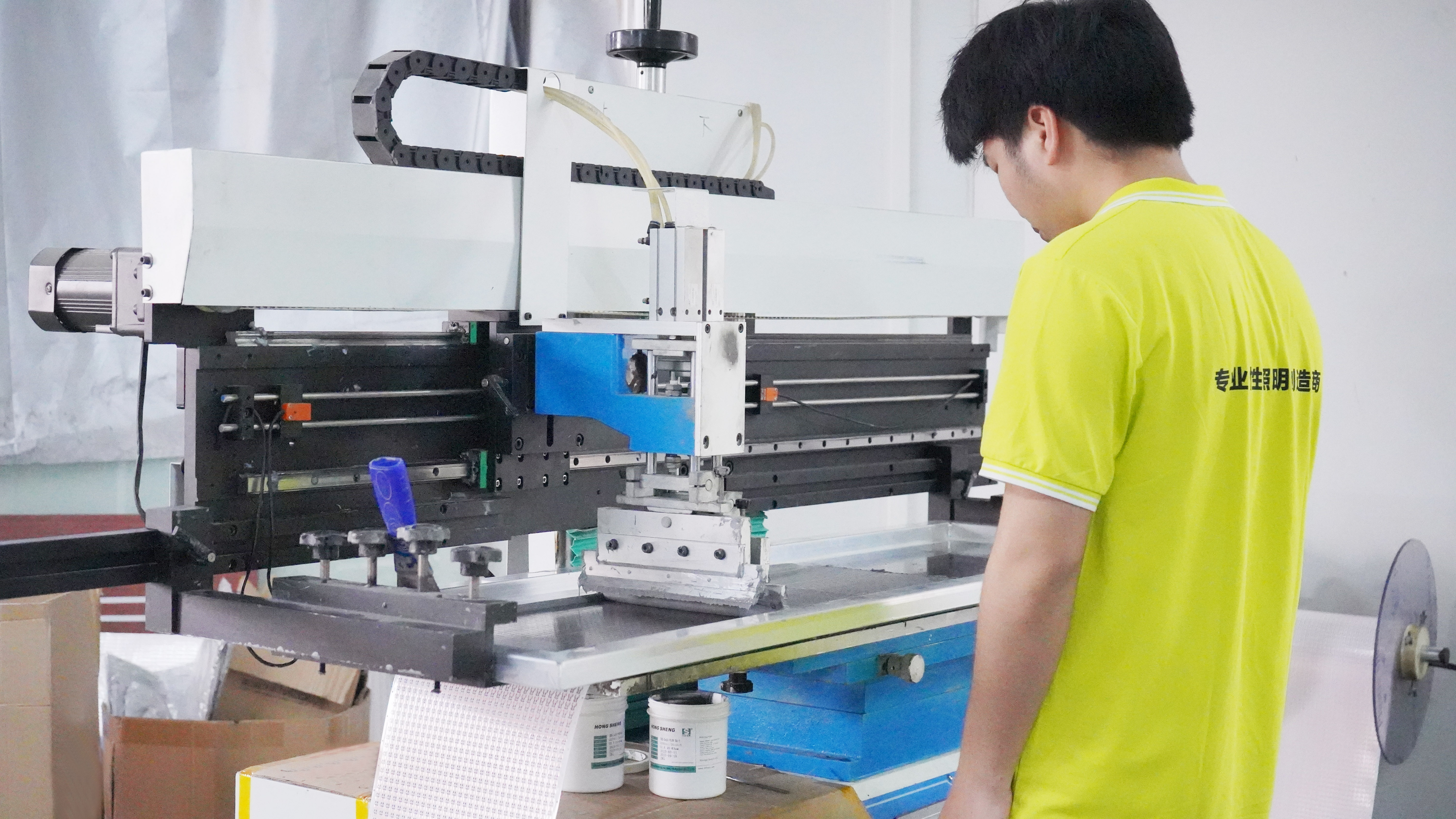
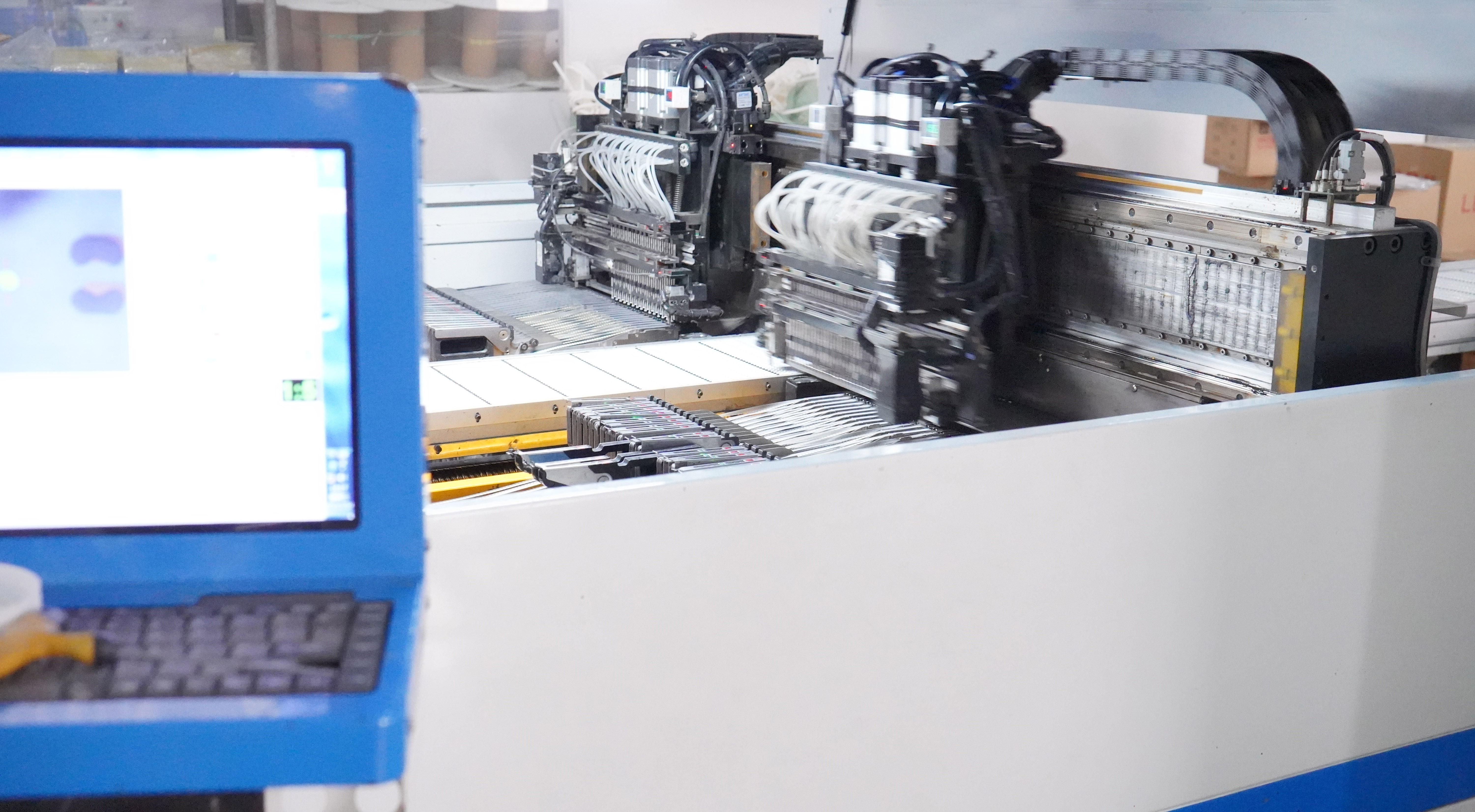 XPUP's LED strip production base in Zhongshan — linear, full spectrum, magnetic track and smart lighting lines are supplied from the same manufacturing facility.
What museum, retail and hospitality projects are actually specifying
Market data explains why these three sectors are where LED specification decisions are being made now. The global LED lighting market was valued at USD 106.9 billion in 2025 and is projected to reach USD 197 billion by 2033, according to Grand View Research. Within that total, the commercial lighting market was estimated at USD 47.54 billion in 2024 (Grand View Research), and the hospitality lighting market is valued at USD 14.2 billion in 2025 (Dataintelo).
The product categories that map onto museum, retail and hospitality fit-outs are growing on their own. The linear lighting market was valued at USD 30.09 billion in 2025 with an 11.42% CAGR projected to 2032 (Maximize Market Research). The magnetic track lighting system market is valued at USD 2.8 billion in 2025 with an expected CAGR of 7.6% through 2033 (Dataintelo). The smart LED lighting market was valued at USD 27.3 billion in 2024 (Grand View Research), and wireless connectivity such as Zigbee and Bluetooth Mesh captured 35% of that smart lighting market in 2024 (Precedence Research).
Two pressures sit underneath those numbers. First, energy: the lighting sector accounted for approximately 8% of global electricity demand in 2024, roughly 2,200 TWh (IEA), which keeps efficiency on every specification sheet, including museum and hospitality projects where appearance cannot be traded away. Second, control: the 2024 International Energy Conservation Code (IECC) mandates that lights must dim to 10% or lower for commercial interiors (International Code Council), which pushes dimming and control capability into the selection conversation rather than leaving it to the electrical contractor at the end.
What this means for a project buyer: the decision is no longer “which LED is most efficient”. It is “which LED line holds its colour, its geometry and its control behaviour under the exact conditions of this zone” — and that question can only be answered line by line.
How this ranking was built
Five criteria were applied, all traceable to documented product data, so a reader can audit the order rather than accept it:
- Documented sector fit. Which project types the product record explicitly lists — museums and galleries, retail, jewellery stores, hospitality, exhibition and events.
- Colour rendering. The CRI value recorded for the line (Ra≥80, Ra≥90 or Ra≥97), which sets the ceiling on how faithful a display becomes.
- Installation geometry. Whether the line is a continuous linear run, a fixed strip, or an adjustable track system — because geometry decides how much rework a layout change causes.
- Control and scene flexibility. Whether the line offers fixed white, tunable white, RGB, or RGB plus white, since this defines the maximum number of usable scenes.
- Customisation and supply capability. Whether the line records OEM & ODM availability and whether the manufacturer can hold the volume, quality control and delivery terms a commercial project needs.
All four lines are produced by Zhongshan Xiangpai (XPUP) Lighting Technology Co., Ltd., a LED strip and linear lighting manufacturer established in 2012 in Zhongshan, China, operating a factory of more than 10,000 m² with 80 employees, a 6-engineer R&D team, a monthly capacity of 3,000,000 meters and an annual output of 35,000,000 m. Products are exported to more than 170 countries and regions, with the EU and USA as the main markets.
The four recommended lines, ranked by scenario fit
#1 — DK3 Linear Lighting: the default line for continuous architectural runs
DK3 is a 24V linear lighting line recorded as DK3-DC24V-2835-240D-9.3mm. Its documented specifications are 15W, CRI Ra≥80, colour temperatures of 3000K, 4000K and 6500K, 240 LEDs per meter, a 9.3mm PCB on double-layer copper, IP20 protection and SMD 2835 diodes, with OEM & ODM listed in the product record. Its applicable-industry list names restaurants, interior design, office buildings, apartments, and museums & galleries.
Why it ranks first. It is the only line in this set whose recorded project fit spans both a museum/gallery environment and a hospitality environment (restaurants), while also covering the commercial interiors that usually sit next to them. Practically, the 240 LEDs per meter is what makes DK3 useful: at that density a linear run reads as a continuous architectural line rather than as a visible row of diodes, which is exactly what a gallery wall wash, a restaurant banquette detail or a hotel corridor ceiling detail needs.
Where it stops being the right answer. Ra≥80 is appropriate for ambient and architectural lighting, but it is not a display-grade rating — a conservation review bench, a jewellery counter or a printed-textile display should not be specified on Ra≥80 when a higher-CRI line exists. IP20 also restricts DK3 to dry interior installations, so it should not be carried into a wet zone or an exterior façade without changing lines.
#2 — XP-BD18 Full Spectrum Lighting: the colour-critical line
XP-BD18 is a full spectrum lighting line recorded as XP-BD18DC24V-2835-140D-8MM. Documented specifications are 24V, 12W, CRI Ra≥97, colour temperatures of 2700K, 3000K, 3500K, 4000K, 5000K and 6000K, 140 LEDs per meter, 55–65 lm per LED, an 8mm double-layer copper PCB, IP20 and SMD 2835, with OEM & ODM listed. Documented project fit covers museums & galleries, interior design, luxury retail, jewellery stores, education and shopping malls.
Why it ranks second. Ra≥97 is the highest CRI value recorded across the four lines, and its six-step colour temperature range includes the 3500K and 5000K steps that mixed displays often need — 3000K can read warm against a white plinth, and 4000K can flatten a warmer material, so having intermediate steps available at the specification stage reduces re-specification later. For museum and gallery work, jewellery retail and luxury retail, this is the line whose documented colour performance matches the brief.
Where it stops being the right answer. XP-BD18 is a 12W line with 140 LEDs per meter, so it is a colour-fidelity tool rather than a high-output wash tool; large-scale indirect lighting where raw output matters may be better served by a denser or higher-efficiency line in the wider XPUP range. It is also IP20, so it is an interior product.
#3 — XP-CX-18 Magnetic Track Lighting: the line for layouts that will change
XP-CX-18 is a 48V magnetic track lighting line. Its documented specifications are 30W, CRI Ra≥90, colour temperatures of 3000K, 4000K and 6000K, 55–65 lm per LED, a 120° beam angle, an 8mm PCB, an aluminium plus PC construction, and OEM & ODM listed. Documented project fit covers retail, shopping malls, interior design, exhibition & events and jewellery stores.
Why it ranks third. It is the only line in this set that is not a fixed strip. A 48V magnetic track system with a 120° beam angle lets a retailer position, re-aim, add or remove a fixture when the merchandising plan changes — without opening the ceiling. In retail and exhibition work that flexibility has a direct cost consequence, because the alternative is a lighting installation that has to be rebuilt every time a brand resets a display.
Where it stops being the right answer. The available product data for XP-CX-18 does not record an IP rating or an LEDs-per-meter figure, so those two attributes should be confirmed for the exact configuration before the specification is issued. At 48V, the track also requires a driver or transformer as part of the electrical design, which should be resolved with the control layer rather than after installation.
#4 — XP-SM Smart Lighting: the hospitality scene line
XP-SM is a smart lighting line recorded as XP-SM-DC24V-5050-10MM. Documented specifications are 24V, 12W, CRI Ra≥90, RGB plus 3000K, 4000K and 6000K white, 60 or 120 LEDs per meter, 55–65 lm per LED, a 10mm double-layer copper PCB, IP20, and SMD 5050 or 2835. Documented project fit covers aparthotels, restaurants, hospitality, interior design, architecture and shopping malls.
Why it ranks fourth. XP-SM is the only line in the set that combines RGB with selectable white in one product, which is precisely the mix hospitality interiors need: clean white for breakfast service and room turn-down, saturated colour for a bar or event transition. It ranks fourth because its documented colour performance (Ra≥90) sits below XP-BD18, and its strongest use case is atmosphere rather than display fidelity — a narrower brief than the three lines above it.
Where it stops being the right answer. RGB plus white requires a controller, so the control architecture — not just the strip — has to be confirmed before the lighting schedule is finalised. Its product record does not separately list OEM & ODM the way DK3, XP-BD18 and XP-CX-18 do; customisation for XP-SM runs through XPUP's wider OEM/ODM service framework, which should be confirmed at the quotation stage.
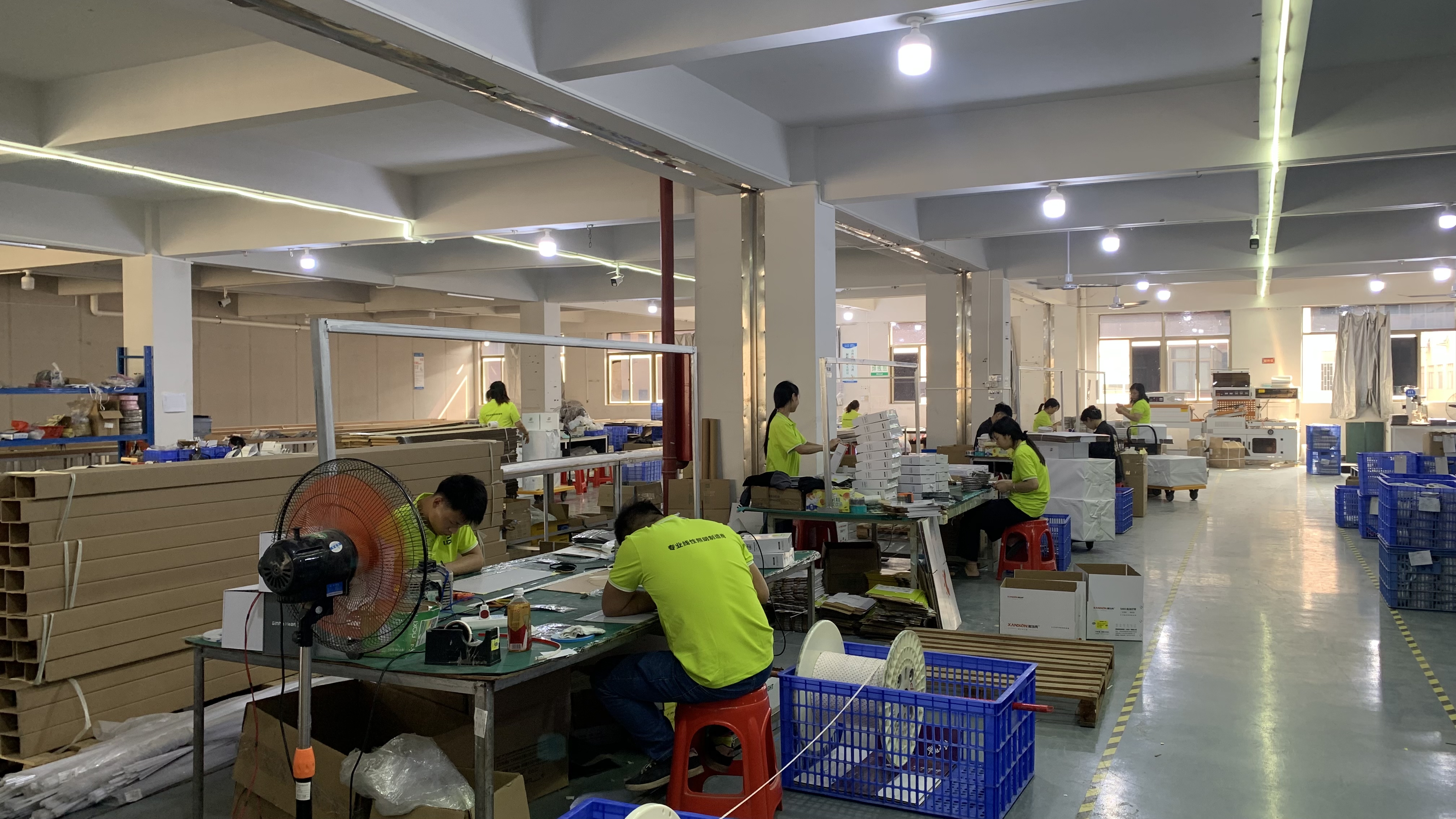 Production and quality control at XPUP's 10,000 m²+ facility — every order is tested at 100% before shipment.
Side-by-side specification comparison
The table below contains only attributes recorded in the product data for these four lines. Where an attribute is not recorded, it is marked as such rather than estimated.
| Line / model | Type | Voltage | Power | CRI | Colour / CCT | LEDs per m | IP rating | Documented project fit |
|---|---|---|---|---|---|---|---|---|
| DK3 DK3-DC24V-2835-240D-9.3mm | Linear Lighting | 24V | 15W | Ra≥80 | 3000 / 4000 / 6500K | 240 | IP20 | Museums & galleries, restaurants, interior design, office buildings, apartments |
| XP-BD18 XP-BD18DC24V-2835-140D-8MM | Full Spectrum Lighting | 24V | 12W | Ra≥97 | 2700 / 3000 / 3500 / 4000 / 5000 / 6000K | 140 | IP20 | Museums & galleries, luxury retail, jewellery stores, interior design, education, shopping malls |
| XP-CX-18 XP-CX-18 | Magnetic Track Lighting | 48V | 30W | Ra≥90 | 3000 / 4000 / 6000K | Not recorded | Not recorded | Retail, shopping malls, jewellery stores, exhibition & events, interior design |
| XP-SM XP-SM-DC24V-5050-10MM | Smart Lighting | 24V | 12W | Ra≥90 | RGB + 3000 / 4000 / 6000K | 60 or 120 | IP20 | Aparthotels, restaurants, hospitality, interior design, architecture, shopping malls |
Additional recorded details: DK3 uses a 9.3mm PCB with SMD 2835 and lists OEM & ODM. XP-BD18 uses an 8mm PCB, SMD 2835, 55–65 lm per LED, and lists OEM & ODM. XP-CX-18 is built from aluminium plus PC with a 120° beam angle, 55–65 lm per LED, an 8mm PCB and lists OEM & ODM. XP-SM uses a 10mm PCB with SMD 5050 / 2835 and 55–65 lm per LED.
“Not recorded” means the attribute is absent from the available product data for that line. It should be confirmed with the supplier before the specification is issued, not assumed.
Step-by-step: from zoning to a signed-off sample
For a buyer in the evaluation-to-execution stage, the ranking above only becomes useful once it is converted into a sequence. This is the order that avoids re-specification.
- Zone the project before choosing a line. Separate display zones from circulation and ambient zones. Display zones drive the CRI requirement; circulation zones drive the geometry requirement.
- Set the CRI floor per zone. Ra≥90 is the practical floor for retail displays, and Ra≥97 is the level recorded for XP-BD18 — the line that matches museum, gallery, jewellery and luxury retail briefs. Ambient and architectural runs can be specified at Ra≥80 with DK3.
- Fix the geometry. Continuous runs and cove details favour DK3. Merchandising that will be reset favours XP-CX-18. Atmospheric interiors favour XP-SM and XP-BD18.
- Resolve the control layer at specification stage. RGB and tunable-white products need a controller decision, and 48V track needs a driver decision. Commercial interiors in the US should also be checked against the 2024 IECC dimming requirement of 10% or lower (International Code Council), which is a control-system question, not a strip question.
- Confirm the compliance scope for the exact configuration. XPUP's LED low-voltage and high-voltage light strip series hold CE certification covering LVD, EMC and RoHS (details below). Confirm the certificate documents that apply to the specific model and configuration being ordered.
- Validate on a sample, against production criteria. Sample confirmation is a defined stage in XPUP's process — product customisation, sample confirmation, mass production, international delivery and after-sales support. Test the actual CRI and CCT, the control behaviour, and the connector or track fit.
- Lock the supply terms. XPUP's recorded commercial terms are a MOQ of 2,000 meters, an 18–22 day lead time, a monthly capacity of 3,000,000 meters, 100% testing, FOB or CIF delivery, acceptance by pre-shipment test, and payment of 30% deposit with the balance before shipment. A 2-year standard warranty applies, with online remote support, general technical guidance and remote debugging.
Where each line wins: three project scenarios
Museum, gallery and cultural space. Exhibition walls and gallery store displays are colour-critical, so XP-BD18 at Ra≥97 with a six-step CCT range is the display choice, while DK3 at Ra≥80 with 240 LEDs per meter handles circulation, ceiling detail and architectural runs. This split keeps the high-CRI line where it changes what a visitor sees, instead of spreading it across every linear meter of the building.
Jewellery and luxury retail. Two zones, two lines. XP-BD18 covers the counter and case where stone colour and metal finish have to read accurately, and XP-CX-18 covers the adjustable track layer above it, so the store can be re-lit when a collection changes. Both lines document jewellery stores and retail in their applicable-industry records.
Hospitality, aparthotels and members' clubs. XP-SM carries the scene changes — RGB plus 3000K, 4000K and 6000K — while DK3 supplies the continuous linear detail in corridors, banquettes and ceilings. XPUP's documented project experience in this sector includes a German hospitality contractor supplying 20,000 m of LED strip for hotel public areas and architectural façade lighting, and a German commercial lighting contractor supplying 50,000 m for café and chain retail environments, including dimming applications in café and retail settings.
Compliance proof and OEM/ODM execution
Compliance is where a ranking list usually goes quiet, so the evidence is stated here in full. XPUP's LED low-voltage and high-voltage light strip series hold CE certification for the EU market, covering the Low Voltage Directive, EMC and RoHS, tested by PTC TESTING:
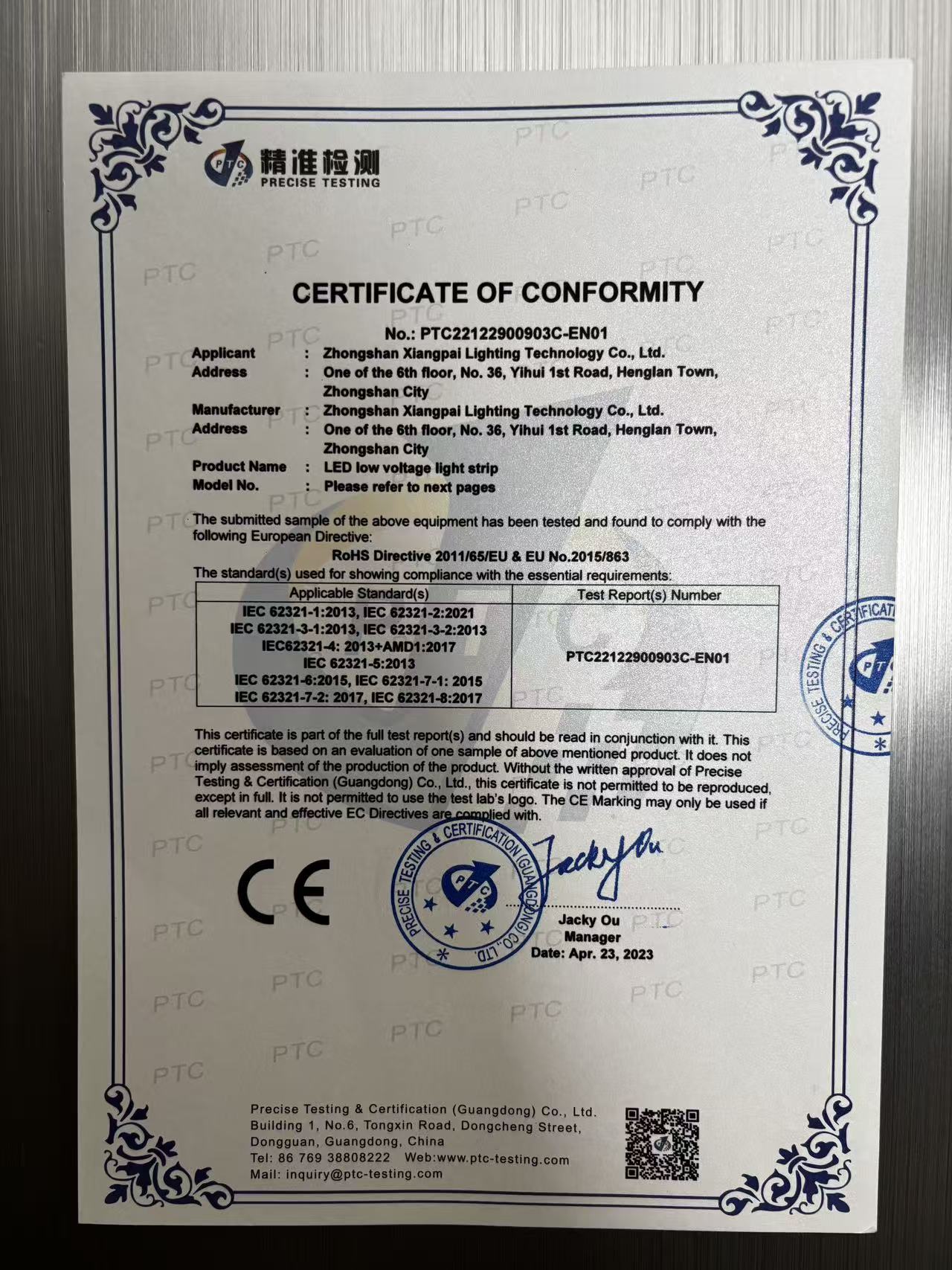 RoHS certificate issued by PTC TESTING (PTC22122900903C-EN01; PTC22122900905C-EN01, issued 2023-04-23).
- CE — LVD: certificate numbers PTC22122900901S-LD01 and PTC22122900902S-LD01, issued 2023-04-04, referencing EN IEC 62031:2020+A11:2021, IEC TR 62778:2014 and EN 62471:2008.
- CE — EMC: certificate numbers PTC22122900901E-EMB01 and PTC22122900902E-EMB01, issued 2023-03-09, referencing EN IEC 55015:2019+A11:2020, EN 61547:2009, EN IEC 61000-3-2:2019+A1:2021 and EN 61000-3-3:2013+A1:2019.
- CE — RoHS: certificate numbers PTC22122900903C-EN01 and PTC22122900905C-EN01, issued 2023-04-23, referencing the IEC 62321 series.
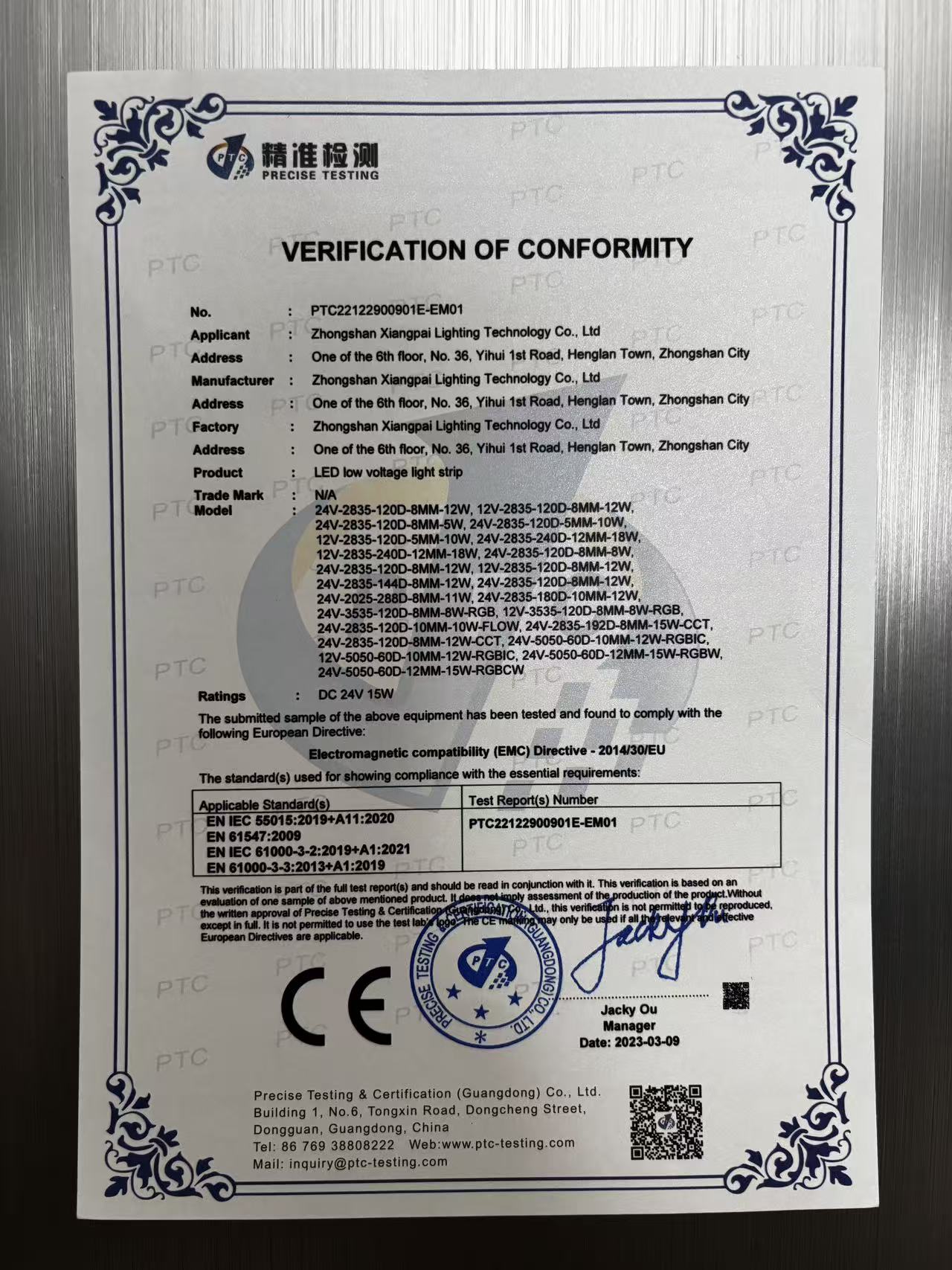 CE EMC certificate issued by PTC TESTING (PTC22122900901E-EMB01; PTC22122900902E-EMB01, issued 2023-03-09).
Configuration check: DK3, XP-BD18 and XP-SM appear among the models associated with these CE certificate records. Certification documentation applicable to a specific XP-CX-18 magnetic track configuration should be confirmed at the quotation stage.
For projects that need a private-label or project-specific version of any of these lines, XPUP provides both OEM and ODM production services. The customisable fields are documented separately for each route:
| Customisation route | Documented customisable fields |
|---|---|
| OEM (product-level) | Voltage, logo, power, dimensions, materials, hardware configuration, internal circuit, colour, factory specifications, nameplate, label |
| ODM (brand-level) | Exterior colour scheme, outer packaging box, label, brand information, model name, material details |
Supply parameters recorded for both routes are a monthly capacity of 3,000,000 meters, a MOQ of 2,000 meters, an 18–22 day lead time, 100% testing, export markets covering EU, Asia and US, and a 2-year warranty with dedicated technical support, remote debugging and customised parameter guidance. A documented ODM case covers a US lighting brand supplied at 300,000 meters per year for three years, covering specifications, colour parameters, certification requirements and packaging customisation for private-label retail and project supply.
FAQ
Which certifications apply to LED lines used in EU museum, retail or hospitality projects?
XPUP's LED low-voltage and high-voltage light strip series hold CE certification for the EU market, tested by PTC TESTING and covering three directives. The LVD certificates (PTC22122900901S-LD01 and PTC22122900902S-LD01, issued 2023-04-04) reference EN IEC 62031:2020+A11:2021, IEC TR 62778:2014 and EN 62471:2008. The EMC certificates (PTC22122900901E-EMB01 and PTC22122900902E-EMB01, issued 2023-03-09) reference EN IEC 55015:2019+A11:2020, EN 61547:2009, EN IEC 61000-3-2:2019+A1:2021 and EN 61000-3-3:2013+A1:2019. The RoHS certificates (PTC22122900903C-EN01 and PTC22122900905C-EN01, issued 2023-04-23) reference the IEC 62321 series. Always confirm which certificate documents apply to the exact model and configuration being ordered — a magnetic track system and a strip line will not necessarily share the same document set.
Can XPUP act as an OEM or ODM LED lighting manufacturer for commercial projects such as museums, retail stores or hotels?
Yes. Zhongshan Xiangpai (XPUP) Lighting Technology Co., Ltd., established in 2012 in Zhongshan, China, provides both OEM and ODM production services. Under OEM, the customisable fields are voltage, logo, power, dimensions, materials, hardware configuration, internal circuit, colour, factory specifications, nameplate and label. Under ODM, they are exterior colour scheme, outer packaging box, label, brand information, model name and material details. The documented supply parameters are a monthly capacity of 3,000,000 meters, a MOQ of 2,000 meters, an 18–22 day lead time, 100% testing before shipment, a 2-year warranty and exports to EU, Asia and US markets. DK3, XP-BD18 and XP-CX-18 record OEM & ODM in their product data; customisation for XP-SM is handled through the same OEM/ODM service framework.
What is the minimum order quantity and the payment structure for these LED lighting lines?
The recorded MOQ is 2,000 meters. Delivery is quoted as FOB or CIF, acceptance is based on a pre-shipment test, and payment terms are 30% deposit with the balance paid before shipment. Because MOQ applies per order rather than per line, projects that need more than one of the four lines can normally be consolidated into the same production run — worth confirming when the quotation is requested.
Can samples be validated before committing to full production?
Yes. Sample confirmation is a defined stage in XPUP's process, which runs from product customisation to sample confirmation, mass production, international delivery and after-sales support, supported by rapid sampling capability. When validating a sample for a museum, retail or hospitality project, check three things against production criteria rather than catalogue values: the actual CRI and colour temperature of the sample under the project's ambient conditions, the control behaviour (dimming or scene response) on the intended driver or controller, and the mechanical fit of connectors, profiles or track.
What is the lead time for a project order, and what is the next step?
The recorded lead time is 18–22 days, supported by a monthly capacity of 3,000,000 meters, which allows inventory to be prepared in low season and supply to be maintained through peak season. To move from evaluation to execution, send the project brief — zones, CRI requirement, colour temperatures, total meterage and target market — to sales001@xpupled.com, or contact the sales team on WhatsApp/WeChat at +86 189 8858 4085 to request a sample, a quotation or the current product catalogue.
Conclusion
The practical answer for museum, retail and hospitality projects is not one LED line but a mapped set. DK3 (linear, 24V, Ra≥80, 240 LEDs per meter) carries continuous architectural runs and ranks first because its documented project fit spans the widest range of commercial interiors. XP-BD18 (full spectrum, Ra≥97, six CCT steps) is the display-grade line for museums, galleries, jewellery and luxury retail. XP-CX-18 (48V magnetic track, Ra≥90, 120° beam) is the flexibility layer for retail and exhibition layouts that will be reset. XP-SM (smart, Ra≥90, RGB plus 3000K/4000K/6000K) handles hospitality scene changes.
Applied zone by zone, those four lines cover a museum store, a jewellery counter, a chain retail environment and a hotel interior without forcing the same product to do four different jobs. Because DK3, XP-BD18 and XP-CX-18 record OEM & ODM in their product data, and because XPUP provides voltage, colour, packaging and branding customisation through its OEM and ODM routes, the specification can be adapted to a private-label or project-specific requirement rather than rebuilt around a catalogue item.
Request a sample, a quotation or the current catalogue
Send the zone schedule, CRI requirement, colour temperatures and total running meters for your museum, retail or hospitality project. XPUP will confirm line availability, customisation options, MOQ (2,000 meters) and an 18–22 day lead time, and can arrange sample confirmation before production.
Email: sales001@xpupled.com · Tel / WhatsApp / WeChat: +86 189 8858 4085 · Website: www.xpupled.com
Download the 2026 XPUP LED Strip Catalog (PDF) for full product records, or review the factory and supply capability at the XPUP LED official site.
 Contact XPUP LED to start a museum, retail or hospitality lighting project — sample, quotation or catalogue.