
What Is Full Spectrum LED Lighting? A Beginner’s Guide to Chips, CRI, and Color Temperature
Full spectrum LED lighting is LED light that is built to render the visible colour spectrum more continuously than a standard white LED, so the surfaces it illuminates keep more of their natural colour instead of flattening toward grey. Whether a product earns that description is decided by three measurable specifications: the LED chip and how densely it is mounted on the board, the colour rendering index (CRI), and the range of colour temperatures the product is available in.
Most buyers meet the phrase “full spectrum” while researching display, gallery or premium interior lighting, at the point where a supplier shortlist exists but the specification is still vague. This guide explains the vocabulary from the ground up and then anchors each concept to a real product: the XP-BD18DC24V-2835-140D-8MM, a full spectrum LED strip from XPUP LED, with the DK3-DC24V-2835-240D-9.3mm linear strip from the same range used to show what chip density and PCB width change in practice.
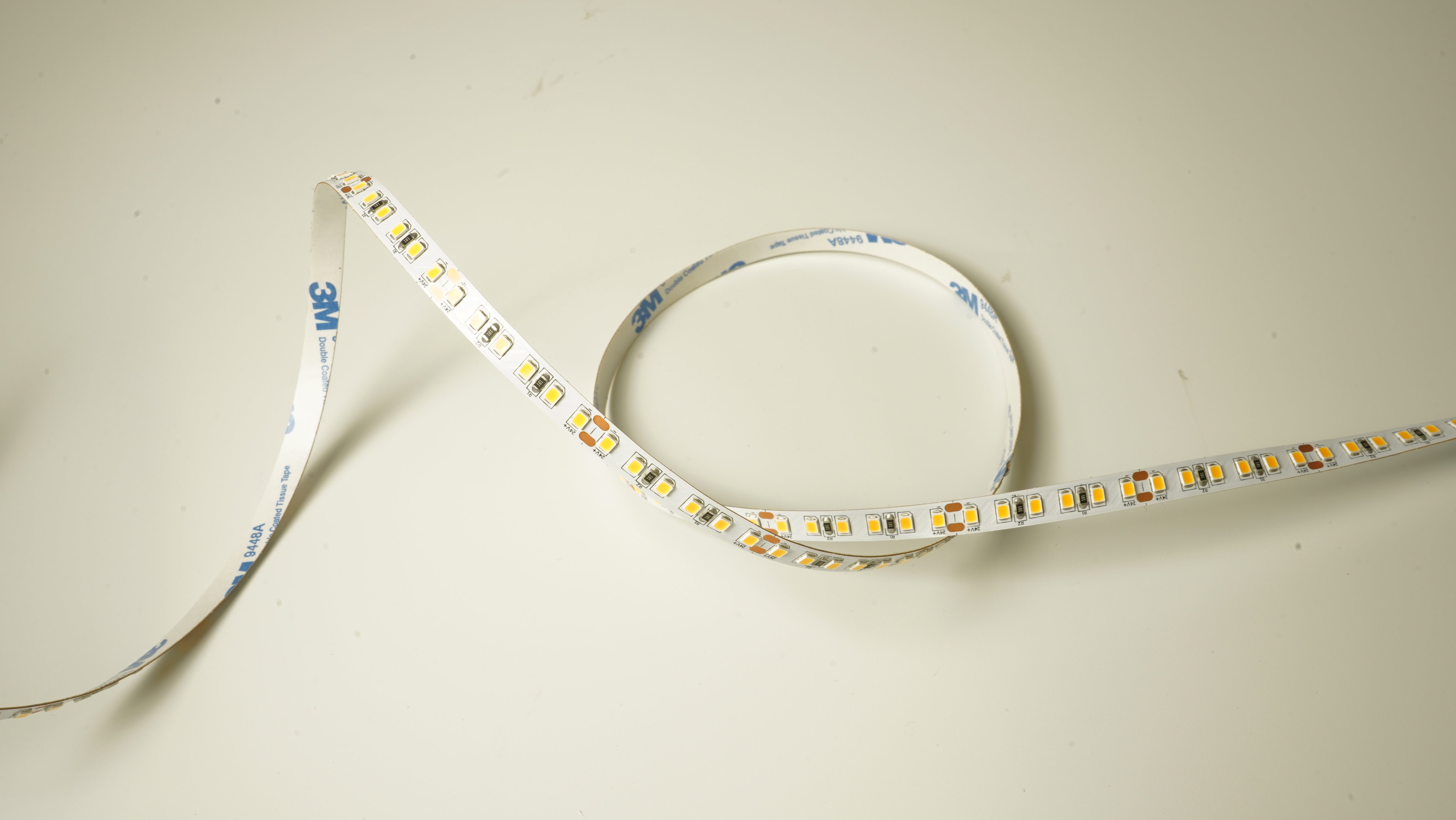
XP-BD18DC24V-2835-140D-8MM, the full spectrum linear strip used as the case study throughout this guide. Image: XPUP LED.
Why “Full Spectrum” Is Hard to Judge From a Product Listing
Three practical problems sit behind the label. First, full spectrum is a descriptive industry term rather than a single pass-or-fail mark printed on a datasheet, so two products using the same words can behave differently in the same room. Second, the evidence that would settle the question — a spectral power distribution curve — is seldom part of a trade listing, which leaves buyers comparing a small set of numbers instead.
Third, those numbers trade against each other. Raising colour rendering normally costs luminous output, and pushing either value moves the cost of the chip set. That is the real decision facing a specifier: not “is this full spectrum?” but “which combination of chip, CRI and colour temperature does my scene need, and what am I giving up to get it?”
A fourth problem is physical. Linear strip has to seat inside an aluminium profile or a display-cabinet channel, and a wider board simply will not fit a channel cut for a narrower one. Chip density and PCB width are therefore not abstract quality markers; they decide which installations are possible at all.
Industry Background: Why Colour Quality Moved Up the Agenda
Lighting accounted for roughly 8% of global electricity demand in 2024, around 2,200 TWh, according to the International Energy Agency. That scale explains why efficiency dominated the first decade of LED adoption, and why colour quality is the newer differentiator: once most fixtures are already efficient, what separates suppliers is how the light looks on the surface.
The market has room for that shift. Grand View Research valued the global LED lighting market at USD 106.9 billion in 2025 and projects USD 197 billion by 2033. Adoption is mainstream rather than early: the U.S. Energy Information Administration reported that 90% of U.S. households used LED bulbs for indoor lighting in 2024, and that residential LED penetration reached 63% of homes using mostly LEDs by early 2024, up from 4% in 2015.
Colour-focused segments are now tracked as markets in their own right. Research Nester valued the Human Centric Lighting market at USD 3.66 billion in 2024, projecting a 17.1% CAGR through 2036, while Mordor Intelligence placed Europe at a 37.4% share of that market in 2024, attributing it to strict workplace wellbeing rules. The linear format follows the same curve: Maximize Market Research valued the linear lighting market at USD 30.09 billion in 2025, with an 11.42% CAGR projected to 2032.
What Full Spectrum LED Lighting Means in Practice
A working definition: full spectrum LED lighting is light whose emission covers the visible range broadly enough that saturated colours — deep reds, skin tones, wood grain, gemstone tints — keep their identity under the fixture rather than shifting toward green or collapsing toward grey.
Because the spectrum curve itself is usually missing from the listing, the closest verifiable proxy is CRI, read together with the chip specification and the colour temperatures offered. CRI — shown on datasheets as Ra — scores how faithfully a light source reveals colour against a reference source on a 0–100 scale, where higher is better. It is a summary number rather than a description of the spectrum, but it is checkable, and it separates products that look identical in a photograph.
Case study: XP-BD18DC24V-2835-140D-8MM
XPUP LED, registered as Zhongshan Xiangpai(XPUP) Lighting Technology Co., Ltd, is a LED strip and linear lighting manufacturer established in 2012 in Zhongshan, China. The company exports to more than 170 countries and regions, with the EU and USA as its major markets. Its XP-BD18DC24V-2835-140D-8MM is classified as a full spectrum lighting product and is the reference point for the rest of this guide.
Technically it is a 24V, 12W linear strip using SMD 2835 LED chips at 140 LEDs per meter on an 8mm double-layer copper PCB, with a colour rendering index of Ra≥97 and 55 to 65 lumens per LED. Two details matter more than the headline numbers. The strip can be cut at each LED, so a cabinet run and a short display shelf can both be served from the same reel with predictable cut points. And it is offered in six colour temperatures — 2700K, 3000K, 3500K, 4000K, 5000K and 6000K — which is what makes one product usable across a museum case, a jewellery display and a retail wall inside the same project.
| Specification | XP-BD18DC24V-2835-140D-8MM |
|---|---|
| Product class | Full spectrum lighting (linear LED strip) |
| LED package | SMD 2835 |
| Chip density | 140 LEDs per meter |
| Colour rendering | CRI Ra≥97 |
| Colour temperatures | 2700K / 3000K / 3500K / 4000K / 5000K / 6000K |
| Luminous flux | 55–65 lumens per LED |
| Voltage and power | 24V DC, 12W |
| PCB | Double-layers copper, 8mm width |
| Ingress protection | IP20 |
| Cutting | Cuttable at each LED for various lengths |
| Customization | OEM and ODM supported |
| Intended applications | Museums and galleries, interior design, luxury retail, jewellery stores, education, shopping malls |
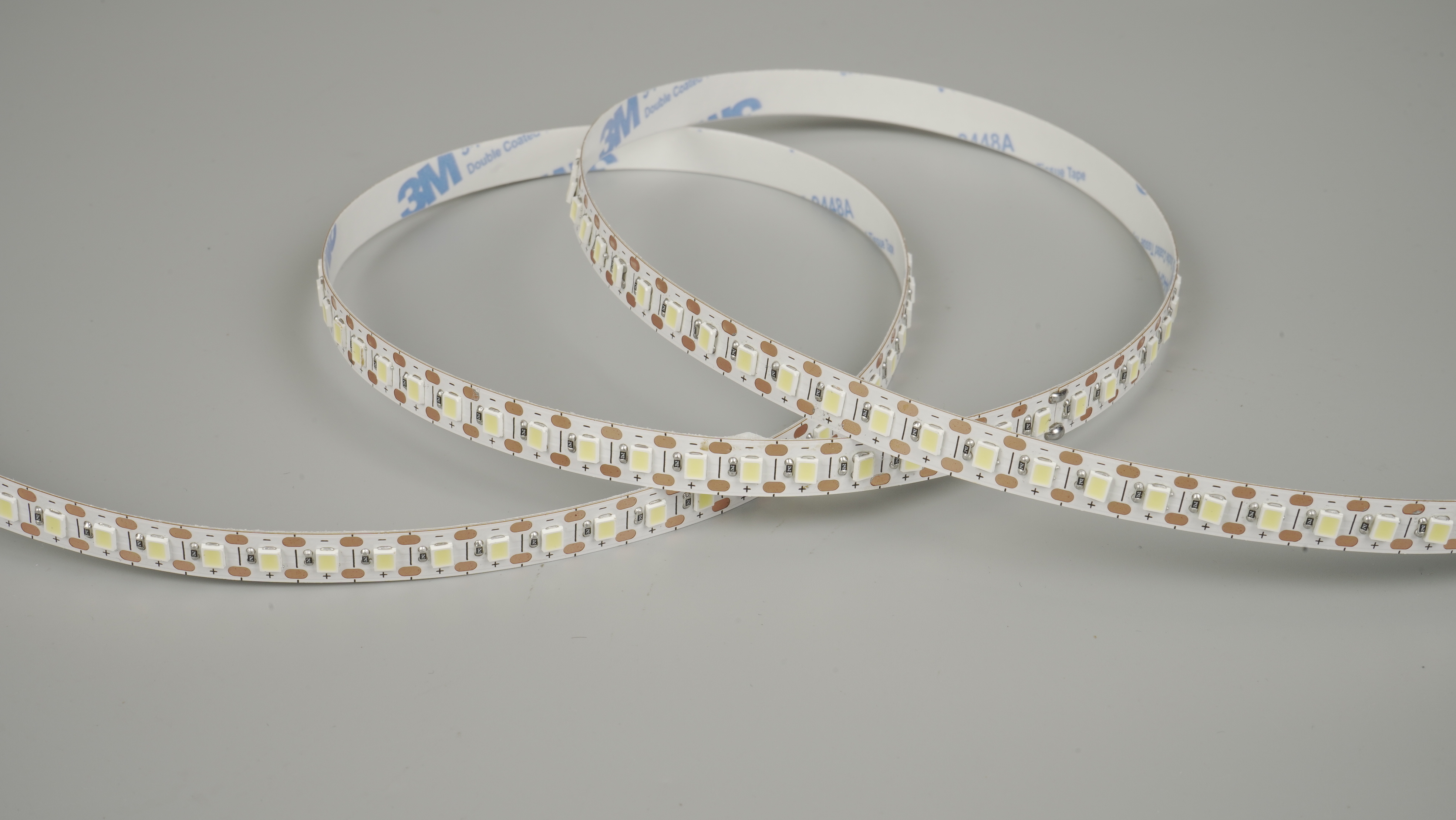
SMD 2835 chips on a double-layer copper PCB: the two structural facts a specifier can verify before sampling. Image: XPUP LED.
The Specifications That Decide the Result
1. The chip: what SMD 2835 and chip density actually mean
SMD 2835 is a surface-mount LED package widely used in linear strip because it balances output, footprint and cost. Both products discussed here use it: the XP-BD18DC24V-2835-140D-8MM at 140 LEDs per meter, and the DK3-DC24V-2835-240D-9.3mm at 240 LEDs per meter.
Density is the half of the chip story that changes what the eye sees. XPUP describes the DK3 as delivering high density, uniform light emission and no grainy appearance, which is why it is specified for indoor lighting strips and black profiles where individual diodes would otherwise read as visible dots along the run. The trade-off is straightforward: more chips per meter means a tighter light engine and a higher bill of materials, while lower density at a very high CRI puts the budget into colour quality instead. Neither is better in the abstract — the scene decides.
2. CRI: what Ra≥90 and Ra≥97 actually change
CRI steps up across the XPUP range, and the steps map onto application rather than marketing tiers. The DK3-DC24V-2835-240D-9.3mm sits at Ra≥80 for restaurants, office buildings, apartments and interior design. XP-SM-DC24V-5050-10MM sits at Ra≥90 in the smart lighting family for hospitality interiors and architectural surfaces. XP--BD14-DC24V-2835-144D-8MM sits at Ra≥95 with a wide beam angle, designed for display cabinets, resorts, boutique hotels and serviced apartments. The XP-BD18DC24V-2835-140D-8MM sits at Ra≥97.
Where the difference shows is in objects that carry colour as information. Two adjacent reds read as two reds rather than one; gold and brass stop looking identical; skin tones stay believable in a portrait or on a mannequin. For general ambient lighting those distinctions rarely justify the cost. For a jewellery case, a textile display or a gallery wall, they are the point of the installation.
3. Colour temperature: 3000K, 4000K, 6000K and the values in between
Colour temperature describes the tint of white light on the Kelvin scale. For buyers new to it, three anchors are enough: 3000K reads warm, 4000K reads neutral, and 6000K reads cool. The XP-BD18DC24V-2835-140D-8MM covers those three plus 2700K, 3500K and 5000K; the DK3-DC24V-2835-240D-9.3mm offers 3000K, 4000K and 6500K.
The intermediate values are not decoration. A project that mixes new strip with existing fixtures often needs a strip that lands between a warm and a neutral source, so having 3500K and 5000K available means the strip can be matched to the surrounding installation instead of the installation being reworked. Colour temperature also sets how the CRI is perceived: a Ra≥97 strip at 2700K and the same strip at 6000K will satisfy different rooms, and the specification should name the Kelvin value, not just “warm white”.
4. PCB width and construction
Both strips use double-layers copper PCB, and the width differs: 8mm on the XP-BD18DC24V-2835-140D-8MM, 9.3mm on the DK3-DC24V-2835-240D-9.3mm. The immediate consequence is fit, since 8mm seats in narrow aluminium profiles and cabinet channels while a 9.3mm board needs a channel sized for it. The second consequence is electrical: the XP-BD18 runs at 24V and 12W, the DK3 at 24V and 15W, so the power supply and any dimming control must be matched to the actual load rather than to the reel length alone.
Both are rated IP20, which places them in indoor dry environments. XPUP lists operating conditions of −20°C to +45°C for its strip applications, together with the requirement to keep the strip uncovered, away from chemically corrosive environments, and connected to a correctly rated power supply to avoid overload.
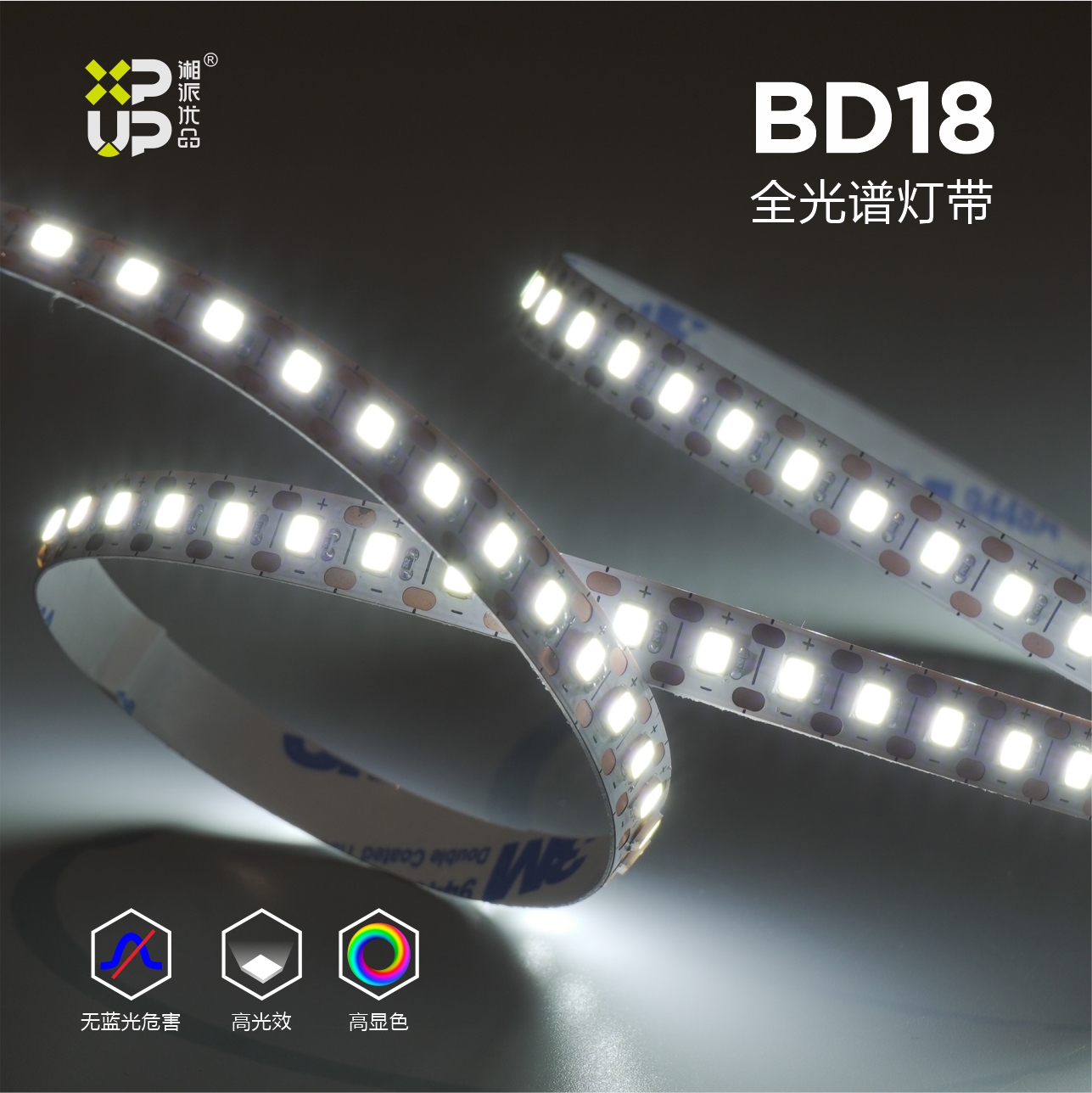
Colour rendering is judged on the surface, not on the datasheet: the same strip at Ra≥97 reads differently across warm and cool colour temperatures. Image: XPUP LED.
Step-by-Step: How to Specify a Full Spectrum Strip
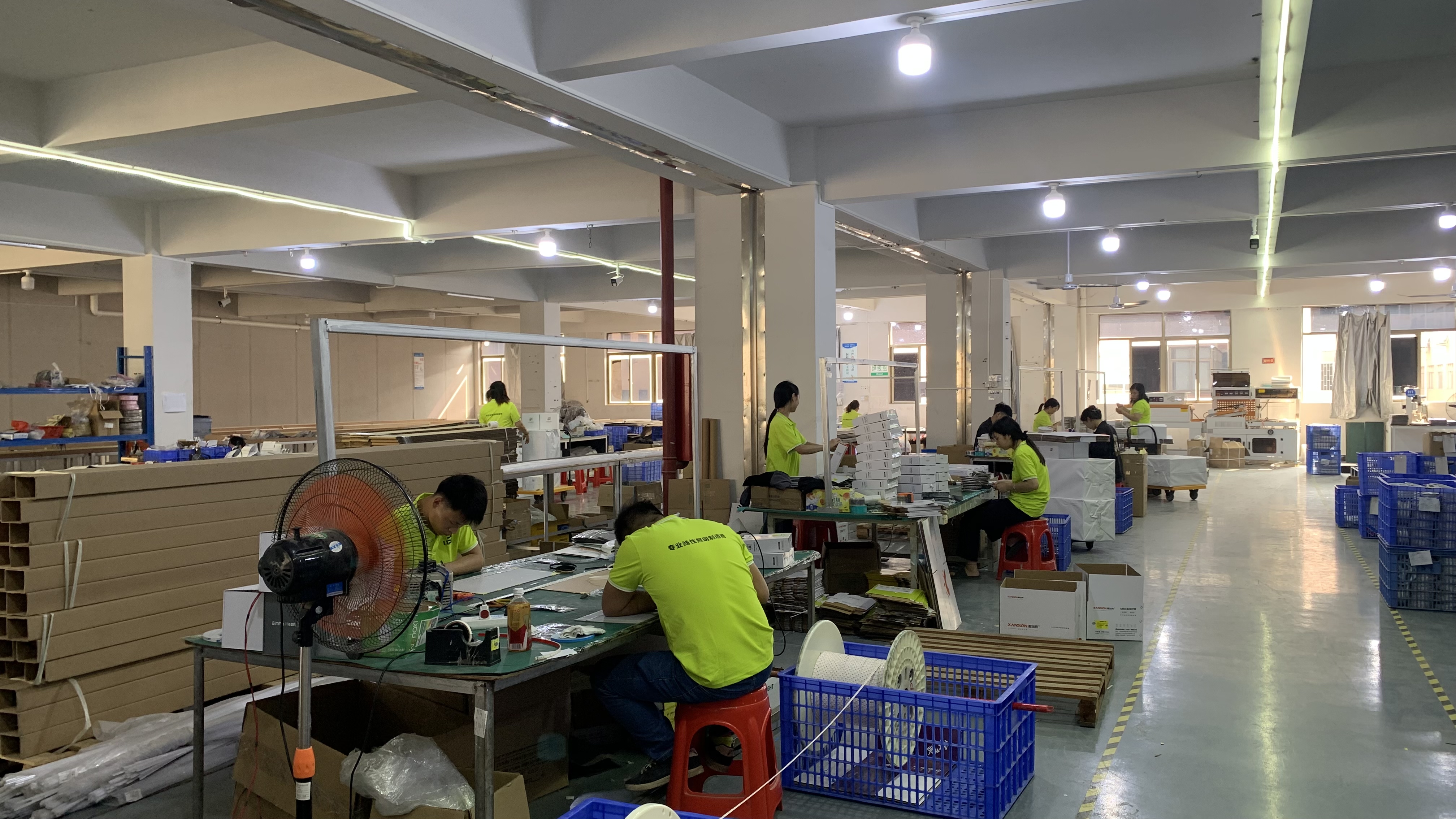
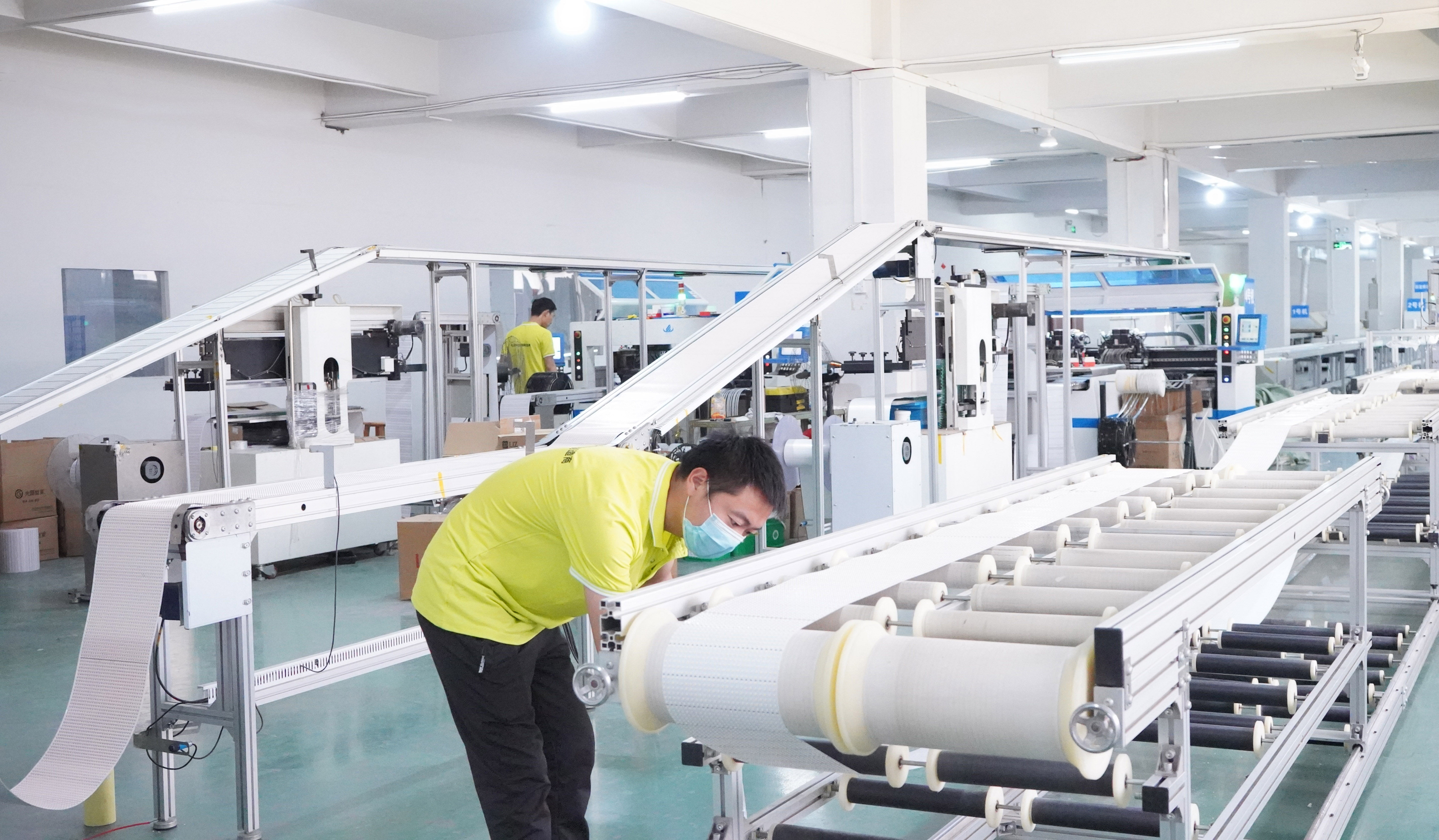
Manufacturing consistency behind the specification: XPUP operates a factory of more than 10,000 m² in Zhongshan with an in-house R&D laboratory. Image: XPUP LED.
Use Cases: Where High-CRI Full Spectrum Strip Earns Its Cost
The XP-BD18DC24V-2835-140D-8MM is intended for museums and galleries, interior design, luxury retail, jewellery stores, education and shopping malls, and XPUP positions it for jewellery stores and display cases in particular. Those applications share one trait: the viewer is being asked to judge an object by appearance.
- Museums and galleries. Artwork and artefacts carry colour that should not be reinterpreted by the light source, and the six colour temperature options allow different rooms to be tuned without changing product.
- Jewellery and display cases. Metal tones and stone tints need separation, which is where the gap between Ra≥90 and Ra≥97 becomes visible to a customer rather than to a meter.
- Luxury retail and shopping malls. Long runs are cut at each LED, so display walls and shelf edges can be lit with consistent output across the full run.
- Interior design and education. Where a linear detail has to read as clean light rather than as a row of dots, higher density or a diffused profile does the work.
There are also places where it is the wrong choice. Back-of-house areas, entertainment venues and colour-changing ambience are served by other families in the same range: XP-D14DC24V-5050-60D-10MM for RGB ambient lighting in KTV, clubs and entertainment centres, or G7-DC24V-2835-126D-8mm where the priority is low power consumption at high output. Full spectrum strip buys colour fidelity, and a project that does not need colour fidelity should not pay for it.
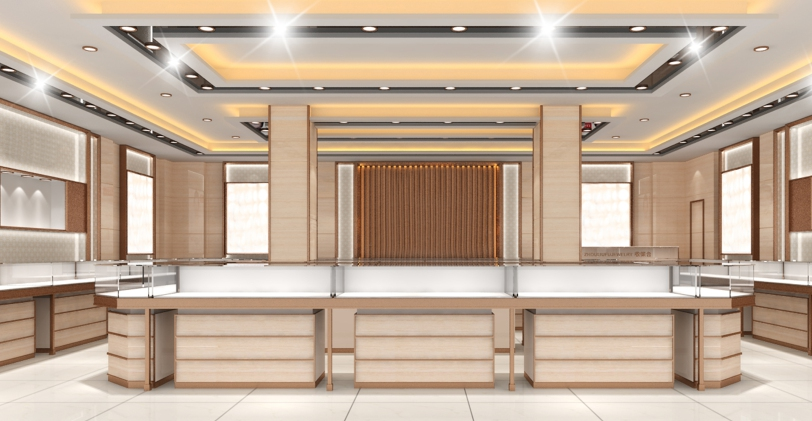
Display and hospitality work is where CRI is judged by the eye: XPUP-BD14 series at Ra≥95 is designed for display cabinets and boutique hotel interiors. Image: XPUP LED.
Comparison Table: Four XPUP Strip Families Side by Side
| Model | Family | SMD / density | CRI | Colour temperatures | Voltage / power | PCB | IP | Typical use |
|---|---|---|---|---|---|---|---|---|
| XP-BD18DC24V-2835-140D-8MM | Full spectrum lighting | 2835 / 140 LEDs per m | Ra≥97 | 2700–6000K (six options) | 24V DC / 12W | 8mm, double-layer copper | IP20 | Museums, galleries, luxury retail, jewellery, education, shopping malls |
| XP--BD14-DC24V-2835-144D-8MM | Hospitality lighting | 2835 / 144 LEDs per m | Ra≥95 | 2700–6000K (six options) | 24V DC / 12W | 8mm, double-layer copper | IP20 | Display cabinets, resorts, boutique hotels, aparthotels, serviced apartments |
| XP-SM-DC24V-5050-10MM | Smart lighting | 5050 / 2835, 60D or 120D | Ra≥90 | RGB, 3000K, 4000K, 6000K | 24V DC / 12W | 10mm, double-layer copper | IP20 | Aparthotels, restaurants, hospitality, interior design, architecture, shopping malls |
| DK3-DC24V-2835-240D-9.3mm | Linear lighting | 2835 / 240 LEDs per m | Ra≥80 | 3000K, 4000K, 6500K | 24V DC / 15W | 9.3mm, double-layer copper | IP20 | Restaurants, interior design, office buildings, apartments, museums and galleries; indoor strips and black profiles |
All figures as published by XPUP LED for the listed models. Colour temperature coverage, CRI and board width are the three lines that separate the families; voltage and IP rating are shared across this selection.
Frequently Asked Questions
Is full spectrum LED strip compliant for EU and US projects?
Certification is a company-level and product-level question that should be settled before the specification is frozen. XPUP LED states that its products are certified with CE and RoHS and meet EU and US market requirements, with the EU and USA as its major markets. Environmental protection is a separate line: the XP-BD18DC24V-2835-140D-8MM is rated IP20, which means it is intended for indoor dry locations, so wet-area or outdoor runs require a different product rather than a different label.
What should buyers check in LED lighting manufacturers before ordering full spectrum strip?
Four items can be verified and compared on equal terms: manufacturing base, production capacity, in-house R&D, and whether the specific model supports customization. XPUP LED was established in 2012, operates a factory of more than 10,000 m² in Zhongshan with approximately 80 staff, and reports annual production capacity of 35,000,000 meters of LED strip. The company runs a dedicated R&D laboratory focused on LED strip optical upgrades and new product development with a team of 6 engineers, and the XP-BD18DC24V-2835-140D-8MM supports OEM and ODM.
What drives the price of full spectrum LED strip?
Quotations follow the confirmed specification rather than a single catalogue number, because one product family can span very different builds. On the XP-BD18DC24V-2835-140D-8MM the cost-relevant variables are the SMD 2835 chip line at 140 LEDs per meter, the Ra≥97 colour rendering value, the 8mm double-layer copper PCB, the chosen colour temperature from six options, and any OEM or ODM customization of cut length, packaging or branding. Comparing two suppliers on price is only meaningful when those five items match, which is why a written specification should be issued before quotation.
Can I request samples before committing to a production order?
Yes. XPUP LED’s process runs from product customization to sample confirmation and then mass production, and the company describes rapid sampling as part of its OEM/ODM service. For full spectrum work the sample stage matters more than usual, because CRI and colour temperature should be judged on the actual surface under the actual room lighting; comparing a Ra≥97 sample against an existing fixture tells you more than any datasheet. Samples are arranged through sales001@xpupled.com.
How is lead time and delivery scheduled?
Lead time is confirmed per order because it depends on specification and volume. What can be verified in advance is capacity and continuity: annual production capacity of 35,000,000 meters of LED strip, a factory of more than 10,000 m² with approximately 80 staff, and a practice of preparing inventory in low seasons to maintain supply during peak seasons for partner brands. Each order runs through dedicated one-to-one communication from solution discussion and sample customization through production scheduling, quality inspection, logistics and after-sales. To open a schedule discussion, send the confirmed specification to sales001@xpupled.com or message +86 189 8858 4085.
Conclusion: Read the Specification, Not the Label
Full spectrum LED lighting is best understood as an outcome rather than a badge. The outcome is colour fidelity on the surface, and it is produced by a specific combination of chip, density, CRI and colour temperature. The XP-BD18DC24V-2835-140D-8MM shows how that combination looks on paper: SMD 2835 chips at 140 LEDs per meter, Ra≥97, six colour temperatures from 2700K to 6000K, 24V at 12W, an 8mm double-layer copper PCB, IP20, cuttable at each LED, with OEM and ODM support. The DK3-DC24V-2835-240D-9.3mm shows the other side of the same trade — more chips per meter and a wider board, at Ra≥80 and 15W, for continuous grain-free lines of light.
For a buyer at the research stage, the practical next step is not to choose a brand but to write the four lines that decide everything else: CRI target, colour temperature, LEDs per meter, and board width. Once those are fixed, supplier comparison becomes a factual exercise.
Next step: sample the light, not the photo. The full 2026 XPUP LED Strip Catalog covers strip families, specifications and customization options, and can be downloaded here: 2026 XPUP LED Strip Catalog (PDF). For a sample of the XP-BD18DC24V-2835-140D-8MM in your chosen colour temperature, or a quotation against your specification, contact the XPUP LED team at sales001@xpupled.com or +86 189 8858 4085, or visit www.xpupled.com.
Have Questions or Need More Details?
Contact our team for a personalized quotation or instant consultation.
Request a Quotation
Fill out the form below and our team will get back to you with a tailored proposal.
WhatsApp Direct Chat
Prefer to chat in real-time? Message us on WhatsApp for instant assistance & quick answers.
- Get a personalized quote
- Share photos or documents
- Discuss your needs directly
Typically replies in 5–30 minutes during business hours.