
What Is an Acoustic Wall LED Strip Light? New Builders' Guide to Indoor SMD Lighting
An acoustic wall LED strip light is a flexible, low-voltage LED strip specified for installation inside acoustic wall panels, felt slat systems, fabric-wrapped modules and similar wall-facing constructions. It is not a separate LED technology. It is an ordinary DC strip whose electrical, optical and mechanical parameters are chosen so the strip can live inside a shallow, poorly ventilated panel cavity and still deliver an even, glare-free line of light across the panel face, without visible dots, colour drift between panels or premature failure.
XPUP LED, the brand of Zhongshan Xiangpai(XPUP) Lighting Technology Co., Ltd., a Zhongshan-based LED strip manufacturer established in 2012, classifies a representative build for this application as model CA-DC24V-2835-180D-8mm-3000K: SMD 2835 LEDs at 180 LEDs per metre, 24V DC input, IP20 protection, CRI≥80, an 8 mm PCB width and a 3000K colour temperature.
This guide explains what that classification actually contains, why the copper PCB and the double-layer board construction matter more than most first-time buyers expect, and how a builder should sequence the decision from panel detail to delivery. It is written for contractors, distributors and brand owners who are specifying or buying strip lighting for wall integration for the first time.
Scope: this guide covers indoor, dry-location installation only. Model CA-DC24V-2835-180D-8mm-3000K is rated IP20; wet-area, bathroom and outdoor installations use different IP ratings and are outside the scope of this article.
The Problem: Acoustic Panels Are Specified for Sound, Not for Light
Acoustic wall systems are usually selected for absorption, surface finish and design intent. Lighting is added later, often from a detail that shows a glowing line and says nothing about how that line is produced. The result is a strip chosen quickly, from a catalogue, against a cavity nobody has measured.
Six recurring constraints decide whether the installation works:
- Channel geometry. The reveal in an acoustic panel is narrow, often only a few millimetres wider than the strip itself. An 8 mm board fits where a 10 mm or 12 mm board does not, and the diffuser depth limits how far the LEDs can sit from the surface.
- Heat without airflow. Inside a panel, a strip has little convective cooling. Heat has to travel through the PCB into the channel or the panel substrate, which is a board design question, not a lighting-effect question.
- Run length and voltage drop. A wall line can run several metres from a single feed. If the copper cannot carry the current, the far end of the run turns dimmer or warmer than the near end, and the defect is visible across a whole room.
- Dot visibility. Low-density strip behind a shallow diffuser reads as a string of bright points. It is the most common aesthetic complaint on acoustic wall installations, and it is decided at specification rather than at installation.
- Batch consistency. Two panels lit with strip from different production lots can show a visible colour step. Colour temperature and CRI therefore have to be frozen as an order requirement.
- Service access. A strip glued into a closed panel cannot be replaced without opening the wall. Connection points and driver location need to be planned before the panel closes.
Industry Background: Why LED Strip Moved Into the Wall
Strip lighting has shifted from a decorative accessory to a construction material, and the wall is where that shift is most visible. Published market data describes the scale of the category and, indirectly, why the specification vocabulary has become more technical.
- The global LED strip market was valued at approximately USD 5.8 billion in 2025 and is projected to reach USD 13.2 billion by 2034, growing at a 9.6% CAGR (Dataintelo).
- Flexible LED strips are the largest product type in the market, holding a 67.4% share as of 2025 (Dataintelo).
- The 24V segment accounted for 52.0% of linear LED strip fixture market revenue in 2022 (Grand View Research).
- The 3000K-4000K colour temperature segment held a 33.2% revenue share in the linear LED strip fixture market (Grand View Research).
- Commercial applications contribute approximately 33.8% of global LED strip revenue (Dataintelo, 2024).
- High-density strips above 120 LEDs per metre account for nearly 19% of premium installations, according to a Business Research Insights estimate for 2025.
Two standards frame the compliance conversation. In the United States, low-voltage LED strips operating at 12V or 24V are classified under UL 2108. Internationally, IEC 60598-2-20:2022 specifies safety requirements for lighting chains, a category that includes LED strips. Neither standard replaces a project specification, but both explain why a supplier's documentation is requested before a wall system is approved.
The design trend behind the category is no-main-light interior design: ceilings without central fixtures, with light delivered from coves, reveals and wall surfaces instead. XPUP has been recognised in that field with industry listings including Top Ten Linear Lighting Brands, Top Ten No-Main-Light Lighting Brands and Quality Linear Lighting Manufacturer. Acoustic wall lighting sits directly inside that trend, because the panel is already a designed surface and the light simply finishes it.

The Solution: What a Correctly Specified Acoustic Wall Strip Contains
The verified reference build: CA-DC24V-2835-180D-8mm-3000K
The model designation is a compressed specification. Read from left to right, CA identifies the series, DC24V the input voltage, 2835 the LED package, 180D the density at 180 LEDs per metre, 8mm the PCB width and 3000K the colour temperature.
| Parameter | Verified value | What it means on a wall |
|---|---|---|
| LED package | SMD 2835 | A compact surface-mount package that allows a high diode count on a narrow board. |
| Density | 180 LEDs per metre | Shorter spacing between light points, which reduces dotting behind a shallow diffuser. |
| Input voltage | 24V DC | Low-voltage DC operation; lower current per metre than 12V for the same load, which supports longer runs. |
| Ingress protection | IP20 | Indoor, dry locations only: protected wall cavities, not bathrooms or exteriors. |
| Colour rendering | CRI≥80 | Sufficient colour fidelity for wood, felt, plaster and textile wall finishes. |
| PCB width | 8 mm | Fits narrow aluminium channels and panel reveals where 10 mm and 12 mm boards will not seat. |
| Colour temperature | 3000K | Warm white, the reference tone for residential and hospitality interiors. |
Two values the model code does not fix: wattage per metre and luminous output. Those follow the specific build and are confirmed from the datasheet and the pre-shipment test report for the order. A buyer who needs those numbers should request them in writing with the quotation, together with the CCT and CRI tolerance for the production lot.
Why the copper PCB and double-layer construction decide the outcome
Two strips can look identical from the front and behave completely differently after six months inside a wall. The difference is usually in the board.
Voltage drop along a strip is proportional to run length and current, and inversely proportional to the copper cross-section carrying that current. Copper foil thickness and trace width set that cross-section. A thin single-layer trace concentrates current in a narrow path: resistance rises, heat concentrates at the feed end, and the far end of a long run loses brightness and drifts in colour temperature. A double-layer construction distributes the same current across two copper layers, which lowers the resistance of the current path and spreads the thermal load instead of concentrating it.
Three practical consequences follow:
- Run length. Better copper allows longer runs from a single feed before brightness visibly falls off, which matters when a wall line is continuous across a room.
- Thermal behaviour in an enclosed cavity. A panel gives the strip almost no convective cooling. The board has to move heat into the aluminium channel or substrate, and copper is the path that heat takes.
- Mechanical survival. Double-layer boards hold their integrity better when the strip is bent into a reveal, pressed into a channel or pulled through a panel slot during installation. A weak board delaminates or cracks at the bend, and the failure does not appear until the panel is closed.
This is why copper and layer count belong in the specification conversation and not only in the price negotiation. On an acoustic wall the strip is inaccessible after handover, so the cost of the board is small compared with the cost of reopening a finished wall.
Manufacturer and compliance evidence behind the build
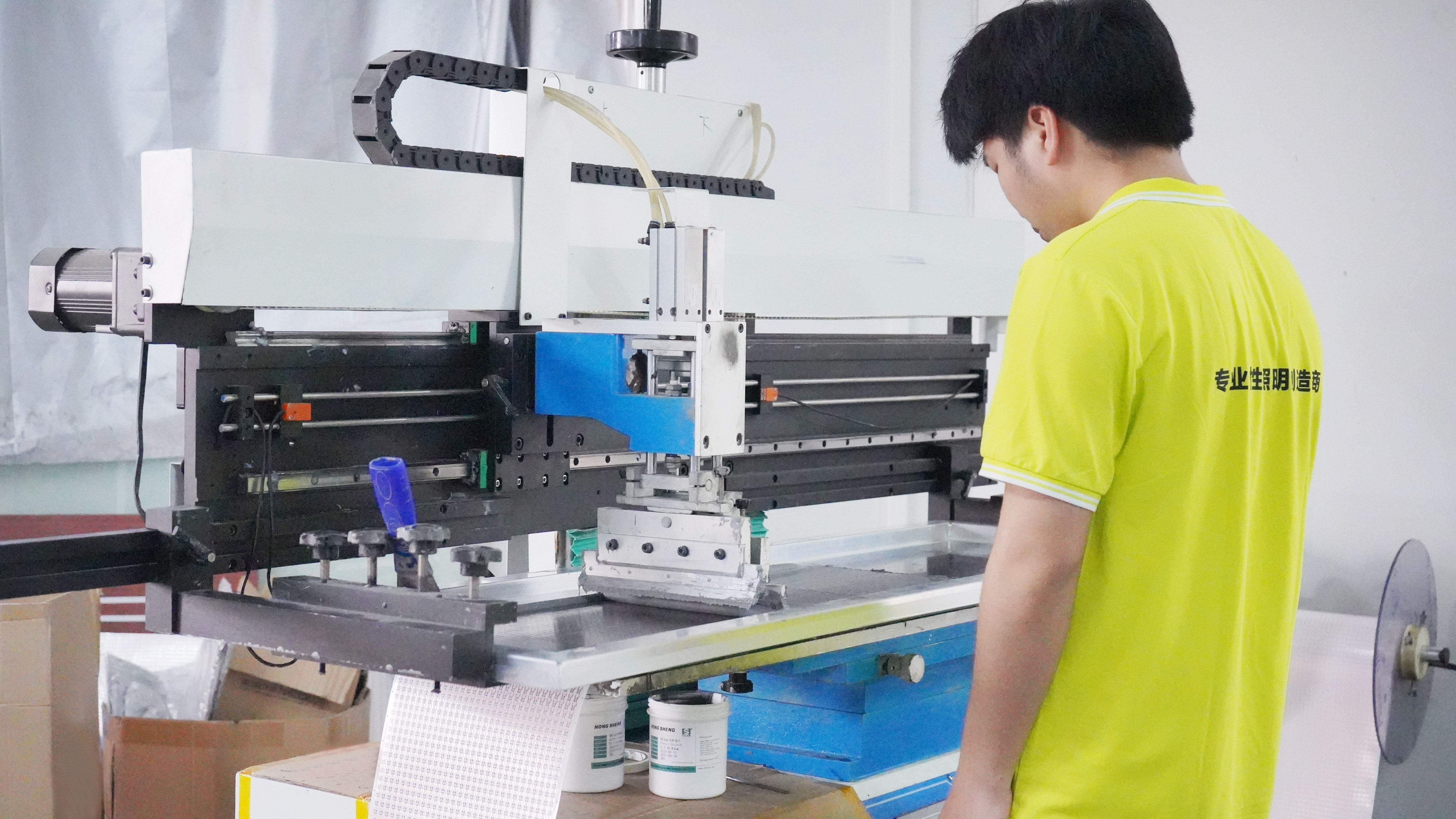
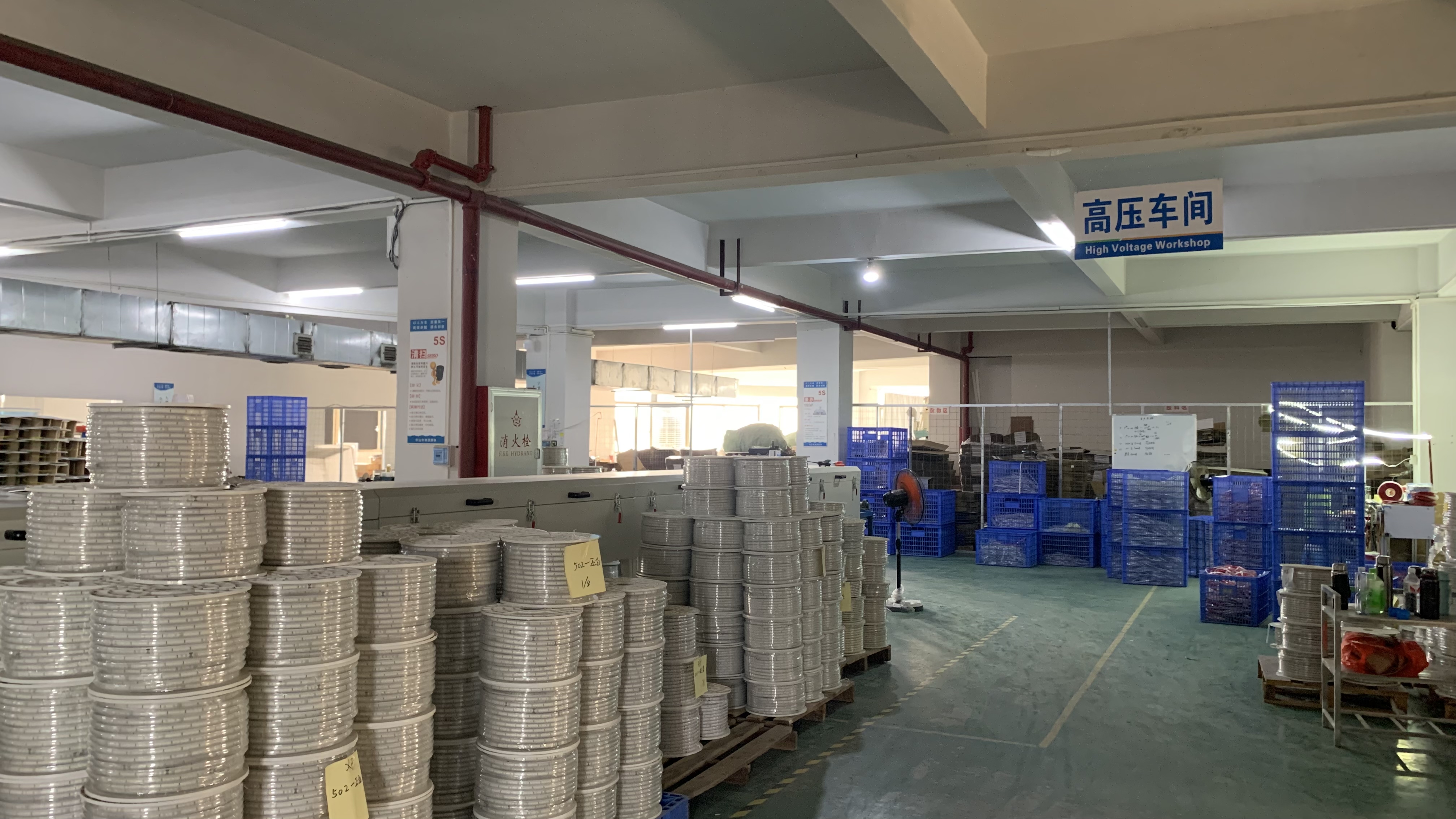
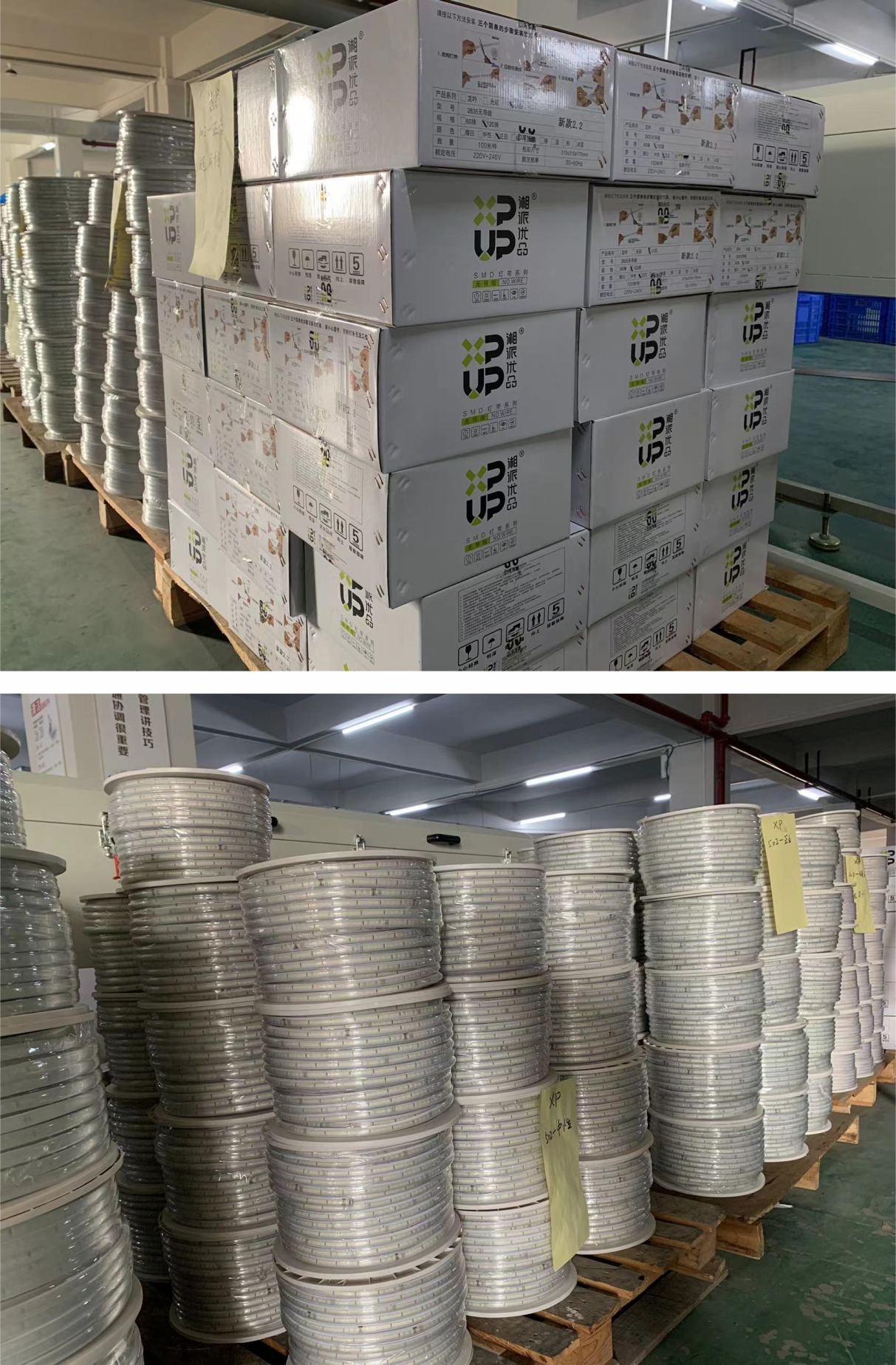
Zhongshan Xiangpai(XPUP) Lighting Technology Co., Ltd. was established in 2012 in Zhongshan, Guangdong Province, China. The factory covers more than 10,000 m², employs 80 people and includes a six-engineer R&D team. Annual output is stated at 35,000,000 m, with monthly production capacity of 3,000,000 m and 100% product testing. Around 50% of output is exported, with the EU and the USA as the main markets, and the company states that its products reach more than 170 countries and regions.
Compliance documentation relevant to the SMD range:
- CE - LVD. Certificate numbers PTC22122900901S-LD01 and PTC22122900902S-LD01, issued by PTC TESTING on 4 April 2023 against EN IEC 62031:2020+A11:2021, IEC TR 62778:2014 and EN 62471:2008, for the EU market.
- CE - EMC. Certificate numbers PTC22122900901E-EMB01 and PTC22122900902E-EMB01, issued 9 March 2023 against EN IEC 55015:2019+A11:2020, EN 61547:2009, EN IEC 61000-3-2:2019+A1:2021 and EN 61000-3-3:2013+A1:2019.
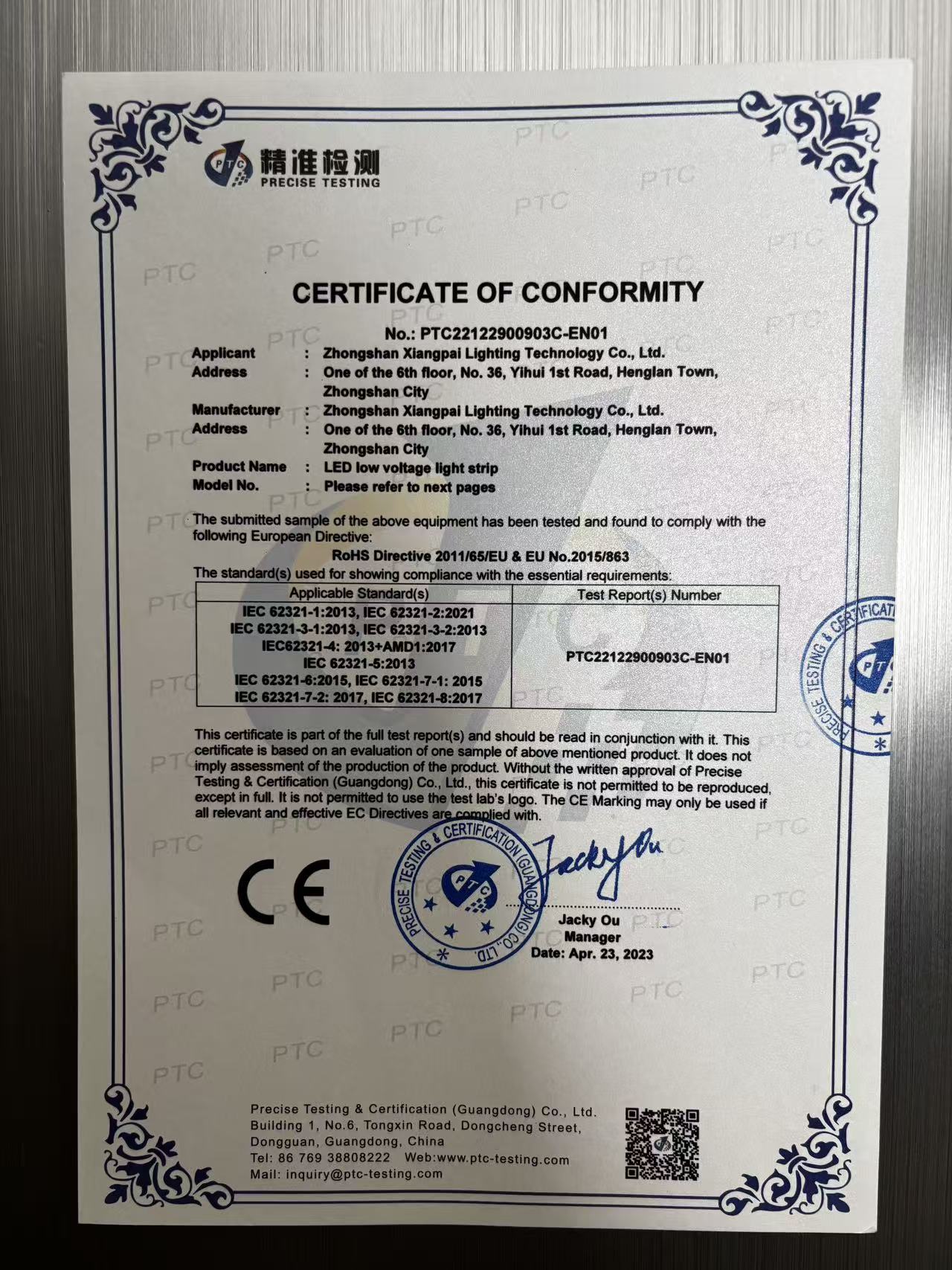
- CE - RoHS. Certificate numbers PTC22122900903C-EN01 and PTC22122900905C-EN01, issued 23 April 2023 against the IEC 62321 series (IEC 62321-1:2013 through IEC 62321-8:2017).
All three certification scopes cover the LED low-voltage and high-voltage strip series, and model CA-DC24V-2835-180D-8mm-3000K is listed within that scope. The company also holds design and structural process patents for its C19 and C20 series strips, authorised by the China National Intellectual Property Administration.
Step-by-Step: Specifying an Acoustic Wall Strip Without Rework
The sequence below is ordered so that each decision narrows the next. Following it avoids the most expensive outcome: discovering a mismatch after the panels are closed.
- Start from the panel detail, not the strip. Measure the reveal width, channel depth, diffuser type and the distance from the LED surface to the diffuser. These numbers decide whether an 8 mm board is compulsory and how high the density must be.
- Fix the electrical architecture. Select 24V DC for the run, locate the driver outside the sealed cavity, and count feed points. For every continuous line, state the maximum run per feed so the installing electrician is not improvising on site.
- Select density against the diffuser. For shallow reveals, higher density, such as 180 LEDs per metre in the reference build, reduces visible point spacing. Where the diffuser is deep or the light is fully indirect, lower-density models can be adequate.
- Freeze the colour. Specify 3000K with CRI≥80 as an order requirement, and require a single production lot per project. Colour consistency across panels is a purchasing requirement, not an installation skill.
- Validate the board, not just the diode. Ask about copper and layer construction, bend radius and the recommended fixing method, and confirm how the strip behaves when bent around a panel corner.
- Match the IP rating to the room. IP20 is correct for dry protected cavities. It is not correct for bathrooms, kitchens with direct water exposure, or any exterior location.
- Check dimming compatibility before ordering. Confirm the driver and control protocol against the strip you selected. Compatibility is verified with samples, not with assumptions.
- Install, test, then close. Mount the strip into an aluminium channel where the detail allows, combine adhesive fixing with mechanical support at intervals, run a full-length power test including the far end of every run, and photograph the wiring before the panel closes.
Use Cases: Where an Acoustic Wall Strip Earns Its Place
Residential feature walls and media walls
A home decoration distributor in Germany and Italy has taken 20,000 m per year of XPUP strip over a three-year programme, with RGB LED strip and acoustic panel LED strips applied in premium residential projects; model CA-DC24V-2835-180D-8mm-3000K sits inside the product range associated with that programme. 3000K warm white is the standard choice where wall finishes are wood, felt or plaster.
Hotels, lounges and hospitality corridors
Hospitality walls want a continuous, low-glare line that reads as architecture rather than as a fixture. The strip has to hold its brightness across a long corridor run and stay consistent between floors, and both are copper and lot-control issues rather than LED issues. XPUP has supplied German hotel lighting projects where stable brightness and colour quality were the stated requirement.
Commercial offices, acoustic pods and meeting rooms
Commercial applications account for roughly 33.8% of LED strip revenue, and acoustic treatment is common in that segment. Pods and meeting rooms combine sound absorption with a lit wall surface, which makes the strip part of the room's visual identity as well as of its light level.
Retail and showroom walls
Wall-washing in retail is a merchandise decision: the light has to render product and finish colour faithfully, which is why CRI≥80 is treated as a minimum rather than a premium option on customer-facing surfaces.
Renovation and retrofit
Business Research Insights estimates that nearly 49% of renovation projects include LED strip installations. In retrofit work the panel detail is often already built, so the strip must be selected against an existing cavity, which is the case where 8 mm width and construction quality matter most.
Comparison: Verified XPUP Strip Models Relevant to Wall Lighting
The table compares models that appear in XPUP's certified range, using the parameters expressed in each model designation.
| Model | LED package | LEDs per metre | Voltage | PCB width | Position in a wall build |
|---|---|---|---|---|---|
| CA-DC24V-2835-180D-8mm-3000K | SMD 2835 | 180 | 24V DC | 8 mm | Reference build for acoustic panels: 3000K, CRI≥80, IP20, narrow board. |
| G7-DC24V-2835-126D-8mm | SMD 2835 | 126 | 24V DC | 8 mm | Lower-density alternative where the diffuser is deeper or the light is fully indirect. |
| B7-DC24V-2835-180D-10MM | SMD 2835 | 180 | 24V DC | 10 mm | Same density on a wider board where the channel allows it. |
| XP-D4DC24V-2835-192D-8MM | SMD 2835 | 192 | 24V DC | 8 mm | Higher-density option in the same package family for shallow reveals. |
| XP-B7DC24V-2835-240D-10MM | SMD 2835 | 240 | 24V DC | 10 mm | High-density board for short, very even accents where width is available. |
| XP-D5DC24V-3535-120D-8MM | SMD 3535 | 120 | 24V DC | 8 mm | Different package family; compare on datasheets rather than on density alone. |
The parameters above are those expressed in the model designation. Colour temperature, CRI, wattage, luminous output and IP rating are confirmed per model on the datasheet and on the pre-shipment test report before an order is placed.
Frequently Asked Questions
1. Is an IP20 acoustic wall strip compliant for indoor EU and US projects?
IP20 means the strip is protected against solid objects above 12.5 mm and has no water protection, so it suits dry, protected indoor cavities only. On the EU side, model CA-DC24V-2835-180D-8mm-3000K falls within XPUP's CE scope: LVD certificates PTC22122900901S-LD01 and PTC22122900902S-LD01, EMC certificates PTC22122900901E-EMB01 and PTC22122900902E-EMB01, and RoHS certificates PTC22122900903C-EN01 and PTC22122900905C-EN01, all issued by PTC TESTING. In the United States, low-voltage 12V/24V LED strips are classified under UL 2108, and IEC 60598-2-20:2022 is the international reference for lighting chains. Project-specific requirements should always be confirmed against the specification issued for that building.
2. Can one manufacturer handle OEM and ODM custom projects across SMD and COB strip formats?
Yes. XPUP provides both OEM and ODM production services, and its core range includes SMD strips alongside high-brightness COB LED strips, RGB and RGBCW strips, outdoor waterproof strips and smart dimmable ambient strips. OEM customisation covers voltage, logo, power, dimensions, materials, hardware configuration, internal circuit, colour, factory specifications, nameplate and label. ODM customisation covers exterior colour scheme, outer packaging box, label, brand information, model name and material details.
3. What are the commercial terms for a wall lighting order?
The minimum order quantity is 2,000 metres, delivery terms are FOB or CIF, payment terms are 30% deposit with the balance before shipment, and acceptance is based on a pre-shipment test. Unit price is not fixed by the model code: it follows the frozen specification, including board construction, colour tolerance, packaging and order volume, and is confirmed in the quotation.
4. How should samples be validated before a full order?
Samples are produced and confirmed before mass production so the specification can be verified physically. On an acoustic wall project, test the sample in the actual diffuser and channel where possible: check for visible dotting at the specified mounting distance, measure brightness at both ends of a full-length run, confirm that 3000K and CRI≥80 match the approved reference, and bend the strip the way the installation will bend it. Mass production is then controlled by 100% testing and a pre-shipment test.
5. What lead time should a project plan for?
Typical production lead time is 18-22 days against a monthly capacity of 3,000,000 metres, with a two-year standard warranty and technical support that includes remote debugging and customised parameter guidance. Sample approval should be scheduled ahead of that window. To start a specification review or request a sample of the reference build, contact XPUP at sales001@xpupled.com or via WhatsApp.
Conclusion
An acoustic wall LED strip light is a specification, not a product category. What separates a clean wall line from a visible one is decided long before installation: density against diffuser depth, the 24V architecture and feed layout, colour temperature and CRI frozen per lot, and above all the board, meaning the copper cross-section and double-layer construction that carry current and heat across a long, enclosed run.
Model CA-DC24V-2835-180D-8mm-3000K shows what that specification looks like in practice for indoor work: SMD 2835 at 180 LEDs per metre, 24V DC, IP20, CRI≥80, 8 mm width and 3000K, built by a manufacturer whose CE, EMC and RoHS documentation covers the series. For a builder, the discipline is simpler than the engineering: design from the panel detail, freeze the specification, validate it on a sample, and buy the board, not just the LEDs.
Next Step
Download the 2026 XPUP LED Strip Catalog for the full model range, or send your wall detail and required run lengths for a specification review and a sample request.
Email: sales001@xpupled.com | Tel / WhatsApp / WeChat: +86 189 8858 4085 | Website: www.xpupled.com
Zhongshan Xiangpai(XPUP) Lighting Technology Co., Ltd., 5th Floor, No.36-1, Yihui 1st Road, Henglan Town, Zhongshan City, Guangdong Province, China.
Have Questions or Need More Details?
Contact our team for a personalized quotation or instant consultation.
Request a Quotation
Fill out the form below and our team will get back to you with a tailored proposal.
WhatsApp Direct Chat
Prefer to chat in real-time? Message us on WhatsApp for instant assistance & quick answers.
- Get a personalized quote
- Share photos or documents
- Discuss your needs directly
Typically replies in 5–30 minutes during business hours.