
Head-to-Head: AC-Output vs. DC-Output Solid State Relays — Which Fits Your Application?
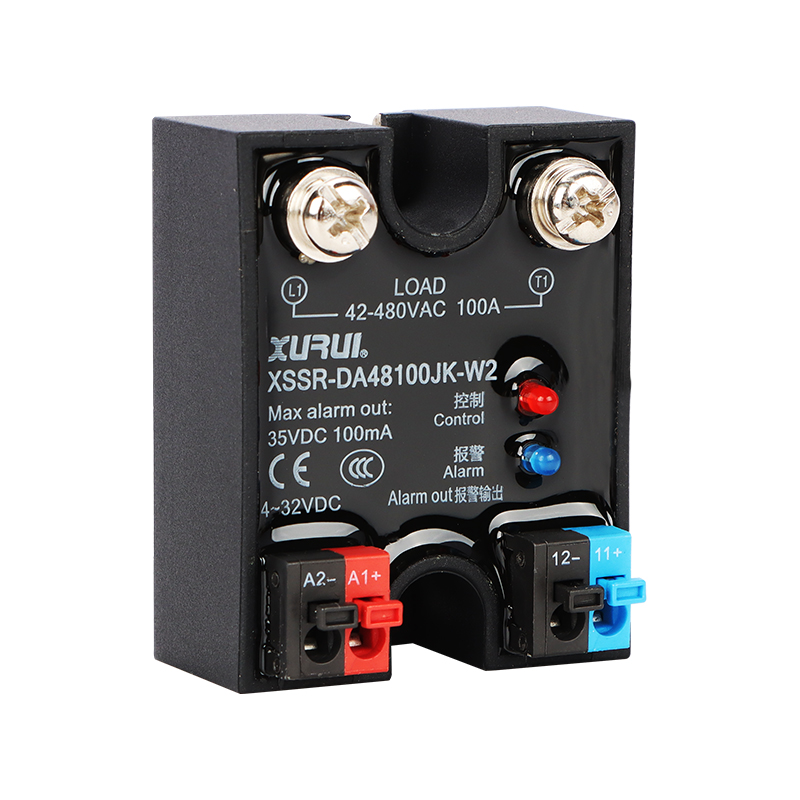
XURUI XSSR-W2-JK: an AC-output solid state relay rated for 42–480VAC loads at 10A–120A, with a plastic housing and aluminium alloy base plate.
The decision comes down to one question first: what kind of power does your load run on? If the load is fed by AC mains — a heater, an AC motor, a lamp, a transformer — you want an AC-output solid state relay. If the load runs on DC — a DC pump, a solenoid valve, a DC motor — you want a DC-output solid state relay. Everything else in the selection process comes after that, not before it.
Most solid state relay (SSR) selection errors in consumer electronics and light industrial projects do not come from picking the wrong amp rating. They come from picking the wrong output topology and then trying to compensate with a bigger current number. This article works through both topologies, shows where each one belongs, and gives a step-by-step method for matching an SSR to the load in front of you.
The Confusion That Sinks SSR Projects: Control Voltage vs. Load Voltage
An SSR has two electrical sides, and they are independent. The input side accepts a control signal — commonly a DC logic voltage such as 3–32VDC, and on some models an AC control voltage such as 80–250VAC. The output side switches the load circuit. A relay with a 3–32VDC control input is not a "DC relay." It is a relay with a DC control input whose output may still be designed for an AC load.
That distinction is where projects go wrong. A buyer reading a specification sheet sees "3–32VDC" on the input line, assumes the part fits a DC load, and installs it on a DC pump. The relay's output stage was never designed for that circuit.
Why does it fail? An AC-output SSR uses a thyristor or triac output stage. Once that output stage is triggered, it stays conducting until the alternating current falls below its holding level, which in a mains circuit happens naturally at the zero crossing of every cycle. A DC load has no zero crossing. The current never falls to zero on its own, so the output stage has no natural point at which to release. The relay may remain conducting after the control signal is removed.
The rule to carry into every specification review: a control-side DC rating says nothing about the load side. Check the load voltage line — for example 0–240VAC, 24–480VAC, 42–480VAC, 75–480VAC, or 24–380VAC. If that line says VAC, the relay is built for an AC load, no matter what the input line says.
Why the Market Still Splits Along AC and DC Lines
Mains AC remains the dominant power form for heating, lighting, motor starting, and building services, which is why the AC-output SSR is the more common device in panels and in appliance control boards. DC loads are growing alongside battery systems, photovoltaic equipment, DC pumps, and portable power products, and those loads need a different output stage rather than a re-rated AC part.
The commercial weight behind this category is substantial. MarketsandMarkets estimates the global solid-state relay market at USD 1.74 billion in 2025, projected to reach USD 2.36 billion by 2030. Mordor Intelligence places Asia-Pacific at an estimated 42% share of that market in 2025, driven by electric-vehicle charger deployment and photovoltaic inverter manufacturing in China and Japan. The same source reports that panel-mount designs held the largest mounting configuration share at 38.67% in 2025, with DIN-rail variants the fastest-growing segment.
On the compliance side, industrial solid state relays are expected to meet international safety standards including IEC/EN 60947-4-3 (contactors and motor-starters) and UL 508 (industrial control equipment). The relevant standard does not change with output topology, but the test conditions applied to the output stage do — which is one more reason to match the topology to the load before discussing certification paperwork.
XURUI (Zhejiang Xurui Electronic Co., Ltd.) is a Chinese manufacturer of industrial electric switches and solid state relays, founded in 2002 and based in Wenzhou, Zhejiang. Its product portfolio covers micro switches, limit switches, foot switches, toggle switches, reed switches, proximity switches, photoelectric switches, and solid state relays, exported to markets including the United States, Germany, Japan, South Korea, Turkey, Belgium, and Egypt.
How an AC-Output SSR Actually Switches
An AC-output SSR places a semiconductor switching element in series with an AC load and drives it from an isolated control circuit. The two behavioural questions that matter during selection are when the output turns on, and what remains when it is supposedly off.
Zero-crossing vs. random turn-on
A zero-crossing SSR waits for the AC waveform to pass through zero before it conducts. In the XURUI range, the XSSR-M1~M6 series is specified with zero-crossing triggering, load voltage of 75–480VAC, a load current range of 60A–1000A (M1 covering 60–200A and M6 covering 700–1000A), switching time of ≤10ms, dielectric strength of ≥2500VAC, insulation resistance of ≥100MΩ, and an operating temperature range of −20°C to +70°C.
Zero-crossing switching is the natural fit for resistive heating. The output stage commits at the point in the cycle where switching stress is lowest, and it does not create a steep current step in the middle of the waveform. For loads such as electric stoves, warm-air heating, and general heater control, this is the intended mode of operation.
Random turn-on (also called instantaneous or phase-control triggering) allows the output to conduct as soon as the command arrives, which is what phase-angle control requires. The XSSVR-CA W2 illustrates the analogue-control end of this family: a 4–20mA input, a 0–240VAC load range, 10A–120A maximum load current, minimum load current of 0.05A, switching time ≤10ms, frequency range 47–63Hz, and a PA66 nylon housing — positioned for analogue closed-loop control in industrial automation systems.
What leakage current means when the load is small
An AC-output SSR is not a mechanical contact. In the off state it still presents a small leakage path. XURUI specifications put output leakage current at ≤5mA on the XSSR-W6 and XSSR-W2-JK, ≤8mA on the XSSR-3 W3 and W4, ≤5mA on the XSSR-W1, and ≤1mA on the XSSR-P4/P5/P6 series.
For a multi-kilowatt heater, a few milliamps of leakage is irrelevant. For a very small load — a low-wattage indicator lamp or a sensitive input circuit — it can be enough to produce a faint glow or an unexpected signal. This is a load-sizing question, not a defect, and it is the reason minimum load current is published alongside maximum load current.
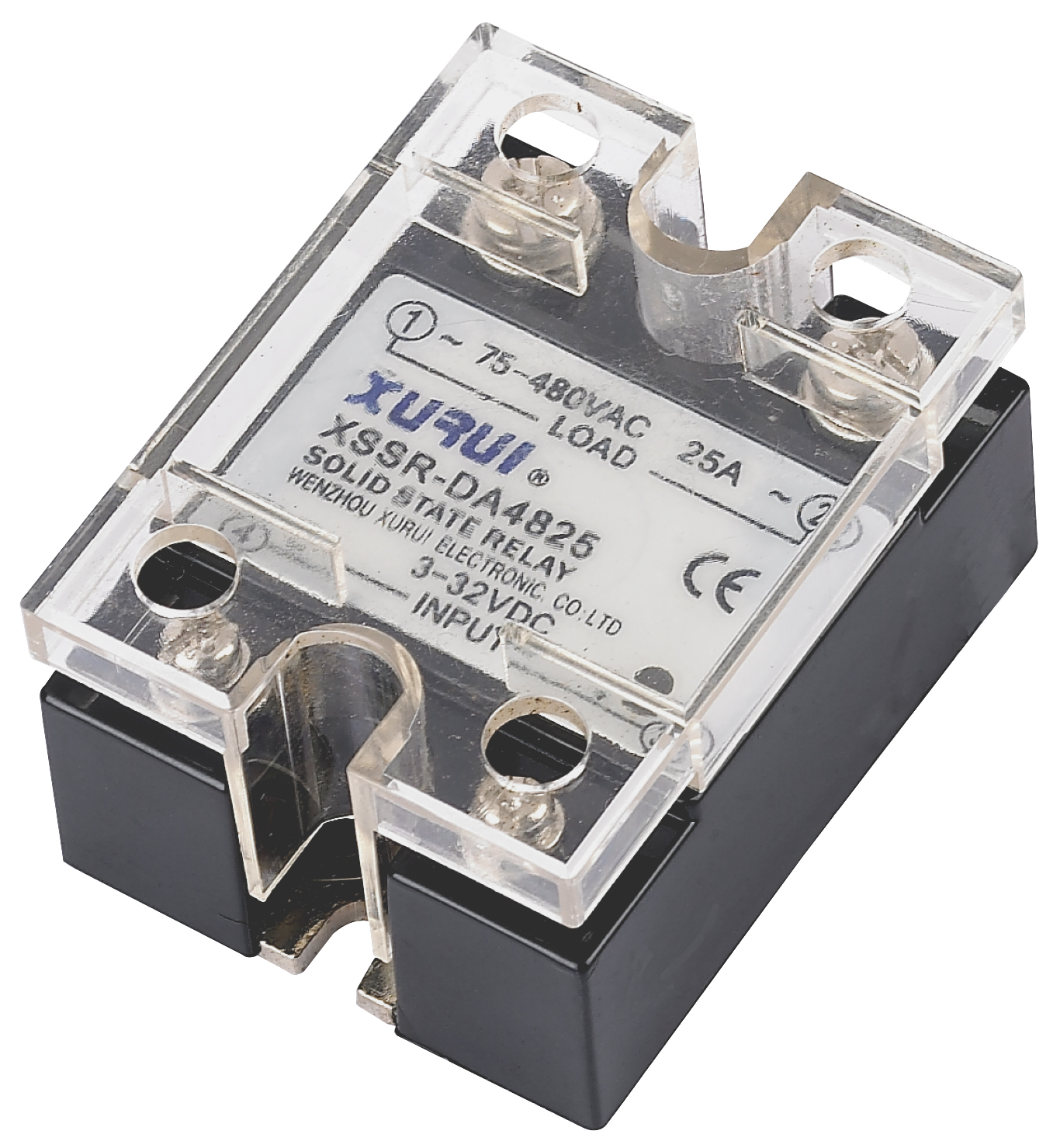
XURUI XSSR-DA-W5: 75–480VAC load voltage, 10A–125A load current, ≤10ms switching time, PA66 nylon housing — a representative AC-output model for heating and AC motor control.
How a DC-Output SSR Differs
A DC-output solid state relay uses a MOSFET-based output stage rather than a thyristor or triac stage. Because there is no alternating waveform, there is no zero crossing to wait for and no natural current zero to release the output. Turn-on and turn-off are controlled by the gate drive, and the relay can interrupt a DC load at any point in the conduction cycle.
That capability comes with a design obligation rather than a bonus: the energy stored in a DC load has to go somewhere when the relay turns off.
The freewheeling path you cannot skip
DC pumps, solenoid valves, and DC motors are inductive. When a DC-output SSR interrupts current through an inductor, the collapsing magnetic field produces a voltage transient that will look for a path — through the relay, through the wiring, or through whatever else shares the circuit. The standard practice is to provide a freewheeling (flyback) diode across the inductive load so that the stored energy circulates locally instead of being applied to the output stage.
The same principle applies to surge suppression on the AC side, but the DC case is less forgiving: a DC arc has no zero crossing to extinguish it, so the suppression path must be part of the circuit design from the beginning rather than an afterthought.
What this SSR family covers
The XURUI solid state relay range documented in this article is built for AC loads. The published models cover these load voltage windows:
- 0–240VAC — XSSVR-CA W2, 10A–120A, 4–20mA analogue input
- 24–480VAC — XSSR-3 W3 (10A–75A) and XSSR-3 W4 (75A–200A)
- 42–480VAC — XSSR-W2-JK, 10A–120A, 4–32VDC control
- 75–480VAC — XSSR-W1 (10A–100A), XSSR-W5 (10A–125A), XSSR-W6 (10A–100A), and XSSR-M1~M6 (60A–1000A)
- 24–380VAC — XSSR-P4/P5/P6, 1A, minimum load current 0.02A
If your load is DC, that is a specification conversation to have with the manufacturer before ordering, because the output stage and the protection scheme change with the topology.
Matching the Topology to the Load: A Step-by-Step Method
The sequence below is written so that each step can be answered from a load nameplate, a schematic, or a control signal definition. Steps 1 and 2 decide the topology; the rest decide the specific part.
Step 1 — Identify the load power form. AC or DC. Read the load nameplate, not the panel supply. A 24VDC solenoid inside an AC-fed cabinet is still a DC load.
Step 2 — Classify the load behaviour. Resistive loads include heaters and incandescent lamps. Inductive loads include motors, solenoids, valves, and transformers. This classification drives both the topology choice and the current margin.
Step 3 — Apply the current safety factor. XURUI specifications state a load current safety factor of 50–60% for resistive loads and 30–40% for inductive loads on the XSSVR-CA W2 and XSSR-W2-JK. In practice this means a relay rated at 40A should not be asked to carry a 40A inductive load continuously. The 25A and 40A brackets that buyers commonly search for sit inside the published 10A–100A, 10A–120A, and 10A–125A ranges of the XSSR-W1, XSSR-W2-JK, XSSR-W5, and XSSR-W6 models.
Step 4 — Confirm the load voltage window. A 240V AC mains circuit fits the 0–240VAC or 75–480VAC windows. A 480V three-phase-adjacent circuit fits the 24–480VAC or 75–480VAC windows. A 600V-class installation needs to be checked against the manufacturer's documented range rather than assumed.
Step 5 — Define the control signal. XURUI models accept 3–32VDC control, 4–32VDC control, 4–20mA analogue input, or AC control at 80–250VAC depending on the series. Control current typically sits in the 6–25mA band, which keeps the driving PLC output or logic circuit lightly loaded.
Step 6 — Plan the thermal path. SSR losses appear as heat at the output stage. XURUI models use an aluminium alloy base plate on the XSSR-W1 and XSSR-W2-JK and a PA66 nylon housing across the range, with an operating temperature range of −20°C to +70°C on most models and −20°C to +70°C on the XSSR-M1~M6. The relay must be mounted on a surface that can carry that heat away, and the mounting style — horizontal screw mounting, modular enclosure, or PCB mounting on the XSSR-P series — should be chosen to suit the panel or board.
Step 7 — Check minimum load current. Published minimums run from 0.02A on the XSSR-P4/P5/P6 to 0.05A on the XSSVR-CA W2 and XSSR-W2-JK, and 0.08A–0.1A on the XSSR-W5, XSSR-W6, XSSR-W1, and XSSR-3 series. Loads below that threshold may not behave as expected in the off state.
Step 8 — Verify compliance and supply terms. Confirm the standard the installation has to satisfy — IEC/EN 60947-4-3 and UL 508 are the usual references for industrial control equipment — and confirm the manufacturer's certifications and delivery terms in writing.
Use Cases: Heater, Conveyor, and Small Device Switching
Resistive heating in industrial equipment
Heating is the classic AC-output application. A German industrial equipment manufacturer used 1,200 units of the XURUI XSSR-W1 across heating control systems over a three-year period and reported maintenance cost reduced by 60% with fewer mechanical failures recorded. The XSSR-W1 specification — 75–480VAC load voltage, 10A–100A load current, ≤10mS switching time, ≥2500VAC dielectric strength, and a plastic housing on an aluminium alloy base plate — matches the resistive, continuously cycled profile that heating control demands.
PLC-controlled lines and conveyor systems
Where an SSR is driven from a PLC output and feeds a motor or conveyor circuit, the inductive safety factor and zero-crossing behaviour both matter. An industrial automation solution provider in Malaysia deployed 800 units of the XSSR-M1~M6 series across PLC control systems and conveyor systems over two years, reporting maintenance cost reduced by 65% with zero major failures reported during operation. The XSSR-M1~M6 range covers 75–480VAC loads at 60A–1000A with zero-crossing triggering and a modular enclosure.
Small-load switching inside consumer devices
Not every SSR sits in a panel. The XSSR-P4/P5/P6 series is rated for 24–380VAC loads at 1A maximum, with a minimum load current of 0.02A, ≤1mA output leakage current, ≤10mS switching time, and ≥2500VAC dielectric strength. That profile suits compact appliance control, small heating elements, and low-power AC switching inside consumer electronics where board space and leakage both matter.
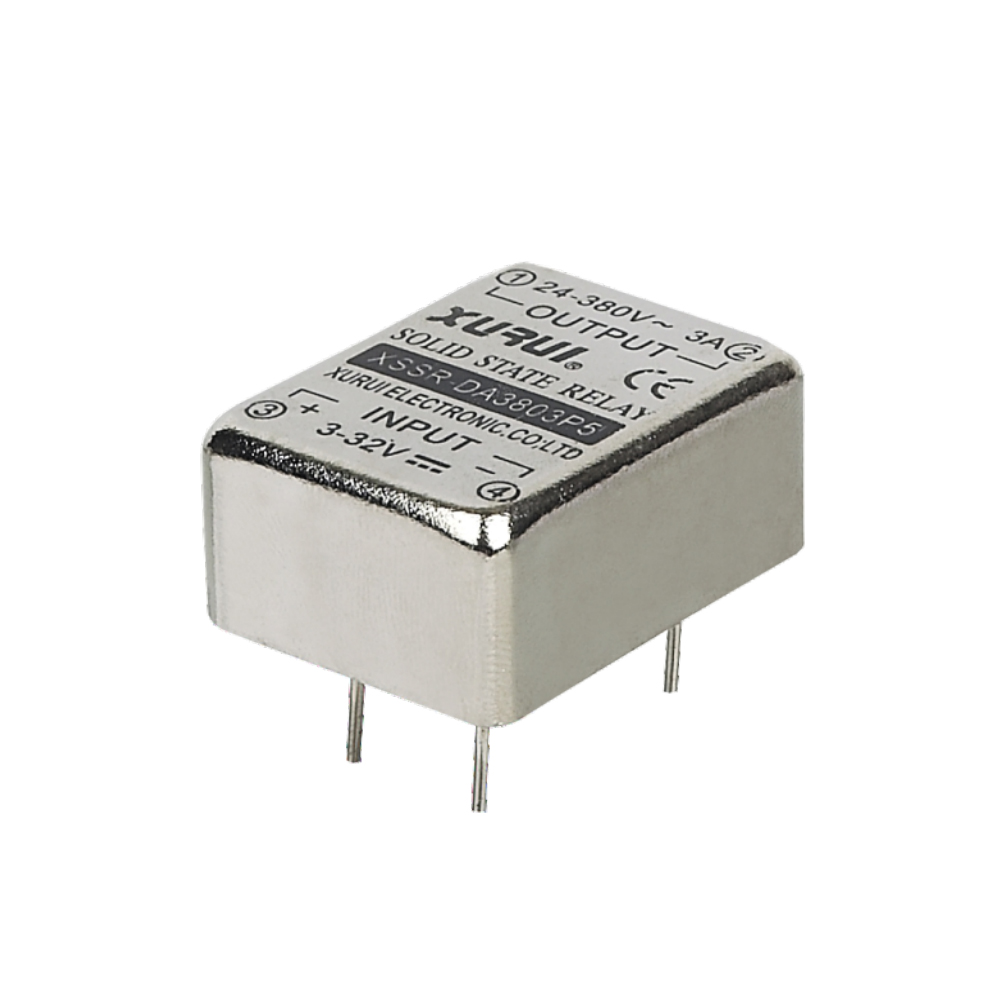
XURUI XSSR-DA3803P5 from the XSSR-P4/P5/P6 series: 24–380VAC load voltage, 1A maximum load current, 0.02A minimum load current — a compact AC-output option for small-load switching.
AC-Output vs. DC-Output Solid State Relay: Decision Table
The table below compares the two topologies on the factors that decide a project. Where the comparison touches XURUI product data, only documented figures are used; where the DC-output column falls outside the documented range of this product family, the table says so rather than filling the gap.
| Decision factor | AC-output solid state relay | DC-output solid state relay |
|---|---|---|
| Load power source | Mains AC supply | DC bus, battery pack, or DC power supply |
| Output semiconductor | Thyristor or triac output stage | MOSFET output stage |
| Turn-on behaviour | Zero-crossing or random turn-on; XSSR-M1~M6 is specified with zero-crossing triggering | No natural zero crossing exists in a DC circuit, so zero-crossing triggering does not apply |
| Turn-off path | Releases at the AC zero crossing or when current falls below the holding level | Released by gate drive; inductive DC loads need a freewheeling path |
| Typical matched loads | Heaters, AC motors, lighting, transformers, appliance elements | DC pumps, solenoid valves, DC motors, DC heating elements |
| Load current safety factor | 50–60% for resistive loads; 30–40% for inductive loads (XSSVR-CA W2, XSSR-W2-JK) | Not documented for this product family; confirm with the manufacturer |
| Documented XURUI models | XSSR-W1, XSSR-W2-JK, XSSR-W5, XSSR-W6, XSSR-3 W3/W4, XSSR-M1~M6, XSSVR-CA W2, XSSR-P4/P5/P6 | No specific DC-output model is documented in the referenced product data |
| Reference standards | IEC/EN 60947-4-3 and UL 508 are the usual industrial references | Applicable standard depends on the load and the destination market |
Frequently Asked Questions
Can I use an AC-output solid state relay to switch a DC load?
No — this is the mismatch the two topologies exist to prevent. An AC-output SSR relies on the alternating current falling to zero each cycle so that its output stage can release. A DC circuit has no such point, so the output may stay conducting after the control signal is removed. Match the relay to the load: AC load, AC-output SSR; DC load, DC-output SSR.
Which standards apply to industrial solid state relays, and what does XURUI hold?
Industrial solid state relays are required to comply with international safety standards including IEC/EN 60947-4-3 for contactors and motor-starters and UL 508 for industrial control equipment. XURUI has passed ISO9001 quality system certification, and its mainstream products carry CCC, CE, TÜV SÜD, UL, KC, and RoHS certification, complying with international safety and environmental protection standards.
What SSR capabilities does XURUI offer for AC-load projects?
XURUI operates a 5,000+㎡ facility with 150 employees, an annual output of 20 million units, and an engineering team of more than 24 engineers. The solid state relay range covers AC loads from 0–240VAC up to 75–480VAC and 24–380VAC depending on series, with load currents from 1A on the compact XSSR-P4/P5/P6 up to 1000A on the XSSR-M1~M6 family. The company supports OEM and ODM production, with customization of handle, logo, dimensions, and operating characteristics, and applies 100% pre-shipment testing.
How should I budget an SSR project — is a higher current rating always the safer buy?
Not necessarily. Buying well above the required rating adds cost and can push the operating point below the published minimum load current, which affects off-state behaviour on small loads. The more reliable approach is to size from the load: apply the 50–60% resistive or 30–40% inductive safety factor to the actual load current, then select the model whose documented voltage window and minimum load current both fit. XURUI's published ranges start at a minimum order quantity of 100 units, which keeps a first project order proportionate.
Validate before you commit
For AC-load projects, XURUI supports sample orders and OEM/ODM customization so the relay can be verified against the actual load before a production run. Standard lead time is 15–30 days, with monthly capacity ranging from 5,000 to 250,000 units and 100% pre-shipment testing on every batch.
Request a sample or quote through xuruiswitch.com, or download the full product catalogue here: XURUI Product Catalogue (PDF).
Conclusion
AC-output and DC-output solid state relays are not interchangeable parts separated by a spec sheet column. They are different answers to different load physics. An AC-output SSR — with its thyristor or triac stage, zero-crossing or random triggering, and small but non-zero leakage — is built for mains-powered heating, motor, and lighting loads. A DC-output SSR is built for DC loads, and it only performs reliably when the circuit around it accounts for stored inductive energy.
Start with the load nameplate. Confirm the power form, classify the load as resistive or inductive, apply the safety factor, then match the voltage window, minimum load current, control signal, thermal path, and compliance requirements in that order. Done in that sequence, the topology question answers itself — and the rest of the specification becomes a straightforward checklist rather than a series of corrections after installation.

Zhejiang Xurui Electronic Co., Ltd. operates a 5,000+㎡ manufacturing facility in Wenzhou, Zhejiang, with an engineering team of more than 24 engineers and 100% pre-shipment testing.
About XURUI — Zhejiang Xurui Electronic Co., Ltd. was founded in 2002 and manufactures micro switches, limit switches, foot switches, toggle switches, reed switches, solid state relays, proximity switches, and photoelectric switches. The company holds ISO9001 certification, with mainstream products carrying CCC, CE, TÜV SÜD, UL, KC, and RoHS certification. Website: xuruiswitch.com · Email: Leon@chinaxurui.com · Tel: +86-577-62911448
Have Questions or Need More Details?
Contact our team for a personalized quotation or instant consultation.
Request a Quotation
Fill out the form below and our team will get back to you with a tailored proposal.
WhatsApp Direct Chat
Prefer to chat in real-time? Message us on WhatsApp for instant assistance & quick answers.
- Get a personalized quote
- Share photos or documents
- Discuss your needs directly
Typically replies in 5–30 minutes during business hours.