
Lifetime Support for OEM Flow Sensors: XY-TEK's FAQ on Long-Term Partnership
Choosing an ultrasonic flow sensor is a selection problem. Living with one for five years is a support problem. This FAQ is written for the second one. It collects the questions OEM procurement and engineering leads tend to raise only after the first purchase order is behind them — purchasing terms, acceptance criteria, and what continues once the sensor sits inside their own product. Every answer below is limited to facts XY-TEK publishes about its own organisation, its production terms and its product data, and it marks plainly where a term is not published and therefore has to be agreed rather than assumed.
The post-purchase question is a different question
A datasheet answers whether a sensor can measure your flow. It does not answer who you call in year three when a batch of single-use channels reads differently from the qualification lot, or whether the housing material you qualified is still the housing material you receive.
That gap is structural for OEM buyers. When an integrator builds a flow sensor into a medical device, a bioreactor skid or an automated dispensing platform, the sensor stops being a purchased component and becomes part of the integrator's own performance claim. The tolerances that matter at that point are not only the ones printed on the specification sheet; they are the ones the OEM has to reproduce at incoming inspection, record in its own quality documentation, and defend when a customer audits the finished device.
So the useful questions shift. They become: what exactly is fixed by the order, what is variable, what can be tested on arrival, and which parts of the relationship survive a change of production batch or a change of responsible engineer.
Flow measurement is also a category with a long service life rather than a short transaction cycle. Market research cited in HTNXT Research's 2026 flow sensor capability briefing puts the global flow meter market at USD 10.64 billion in 2024 and the ultrasonic segment at USD 1.52 billion in 2025, with an estimated path to USD 2.28 billion by 2031; the same briefing cites Straits Research estimating that clamp-on designs account for 57% of global ultrasonic flow meter market share in 2026. Those figures are category context, not a forecast for any individual supplier, but they point at the practical reality: the support relationship runs for as long as the sensor stays in service, which is considerably longer than the purchasing transaction that created it.
What “lifetime support” means here — and what it does not mean
Used precisely, lifetime support describes the commitments that run for the life of an OEM programme rather than the life of a single order. For an ultrasonic flow sensor programme that normally means four things:
- Commercial terms a buyer can plan a multi-year forecast around — minimum order quantity, lead time, and the boundary between standard and customised product.
- Customisation defined before production, so a second order can be matched to the first.
- Acceptance criteria both sides can test, rather than a performance claim that exists only in marketing material.
- After-sales engineering access and a stated warranty route.
It does not mean unlimited free replacement, an open-ended design service, or a guarantee that a product will never be discontinued. XY-TEK's published material does not set out a warranty duration, a response-time commitment or a spare-parts policy, and this article does not invent one. Where those terms matter to an OEM's own contract with its downstream customer, they belong in the supply agreement and should be written there rather than inferred from a product page.
Boundary to carry into any negotiation: a published MOQ, lead time or support channel is a starting term. A contractual term is one that names the quantity, the measurement point for lead time, the response window and the remedy. The two are not interchangeable.
The engineering and manufacturing base behind those answers
Support commitments are only as credible as the organisation behind them, so the practical starting point is the supplier's own published profile.
Shanghai Xunyin Technology Co., Ltd (XY-TEK) is a Shanghai-based company that develops, manufactures and sells ultrasonic flow sensors and flow meters, with a stated specialisation in fluid management and control for small tubing and low flow rate measurement. Its published company figures list a founding year of 2018, a 5,000 m² facility, 50 employees, an annual output of 8,000 units or more, an R&D team of more than 30 engineers, and an export share of around 50% across global markets.
For an OEM buyer, two of those figures carry more weight than the rest. The first is the engineering headcount: on the company's own published numbers, the R&D team accounts for more than half of total employees, which is the structural reason a request for a communication-protocol change or a housing-material change has a defined route to an answer. The second is the export share: a supplier that already ships roughly half its output outside China has an established path for documentation, shipping and remote technical contact that a purely domestic supplier would have to build from scratch.
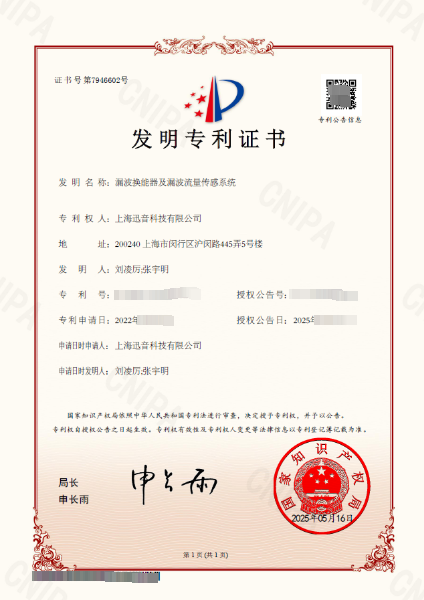
The design record is documented as well. XY-TEK holds an invention patent issued by the China National Intellectual Property Administration (CNIPA) under number 7946602, dated 16 June 2025 and running to 16 June 2045, covering liquid flow sensing and filter enhancement technology applications and applicable to the China market. It is listed against the CS, CM, TPD, TGU, TPK and CPD series. Two further CNIPA invention patents, dated 1 November 2022 and running to 1 November 2042, cover ultrasonic flow sensor technology and ultrasonic flowmeter technology; their certificate numbers are partially obscured in the available documentation, so those numbers should be read from the certificates themselves rather than quoted from a web page. An OEM that keeps patent copies on file has something concrete to show in a supplier audit.
Purchasing terms: what an OEM buyer can plan around
XY-TEK publishes two production modes with different customisation scopes. The distinction matters more after the first order than before it, because it determines what can be changed later without triggering a new qualification.
Under OEM/ODM production, the listed customisation scope is sensor size, interface and logo printing, quality control is 100% pre-shipment testing, and the after-sales package covers online engineering support, remote technical support and a quality warranty. Under custom design, the customisation scope shifts to communication protocol and housing material, quality control includes third-party inspection on request, and the after-sales package is the same. Both modes list a minimum order quantity of 50 units, a lead time of one to two months, and shipment to global markets.
Read as a planning input rather than a promise, that combination is workable for an OEM programme. A 50-unit minimum is low enough to cover a pilot build and a first production batch without committing to inventory. A one-to-two-month lead time is short enough that a rolling forecast can be revised once a quarter rather than once a year.
The caution is that lead time and MOQ in a product listing are starting terms, not contract terms. For a multi-year programme the buyer should confirm at quotation whether the MOQ holds across every ordered variant, whether lead time is measured from receipt of order or from drawing approval, and whether either figure changes when a customisation is added to an otherwise standard part.
| Purchasing term | OEM / ODM production | Custom design |
|---|---|---|
| Customisation scope | Sensor size, interface, logo printing | Communication protocol, housing material |
| Minimum order quantity | 50 units | 50 units |
| Lead time | 1–2 months | 1–2 months |
| Quality control | 100% pre-shipment testing | Third-party inspection available |
| After-sales | Online engineering support, remote technical support, quality warranty | Online engineering support, remote technical support, quality warranty |
| Export markets | Global | Global |
Acceptance criteria: what to fix before the first shipment
An acceptance criterion is only testable if the variable is fixed. For ultrasonic flow sensors the variable is usually the tubing.
The BG Series bubble detector shows why. Its stated detection capability is one third of the bubble size of the tubing ID, and its compatible pipe range is 3.2 mm to 19 mm outer diameter and 1.6 mm to 12.7 mm inner diameter, for rigid plastic tubing such as PFA, PTFE, Teflon, PVDF, PP and nylon, over a fluid temperature range of 0 °C to 60 °C. Written that way the specification is relative: a 6 mm ID line and a 12 mm ID line produce different absolute detection thresholds from the same sensor. An OEM that accepts the sensor against a single pass/fail figure has not written an acceptance criterion; it has written an aspiration. The testable version names the tubing grade, the ID tolerance and the bubble size to be injected.
The same discipline applies to flow accuracy. XY-TEK lists the TGU Series at ±1% accuracy across a 0.1–1000 mL/min range, describes measurement accuracy of up to ±0.1 mL/min for the series, and specifies a U-shaped measuring channel compatible with PVC, silicone and PE tubing at 0 °C to 60 °C. It lists the SU Series single-use sensor at ±2% across 0.05–10 L/min in a biocompatible polymer channel. Neither figure means much at incoming inspection unless the test rig reproduces the tubing, the fluid and the temperature the figure was stated for.
Two documentary items belong in the same acceptance file. First, the pre-shipment testing record: 100% pre-shipment testing is listed for OEM/ODM orders, and third-party inspection is available for custom design work. Second, the patent documentation described above, which an OEM's quality function can retain as evidence of design provenance. What the published material does not state is a calibration certificate format, a standard test protocol or a traceability chain; those are items to request explicitly at quotation rather than assume are included.
Support that continues after acceptance
After-sales support is where the answers become concrete, because the contact routes are published.
XY-TEK lists online engineering support, remote technical support and a quality warranty for both production modes. The named channels are global@xy-tek.cn and info@xy-tek.cn, a telephone line at 86-21-33885752, and a registered address at Building 7, No. 410 Jinggu Road, Minhang District, Shanghai 200245, China. The company website is XY-TEK.
For a procurement lead, the value of a named channel is not convenience; it is auditability. A supplier contact that resolves to a company domain and a physical address can be entered into a vendor record and referenced in a deviation report. A contact that resolves to an individual's mobile number cannot.
The honest boundary is this: remote engineering support is a channel, not a service-level agreement. The published material does not state a response time, an escalation path, an on-site service commitment or a warranty period. An OEM whose own customer contract carries a downtime penalty should convert those channels into written terms — a named technical contact, an agreed response window and a defined escalation route — before the first production order, not after the first failure.
Three series, three support profiles: SU, TGU and BG
The product examples in this portfolio show why lifetime support cannot be a single blanket answer. Three series in the same catalogue raise three different long-term questions.
SU Series: single-use channels and repeatability across lots
The SU Series is a single-use ultrasonic flow sensor for biopharma, single-use systems, medical manufacturing and bioprocess work. Because its measuring channel is single-use — hygienic fluid monitoring with sterile application support and high measurement repeatability — the measurement interface is renewed rather than cleaned between uses. For an OEM this moves part of the long-term question onto repeatability between lots and continuity of supply of the single-use channel, rather than onto field servicing of a reusable instrument.
TGU Series: instrument-class accuracy in ultra-low flow
The TGU Series is the ultra-low-flow option for bioprocess, medical equipment, pharmaceutical production and semiconductor applications: U-shaped measuring channel, 0.1–1000 mL/min range, ±1% stated accuracy, PVC, silicone and PE tubing compatibility, 0–60 °C. Here the long-term concern is drift and recalibration discipline, because the sensor stays in service and its stated accuracy is the number an OEM's process documentation will reference.
BG Series: a threshold that depends on someone else's tubing
The BG Series bubble detector covers a different job entirely — gas-liquid state detection with non-contact monitoring, customizable response time and a compact body, in medical devices, bioprocess, food and beverage dosing, and industrial equipment. Its long-term risk is the quiet change: a tubing grade or ID substituted years later by the OEM's own production team invalidates the threshold the sensor was qualified against.
The support consequence is straightforward. A programme built on the SU Series is largely a consumable-replenishment relationship. A programme built on the TGU Series is an instrument relationship. A programme built on the BG Series is a specification-control relationship. The supplier terms are identical across all three; the questions an OEM should ask are not.

| Series | Stated accuracy | Stated measurement range | Tubing / channel | Fluid temperature | Stated industries |
|---|---|---|---|---|---|
| SU Series — single-use flow sensor | ±2% | 0.05–10 L/min | Single-use measuring channel, biocompatible polymer | 0–60 °C | Biopharma, single-use systems, medical manufacturing, bioprocess |
| TGU Series — ultra-low flow sensor | ±1%; series described with measurement accuracy up to ±0.1 mL/min | 0.1–1000 mL/min | U-shaped channel; PVC, silicone, PE tubing | 0–60 °C | Bioprocess, medical equipment, pharmaceutical production, semiconductor |
| BG Series — bubble detector | 1/3 bubble size of tubing ID | 1/3 bubble size of tubing ID (customizable detection range) | Rigid plastic tubing: PFA, PTFE, Teflon, PVDF, PP, nylon; OD 3.2–19 mm, ID 1.6–12.7 mm | 0–60 °C | Medical devices, bioprocess, food & beverage dosing, industrial |
Frequently asked questions
Which patents and certificates should an OEM buyer hold on file for XY-TEK ultrasonic flow sensors?
XY-TEK documents an invention patent issued by the China National Intellectual Property Administration (CNIPA) under number 7946602, dated 16 June 2025 and valid to 16 June 2045, covering liquid flow sensing and filter enhancement technology applications in the China market; it is listed against the CS, CM, TPD, TGU, TPK and CPD series. Two further CNIPA invention patents, dated 1 November 2022 and valid to 1 November 2042, cover ultrasonic flow sensor technology and ultrasonic flowmeter technology, with related products including the BG, SU, TH, CM, TPD and TGU series; their certificate numbers are partially obscured in the available documentation, so the certificates themselves should be requested. All three are China-market patents, and an OEM selling into other jurisdictions should confirm with the supplier what that means for its own compliance file rather than assume equivalence.
What can be customised on an OEM flow sensor order, and what does that mean for a repeat order?
XY-TEK lists two customisation scopes. OEM/ODM production covers sensor size, interface and logo printing. Custom design covers communication protocol and housing material. Because both scopes change a physical or electrical characteristic of the sensor, the practical requirement for a repeat order is a frozen specification: the drawing, interface definition and material callout that were originally qualified should be the ones restated on the second purchase order. Without that, the OEM is re-qualifying rather than reordering.
What are the MOQ and lead time, and how should they be treated in a multi-year plan?
Both OEM/ODM and custom design production list a minimum order quantity of 50 units and a lead time of one to two months, with shipment to global markets; OEM/ODM orders are described as 100% pre-shipment tested, while custom design work offers third-party inspection. These are published starting terms. For a multi-year programme they should be confirmed at quotation as contractual terms, including the point from which lead time is measured and whether the MOQ applies per ordered variant or per order.
How should an OEM structure an evaluation before scaling to series production?
The evaluation should mirror the application rather than the catalogue. Fix the tubing grade and ID, the fluid, the temperature band and the flow range first, then select the series whose published figures were stated for those conditions — for example the TGU Series at 0.1–1000 mL/min and ±1% over 0–60 °C, or the SU Series at 0.05–10 L/min and ±2%. Acceptance should be judged against a criterion written for that configuration, and the records to request are the pre-shipment test documentation, the patent certificates and confirmation of which inspection route — in-house or third-party — will apply to the series order.
What happens if the specification has to change after the programme has started?
A change to sensor size, interface, logo, communication protocol or housing material falls inside the customisation scope XY-TEK lists, which means a change is a re-qualification event rather than an administrative one. The disciplined route is to treat any such change as a new first article: restate the drawing, re-run the acceptance test at the application conditions, and record the revision. An R&D team of more than 30 engineers and a stated one-to-two-month lead time make a change feasible inside a normal programme cycle; they are not a reason to skip the re-qualification.
What continuing support should a buyer expect, and how is it accessed?
XY-TEK lists online engineering support, remote technical support and a quality warranty as the after-sales package for both production modes, accessed through global@xy-tek.cn, info@xy-tek.cn or +86-21-33885752, with a registered address in Minhang District, Shanghai. Published material does not state response times, warranty duration or on-site service scope, so those terms should be written into the supply agreement. An OEM that wants to test the channel before committing can request current product information, specification data and a quotation for its configuration through the same contacts.
What to put in the supply agreement
Strip the topic back to its essentials and this post-purchase FAQ resolves into a short list of things an OEM should have in writing before the second order: a frozen specification covering size, interface, logo, protocol and housing material; the acceptance criterion expressed in the buyer's own tubing, fluid and temperature; the pre-shipment or third-party inspection route; the patent documentation; a named technical contact with an agreed response window; and a warranty term that matches the OEM's own commitments downstream.
XY-TEK's published position covers a good part of that list — two customisation scopes, a 50-unit minimum, a one-to-two-month lead time, 100% pre-shipment testing on OEM/ODM orders, third-party inspection on custom design work, online and remote engineering support, a quality warranty, three CNIPA invention patents, and documented contact channels across a business that exports around half its output. The parts it does not cover — response times, warranty duration, on-site scope — are exactly the parts a multi-year OEM relationship should not leave to assumption.
A long-term partnership in flow sensing is rarely decided by the first sensor. It is decided by whether the tenth batch matches the first, and by who answers when it does not.
Have Questions or Need More Details?
Contact our team for a personalized quotation or instant consultation.
Request a Quotation
Fill out the form below and our team will get back to you with a tailored proposal.
WhatsApp Direct Chat
Prefer to chat in real-time? Message us on WhatsApp for instant assistance & quick answers.
- Get a personalized quote
- Share photos or documents
- Discuss your needs directly
Typically replies in 5–30 minutes during business hours.