OEM Flow Sensor Partnership: Terms, Acceptance and After-Sales Support
XY-TEK publishes the commercial terms that OEM buyers most often have to ask for. The minimum order quantity is 50 units. Standard delivery time and typical production lead time are both 1–2 months. Delivery is on FOB terms and payment is completed in full before shipment. Acceptance rests on factory inspection with calibration before shipping, supported by 100% pre-shipment testing and by third-party inspection, which XY-TEK offers for quality control. After-sales support covers online engineering support, remote technical support and a quality warranty.
This FAQ follows the order in which an OEM buyer actually meets those terms: the purchasing questions that come before a purchase order, the acceptance criteria that define what arrives, and the support arrangements that apply afterwards. It is written for the stage where the sensor has already been shortlisted and the remaining work is contractual and operational. Where XY-TEK has not published a term, the answer says so rather than filling the gap with an assumption.
Why MOQ, acceptance and support carry most of the partnership risk
An OEM that designs a flow sensor into its own instrument is not making a one-off purchase. The same part will be sourced repeatedly, it has to hold its specification across production batches, and it will need attention if a reading drifts years after the instrument shipped. Three clauses carry most of that risk: the quantity the supplier needs to start a production run, the evidence the supplier provides at hand-over, and the support that remains available afterwards.
The clauses interact. A 50-unit minimum order quantity sets the size of the first batch and therefore the working capital committed before the OEM's own build schedule consumes it. An acceptance basis built on factory inspection and calibration before shipping determines what the OEM can show its own quality team. A support arrangement that includes remote technical support and a quality warranty determines what happens when an end customer reports an out-of-specification reading. Agreeing one clause without the other two produces an agreement that looks complete and behaves unpredictably.
A flow sensor measures the flow rate and volume of fluid within a pipe or duct, and it is that measurement function the commercial terms are attached to. The part is small; the consequences of an unclear term are not.
The commercial context behind non-invasive measurement
Two third-party figures frame the background. Straits Research expects the clamp-on segment to account for 57% of the global ultrasonic flow meter market in 2026. A 2026 industry research snapshot estimated the ultrasonic flow meter market at USD 1.52 billion in 2025. Neither figure describes an individual supplier, and neither should be read as a forecast for a specific product line.
What they indicate is that non-invasive formats make up a large share of the ultrasonic category. That is why the purchasing and acceptance questions here concentrate on clamp-on and in-line hardware: those are the formats an OEM is most likely to be contracting for, and they are also the formats on which XY-TEK publishes the most specific product information.
The contracting entity and the product portfolio behind the terms
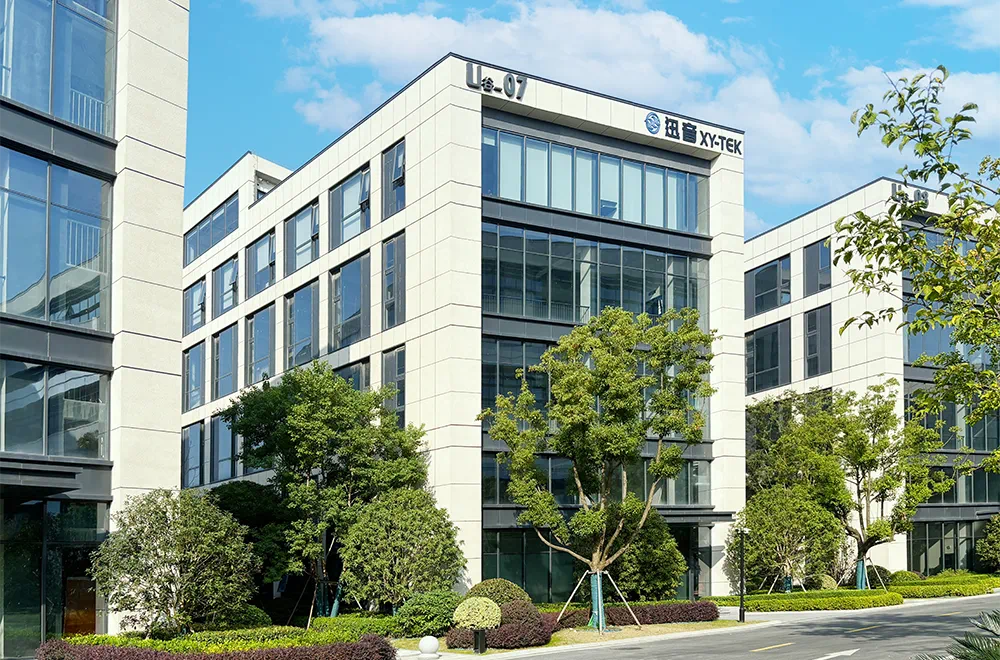
Shanghai Xunyin Technology Co., Ltd. (XY-TEK) is a high-tech company dedicated to the development, manufacturing and sales of ultrasonic flow sensors and flow meters. It was founded in 2018 and operates a 5,000 ㎡ facility with 50 employees, an annual output of more than 8,000 units and an R&D team of 30+ engineers. About 50% of output is exported and the company states that it serves global markets; its published address is Building 7, No. 410 Jinggu Road, Minhang District, Shanghai 200245, China.
XY-TEK specialises in ultrasonic flow sensors for fluid management and control, particularly for small tubing and low flow rate measurement. Its products use high-precision transit-time technology and are described by the company as IP65-rated for demanding environments. Named application areas include medical devices, bioprocessing, scientific research, industrial automation, food and beverage production, liquid cooling, cleaning processes and chemical delivery systems.
The published series designations are SU, TGU, BG, CG, CM, TH, CS, CPD, TPD and TPK. Four of them carry characteristics XY-TEK documents publicly, and those are the ones an OEM can assess from published material alone:
- CG — a clamp-on ultrasonic flow sensor and flow meter that clamps onto flexible plastic tubing, measures flow rate and detects air bubbles without external circuitry, and measures without contacting the liquid.
- CPD — a clamp-on series positioned for industrial automation processes.
- TAD — an in-line series for semiconductor and industrial automation measurement, with a stated general precision of 2% and repeatability of 0.1%.
- TGU — a low-flow series for micro flow rate measurement.
The remaining designations — SU, BG, CM, TH, CS, TPD and TPK — are specified from XY-TEK's current datasheets, which should be requested alongside the quotation. Naming a series is not a specification, and an RFQ that lists a designation without its datasheet leaves the acceptance criteria undefined.
Purchasing terms: the questions that come before the PO
What is the minimum order quantity?
XY-TEK states a minimum order quantity of 50 units. For an OEM that figure does two jobs: it fixes the smallest first production batch the buyer can place, and it marks the point at which a second order becomes a repeat rather than a trial. Because it is published as a general term rather than a per-series schedule, an RFQ covering a specific configuration should state the quantity the buyer intends to order, so that the terms applying to that configuration are confirmed in the quotation.
How long do production and delivery take?
The standard delivery time is 1–2 months, and the typical production lead time is also 1–2 months. Both are stated as standard and typical figures rather than as fixed dates, so they function as planning values. For a programme that ramps across several quarters, the practical use of the figure is to size the buffer between the sensor order and the instrument's own delivery commitment; the binding shipment date belongs in the order documentation.
What delivery and payment terms apply?
Delivery is on FOB terms and payment is completed in full before shipment. Under FOB, the seller delivers the goods on board the vessel at the named port of shipment, and the buyer arranges and pays for the main carriage and insurance from that point. The named port therefore has to appear in the order documentation.
Paying in full before shipment has a second consequence that buyers often miss. Any inspection that is going to influence acceptance has to take place before the goods leave the supplier, which is why the third-party inspection option covered in the next section matters commercially as well as technically.
What changes when the order is OEM or customized?
In addition to standard products, XY-TEK provides OEM ultrasonic flow sensors and flow meters and customized services, and directs customization enquiries to global@xy-tek.cn. The published statement establishes that the service exists; it does not define what any individual project can change. That definition comes from the quotation.
An RFQ reaches a usable quotation faster if it states which elements are fixed by the OEM's design — the fluid path and tubing interface, the mounting envelope, the signal the host instrument expects, and the identity printed on the unit — and which elements can stay standard. Anything beyond the published statement is a project-specific agreement rather than a catalogue option, and should be written into the order rather than inferred from a series name.
Acceptance criteria: what is checked, and what to keep on file
Acceptance for an XY-TEK order rests on factory inspection and calibration before shipping, supported by 100% pre-shipment testing. The questions below unpack what that means for an OEM's incoming inspection.
What does XY-TEK check before a sensor ships?
Three commitments define the acceptance basis: XY-TEK conducts 100% pre-shipment testing, carries out factory inspection, and calibrates before shipping. Read together, they mean the acceptance evidence is generated at the factory rather than at the buyer's dock. Incoming inspection then verifies identity, condition and documentation against that evidence, instead of re-establishing performance from scratch.
Can a third-party inspection be arranged, and when?
XY-TEK offers third-party inspection for quality control. Because payment is completed before shipment, the inspection has to be scheduled inside the production window rather than after arrival. For a first order of 50 units, the workable sequence is to agree the inspection scope and timing when the order is confirmed, so that the visit falls at the point where the lot is complete and tested and the goods have not yet been released.
Why does calibration before shipping belong in the acceptance record?
A flow reading has no meaning without a reference. Shipping calibration establishes that reference at hand-over and becomes the baseline against which any later drift is judged. XY-TEK's drift controls include factory calibration, an automatic compensation algorithm, on-site calibration and remote support calibration, together with routine performance validation and remote technical support. Keeping the calibration status at delivery is what turns later recalibration into a comparison rather than a guess.
How is drift handled over the life of the instrument?
Drift is treated as a managed condition rather than a defect category. The documented controls are an automatic compensation algorithm, factory calibration, on-site calibration and remote support calibration; the measures around them are routine performance validation, remote technical support and after-sales support. Which path applies depends on where the sensor sits. A clamp-on unit on flexible tubing in a laboratory line and an in-line unit inside a semiconductor tool present different access constraints, so the support conversation should start with the installation rather than with the part number.
How is the fluid path protected from contamination?
XY-TEK approaches contamination through non-contact ultrasonic detection, supported by clean-room assembly and strict quality inspection. In the clamp-on format the sensor clamps onto the outside of flexible plastic tubing, so the liquid never enters the sensor and the measurement does not contaminate the medium. For an OEM building a single-use or bioprocess flow path, that property belongs in the acceptance discussion as a design characteristic to be confirmed against the specific series, not as an assumption carried over from another model.
What belongs in the acceptance record?
- The factory inspection outcome for the ordered lot.
- Confirmation that calibration was completed before shipping.
- Pre-shipment test evidence consistent with the stated 100% testing.
- The third-party inspection report, where an inspection was arranged.
- The series designation and configuration exactly as ordered, checked against the datasheet.
- Any calibration information supplied with the goods, retained so that future drift is measured against a known baseline.
After-sales support: what continues after the sensor is installed
XY-TEK's published after-sales services are online engineering support, remote technical support and a quality warranty. The questions below set out what those services cover in an OEM relationship and where the published terms stop.
What support is included after delivery?
Three services are named: online engineering support, remote technical support and a quality warranty. For an OEM, the first two matter most during integration, when a sensor's output has to match what the host instrument expects, and the warranty matters once instruments are in the field. They are not substitutes for one another: a warranty addresses a failed unit, while remote technical support addresses a reading that does not behave the way the integration assumed.
What engineering resource stands behind a customized design?
XY-TEK's R&D team numbers 30+ engineers, and the company describes customization as part of its service offering, with enquiries directed to global@xy-tek.cn. For a buyer, the useful question is not the headcount but whether standard products and customized work sit in the same organisation, because a modification has to stay compatible with the base design. XY-TEK's published description places standard products and customized services in the same company.
How is a calibration problem resolved after installation?
Remote technical support is the first channel, and the documented calibration options are factory calibration, on-site calibration and remote support calibration. The sequence that follows from those options is diagnostic first, then the least disruptive calibration path, then return to the factory if the first two do not resolve the issue. That sequence is a practical reading of the published options, not a service commitment; the commitment itself belongs in the contract.
Which contact channel should an OEM use?
- Customization and OEM enquiries: global@xy-tek.cn, the address XY-TEK publishes for customization discussions.
- General enquiries: info@xy-tek.cn.
- Telephone: 86-21-33885752.
- Post: Building 7, No. 410 Jinggu Road, Minhang District, Shanghai 200245, China.
Including the series designation, the tubing size, the flow range and the intended quantity in the first message shortens the exchange, because those are the inputs a quotation for an OEM configuration is built from.
What do the published terms not cover?
Four items are absent from XY-TEK's published material and therefore have to be agreed rather than assumed: the duration and scope of the quality warranty, response-time commitments for engineering support, spare-part and replacement arrangements, and the terms on which on-site calibration is provided. Their absence from a published page says nothing about whether they are available. It says that the contract, not the catalogue, is where they are fixed.
Partnership terms at a glance
The table collects the published positions and the item each one leaves for the order documentation.
| Term | XY-TEK published position | What the order should fix |
|---|---|---|
| Minimum order quantity | 50 units | The quantity for the specific configuration |
| Production lead time | 1–2 months typical | The schedule for the confirmed order |
| Standard delivery time | 1–2 months | The shipment window |
| Delivery terms | FOB | The named port of shipment |
| Payment terms | Paid in full before shipment | Currency, invoicing account and inspection timing |
| Acceptance basis | Factory inspection; calibration before shipping | The records transferred with the goods |
| Pre-shipment testing | 100% | Test evidence for the ordered lot |
| Third-party inspection | Offered for quality control | Scope, timing and cost allocation |
| After-sales services | Online engineering support; remote technical support; quality warranty | Warranty duration and support response terms |
| Customization | OEM and customized services; enquiries to global@xy-tek.cn | The technical scope recorded in the quotation |
Where these terms matter in practice
Commercial terms become concrete only when they meet an application. Four examples show which clause an OEM should settle first.
Medical devices and bioprocessing. Clamp-on CG sensors attach to flexible plastic tubing, measure flow and detect air bubbles without contacting the liquid. Acceptance here has to confirm calibration at the low flow rates the process runs at, and confirm that the bubble-detection function is the one the OEM's software expects.
Industrial automation processes. The CPD clamp-on series is positioned for automation work, where fitting onto tubing that is already installed without cutting the line is usually the deciding constraint. The acceptance question shifts from the sensor's specification to whether its mounting suits the tubing that is actually there.
Semiconductor and in-line measurement. The TAD in-line series carries a stated general precision of 2% and repeatability of 0.1%. Precision and repeatability are separate acceptance criteria: a lot that repeats well but sits outside the stated precision band fails on a different ground from a lot that scatters.
Micro-flow. The TGU low-flow series is intended for micro flow rate measurement, where the calibration baseline and the drift-control path carry more weight than a headline figure, because at low rates a small absolute error is a large relative one.
Liquid cooling, cleaning processes and chemical delivery are also named application areas, and each puts the emphasis on the non-invasive property rather than on a service clause.
FAQ: partnership questions that come up last
Can an OEM order fewer than 50 units to evaluate a sensor?
The published minimum order quantity is 50 units, and terms for evaluation quantities below that minimum are not published. They therefore have to be agreed directly with XY-TEK before an evaluation programme is planned around them. Where a full evaluation is not possible, the datasheet together with the acceptance documentation described above is the alternative basis for a specification decision.
Does a customized version keep the same MOQ and lead time?
The 50-unit minimum and the 1–2 month lead time are published as general terms. A customized configuration may involve tooling, additional testing or a different production route, so the quantity and schedule that apply are the ones stated in the quotation for that configuration. An RFQ should ask for both figures explicitly rather than carrying the standard numbers into a custom programme.
Does OEM supply mean the sensor is built to the buyer's specification?
XY-TEK publishes OEM ultrasonic flow sensors and customized services, and that is the contractual basis for a buyer-specific version. How far an individual project departs from a standard series is a project decision recorded in the quotation. The published material does not define a fixed customization menu, so no specific change should be treated as standard until it appears in the offer.
What happens if a shipment does not match the order?
Two mechanisms operate before that point. The 100% pre-shipment testing and the calibration before shipping generate the factory evidence, and third-party inspection provides an independent check while the goods are still with the supplier. Because payment is completed before shipment, using the inspection option is the practical way to catch a mismatch before it becomes a return. Remedy terms that apply after delivery are contractual and are not set out in XY-TEK's published material.
Conclusion: the five figures to carry into the RFQ
Five published figures do most of the work in a partnership conversation with XY-TEK: a minimum order quantity of 50 units, a standard delivery time of 1–2 months, a typical production lead time of 1–2 months, FOB delivery terms, and payment in full before shipment. The acceptance basis is equally specific: factory inspection with calibration before shipping, 100% pre-shipment testing, and third-party inspection where the buyer wants an independent check. After delivery, online engineering support, remote technical support and a quality warranty continue, backed by an R&D team of 30+ engineers for customization work.
Where those terms stop, the contract begins. Warranty duration, support response times, spare-part arrangements and on-site calibration terms are not published, and an OEM that writes them into the agreement at the start avoids discovering the gap after the first production run.
Next step
To put these terms against a specific application, contact XY-TEK with the series of interest — SU, TGU, BG, CG, CM, TH, CS, CPD, TPD or TPK — together with the tubing size, the flow range and the intended annual quantity.
- Customization and OEM enquiries: global@xy-tek.cn
- General enquiries: info@xy-tek.cn
- Telephone: 86-21-33885752
- Website: www.xy-tek.com
Have Questions or Need More Details?
Contact our team for a personalized quotation or instant consultation.
Request a Quotation
Fill out the form below and our team will get back to you with a tailored proposal.
WhatsApp Direct Chat
Prefer to chat in real-time? Message us on WhatsApp for instant assistance & quick answers.
- Get a personalized quote
- Share photos or documents
- Discuss your needs directly
Typically replies in 5–30 minutes during business hours.