
Selecting the Right Flow Sensor for Semiconductor and Water Treatment Applications
Semiconductor fabs and water treatment plants rarely buy the same instrument, yet they ask the same four questions when a flow sensor is specified. Can the sensor measure without touching or contaminating the fluid? Does it cover the real flow range of the line? Can it report data continuously enough for closed-loop control? And will it keep running without mechanical wear, recalibration downtime or pipe modification? Non-invasive clamp-on ultrasonic flow sensors such as the CPD Series from XY-TEK are built around those four questions: the sensor has no moving parts, clamps onto the outside of rigid plastic tubing without pipe cutting, monitors flow in real time across a 0.1–50 L/min scope with ±2% accuracy, and includes air bubble monitoring.
This guide is written for engineers, procurement managers and OEM integrators who are evaluating a flow sensor for these two industries for the first time — typically at the awareness and research stage, before a specification is frozen and before a tubing or panel layout is finalized. It explains why the application, not the datasheet alone, drives the choice, then walks through a six-step selection process and compares the clamp-on and inline formats that XY-TEK manufactures.
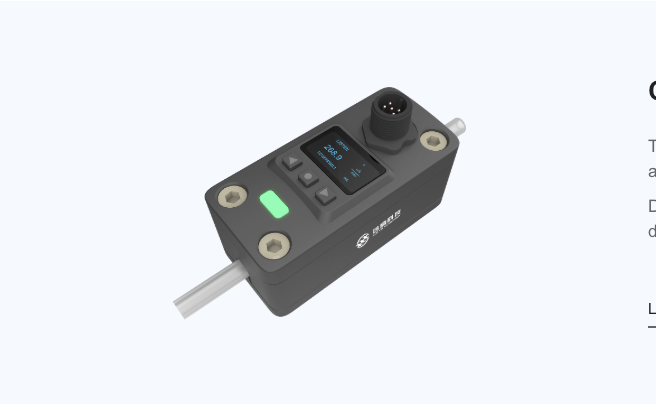
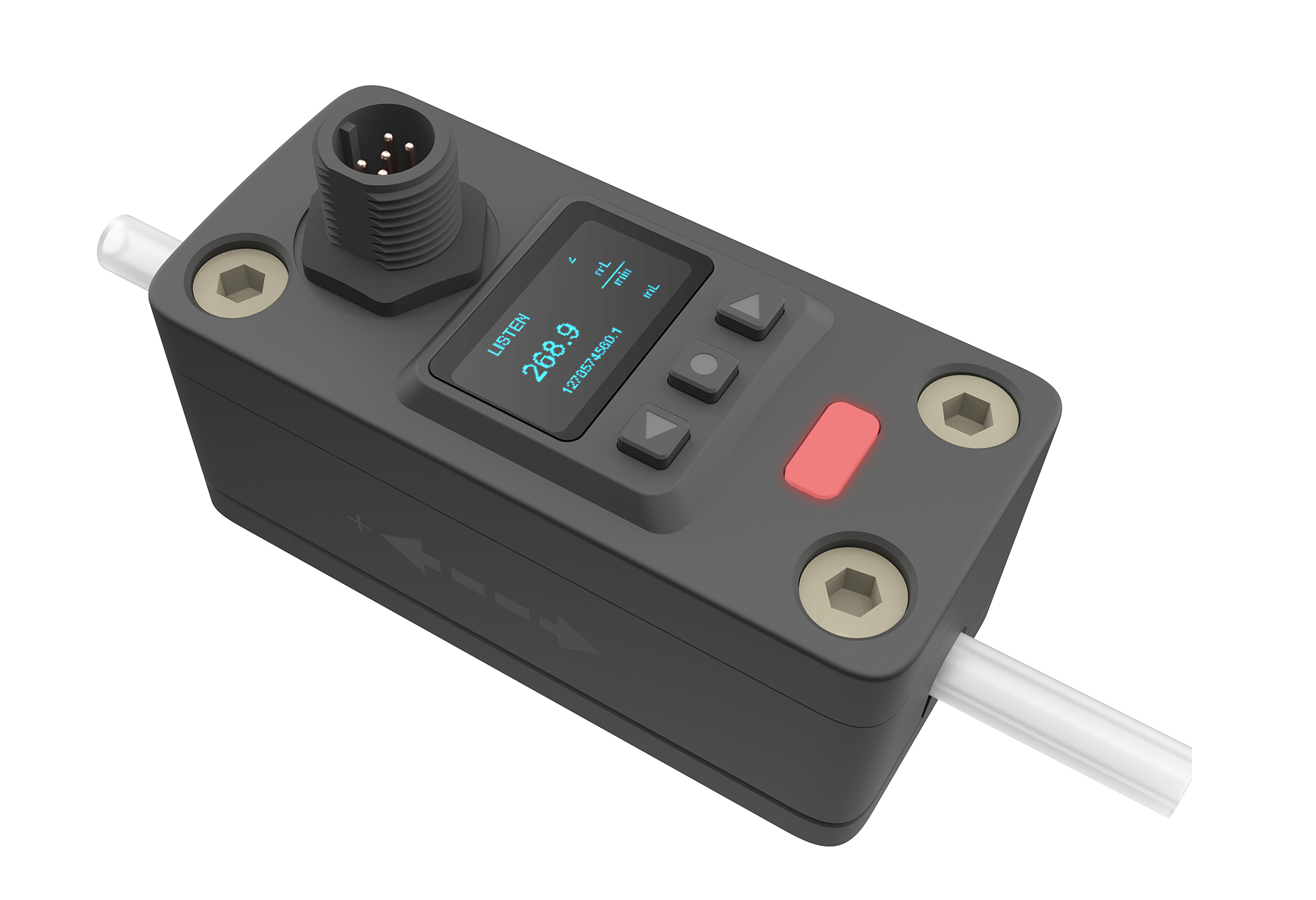
CPD Series clamp-on ultrasonic flow sensor — non-invasive, no moving parts, 0.1–50 L/min, ±2% accuracy, built-in LED display and air bubble monitoring.
What Makes Semiconductor and Water Treatment Flow Measurement Difficult
Both industries care about flow accuracy, but they arrive at that requirement from opposite directions. Semiconductor lines are intolerant of contamination and downtime; water treatment lines are intolerant of maintenance-heavy hardware and unstable measurement. The same sensor format can serve both, provided it does not introduce a new failure point into either environment.
Semiconductor: purity, small tubing and uptime
Semiconductor process lines typically carry high-purity water, acids, solvents and chemical additives through small-diameter rigid plastic tubing. Two consequences follow. First, any wetted sensor element is a potential source of particles or chemical residue, so non-invasive measurement is preferred wherever the accuracy budget allows it. Second, because the tubing is small and often routed inside a tool or a compact skid, cutting the pipe to install an inline meter means downtime and, in many workflows, a re-validation step. A clamp-on format that installs on the outside of the tube avoids both issues: the CPD Series is compatible with rigid plastic tubing such as PFA, PTFE, Teflon, PVDF, PP and Nylon, with a compatible pipe outer diameter range of 6–26 mm and inner diameter range of 3–20 mm.
Water treatment: continuous duty and mixed chemistry
Water treatment duty is a different operating profile. Flow sensors in dosing, filtration and transfer lines run continuously and see a wide range of chemistry — water, acids, chemicals, and slurry or paint-like media that contain no or few solid particles. Mechanical meters in this environment wear, generate pressure loss and eventually need service access that may not exist in a packed skid. A no-moving-part clamp-on sensor such as the CPD Series, rated for fluid temperatures from 0°C to 90°C and made from engineering plastic and an ultrasonic transducer, removes the wear mechanism entirely and keeps the wetted path unchanged.
The shared constraint
The decision rule that applies to both industries is simple: the measurement device must not become a new contamination source, a new pressure-loss point or a new maintenance item. This is why non-invasive, no-moving-part measurement is usually the first option to evaluate in semiconductor and water treatment service, and why inline wetted construction should be justified by a specific requirement — very high accuracy on a fixed line, or a permanent pipe run where clamp-on access is impossible.
Where the Market Is Moving
Several published market estimates explain why clamp-on ultrasonic formats keep appearing on specification sheets. Grand View Research estimated the global flow meter market at USD 10.64 billion in 2024, projected to reach USD 15.17 billion by 2030. Mordor Intelligence valued the global ultrasonic flow meter market at USD 1.52 billion in 2025, with growth to USD 2.28 billion expected by 2031. Fortune Business Insights reported that Asia Pacific held the largest share of the ultrasonic flow meter market in 2025 at 38.6%, driven by industrial expansion. Global Information, Inc. (GII) valued the clamp-on ultrasonic flowmeter segment at USD 1.25 billion in 2024, growing at a CAGR of 7.4% through 2032. For the semiconductor side specifically, Market Research Future estimated flow control in the semiconductor industry at USD 5.83 billion in 2024, driven by high-purity fluid management.
Note that published estimates of the ultrasonic flow meter market diverge substantially because vendors define the category differently — some include municipal smart water meters, others count only process instrumentation. Buyers should treat these figures as directional market context, not as a specification input. Estimates from Vertex AI / Grand View Research, Mordor Intelligence and Dataintelo for the same 2024–2025 period differ by a factor of several, which is a scope difference rather than a contradiction.
On the supply side, Dataintelo lists Emerson Electric, Siemens AG, Endress+Hauser and Honeywell among the major global competitors in the ultrasonic flow sensor market. Alongside these broad-line suppliers, specialist manufacturers such as XY-TEK focus on a narrower problem: ultrasonic flow sensors for small tubing and low flow rates, including the CG series clamp-on sensors that attach directly to flexible plastic tubing.
Reference standard worth naming in a specification: ISO 24062:2023 specifies requirements for clamp-on ultrasonic transit-time meters for liquids and gases in closed conduits. Where a sensor is destined for medical or single-use manufacturing environments, EN ISO 13485 quality management system expectations apply to the sensor supplier. These are buyer-side references; a specific sensor configuration should always be confirmed against the supplier's own documentation.
The Non-Invasive Clamp-On Approach: CPD Series and Related Formats
The CPD Series is a clamp-on ultrasonic flow sensor classified as a non-invasive industrial flow sensor. Its defining characteristics map directly onto the two target industries: it requires no pipe cutting, has no moving parts, needs low maintenance, supports real-time flow monitoring, and offers a measurement scope of 0.1–50 L/min at ±2% accuracy. Installation is clamp-on, the construction is engineering plastic with an ultrasonic transducer, and the unit includes air bubble monitoring, digital output compatibility and a built-in LED display. XY-TEK lists industrial automation, semiconductor, food & beverage and water treatment as its applicable industries.
That combination matters more than any single line on the datasheet. In semiconductor service, air bubble monitoring is not a bonus feature but a process safeguard — bubbles in a chemical delivery or rinse line distort flow readings and can indicate a supply problem upstream. In water treatment service, the same bubble signal helps distinguish a genuine drop in dosing flow from an air pocket in the suction line, which is a common cause of false alarms in chemical dosing systems.
Supporting formats in the same portfolio
The CPD Series is not the only relevant option, and a good selection exercise compares it against the rest of the range before committing:
- CS Series — clamp-on ultrasonic flow sensor: 0.1–50 L/min at ±3% accuracy, compact integrated design, clamp-on installation, air bubble monitoring and digital output compatibility. Applicable to semiconductor, water treatment, food & beverage and industrial automation.
- CG Series — clamp-on ultrasonic flow sensor: 0.02–20 L/min with ±1% accuracy, ABS housing with stainless steel sensor components, analog, pulse and RS485 outputs, air bubble and bi-directional flow detection. Designed for flexible plastic tubing such as PVC, silicone, PFA, PE and PUR, with fluid temperatures from 0°C to 60°C.
- CM Series — OEM clamp-on flow meter: 0.05–30 L/min at ±3% accuracy with RS485 output, compact design, non-contact liquid measurement and stable signal transmission for easy OEM integration.
- TPK and TPD Series — inline ultrasonic flow sensors: 0.5–100 L/min at ±2% of reading, stainless steel and engineering plastics, integrated structure, no moving parts, low maintenance and real-time flow monitoring; used in industrial automation, battery manufacturing, chemical processing and liquid cooling.
- TGU Series — low-flow ultrasonic flow sensor: 0.1–1000 mL/min at ±1% accuracy with a U-shaped measuring channel, compatible with PVC, silicone and PE tubing; intended for bioprocess, medical equipment, pharmaceutical production and semiconductor applications.
- SU Series — single-use ultrasonic flow sensor: 0.05–10 L/min, single-use measuring channel in biocompatible polymer materials, high measurement repeatability, supporting sterile applications and hygienic fluid monitoring for biopharma and medical manufacturing.
Behind these formats, XY-TEK (Shanghai Xunyin Technology Co., Ltd) was established in 2018 and designs and manufactures ultrasonic flow sensors and meters for fluid management and control. The company employs approximately 50 staff in a 5,000 square meter facility, with an R&D team of more than 30 engineers and an annual production capacity of over 8,000 units. Export business accounts for 50% of total sales, serving medical devices, bioprocessing, scientific research, industrial automation and food/beverage production.
A Six-Step Selection Process for These Two Industries
Step 1 — Define the duty point before the sensor
Write down the fluid, the minimum, normal and maximum flow, the fluid temperature, the tubing outer and inner diameter, the tubing material and the required output. Clamp-on ultrasonic measurement is sensitive to tubing dimensions and material because the sound path passes through the wall, so a diameter range that was estimated rather than measured is the single most common cause of a mismatched selection. The CPD Series covers 0–90°C fluid temperature and 6–26 mm outer diameter tubing, which is a useful first filter.
Step 2 — Screen fluid and tubing compatibility
Next, confirm that the measurable-fluid and pipe-material lists accept your media. The CPD Series supports water, acids, pure water, drinks, oil, paints, chemicals and slurry containing no or few solid particles, on rigid plastic tubing such as PFA, PTFE, Teflon, PVDF, PP and Nylon. If the line uses flexible tubing instead — PVC, silicone, PFA, PE or PUR with smooth inner and outer surfaces — the CG Series is the matching clamp-on option. Heavy solids, high opacity or entrained gas outside the specified limits should be treated as a stop condition and escalated to the supplier rather than accommodated by assumption.
Step 3 — Match the sensor to the flow range
Flow range is where semiconductor and water treatment lines often diverge. A chemical delivery line in a fab may sit in the low millilitre-per-minute region, while a treatment transfer line may run in the tens of litres per minute. The XY-TEK range covers both ends: TGU Series from 0.1–1000 mL/min, CG Series from 0.02–20 L/min, CM Series from 0.05–30 L/min, CPD and CS Series from 0.1–50 L/min, and TPK and TPD inline sensors from 0.5–100 L/min. Choosing a sensor whose range brackets the normal operating point — rather than the maximum possible flow — keeps resolution usable across the working band.
Step 4 — Decide clamp-on or inline
Default to clamp-on in both industries unless a specific constraint rules it out. Clamp-on installation requires no pipe cutting, so it can be retrofitted during a maintenance window without breaking the fluid path. Inline sensors such as the TPK and TPD Series remain appropriate where a permanent pipe run already exists, where the line is being built new, or where an integrated stainless steel or engineering plastic body is preferred for mechanical robustness in liquid cooling and battery manufacturing environments.
Step 5 — Check the signal and control interface
Real-time monitoring is only useful if the signal reaches the controller. Confirm the output format against your PLC, SCADA or dosing controller: the CPD Series offers digital output compatibility with a built-in LED display for local verification, the CM Series uses RS485, and the CG Series provides analog, pulse and RS485 outputs simultaneously. Also decide whether the application needs bubble detection as a control input or only as an alarm condition, since that changes how the signal is wired and handled in the program logic.
Step 6 — Validate on the real tubing and plan supply
Finish with a validation run on the actual tubing and fluid, not a bench surrogate. Clamp-on sensors respond to the acoustic path through the specific tube wall, so a test on the production tube is the most reliable confirmation of accuracy and repeatability in semiconductor and water treatment service. This step also gives the operations team a chance to confirm installation clearance around the sensor body.
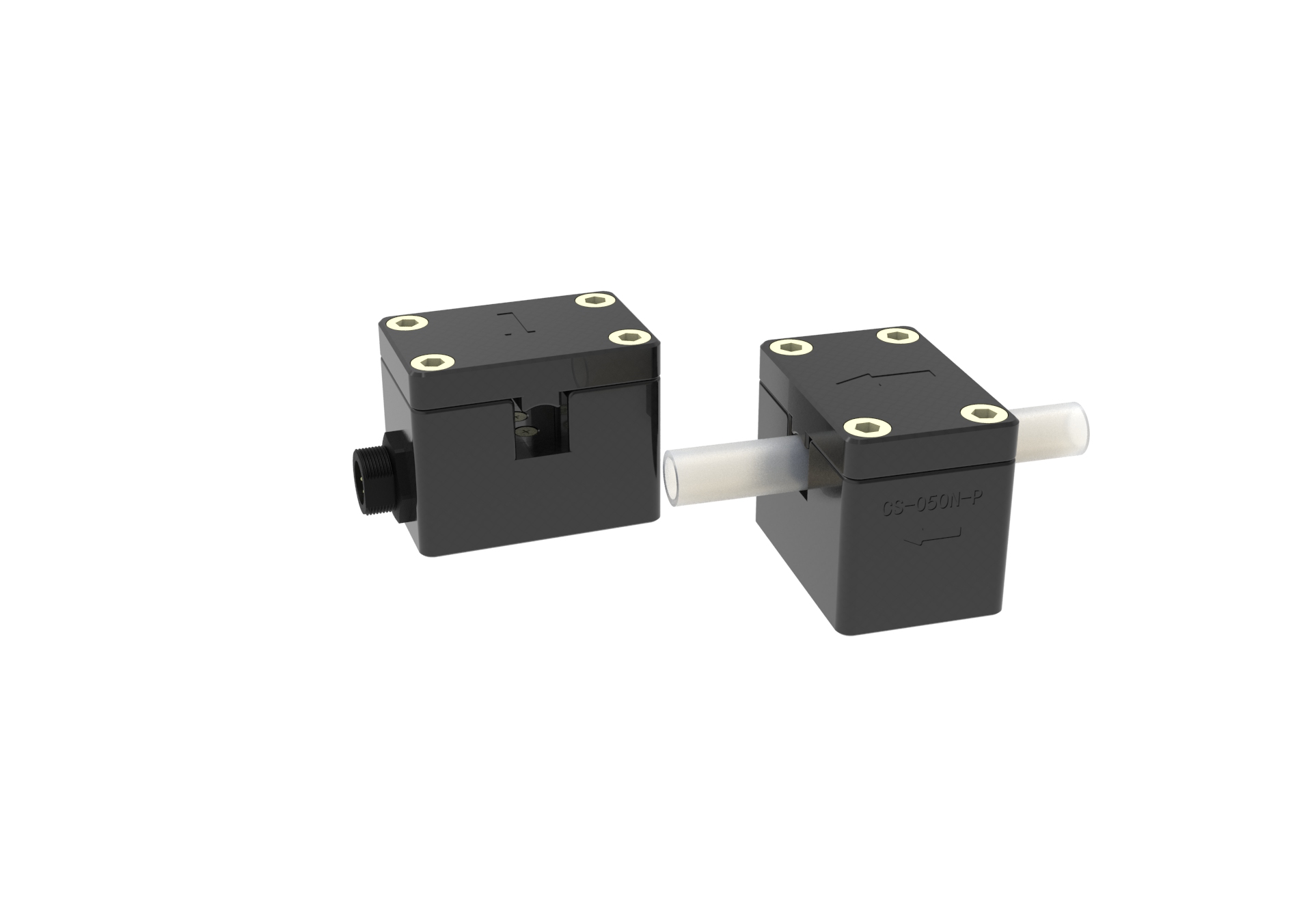
Clamp-on installation keeps the fluid path untouched — no pipe cutting, no wetted moving parts, no additional pressure loss.
Application Scenarios in Practice
Semiconductor process and utility lines
In semiconductor service, the flow sensor is usually mounted on small-diameter rigid tubing carrying high-purity water, acids or chemical additives. The CPD Series is intended for this environment: non-invasive clamp-on mounting, air bubble monitoring to flag gas pockets in chemical delivery, and no moving parts that could shed particles into a purity-critical line. Because nothing is inserted into the tube, maintenance work on the sensor does not open the fluid path.
Water treatment dosing, filtration and transfer
Water treatment lines value different properties from the same hardware: continuous duty, tolerance of mixed chemistry, and low maintenance. The CPD Series is designed for water treatment use with a 0–90°C fluid temperature range and a measurable-fluid list that spans water, acids, chemicals and low-solids slurry. The absence of moving parts removes the wear cycle that drives replacement intervals on mechanical meters, and digital output compatibility allows the reading to be fed into dosing control or plant monitoring without a separate transmitter.
Micro-flow precision control in shared industrial systems
Many facilities that run semiconductor or water treatment processes also operate precision fluid systems in the same building: spraying, dispensing and cleaning equipment on automated production lines. These applications require micro-flow and pulse-flow monitoring with high stability and fast response, detection of bubbles, blockage or abnormal flow, and process data traceability. Non-contact clamp-on ultrasonic time-difference measurement supports closed-loop control in these systems, and the same approach is used in industrial markets such as Germany and the United States. For very small duty points, the TGU Series extends the same measurement principle down to 0.1–1000 mL/min.
Micro-flow monitoring in dispensing, spraying and cleaning systems — the same non-contact measurement principle used in semiconductor and water treatment lines.
Adjacent purity-critical duty points
Where a semiconductor or water treatment facility also runs bioprocess, laboratory or medical-adjacent equipment, two further formats are relevant. The SU Series single-use ultrasonic flow sensor covers 0.05–10 L/min with a single-use measuring channel in biocompatible polymer materials, supporting sterile applications and hygienic fluid monitoring. The BG Series bubble detector sensor provides non-contact gas-liquid state detection with customizable detection range and response time. Standardisation across these formats keeps spares, protocols and training consistent across a site.
Comparison Table: Which XY-TEK Format Fits Which Duty
| Model | Format | Flow range | Accuracy | Installation | Typical industries |
|---|---|---|---|---|---|
| CPD Series | Clamp-on, non-invasive | 0.1–50 L/min | ±2% | Clamp-on, no pipe cutting | Water treatment, semiconductor, food & beverage, industrial automation |
| CS Series | Clamp-on, non-invasive | 0.1–50 L/min | ±3% | Clamp-on | Water treatment, semiconductor, food & beverage, industrial automation |
| CG Series | Clamp-on | 0.02–20 L/min | ±1% | Clamp-on, flexible tubing | Industrial automation, biopharmaceutical, medical devices |
| CM Series | OEM clamp-on flow meter | 0.05–30 L/min | ±3% | Clamp-on | Medical devices, OEM equipment, fluid control systems, laboratory equipment |
| TPK Series | Inline | 0.5–100 L/min | ±2% | Inline, integrated structure | Industrial automation, battery manufacturing, chemical processing, liquid cooling |
| TPD Series | Inline | 0.5–100 L/min | ±2% | Inline, integrated structure | Industrial automation, battery manufacturing, chemical processing, liquid cooling |
| TGU Series | Low-flow, U-shaped channel | 0.1–1000 mL/min | ±1% | Channel-mounted, PVC / silicone / PE tubing | Bioprocess, medical equipment, pharmaceutical production, semiconductor |
| SU Series | Single-use | 0.05–10 L/min | ±2% | Single-use measuring channel | Biopharma, single-use systems, medical manufacturing, bioprocess |
| BG Series | Ultrasonic bubble detector | Detection based on bubble size relative to tubing ID | Non-contact gas-liquid state detection | Clamp-on | Medical devices, bioprocess, food & beverage dosing, industrial |
For semiconductor and water treatment selection specifically, the practical decision narrows to a smaller set of criteria. The table below frames the clamp-on versus inline choice around the constraints that actually appear in these two industries.
| Selection criterion | Clamp-on (e.g. CPD, CS Series) | Inline (e.g. TPK, TPD Series) |
|---|---|---|
| Pipe cutting required | No | Yes — the sensor becomes part of the pipe run |
| Fluid path impact | Unchanged; no wetted moving parts | Fluid passes through the sensor body |
| Maintenance characteristics | No moving parts, low maintenance | No moving parts, low maintenance, integrated structure |
| Retrofit into an existing line | Straightforward; can be done during a maintenance window | Requires a planned shutdown and rework |
| Bubble monitoring | Included on CPD and CS Series | Not part of the cited specification |
| Best fit in these two industries | Small-diameter rigid or flexible tubing, purity-critical and retrofit duty | Permanent pipe runs and integrated skid builds |
Flow monitoring, bubble detection and real-time metering on small-diameter lines — the control functions shared by semiconductor and water treatment processes.
Frequently Asked Questions
Do clamp-on ultrasonic flow sensors meet the standards that semiconductor and water treatment projects require?
There is no single certificate that covers both industries. ISO 24062:2023 specifies requirements for clamp-on ultrasonic transit-time meters for liquids and gases in closed conduits, and it is the reference to name when a clamp-on sensor is specified for a closed-pipe application. Where a sensor is used in medical or single-use manufacturing environments, EN ISO 13485 quality management system expectations apply to the sensor supplier. Because suitability also depends on fluid, tubing dimensions, temperature and output format, buyers should request supplier documentation for the exact configuration rather than accept a category-level claim. The CPD Series is designed for water treatment, semiconductor, food & beverage and industrial automation industries.
What flow range and accuracy does the CPD Series deliver, and is that enough for both industries?
The CPD Series measures 0.1–50 L/min with ±2% accuracy, supports compatible pipe outer diameters of 6–26 mm and inner diameters of 3–20 mm, and is rated for fluid temperatures from 0°C to 90°C. That band covers a large share of semiconductor chemical and rinse-water lines and most water treatment dosing and transfer duty. Where the duty point falls outside it, the same portfolio extends both directions: the TGU Series covers 0.1–1000 mL/min for very small flows, while the TPK and TPD inline sensors cover 0.5–100 L/min for larger lines. Range selection should be based on the normal operating point, not the maximum possible flow.
What drives the cost of a clamp-on flow sensor project in these industries?
XY-TEK does not publish a price list for these sensors, because configuration drives cost far more than model name. The main cost drivers are the flow range and format, the pipe size range, the construction materials and fluid temperature rating, the output interface required (digital output compatibility, RS485, analog or pulse), whether bubble detection and an integrated display are needed, the quantity and level of OEM customisation, and any documentation or validation package requested by the buyer's quality team. Defining the duty point first — fluid, flow band, temperature, tubing dimensions and output — is the most effective way to keep a quote comparable across suppliers.
Can we validate the sensor on our own tubing before committing to a specification?
Yes, and it is the recommended approach. Clamp-on ultrasonic measurement depends on the acoustic path through the specific tube wall, so a validation run on the actual production tubing and fluid is more informative than a bench test on a different tube. Confirmation should cover the tubing outer and inner diameter within the compatible range (6–26 mm outer diameter for the CPD Series, for example), the fluid temperature, and whether air bubble monitoring behaves as expected in the real line. XY-TEK provides OEM ultrasonic flow sensors and customized services; contact the team at global@xy-tek.cn to discuss sample and pilot arrangements for a specific configuration.
What information should we prepare to shorten the path from evaluation to supply?
Six items are enough to start: the fluid and its temperature range, the minimum, normal and maximum flow rates, the tubing outer and inner diameter with material, the required output interface, the installation environment including available clearance, and the expected annual quantity. With that information, an application can be matched to a format in the range — clamp-on for retrofit and purity-critical lines, inline for permanent pipe runs — and the discussion moves directly to configuration. XY-TEK manufactures in a 5,000 square meter facility with an R&D team of more than 30 engineers and annual capacity of over 8,000 units, serving export markets that account for 50% of sales. Send the application details to global@xy-tek.cn or call 86-21-33885752 to start a flow sensor specification.
Conclusion
Semiconductor and water treatment applications look different on the surface, but they converge on the same requirement: measure the fluid without disturbing it, and do so continuously without adding a maintenance burden. Non-invasive clamp-on ultrasonic sensors such as the CPD Series meet that requirement through a no-moving-part design, clamp-on installation with no pipe cutting, real-time flow monitoring, air bubble detection and a 0.1–50 L/min range at ±2% accuracy, with the surrounding XY-TEK portfolio covering duty points from 0.1 mL/min up to 100 L/min.
The selection process itself is not complicated: define the duty point, screen fluid and tubing compatibility, match the flow range, choose clamp-on or inline, confirm the control interface, then validate on the real tubing. Doing those six steps in order prevents the most common and most expensive selection errors in both industries — a sensor dimensioned against the wrong tube, a range chosen for peak rather than normal flow, or a wetted meter installed in a line that never needed one.
Next step: send your duty point to XY-TEK and request a sample or quotation for the configuration that fits your line. Email global@xy-tek.cn or call 86-21-33885752. Company details and the full sensor range are available at www.xy-tek.com.
Request a CPD Series clamp-on ultrasonic flow sensor sample or quotation for your semiconductor or water treatment line.
Have Questions or Need More Details?
Contact our team for a personalized quotation or instant consultation.
Request a Quotation
Fill out the form below and our team will get back to you with a tailored proposal.
WhatsApp Direct Chat
Prefer to chat in real-time? Message us on WhatsApp for instant assistance & quick answers.
- Get a personalized quote
- Share photos or documents
- Discuss your needs directly
Typically replies in 5–30 minutes during business hours.