
Ultrasonic Flow Sensor Basics: Clamp-On, Inline, Single-Use
A flow sensor measures the flow rate and volume of fluids within a pipe or a duct, and is used to monitor and control liquid flow. In ultrasonic designs, that measurement happens without any moving part in the flow path — which is why the format decision (clamp-on, in-line, or non-invasive measurement on a single-use fluid path) usually matters more than the brand decision. This guide is written for procurement engineers and OEM integrators who need a working baseline on the category before they start comparing specific suppliers or models.
Why the Format Decision Comes Before the Supplier Decision
Most ultrasonic flow sensor selection problems are not caused by weak suppliers. They are caused by a format that was fixed too early in the project. A format simultaneously determines four things: whether the sensor touches the liquid, whether the line has to be cut, how much pressure the pump has to add, and which accuracy class is realistic for the application.
Once those constraints are written into a drawing or a bill of materials, changing them is expensive. The mechanical interface changes, the validation work is repeated, and the sourcing process often restarts at the sample stage. Buyers who understand the format families first tend to write better specifications: they avoid over-specifying accuracy where the process does not need it, and avoid under-specifying contamination control where the process depends on it.
A useful way to frame it: clamp-on, in-line, and single-use-compatible sensors can all be ultrasonic, can all rely on the same transit-time principle, and can even come from the same manufacturer — yet they answer different integration questions. The format is a process decision, not a catalogue decision.
Industry Background: A Mature Category with a Growing Ultrasonic Segment
Flow measurement is a mature field, but its ultrasonic segment is still expanding. The global flow meter market was estimated at USD 10.64 billion in 2024 and is projected to reach USD 15.17 billion by 2030. The ultrasonic flow meter segment specifically was valued at USD 1.52 billion in 2025, with an estimated growth path to USD 2.28 billion by 2031.
Mounting method is one of the clearest splits inside that segment: clamp-on ultrasonic flowmeters are expected to account for 57% of the global ultrasonic flow meter market share in 2026. For buyers, that figure carries a practical message — the majority of ultrasonic demand is being solved by sensors that attach to the outside of a pipe or tube rather than interrupting the flow path. Retrofits, contamination-sensitive processes, and small-tubing systems all push selection in the same direction.
Shanghai Xunyin Technology Co., Ltd. (XY-TEK), founded in 2018, develops, manufactures, and sells ultrasonic flow sensors and flow meters, with a stated focus on small tubing and low flow rate measurement. Its sensors are used in medical devices, bioprocessing, scientific research, industrial automation, and food and beverage production, and the company also supplies OEM ultrasonic flow sensors together with customized services.
How Ultrasonic Flow Sensing Works
Ultrasonic flow sensors using transit-time technology calculate flow by comparing the travel time of an acoustic signal sent with the flow against the travel time of a signal sent against it. The difference between the two is proportional to the velocity of the liquid, which is then converted into flow rate. XY-TEK states that its products use high-precision transit-time technology with IP65-rated durability for demanding environments.
Three characteristics follow from that principle and shape every format decision:
- No moving parts in the measurement path. There are no turbine blades or rotors to wear, so there is no mechanical wear risk and no drift caused by worn components. Ultrasonic measurement is also insensitive to fluid cleanliness, which makes it more tolerant of low-flow and dirty media than mechanical designs.
- Zero pressure drop. Because the measurement does not obstruct the loop in clamp-on form, the sensor does not add resistance that the pump has to compensate for.
- Independence from fluid conductivity. Transit-time measurement works with both conductive and non-conductive liquids. Electromagnetic meters, by contrast, require a conductive medium and cannot measure fluorinated liquids or mineral oils.
These are general properties of the technology rather than differences between one ultrasonic format and another. Where the formats differ is in where the sensor sits relative to the liquid.
The Format Families in Practice
Clamp-On (Non-Invasive) Sensors
Clamp-on sensors mount on the outside of the tubing and measure through the wall, so the sensor never contacts the medium. XY-TEK's CG Series clamp-on ultrasonic flow sensors are compact and output results without external circuitry; they clamp directly onto flexible plastic tubing to measure liquid flow rate and detect air bubbles. Because the liquid stays inside a closed tube, clamp-on measurement fits medical devices and bioprocess equipment, where the fluid path has to stay uncontaminated.
The CPD Series applies the same clamp-on principle to industrial automation processes, where the priority is usually retrofit-friendly installation on existing tubing rather than a sterile fluid path.
A practical boundary applies to this format: clamp-on measurement is generally suitable where the tube wall material and thickness allow ultrasonic transmission and where the tubing is stable enough to keep the transducer in position. It is a weaker fit for lines that are opened frequently or where the outer surface cannot be prepared reliably.
In-Line Sensors
In-line sensors become part of the flow path: the liquid passes through the sensor body. XY-TEK's TAD Series in-line ultrasonic sensors are specified with a general precision of 2% and repeatability of 0.1%, and the manufacturer states that they have no mechanical wear and no measurement drift issues. They are designed to integrate into existing flow systems and are positioned for semiconductor and industrial automation applications.
The trade-off is mechanical. The line has to be opened for installation, the sensor body becomes a wetted component that must be compatible with the fluid, and the installation has to be planned into the system layout from the beginning. In exchange, in-line formats typically offer the most stable and tightly controlled measuring position — which is why they are common in semiconductor and process automation loops.
Single-Use Fluid Paths
In single-use systems, the wetted path is designed to be replaced rather than cleaned in place. That requirement removes in-line sensors from consideration almost automatically: any sensor entering the fluid path would have to be sterilized, validated, and discarded with the tubing set. Non-invasive measurement is the compatible answer — the sensor clamps onto the disposable tubing, reads through the wall, and is reused while the fluid path is not.
Contamination control is the reason this format exists. XY-TEK manages liquid contamination risk through non-contact ultrasonic detection, supported by clean-room assembly and strict quality inspection. Combined with bubble detection on clamp-on designs, this gives single-use processes a way to confirm that flow is present and that the line is free of air without breaking the closed path.
Low-Flow and Micro-Flow Measurement
Low flow rates are a separate engineering problem, not simply a smaller version of a standard application. XY-TEK specializes in ultrasonic flow sensors for fluid management and control, particularly for small tubing and low flow rate measurements, and its TGU Series is a low-flow ultrasonic flow sensor intended for micro flow rate measurement. When a project's normal flow is measured in millilitres rather than litres, the format question becomes a resolution question: the sensor must resolve small changes in velocity without adding dead volume to the loop.
Step-by-Step Breakdown: Choosing a Format
The following sequence reflects the order in which the constraints actually bind. Working through it before requesting quotations usually removes at least one unsuitable option from the shortlist.
- Define the fluid and the tubing. Identify the medium, the tube material and size, and whether the fluid path is reusable, disposable, or clean-in-place. This single step eliminates most format mismatches.
- Establish the real flow range. Confirm the normal flow, the minimum flow that must still be measured, and how much the process actually varies. A sensor that is accurate at nominal flow but blind at the low end creates a false sense of coverage.
- Decide whether the fluid path may be opened. If contact with the medium is unacceptable — sterile, single-use, or chemically sensitive processes — the non-invasive clamp-on format is the realistic starting point.
- Determine whether this is a new build or a retrofit. New builds can accommodate an in-line body in the layout. Retrofits usually cannot, which shifts the decision toward clamp-on installation.
- Set accuracy and repeatability requirements as numbers. “High accuracy” is not a specification. State the tolerance the process can accept and the repeatability needed for closed-loop control — for example, the 2% precision and 0.1% repeatability specified for the TAD Series in-line sensors.
- Plan for drift before the order, not after. Even a wear-free sensor needs periodic validation. XY-TEK addresses sensor drift with an automatic compensation algorithm, together with factory calibration, on-site calibration, and remote support calibration.
- Confirm commercial and supply terms. Check minimum order quantity, production lead time, testing scope, and after-sales support while the format is still being evaluated, not after the design is frozen.
Typical Application Fit by Industry
Application fit is usually what settles a format debate, because different industries tolerate fluid contact differently.
- Medical devices. Non-invasive clamp-on measurement on small flexible tubing, with bubble detection available on the CG Series.
- Bioprocess and life science. Single-use fluid paths measured through disposable tubing, supported by non-contact detection and clean-room assembly.
- Semiconductor. In-line measurement for tightly controlled process loops, where the TAD Series is positioned.
- Industrial automation. Both clamp-on (CPD Series) and in-line (TAD Series) formats, depending on whether the line can be interrupted.
- Food and beverage production. Flow monitoring where cleaning and contamination control matter as much as accuracy.
- Liquid cooling, cleaning processes, and chemical delivery systems. Applications XY-TEK names for its transit-time products, where zero pressure drop and independence from fluid conductivity are useful properties.
- Scientific research. Small-tubing and low-flow setups where the priority is resolving micro flow rates.
Comparison Table: Clamp-On vs In-Line vs Single-Use Formats
| Dimension | Clamp-On (Non-Invasive) | In-Line | Single-Use Fluid Path |
|---|---|---|---|
| Fluid contact | None — measures through the tube wall | Yes — the sensor body sits in the flow path | None — measures through disposable tubing |
| Installation | Clamps onto flexible plastic tubing; no line cut | Integrated into the existing flow system; line must be opened | Clamps onto the tubing set; the tubing is replaced, the sensor is not |
| Representative XY-TEK series | CG Series (medical, bioprocess); CPD Series (industrial automation) | TAD Series (semiconductor, industrial automation) | Served by non-invasive clamp-on designs |
| Stated performance data | Compact, no external circuitry required; CG Series detects air bubbles | 2% general precision; 0.1% repeatability; no mechanical wear or measurement drift issues | Non-contact detection; clean-room assembly and strict quality inspection |
| Best fit | Retrofits, contamination-sensitive lines, small tubing | New builds and process loops that need a fixed measuring position | Sterile, disposable, and contamination-critical systems |
| Main consideration | Tubing material and wall thickness must transmit ultrasound | Wetted parts must be fluid-compatible; layout must accommodate the body | Depends on a supplier whose non-invasive design fits the tubing set |
From Format Choice to Long-Term Supply
Once the format is fixed, the question shifts from which sensor to which supply relationship. A format decision made during a pilot usually has to survive into volume production, and sometimes into a second product generation. That is why procurement teams increasingly evaluate the supplier's manufacturing and quality base at the same time as the product specification.
XY-TEK operates a 5,000 m² facility with 50 employees, including a 30-plus-member R&D team, and reports an annual output of more than 8,000 units with a 50% export ratio across global markets. For buyers, the relevant point is continuity: the same engineering team that supports a pilot format is the team that supports the volume order.
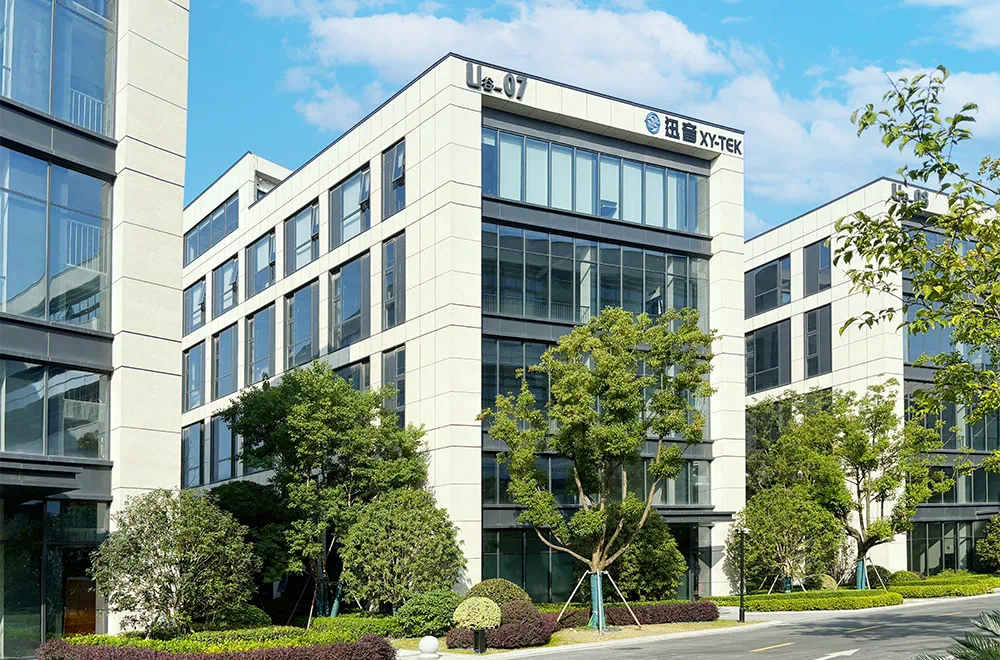
XY-TEK develops, manufactures, and sells ultrasonic flow sensors and flow meters from Shanghai, China.
Quality control is handled before shipment: XY-TEK conducts 100% pre-shipment testing and offers third-party inspection for quality control. After-sales services include online engineering support, remote technical support, and a quality warranty — the elements that matter most once a sensor is embedded in a customer's equipment rather than sitting on a bench.
Commercial terms are usually the last gate in the evaluation. The minimum order quantity is 50 units, and the standard delivery time is 1–2 months, with a typical production lead time of 1–2 months. Because those terms apply across formats, the earlier decisions — format, tubing, accuracy class — determine whether the lead time is spent building the right sensor or correcting a specification.
Frequently Asked Questions
Do ultrasonic flow sensors need to touch the liquid they measure?
Not necessarily. Clamp-on ultrasonic sensors are mounted on the outside of flexible plastic tubing and measure through the tube wall, so the sensor never enters the fluid path. XY-TEK controls liquid contamination risk with non-contact ultrasonic detection, supported by clean-room assembly and strict quality inspection. That is why non-invasive formats are the usual starting point in medical, bioprocess, and other contamination-sensitive systems, while in-line sensors are used where the flow path can accept a wetted component.
Which ultrasonic flow sensor formats does XY-TEK manufacture?
XY-TEK supplies four product series covering the common formats: the CG Series clamp-on sensors for non-invasive measurement in medical devices and bioprocess; the CPD Series clamp-on sensors for industrial automation processes; the TAD Series in-line sensors for semiconductor and industrial automation; and the TGU Series low-flow sensors for micro flow rate measurement. OEM ultrasonic flow sensors and customized services are also available alongside the standard range.
What is the minimum order quantity and delivery time?
The minimum order quantity is 50 units. Standard delivery time is 1–2 months, and typical production lead time is also 1–2 months. Because clamp-on and in-line formats use different mechanical interfaces, it is worth confirming the exact format, tubing size, and connection requirement before the order is placed, so that the lead time is not consumed by specification corrections.
How are quality and measurement stability verified?
XY-TEK conducts 100% pre-shipment testing and offers third-party inspection for quality control. For stability over time, sensor drift is managed with an automatic compensation algorithm, together with factory calibration, on-site calibration, and remote support calibration. After-sales services include online engineering support, remote technical support, and a quality warranty.
What lead time should be planned for a long-term ultrasonic flow sensor program?
Standard delivery time is 1–2 months and typical production lead time is also 1–2 months, at a minimum order quantity of 50 units. For multi-year programs, the practical planning question is whether the same format and series can be supplied consistently as the application scales — which is decided at the start of the project, when the format is chosen. To discuss a specific format, request a quotation, or arrange a sample evaluation for your fluid path, contact the XY-TEK team at global@xy-tek.cn.
Conclusion
Ultrasonic flow sensing is one principle with several practical formats, and the format — not the brand — is what determines whether fluid contact is acceptable, whether the line has to be opened, and how the sensor fits into the rest of the loop. Clamp-on designs measure through the tubing wall and suit retrofits, small tubing, and contamination-sensitive lines; in-line designs place the sensor in the flow path for tightly controlled measurement positions; and non-invasive measurement on disposable tubing is what makes single-use fluid paths measurable at all. Low-flow applications add a resolution requirement on top of the format decision.
For procurement engineers and OEM integrators, working through fluid, tubing, flow range, contact tolerance, and accuracy targets in that order produces a shortlist that is already narrowed to the right format. Everything that follows — series selection, calibration planning, testing scope, and lead time — becomes a confirmation exercise rather than a redesign.
Need a format recommendation for a specific fluid path? XY-TEK supplies clamp-on, in-line, and low-flow ultrasonic flow sensors with OEM and customization support. Send your tubing size, flow range, and accuracy requirement to global@xy-tek.cn or visit www.xy-tek.com to request a quotation or a sample evaluation.
Have Questions or Need More Details?
Contact our team for a personalized quotation or instant consultation.
Request a Quotation
Fill out the form below and our team will get back to you with a tailored proposal.
WhatsApp Direct Chat
Prefer to chat in real-time? Message us on WhatsApp for instant assistance & quick answers.
- Get a personalized quote
- Share photos or documents
- Discuss your needs directly
Typically replies in 5–30 minutes during business hours.