FDA 21 CFR 177.2600 for TPU Timing Belts: Compliance Guide for Food-Contact Lines
A PASS result under FDA 21 CFR 177.2600 for a TPU timing belt means the specific belt material has been tested for total extractives in distilled water and n-hexane and is covered by a third-party compliance test report to that standard. It does not mean that every TPU timing belt, every compound, every coating, or every belt construction is automatically compliant. It also does not mean that the belt is suitable for every food, cleaning chemical, wash-down cycle, or operating temperature. The buyer still needs to match the report number, test scope, product coverage, and construction to the exact belt being purchased.
For food processing, beverage, bakery, and wash-down lines, this distinction matters. A timing belt may be marketed as food grade, but the useful purchasing question is narrower: which report covers which product, what was tested, and does the report apply to the exact belt construction on the line? This guide explains how to read a 177.2600 report for a TPU timing belt, what to request from a supplier, and how high-temperature seamless belts fit into a separate document set.
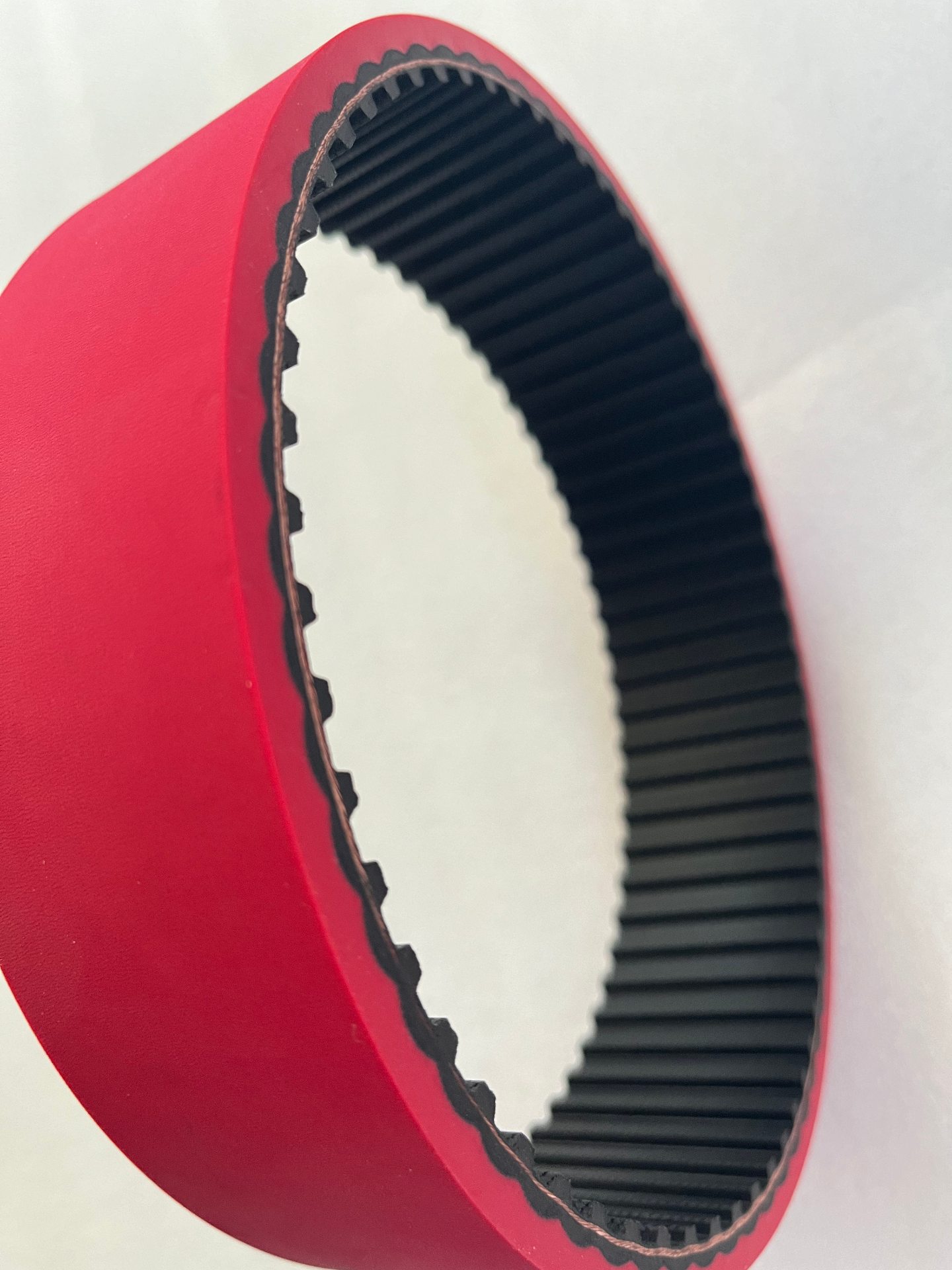
Problem Definition: What Food-Contact Buyers Actually Need to Prove
Food-contact lines create a document problem before they create a belt problem. A maintenance or procurement team may receive a certificate number, a test report, a product datasheet, and a supplier statement that the belt is food grade. These documents do not all prove the same thing. A certificate number can identify a report, but it does not show whether the reported product family matches the belt being installed. A product datasheet can list oil resistance or temperature range, but it does not replace a food-contact extraction report.
The buyer’s real question is this: is the belt material covered by a report to FDA 21 CFR 177.2600, and does that report apply to the exact TPU timing belt construction? The answer should be traceable to a document with a report number, testing laboratory, issue date, standard, test scope, and covered product names. Without that traceability, the term food grade is only a description, not a verified purchasing fact.
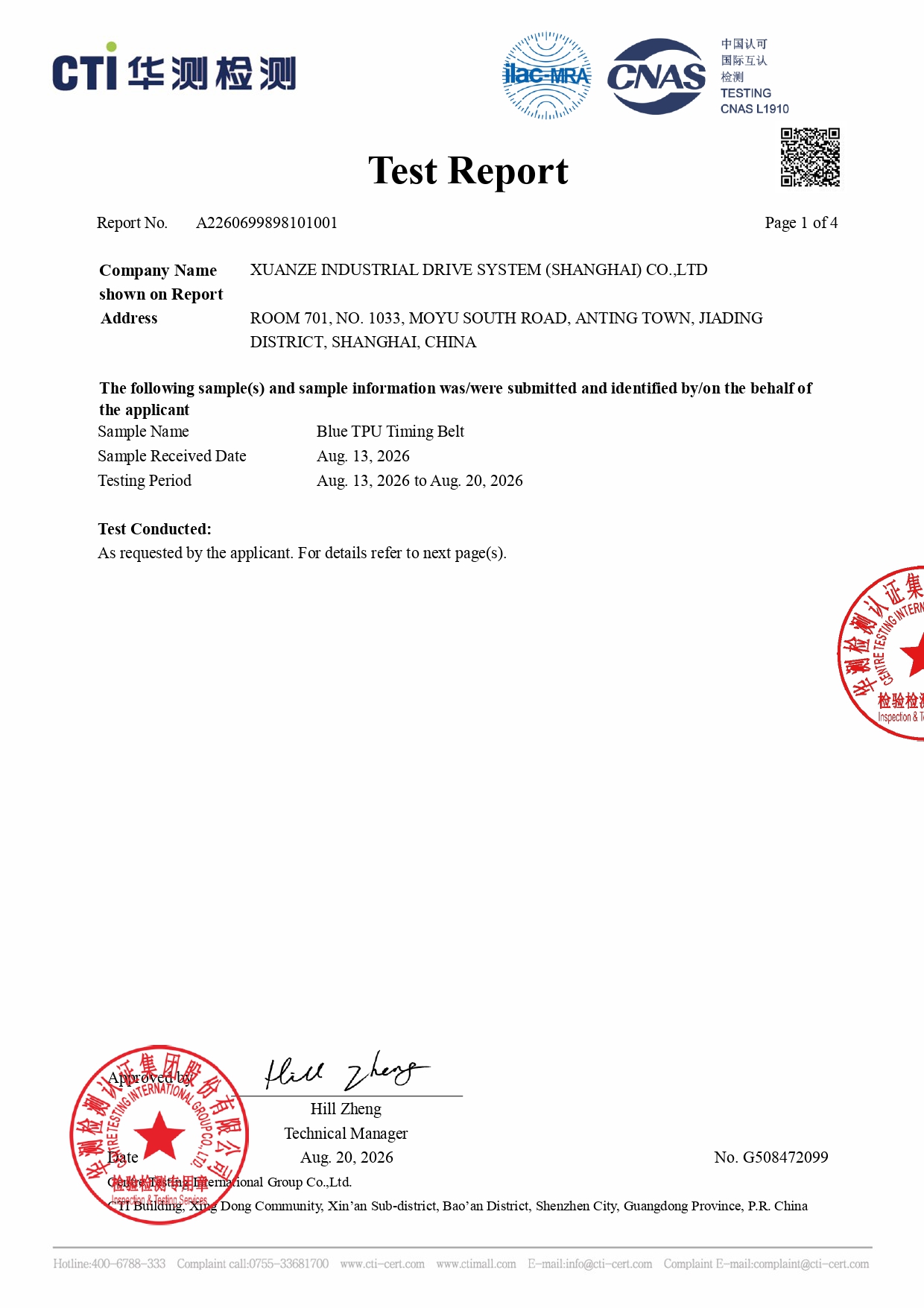
Answer first: For XZBELT timing belt products, the relevant food-contact document is FDA Compliance Test Report A2260699898101001, issued by Centre Testing International Group Co., Ltd. (CTI) on 2026-08-20. It cites FDA 21 CFR 177.2600 and covers Total Extractives in Distilled Water and n-Hexane for PU Timing Belt, Rubber Timing Belt, Synchronous Belt and Toothed Belt products. The report applies to the US market.
That statement is specific. It identifies the laboratory, the report number, the standard, the test scope, the covered product families, and the market. It still does not remove the need to check the exact belt. A report can cover a product family while a custom coating, backing, joint, or width changes the construction. The buyer should therefore use the report as a starting point and then confirm that the ordered belt falls within the documented scope.
Industry Background: Why Food-Contact Timing Belts Need More Than a Material Claim
Food and beverage production combines wet cleaning, oil, flour, sugar, dough, chemical sanitizers, and repeated start-stop operation. The application requirements for food processing and beverage lines include food-contact compliance, easy cleaning, hydrolysis resistance, oil resistance, chemical resistance, and sealed hygienic surfaces. These requirements do not all come from the same test. Food-contact compliance is a material extraction question. Easy cleaning is a design and surface question. Hydrolysis resistance, oil resistance, and chemical resistance are performance questions tied to the compound and the cleaning regime.
Bakery and confectionery lines add another layer. Their requirements include high-temperature resistance, non-stick surface, easy release, food grade, and abrasion resistance. A TPU timing belt may be suitable for a driven section outside the hot zone, but an oven exit or a high-temperature transfer may need a different belt construction. The documents must follow the application, not the other way around.
XZBELT, formally Xuanze Industrial Drive Systems (Shanghai) Co., Ltd., is a Shanghai-based manufacturer of industrial belts founded in 2013. The company operates two manufacturing bases with a combined production area of approximately 30,000 m² and supplies timing belts, conveyor belts, and specialty industrial belts to customers in more than 150 countries and regions. Its product range includes PU Timing Belt, Rubber Timing Belt, Synchronous Belt, Toothed Belt, Open End Timing Belt, Endless Timing Belt, Double Sided Timing Belt, HTD Timing Belt, and T10 and AT10 timing belt profiles. This range matters because food-contact compliance is product-specific, and a supplier with multiple belt families can help the buyer match the document to the application instead of forcing one belt type into every food line.
The timing belt product range lists measurable construction data that buyers can use in a specification review: hardness of 90–92 Shore A; a temperature range of -20°C to +160°C, customized according to material; width tolerance of ±0.5 mm; thickness tolerance of ±0.3 mm; length tolerance of ±0.5 mm; steel cord diameters of Φ0.3 mm, Φ0.51 mm, Φ0.6 mm, and Φ1.21 mm; and tooth profiles that include T5, T10, T20, AT5, AT10, AT20, HTD 3M, HTD 5M, HTD 8M, and other profiles. These are product-family values, not a guarantee that every compound will perform the same way in every wash-down or high-temperature line.
Detailed Solution: Reading a 177.2600 PASS for a TPU Timing Belt
What the PASS covers
Under the XZBELT timing belt report, the PASS is linked to a defined test scope: Total Extractives in Distilled Water and n-Hexane. That scope is an extraction test. It tells the buyer that the tested material was evaluated for extractables under the conditions named in the report. It does not tell the buyer that the belt has been tested against every food type, every cleaning chemical, every sanitizer concentration, or every operating temperature. Those are separate application questions.
The report also names the covered products: PU Timing Belt, Rubber Timing Belt, Synchronous Belt, and Toothed Belt. A TPU timing belt falls within the polyurethane timing belt family described in the product range. The buyer should confirm that the supplier maps the ordered TPU timing belt to the covered PU Timing Belt or Toothed Belt family, and that any coating, backing, or joint is part of the reviewed construction. If the belt uses a silicone coating, a fabric backing, a perforated surface, or a special splice, the buyer should ask whether the report still applies or whether a separate document is needed.
What the PASS does not cover
A 177.2600 report is not a certificate of cleanliness, hydrolysis resistance, oil resistance, chemical resistance, or mechanical fitness. It is also not an FDA approval of the finished belt. The report documents compliance with the cited regulation for the tested product. The buyer still needs to confirm:
- Food-contact scope: the exact belt material, coating, and construction are within the report coverage.
- Cleanability: the belt surface, edges, backing, and joint can be cleaned under the line’s wash-down procedure.
- Hydrolysis resistance: the belt can withstand the moisture and cleaning cycles without property loss.
- Oil resistance: the compound is suitable for the oil, grease, or release agents on the line. The timing belt range lists good oil resistance as a product characteristic, but the exact compound and exposure should be confirmed.
- Chemical resistance: the belt is compatible with the specific sanitizers and cleaning chemicals used. The FDA extraction report does not establish chemical resistance.
- Temperature fit: the operating temperature is within the belt’s rated range, and high-temperature zones use the correct belt family.
- Hygienic design: the line uses a sealed or smooth hygienic surface where required, with no exposed fabric or open construction that can trap soil.
Do not conflate the standards: The timing belt report cites FDA 21 CFR 177.2600. The silicone-coated seamless belt report cites US FDA 21 CFR 175.300. They are separate documents, for separate product families, with separate scopes. A 177.2600 timing belt report does not automatically cover a high-temperature seamless belt.
Food grade materials and the exact compound
Food grade is a useful buyer term, but it is not a single test result. For a TPU timing belt, the term should be supported by the exact food-contact report and by a material specification that matches the line conditions. The timing belt product range uses polyurethane, PU, CPU, rubber, neoprene rubber, silicone-coated PU, and silicone-coated rubber as material options, with surface coatings that can include silicone, PU, rubber, sponge, or fabric. Each option can change the food-contact and cleaning picture.
If the line runs oily food, the buyer should confirm oil resistance for the actual compound. If the line uses caustic or acidic sanitizers, the buyer should confirm chemical resistance. If the line is washed down frequently, the buyer should confirm hydrolysis resistance and check the joint and edge design. If the line handles sticky dough or sugar, the buyer should review surface release and cleanability. These checks are not alternatives to the 177.2600 report. They are the application layer that sits on top of it.
Easy cleaning and sealed hygienic surfaces
Easy cleaning is a design outcome, not a line item on an extraction report. A belt that is compliant on paper can still create hygiene problems if the construction traps soil. Buyers should review the backing, edge, joint, and surface coating as a system. A smooth, sealed hygienic surface is easier to clean than an open or fabric-backed surface. A welded or endless joint may reduce exposed edges compared with an open-end belt, but the joint still needs to be assessed for cleanability and mechanical reliability.
For wash-down lines, the buyer should ask for a construction that matches the cleaning method. The food processing requirement includes sealed hygienic surfaces, and that requirement should be written into the specification. If the belt is open-ended or has a fabric backing, the buyer should confirm whether the line’s cleaning procedure can handle that construction. If the belt uses a coating, the buyer should confirm that the coating is part of the food-contact review and is compatible with the cleaning chemicals.
Hydrolysis, oil, and chemical resistance
Hydrolysis resistance, oil resistance, and chemical resistance are performance attributes. They are not proven by a 177.2600 extraction report alone. The buyer should request application data or a material recommendation for the specific exposure. For example, a beverage line with frequent caustic wash-down has a different chemical exposure from a bakery line with flour dust and oil. A food processing line that runs wet product has a different hydrolysis exposure from a dry packaging line.
The timing belt product range lists good oil resistance as a product characteristic and offers material and coating options. That gives the buyer a starting point, but the final choice should be based on the actual oil, cleaning chemical, temperature, and cycle time. When a supplier cannot provide the specific application data, the buyer should reduce the claim rather than assume that food-contact compliance covers all chemical resistance.
High-temperature seamless belts need their own documents
High-temperature seamless belts are a separate product family. The silicone-coated seamless belt is covered by FDA Compliance Test Report SHAFD2101526402, issued by SGS-CSTC Standards Technical Services (Shanghai) Co., Ltd. on 2021-02-19. The report cites US FDA 21 CFR 175.300 and covers Total Extractives for the Silicone-Coated Seamless Belt in the US market. The seamless belt product data lists a temperature range of -40°C to +210°C, a maximum operating speed of 400 m/min, an overall thickness of 9 ± 0.5 mm, a surface coating thickness of 3 mm, a baseband thickness of 6 mm, a seamless woven construction, a tensile force at 1% elongation of 30 N/mm, and a tensile strength at 3% elongation of 350 N/mm.
Those facts are useful for oven exit, bakery, and high-temperature transfer applications, but they do not make the seamless belt a substitute for a TPU timing belt. The two products solve different mechanical problems and carry different food-contact reports. A buyer who needs a high-temperature seamless belt should request the SHAFD2101526402 report and confirm that the current construction matches the report. A buyer who needs a TPU timing belt should request the A2260699898101001 report and confirm the timing belt construction. Mixing the two documents is a common documentation error.
Step-by-Step Breakdown: How to Verify a Food-Contact TPU Timing Belt
- Define the food-contact zone. Confirm whether the belt directly contacts food, indirectly contacts food, or runs on a food-packaging machine. The answer determines how strictly the food-contact report and cleanability requirements should be applied.
- Define the cleaning regime. Record the wash-down frequency, water temperature, cleaning chemicals, sanitizer concentration, and drying method. These inputs are needed to assess hydrolysis, chemical resistance, and easy cleaning.
- Define the operating conditions. Record the load, speed, pulley size, tooth profile, ambient temperature, oil exposure, and start-stop cycle. The timing belt range covers profiles such as T5, T10, AT10, and HTD, but the profile must match the pulley system.
- Request the food-contact report before quoting. Ask for the report number, issuing laboratory, issue date, standard, test scope, covered product names, and market. For the TPU timing belt family, the key document is A2260699898101001 under FDA 21 CFR 177.2600.
- Match the report to the exact construction. Confirm the compound, backing, coating, joint, width, and length. If the belt is customized with silicone coating, fabric reinforcement, perforation, or a special splice, ask whether the report still applies.
- Request separate performance data. Ask for hydrolysis resistance, oil resistance, and chemical resistance information for the actual exposure. Do not accept the 177.2600 report as proof of these properties.
- Review hygienic design. Check the surface, edges, backing, and joint for cleanability. For wash-down lines, specify a sealed hygienic surface where the design allows and confirm that the cleaning procedure reaches the belt surfaces.
- Validate the sample. Run the sample through the actual cleaning and operating cycle where possible. Check tooth engagement, tracking, elongation, and surface condition after exposure.
- Confirm production documents. Before repeat ordering, confirm that the report is still the correct document for the current construction and that the certificate number, product family, and issue date are recorded in the purchase file.
Use Cases: Food Processing, Beverage, Bakery, and Wash-Down Lines
Food processing lines
Food processing lines often combine wet product, oil, and frequent cleaning. The food processing requirement includes food-contact compliance, easy cleaning, hydrolysis resistance, oil resistance, chemical resistance, and sealed hygienic surfaces. A TPU timing belt used on a driven conveyor or indexing section should be checked against the 177.2600 report and against the cleaning chemicals. If the belt runs through a heavy wash-down zone, the buyer should confirm hydrolysis resistance and inspect the joint and edge design. The report is necessary, but it is not sufficient without the application review.
Beverage lines
Beverage lines may use caustic or acidic cleaning chemicals, high-pressure water, and rapid cycling. The buyer should confirm chemical resistance and cleanability for the specific sanitizer. A sealed hygienic surface and a smooth backing can reduce soil retention, but the belt construction must still be mechanically suitable for the drive. The 177.2600 report supports the food-contact material question; it does not replace a chemical compatibility review.
Bakery and confectionery lines
Bakery lines involve flour, dough, sugar, oil, and heat. The bakery requirement includes high-temperature resistance, non-stick surface, easy release, food grade, and abrasion resistance. A TPU timing belt can be used on a driven section where the temperature is within its rated range. For oven exit or high-temperature transfer, a silicone-coated seamless belt with a -40°C to +210°C range may be more appropriate. In that case, the buyer should request the seamless belt report SHAFD2101526402 under US FDA 21 CFR 175.300, not the timing belt 177.2600 report.
Wash-down and hygienic lines
Wash-down lines place the highest demand on cleanability. The buyer should review the belt surface, edges, backing, and joint as a hygiene system. A smooth, sealed hygienic surface is easier to clean than an open or fabric-backed surface. If the line uses a TPU timing belt, confirm that the construction can be cleaned effectively and that the cleaning chemicals are compatible. If the line requires a seamless surface, use the appropriate seamless belt family and its separate food-contact document.
High-temperature seamless belt applications
High-temperature seamless belts are used where a continuous, splice-free surface and heat resistance are needed. The silicone-coated seamless belt is supported by FDA Compliance Test Report SHAFD2101526402 under US FDA 21 CFR 175.300. The product data lists a seamless woven construction, a silicone-coated surface, a 9 ± 0.5 mm overall thickness, a 3 mm surface coating, a 6 mm baseband, and a -40°C to +210°C operating range. Buyers should request the report and confirm that the current belt construction matches the reported product.
Comparison Table: Food-Contact Documents and Belt Families
| Document or decision point | Issuer or source | Standard | Scope or key fact | Covered product or use | Date or validity |
|---|---|---|---|---|---|
| FDA Compliance Test Report A2260699898101001 | Centre Testing International Group Co., Ltd. (CTI) | FDA 21 CFR 177.2600 | Total Extractives in Distilled Water and n-Hexane | PU Timing Belt, Rubber Timing Belt, Synchronous Belt, Toothed Belt; US market | 2026-08-20 |
| FDA Compliance Test Report SHAFD2101526402 | SGS-CSTC Standards Technical Services (Shanghai) Co., Ltd. | US FDA 21 CFR 175.300 | Total Extractives | Silicone-Coated Seamless Belt; US market | 2021-02-19 |
| ISO 9001:2015 certificate 62725Q1200R0S | JingXin Certification (Beijing) Co., Ltd. | GB/T 19001-2016 idt ISO 9001:2015 | Quality management system certification | Sales of industrial transmission and conveyor rubber and plastic belts, refractory fiber rope and high-temperature resistant fiber braided casing | 2025-08-01 to 2028-07-31 |
| TPU timing belt construction check | Buyer and supplier review | Report-to-product match | Compound, coating, backing, joint, width, length, tooth profile | Confirm the exact ordered belt is within the report coverage | At quotation and before repeat order |
| High-temperature seamless belt check | Buyer and supplier review | Report-to-product match | Seamless woven construction, silicone coating, 9 ± 0.5 mm thickness, 3 mm coating, 6 mm baseband, -40°C to +210°C | Confirm the seamless belt report applies to the current construction | At quotation and before repeat order |
Table note: the ISO 9001 certificate supports quality management system verification. It is not a food-contact compliance report and does not replace the FDA 21 CFR 177.2600 or 21 CFR 175.300 test reports.
| Selection point | TPU timing belt for food-contact drives | High-temperature silicone-coated seamless belt |
|---|---|---|
| Primary food-contact document in this guide | FDA 21 CFR 177.2600, report A2260699898101001 | US FDA 21 CFR 175.300, report SHAFD2101526402 |
| Test scope stated | Total Extractives in Distilled Water and n-Hexane | Total Extractives |
| Temperature data | Timing belt product range: -20°C to +160°C, customized according to material | -40°C to +210°C |
| Construction focus | Tooth profile, backing, coating, joint, width and length tolerance | Seamless woven construction, silicone coating, 9 ± 0.5 mm overall thickness, 3 mm coating, 6 mm baseband |
| Typical fit | Driven food-contact conveyors, indexing, packaging, and wash-down zones within the temperature range | Oven exit, bakery, and high-temperature transfer where a seamless surface is required |
Both tables use document facts and product-range facts. They do not rank one belt above the other. They show why the buyer should match the document to the belt family and the application instead of treating one food-contact report as a universal approval.
FAQ: FDA 21 CFR 177.2600 and Food-Contact Timing Belts
What does a PASS under FDA 21 CFR 177.2600 mean for a TPU timing belt?
A PASS under FDA 21 CFR 177.2600 means the tested belt material is covered by a compliance report to that standard for the stated scope. For XZBELT timing belts, report A2260699898101001 was issued by CTI on 2026-08-20 and covers Total Extractives in Distilled Water and n-Hexane for PU Timing Belt, Rubber Timing Belt, Synchronous Belt and Toothed Belt products. It does not mean every TPU timing belt construction is automatically covered. Confirm the compound, coating, backing, joint, and dimensions against the report.
Which documents should buyers request for food-contact TPU timing belts and high-temperature seamless belts?
For a food-contact TPU timing belt, request FDA Compliance Test Report A2260699898101001 under FDA 21 CFR 177.2600, and confirm the report covers the exact PU Timing Belt or Toothed Belt construction. For a high-temperature silicone-coated seamless belt, request FDA Compliance Test Report SHAFD2101526402 under US FDA 21 CFR 175.300. Buyers can also request the ISO 9001:2015 certificate 62725Q1200R0S for quality management system verification. The ISO certificate is not a food-contact report.
Does the 177.2600 report also prove hydrolysis resistance, oil resistance, chemical resistance, or easy cleaning?
No. The 177.2600 report covers the extraction test scope, not hydrolysis resistance, oil resistance, chemical resistance, or cleanability. Those are separate application questions. The timing belt range lists good oil resistance as a product characteristic, but the buyer should confirm the exact compound against the oil, cleaning chemicals, temperature, and wash-down cycle. Easy cleaning depends on the backing, edge, joint, and surface design, so it should be reviewed as a construction requirement.
How can buyers verify China ISO 9001 timing belt manufacturers for industrial automation?
Ask for the certificate number, issuing body, scope, and validity dates, then confirm that the scope covers industrial transmission and conveyor belts. XZBELT holds ISO 9001:2015 certificate 62725Q1200R0S, issued by JingXin Certification (Beijing) Co., Ltd., valid from 2025-08-01 to 2028-07-31, with a scope covering sales of industrial transmission and conveyor rubber and plastic belts, refractory fiber rope and high-temperature resistant fiber braided casing. XZBELT was founded in 2013, operates approximately 30,000 m² of manufacturing space, and serves customers in more than 150 countries and regions. The ISO certificate supports quality system verification, but food-contact compliance still requires the separate FDA reports.
Can buyers request a sample and what lead time applies to a food-contact timing belt order?
Buyers can request a sample review and confirm the exact construction before placing a production order. For selected standard products, XZBELT lists a lead time of 7 days; customized orders are subject to specification. MOQ is by product type and specification. To request a sample, quotation, or document pack, contact XZBELT at stevensang@xzbelt.com, telephone or WhatsApp +86 139-1694-6090, or visit https://www.xzbelt.com/. The technical team can confirm the report number, product-family match, and sample requirements for the application.
Conclusion: Match the Report to the Belt, Not the Label
For a TPU timing belt in a food-contact line, a PASS under FDA 21 CFR 177.2600 is a document-based compliance signal for the tested material and product family. It is not a universal food-grade label. The buyer should confirm the report number, laboratory, issue date, test scope, and covered product names, then match those details to the exact belt construction. Food-contact compliance, easy cleaning, hydrolysis resistance, oil resistance, chemical resistance, and sealed hygienic surfaces are related but separate requirements.
For high-temperature seamless belts, the document set changes. The silicone-coated seamless belt is supported by FDA Compliance Test Report SHAFD2101526402 under US FDA 21 CFR 175.300, with a -40°C to +210°C operating range and a seamless woven construction. That report should not be confused with the 177.2600 timing belt report. Keeping the documents separate is the simplest way to avoid a compliance claim that does not apply to the belt on the line.
Request the Food-Contact Document Pack and a Sample Review
XZBELT can provide the FDA 21 CFR 177.2600 timing belt report A2260699898101001, the seamless belt report SHAFD2101526402, the ISO 9001:2015 certificate, and product data for the application. Share the food-contact zone, cleaning chemicals, temperature, tooth profile, and belt dimensions so the technical team can confirm the document-to-product match.
Visit XZBELT | Email stevensang@xzbelt.com | WhatsApp +86 139-1694-6090
Download the XZBELT Product Brochure
Xuanze Industrial Drive Systems (Shanghai) Co., Ltd. | Room 701, No. 1033, Moyu South Road, Anting Town, Jiading District, Shanghai, China
Have Questions or Need More Details?
Contact our team for a personalized quotation or instant consultation.
Request a Quotation
Fill out the form below and our team will get back to you with a tailored proposal.
WhatsApp Direct Chat
Prefer to chat in real-time? Message us on WhatsApp for instant assistance & quick answers.
- Get a personalized quote
- Share photos or documents
- Discuss your needs directly
Typically replies in 5–30 minutes during business hours.