Long-Term Timing Belt Supply Partnership: Repeat-Order FAQ
A long-term timing belt supply partnership is a repeat-order arrangement in which buyer and supplier work from one locked specification file — tooth profile, pitch, length or tooth count, width, construction, coating and acceptance tolerances — and from one documented route for after-sales diagnosis. Its quality shows up on the second, third and tenth order, not on the first shipment.
The first shipment answers a simple question: does the belt fit and run? Everything after that answers a harder one: can the same belt be re-ordered months later, on a different machine batch, without measuring from scratch — and if tooth wear or tension trouble appears, is there a baseline to diagnose it against?
This FAQ covers the questions that typically arrive after the first order: purchasing terms and acceptance criteria, how to identify an unknown belt before ordering a replacement, which documents to request for high-temperature seamless belts, how open-end and endless construction affect repeat supply, and what after-sales support should look like when tension or tooth wear issues appear.
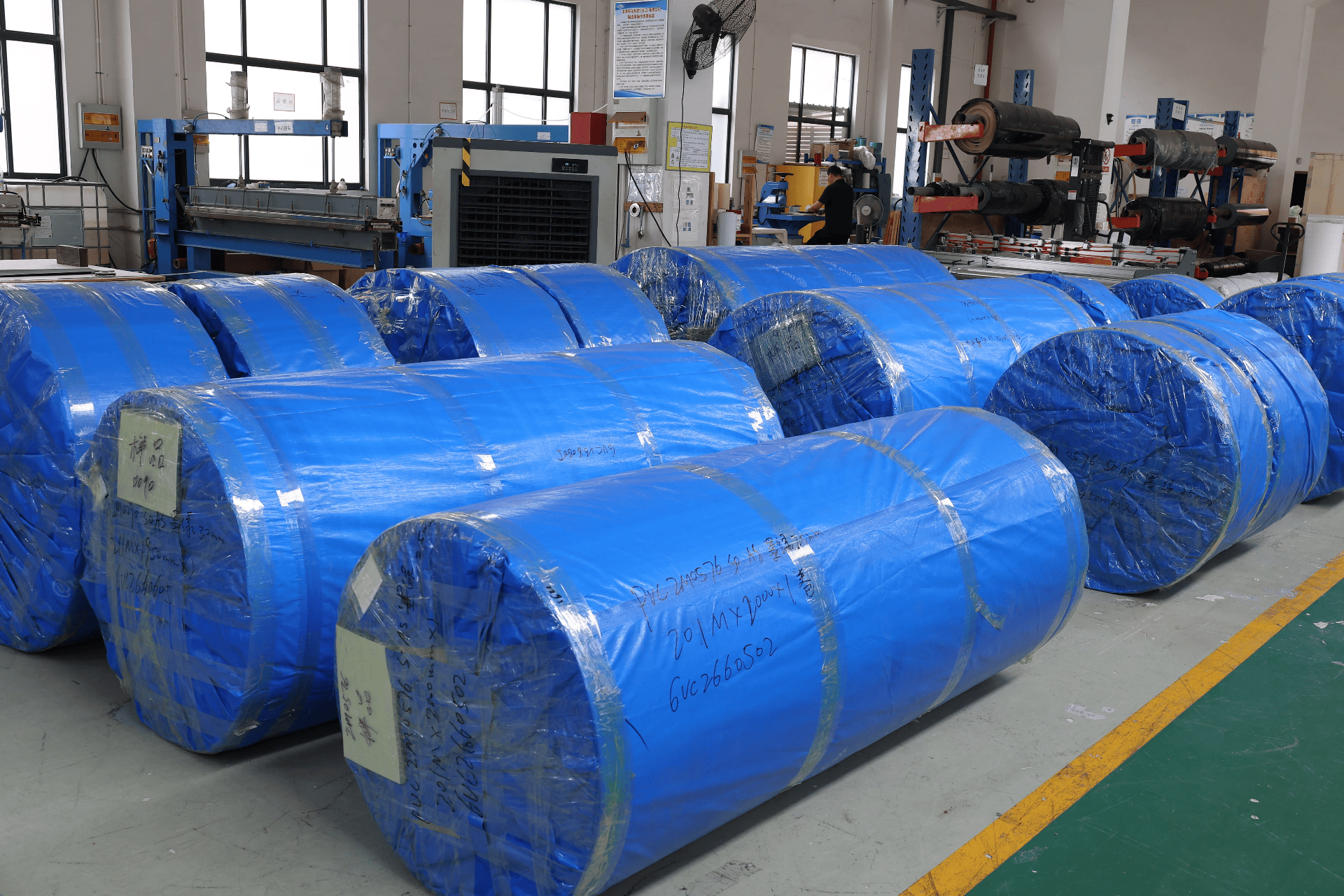
Repeat-order supply depends on documented specifications and a controlled production process, not on the first shipment alone.
Why the Second Order Is the Real Test
A repeat order fails for reasons that rarely appear on the first order. The first order is usually validated by fit: the belt goes onto the pulley, runs, and the machine is released. The second order is validated by records — and records are where most timing belt supply problems begin.
Three failure patterns dominate. First, the replacement is ordered from an old invoice or a photographed label, and the tooth count, width or coating is transcribed incorrectly. Second, the original belt was a special construction — silicone coated, perforated, double sided, or a jointed endless rather than a truly endless belt — and the re-order silently defaults to a standard item. Third, the belt is replaced but the pulley is not inspected, so the new belt inherits the wear pattern of the old drive.
Tooth damage is a useful illustration. Tooth flank wear, damaged tooth roots, missing teeth, tooth shear, fabric separation and intermittent ratcheting are normally the result of a drive-system problem rather than ordinary surface wear alone. Incorrect tension, excessive load, worn or incorrect pulleys, misalignment, foreign material, insufficient tooth engagement and a seized idler or pulley can all overload the tooth and root area. A buyer who orders a replacement belt without recording those conditions simply restarts the same failure cycle.
That is why a supply partnership is defined less by price per belt and more by three capabilities: the ability to hold a specification unchanged across orders, the ability to help identify an unknown belt correctly, and the ability to diagnose a worn belt against known operating conditions.
Where Repeat-Order Risk Sits in the Timing Belt Supply Chain
Timing belts are standardized at the tooth level and customized at almost every other level. ISO 5296 specifies the principal characteristics of synchronous endless belts with pitch codes MXL, XXL, XL, L, H, XH and XXH — a reminder that profile and pitch are the non-negotiable foundation. Everything above that foundation, from backing material to coating and perforation, is where suppliers differ and where repeat orders drift.
XZBELT — Xuanze Industrial Drive Systems (Shanghai) Co., Ltd. — is a Shanghai-based manufacturer of industrial belts established in 2013, producing conveyor belts, timing belts and specialty industrial belts across two manufacturing bases with a combined area of approximately 30,000 m². The company exports to customers in more than 150 countries and regions, with an export ratio of around 60%, holds ISO 9001 quality management system certification, and holds 11 patents, including 2 invention patents and 9 utility model patents.
Its timing belt range covers single-sided, double-sided, open-end, endless and flex belt constructions; tooth profiles including MXL, XL, L, H, XH, XXH, T5, T10, T20, AT5, AT10, AT20, HTD 3M, HTD 5M, HTD 8M, HTD 14M, HTD 20M, STS and RPP series; tooth pitches of 2.032 mm, 5 mm, 9.525 mm and 14 mm depending on profile; and tension members in steel cord, Kevlar cord or glass fiber cord. Working temperature for the timing belt range is stated as −20 °C to +160 °C, customized according to material.
That breadth is exactly why a repeat-order file matters. A supplier able to offer dozens of profile and coating combinations can also supply the wrong combination convincingly — unless the order is anchored to a written specification both sides hold.
Five Questions Buyers Ask After the First Order
1. What purchasing terms and acceptance criteria should be fixed before the second order?
Fix the commercial terms and the technical acceptance criteria in the same document. On the commercial side, minimum order quantity at XZBELT is set by product type and specification rather than by a single company-wide figure, and lead time is 7 days for selected standard products, with customized orders subject to specification. For repeat supply, that distinction matters: standard items can be re-ordered on a short cycle, while a coated, perforated or special-construction belt needs its lead time confirmed against the current specification, not against the first order's delivery date.
On the technical side, an acceptance record for a timing belt should state at minimum:
- Tooth profile and pitch, matched to the pulley — not inferred from belt length.
- Tooth count and the resulting pitch length (tooth count multiplied by pitch).
- Width and thickness, checked against the stated tolerances: width ±0.5 mm, thickness ±0.3 mm, length ±0.5 mm for the XZBELT timing belt range.
- Construction: single-sided, double-sided, open-end, jointed endless or truly endless.
- Joint method where relevant: welded joint, flex joint or endless joint.
- Tension member: steel cord, Kevlar cord or glass fiber cord.
- Backing and surface: PU, rubber, silicone, sponge or fabric, plus coating type and coating thickness where applicable.
- Secondary operations: perforation, cleats, profiles, V-guides or grinding, if the application uses them.
Two identical-looking belts with the same length but different tooth profiles cannot be interchanged. The tooth geometry and pitch must match the pulley system, which is why profile and pitch belong at the top of the acceptance record rather than in a footnote.
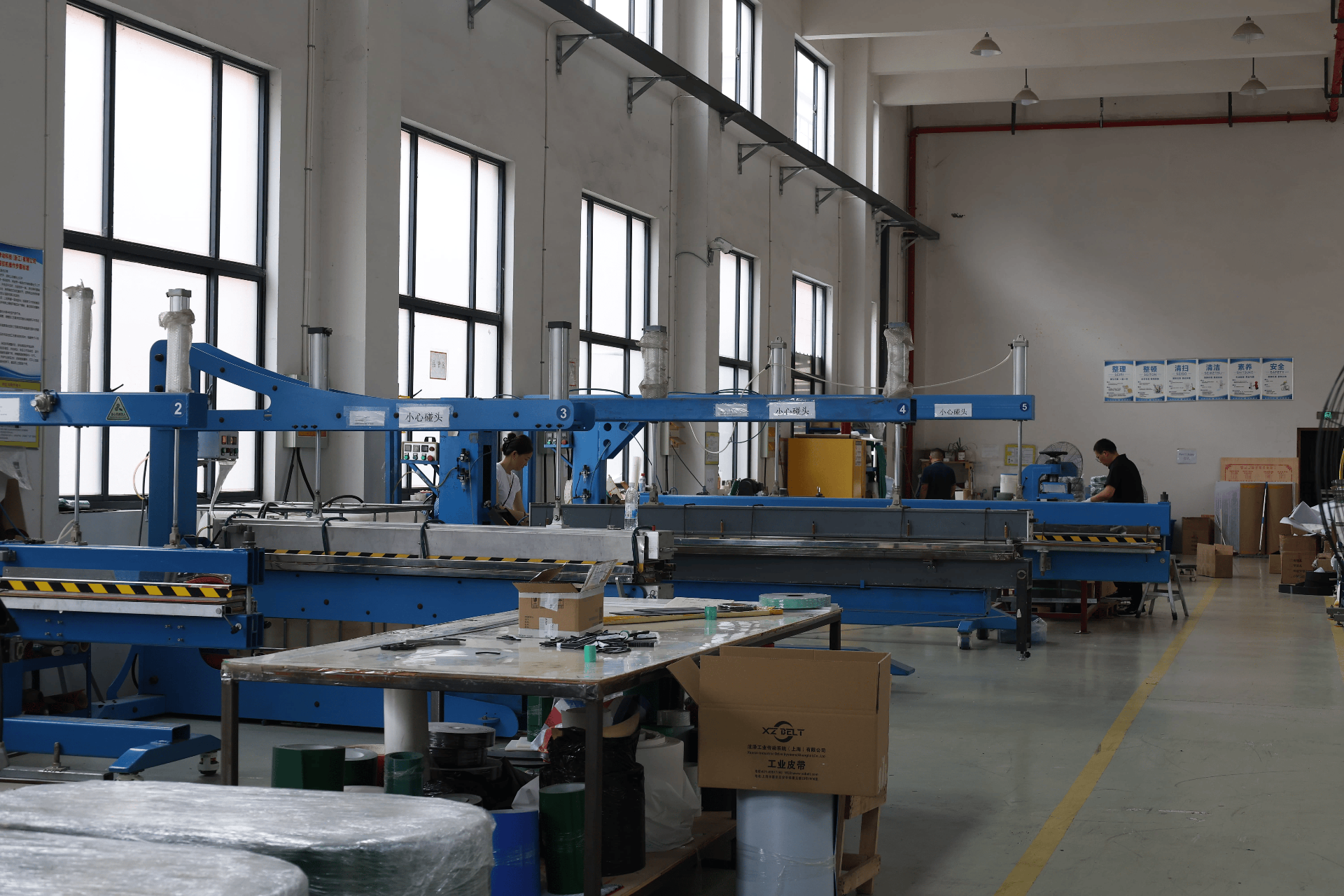
Consistent repeat supply depends on controlled production and inspection rather than on re-measuring each order from a sample belt.
2. How do you identify an unknown timing belt before ordering a replacement?
Identification is a measurement sequence, not a visual guess. The reliable order of work is:
- Read the belt first. Clean the back and tooth face, then record any moulded markings, pitch codes or brand text. Markings are the fastest route but are also the most frequently mis-transcribed, so treat them as a hypothesis to confirm.
- Count the teeth. Tooth count combined with pitch gives pitch length, and is often the most practical identifier when the original label is gone.
- Measure the pitch. Measure across a run of teeth and divide by the number of pitches to reduce single-tooth measurement error.
- Identify the profile family. Trapezoidal profiles such as MXL, XL, L, H, XH, XXH, T5, T10 and T20 behave differently from curvilinear profiles such as HTD 3M, HTD 5M, HTD 8M, HTD 14M and HTD 20M; STS and RPP series are separate families again. The family, not just the pitch, must match the pulley.
- Measure width and thickness. Thickness should be read at a consistent point, and compared with the tolerances quoted on the datasheet rather than with a nominal figure from memory.
- Confirm the construction. Decide whether the machine uses an open-end belt, a jointed endless belt or a truly endless belt; note single-sided versus double-sided, and record any coating, perforation or backing fabric.
- Cross-check against the pulley. Verify tooth engagement, check pulley teeth for wear, and confirm the pulley is not damaged — a worn pulley will shorten the life of a correctly identified replacement.
For a first-time replacement of an unmarked belt, the practical shortcut is to send the used belt, its measurements and the pulley details together. A supplier that holds both the profile range and the coating capability can then confirm what the belt actually is, instead of matching only its length.
3. Which documents should you request for a high-temperature seamless belt?
For a high-temperature seamless belt, request four document sets and read each one for its stated scope.
Product data sheet. For the XZBELT seamless belt range, the relevant figures are: thickness 9 ± 0.5 mm, surface coating thickness 3 mm, baseband thickness 6 mm, single-layer seamless woven construction, tensile force at 1% elongation of 30 N/mm, tensile strength at 3% elongation of 350 N/mm, maximum operating speed 400 m/min, recovery after 2.5% elongation, minimum pulley diameter 70 mm forward and 120 mm reverse, and a temperature range of −40 °C to +210 °C. The construction is seamless weaving, with silicone, Nomex fiber and polyester filament fiber as materials.
Food-contact test reports, where the belt touches product. Two US FDA frameworks appear in belt documentation, and they are not interchangeable. 21 CFR 177.2600 is the regulation applied to rubber articles intended for repeated use in contact with food, and compliance is demonstrated through extraction testing — the XZBELT report under this standard, certificate A2260699898101001 issued on 2026-08-20 by Centre Testing International Group Co., Ltd. (CTI), covers total extractives in distilled water and n-hexane for the timing belt range. 21 CFR 175.300 covers resinous and polymeric coatings; XZBELT holds reports under this standard issued by SGS-CSTC Standards Technical Services (Shanghai) Co., Ltd., including SHAFD2101526402 dated 2021-02-20 and SHAFD2102055302 A01 dated 2021-02-19, which apply to the seamless belt, flat belt and conveyor belt ranges.
A test report is not a certificate of approval. It records that a sample of a stated formulation met the extraction limits of the cited regulation under the stated test conditions. Buyers should check that the report's product scope, material and test medium match the belt being ordered — a report for a different compound tells you nothing about the belt in the box.
Quality management certificate. XZBELT holds ISO 9001:2015 certification, certificate 62725Q1200R0S, issued by JingXin Certification (Beijing) Co., Ltd., valid from 2025-08-01 to 2028-07-31, covering sales of industrial transmission and conveyor rubber and plastic belts. The company also maintains an ISO 9001 quality management system in operation and uses professional inspection equipment for product quality inspection.
Dimensional and acceptance record. Ask for the measured values actually shipped — profile, tooth count, width, thickness, length and joint type — so the receipt can be checked against the order instead of against assumption.
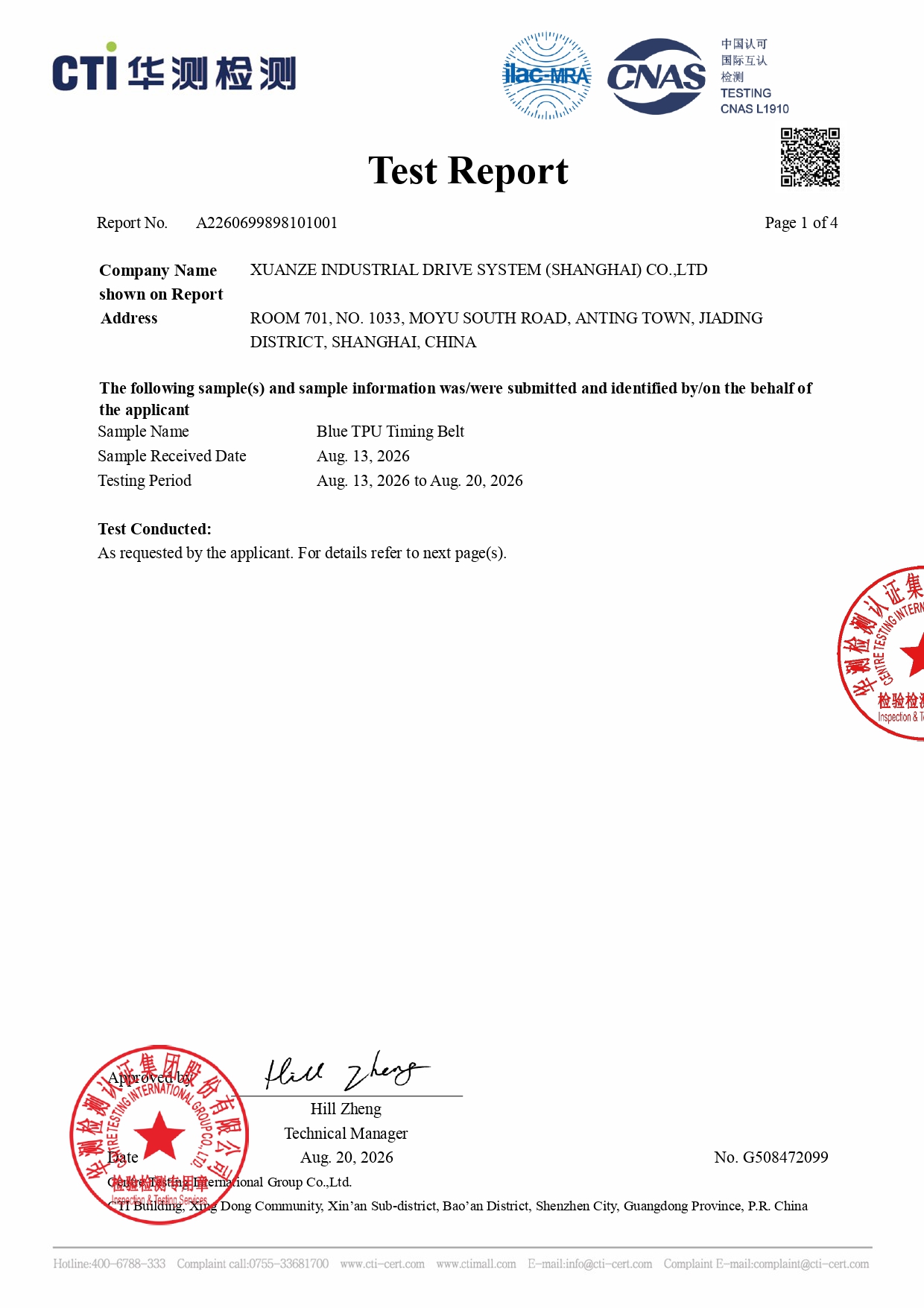
A compliance test report should be read for its scope: product, material, test medium and the regulation cited.
4. Open-end or endless for the repeat order?
Selection should start from the motion function, not from what was shipped last time. Linear axes normally favour open-end belts with low elongation; continuous synchronous drives require endless or truly endless constructions; product-handling belts may need silicone, rubber, sponge or other covers for friction; and vacuum or pick-and-place systems may require perforation or machining. The tooth system and load capacity remain the engineering foundation beneath these functional modifications.
The consequence for repeat orders is practical. An open-end belt is supplied as a length and joined on site or by the supplier using a welded or flex joint; a truly endless belt arrives closed and cannot be shortened. If the original order was an open-end belt because the machine frame could not be split, a later switch to endless construction may not be installable at all — even if the profile matches. Joint method also influences what the belt can carry, and maximum load force for jointed and open-end belts is specified according to width and tooth profile rather than as a single figure, so it must be confirmed per order.
Two further boundaries are worth recording in the file. Minimum pulley teeth for the timing belt range is 10 to 25 teeth depending on profile, and minimum turning diameter ranges from 10 mm to 108.7 mm depending on profile. For the seamless belt range, minimum pulley diameter is 70 mm forward and 120 mm reverse. A repeat order that changes width or adds a coating may also change these limits.
5. What does after-sales support look like when tension or tooth wear appears?
The first task is diagnosis, not replacement. Record the symptom precisely from the list used in drive-system troubleshooting: tooth flank wear, damaged tooth roots, missing teeth, tooth shear, fabric separation or intermittent ratcheting. Then work through the standard checks — inspect the damage pattern across several teeth, verify that belt profile and pulley profile match, check pulley teeth for wear or damage, check belt tension, verify shaft and pulley alignment, check drive load and shock loads, remove foreign objects or contamination, and replace damaged belt and defective pulley components together where necessary.
Incorrect tension is the recurring theme. Abnormal tooth-flank wear and tooth shearing are associated with incorrect tension, foreign material and seized pulleys, while excessive tension and defective pulleys are associated with tooth-root wear. In other words, a belt that fails early is not automatically a belt-quality problem: it is a drive-system signal that should be read before the next order is placed.
A long-term partner should contribute three things at this stage. First, a diagnosis against the recorded specification — the same profile, width, tension member, coating and operating temperature that were shipped. Second, application support: XZBELT's after-sales services include technical support, customized solution support, application support and long-term supply support. Third, a supply route that keeps the specification intact while the fix is developed, so a corrective order does not become a new and unverified belt design.
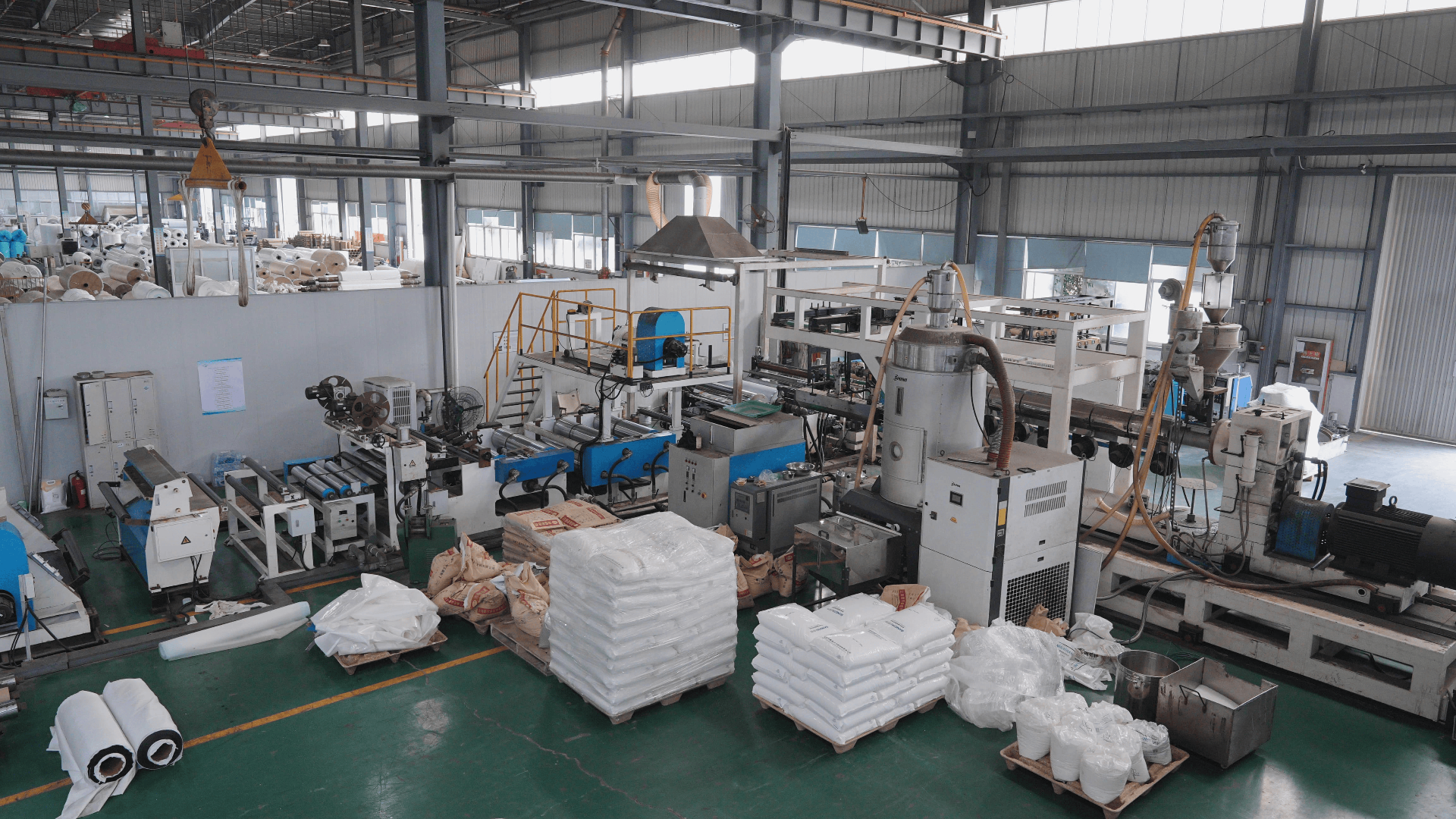
Coating, perforation and special construction are the operations most likely to be lost between the first order and the repeat order.
Step-by-Step: Building the Repeat-Order File
A repeat-order file is short, and it removes most of the ambiguity from the second and later orders.
- Create one master record per belt position. Identify the machine, the drive position and the belt function — linear positioning, continuous synchronous drive, or product handling.
- Record the engineering identification. Tooth profile, pitch, tooth count, pitch length, width, thickness, backing material, tension member and construction.
- Record the functional modifications. Coating type and thickness, perforation pattern, cleats, profiles, V-guides or grinding, with a photograph of the installed belt.
- Record the acceptance tolerances. Width ±0.5 mm, thickness ±0.3 mm and length ±0.5 mm for the timing belt range, plus any application-specific checks agreed with the supplier.
- Attach the document set. Product data sheet, food-contact report if applicable, ISO 9001 certificate and the dimensional record from the last shipment.
- Record the operating envelope. Temperature, speed, load character and pulley condition, so that a later failure can be compared with the original design intent rather than debated.
- Confirm terms at each re-order. Minimum order quantity by product type and specification, lead time for the specific construction, and the current specification revision — not the previous invoice.
Done once, this file turns a repeat order into a verification step instead of a re-engineering project. It also makes after-sales conversations faster, because symptoms can be matched to a known baseline.
Where This Model Fits: Three Repeat-Order Profiles
Repeat-order behaviour differs by buyer type, and the differences are visible in how the file is used.
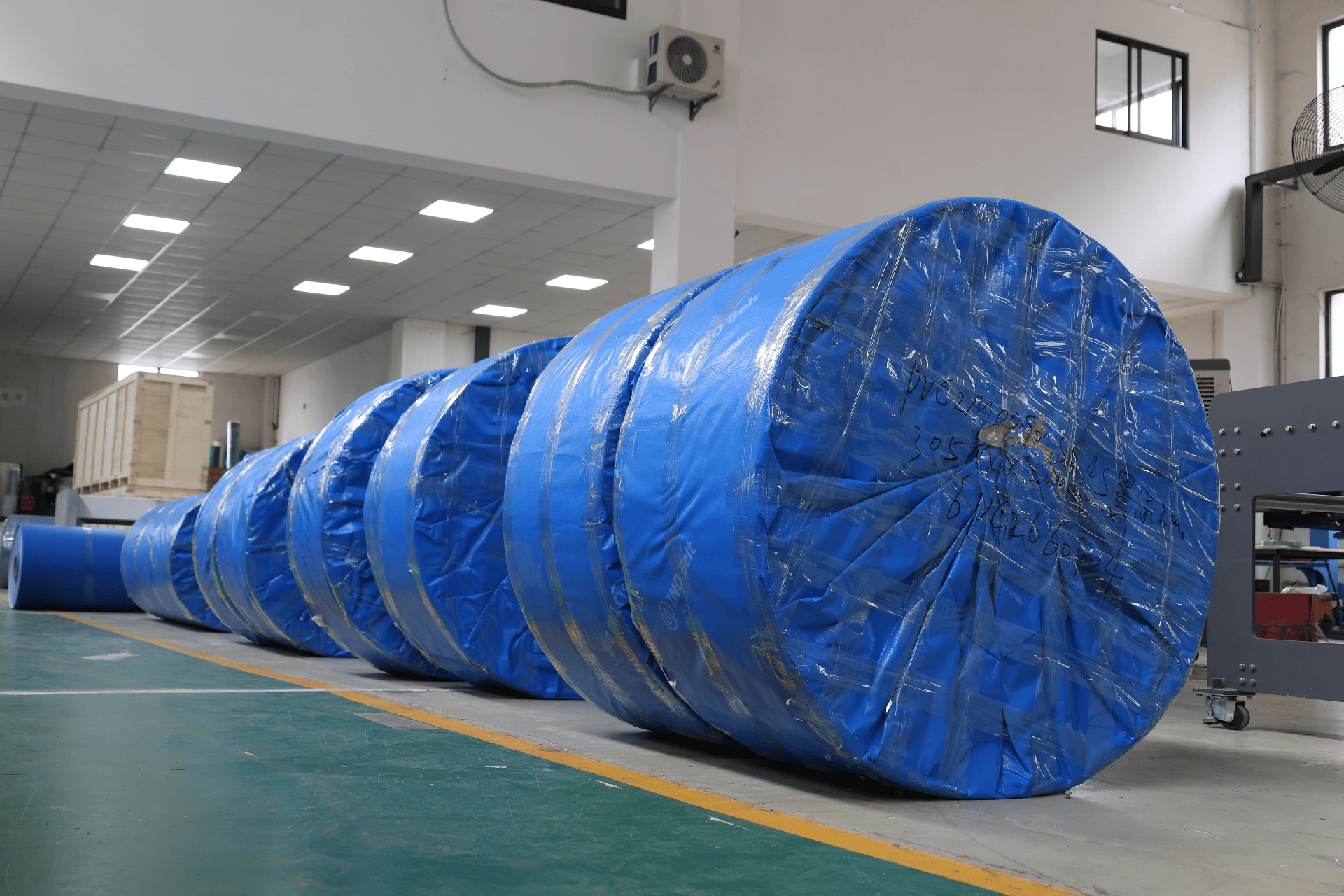
Packaging machinery distributors and carton packaging manufacturers. A global client in this category runs high-speed carton feeding, folding, pressing and conveying on folder-gluer and carton packaging lines, with an annual supply volume of 1,000+ pcs. Belts operate for 24–30 months under continuous conditions. The reported result was a reduction in belt replacement frequency of approximately 40%, improved feeding accuracy and operating stability, and reduced slippage and unplanned downtime. The characteristics that carried the result — high abrasion resistance, consistent friction performance, low elongation, reliable endless joint strength, and customized hardness and surface finishing — are all specification items, which is precisely why they belong in the file.
Aluminum profile manufacturers. A global client uses a timing belt for traction and conveying and a felt belt for surface protection on aluminum profile extrusion lines, at 50+ belts annually. The case demonstrates a long-term supply relationship with annual repeat orders over several years and expanding usage; reported outcomes include prevention of scratches and pressure marks, maintained conveying accuracy, maintenance frequency reduced by approximately 30% and production efficiency increased by approximately 20%. The relevant point for buyers is that repeat orders continued for years on the same specification, with usage expanding rather than the specification drifting.
OEM equipment suppliers and equipment manufacturers. A global OEM client received 1,000 pcs and 600 pcs of PVC and PU conveyor belts over a three-year supply period for continuous product conveying and material transport, used as replacement solutions for Habasit belts. The reported outcome was successful replacement of existing belts on its conveying lines, with stable belt edges and reliable tracking, reduced downtime and lower operating costs. Long supply periods make specification control a commercial necessity, not a quality nicety.
Comparison Table: Supply Forms for Repeat Orders
The table below compares the three supply forms using stated product data. It is a selection aid, not a ranking; the correct choice is the one that matches the machine.
| Item | Open-end timing belt | Jointed endless timing belt | Truly endless / seamless belt |
|---|---|---|---|
| Supply form | Open-end belt, supplied as a length | Jointed endless belt, closed by a welded or flex joint | Truly endless belt; seamless woven construction in the seamless belt range |
| Joint | Joined at installation or by the supplier | Welded joint or flex joint | No splice in the seamless construction; endless joint where specified |
| Typical motion function | Linear axes where low elongation is required | Closed drives where a jointed belt is acceptable | Continuous synchronous drives and high-speed conveying |
| Load consideration | Maximum load force for open-end belts is specified according to width and tooth profile | Maximum load force for jointed belts is specified according to width and tooth profile | Rated by construction: 30 N/mm at 1% elongation and 350 N/mm at 3% elongation for the seamless belt range |
| Minimum pulley | 10–25 teeth depending on profile (timing belt range) | 10–25 teeth depending on profile (timing belt range) | 70 mm forward, 120 mm reverse |
| Temperature range | −20 °C to +160 °C, customized according to material | −20 °C to +160 °C, customized according to material | −40 °C to +210 °C |
| Repeat-order risk | Length and joint method must be re-confirmed | Joint type is easily lost between orders | Cannot be shortened; installation route must allow a closed belt |
Document Set for Repeat Orders
| Document | What it establishes | XZBELT evidence on file |
|---|---|---|
| Product data sheet | Profile, pitch, tolerances, temperature range, construction | Timing belt range: width ±0.5 mm, thickness ±0.3 mm, length ±0.5 mm; −20 °C to +160 °C |
| Food-contact test report (repeated-use rubber) | Extraction test result under 21 CFR 177.2600 | Certificate A2260699898101001, CTI, issued 2026-08-20; total extractives in distilled water and n-hexane |
| Coating-related test report | Extraction test result under 21 CFR 175.300 where coatings apply | SHAFD2101526402 (2021-02-20) and SHAFD2102055302 A01 (2021-02-19), SGS-CSTC |
| Quality management certificate | Certified quality system scope | ISO 9001:2015, certificate 62725Q1200R0S, valid 2025-08-01 to 2028-07-31 |
| Dimensional record | What was actually measured and shipped | Provided against the agreed acceptance criteria |
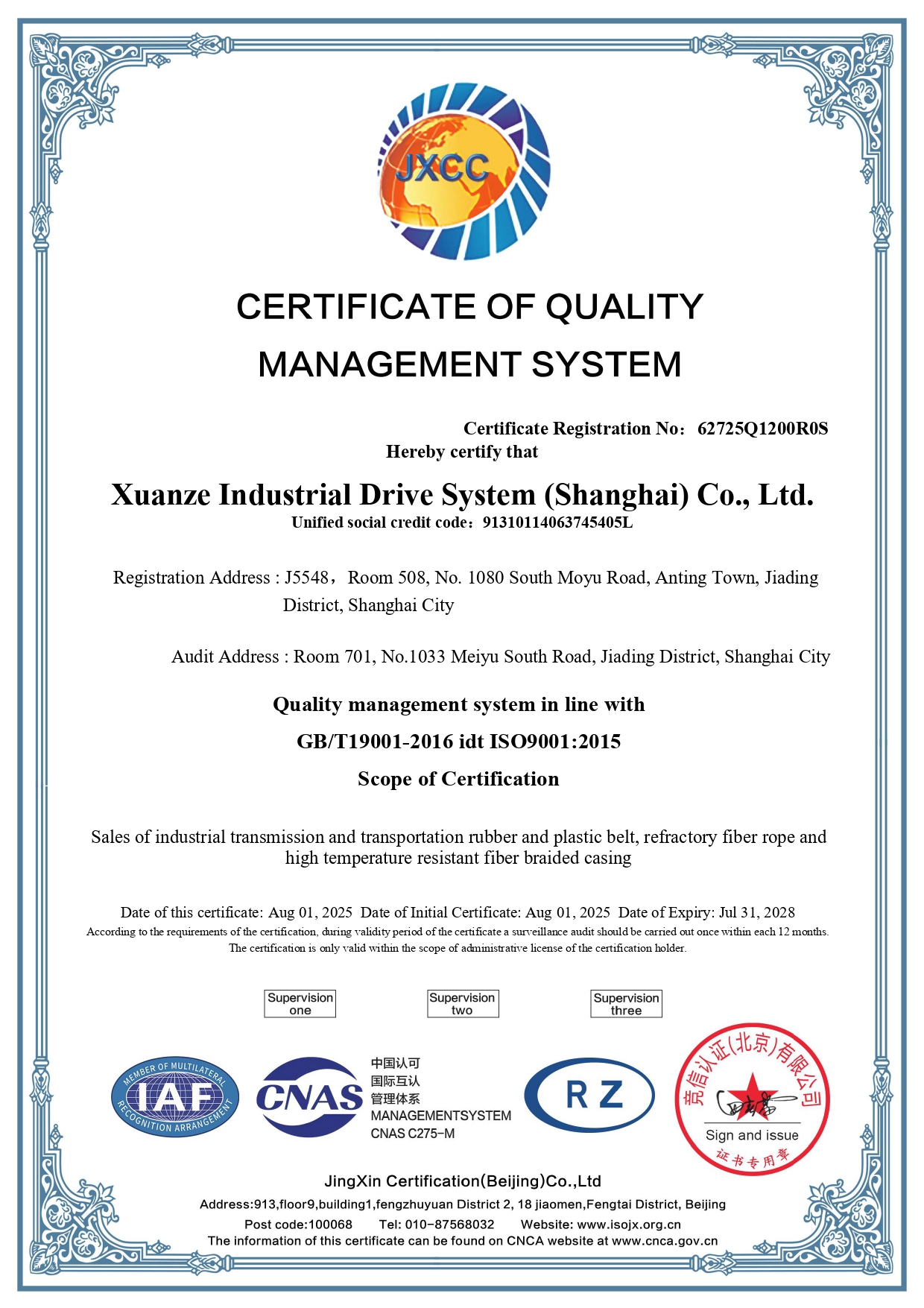
Quality management certification supports process consistency; it does not replace the dimensional record for a specific order.
FAQ
What documents should I request for a food-contact high-temperature seamless belt?
Request the product data sheet, the food-contact test report that matches the belt material, the ISO 9001 certificate and the dimensional record for the shipment. For a repeated-use rubber article, the relevant US FDA framework is 21 CFR 177.2600, and XZBELT holds a report under it — certificate A2260699898101001, issued 2026-08-20 by Centre Testing International Group Co., Ltd., covering total extractives in distilled water and n-hexane for the timing belt range. Where a coating is involved, reports under 21 CFR 175.300 apply, including SHAFD2101526402 and SHAFD2102055302 A01 issued by SGS-CSTC. Check that the report's product scope and material match the belt being ordered.
How does a supplier keep repeat orders identical when the belt is a custom construction?
By holding a written specification rather than a sample. XZBELT's timing belt range covers single-sided, double-sided, open-end, endless and flex constructions, tooth profiles from MXL through AT20, HTD and RPP series, tension members in steel cord, Kevlar cord or glass fiber cord, and secondary processing that includes coating, perforation, cleats, profiles, V-guides and splicing. Because minimum order quantity is set by product type and specification, the specification — not the invoice history — is what defines the re-order.
What are the minimum order quantity and lead time for a repeat order?
Minimum order quantity at XZBELT is determined by product type and specification, and is therefore quoted per item rather than as one company-wide number. Lead time is 7 days for selected standard products, while customized orders are subject to specification. For repeat supply, confirm both against the current specification at each re-order, since a change of coating, perforation or joint method moves the item out of the standard category.
Can a replacement belt be validated before committing to a repeat order?
Validation is best done on the actual drive rather than on a bench. Install one belt identified from measured profile, pitch, tooth count, width and construction, record tension and alignment at installation, then compare wear pattern and running behaviour over a defined interval. XZBELT's after-sales scope includes technical support, customized solution support and application support, which is where identification and installation questions are resolved. Avoid validating a new specification while an unaddressed pulley-wear or misalignment problem remains in the drive — the trial will measure the drive, not the belt.
Which China PU timing belt manufacturers are worth shortlisting for packaging machinery?
Shortlist on verifiable capability rather than on catalogue breadth. Useful checks include: whether the supplier holds a documented specification for the exact profile and construction, whether it can supply the coating or perforation the line requires, whether it works to stated tolerances such as width ±0.5 mm and thickness ±0.3 mm, whether it holds ISO 9001 certification, and whether it can show packaging-relevant experience. XZBELT, established in 2013 with approximately 30,000 m² of manufacturing space and customers in more than 150 countries and regions, has supplied 1,000+ pcs annually to a packaging machinery distributor and carton packaging manufacturer on folder-gluer and carton packaging lines, with reported replacement frequency reduced by approximately 40%. To evaluate it against your own line, request a quotation against your belt specification or download the XZBELT product brochure.
Conclusion
A long-term timing belt supply partnership is not a discount arrangement. It is a records arrangement: one profile and pitch that match the pulley, one construction that matches the machine, one acceptance tolerance set, one document pack, and one diagnostic route for the day a tooth wears or a belt starts to ratchet.
Buyers who build that file before the second order get three things that price alone cannot deliver — a re-order that arrives identical, an identification process that does not depend on a label, and an after-sales conversation that starts from measured facts rather than from suspicion. On high-temperature and food-contact lines, the same discipline applies to documentation: read each test report for its scope, and confirm that the standard cited, the material and the product in the box are the same thing.
XZBELT supplies timing belts, conveyor belts and specialty industrial belts from Shanghai, with customization and secondary processing supported by ISO 9001 quality management and a stated after-sales scope covering technical support, customized solution support, application support and long-term supply support.
Next step: put your repeat order on a specification
Send the used belt measurements, pulley details and the machine's operating conditions, and XZBELT will confirm profile, construction and coating against the current range, then quote against your specification. For buyers at evaluation stage, the product brochure and the belt data sheets are the fastest way to check whether the profile and construction you need are already covered.
- Website: www.xzbelt.com
- Brochure: XZBELT product brochure (PDF)
- Email: stevensang@xzbelt.com
- Tel / WhatsApp: +86 139-1694-6090
- Address: Room 701, No. 1033, Moyu South Road, Anting Town, Jiading District, Shanghai, China
Have Questions or Need More Details?
Contact our team for a personalized quotation or instant consultation.
Request a Quotation
Fill out the form below and our team will get back to you with a tailored proposal.
WhatsApp Direct Chat
Prefer to chat in real-time? Message us on WhatsApp for instant assistance & quick answers.
- Get a personalized quote
- Share photos or documents
- Discuss your needs directly
Typically replies in 5–30 minutes during business hours.