Timing Belt Application Guide: Logistics, Parcel Sorting & Warehouse Automation
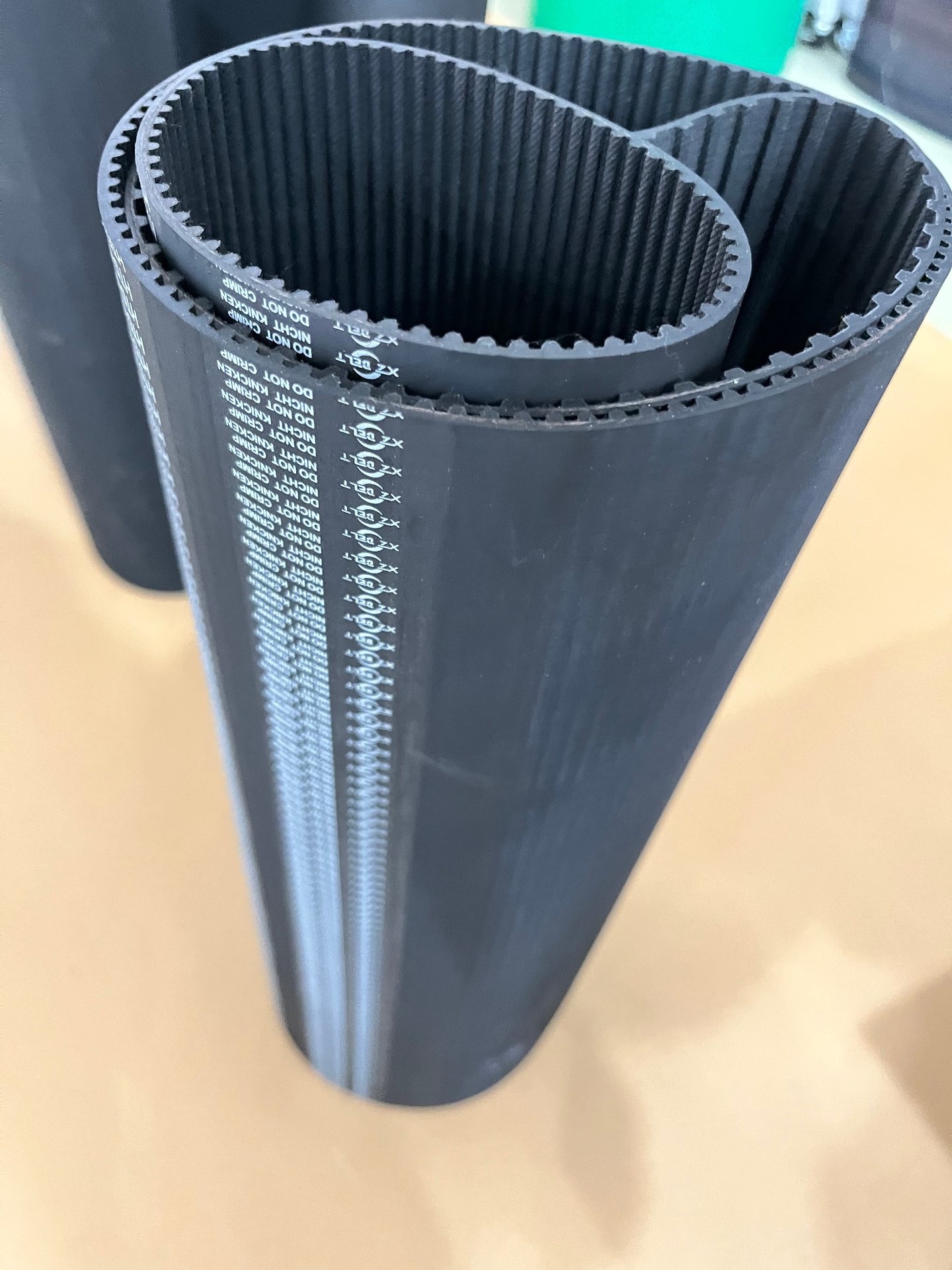
Timing Belt Application Guide: Logistics, Parcel Sorting & Warehouse Automation
Timing belts in logistics and intralogistics projects are selected as synchronous drive and conveying components for parcel merge, sortation, accumulation and related warehouse automation equipment. The correct belt is defined by the project duty cycle: 24/7 operation, repeated parcel impact, high-speed sorting, accumulation, and the interface with sorters, scanners, rollers, telescopic conveyors and merge conveyors. Tooth profile alone is not enough.
This guide is written for project teams in the Research and Evaluation stage of a logistics automation project. It explains how distribution center, fulfillment center and parcel sorting center requirements should be translated into timing belt specifications, and where open-end, jointed endless or truly endless constructions fit.
Problem Definition: A General Belt Is Not an Intralogistics Belt
The common procurement problem is not a missing timing belt. It is a mismatch between a general-purpose timing belt and the actual intralogistics duty cycle. In a parcel sorting center, the belt may run for long hours, stop and start with sorter cycles, absorb repeated parcel impact, and operate in an environment where antistatic performance, low noise, low rolling resistance, stable tracking and high throughput are explicit project requirements.
If the belt is selected only by length and tooth profile, the project may still face early wear, tracking instability, noise, joint concerns or unplanned replacement. The specification should start from the material flow, then move to belt construction, material, tension member, surface treatment and acceptance criteria.
Answer first: For logistics and intralogistics projects, define the belt by function and duty cycle. The logistics application data lists wear resistance, antistatic performance, low noise, low rolling resistance, stable tracking and high throughput as special requirements for distribution centers, fulfillment centers, parcel sorting centers and warehouse automation.
Industry Background: Why Timing Belts Matter in Warehouse Automation
XZBELT (Xuanze Industrial Drive Systems (Shanghai) Co., Ltd.) is a Shanghai-based manufacturer of conveyor belts and timing belts. The company was established in 2013, operates approximately 30,000 m² of manufacturing space, and supplies industrial belt products to customers in more than 150 countries and regions. Its timing belt range includes PU, rubber, neoprene, silicone-coated PU and silicone-coated rubber constructions.
Logistics and warehousing is listed among the application industries for XZBELT products, together with airport baggage handling, packaging, food processing, printing and automation equipment. For timing belts, the product data covers tooth profiles such as MXL, XL, L, H, XH, XXH, T5, T10, T20, AT5, AT10, AT20, HTD 3M, HTD 5M, HTD 8M, HTD 14M, HTD 20M, STS and RPP. This breadth matters in logistics projects because sorters, merge conveyors and accumulation conveyors may use different pulley systems and space envelopes.
The logistics and intralogistics application data defines the operating context clearly: high throughput, long running hours, repeated parcel impact, accumulation and sorting. Project types include distribution centers, fulfillment centers, parcel sorting centers and warehouse automation. Functions include parcel conveying, merging, sorting, accumulation, loading and unloading. Matched equipment includes sorters, scanners, rollers, telescopic conveyors, merge conveyors and warehouse automation systems.
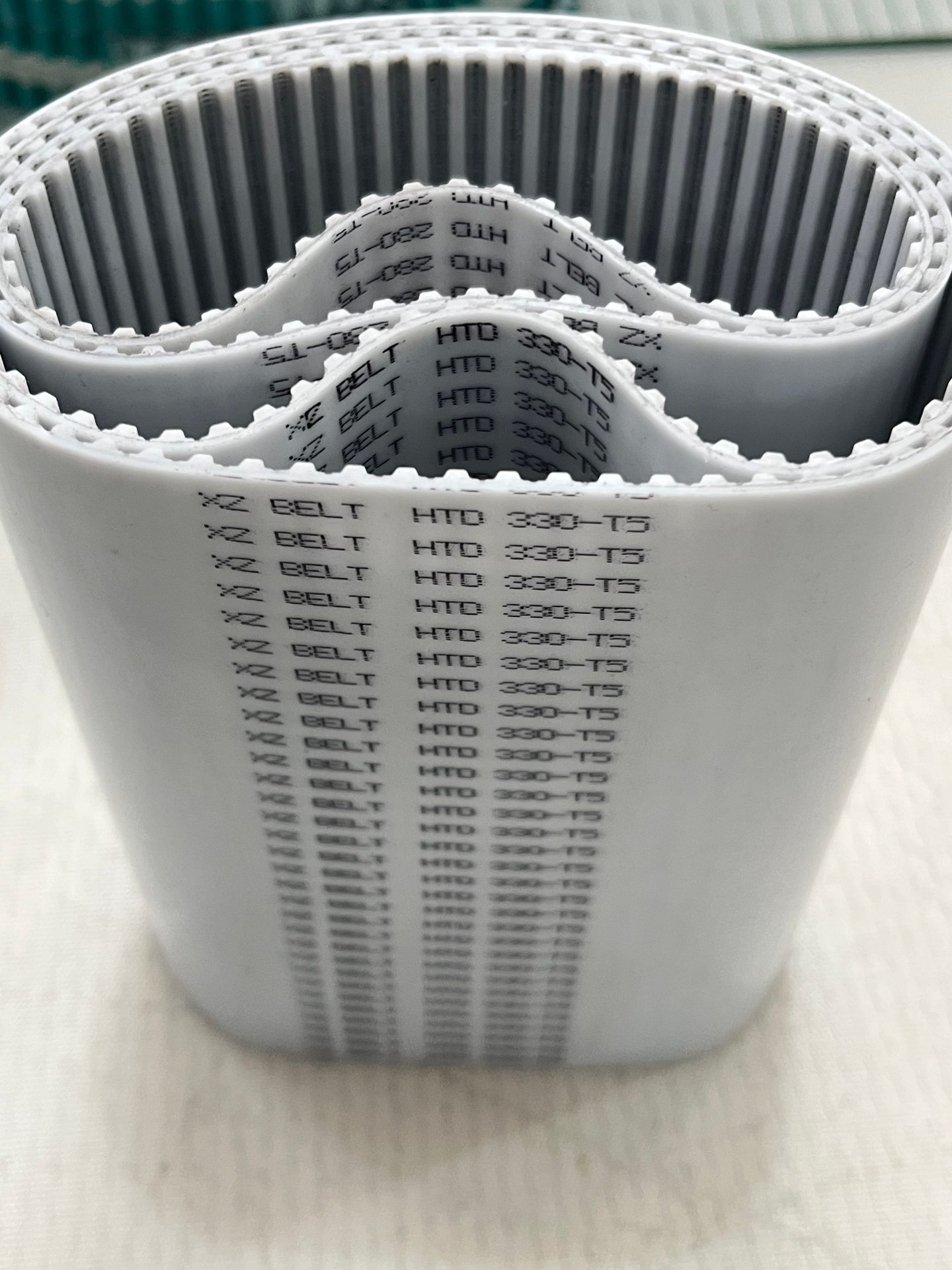
What Distribution Centers and Parcel Sorting Centers Require
Distribution center requirements should be written as belt and drive requirements, not left as general project language. The logistics application data identifies the following requirements for timing belt adaptation.
- Wear resistance: repeated parcel impact, accumulation and sorting cycles place wear on the belt surface and tooth area. The belt specification should state the wear-resistant compound and surface treatment required for the zone.
- Antistatic performance: the timing belt product data lists an antistatic index of 10⁸–10⁹, customized. If the project requires antistatic performance, this should be stated in the inquiry and verified against the selected construction.
- Low noise: fulfillment and parcel sorting centers list low noise as a requirement. Noise should be checked as part of the drive and conveyor interface, not assumed from the belt alone.
- Low rolling resistance and stable tracking: these are listed requirements for logistics projects. The belt should be matched to pulley alignment, conveyor structure and tracking controls.
- High throughput and 24/7 continuous operation: long running hours and high-speed sorting mean the belt must be selected for continuous duty, not occasional motion.
- Compatibility with supporting equipment: sorters, scanners, rollers, telescopic conveyors and merge conveyors define the interface. The belt must fit the equipment, not the other way around.
These requirements are connected. A belt that tracks poorly can affect scan stability. A joint that is not suited to the pulley and load can affect sorter uptime. A compound that is not wear-resistant can change belt life under repeated parcel impact. The selection process should therefore be system-level.
Detailed Solution: Timing Belt Configuration for Logistics Projects
1. Start with the material flow, not the belt catalogue
Map the project into functional zones: parcel merge, scan point, sortation, accumulation, and loading or unloading. The logistics application data lists parcel conveying, merging, sorting, accumulation, loading and unloading as functions. Each zone has a different belt task. A merge conveyor may need stable tracking under changing parcel streams. A sorter may need synchronous positioning and low elongation. An accumulation conveyor may need wear resistance and low noise under repeated parcel impact. A telescopic conveyor may need a compact drive envelope and stable tracking.
2. Translate 24/7 operation into construction requirements
For 24/7 continuous operation, the belt should be specified with a suitable tension member and joint method. XZBELT timing belts can use steel cord, Kevlar cord or glass fiber cord as the tension member. Joint methods include welded joint, flex joint and endless joint. Supply forms include open-end belt, jointed endless belt and truly endless belt. The project should state whether the belt will be installed as an open-end belt and joined, or supplied as a jointed endless or truly endless belt.
3. Match tooth profile, pitch, width and length to the pulley system
Tooth profile and pitch must match the pulley system. Two timing belts with the same length but different tooth profiles cannot be interchanged. The timing belt product data covers MXL, XL, L, H, XH, XXH, DXL, DL, DH, T5, T10, T20, AT5, AT10, AT20, HTD 3M, HTD 5M, HTD 8M, HTD 14M, HTD 20M, STS S2M, S3M, S4.5M, S5M, S8M, S14M, RPP P3M, P5M, P8M and P14M profiles, with custom options. Width, length and thickness are customized, with width tolerance ±0.5 mm, thickness tolerance ±0.3 mm and length tolerance ±0.5 mm.
4. Select material and surface treatment for the zone
PU timing belts list high positioning accuracy, slip-free transmission, high tensile strength, low elongation, excellent wear resistance, good oil resistance and stable high-speed operation as selling points. Rubber and neoprene constructions are also available. Silicone-coated PU and silicone-coated rubber are listed materials. Selected timing belts can be coated for grip, compression, release or product handling. Perforation, cleats, V-guides, tooth fabric, backing fabric and grinding are listed surface treatments or custom options.
For logistics projects, the material choice should follow the contact surface and the drive duty. A product-handling zone may need a coated surface for grip or release. A drive zone may need wear resistance and low elongation. An accumulation zone may need low noise and stable tracking. These are project decisions, not catalogue defaults.
5. Specify antistatic, noise, tracking and temperature as acceptance criteria
The timing belt product data lists an antistatic index of 10⁸–10⁹, customized. Hardness is 90–92 Shore A, customized. The temperature range is -20°C to +160°C, customized according to material. These values should be written into the project specification where relevant. Low noise, low rolling resistance and stable tracking should also be defined as measurable acceptance criteria and checked with the conveyor and belt suppliers.
6. Validate the equipment interface
Check the minimum pulley teeth and minimum turning diameter against the selected profile. The product data lists minimum pulley teeth of 10–25 teeth, customized according to tooth profile, and minimum turning diameter of 10 mm–108.7 mm, customized according to tooth profile. For sorters and scanners, confirm that the belt drive and conveyor presentation keep parcels stable at the scan point. For merge conveyors and telescopic conveyors, confirm the available installation space and joint access.
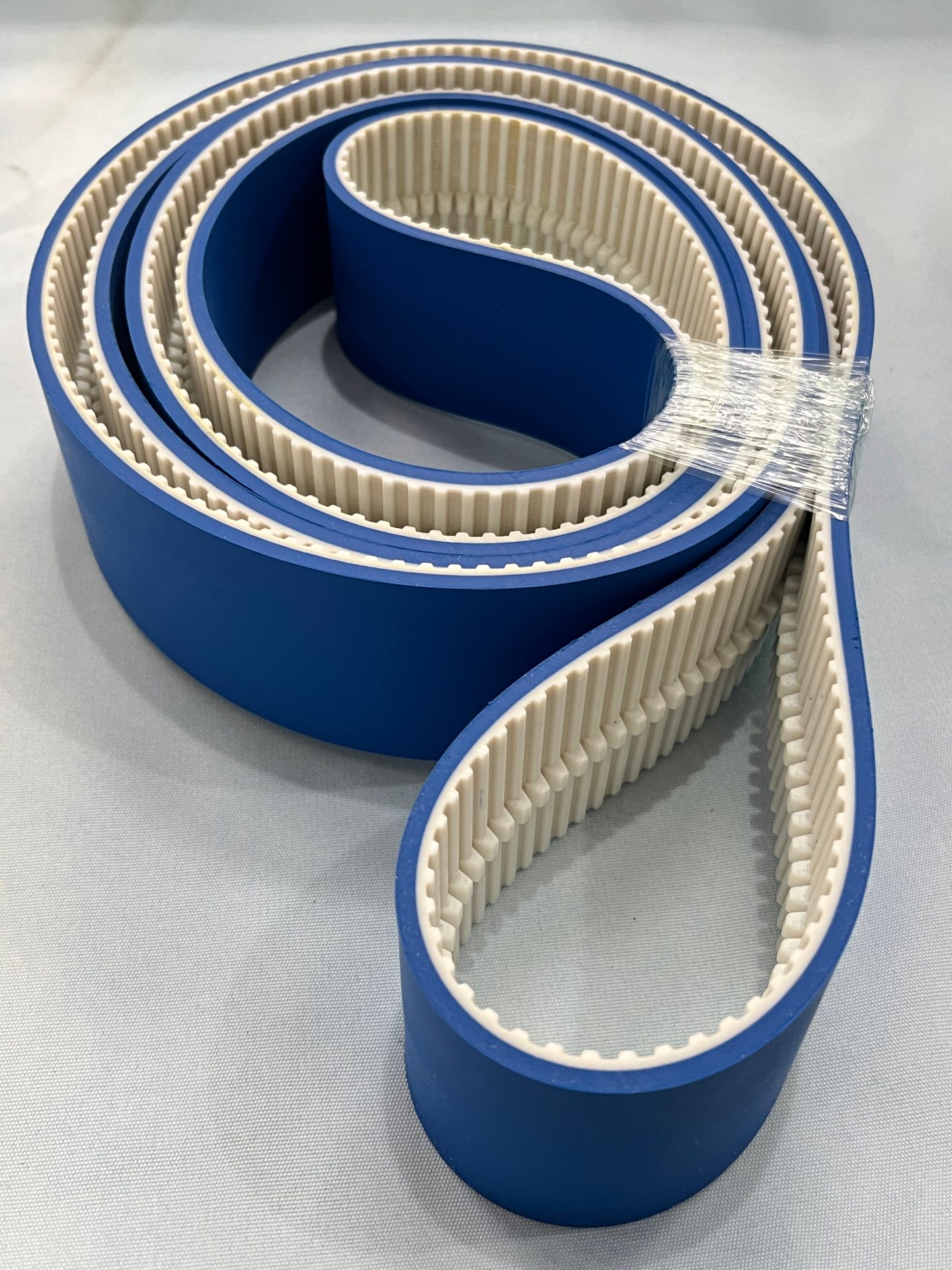
Step-by-Step Breakdown for Project Teams
The following sequence keeps the timing belt specification aligned with the logistics project, rather than treating the belt as a last-minute component.
- Define the zone: parcel merge, scan, sort, accumulate, load or unload. Record the function and the matched equipment from the project layout.
- Record the duty cycle: continuous 24/7 operation, high-speed sorting, accumulation cycles, repeated parcel impact and long running hours.
- Collect pulley and drive data: tooth profile, pitch, number of teeth, pulley diameter, width, load, speed and available installation space.
- Choose the supply form: open-end belt, jointed endless belt or truly endless belt. Confirm the joint method: welded joint, flex joint or endless joint.
- Select the tension member: steel cord, Kevlar cord or glass fiber cord, based on load, elongation and pulley geometry.
- Select material and surface: PU, rubber, neoprene, silicone-coated PU or silicone-coated rubber; then add coating, perforation, cleats, V-guides, fabric or grinding if required.
- Write the acceptance criteria: wear resistance, antistatic performance where required, low noise, low rolling resistance, stable tracking, high throughput and temperature range.
- Validate and document: check minimum pulley teeth and turning diameter, confirm the sorter and scanner interface, and record the approved belt specification for repeat orders.
Use Cases in Logistics, Parcel Sorting and Warehouse Automation
Parcel merge conveyors
Merge conveyors combine parcel streams before sortation. The logistics application data lists merging as a function and merge conveyors as matched equipment. Timing belts used in these conveyors should be selected for stable tracking, wear resistance and compatibility with the conveyor drive. If the merge zone runs continuously, the belt specification should reflect 24/7 operation and repeated parcel impact.
High-speed sorters
Sorters are listed as matched equipment for logistics and intralogistics projects. Timing belts in sorter drives should be selected for synchronous transmission, low elongation and stable high-speed operation. The belt profile and pitch must match the sorter pulley system. The joint method and supply form should be confirmed before the belt is released for production.
Accumulation conveyors
Accumulation is a defined function in the logistics application data. Accumulation conveyors hold and release parcels, so the belt may see repeated starts, stops and parcel impact. Wear resistance, low noise, low rolling resistance and stable tracking are relevant requirements. Antistatic performance should be specified where the project requires it.
Warehouse automation and loading or unloading
Warehouse automation systems, rollers, scanners and telescopic conveyors are listed as matched equipment. Timing belts can be used in conveyor systems and automation equipment across these zones. The project should confirm the belt width, length, surface treatment and tracking arrangement against the actual equipment. Loading and unloading areas may also require attention to joint access and replacement planning.
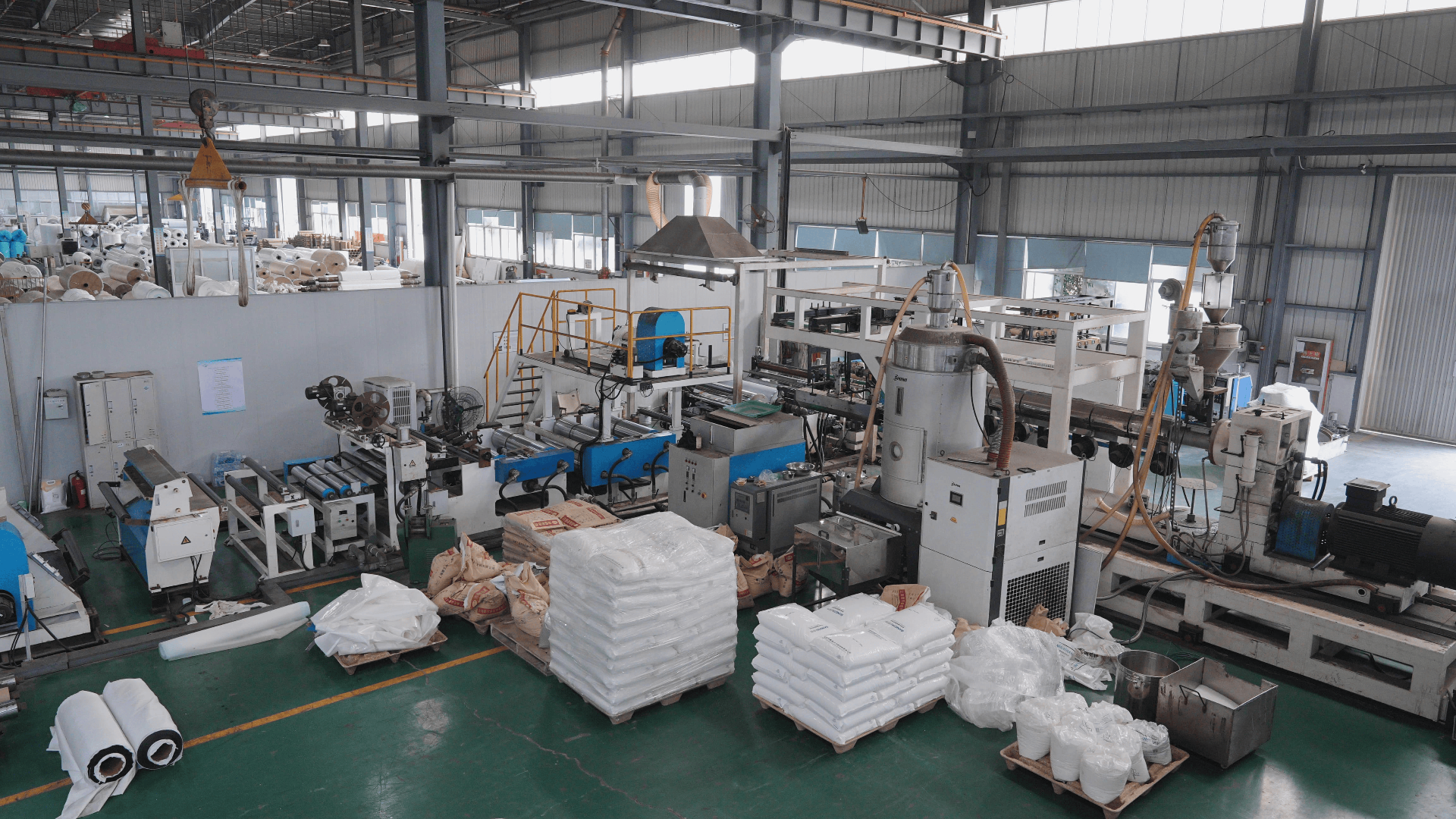
Comparison Table: Timing Belt Options for Intralogistics
The table below uses only the facts listed in the timing belt product data and related application data. It is a selection aid, not a substitute for project-specific engineering review.
| Option | Corpus-stated capability | Logistics project consideration | What to confirm |
|---|---|---|---|
| PU timing belt | Material includes polyurethane, PU and CPU. Selling points include high positioning accuracy, slip-free transmission, high tensile strength, low elongation, excellent wear resistance, good oil resistance and stable high-speed operation. | Suited to synchronous drive and conveying functions where wear resistance, low elongation and stable high-speed operation are required. | Antistatic index, hardness, pulley data, load, speed and joint method. |
| Rubber timing belt | Material includes rubber and neoprene rubber. Temperature range is -20°C to +160°C, customized according to material. | An option where a rubber or neoprene construction is specified for the project. | Temperature, oil exposure, antistatic requirement and surface treatment. |
| Silicone-coated timing belt | Material includes silicone-coated PU and silicone-coated rubber. Selected timing belts can be coated for grip, compression, release or product handling. | Relevant where the belt surface interacts with the parcel or product and a specific handling surface is needed. | Coating thickness, hardness, grip or release requirement and wear resistance. |
| Kevlar reinforced timing belt | Tension member options include Kevlar cord. Intermediate layer material includes Kevlar. | An option where the project specification calls for a Kevlar tension member or intermediate layer. | Load, elongation, minimum pulley teeth and joint method. |
| Open-end, jointed endless or truly endless | Supply forms include open-end belt, jointed endless belt and truly endless belt. Joint methods include welded joint, flex joint and endless joint. | The choice depends on installation access, sorter or conveyor design and maintenance planning. | Joint strength, pulley compatibility, length tolerance and replacement procedure. |
FAQ
What timing belt properties matter most in 24/7 parcel sorting and accumulation?
Wear resistance, antistatic performance where specified, low noise, low rolling resistance, stable tracking and high throughput are the requirements listed for logistics and intralogistics applications. The belt should be selected against those requirements together with tooth profile, pitch, width, length and pulley data. Because the duty cycle includes long running hours, repeated parcel impact and high-speed sorting, the tension member and joint method should also be confirmed.
Can timing belts be supplied as open-end or endless for sorter and conveyor drives?
XZBELT timing belts can be supplied as open-end belt, jointed endless belt or truly endless belt. Joint methods include welded joint, flex joint and endless joint. The correct choice depends on the equipment design, installation access and maintenance plan. Tooth profile and pitch must match the pulley system, and two belts with the same length but different tooth profiles cannot be interchanged.
Can XZBELT customize width, coating, perforation and antistatic performance for warehouse automation?
XZBELT lists OEM, ODM, custom manufacturing and secondary processing capabilities. Customization includes material, width, length, thickness, color, surface pattern, cleats, sidewalls, perforation, fabric reinforcement, silicone coating, sponge coating, special surface coating, splicing and special belt structure. The timing belt data lists an antistatic index of 10⁸–10⁹, customized, and hardness of 90–92 Shore A, customized. The project should state the required values in the inquiry.
Does XZBELT support timing belt applications beyond logistics, such as printing machine drive systems?
XZBELT timing belts list printing, packaging, logistics and automation equipment among applicable industries. For printing machine drive systems, the same selection discipline applies: tooth profile, pitch, length or tooth count, width, load, speed, pulley data and operating environment. For logistics projects, the additional requirements are wear resistance, antistatic performance, low noise, low rolling resistance, stable tracking and high throughput. Sharing the machine or conveyor data allows a project-specific recommendation.
What information is needed for a logistics timing belt quote, sample or lead time review?
Provide the functional zone, equipment type, tooth profile, pitch, length or tooth count, width, load, speed, pulley data, required joint method, surface treatment and environmental requirements. State antistatic, noise, tracking and temperature criteria where applicable. XZBELT lists a lead time of 7 days for selected standard products, with customized orders subject to specification. MOQ is by product type and specification. For a project review, share the conveyor layout and belt data with XZBELT and request a sample or quote through www.xzbelt.com.
Conclusion
Timing belt adaptation for logistics, parcel sorting and warehouse automation should follow the material flow. Start with parcel merge, scan, sort, accumulation and loading or unloading. Then define the duty cycle: 24/7 continuous operation, high-speed sorting, repeated parcel impact, long running hours and high throughput. Finally, translate those requirements into tooth profile, pitch, width, length, material, tension member, joint method, surface treatment and acceptance criteria.
The logistics application data provides a clear requirement set: wear resistance, antistatic performance, low noise, low rolling resistance, stable tracking and high throughput, with support from sorters, scanners, rollers, telescopic conveyors, merge conveyors and warehouse automation systems. A timing belt that is selected against those requirements is easier to validate, document and repeat across a distribution center or parcel sorting center project.
Next step for logistics projects: share your conveyor layout, pulley data, duty cycle and environmental requirements with XZBELT. Request a timing belt sample or quote, or download the XZBELT brochure for product and capability details: XZBELT brochure.
Contact: Steven Sang | Email: stevensang@xzbelt.com | Tel / WhatsApp: +86 139-1694-6090 | Website: www.xzbelt.com
Have Questions or Need More Details?
Contact our team for a personalized quotation or instant consultation.
Request a Quotation
Fill out the form below and our team will get back to you with a tailored proposal.
WhatsApp Direct Chat
Prefer to chat in real-time? Message us on WhatsApp for instant assistance & quick answers.
- Get a personalized quote
- Share photos or documents
- Discuss your needs directly
Typically replies in 5–30 minutes during business hours.