Timing Belt Tooth Wear and Tear: A Technical Guide to Tension, Alignment, and Selection
Timing belt teeth fail because of the drive, not because of the belt alone. Incorrect tension, pulley misalignment, insufficient tooth engagement, and a mismatched belt construction overload the tooth and tooth-root area until the belt sheds teeth. This guide links each visible damage pattern to its likely cause, explains the risks created by incorrect timing belt tension, lists the parameters buyers should confirm before ordering an industrial timing belt, and closes with a practical acceptance checklist for replacement decisions.
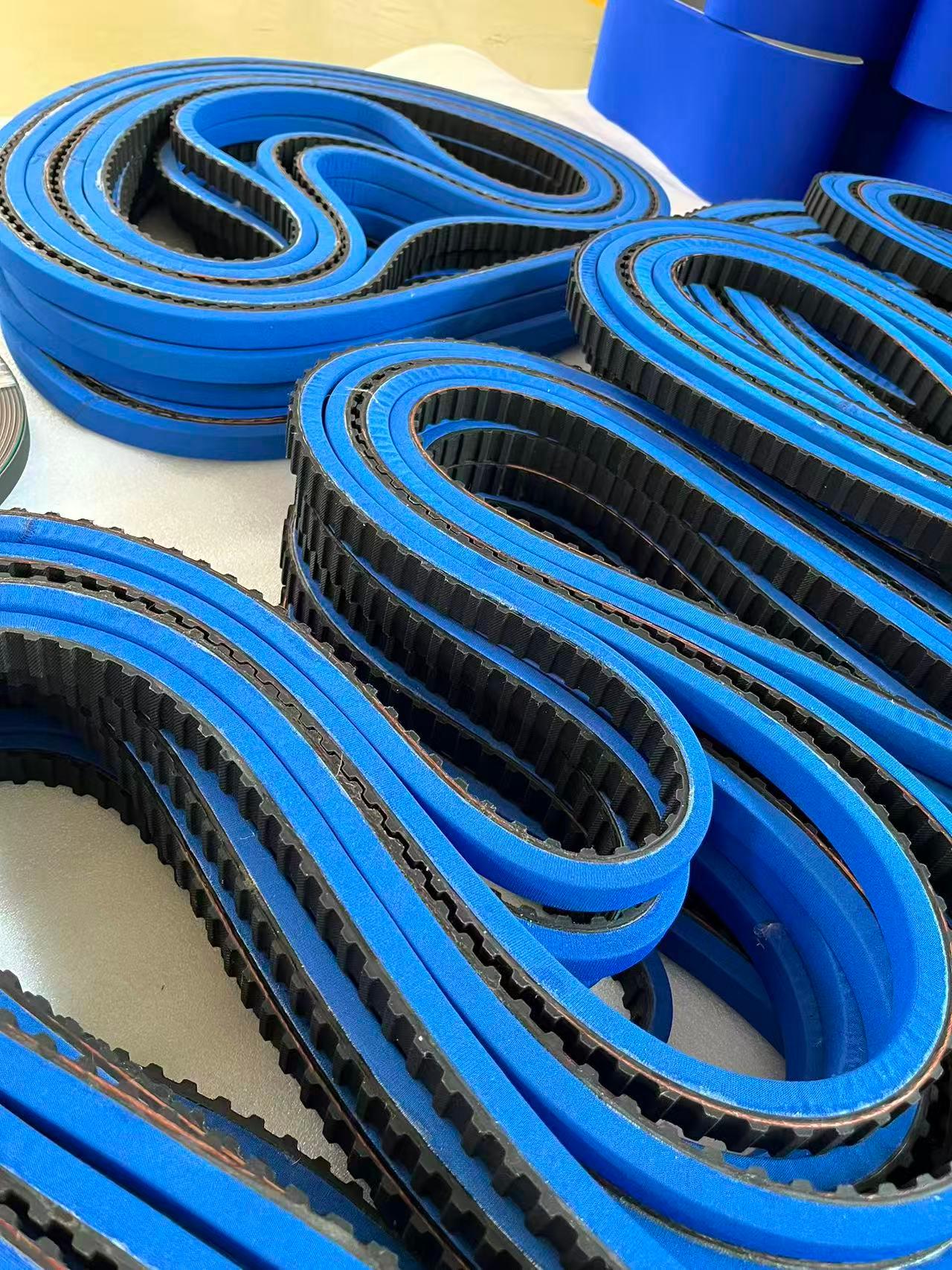
Problem Definition: What Tooth Wear and Tooth Tear Actually Look Like
Tooth damage is usually the result of a drive-system problem rather than ordinary surface wear alone. A belt that has simply reached the end of its service life wears gradually and evenly across the whole tooth face. A belt that fails early shows a pattern — and the pattern is the diagnostic clue.
Typical visible symptoms include:
- Tooth flank wear concentrated on one side of the tooth
- Damaged or cracked tooth roots
- Missing teeth or full tooth shear
- Fabric separation at the tooth base
- Intermittent ratcheting under load
Incorrect tension, excessive torque, worn or incorrect pulleys, foreign objects, misalignment, and tooth-profile mismatch can all overload the tooth and tooth-root area. Continental specifically links abnormal tooth-flank wear and tooth shearing with incorrect tension, foreign material, and seized pulleys, while Optibelt identifies excessive tension and defective pulleys as causes of tooth-root wear. Two different failure signatures, two different mechanisms — but both come back to the drive rather than to the belt compound.
This matters for buyers because a replacement belt ordered without addressing the cause will fail the same way. In a folder-gluer or carton packaging line, where belt slippage and unplanned downtime directly affect output, repeating the same failure every few months is far more expensive than diagnosing it once.
Industry Background: Why Tooth Failures Are Becoming More Visible
Industrial timing belts are judged today against a rising baseline of speed, indexing accuracy, and uptime. Mordor Intelligence projects the global timing belt market to reach approximately USD 9.57 billion by 2030, growing from a 2025 base of USD 9.10 billion. The polyurethane segment is forecast to grow fastest: Credence Research estimates a CAGR of 12.57% for PU timing belts, reaching USD 25.5 billion by 2032.
That PU figure should be read with a caveat. Other research houses publish materially lower PU growth estimates — around 3.10% — which suggests the higher figure includes high-value custom and robotics-driven applications rather than standard industrial replacement belts alone. Either way, the direction is consistent: more drives are being specified with PU and with application-specific constructions.
Rubber still dominates the automotive segment, estimated at USD 7.23 billion in 2024 according to Market Research Future. That split matters when a buyer specifies a belt for a given machine: the material decision is driven by the application, not by which material is growing faster.
On the standards side, ISO 5296:2012 specifies the principal characteristics of synchronous endless belts with pitch codes MXL, XXL, XL, L, H, XH, and XXH. Standardised pitch codes exist precisely because tooth geometry must match the pulley system — a point that becomes central when a tooth failure is being diagnosed.
The Four Things That Actually Destroy Timing Belt Teeth
1. Incorrect Tension
Tension is the single most common reason a timing belt loses teeth, and it fails in both directions.
Over-tensioning raises the load carried by the tooth root and by the tension member at the point where the belt bends around the pulley. The result tends to be tooth-root wear and cracking rather than tooth shear — the belt is being stretched against the pulley while the teeth are already carrying the drive torque.
Under-tensioning lets the belt ride up on the pulley teeth. Instead of the full tooth flank sharing the load, contact is concentrated on the tooth tip. The belt ratchets, the tooth flank wears abnormally, and in high-torque indexing drives the teeth shear off outright.
Both conditions are aggravated in drives with frequent start-stop cycles, which is exactly the operating mode of packaging machinery, where belts run under high-speed conditions with frequent start-stop and precise positioning requirements.
2. Alignment
Pulley misalignment makes the belt enter and leave the pulley at an angle. The load then concentrates on one edge of the tooth rather than across the full width. A belt that shows more wear on one tooth flank than the other, or wear concentrated on one side of the belt width, is usually telling you the shafts or pulleys are out of alignment.
Misalignment also produces the classic secondary symptom: tooth flank wear accompanied by edge fraying and unstable tracking. On printing and paper converting lines, where precise sheet positioning and a non-marking surface are both required, misalignment shows up first as positioning drift rather than as obvious belt damage — by the time teeth are visibly worn, the machine has usually been producing scrap for some time.
3. Tooth Engagement
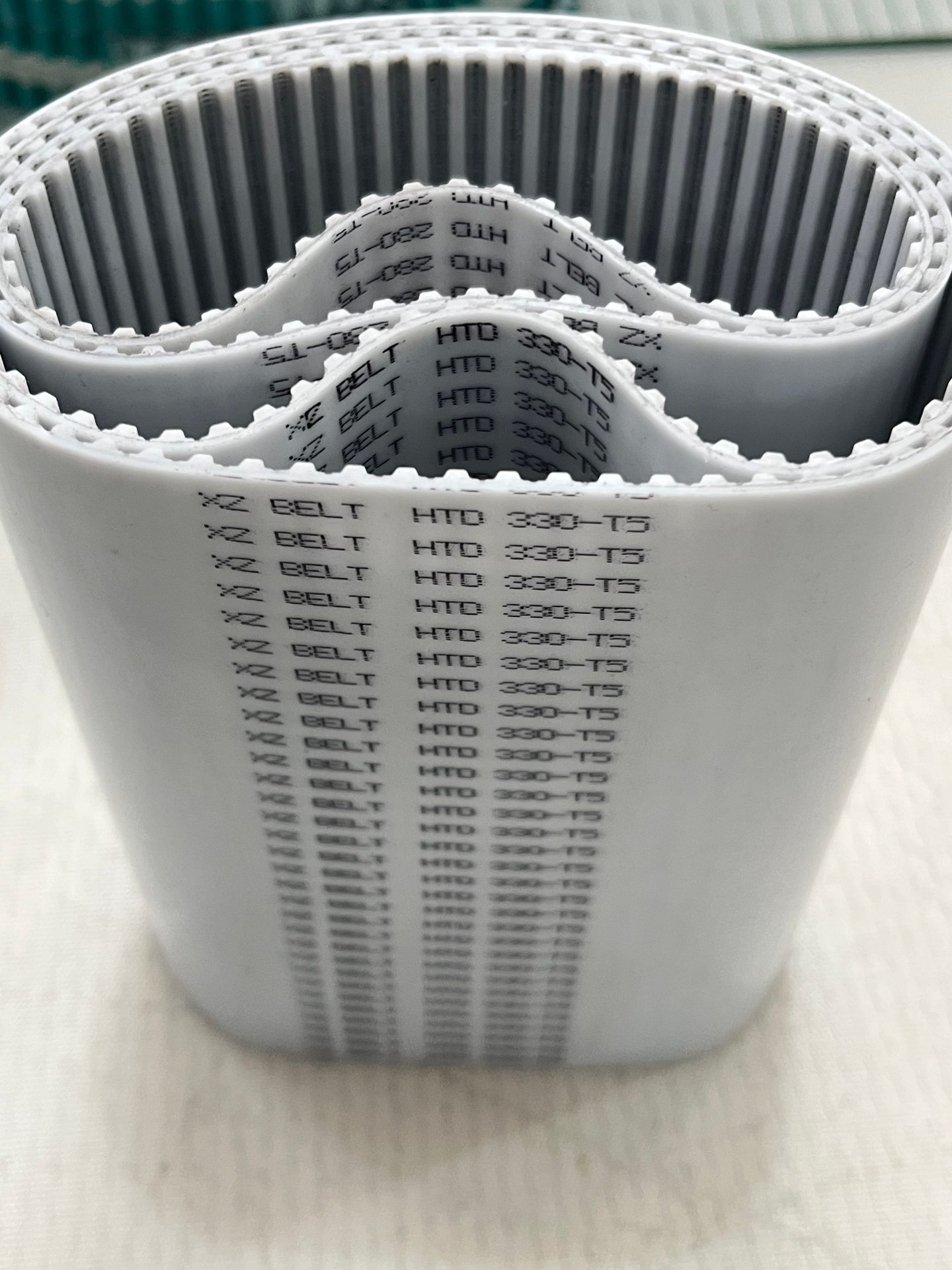
Correct tooth engagement comes first in any specification decision. Before reinforcement, coating, or open-end versus endless construction is discussed, the buyer should establish tooth profile, pitch, length or tooth count, and width.
Two failure modes belong here:
- Profile mismatch. A belt with the correct length but the wrong tooth profile cannot be interchanged with the original. The tooth geometry and pitch must match the pulley system.
- Insufficient pulley teeth. Too few teeth on the pulley — or a pulley diameter below the belt's minimum turning diameter — increases bending stress at the tooth root and reduces load capacity and service life.
Tooth count is often the more useful identification number when pitch is known, because pitch length equals tooth count multiplied by pitch. That single relationship resolves most cataloguing confusion on the factory floor.
4. Material and Construction Choice
The fourth driver is the belt itself — but only after the first three have been addressed. Selection should begin with the required motion function:
- Linear axes normally favour open-end belts with low elongation and appropriate reinforcement.
- Continuous synchronous drives require endless or truly endless constructions.
- Product-handling belts may need silicone, rubber, sponge, or fabric covers to achieve the required friction and release behaviour.
- Vacuum or pick-and-place systems may require perforation or machining.
Temperature belongs in the same decision. XZBELT timing belts are specified with a temperature range of −20°C to +160°C depending on material, with hardness of 90–92 Shore A and dimensional tolerances of ±0.5 mm on width and length and ±0.3 mm on thickness. Where a drive runs beyond the standard range, the material — not the profile — is what has to change.
The tension member choice sits underneath all of this. It controls load-carrying ability, elongation, and stiffness. Steel cord, Kevlar cord, and glass fiber cord are the common options, with steel cord diameters available from Φ0.3 mm to Φ1.21 mm depending on tooth profile.
Step-by-Step Breakdown: Diagnosing and Replacing a Failed Timing Belt
The following sequence follows the recognised diagnostic order and should be completed before a replacement belt is ordered. Skipping steps is how the same failure gets repeated.
- Inspect the damage pattern across several teeth. Even wear across all teeth suggests normal life. Concentrated flank wear, root cracking, or shear points to a drive condition.
- Verify belt profile and pulley profile match. Confirm profile, pitch, and tooth count against the pulley, not against the old belt's label alone.
- Check pulley teeth for wear or damage. A worn pulley will destroy a new belt in a short time.
- Check belt tension against the drive manufacturer's specification.
- Verify shaft and pulley alignment. Both parallel and angular alignment.
- Check drive load and shock loads. Confirm the belt was not undersized for the torque and the acceleration profile.
- Remove foreign objects or contamination. Debris trapped in the tooth mesh is a documented cause of tooth shear.
- Replace the damaged belt and any defective pulley components together where necessary.
Acceptance Criteria Before Releasing a Replacement Belt
Use this checklist as the practical go/no-go test for a replacement decision:
- Tooth profile and pitch verified against the pulley, not inferred from belt length
- Length or tooth count confirmed (pitch length = tooth count × pitch)
- Belt width confirmed against the pulley face and the transmitted load
- Tension set to the drive manufacturer's specification
- Shaft and pulley alignment verified
- Pulley tooth condition inspected and accepted, or the pulley replaced
- Minimum pulley teeth and minimum turning diameter respected for the selected profile
- Temperature, oil, dust, and contamination exposure within the selected material's range
- Construction type (open-end, jointed endless, or truly endless) matched to the motion type
- Coating or perforation specified only where the application actually requires it
Use Cases: Where Tooth Failure Shows Up and What Each Application Demands
Packaging Machinery
Packaging drives combine high speed with frequent start-stop and precise positioning. Requirements include accurate positioning, low elongation, high grip, vacuum perforation where relevant, wear resistance, and dimensional stability. Vacuum conveying applications additionally require a vacuum system matched to the belt's perforation pattern. This is the environment where under-tensioning produces the fastest tooth shear, because every indexing cycle loads the tooth flank abruptly.
A representative case: a packaging machinery distributor and carton packaging manufacturer running 1,000+ belts annually on folder-gluer and carton packaging lines for high-speed carton feeding, folding, pressing, and conveying. Over 24–30 months of continuous operation, the installation reduced belt replacement frequency by approximately 40%, improved feeding accuracy and operating stability, and minimised belt slippage and unplanned downtime. The contributing factors were high abrasion resistance, consistent friction performance, low elongation, reliable endless joint strength, and customised hardness and surface finishing.
Printing and Paper Converting
Printing drives run lightweight products at high speed with rapid acceleration and precise sheet positioning. The stated requirements are high friction consistency, precise positioning, abrasion resistance, low elongation, and a non-marking surface. On these lines, a belt that is marginally under-tensioned does not fail immediately — it drifts, and the drift appears as register error before it appears as tooth damage.
Industrial Automation and Precision Equipment
Servo-driven automation runs under frequent acceleration and deceleration, servo positioning, and high-cycle-rate conditions, in intermittent high-speed reciprocating motion. Requirements include low elongation, backlash control, positioning accuracy, high tensile strength, and low vibration. These drives are typically specified with open-end PU timing belts for linear actuators and gantry systems, with Kevlar reinforced constructions for high-load automation and heavy-duty conveyor systems. Where the motion is continuous rather than linear, double-sided timing belts suit compact multi-pulley drives.
Where Construction Choice Changes the Failure Mode
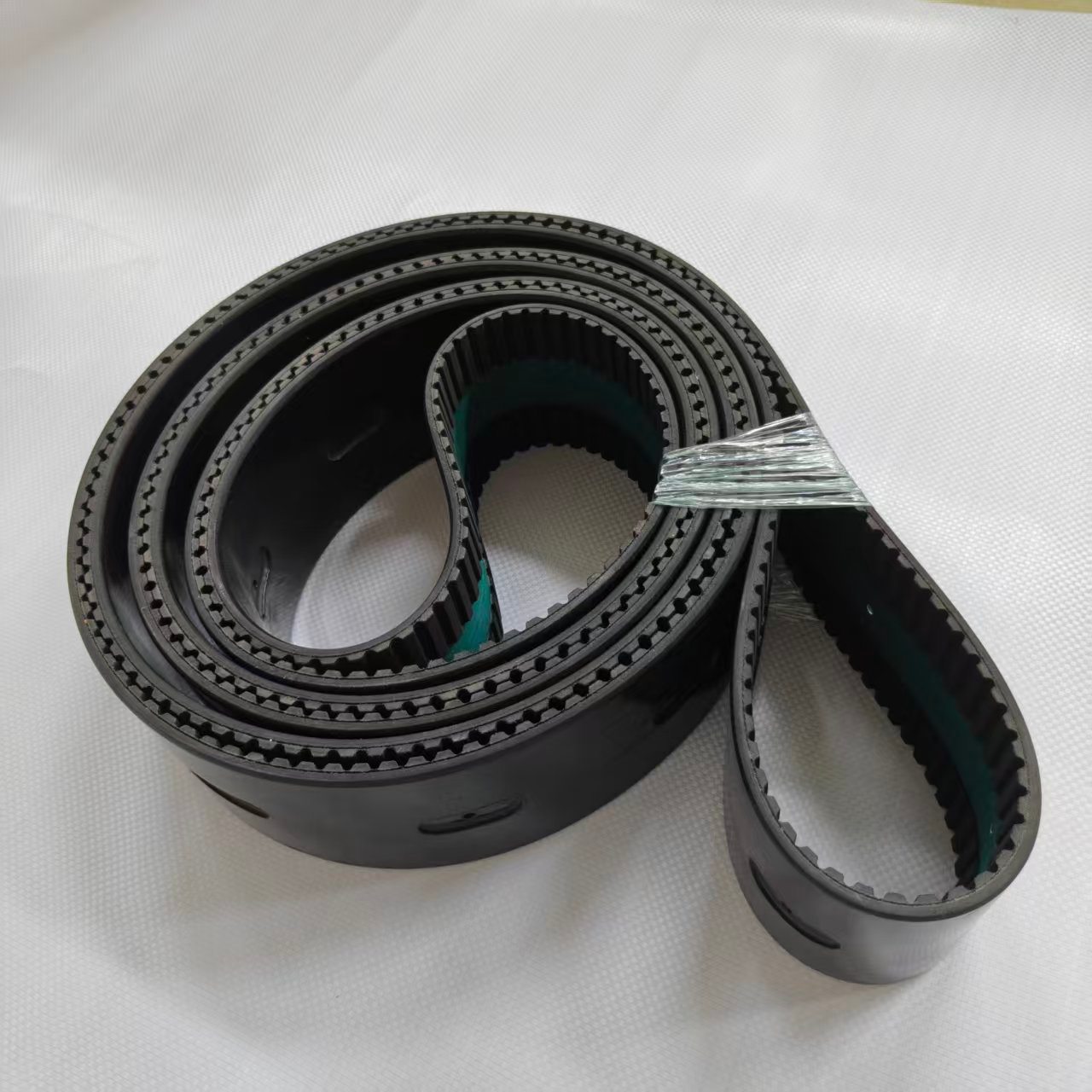
Another documented case involved a large aluminium profile manufacturer using 50+ belts annually for traction, conveying, and surface protection on extrusion lines. The problem was scratches and pressure marks on the profiles during handling — a wear and surface problem rather than a tooth failure. Over more than 12 months of continuous operation, the installation prevented scratches and pressure marks while maintaining conveying accuracy, reduced maintenance frequency by approximately 30%, and increased production efficiency by approximately 20%. The relevant properties were a protective felt surface, stable synchronous transmission, low elongation, reliable bonding strength, and precise dimensional stability.
The lesson transfers directly to tooth failure: the belt property that matters is the one the application actually exercises. Friction matters where grip matters. Low elongation matters where positioning matters. Temperature resistance matters where the environment demands it.
Comparison Table: Matching Construction to Drive Condition
The table below compares timing belt configurations available from XZBELT against the drive conditions they are designed for. All values are manufacturer specification data.
| Configuration | Specification Facts | Designed For | What to Confirm Before Ordering |
|---|---|---|---|
| Open-end PU timing belt | Welded or flex joint; steel cord, Kevlar cord, or glass fiber cord tension member | Linear actuators, gantry systems, servo-controlled automation | Joint strength depends on width and tooth profile — confirm both, plus minimum pulley teeth (10–25 depending on profile) |
| Truly endless timing belt | Endless joint; multi-layer construction | Continuous synchronous drives, high-cycle-rate indexing | Length or tooth count must be confirmed at order — an endless belt cannot be re-tensioned by shortening |
| Double-sided timing belt | Teeth on both faces; single-sided and double-sided both available | Compact multi-pulley drives, compact textile equipment | Both pulley profiles must match; confirm which face carries the drive load |
| Kevlar reinforced timing belt | Kevlar cord tension member and Kevlar intermediate layer | High-load automation, heavy-duty conveyor systems | Higher stiffness increases minimum pulley diameter requirements |
| Silicone / PU / rubber coated belt | Surface coating of silicone, PU, rubber, sponge, or fabric; coating thickness customised | Product handling, grip and release applications | Specify coating type and thickness against the product being handled |
| Perforated PU timing belt | Perforation as a surface treatment; perforation and cleats customised | Vacuum conveying and product positioning systems | Hole pattern must match the vacuum system, not just the belt width |
| High-temperature rubber timing belt | Rubber or neoprene; overall belt range −20°C to +160°C depending on material | Packaging machines and sealing equipment | Confirm actual continuous operating temperature, not peak temperature |
| Standard profile range (reference) | MXL, XL, L, H, XH, XXH, T5, T10, T20, AT5, AT10, AT20, HTD 3M–20M, STS S2M–S14M, RPP P3M–P14M | General industrial transmission | Profile and pitch first; length and width second |
Profile standards such as those covered by ISO 5296:2012 exist so that profile codes mean the same thing across suppliers. In practice, that means the buyer's specification work is mostly about matching the pulley, not about shopping across incompatible tooth systems.
Frequently Asked Questions
Why do timing belt teeth wear or tear off?
Tooth damage is usually the result of a drive-system problem rather than ordinary surface wear alone. Incorrect tension, excessive torque, worn or incorrect pulleys, foreign objects, misalignment, and tooth-profile mismatch can all overload the tooth and tooth-root area. Published failure analysis links abnormal tooth-flank wear and tooth shearing with incorrect tension, foreign material, and seized pulleys, and links tooth-root wear with excessive tension and defective pulleys. Diagnosing the damage pattern is the first step — the pattern identifies the mechanism.
Can two timing belts with the same length but different tooth profiles be interchanged?
No. The tooth geometry and pitch must match the pulley system. Identical length means only that the belts have the same pitch length; it says nothing about whether the teeth will seat correctly in the pulley grooves. A belt with the correct length and the wrong profile will either ratchet or destroy its own teeth. When pitch is known, tooth count multiplied by pitch gives the pitch length, which is often the more reliable identification route.
What should a buyer confirm before ordering a timing belt for a printing machine drive system?
Correct tooth engagement comes first. The buyer should establish tooth profile, pitch, length or tooth count, and width before deciding on reinforcement, endless or open-end construction, or special processing. Printing machine drive systems typically require high friction consistency, precise positioning, abrasion resistance, low elongation, and a non-marking surface. Where the drive is a linear motion or synchronized drive system in textile or printing equipment, open-ended PU timing belts are commonly specified; where high-precision positioning is the priority, low-elongation construction matters more than any other single property.
Can PU timing belts be supplied open-end and endless, and can they be coated or perforated?
Yes, depending on profile and manufacturing construction. XZBELT supplies open-end belts, jointed endless belts, and truly endless belts. Selected timing belts can be coated with silicone, PU, rubber, sponge, or fabric for grip, compression, release, or product handling, and selected PU timing belts can be perforated or machined for vacuum and handling systems. Customisation also covers material, width, length, thickness, colour, surface pattern, cleats, sidewalls, perforation, fabric reinforcement, silicone coating, sponge coating, special surface coating, splicing, and special belt structure.
What is the lead time for a customized timing belt?
XZBELT works with a lead time of 7 days for selected standard products, with customized orders subject to specification. Because tooth profile, pitch, tooth count, width, tension member, construction type, coating, and perforation all affect tooling and processing, the specification needs to be confirmed before the lead time can be fixed. Sending the drive details — pulley profile, tooth count, width, load, speed, and operating temperature — is the fastest route to an accurate quotation. You can share your specifications and request a sample through xzbelt.com or the contact details below.
Conclusion: Diagnose the Drive, Then Specify the Belt
Timing belt tooth wear and tooth tear are not random. They are the predictable outcome of a specific condition: tension outside the drive specification, pulleys out of alignment, teeth that are not fully engaged with the pulley, or a belt construction that does not match the load, speed, and environment. Each condition leaves a different damage signature, and each signature points to a different corrective action.
The practical sequence for any replacement decision is therefore fixed: identify the damage pattern, verify profile and pitch against the pulley, inspect the pulley teeth, correct tension and alignment, size the belt for the real load and acceleration profile, and only then choose the construction. Products like a Kevlar reinforced timing belt, a high-precision timing belt, or a silicone coated timing belt solve specific problems — they do not compensate for an unaligned shaft.
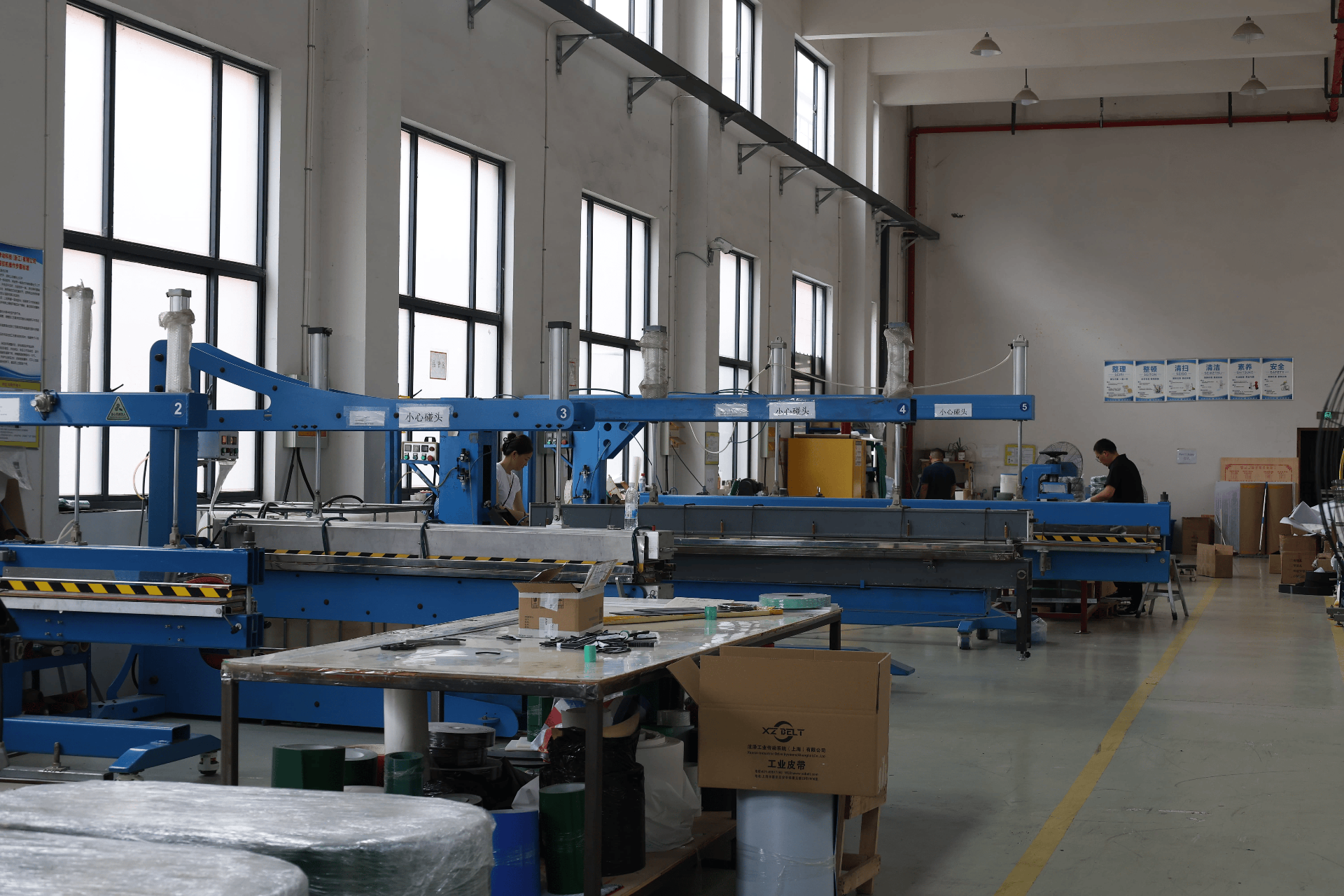
XZBELT — Xuanze Industrial Drive Systems (Shanghai) Co., Ltd. — manufacturers and supplies timing belts and industrial belts. Established in 2013, the company operates approximately 30,000 m² of manufacturing space, has been recognised as a Shanghai High-Tech Enterprise in the 2019–2022 and 2022–2025 certification periods, holds 11 belt-related patents (2 invention and 9 utility model), and operates an ISO 9001 quality management system. Products are exported to more than 150 countries and regions, with technical support, customised solution support, and long-term supply support available to industrial buyers.
Contact
Contact person: Steven Sang
Email: stevensang@xzbelt.com
Tel / WhatsApp: +86 139-1694-6090
Address: Room 701, No. 1033, Moyu South Road, Anting Town, Jiading District, Shanghai, China
Website: https://www.xzbelt.com/
Send Us Your Drive Details
Share your pulley profile, tooth count, belt width, load, speed, and operating temperature. We will confirm the correct construction and come back with a quotation and sample arrangement.
Download the XZBELT Catalogue Request a Quote on WhatsAppHave Questions or Need More Details?
Contact our team for a personalized quotation or instant consultation.
Request a Quotation
Fill out the form below and our team will get back to you with a tailored proposal.
WhatsApp Direct Chat
Prefer to chat in real-time? Message us on WhatsApp for instant assistance & quick answers.
- Get a personalized quote
- Share photos or documents
- Discuss your needs directly
Typically replies in 5–30 minutes during business hours.