XZBELT Conveyor Belt Manufacturer: Company and Capability Review
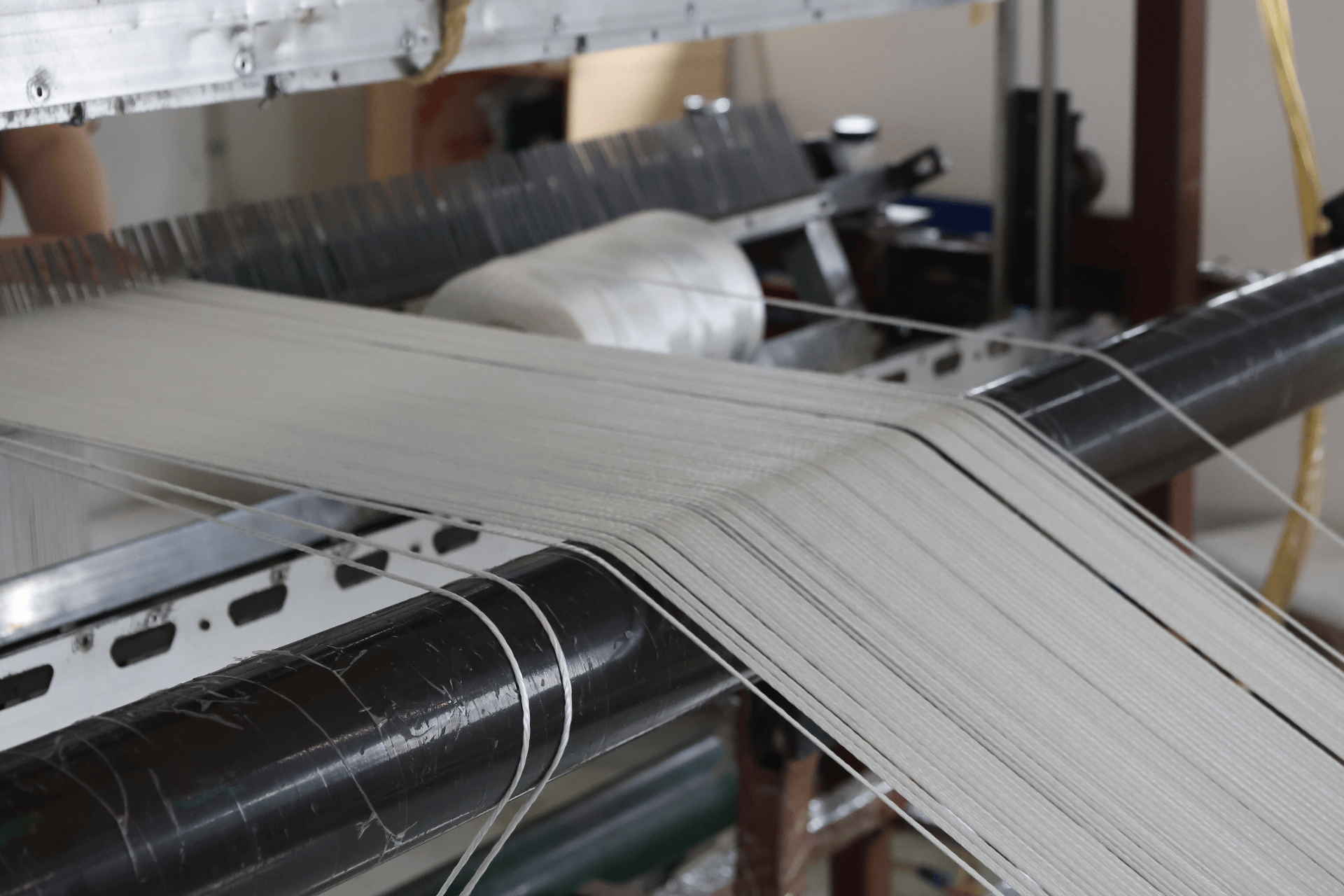
Cover: XZBELT specialty industrial belt manufacturing base. Image source: XZBELT.
XZBELT is the industrial belt brand of Xuanze Industrial Drive Systems (Shanghai) Co., Ltd., a manufacturer founded in 2013 and headquartered in Anting, Jiading District, Shanghai, China. The company manufactures conveyor belts, timing belts, power transmission belts and specialty industrial belts, and its products are used in food processing, packaging, logistics and warehousing, airport baggage handling, printing, woodworking, electronics, pharmaceutical manufacturing, metallurgy and steel processing.
Exports account for approximately 60% of output, and the company reports having served customers in more than 150 countries and regions. This review examines XZBELT the way a procurement team or an OEM engineer would at the discovery stage: what the company actually makes, how its manufacturing is structured, where its customization capability sits, what is verifiable, and which questions a buyer should still resolve before issuing a purchase order.
Problem Definition: Why Conveyor Belt Supplier Evaluation Is Harder Than It Looks
The first problem a buyer meets is not a shortage of suppliers. It is a shortage of comparable information. Conveyor belt catalogues across the market describe similar material names — PVC, PU, PE, PVK, silicone, felt — in similar language, and quotations frequently reduce the specification to width, length and price per square metre.
That reduction hides the variables that decide service life. A conveyor belt is not a commodity sheet. Its performance depends on the carcass, the cover compound, the surface pattern, the joint method, the pulley geometry it runs on, the tension applied, and the environment it operates in. Two belts of identical dimensions can behave completely differently on the same machine.
Splice failure illustrates the point. Repeated joint failures are rarely explained by “a bad belt” alone. They typically trace back to a joint type that does not suit the belt construction, incorrect joint preparation, press parameters that were not respected, excessive operating tension, a pulley smaller than the belt's minimum bending diameter, or conveyor misalignment. Each of these is a specification and process issue, not a raw-material issue.
The same logic applies to thickness. A thicker belt does not automatically last longer, because service life is governed by carcass, cover material, tension, pulley size, wear, joint quality, tracking and the operating environment together. For a discovery-stage buyer, the practical question therefore becomes: which manufacturers can demonstrate control over construction and fabrication, not only over supply?
That is the frame for this review. The sections below examine XZBELT against that question using the company's stated manufacturing facts, product data and published capabilities.
Industry Background: Why Lightweight Belt Capability Matters Now
The conveyor belt category is large, mature and structurally split between heavy-duty bulk handling and lighter process conveying. Third-party research places the global conveyor belt market at a forecast USD 6.08 billion in 2026 (Mordor Intelligence), while the light-weight segment — the PVC, PU and PE family that dominates food, packaging, logistics and general process conveying — is estimated at a 6.2% CAGR for 2025–2033 (Cognitive Market Research).
Growth in the light segment is being driven by automation density rather than by tonnage. More conveyors, more indexing stations, more wash-down lines and more high-speed sorting mean more belts per production line, and more of those belts require fabrication: cleats, sidewalls, guides, perforation, coatings and endless joints.
Standardisation is tightening alongside that growth. ISO 21183-1:2026 sets out the characteristics of light conveyor belts, and EN 12882:2015 covers safety requirements for general-purpose conveyor belts in the European Union. Food-contact applications add a further layer of documentation, and regional demand is concentrated: Asia Pacific accounted for 38.4% of food-grade conveyor belt market revenue in 2025 (Dataintelo).
The supplier landscape reflects this split. International belt brands are well represented in material science and published technical data, while regional manufacturers compete on fabrication depth, response speed and one-stop sourcing. XZBELT sits in the second group, and the company states that it maintains business cooperation and technical exchange with international belt brands including Habasit, Ammeraal Beltech and Forbo Siegling — a positioning that suggests access to reference constructions alongside its own manufacturing.
XZBELT at a Glance
XZBELT positions itself as a professional supplier of specialty industrial belts, focused on development, manufacturing and customization rather than on full conveyor system integration. The company's operating structure is the clearest indicator of what it is built to do.
- Legal entity: Xuanze Industrial Drive Systems (Shanghai) Co., Ltd., trading as XZBELT.
- Founded: 2013 — 13 years of manufacturing operation as of 2026, supported by a team with more than 20 years of accumulated industrial belt industry experience.
- Headquarters: Room 701, Jiating Building, Jiatinghui Commercial Plaza, Anting, Jiading District, Shanghai, China, next to Anting Station on Shanghai Metro Line 11; roughly 60 km from Shanghai Pudong International Airport and just over 10 km from Shanghai Hongqiao International Airport.
- Additional operations: Changxing (Huzhou, Zhejiang), Kaifeng (Henan) and Suzhou (Jiangsu).
- Manufacturing area: approximately 30,000 m² across two manufacturing bases.
- Workforce and R&D: 50 employees, including a 5-engineer R&D team.
- Output and reach: stated annual production capacity of 2,000,000 units; approximately 60% export share; customers in more than 150 countries and regions.
- Quality and IP: ISO 9001 Quality Management System certification; 11 belt-related patents (2 invention patents, 9 utility model patents); recognised as a Shanghai High-Tech Enterprise in the 2019–2022 and 2022–2025 certification periods.
For a discovery-stage buyer, the useful signal here is not the headline numbers but the combination: a company with dedicated R&D, patent activity and a high-tech enterprise designation is set up for custom construction work, which is exactly where generic belt trading stops and engineering begins.
Core Products and Solutions
General conveyor belt range
The core conveyor belt programme covers PVC conveyor belts, PU conveyor belts, TPU conveyor belts, PE conveyor belts, PVK conveyor belts, food grade conveyor belts, homogeneous conveyor belts, felt conveyor belts, PTFE conveyor belts, silicone conveyor belts, cotton conveyor belts and nylon conveyor belts. Base materials include PU, TPU, PVC, PVK, PA, nylon, polyester, Nomex, felt and silicone, with customised compounds available.
Published construction data for this family includes thickness from 0.8–8 mm, 1–3 plies, a temperature range of −20 °C to +220 °C for selected types depending on material, and a surface pattern library covering smooth, matt, diamond, golf, crescent and rough-top finishes. Joint methods include hot-melt joint, finger joint, Z-splice, stepped Z-splice, overlap joint, tooth joint, steel buckle and mechanical fastener. Supply forms include open belt, roll belt and endless belt.
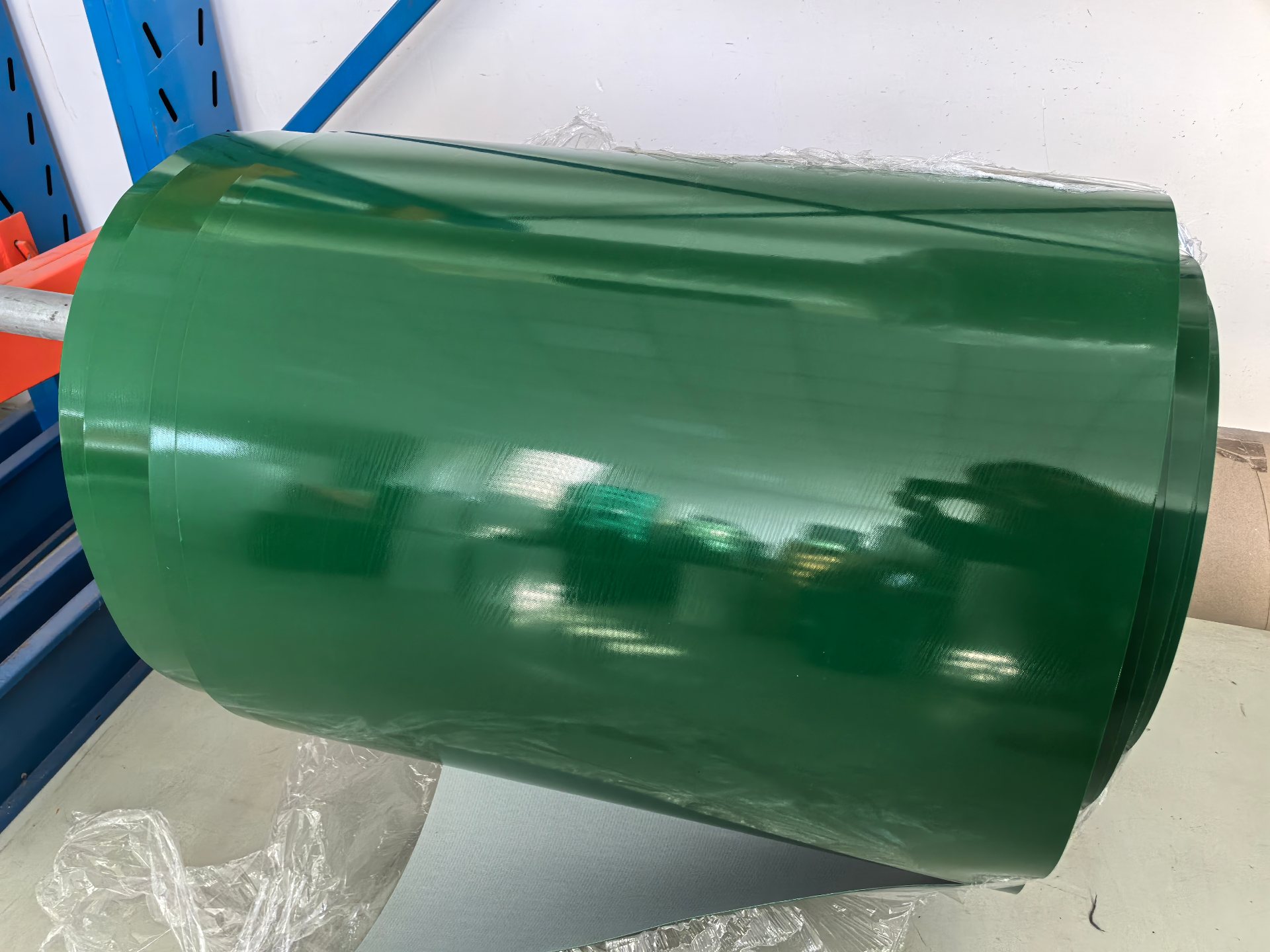
PVC conveyor belt from the XZBELT general conveyor range. Image source: XZBELT.
Seamless and high-temperature belts
Seamless belts are a distinct construction rather than a variant of the general range. XZBELT lists silicone-coated seamless belts, high-temperature seamless belts and seamless woven belts, built from silicone, Nomex fibre and polyester filament fibre on a seamless weaving construction — which removes the splice as a mechanical weak point.
The published specification is specific enough to design against: thickness 9 ± 0.5 mm with a 3 mm surface coating on a 6 mm baseband; tensile force of 30 N/mm at 1% elongation and tensile strength of 350 N/mm at 3% elongation; maximum operating speed 400 m/min; minimum pulley diameter 70 mm forward and 120 mm reverse; operating temperature range −40 °C to +210 °C. These belts are intended for high-temperature processing equipment, textile machinery, packaging machinery and industrial conveying and transfer equipment.
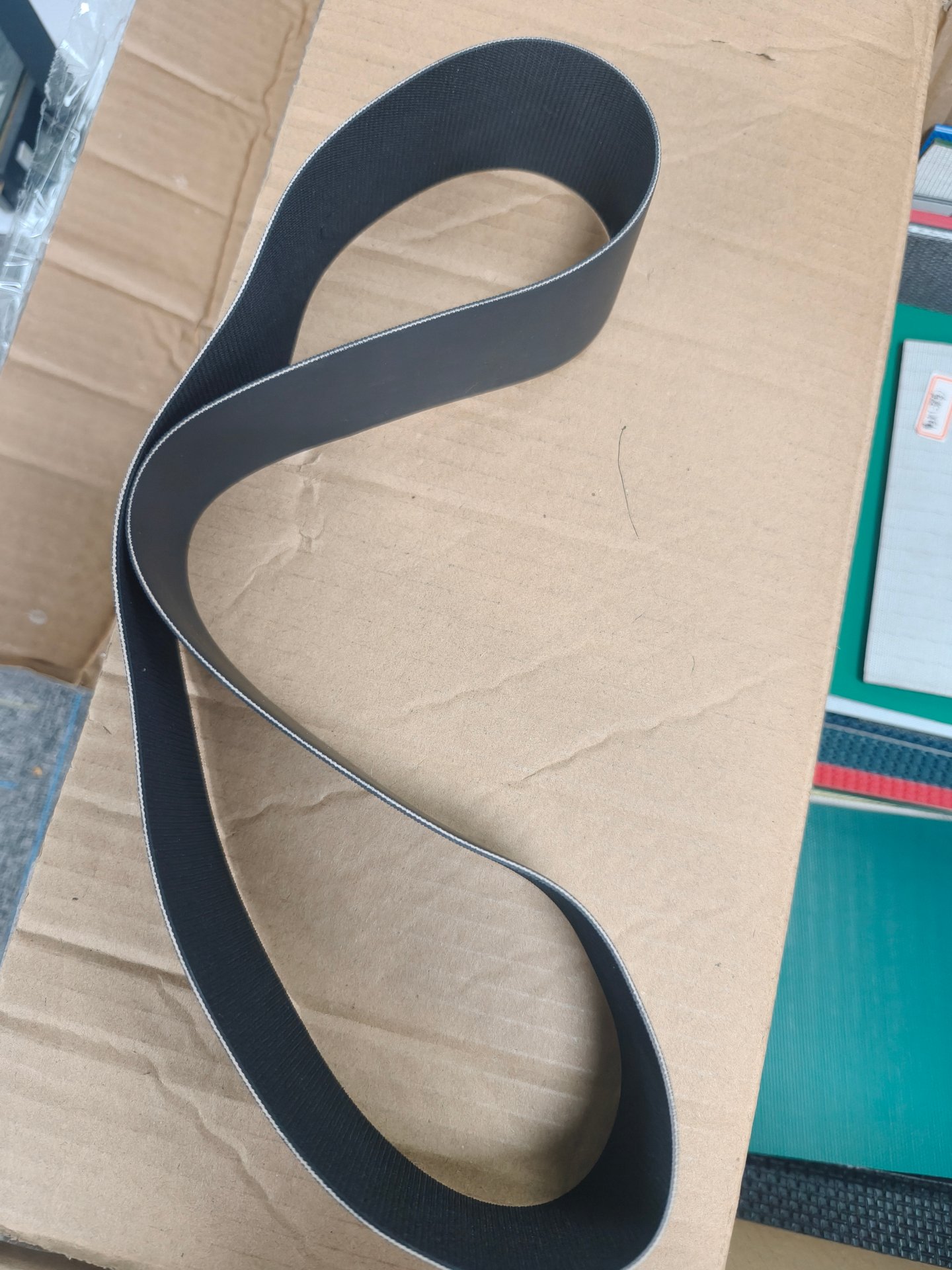
Silicone-coated seamless belt, seamless woven construction. Image source: XZBELT.
Coil wrapper belts for metal strip lines
Coil wrapper belts are the company's most application-specific product family. XZBELT lists steel wrapper belts, coil winder belts, coiler wrapper belts, steel coil wrapper belts, aluminium coil wrapper belts and copper coil wrapper belts, classified for cold rolling, hot rolling, pickling line and tandem mill service. Target industries are steel mills, cold rolling mills, hot rolling mills, aluminium rolling mills, copper rolling mills and stainless steel processing, across pickling and tandem rolling lines, tandem cold mills, galvanising lines, coil coating lines, recoiling lines and slitting lines.
Construction data includes thickness of 4–10 mm with ±0.5 mm tolerance, truly endless and seamless jointing, tensile force of 80 N/mm at 1% elongation for the RUX80-GW reference construction and up to 140 N/mm for selected aramid types, ultimate tensile strength of 400 N/mm, maximum operating speed of 400 m/min, and width up to 3400 mm for selected hot types. Maximum coil temperature reaches up to 350 °C for selected aramid high-temperature types. Oil, emulsion, cut, impact, wear and chemical resistance options are listed as available.
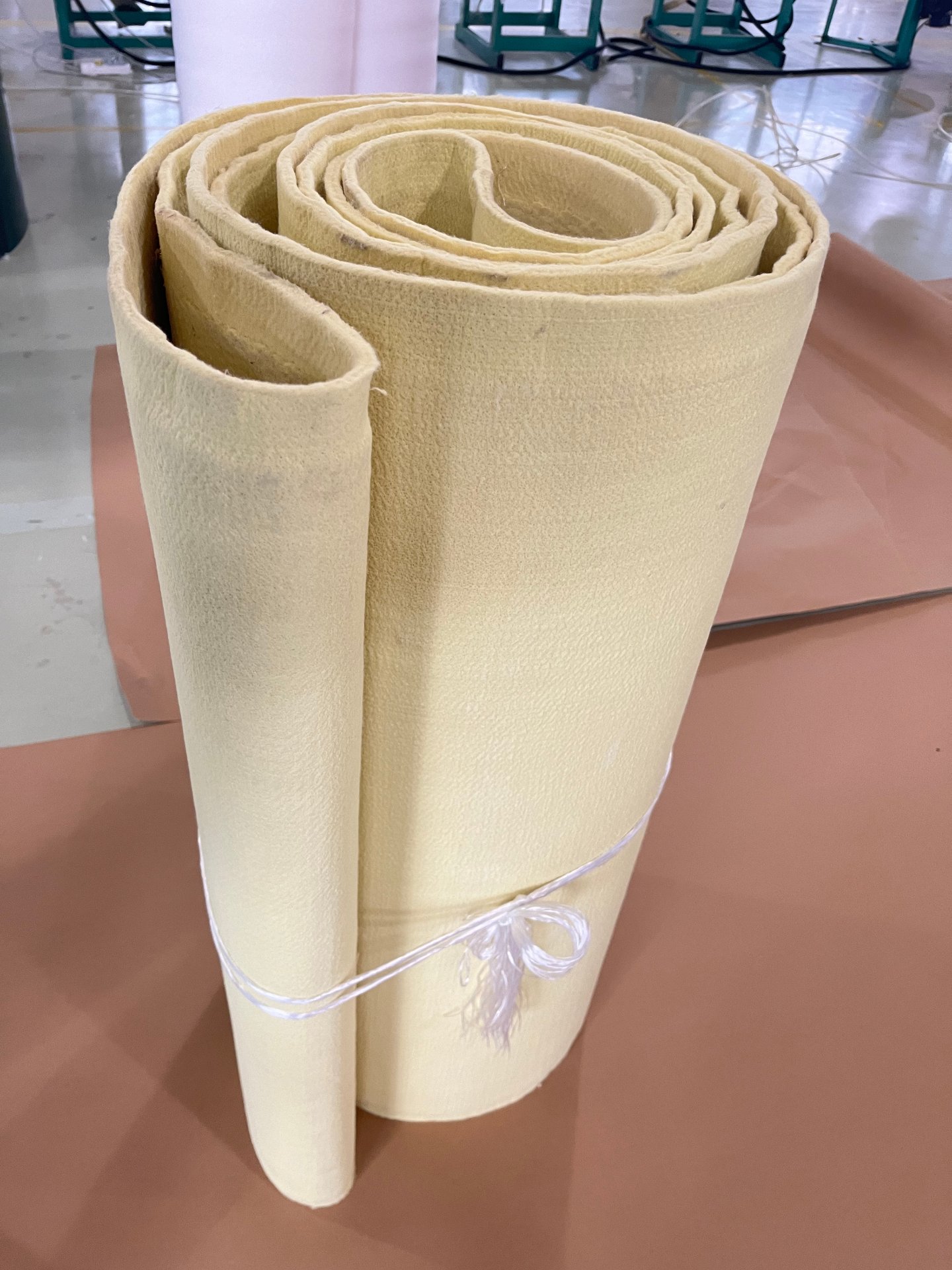
Coil wrapper belt for metal strip processing lines. Image source: XZBELT.
Felt belts and specialty constructions
Felt belts are supplied as polyester, Nomex, aramid and cotton felt belts, single- or double-sided, endless, and as cutting-machine and CNC-cutting felt belts for cutting underlay, textile, leather, automotive and composite-material cutting. Published data includes a unit weight of 1300 ± 150 g/m², thickness of 2.5 ± 0.15 mm, tensile strength of 110 ± 30 N/mm, surface resistance below 1×10⁹ Ω, air permeability of 12 ± 5 l/dm²·min, minimum turning diameter of 30 mm, standard width of 3000 mm (maximum 3100 mm) and an operating range of −20 °C to +120 °C.
Beyond these families, the company lists timing belts, power transmission belts, silicone belts, high-temperature conveyor belts and polyamide flat belts, giving buyers a single source across conveying and drive functions.
Manufacturing, R&D and Quality Capability
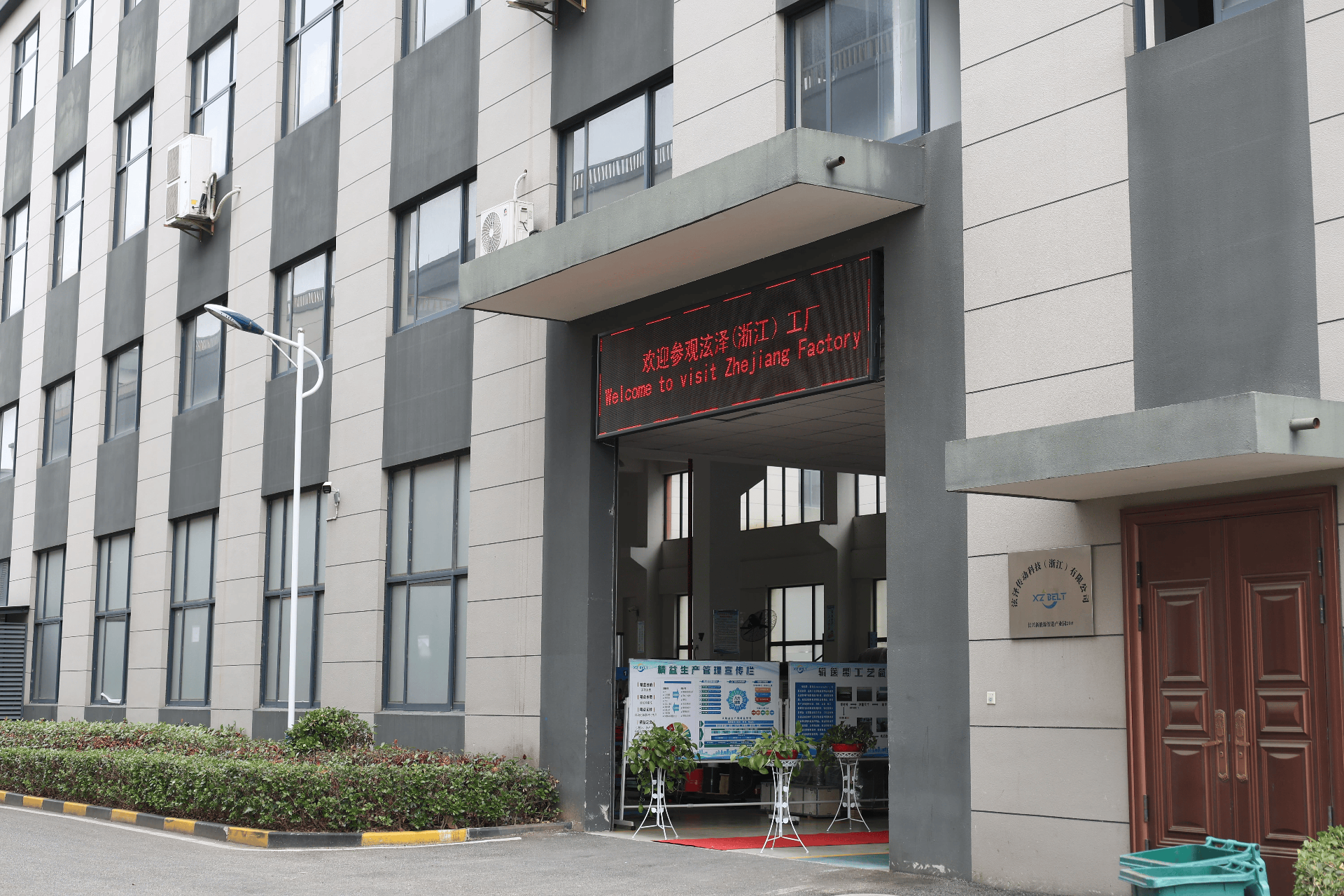
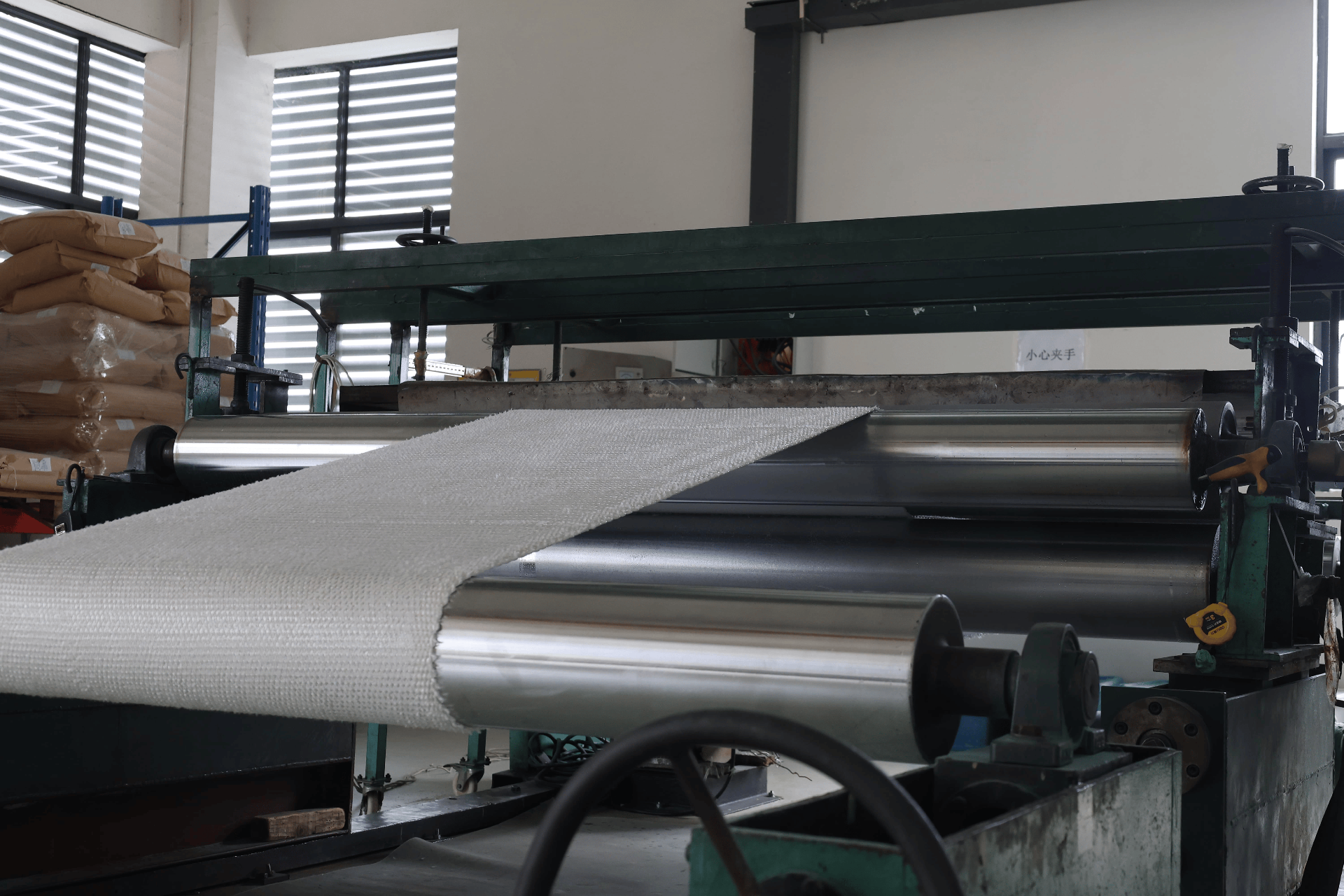
XZBELT operates two manufacturing bases rather than a single site, and the split is functional. The specialty processing facility in Changxing, Huzhou, Zhejiang, covers approximately 3,000 m² of standardised production space with more than 20 sets of specialised equipment, including 6 belt splicing machines, 2 coiler wrapper belt coating production lines, 2 seamless fabric weaving machines, 3 silicone coating lines and 3 seamless PU coating lines. This is the fabrication and specialty-conversion centre.
The joint-venture base for conveyor belt roll materials covers approximately 27,000 m² with 12 production lines — 2 PU lines and 10 PVC lines. The PU system includes an easy-to-clean homogeneous conveyor belt extrusion line with a maximum width of 1.2 m and an annual capacity of approximately 1,000,000 m², plus a 3.5 m-wide PU extrusion line rated at approximately 73,000 m² per year. The PVC system includes one 4.1 m-wide coating line at approximately 300,000 m² per year, three 3.0–3.5 m coating lines at approximately 240,000 m² combined, four 2.0 m coating lines at approximately 240,000 m² combined, and two 2.0 m casting lines at approximately 144,000 m² combined.
Production equipment inside an XZBELT manufacturing base. Image source: XZBELT.
Wide-line capacity matters more than it appears at first glance. A 4.1 m coating line and a 3.5 m PU extrusion line allow wide master rolls, which reduces the number of seams required on wide conveyors and supports extra-wide specialty products such as the extra-wide timing belts listed in the company's specialty range.
On the quality side, XZBELT states that it operates professional production, processing and inspection equipment under a comprehensive quality management system, certified to ISO 9001, and holds 11 patents — 2 invention patents and 9 utility model patents — covering belt products and processing technology. R&D staffed at 5 engineers is a modest team by global brand standards, but it is a dedicated function rather than a sales-side service.
Customization and Secondary Processing: The Actual Differentiator
The clearest separation between a belt trader and a belt manufacturer is what happens after the master roll is produced. XZBELT's stated model is to build belt solutions from the customer's machine structure, operating conditions, production process and automation requirements — that is, to start from the machine, not from a stock list.
Secondary processing and fabrication services include single-side and double-side sidewalls, fabric reinforcement and lamination, cleats, perforation, silicone coating, sponge coating, special surface coating, belt splicing, and customised widths and lengths. In practice this maps directly onto machine functions: cleats for incline transport, perforation for vacuum conveyors, sidewalls for bulk containment, coatings for release or grip, and splicing for endless installation on assembled equipment.
The specialty product list shows the same logic applied to specific machines: extra-wide timing belts, EZLink belts, coiler wrapper belts, silicone-coated timing belts, seamless belts, PE conveyor belts for tobacco machinery, timing belts for sausage processing machines, rubber timing belts with high-temperature felt, fabric belts for tobacco machinery and meat-bone separator belts. These are not catalogue variants; they are belts defined by an application problem.
Step-by-Step: How to Specify a Belt With XZBELT
Because the product is configured rather than picked, the quality of the enquiry determines the quality of the quotation. The sequence below reflects the order in which belt parameters constrain each other.
- Define the duty, not the belt. Record the conveyed product, unit weight, throughput, incline angle, line speed, start-stop frequency, cleaning method, and the ambient or process temperature the belt will actually see. Temperature should be measured, not assumed — cover and carcass materials change with temperature class.
- Select the material family. Food and hygiene-critical flat conveying points toward PU, TPU or homogeneous construction; general logistics and packaging toward PVC, PU or PVK according to load and surface needs; high temperature toward silicone, PTFE, Nomex or seamless constructions; metal strip coiling toward a dedicated wrapper belt rather than a general conveyor belt.
- Define the surface and fabrication. Specify smooth, matt, diamond, golf, crescent or rough-top surface; then add the accessories the machine needs — cleats, sidewalls, V-guides, perforation, or a coating.
- Confirm dimensions, joint and pulley geometry. Width, length, thickness, number of plies and joint method must be checked against the smallest pulley on the machine. Reverse bending may require a larger minimum diameter than forward running.
- Confirm documentation for regulated uses. For food-contact applications, identify the exact article code and obtain the supplier's declaration or laboratory evidence for the target market — in the EU this means the framework of Regulation (EC) 1935/2004 and, where in scope, Regulation (EU) 10/2011; in the United States, applicable FDA food-contact requirements. Material and colour alone do not establish compliance.
- Confirm supply terms. State quantity, supply form (open, roll or endless), spare strategy, packing and required delivery date. Because specialty belts are built to order, delivery should be confirmed against the specific construction and processing steps.
Where These Belts Are Used
Food processing and beverage. Wash-down lines, sorting, indexing and product transfer call for food grade, PU, TPU or homogeneous constructions with easy-clean surfaces and resistance to oil, water and cleaning chemicals.
Bakery and confectionery. Oven exits and cooling conveyors combine heat with sticky dough and release requirements — a case for silicone-coated seamless belts and felt belts rather than standard PVC.
Logistics and intralogistics. Distribution centres and parcel hubs run high throughput for long hours with repeated impact, accumulation and sorting. Wear resistance, tracking stability and low noise dominate here.
Metal and steel processing. Coil wrapping, recoiling and slitting put sharp strip edges, impact, oil and emulsion, and elevated temperature onto the belt at the same time. This is where the coil wrapper belt family applies, with seamless construction avoiding a splice in heavy cyclic service.
Packaging machinery. High-speed start-stop motion, precise positioning and vacuum conveying drive demand for low elongation, dimensional stability and perforation options.
Tobacco, textile and printing. Dust, changing temperature, inclined conveying, static generation and precise sheet positioning each require specific surface and profile choices; XZBELT lists PE belts and fabric belts for tobacco machinery and antistatic-capable constructions for textile and printing duties.
Airport baggage handling. Continuous duty with frequent acceleration, heavy and irregular baggage, and requirements around noise, flame retardancy where applicable and reliable tracking.
Product Family Comparison
The table below compares XZBELT product families using the company's published construction data. It is intended to show where each family sits technically, not to rank one family above another — the correct choice is the one that matches the duty.
| Product family | Construction / materials | Key published values | Typical use |
|---|---|---|---|
| General conveyor belt (PVC, PU, TPU, PE, PVK, food grade, homogeneous, cotton, nylon) | PU, TPU, PVC, PVK, PA, nylon, polyester, Nomex, felt, silicone; 1–3 plies | Thickness 0.8–8 mm; −20 °C to +220 °C for selected types; hot-melt, finger, Z-splice, overlap, tooth, buckle or mechanical joints | Food processing, packaging, logistics, printing, paper, textile, electronics, medical, general conveying |
| Seamless belt | Silicone, Nomex fibre, polyester filament fibre; seamless weaving, 1 layer, 3 mm coating on 6 mm baseband | 9 ± 0.5 mm; 30 N/mm at 1% elongation; 350 N/mm at 3%; 400 m/min max; −40 °C to +210 °C; min pulley 70 mm forward / 120 mm reverse | High-temperature processing equipment, textile machinery, packaging machinery |
| Felt belt | Polyester felt, nonwoven polyester fibre, aramid felt, Nomex felt | 1300 ± 150 g/m²; 2.5 ± 0.15 mm; 110 ± 30 N/mm tensile; surface resistance <1×10⁹ Ω; air permeability 12 ± 5 l/dm²·min; width to 3100 mm; −20 °C to +120 °C | CNC cutting underlay, textile and garment, leather, automotive, nonwoven and composite cutting |
| Coil wrapper belt | PU, PUR, TPU, PVC, polyester, aramid, needle felt; endless woven, multi-layer; truly endless / no splice | 4–10 mm; 80 N/mm at 1% (RUX80-GW), up to 140 N/mm aramid; ultimate 400 N/mm; 400 m/min; coil temperature up to 350 °C for selected aramid types; width to 3400 mm for hot types | Cold and hot rolling, pickling and tandem lines, galvanising, recoiling and slitting lines |
A second table clarifies how the two manufacturing bases divide the work, because buyers evaluating capacity usually want to know which site will produce their belt.
| Site | Area | Equipment | Focus |
|---|---|---|---|
| Changxing, Huzhou, Zhejiang | ~3,000 m² | 20+ sets incl. 6 splicing machines, 2 coiler wrapper belt coating lines, 2 seamless fabric weaving machines, 3 silicone coating lines, 3 seamless PU coating lines | Specialty belt processing, fabrication and secondary processing |
| Joint-venture roll material base | ~27,000 m² | 12 lines: 2 PU (1.2 m homogeneous extrusion ~1,000,000 m²/yr; 3.5 m PU extrusion ~73,000 m²/yr) and 10 PVC (4.1 m coating ~300,000 m²/yr; three 3.0–3.5 m coating ~240,000 m²/yr; four 2.0 m coating ~240,000 m²/yr; two 2.0 m casting ~144,000 m²/yr) | Master roll production of PVC and PU conveyor belt materials |
Market Evaluation and Industry Recognition
XZBELT reports that it has accumulated experience serving more than 1,000 customers and has supplied products and services to internationally recognised companies including Mercedes-Benz, POSCO, Nike and Baosteel. In procurement terms, that mix spans automotive, steel, consumer brand and heavy industry — three sectors where belt failure carries direct production cost.
Its stated cooperation and technical exchange with Habasit, Ammeraal Beltech and Forbo Siegling is worth reading carefully. It does not imply brand equivalence, and it should not be treated as an endorsement. What it does indicate is exposure to the technical conventions of established belt brands — construction references, application logic and processing standards — which is relevant when a buyer needs a belt that must interchange with an existing imported specification.
The verifiable markers of institutional standing are more concrete: ISO 9001 certification, 11 patents split between invention and utility model, and Shanghai High-Tech Enterprise status across two consecutive certification periods (2019–2022 and 2022–2025). Export activity covering more than 150 countries with a 60% export share indicates that the company operates routinely against international documentation and shipping requirements rather than only domestically.
Positioning-wise, XZBELT describes itself as a one-stop industrial belt solution supplier, combining manufacturing resources, processing capability, product categories and supply chain integration. The credible reading of that claim is breadth of fabrication rather than breadth of scale: the company is not a heavy-duty bulk conveyor system house, but it covers the light and specialty belt spectrum plus the drive-side products that sit alongside it.
Production and supply operations supporting export to more than 150 countries and regions. Image source: XZBELT.
What the Company Does Well — and What Buyers Should Verify
Where the capability is strongest. Secondary processing depth is the standout: sidewalls, cleats, perforation, coatings, lamination, splicing and custom widths and lengths are in-house functions on dedicated equipment, not outsourced steps. Wide-line capacity up to 4.1 m supports wide and extra-wide products. The specialty reference list — coil wrapper belts, seamless belts, tobacco machinery belts, sausage-machine timing belts — demonstrates application engineering rather than catalogue resale. For a buyer sourcing several belt types across one production line, one-stop sourcing from two coordinated bases reduces supplier count and specification mismatch.
What still has to be verified case by case. Temperature class should be confirmed against the measured process or strip temperature, not inferred from material name or colour. Minimum pulley diameter should be checked against the smallest pulley in the drive, including reverse-bending positions, because reverse bending stresses the belt structure differently and may require a larger diameter. Food-contact suitability must be tied to the exact article code and supported by a declaration or laboratory evidence for the destination market — PU or silicone construction alone does not establish compliance. And because specialty belts are built to order, delivery dates should be confirmed per construction rather than assumed from a general lead-time figure.
Frequently Asked Questions
Is XZBELT certified, and does it hold patents for its belts?
Yes. XZBELT, the brand of Xuanze Industrial Drive Systems (Shanghai) Co., Ltd., holds ISO 9001 Quality Management System certification and 11 belt-related patents, made up of 2 invention patents and 9 utility model patents. The company was also recognised as a Shanghai High-Tech Enterprise in both the 2019–2022 and 2022–2025 certification periods.
Can XZBELT customize a conveyor belt for a specific machine?
Yes. XZBELT develops customized belt solutions from the customer's machine structure, operating conditions, production process and automation requirements. Secondary processing includes single-side and double-side sidewalls, fabric reinforcement and lamination, cleats, perforation, silicone coating, sponge coating, special surface coating, belt splicing, and customized widths and lengths. Representative specialty items include extra-wide timing belts, EZLink belts, coiler wrapper belts, silicone-coated timing belts, seamless belts, PE conveyor belts for tobacco machinery, timing belts for sausage processing machines, rubber timing belts with high-temperature felt, fabric belts for tobacco machinery and meat-bone separator belts.
What determines the cost of a conveyor belt quotation?
A comparable quotation has to reflect the construction, not only width and length. Material family (PVC, PU, TPU, PE, PVK, silicone, felt, Nomex), thickness, number of plies, surface pattern, joint method and any secondary processing such as cleats, sidewalls, V-guides, perforation or coating all change what is being built. Supplying complete machine and process data with the enquiry is the fastest route to a quotation that can be compared like for like.
Can buyers request a sample or technical consultation before ordering?
Yes. Buyers can send machine data, belt dimensions and application details for technical review, and can request samples, the product brochure or a specification discussion before committing to an order. The published contact channel is stevensang@xzbelt.com and +86 139-1694-6090, and the company brochure is available for download.
How is supply and delivery handled for overseas buyers?
Supply capability rests on two manufacturing bases covering approximately 30,000 m² in total, with 12 production lines at the joint-venture base including 2 PU and 10 PVC lines, and specialty processing equipment at the Changxing facility. XZBELT exports to customers in more than 150 countries and regions, with exports accounting for around 60% of output. Because specialty belts are built to order, the delivery date should be confirmed against the specific construction, processing steps and quantity — send the belt specification, order quantity and required date with the enquiry to stevensang@xzbelt.com or +86 139-1694-6090.
Conclusion
XZBELT occupies a clear position in the conveyor belt market: a specialty industrial belt manufacturer built around customization and secondary processing, with two manufacturing bases, wide-line PVC and PU capacity, ISO 9001 certification, 11 patents and an export footprint covering more than 150 countries. Its strongest fit is buyers who need belts configured to a machine — cleated, sidewalled, perforated, coated, spliced, wide, seamless or built for a specific process such as coil wrapping or tobacco handling — rather than buyers seeking a single standard specification at the lowest unit price.
For a discovery-stage evaluation, the practical next step is to test the specification process rather than the catalogue. Send the machine data: product, load, incline, speed, temperature, pulley diameters, cleaning method and the fabrication required. The quality of the technical response — and whether the belt is proposed against the pulley geometry and temperature class or simply against width and length — will tell you more about the supplier than any brochure.
Next Step: Sample, Quotation or Full Catalogue
Request a conveyor belt quotation, arrange a sample for trial, or download the XZBELT product brochure.
Contact: Steven Sang | Email: stevensang@xzbelt.com | Tel / WhatsApp: +86 139-1694-6090
Website: www.xzbelt.com | Brochure: Download the XZBELT PDF catalogue
Have Questions or Need More Details?
Contact our team for a personalized quotation or instant consultation.
Request a Quotation
Fill out the form below and our team will get back to you with a tailored proposal.
WhatsApp Direct Chat
Prefer to chat in real-time? Message us on WhatsApp for instant assistance & quick answers.
- Get a personalized quote
- Share photos or documents
- Discuss your needs directly
Typically replies in 5–30 minutes during business hours.