
Compliance Guide for Wipes Liquid Sourcing: Standards, Certifications, Regions

Wipes liquid compliance is decided by three variables before any purchase order is signed: the claim you intend to print on the pack, the surface or skin the liquid will touch, and the market where the finished wipe will be sold. No single certificate answers all three, and a quality-management certificate does not authorise a disinfectant claim.
The short answer for buyers: request four document sets and check them against each other — a model-level specification sheet, a full ingredient declaration with material-grade certificates, test reports that state the method and the date, and the registration or filing evidence that covers the specific claim in the specific market. If one of the four is missing, the claim is unverified, however complete the sales deck looks.
What this guide covers: the certification and regulatory landscape for wipes liquid across baby and bath products, patient care and disinfecting liquids, household cleaning, automotive and optical liquids, and personal-care functional liquids; the documents to request for each; and a pre-purchase verification checklist covering ingredient declarations, model-level specification sheets and acceptance criteria.
It is a sourcing document, not legal advice. Final classification for your market must be confirmed by a local regulatory consultant or the competent authority.
The Compliance Gap Sits Between the Liquid Supplier and the Wipes Converter
Wipes liquid is a semi-finished industrial chemical. The consumer product is the impregnated nonwoven, and in most markets the registration, the safety file and the label liability attach to that finished product and to the claim printed on it. The evidence needed to support the claim, however, is generated upstream at liquid level: the preservative system, the active-ingredient concentration, the pH window, the stability data and the microbiological results all belong to the liquid.
That split creates four recurring failure modes in sourcing.
- Generic catalogue copy instead of a specification. Phrases such as “food grade”, “cosmetic grade”, “non-irritating” or “≥99.9% antibacterial” appear without a material-grade certificate, a test method, a contact time or a concentration basis. None of them is a specification until the supporting document is named.
- Certificate conflation. ISO 9001 is a quality-management system certificate covering a stated site and scope. It is not a product approval, it does not certify a formula, and it does not authorise an antibacterial or disinfectant claim.
- Figures amplified through secondary sources. Supplier-reported numbers are frequently restated in press releases and trade articles without the underlying record. As one illustration from the public record, a press-release-style secondary source reported both an annual output of 2,000 tons and a monthly capacity of 3,000 tons for the same supplier — two figures that do not reconcile under a single scope. Buyers should request the production record rather than citing the release.
- Unclear claim ownership in private label. In a private-label programme someone must hold the safety file, act as the responsible person where the framework requires one, and carry liability if the claim fails. If the contract does not say who, the importer usually discovers the gap at customs or at the first complaint.
How Wipes Liquid Is Regulated in 2026: Three Claim Tiers
Regulatory treatment follows the claim, not the product name. A “baby wipe” and a “surface wipe” can be built on comparable surfactant chemistry and still sit in completely different frameworks, because one claims gentle cleansing and the other claims microbial reduction. Sorting your brief into the correct claim tier is the first compliance decision, and it is made before a formula is chosen.
Tier 1 — Cosmetic and personal-care positioning
Products whose claim is cleansing, moisturising, refreshing or caring: baby wipes liquid, bath wet wipes liquid, makeup remover liquid, intimate liquids and much of the personal-care range. The frameworks typically engaged are the EU Cosmetics Regulation (EC) No 1223/2009, which requires a product information file and an EU responsible person, and China’s cosmetics regime for products placed on the domestic market. In most jurisdictions the finished product carries the obligation, but the liquid supplier supplies what the file is built from: the full ingredient list, allergen and fragrance declarations, preservative justification, stability data and the raw-material grade certificates.
Tier 2 — Biocidal and disinfectant positioning
Products that claim to kill or reduce micro-organisms on surfaces, or to repel insects. In the United States a disinfectant claim requires an EPA-registered product under FIFRA, with a label that states the active ingredients and their concentrations. How product-specific that is can be seen in two EPA labels on the public record: one ready-to-use disinfectant wipe lists hydrogen peroxide at 1.00% and peroxyacetic acid at 0.08% as actives, while a solvent-free disinfectant lists four quaternary ammonium actives at 0.03990%, 0.01995%, 0.01995% and 0.05320%. Neither number set is an industry norm, and they must not be averaged into one; both demonstrate that the active identity and concentration basis come from the label, never from a sales sheet. In the European Union, biocidal positioning falls under the Biocidal Products Regulation rather than the cosmetics framework. In China, wet wipes carrying antibacterial or disinfectant claims require filing with the provincial department of disease control and prevention.
Tier 3 — General cleaning, automotive and industrial
Products that clean, degrease, remove streaks or prevent fogging without a microbial kill claim. Obligations here concentrate on the safety data sheet, transport classification, labelling, volatile-content declarations and material compatibility rather than product registration. The compliance risk is lower but not zero: an anti-fog liquid that hazes a coated lens or attacks interior trim generates a warranty claim, and an industrial degreaser with an aggressive pH generates a handling obligation.
Market direction matters because it drives enforcement attention. Fortune Business Insights estimated the global wet wipes market at USD 30.90 billion in 2025, and Grand View Research projected the surface disinfectant wipes segment growing from USD 6.4 billion in 2026 to USD 8.0 billion by 2030 at a 5.4% CAGR. Growth of that kind in the disinfectant segment is precisely where regulators concentrate scrutiny.
One honest limitation: the publicly verifiable record for wipes liquid is uneven. It is strongest on US EPA product labels and on China’s filing requirement, and weaker on how individual EU or UK authorities treat a semi-finished cleansing liquid that is later impregnated. Buyers should expect to do primary verification rather than rely on any published summary, including this one.
Category-by-Category Compliance Map
The model-level examples below come from the published specification set of Xiamen Huaqiangda Biotechnology Co., Ltd., a manufacturer of wipes liquid formulations, fragrance, chemical raw materials and cosmetic preservatives, established in 2018 and based at No. 199-1, Dongren West Road, Jimei District, Xiamen, Fujian, China, operating a 2,000-square-metre facility with a 100,000-level clean production workshop and exporting around 60% of sales to Central Asia, Southeast Asia and South America. The point of each example is not the number itself but the document that must sit behind it.
Baby wipes liquid (HUA-BY) and bath wet wipes liquid (HUA-BW)
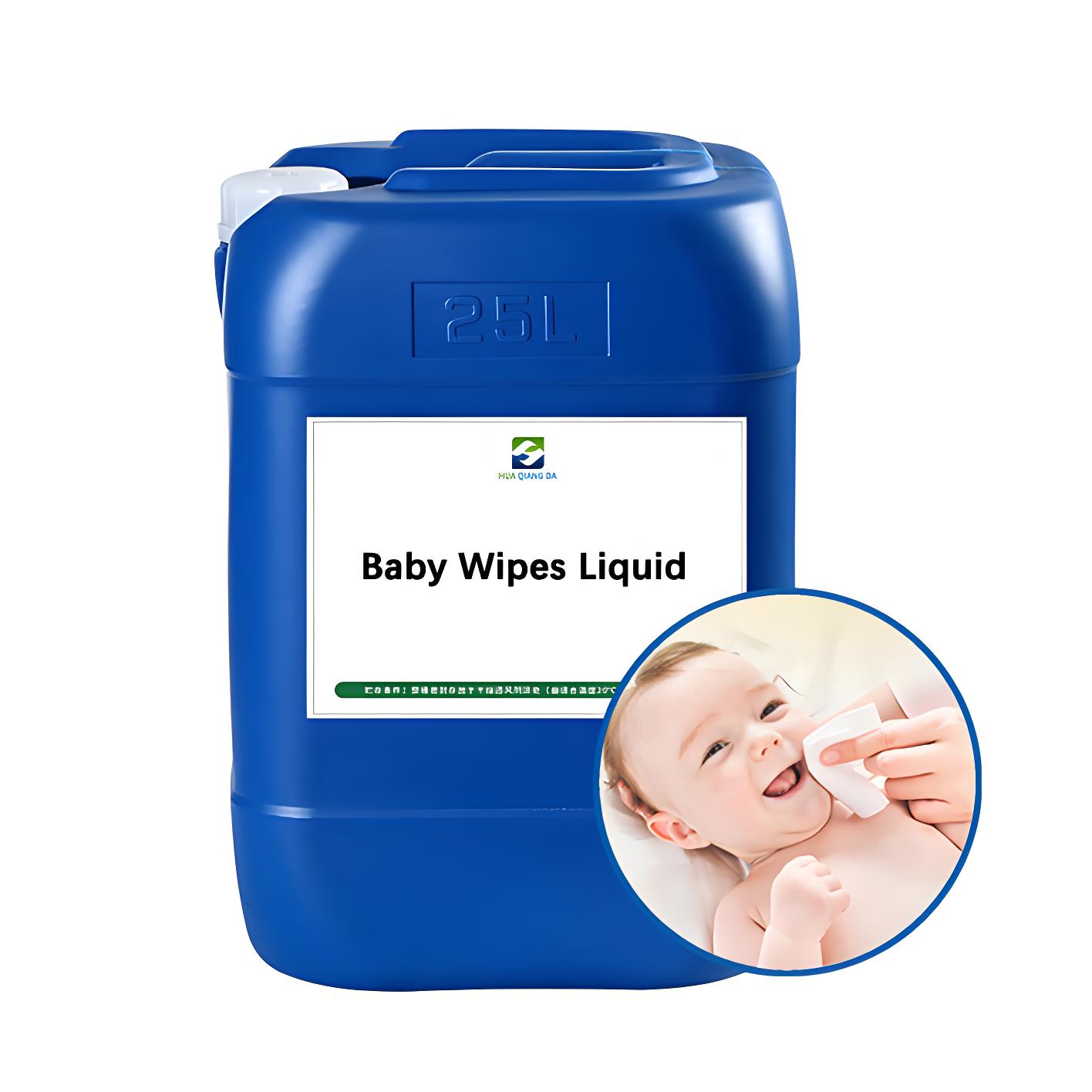
HUA-BY is specified as an alcohol-free baby care liquid with a pH of 5.5–6.5, mild non-ionic surfactants, aloe vera extract as moisturising ingredient, chamomile extract as soothing component, a baby-care-grade preservative system, and a fragrance-free or mild fresh scent option. HUA-BW is a bath wet wipes liquid built on mild surfactants with aloe vera and chamomile, using a cosmetic-grade preservative system, positioned for personal care, healthcare, travel and retail channels.
The compliance question for this tier is not “is it gentle” but “what substantiates the word gentle”. Ask for four things. First, the protocol behind any hypoallergenic positioning — a declaration without a defined test population and patch-test protocol is a marketing word. Second, the identity of the preservative system plus its challenge-test result; “baby-care-grade” describes a positioning, not a chemical. Third, a written fragrance statement, either fragrance-free or a full allergen declaration, because fragrance allergens are a standard declaration item in cosmetic frameworks. Fourth, the pH window and its tolerance across the 24-month shelf life, since a formula that starts at 5.5 and drifts upward is a different product by month eighteen.
Industry direction supports the specification but not the substantiation: baby formulations increasingly feature alcohol-free, hypoallergenic and pH-balanced specifications with natural ingredients such as aloe vera. A market trend is not a test report, and buyers should keep the two separate.
Patient care disposable wipes liquid (HUA-PC)
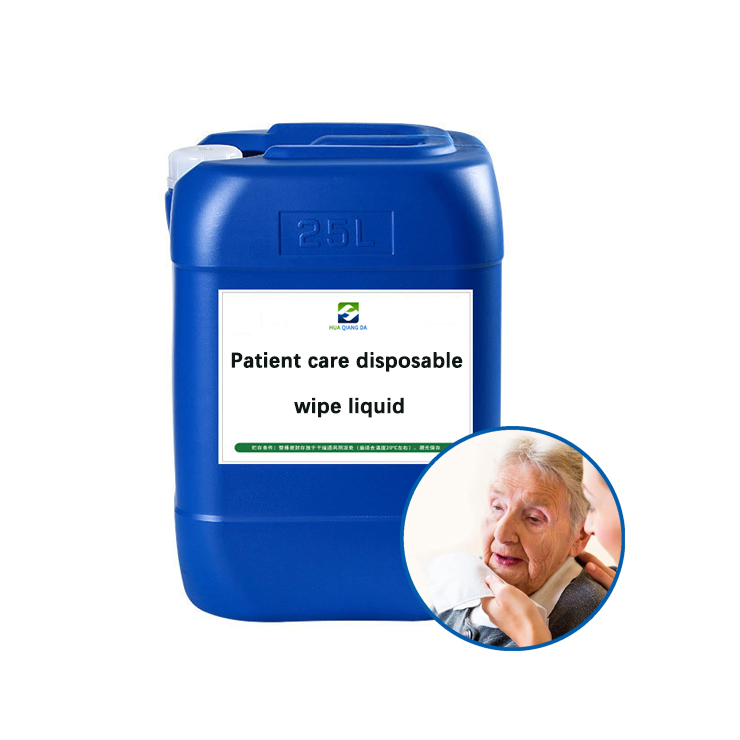
HUA-PC is alcohol-free, with a pH of 5.5–7.0, an antibacterial rate of ≥99%, mild non-ionic surfactants, aloe vera extract, glycerin, a medical-grade preservative and a fragrance-free or mild fresh scent. It is positioned for nursing home and healthcare use on sensitive skin.
Healthcare buyers should treat the ≥99% figure as an incomplete sentence. A microbial reduction result means nothing without the organism tested, the method used, the contact time and the dilution. Request the report and check that the method is named — a suspension test of the EN 1276 type, for example, is a different statement from a carrier or surface test. Also request the fragrance-free statement in writing, the preservative identity, microbial limit specifications for the bulk liquid, and a substrate compatibility result, because the same liquid can behave differently on a spunlace versus an airlaid nonwoven.
Disinfecting wipes liquid (HUA-DW)
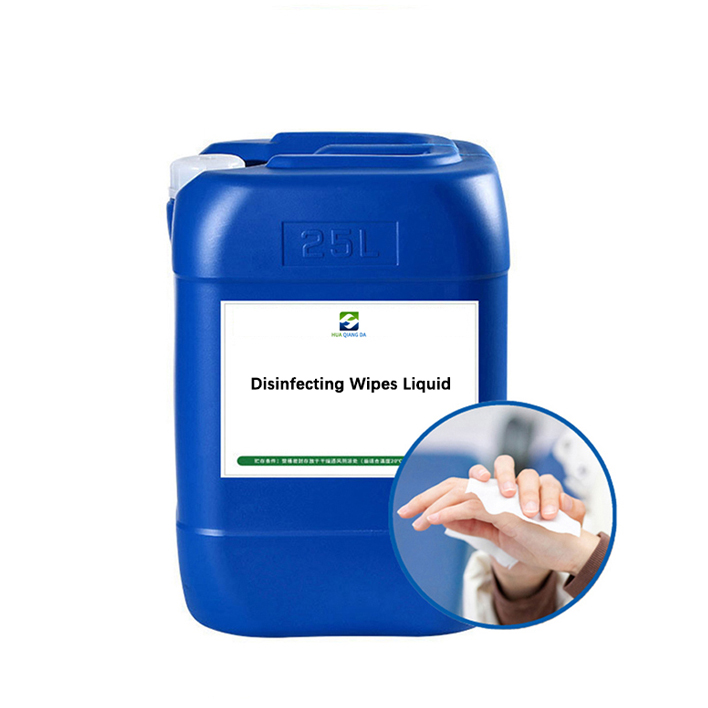
HUA-DW is a quaternary ammonium based disinfecting wipes liquid containing QACs, surfactants, a corrosion inhibitor and purified water, intended for household, office and medical non-critical surfaces.
The compliance crux for this tier is registration, not chemistry. Ask for the label or registration that authorises the exact claim in the target market, and check that the active-ingredient identity and concentration basis on the supplier’s technical data sheet match that label character for character. Ask for the contact time and the approved surface list. If no registration exists for the market, the same liquid can still be sold as a cleaning liquid — it simply cannot be sold as a disinfectant, and the artwork must reflect that. Note also that a corrosion inhibitor is present for a reason: QAC systems left on metal or on certain plastics can leave residue or dulling, so surface compatibility belongs in the acceptance criteria, not in the after-sales conversation.
Household cleaning: multi-purpose, kitchen, toilet and floor liquids
This cluster uses the same active chemistry at different claim strengths, which makes it the most common place where documentation and artwork drift apart. HUA-MP multi-purpose liquid is a pH 6.5–8.0 formulation with benzalkonium chloride, a citrus extract solvent and purified water, declared at ≥99% antibacterial and suitable for glass, plastic, stainless steel, wood and ceramic. HUA-KW kitchen liquid sits at pH 6.5–8.5 with ≥99% antibacterial and a lemon scent, aimed at countertops, stoves, sinks and stainless surfaces. HUA-AT antibacterial toilet liquid is declared at ≥99.9% with benzalkonium chloride and a citrus extract deodorising agent, pH 6.5–8.5, for toilet seats, bathroom countertops, ceramic and stainless steel.
Two questions resolve most of this cluster. First, why does one model claim 99% and another 99.9%? The difference is almost always test scope — organism panel, contact time, inoculum — not marketing preference, so request both reports and compare the method sections. Second, is the printed claim “antibacterial cleaning” or “disinfection”? The second wording triggers registration in most markets, and re-labelling after the artwork is printed is far more expensive than asking the question first. Where a kitchen liquid is used near food contact surfaces, ask for a specific food-contact statement rather than accepting the adjective “food grade”.
Automotive: car glass anti-fog wipes liquid (HUA-CG)
HUA-CG is formulated with surfactants, a polymer anti-condensation compound, purified water and a corrosion inhibitor, and is designed for windshields, rearview mirrors and side windows in automotive care.
Automotive compliance is driven by three documents. A material compatibility report covering glass, trim, sensor covers and wiper rubber, because a residue that interferes with driver vision is a safety issue and not a cosmetic one. A safety data sheet consistent with the transport and labelling obligations for the concentrate. And the substantiation behind any anti-fog duration claim: the test conditions, the substrate and the endpoint definition. The same logic applies to the anti-fog liquid for eyeglass lenses below, and buyers who standardise the request format across both categories save a review cycle.
Optical: lens cleaning (HUA-LC) and eyeglass anti-fog (HUA-AW)
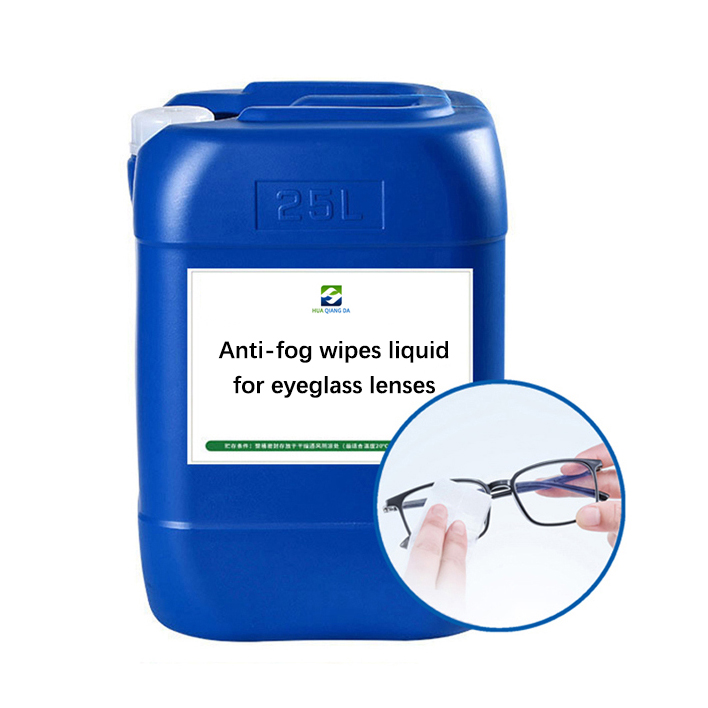
HUA-LC is an alcohol-free lens cleaning liquid at pH 6.0–7.5, containing surfactants, purified water, an anti-static polymer compound and an optical-grade preservative, declared as streak-free and quick-drying for eyeglass lenses, camera lenses, mobile screens and optical equipment, with a 24-month shelf life. HUA-AW is an alcohol-free eyeglass anti-fog liquid at pH 6.0–7.5, built on surfactants and a polymer anti-condensation compound with an optical-grade preservative, declared with anti-fog duration up to 24 hours and streak-free performance on eyeglass lenses, goggles and camera lenses.
Two claims in this pair need definition before they reach packaging. “Streak-free” needs a substrate, a lighting condition and a pass criterion. “Anti-fog up to 24 hours” needs to state whether the duration is continuous or cumulative, under what temperature and humidity, and on which coating. Coating compatibility is the most frequent failure point: a cleaner that performs on an uncoated lens can haze a multilayer anti-reflective stack, and an anti-fog polymer that works on glass can leave a film on polycarbonate. The alcohol-free formulation is relevant twice — for coated optics, and for markets where alcohol content changes transport classification or labelling.
Personal care functional liquids: mosquito repellent (HUA-MR) and delay wet wipes
HUA-MR is a DEET-free mosquito repellent wipes liquid built on plant-based repellent extract, with citronella oil and eucalyptus extract as actives, aloe vera extract as moisturising component, a declared repellent duration of up to 4–6 hours, pH 5.5–7.0 and a 24-month shelf life.
This is the highest-risk category in the range, for two reasons. First, a repellent claim is a biocidal claim in many markets; being DEET-free lowers the toxicological profile but does not remove the obligation, it changes the active-ingredient file. Request the efficacy test with species, conditions and method, the composition of the essential-oil fraction, the allergen declaration for citronella and eucalyptus constituents, and the maximum permitted use instructions. Second, the delay wet wipes liquid contains benzocaine, a local anaesthetic, at pH 5.0–6.5 in an alcohol-free, sensitive-skin formula. Because of that active, an intimate product of this type may fall outside ordinary cosmetic classification in some markets. Confirm the classification and any permitted concentration with a local consultant before quoting the claim; a cosmetic compliance statement is not a substitute for that confirmation.
Claims that need a test method before you print them
Some of the most requested marketing words have the weakest documentation in circulation. Biodegradable, eco-friendly, natural and hypoallergenic are all claimable, and all meaningless without a named method. For biodegradability, ask for a recognised ready-biodegradability test result — an OECD 301-series method, for example — and for the conditions under which it was run. For “natural”, ask for a defined origin statement covering the whole composition rather than the two botanical extracts. For “hypoallergenic” and “non-irritating”, ask for the dermatological protocol and the population tested. Where a supplier’s public material claims cosmetic-grade and even food-grade raw materials and compatibility with various nonwoven fabrics, ask for the grade certificates and the compatibility report that make those words auditable; the claim itself is a starting point for verification, not the verification.
Pre-Purchase Verification: A Seven-Step Workflow
The sequence below is designed so that each step produces a document you can file. Run it before the first purchase order, then re-run steps three to six at every formula change and at a defined reorder interval.
- Fix the claim and the market before the formula. Write one sentence describing what the finished wipe will claim and where it will be sold. Classification follows that sentence, and everything downstream depends on it.
- Request the model-level specification sheet, not the catalogue page. It must state appearance, pH window, active ingredient and concentration basis, preservative system, shelf life, packaging format and the declared claim. A sheet that covers a product family rather than a model is not usable in an acceptance criterion.
- Request the full ingredient declaration. Complete composition, INCI nomenclature where the framework is cosmetic, fragrance allergen statement, and the grade certificate for each regulated raw material.
- Request test reports with method and date. Efficacy with organism, method and contact time; preservative challenge test; stability and compatibility over the declared shelf life; microbiological limits on the bulk liquid; skin or material compatibility as relevant to the category.
- Verify certificates independently. Take the certificate number and check it on the issuing body’s register. Confirm the certified scope covers the specific site and the specific product category, and confirm validity dates. A certificate that cannot be located on a register is an unverified claim.
- Fix acceptance criteria in the purchase order. pH range with a test method, appearance and odour, active-ingredient assay, microbial limits, packaging and fill weight, retention sample, and a defined re-test interval. Acceptance criteria written into the order are what protect you; criteria left in an email are not.
- Operate change control. Any substitution of preservative, surfactant, fragrance or active must be notified and re-approved in writing before shipment. Undisclosed substitution is the single most common cause of a compliant first batch followed by a non-compliant third one.
Three Sourcing Scenarios and What Compliance Looks Like in Each
A retail private-label baby programme in Southeast Asia. The retailer owns the brand, so the retailer normally owns the safety file and must be able to name a responsible person for the market. The liquid supplier’s job is to supply the ingredient declaration, fragrance allergen statement, preservative justification, stability data and the pH 5.5–6.5 window, plus a fragrance-free option if the retailer sells to sensitive-skin shoppers. The failure to avoid is a contract that specifies the formula but not who holds the file.
A nursing-home patient care contract. Here the buyer is often a healthcare operator or a distributor serving one, and the ≥99% antibacterial statement will be read by an infection-control professional. The file must include the method, the contact time and the organism panel, plus a fragrance-free statement and a material compatibility result for the specific nonwoven. Procurement rules in healthcare frequently require the documentation before the sample is even trialled, so assemble it first.
An automotive aftermarket anti-fog brand. The claim sits on a consumer package and is used on a windscreen, so the two documents that matter most are the compatibility report and the claim substantiation behind the anti-fog duration. Add the safety data sheet for transport and a labelling check for the destination market. This is a Tier 3 product with Tier 2 style scrutiny, because a vision-related failure is expensive regardless of which framework applies.
Model-Level Verification Table
The table below consolidates declared parameters for representative models. It is a request template, not a compliance certificate: every row still needs the underlying report before the claim can be printed.
| Model | Category | Declared parameters | Ingredient system to confirm | Primary document to request |
|---|---|---|---|---|
| HUA-BY | Baby wipes liquid | pH 5.5–6.5; alcohol-free; hypoallergenic positioning; 24-month shelf life | Mild non-ionic surfactants; aloe vera; chamomile; baby-care-grade preservative | Preservative challenge test plus hypoallergenic protocol |
| HUA-BW | Bath wet wipes liquid | Alcohol-free positioning; cosmetic-grade preservative | Mild surfactants; aloe vera; chamomile | Cosmetic-grade raw material certificates |
| HUA-PC | Patient care disposable wipes liquid | pH 5.5–7.0; antibacterial rate ≥99%; alcohol-free | Mild non-ionic surfactants; aloe vera; glycerin; medical-grade preservative | Efficacy report with method and contact time |
| HUA-DW | Disinfecting wipes liquid | Non-critical surface use; no concentration stated here | Quaternary ammonium compounds; surfactants; corrosion inhibitor | Registration or label authorising the disinfectant claim |
| HUA-AT | Antibacterial toilet wipes liquid | pH 6.5–8.5; antibacterial rate ≥99.9%; 24-month shelf life | Benzalkonium chloride; citrus extract deodorising agent | Efficacy report plus surface compatibility data |
| HUA-CG | Car glass anti-fog wipes liquid | Streak-free and quick-drying on automotive glass | Surfactants; polymer anti-condensation compound; corrosion inhibitor | Material compatibility report and anti-fog test definition |
| HUA-LC | Lens cleaning wipes liquid | pH 6.0–7.5; alcohol-free; streak-free; quick-drying; 24-month shelf life | Surfactants; anti-static polymer; optical-grade preservative | Coating compatibility and streak-free test criteria |
| HUA-AW | Eyeglass anti-fog wipes liquid | pH 6.0–7.5; alcohol-free; anti-fog up to 24 hours | Surfactants; polymer anti-condensation compound; optical-grade preservative | Anti-fog duration test with substrate and conditions |
| HUA-MR | Mosquito repellent wipes liquid | pH 5.5–7.0; DEET-free; repellent duration up to 4–6 hours | Citronella oil; eucalyptus extract; aloe vera extract | Repellent efficacy test plus allergen declaration |
| HUA-MP | Multi-purpose wipes liquid | pH 6.5–8.0; antibacterial rate ≥99%; quick-drying | Benzalkonium chloride; citrus extract solvent | Efficacy report and claim-tier confirmation |
| HUA-KW | Kitchen wipes liquid | pH 6.5–8.5; antibacterial rate ≥99%; lemon scent | Benzalkonium chloride; citrus extract solvent | Food-contact statement where surfaces adjoin food |
Frequently Asked Questions
Does wipes liquid need a separate registration in every country where the finished wipe is sold?
In most markets the obligation attaches to the finished product and to its claim, not to the bulk liquid, but the evidence behind the claim is produced at liquid level. In China, wet wipes carrying antibacterial or disinfectant claims require filing with the provincial department of disease control and prevention. In the United States, a disinfectant claim requires an EPA-registered product whose label states the active ingredients and concentrations — for example, one ready-to-use disinfectant wipe label lists hydrogen peroxide at 1.00% and peroxyacetic acid at 0.08%, while a solvent-free disinfectant label lists four quaternary ammonium actives between 0.01995% and 0.05320%. In the European Union, cosmetic positioning and biocidal positioning fall under different frameworks, so the same liquid can need different files depending on the claim. Confirm classification for each target market before artwork approval.
Can one supplier support both cosmetic-positioned and biocidal-positioned wipes liquid?
Formulation capability and regulatory authorisation are two different capabilities, and a supplier can hold the first without the second. Xiamen Huaqiangda Biotechnology Co., Ltd. provides OEM/ODM formulation support across baby, antibacterial, makeup remover, kitchen, pet and related wet wipes categories, with a five-engineer R&D team working on preservative systems, gentle antibacterial technologies and skin-friendly formulations, and lists wet wipes liquid, wipes solution and wipes formula among its product categories. That supports formula development across both tiers. It does not by itself authorise a disinfectant claim in your market, so request the model-level ingredient declaration and test reports from the formulation side, and the registration or filing separately from the claim side.
Does compliance documentation change the cost per litre?
No verified public price data exists for wipes liquid, and quotations are rarely comparable as issued, so treat any single figure with caution. Documentation affects cost through four drivers you can quantify: the active-ingredient system and its concentration basis, the preservative system, the test scope behind the claim (one efficacy test versus a full panel plus stability plus compatibility), and packaging format — bulk liquids are commonly supplied in 25 kg containers or 1-ton IBC tanks. Request quotations normalised by concentration, pack size, minimum order quantity and Incoterm. A quote at half the active concentration is not a cheaper product; it is a different product with a weaker claim.
What should accompany a sample shipment?
A sample should arrive with its paperwork, otherwise the trial only tests the liquid and not the supply chain. Ask for the certificate of analysis for that batch, the safety data sheet, the model-level specification sheet stating pH window, appearance, active ingredient and concentration basis, preservative system and shelf life, the full ingredient declaration with allergen statement, stability and microbiological data, the relevant compatibility test for your nonwoven or surface, and the registration or filing reference where a biocidal claim is intended. Then run the liquid on your own nonwoven and your own filling line, because pH drift and preservative depletion appear on substrate, not in a drum.
How much time does documentation review add before a first order?
Separate document review from production lead time, because they run on different clocks. Document review usually consumes the buyer’s own time — classification confirmation, artwork wording, acceptance criteria — and can proceed in parallel with sampling. Production lead time should be requested in writing per model and per pack format, with a clear statement of when the clock starts: at purchase order, at artwork approval, or at raw-material arrival. A lead time quoted for a catalogue range is not a commitment for your specification. To begin that sequence, request the current documentation pack and a model-specific sample directly — the fastest route is to state your target market, intended claim and pack format in one message so the correct file set is issued first time.
Conclusion
Compliance for wipes liquid is not a certificate you collect; it is a chain of documents that must agree with each other. The claim decides the tier, the tier decides the framework, the framework decides the file, and the file decides which test reports and ingredient declarations you need. Baby and bath liquids live or die on preservative justification and allergen declaration; patient care and disinfecting liquids live or die on method, contact time and registration; household liquids live or die on whether the printed word is “antibacterial” or “disinfectant”; automotive and optical liquids live or die on compatibility and claim substantiation; and repellent or anaesthetic-bearing personal care liquids live or die on whether the classification was confirmed before the formula was ordered.
Buyers who ask for the specification sheet, the ingredient declaration, the test report and the registration — and then check that all four describe the same model — remove most of the risk from this category at almost no cost. Buyers who accept a catalogue page and a certificate number remove none of it.
Next Step: Request the Documentation Pack
Xiamen Huaqiangda Biotechnology Co., Ltd. supplies wipes liquid formulations with model-level specification sheets and OEM/ODM formulation support. To evaluate a specific model against your market and claim, send your target market, intended claim and pack format, and request the current documentation pack together with a model-specific sample.
Email: wenkunhua@xmqfh.com | Tel / WhatsApp: +86 159-5929-1685 | Contact: Kelvin
WhatsApp: Start a conversation | Website: www.wipesliquid.com
Download the product brochure: Huaqiangda wipes liquid brochure (PDF)

Have Questions or Need More Details?
Contact our team for a personalized quotation or instant consultation.
Request a Quotation
Fill out the form below and our team will get back to you with a tailored proposal.
WhatsApp Direct Chat
Prefer to chat in real-time? Message us on WhatsApp for instant assistance & quick answers.
- Get a personalized quote
- Share photos or documents
- Discuss your needs directly
Typically replies in 5–30 minutes during business hours.