Laminated Touch Display Module: How OCA Full Lamination Improves a Custom Touch Display
A laminated touch display module is a display assembly in which the cover glass and touch sensor are bonded directly to the TFT display with an optically clear adhesive, leaving no air gap between the layers. In a custom touch display module built for industrial, medical, or self-service equipment, that bonding decision changes contrast, readability, dust and fog behaviour, mechanical robustness, and cost tier — which is why it belongs at the start of the specification process, not at the end.
This guide explains what full lamination is, why an air gap is a measurable problem rather than a cosmetic one, how the module stack is actually built, and how buyers should specify a laminated touch display module without over- or under-buying. Product facts, models, and specifications in this article come from Xiangrui Optoelectronics (Guangzhou Xiangrui Optoelectronics Technology Co., Ltd.), a touch screen and touch display module manufacturer based in Guangzhou, China.
What Is a Laminated Touch Display Module?
A laminated touch display module combines three functional layers into one optical stack: the cover glass with its printed decoration and surface treatment, the touch sensor that detects finger or glove input, and the TFT display that produces the image. In a fully laminated module, an optically clear adhesive film bonds these layers together across the whole active area, so light travels from the display to the user without crossing an air boundary.
Xiangrui Optoelectronics builds its standard modules on a G+G glass lens structure and uses OCA optical adhesive film for optical bonding. The module stack includes aluminosilicate chemically strengthened glass as the cover glass, ITO indium tin oxide as the touch sensor material, OCA optical adhesive film, PVA/TAC film, color filter CF, and TFT glass substrate.
Key distinction: “laminated” describes how the layers are joined, not what the touch technology is. A laminated module can still be capacitive or resistive, matte or glossy, sealed or unsealed. Bonding and touch technology are two separate specification decisions.
The Problem: Why an Air Gap Costs Performance
In a conventional frame-bonded assembly, the cover glass sits above the display with an air gap between them, held at the edges by an adhesive frame. That gap is the source of most field complaints in equipment displays, and each complaint maps to a physical cause.
- Reflected light lowers contrast. Every air-to-glass boundary reflects part of the ambient light back toward the viewer. Full lamination removes that boundary; Xiangrui specifies G+G full lamination as the option featuring a high contrast ratio and no air gap.
- Dust and moisture enter the gap. An open gap is a cavity. Full lamination is specified as dustproof and anti-fog, which matters in workshops, cold-chain handling, and wash-down areas.
- Condensation fogs the viewing area. Where equipment cycles between warm interiors and cold rooms — typical of cold chain and charging pile installations — the sealed, gap-free stack resists fogging.
- Parallax offsets the touch point. With a gap, the point a user touches and the pixel responding to it sit on different planes. Removing the gap keeps the touch point visually aligned with the image.
- The unsupported centre is mechanically weaker. A glass sheet held only at its perimeter flexes under impact. Continuous adhesive bonding supports the glass across its full area.
The cost of ignoring this is usually discovered late: an equipment maker finalises an enclosure, then finds the display unreadable under factory lighting or fogging in a cold room, and must rework the front panel. Deciding the bonding method during the specification phase avoids that loop entirely.
Industry Background: Capacitive Touch, Rugged Demand, and Custom Sourcing
Projected capacitive (PCAP) technology now dominates the touch module market. According to Business Research Insights (SRC-BRI-001), capacitive touch modules held nearly 71% of market share in 2025, while resistive modules accounted for 19%. That split reflects the broader shift toward multi-touch interfaces, gesture control, and flush front panels across industrial, medical, and self-service equipment.
Demand is also growing in absolute terms. Future Market Insights (SRC-FMI-001) projects the commercial touch display market to grow from USD 6.9 billion in 2025 to USD 16.3 billion by 2035, at a CAGR of 9.0%. Growth of that scale is driven less by consumer devices than by equipment that needs a durable human-machine interface: control cabinets, self-service terminals, medical monitors, and energy equipment.
The remaining resistive share is not a legacy accident. Where operators wear heavy work gloves, press with hard objects, work through heavy oil contamination and splashing liquid, or need only single-point input on a tight budget, a 5-wire resistive touch remains the practical choice. For multi-point gestures, better display performance, a flat front surface, high-frequency interaction, and outdoor bright-light use, industrial-grade projected capacitive touch is the correct specification.
Ruggedness requirements are written into standards rather than negotiated informally. Under IEC 62262, an IK10 rating requires equipment to withstand an impact energy of 20 joules — equivalent to a 5 kg object dropped from 40 cm. Buyers comparing “IK10” claims across suppliers should confirm the rating applies to the assembled module and its mounting, not only to a bare glass sample.
The Solution: How OCA Optical Bonding Is Built
Xiangrui Optoelectronics develops, produces, and customises touch screens and touch display modules. Its main products are touch display modules, touch panels, touch screens, and touch display cover glass, with resistive touch screens, capacitive touch screens, and customised touch display modules as core lines. For laminated assemblies, the build follows a defined sequence of material choices.
1. Cover glass and surface treatment
The cover layer is aluminosilicate chemically strengthened glass, chosen for drop and scratch resistance in equipment that is cleaned, bumped, and used continuously. Glass cover plate thickness is customisable, with a maximum thickness of 10 mm. Surface treatment is where most application requirements land: AF anti-fingerprint, AG anti-glare, and AR anti-reflection coatings can be combined on the same lens, and 3A surface treatment is offered on standard modules.
2. Touch sensor and controller
The sensor uses ITO indium tin oxide patterned on the glass lens. PCAP modules support 10-point multi-touch, with thin-glove touch available as an option. Standard modules use a mature driver solution with optional MIPI, LVDS, or HDMI interfaces, so the module can be matched to the host board rather than forcing a board redesign. ESD protection is available to meet industrial EMC requirements in workshops with strong electromagnetic interference.
3. Optical bonding
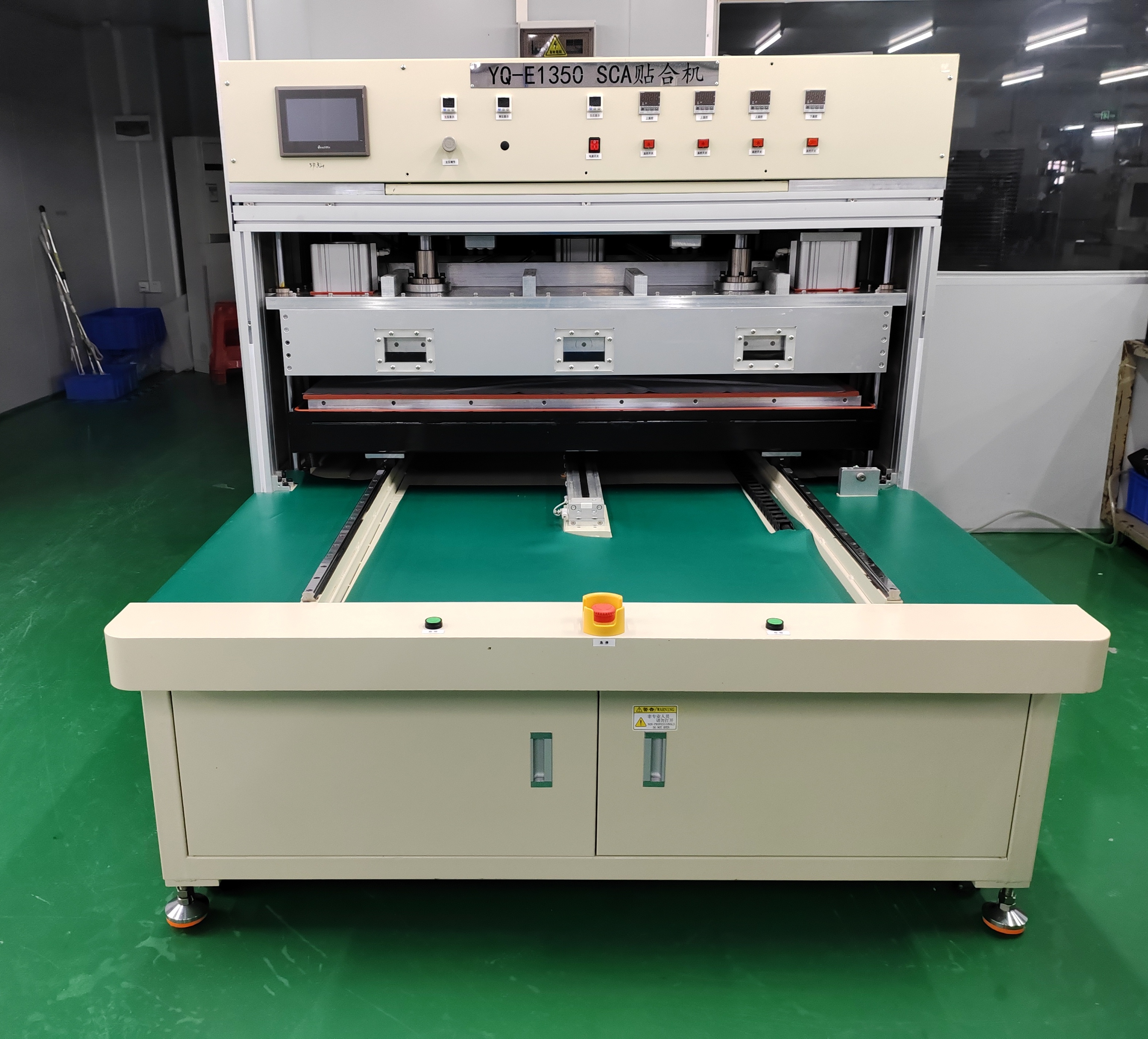
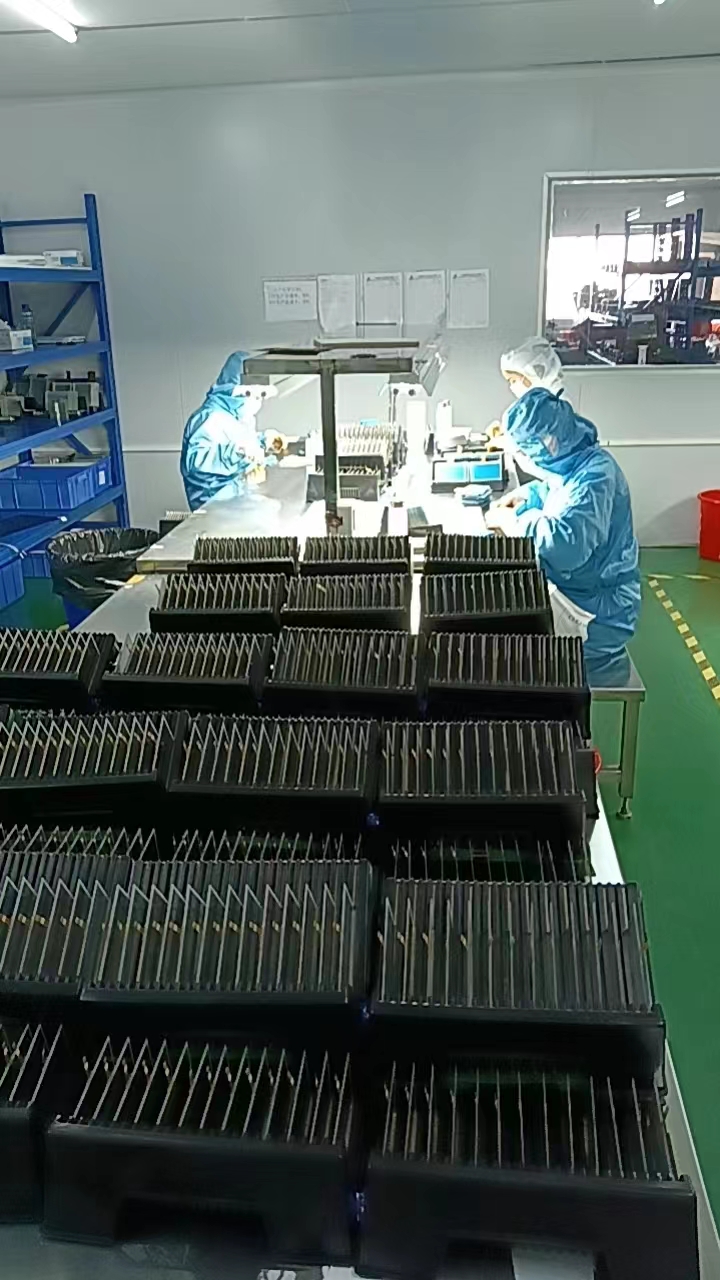
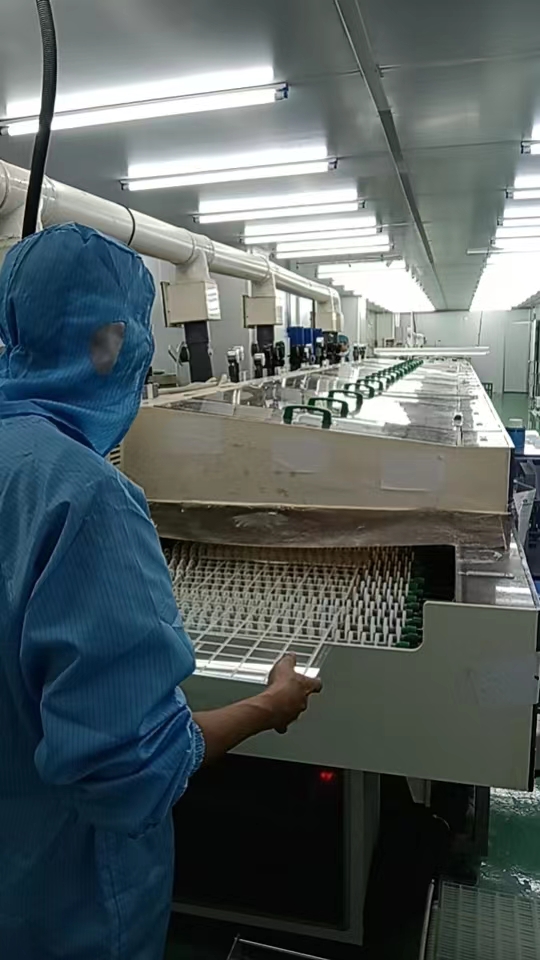
OCA optical adhesive film is applied across the active area and cured under pressure in the bonding process. Xiangrui offers two bonding tiers on the same platform: G+G full lamination, the mainstream option featuring a high contrast ratio, no air gap, and dustproof and anti-fog behaviour; and frame bonding at a lower cost. Offering both lets a customer place a premium version and a cost-controlled version of the same enclosure on two price tiers without changing mechanical design.
4. Display and electrical integration
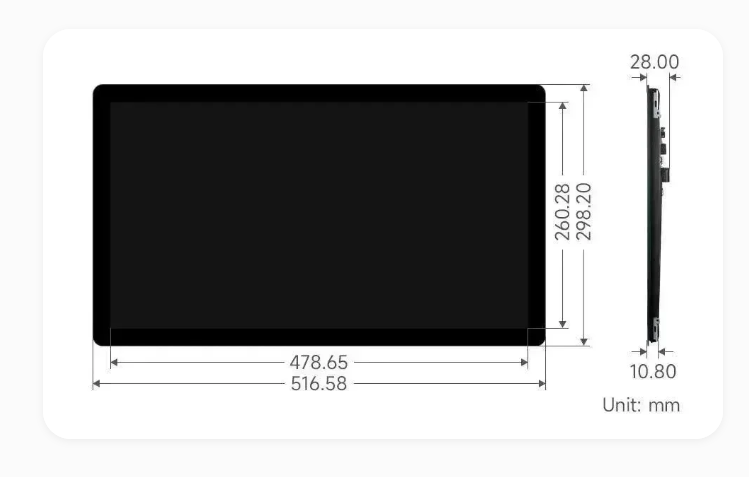
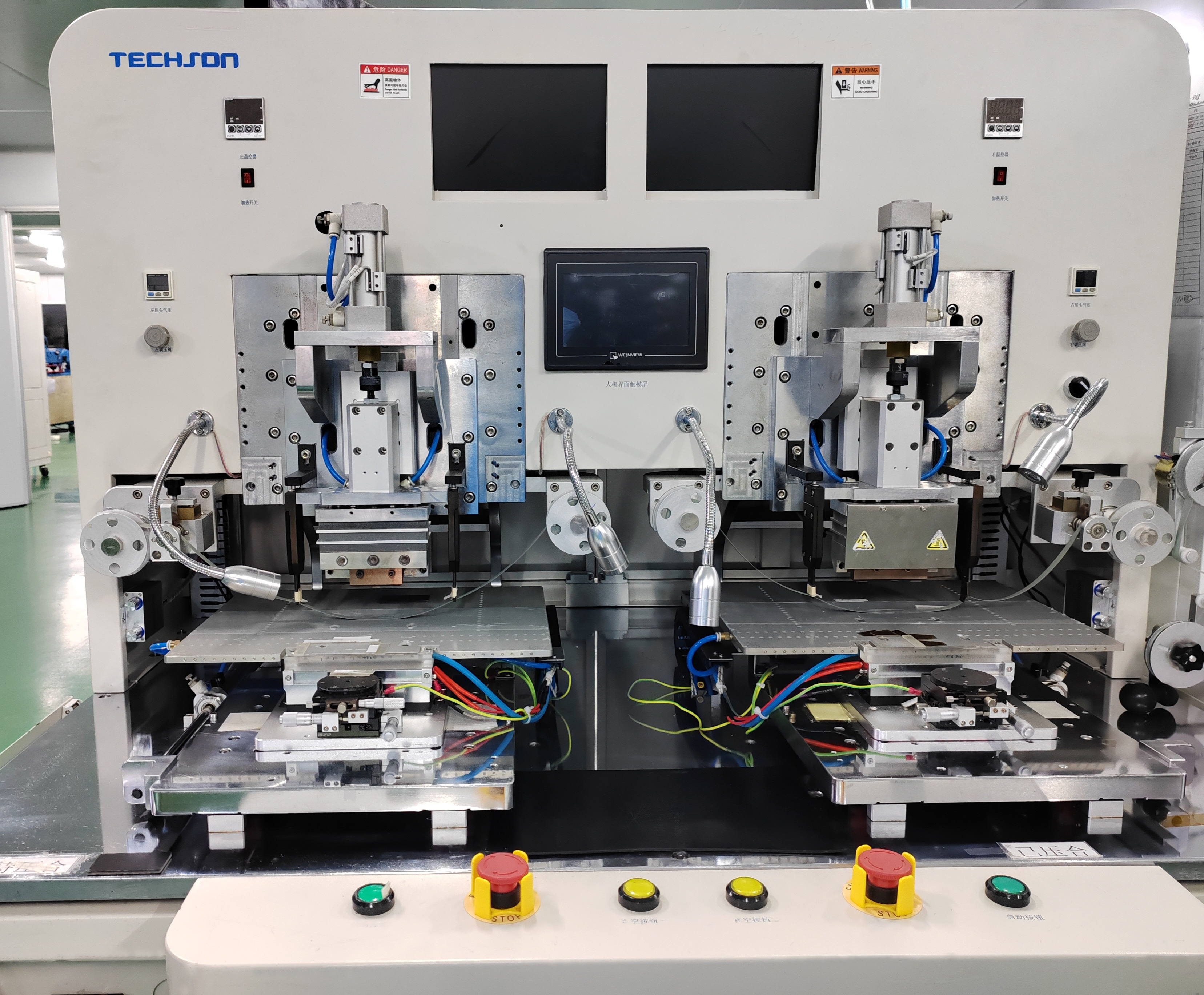
The display layer is a TFT panel with a color filter CF and TFT glass substrate, protected by PVA/TAC film. FPC bonding connects the sensor and display to the host system. The 21.5-inch module, for example, carries a 21.5″ TFT with 1920 × RGB × 1080 resolution and 1000 cd/m² brightness in a standard 16:9 format.
5. Inspection before shipment
Final quality control checks the assembled module rather than the individual components, because lamination defects — bubbles, particles, edge bonding gaps — only appear after the layers are joined. Xiangrui operates under ISO 9001 and ISO 14001 certification and holds 16 utility model patents, and is designated a National High-Tech Enterprise.
Step-by-Step: Specifying a Custom Laminated Touch Display Module
A custom touch display module is specified in a fixed order, because each decision constrains the next. Working in this sequence reduces prototype iterations.
Step 1 — Define the operating environment first
List temperature range, humidity, dust, liquid exposure, cleaning chemicals, glove type, and expected daily operating hours. Xiangrui standard modules are rated for operating temperatures of −20°C to +70°C and storage from −30°C to +80°C, with wide-temperature models available for workshop, cold chain, and charging pile scenarios. If the equipment runs 24/7, say so — continuous operation is a different validation case from intermittent use.
Step 2 — Choose touch technology against the real operating gesture
Decide between capacitive and resistive using the actual operator behaviour. Heavy work gloves, hard-object pressing, heavy oil contamination, splashing liquid, single-point operation, and budget sensitivity point to 5-wire resistive. Multi-point gestures, better display performance, a flat front surface, high-frequency operation, and bright outdoor light point to industrial-grade projected capacitive touch.
Step 3 — Select the size and check the enclosure fit
Xiangrui standard modules cover 7-inch, 10.1-inch, 13.3-inch, 15.6-inch, and 21.5-inch sizes. The 21.5-inch format is a useful reference point for enclosure planning: it is a standard 16:9 Full HD module that fits the cut-outs of most all-in-one enclosures, open frames, self-service cabinets, and medical trolleys, and a wide range of standard industry enclosure accessories are available, which lowers structural development cost. Where the standard size does not fit, the module is customised around the equipment design.
Step 4 — Fix the bonding tier
Choose full lamination where contrast, dust exclusion, anti-fog behaviour, or a flush sealed front matters. Choose frame bonding where the enclosure already seals the display cavity and cost control dominates. Because Xiangrui offers both on the same module platform, this decision can be revisited without a mechanical redesign.
Step 5 — Specify surface treatment, brightness, and protection
Combine AF anti-fingerprint, AG anti-glare, and AR anti-reflection coatings as needed. Select brightness by ambient light: standard 300 cd/m², with high-brightness versions at 500, 700, and 1000 cd/m² for industrial control, semi-outdoor, and outdoor use. Protection levels of IP68 and IK10 are available and customisable on the module.
Step 6 — Confirm the interface and software environment
Match MIPI, LVDS, or HDMI to the host board, and confirm the operating system early. Xiangrui capacitive touch panels support Android, Linux, and Windows; other environments should be discussed with the engineering team during technical evaluation.
Step 7 — Validate, then scale
Run the module in the actual enclosure under the actual cleaning and operating regime before committing to volume. Xiangrui's engineering team of 15 engineers supports product customisation, technical evaluation, design optimisation, and application-specific touch solutions, and the 5,000 m² facility with a reported annual production capacity of 300,000 units supports the transition from customised development to volume production. Actual lead times depend on product specifications and order quantities.
Where Laminated Touch Display Modules Are Used
The same laminated module platform serves several equipment categories, but the requirements that drive the specification differ by industry. Xiangrui supplies touch solutions for industrial control equipment, medical devices, smart self-service terminals, and other intelligent equipment, with an export ratio of 50% and main markets in Asia, Europe, and America.
Industrial control and automation equipment
HMI panels on production lines run 24/7 in wide-temperature, high-humidity, and high-dust conditions. The requirement set is EMC, ESD, glove touch support, stable touch without drift, single-point priority, anti-false touch, high positional accuracy, and vibration and shock resistance. A laminated G+G PCAP module addresses the optical and sealing side of that list; frame bonding is normally rejected here because the gap collects dust and fogs.
Medical devices
Medical monitors and medical HMI units face repeated disinfection, volatile and corrosive liquids, and a need for high touch accuracy with stable coordinates. Coatings must tolerate repeated wiping, and the front surface should be non-porous and not prone to bacterial growth. Here the laminated stack earns its cost twice: the sealed front is easier to clean, and the higher contrast helps clinicians read images and waveforms in bright procedure rooms.
Self-service intelligent equipment
Self-service cabinets and kiosks are exposed to rain, water stains, and rough public use. Requirements include strong anti-mistouch behaviour, resistance to water stain and rain interference, support for bare hand, wet hand, and thin glove operation, low drift, protection against violent false triggering, and a touch lock function, with IP67 and IK08 specified on some units. Full lamination is the usual choice because the gap would otherwise trap moisture and dust in an outdoor or semi-outdoor cabinet.
Smart home devices
Touch monitors and touch HMI units in smart home equipment prioritise AF anti-fingerprint behaviour, anti-mistouch, low power consumption, low blue light, flicker-free operation, and full lamination, with wide-temperature and high-humidity operation. Aesthetically, the flush laminated front is also what allows a flat, edge-to-edge panel design.
New energy equipment
Charging piles and energy equipment combine wide temperature range, high humidity, dust, and continuous operation with EMI, EMC, IP68, IK10, anti-condensation, resistance to damp-heat aging, and high brightness. Condensation is the specific failure mode that makes lamination non-optional in this segment.
Comparison: OCA Full Lamination vs Frame Bonding
The two bonding tiers are not interchangeable across all applications. The table below compares them on the criteria that appear in real specifications; the cost difference is expressed as a tier, not as a price, because module pricing depends on size, brightness, surface treatment, and volume.
| Criterion | OCA Full Lamination (G+G) | Frame Bonding |
|---|---|---|
| Layer structure | Cover glass, sensor, and display bonded continuously with OCA optical adhesive film | Cover glass and sensor held at the frame; an air gap remains between the layers |
| Optical performance | High contrast ratio; no air gap in the optical path | Gap remains between the layers |
| Dust and moisture | Dustproof and anti-fog sealed stack | Open cavity between cover glass and display |
| Mechanical support | Glass supported across the full active area | Glass supported at the perimeter |
| Cost tier | Higher material and process cost; mainstream option for outdoor, medical, and wash-down use | Lower cost option; suitable where the enclosure already seals the display |
| Typical fit | Self-service cabinets, medical trolleys, charging piles, cold-chain equipment, bright ambient light | Cost-controlled indoor equipment with a sealed front panel |
Standard Laminated Touch Display Modules from Xiangrui Optoelectronics
Five standard sizes cover most equipment designs, all built on a G+G glass lens with OCA optical bonding and the same material stack. Custom sizes, brightness levels, surface treatments, and protection ratings are developed against the equipment design.
| Model | Size | Resolution | Brightness | Operating temperature |
|---|---|---|---|---|
| XRCGG070-0108-TPM-D1 | 7.0″ TFT | 1024 × RGB × 600 | 700 cd/m² | −20°C to +70°C |
| XRCGG101-0340-R1 | 10.1″ TFT | 1280 × RGB × 800 | 800 cd/m² | −20°C to +70°C |
| XRCGG133-0040-OB-A0 | 13.3″ TFT | 1920 × RGB × 1080 | 1000 cd/m² | −20°C to +70°C |
| XRCGG156-0186-A0 | 15.6″ TFT | 1920 × RGB × 1080 | 1000 cd/m² | −20°C to +70°C |
| XRCGG215-0106-A0 | 21.5″ TFT | 1920 × RGB × 1080 | 1000 cd/m² | −20°C to +70°C |
All five models share a storage temperature range of −30°C to +80°C, G+G glass lens construction, and aluminosilicate chemically strengthened cover glass. The 15.6-inch module additionally offers customisable IP68 and IK10 protection. The 21.5-inch module is intended for industrial control equipment, medical equipment, smart home devices, self-service intelligent service equipment, and new energy equipment, with typical applications in all-in-one enclosures, open frames, self-service cabinets, and medical trolleys.
Frequently Asked Questions
What protection ratings can a laminated touch display module meet?
Xiangrui Optoelectronics touch display modules have a protection level of IP68 and an impact resistance rating of IK10, and these are customisable on the 15.6-inch module (XRCGG156-0186-A0). IK10 is defined in IEC 62262 as withstanding a mechanical impact of 20 joules, equivalent to a 5 kg object dropped from 40 cm. The manufacturing operation itself is certified to ISO 9001 and ISO 14001.
What operating systems and interfaces does a custom touch display module support?
Capacitive touch panels from Xiangrui Optoelectronics support Android, Linux, and Windows. Standard modules use a mature driver solution with optional MIPI, LVDS, or HDMI interfaces, and ESD protection is available to meet industrial EMC requirements. Glass cover plate thickness is customisable up to a maximum of 10 mm.
Does OCA full lamination cost more than frame bonding?
Yes. Frame bonding is offered as a lower-cost alternative to G+G full lamination, giving customers two price tiers on the same module platform. The gap between the tiers depends on module size, brightness, surface treatment, and order quantity, and full lamination is normally specified where contrast, dust exclusion, anti-fog behaviour, or a sealed flush front is required.
How can I evaluate a module before committing to volume?
Technical evaluation and design optimisation are handled by the Xiangrui Optoelectronics engineering team, which consists of 15 engineers within a workforce of 60, and the company supports OEM and customised touch solutions tailored to equipment designs, interface requirements, and application environments. To discuss evaluation units, specifications, or a drawing review for your enclosure, contact the sales team at sales03@xiangruitec.com.
What lead times apply to custom laminated touch display modules?
Actual lead times depend on product specifications and order quantities. The manufacturing facility covers 5,000 m² and reports an annual production capacity of 300,000 units, which supports the transition from customised product development to volume production. Confirming the specification early — size, brightness, bonding tier, and protection rating — is the most reliable way to keep a production schedule predictable.
Conclusion
Lamination is a structural decision, not a finish option. An OCA-bonded laminated touch display module removes the air gap that causes reflection, dust ingress, fogging, and touch parallax, and it supports the cover glass across its full area instead of at the edges. Frame bonding remains the right answer where the enclosure already seals the display and cost control dominates — which is exactly why the choice should be made deliberately during specification rather than inherited from a reference design.
For buyers sourcing a custom touch display module, the practical sequence is consistent: define the environment, match the touch technology to the real operating gesture, confirm the enclosure fit, then fix bonding, brightness, surface treatment, and protection. Xiangrui Optoelectronics supports that process from technical evaluation through volume production, with five standard sizes from 7-inch to 21.5-inch and customisation around equipment design.
Next Step: Download the Catalogue or Send Your Specification
Review the full product range, models, and specifications in the Xiangrui Optoelectronics English catalogue.
Download the Xiangrui Optoelectronics catalogue (PDF)
To request a quotation or discuss a custom laminated module for your equipment, send your size, resolution, brightness, operating temperature, and protection requirements to the sales team.
Guangzhou Xiangrui Optoelectronics Technology Co., Ltd.
Website: www.gzxrtp.com | Email: sales03@xiangruitec.com | Tel / WhatsApp: +86 15975474413
Contact: Dion Zhu
Address: Room 402, Building A2, NO.646, Xining West Road, Xintang Town, Zengcheng District, Guangzhou City, Guangdong Province, China
Facebook: Xiangrui Optoelectronics | YouTube: @XiangruiOptoelectronics
Have Questions or Need More Details?
Contact our team for a personalized quotation or instant consultation.
Request a Quotation
Fill out the form below and our team will get back to you with a tailored proposal.
WhatsApp Direct Chat
Prefer to chat in real-time? Message us on WhatsApp for instant assistance & quick answers.
- Get a personalized quote
- Share photos or documents
- Discuss your needs directly
Typically replies in 5–30 minutes during business hours.