Resistive Touch Display Module: Custom Touch Display Guide
Resistive Touch Display Module: A Practical Guide to Custom Touch Display Modules
Quick answer. A resistive touch display module combines a resistive touch panel, a TFT display and the bonding layer between them into a single assembly. It remains the practical choice when an operator wears thick work gloves, when the front surface is exposed to heavy oil, coolant or splashing liquid, when the interface only needs single-point input, or when the project is budget-sensitive. Industrial-grade projected capacitive modules serve the opposite case: multi-touch gestures, better display performance, a flush appearance, high-frequency operation and outdoor strong-light conditions.
This guide explains what a resistive touch display module is, where it still wins against a capacitive touch display module in 2026, how a custom module is specified step by step, and how Guangzhou Xiangrui Optoelectronics Technology Co., Ltd. builds both resistive and capacitive touch solutions for industrial control, medical, self-service, smart home and new energy equipment.
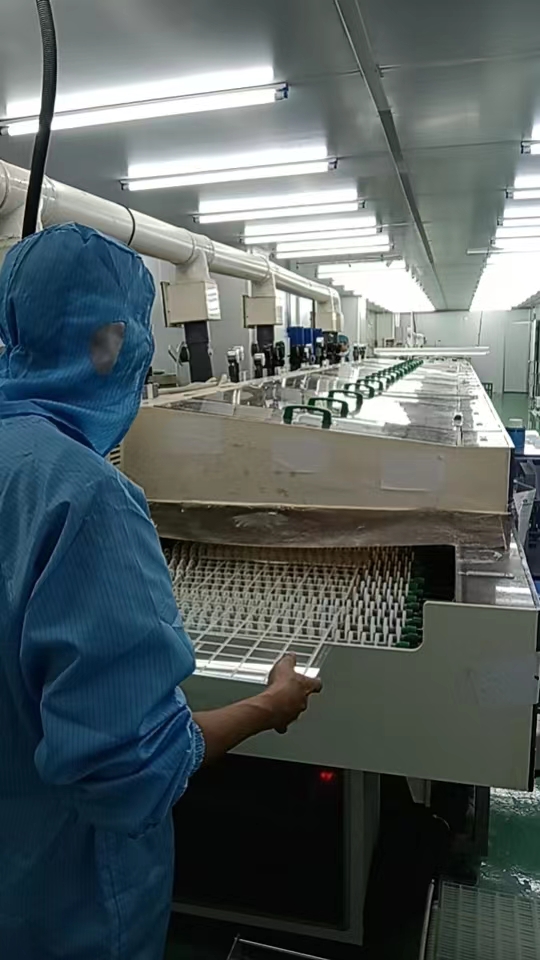
Xiangrui Optoelectronics operates a resistive touch screen production line able to produce different panel structures and module sizes.
What Is a Resistive Touch Display Module?
A resistive touch display module is an integrated assembly in which a resistive touch panel, a TFT display and the optical bonding layer between them are delivered as one component that the equipment maker mounts behind a front bezel. A resistive touch panel registers input from applied pressure rather than from the electrical properties of a bare fingertip. That single characteristic explains most of its remaining applications: a gloved press, a stylus press or a press through a protective membrane produces the same reliable input event.
Mechanically, a Xiangrui touch display module is built from a defined layer stack. The cover glass is aluminosilicate chemically strengthened glass; the touch sensor material includes ITO indium tin oxide; the module uses OCA optical adhesive film for optical bonding and includes PVA/TAC film, color filter CF and a TFT glass substrate. These are the material layers a buyer is actually specifying when approving a module drawing, and they determine how the finished HMI behaves under impact, moisture and continuous use.
Xiangrui Optoelectronics, founded in 2010, develops, produces and customizes touch screens and touch display modules. Its main products include resistive touch screens, capacitive touch screens, customized touch display modules, touch panels, touch screens and touch display cover glass. The company operates a 5,000 m2 manufacturing facility with 60 employees, including 15 engineers, and supports OEM and customized touch solutions tailored to equipment designs, interface requirements and application environments.
The Problem: Why Buyers Reconsider Resistive Technology
A recurring failure mode in equipment projects is choosing a projected capacitive panel by default and only later discovering that the people who actually operate the machine cannot use it comfortably. Where operators wear heavy-duty work gloves, the capacitive coupling that a PCAP panel depends on is weakened. Where the front surface collects oil, coolant or splashing liquid, false triggering and drift become the dominant complaints. Where the interface only ever needs a single press - start, stop, reset, enter a value - multi-touch capability adds cost without adding function.
Resistive technology also has limits that a buyer should accept before choosing it. A resistive panel supports single-point operation, so pinch, rotate and swipe-based navigation are not available. Display performance and the flatness of the front appearance are below those of a fully laminated industrial capacitive module. And for high-frequency interaction with bare hands, a capacitive panel is simply the faster interface.
The decision is therefore not about which technology is newer. It is about which set of operating conditions the machine will actually face for the next five to ten years. A specification written around the operator, the environment and the input task will usually point to one technology clearly.
Industry Background: Where Resistive Fits in the 2026 Touch Display Market
Touch technology is not a single market, and the split between the two mainstream technologies is stable rather than marginal. Capacitive touch modules held a dominant 71% share of the touch screen module market in 2025, while resistive modules accounted for 19%, according to Business Research Insights. Those figures describe market value share, not suitability for a specific machine.
The wider commercial touch display market is projected to grow from USD 6.9 billion in 2025 to USD 16.3 billion by 2035, at a CAGR of 9.0%, according to Future Market Insights. A segment holding close to one fifth of module market value inside a market of that size is not a legacy leftover; it is an installed base of industrial, medical, self-service and cost-sensitive equipment that keeps being rebuilt and replaced.
The geographic pattern matters for sourcing. Xiangrui reports an export ratio of 50%, with main markets in Asia, Europe and America. For a buyer in any of those regions, the practical question is not whether resistive modules still exist, but whether the supplier can customize panel structure, cover glass and bonding to the equipment rather than shipping a fixed catalogue part.
The Solution: How a Custom Resistive Touch Display Module Is Built
Customization starts from the equipment, not from a stock list. Xiangrui supports OEM and customized touch solutions tailored to equipment designs, interface requirements and application environments, and its engineering team handles product customization, technical evaluation, design optimization and application-specific touch solutions. In practice that means four decisions are made together: panel structure, display specification, environmental protection and bonding method.
Panel and display construction
The module layer stack uses aluminosilicate chemically strengthened glass as cover glass, ITO indium tin oxide as touch sensor material, and OCA optical adhesive film for optical bonding, together with PVA/TAC film, color filter CF and a TFT glass substrate. Chemically strengthened aluminosilicate glass is the reason a module can survive repeated cleaning and impact without chipping at the edge, and it is also the layer that can be customized in thickness: the glass cover plate thickness can be customized, with a maximum thickness of 10 mm.
Optical bonding and lamination
A laminated touch display module uses OCA optical adhesive film to bond the touch panel to the display, eliminating the air gap between them. On Xiangrui modules, full lamination is available as a mainstream option that improves contrast, removes the air gap and reduces dust ingress and fogging between layers; frame bonding is also available at a lower cost, giving buyers two price tiers for the same module platform. This is the single largest cost and performance lever in a resistive or capacitive build, and it is decided at quotation stage, not at assembly.
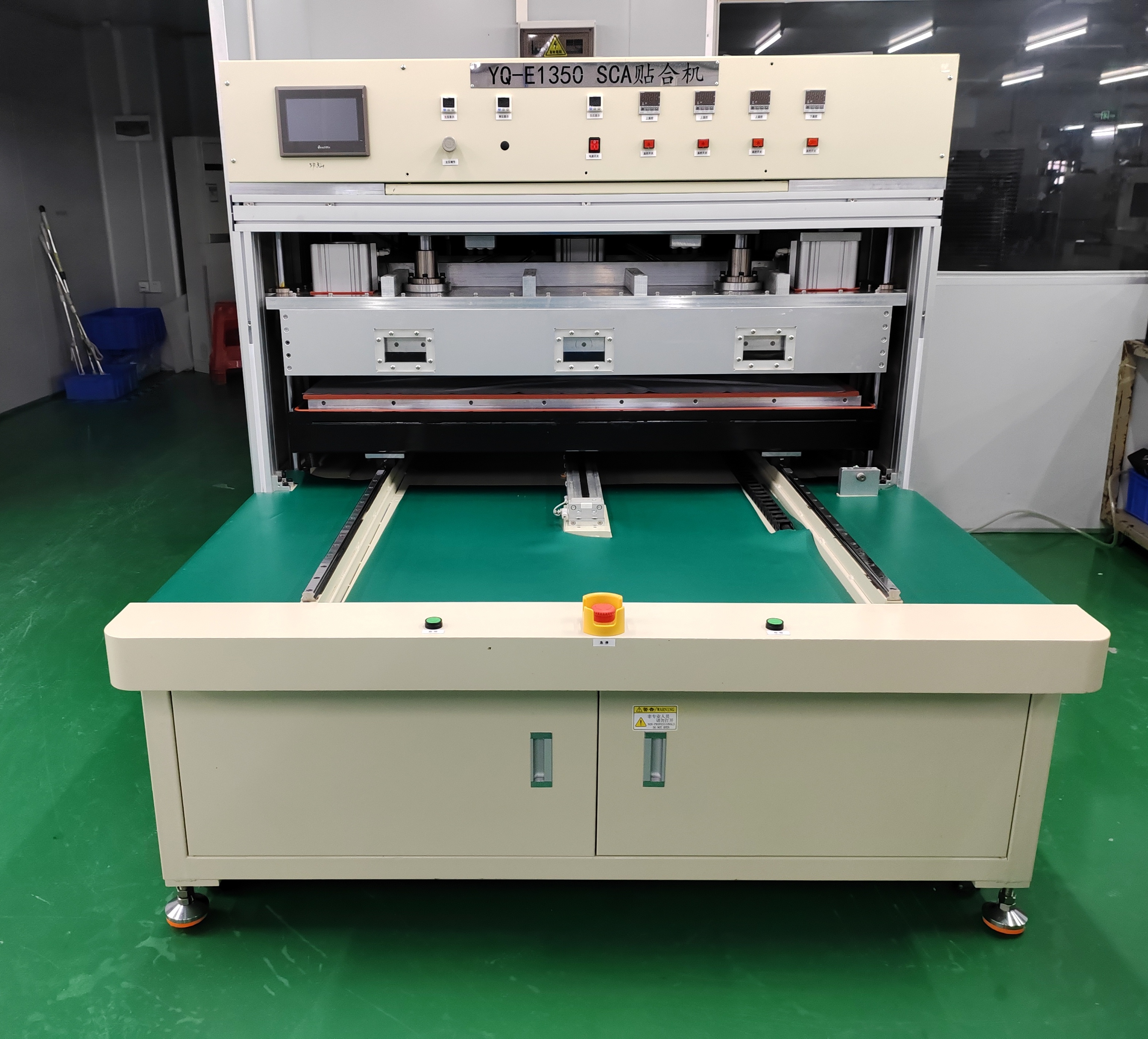
Optical bonding equipment used to laminate the touch panel to the display without an air gap.
Protection and environmental ratings
Xiangrui touch display modules offer a protection level of IP68 and an impact resistance rating of IK10, both customizable according to the enclosure design. IK10 is a defined threshold rather than a marketing label: under IEC 62262, an IK10 rating requires the equipment to withstand an impact energy of 20 joules, equivalent to a 5 kg object dropped from 40 cm. For a panel mounted on a machine that is cleaned with hoses or struck by tools and trolleys, that number is the difference between a spare-part line item and a non-issue.
Temperature range follows the same logic. Xiangrui modules are designed for wide-temperature operation with an operating range of -20 C to +70 C and a storage range of -30 C to +80 C, and they support continuous operation and glove touch operation. Wide-temperature performance is what allows the same module family to be used in a workshop, a cold-chain installation and a charging pile without redesigning the electronics.
Surface treatments for readable, cleanable fronts
An anti-glare touch display module solves a different problem from a high-brightness module, and both are frequently needed together. Xiangrui modules support AF anti-fingerprint, AG anti-glare and AR anti-reflection surface treatments, which can be combined on the same cover glass, together with 3A surface treatment and high light transmittance. For a resistive panel that is pressed with gloved fingers all day, an anti-glare finish reduces reflected ceiling light and the fingerprint layer that builds up on a gloss surface.
Manufacturing capacity behind the build
A custom module is only as reliable as the line that builds it. The Xiangrui facility covers 5,000 square meters and reports an annual production capacity of 300,000 units, supported by 60 employees including 15 engineers. The company holds ISO 9001 and ISO 14001 certification, is recognized as a National High-Tech Enterprise, and holds 16 utility model patents. Final quality control is performed on finished modules before packing, which is the stage where bonding defects, touch linearity and cosmetic issues are caught.
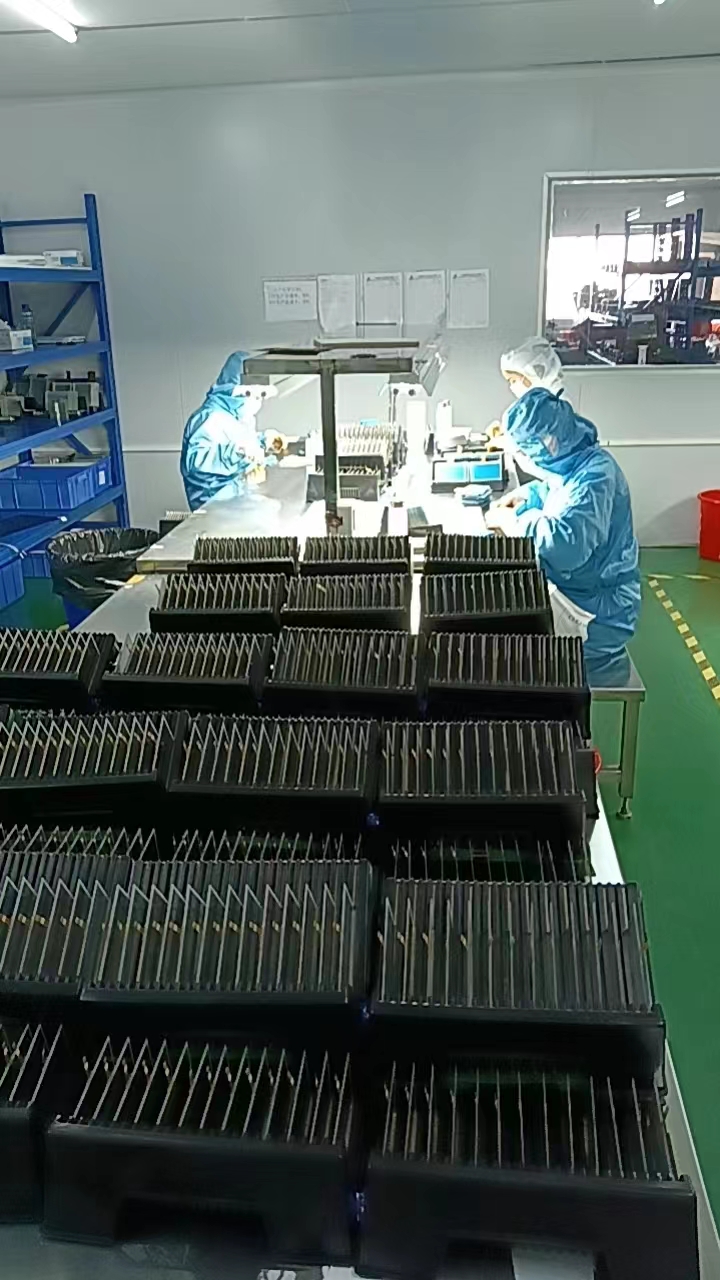
Final quality control on finished touch display modules before packing.
Step-by-Step: Specifying a Custom Resistive Touch Display Module
The sequence below reflects the order in which specification decisions constrain one another. Changing an earlier step after a later one is fixed usually forces a re-quote.
Step 1 - Define the operating condition
Record what the operator wears, what the surface is exposed to, the ambient temperature range and the duty cycle. Industrial control equipment, medical devices, self-service terminals and new energy equipment each impose a different combination of glove type, cleaning agent, dust and continuous 24/7 operation.
Step 2 - Decide single-point versus multi-touch
If operators must wear heavy-duty work gloves, if the panel is subject to heavy oil contamination, dust and splashing liquid, if only single-point operation is needed, or if the budget is sensitive, a 5-wire resistive touch panel is the preferred option. If multi-point gestures are required, together with better display performance, a flat appearance, high-frequency operation or outdoor strong-light conditions, an industrial-grade projected capacitive touch screen is the better fit.
Step 3 - Set the display parameters
Fix the diagonal size, resolution and brightness against the viewing distance and the ambient light. A high-brightness touch display module is specified where the front face sees direct sunlight or strong workshop lighting; brightness options on Xiangrui modules range from standard levels up to 1000 cd/m2 versions, and wide-temperature models rated -20 C to +70 C are available for workshop, cold chain and charging pile scenarios.
Step 4 - Set the protection level
Confirm whether IP68 and IK10 are required, and whether ESD and EMC protection must meet the equipment EMC requirement. Self-service and outdoor equipment typically call for water and rain resistance plus strong anti-mistouch behaviour; medical equipment typically calls for coatings that resist repeated disinfection and surfaces that do not encourage bacterial growth.
Step 5 - Choose the bonding and surface treatment
Select full lamination with OCA optical adhesive film or frame bonding according to the target price tier, then add AG anti-glare, AF anti-fingerprint or AR anti-reflection treatment if the installed environment calls for it. A cover glass thickness up to 10 mm can be specified where the front must withstand heavier abuse.
Step 6 - Validate with a sample, then scale
Approve a physical sample against the actual glove, cleaning agent and light conditions before committing to volume. Once the sample is signed off, annual capacity of 300,000 units supports the transition from pilot build to serial production; actual lead times depend on product specifications and order quantities.
Use Cases: Where Resistive Modules Are Still the Right Answer
Industrial control equipment. Machine HMIs running 24/7 in dusty, humid workshops with wide temperature swings, where operators wear gloves and need stable touch without drift, anti-false-touch behaviour, single-point priority and consistent touch accuracy. Resistive panels fit the glove-and-oil cases; industrial capacitive panels fit curve and drawing viewing.
Automation equipment. Production lines needing a human-machine interface for control of equipment and lines, with EMC and ESD requirements plus vibration and shock resistance. Glove-touch support and high precision requirements make panel selection a functional decision rather than a cosmetic one.
Medical devices. Monitors and medical HMIs where surfaces must resist repeated disinfection, remain non-porous and avoid encouraging bacterial growth, with high touch accuracy and stable coordinates. Simple bedside controllers and portable hand-held detectors operated with thick gloves and basic single-point input are the classic resistive case.
Self-service intelligent equipment. Cabinets and terminals exposed to water stains and rain, needing strong anti-mistouch behaviour, multiple operation states (bare hand, wet hand, thin glove), low drift, touch lock and IP67/IK08 class targets. Here the choice usually depends on whether the user base operates bare-handed indoors or gloved outdoors.
New energy and smart home equipment. Charging piles and energy equipment requiring wide operating temperature, anti-condensation, damp-heat ageing resistance and high brightness; household control panels requiring AF anti-fingerprint, anti-mistouch, low power consumption and full lamination.
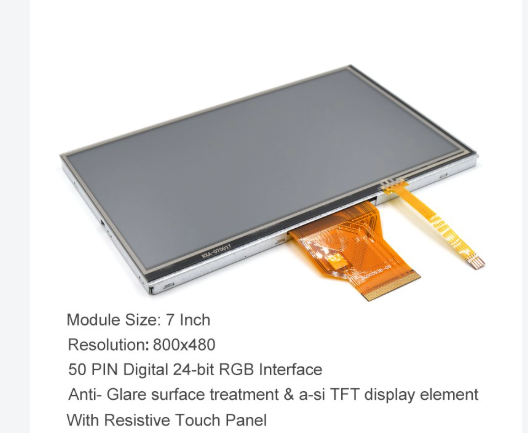
Compact 7-inch embedded touch display module used in smaller HMI and control panel designs.
Resistive vs Capacitive Touch Display Module: Comparison
The table below compares the two technologies only on dimensions that are documented, either in Xiangrui application guidance or in published market data.
| Comparison dimension | Resistive touch display module | Capacitive (PCAP) touch display module |
|---|---|---|
| Touch input | Single-point operation | Multi-point gestures; 10-point multi-touch on Xiangrui 21.5-inch module |
| Glove operation | Suited to heavy-duty work gloves | Bare hand or thin glove |
| Contamination tolerance | Preferred for heavy oil, coolant, dust and splashing liquid | Requires a cleaner operating surface |
| Display performance and appearance | Below a laminated capacitive module | Better display performance and flat appearance |
| Interaction frequency and lighting | Adequate for occasional single presses | Suits high-frequency operation and outdoor strong light |
| Cost position | Preferred where the budget is sensitive | Higher, justified by display and multi-touch gains |
| Global module market share, 2025 | 19% | 71% |
Market share figures: Business Research Insights, touch screen module market, 2025.
Standard Module Sizes Available From Xiangrui
The five modules below are the current standard G+G capacitive touch display module sizes, useful as a reference point for enclosure cutouts, resolutions and brightness levels. Resistive panel builds are specified per equipment design rather than from a fixed size list.
| Size | Model | Resolution | Brightness | Operating / storage temperature |
|---|---|---|---|---|
| 7.0 inch | XRCGG070-0108-TPM-D1 | 1024 x RGB x 600 | 700 cd/m2 | -20 C to +70 C / -30 C to +80 C |
| 10.1 inch | XRCGG101-0340-R1 | 1280 x RGB x 800 | 800 cd/m2 | -20 C to +70 C / -30 C to +80 C |
| 13.3 inch | XRCGG133-0040-OB-A0 | 1920 x RGB x 1080 | 1000 cd/m2 | -20 C to +70 C / -30 C to +80 C |
| 15.6 inch | XRCGG156-0186-A0 | 1920 x RGB x 1080 | 1000 cd/m2 | -20 C to +70 C / -30 C to +80 C |
| 21.5 inch | XRCGG215-0106-A0 | 1920 x RGB x 1080 | 1000 cd/m2 | -20 C to +70 C / -30 C to +80 C |
Frequently Asked Questions
What quality certifications does Xiangrui Optoelectronics hold?
Guangzhou Xiangrui Optoelectronics Technology Co., Ltd. holds ISO 9001 and ISO 14001 certification and is recognized as a National High-Tech Enterprise, with 16 utility model patents. The company was founded in 2010 and operates a 5,000 square meter manufacturing facility.
Is there a thickness limit for the glass cover plate of the touch screen?
Yes. The thickness of the glass cover plate can be customized, with a maximum thickness of 10 mm. The cover glass material used on these modules is aluminosilicate chemically strengthened glass.
What operating systems do the touch panels support?
Xiangrui capacitive touch panels support multiple operating systems, including Android, Linux and Windows. Buyers with a different platform should confirm compatibility with the supplier during technical evaluation.
Should I choose a resistive or a capacitive touch display module for an industrial HMI?
Where heavy-duty work gloves are required, where the panel faces heavy oil contamination, dust and splashing liquid, where only single-point operation is needed, or where the budget is sensitive, a 5-wire resistive touch panel is preferred. Where multi-point gestures are needed along with better display performance, a flat appearance, high-frequency operation and use in outdoor strong light, an industrial-grade projected capacitive touch screen is the better choice.
How do I request a sample or a quotation for a custom touch display module?
Share the equipment type, operating conditions, required size, resolution and protection level with the Xiangrui engineering team. You can send an inquiry to sales03@xiangruitec.com, contact +86 15975474413 on phone or WhatsApp, or review the product range first and then request a sample for validation before serial production.
Conclusion
A resistive touch display module is not a fallback choice; it is a specification decision driven by four concrete conditions: glove type, surface contamination, input complexity and budget. Where those conditions point to pressure-based single-point input, a resistive panel avoids the false triggering, drift and unusability problems that a capacitive panel creates in the same environment. Where multi-touch, high-frequency interaction, better display performance and outdoor strong light dominate, an industrial capacitive module is the correct answer.
Xiangrui Optoelectronics builds both sides of that decision from a 5,000 square meter facility, with 15 engineers supporting customization, technical evaluation and design optimization, ISO 9001 and ISO 14001 certification, and annual capacity of 300,000 units. Modules can be specified with IP68 and IK10 protection, -20 C to +70 C operating temperature, AG anti-glare and AF anti-fingerprint treatment, and full lamination with OCA optical adhesive film.
If you are at the research stage and want to compare the two module families against your own equipment conditions, the fastest next step is a technical conversation rather than a catalogue order. You can review Xiangrui Optoelectronics online, download the company brochure (English PDF), or send your specification to sales03@xiangruitec.com to request a sample or a quotation.
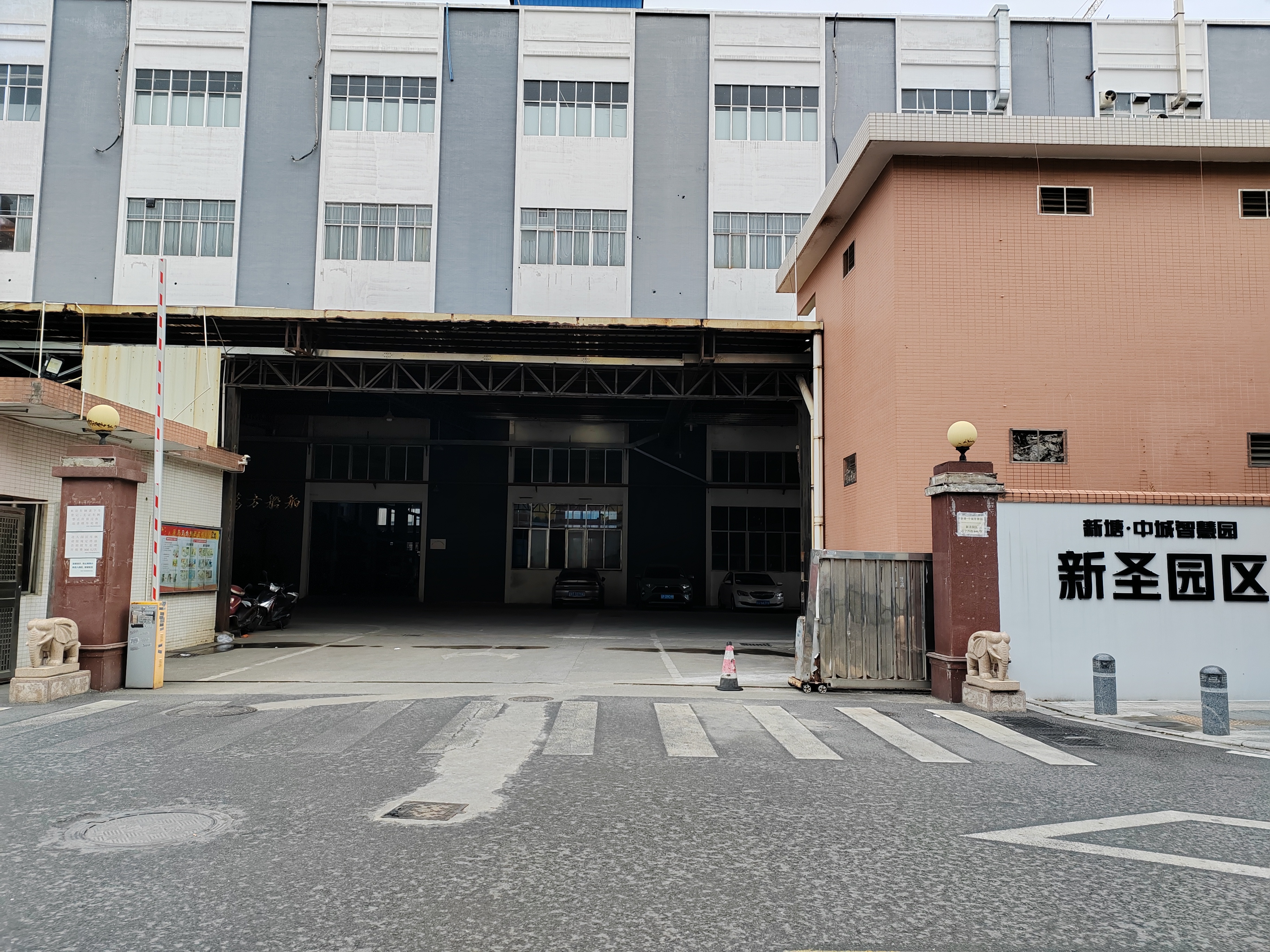
Contact the Xiangrui Optoelectronics team for samples, drawings and quotations on custom touch display modules.
Have Questions or Need More Details?
Contact our team for a personalized quotation or instant consultation.
Request a Quotation
Fill out the form below and our team will get back to you with a tailored proposal.
WhatsApp Direct Chat
Prefer to chat in real-time? Message us on WhatsApp for instant assistance & quick answers.
- Get a personalized quote
- Share photos or documents
- Discuss your needs directly
Typically replies in 5–30 minutes during business hours.