Xiangrui Optoelectronics: Custom Touch Display Module Review
Xiangrui Optoelectronics (Guangzhou Xiangrui Optoelectronics Technology Co., Ltd.) develops and manufactures resistive and capacitive touch panels and custom touch display modules from a single site in Zengcheng District, Guangzhou. This review assesses the company the way a qualification team would: certification evidence first, published specifications second, commercial terms third. Every figure below is drawn from the company's own published material or from independent market and standards records.
Verified company facts at a glance
- Founded 2010; plant and office in Guangzhou, Guangdong, China
- Facility of 5,000 m²; 60 employees, including 15 engineers
- Annual output of 300,000 pcs, as stated by the company
- ISO 9001 certificate no. 50826Q00054R053, valid 2025-02-09 to 2029-02-08
- ISO 14001; National High-Tech Enterprise; 16 utility model patents
- Export share of 50%; main markets Asia, Europe and America
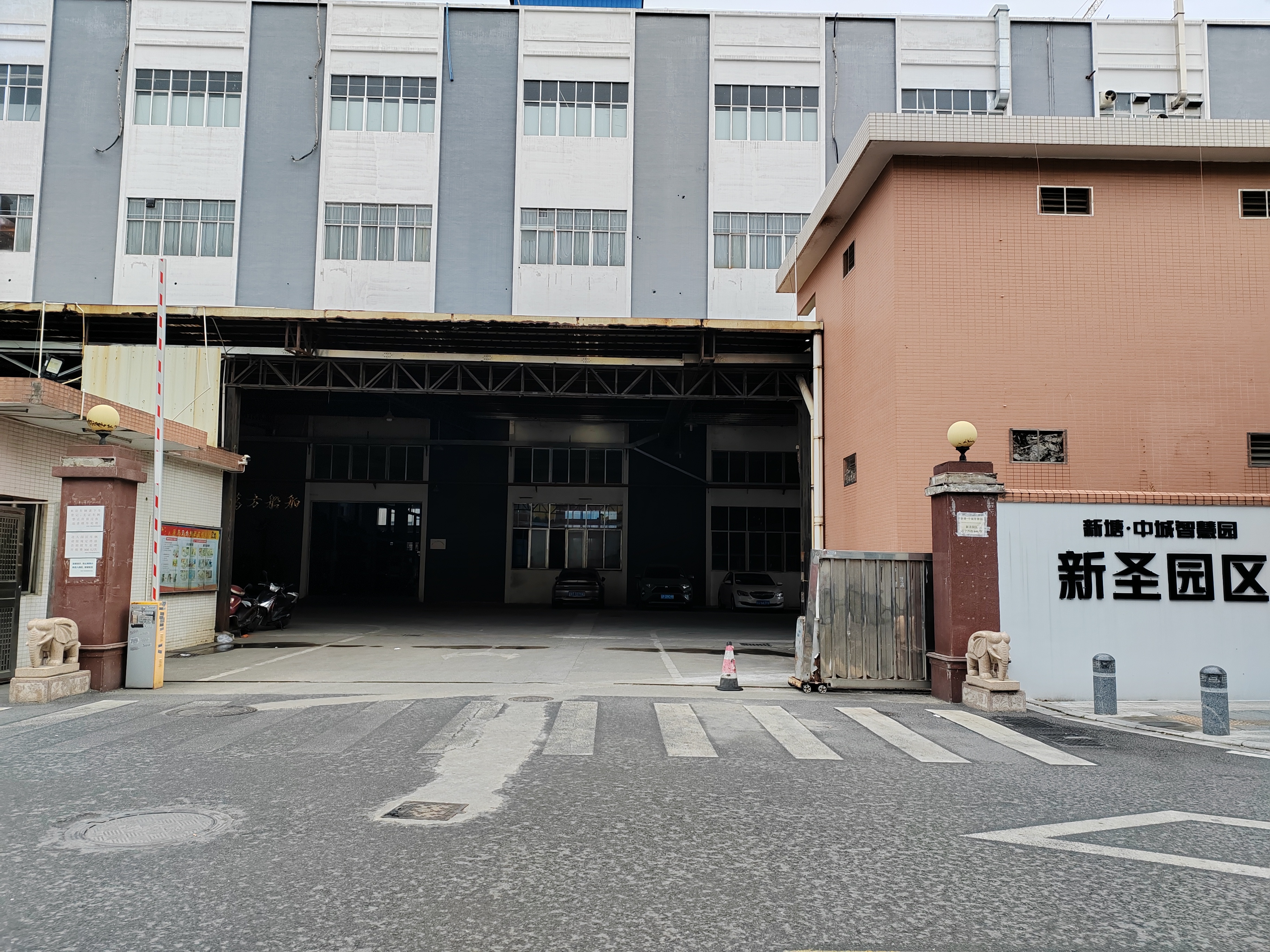
Xiangrui Optoelectronics operates from a single manufacturing site in Zengcheng District, Guangzhou.
Why compliance, specification headroom and commercial terms decide the outcome
Most buyers who shortlist a custom touch display module supplier have already filtered the market down to a handful of factories. The failure that follows is rarely a failure of product imagination; it is a failure to close one of three constraint layers before a purchase order is raised.
The first layer is compliance evidence. A buyer needs to know which management system the supplier is certified against, what the certificate scope actually covers, and who carries the certification burden for the finished machine. A display module is a component; conformity marking of the end product is normally the equipment maker's responsibility, and the supplier's role is to provide the technical documentation that supports that file.
The second layer is specification headroom. Operating temperature, ingress protection, impact rating, brightness and glove-touch behaviour are not interchangeable adjectives. They are measurable thresholds, and each one usually traces back to a standard or to a test the buyer can request.
The third layer is commercial fit: minimum order quantity, quoted lead time, and which configuration decisions raise or lower unit cost. These determine whether a technically suitable module can actually be procured at the volume and cadence the project needs.
This review evaluates Xiangrui Optoelectronics across all three layers, using the company's published data and independent market records, and then states where the supplier fits and where it does not.
Market context behind today's specification requirements
Technology share in the touch module market is heavily skewed toward capacitive sensing. According to Business Research Insights, capacitive touch modules held nearly 71% of the market in 2025, while resistive modules accounted for 19%. The commercial touch display market, as tracked by Future Market Insights, is projected to grow from USD 6.9 billion in 2025 to USD 16.3 billion by 2035, a CAGR of 9.0%.
Those two figures are often read as a technology verdict. Operationally they are not. The 19% resistive segment persists because a specific set of industrial constraints has never been solved by standard capacitive construction: thick work gloves, heavy oil and coolant contamination, single-point operation on a fixed keypad layout, and budget ceilings on high-volume equipment.
Impact protection illustrates how a specification becomes a procurement filter rather than a marketing claim. Under IEC 62262, an IK10 rating requires the enclosure to withstand an impact energy of 20 joules, equivalent to a 5 kg object dropped from 40 cm. A buyer comparing IK08 and IK10 modules is comparing two defined energy thresholds, not two adjectives.
The practical consequence is that a supplier worth shortlisting has to hold both technology routes in-house and be able to state protection, temperature and optical specifications per model. That is the frame used for the rest of this review.
Company profile: site, scale and certification record
Operating base and scale
Guangzhou Xiangrui Optoelectronics Technology Co., Ltd. was founded in 2010 and operates from Room 402, Building A2, No. 646, Xining West Road, Xintang Town, Zengcheng District, Guangzhou City, Guangdong Province. The company describes a 5,000 m² manufacturing facility staffed by 60 employees, including 15 engineers, with an annual output of 300,000 pcs. Publicly stated facility information also lists 3,000+ m² of cleanroom space graded Class 100, Class 1000 and Class 10000.
Roughly 50% of output is exported, with main markets listed as Asia, Europe and America. That export orientation matters for a specification review, because documentation habits, packaging standards and change-notification discipline tend to be shaped by the requirements of overseas equipment makers rather than by a single domestic channel.
Certification and quality management evidence
The company's documented certification is specific enough to verify. Its Quality Management System certificate is registered as ISO 9001 under certificate number 50826Q00054R053, issued by ZhongLianZhouYue International Certification (Beijing) Co., Ltd against GB/T 19001-2016 / ISO 9001:2015, with a validity period from 2025-02-09 to 2029-02-08. The stated scope, under IAF code 19, is the production of capacitive and resistive screens.
That scope wording is the part buyers should read closely. It confirms that both technology routes — capacitive and resistive — sit inside the certified production boundary, rather than one being treated as an outsourced or ancillary activity. The company additionally states ISO 14001 environmental management certification, National High-Tech Enterprise status, and 16 utility model patents.
What the evidence does and does not cover
A management system certificate confirms process control; it does not certify an individual module's electrical or optical performance. Buyers should therefore treat ISO 9001 as the baseline for consistency and ask separately for model-level test data, material declarations and change-notification commitments during the RFQ stage. This distinction is where many qualification files stall, and it is a documentation question rather than a capability question.
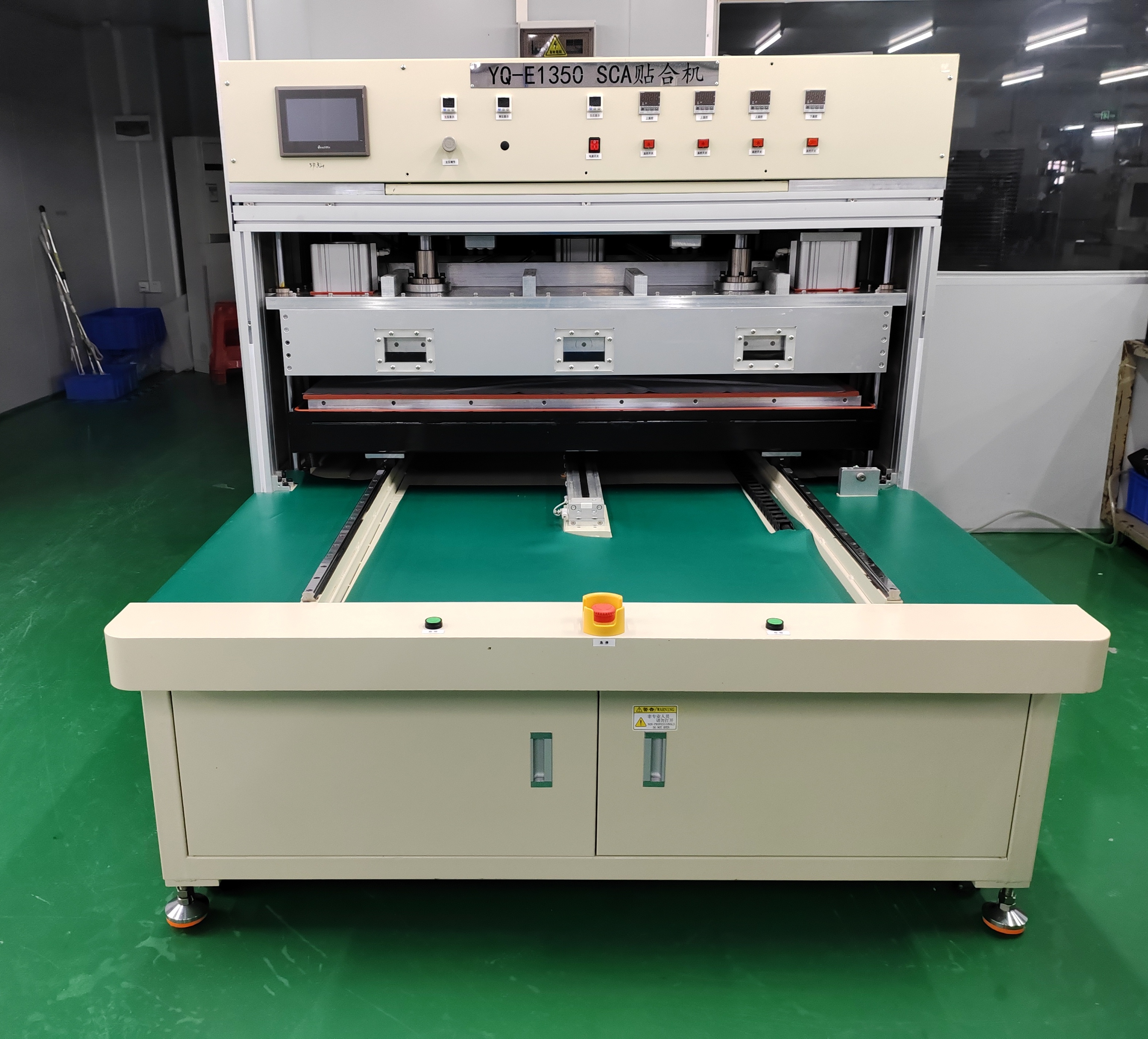
SCA bonding equipment supporting optical lamination of touch display modules.
Product portfolio: five documented custom touch display modules
Xiangrui publishes model-level specifications for a standard range that spans 7.0-inch to 21.5-inch formats. The table below reproduces the stated parameters; nothing has been inferred or rounded.
| Model | Size and resolution | Brightness | Operating / storage temperature | Protection and touch notes |
|---|---|---|---|---|
| XRCGG215-0106-A0 | 21.5-inch TFT, 1920 × RGB × 1080 | 1000 cd/m² | −20 °C to +70 °C / −30 °C to +80 °C | G+G construction; 10-point projected capacitive touch; thin-glove option; ESD protection for industrial EMC |
| XRCGG156-0186-A0 | 15.6-inch TFT, 1920 × RGB × 1080 | 1000 cd/m² | −20 °C to +70 °C / −30 °C to +80 °C | IP68; IK10 (customizable); glove-touch support; 3A surface treatment |
| XRCGG133-0040-OB-A0 | 13.3-inch TFT, 1920 × RGB × 1080 | 1000 cd/m² | −20 °C to +70 °C / −30 °C to +80 °C | IP68; IK10 (customizable); glove-touch support; OCA optical bonding; long-time continuous operation |
| XRCGG101-0340-R1 | 10.1-inch TFT, 1280 × RGB × 800 | 800 cd/m² | −20 °C to +70 °C / −30 °C to +80 °C | G+G glass lens; OCA optical bonding; glove-touch support |
| XRCGG070-0108-TPM-D1 | 7.0-inch TFT, 1024 × RGB × 600 | 700 cd/m² | −20 °C to +70 °C / −30 °C to +80 °C | IP68; IK10; glove-touch support; designed to operate under direct strong sunlight |
Shared platform characteristics
Across the range, the cover glass is aluminosilicate chemically strengthened glass, and the material set includes ITO indium tin oxide, OCA optical adhesive film, PVA/TAC film, colour filter and TFT glass substrate. Surface treatments can be combined: AF anti-fingerprint, AG anti-glare and AR anti-reflection. The 21.5-inch model uses a driver solution with optional MIPI, LVDS or HDMI interfaces, and offers multiple brightness versions at 300, 500, 700 and 1000 cd/m².
Two protection and usability attributes recur in the published specifications: IP68 ingress protection and IK10 impact resistance, both flagged as customizable on the models listed, plus glove-touch operation. For industrial buyers, the combination of wide-temperature operation, glove input and a defined impact rating is usually the difference between a module that survives a workshop floor and one that returns as a warranty claim.
Bonding options and the two price tiers
Xiangrui offers both G+G full lamination and frame bonding. The G+G full lamination option is specified as having no air gap and a dustproof, anti-fog construction, which is the usual choice for high-contrast industrial HMI and outdoor enclosures. Frame bonding is offered at a lower cost, giving buyers two price tiers for the same display platform. This is the single most useful cost lever in the portfolio, because it lets a project trade a defined optical improvement for a defined cost reduction without changing the electronics.
Customization and OEM/ODM scope
Customization is stated across shape, dimensions, anti-interference performance, brightness and resolution, IK rating and IP rating. The company describes its production mode as OEM, ODM, customization services and mass production. Cover glass thickness is also customizable, with a stated maximum of 10 mm — relevant for enclosures where the touch surface doubles as a structural or protective window.
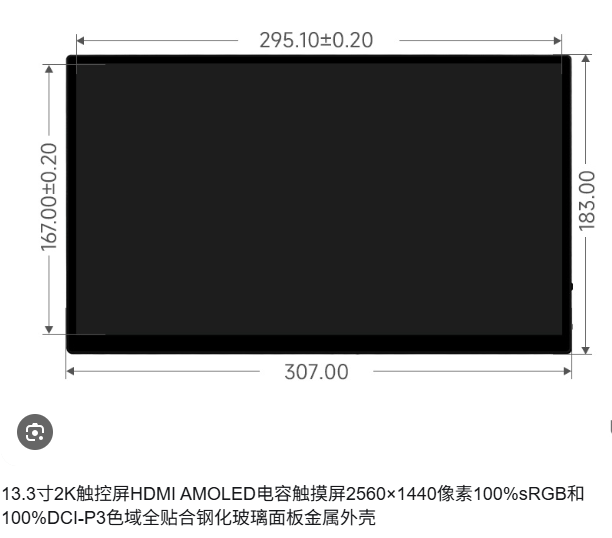
13.3-inch touch display module, model XRCGG133-0040-OB-A0, with IP68 protection, IK10 impact resistance and OCA optical bonding.
Manufacturing, engineering and inspection capability
Manufacturing depth is what separates a trading operation from a source factory, and it shows up in three places: the process list, the engineering headcount and the inspection regime.
The process list published by the company includes cleanroom production, SCA bonding equipment for lamination, FPC bonding, protective film application and final quality control. The 3,000+ m² of Class 100 to Class 10000 cleanroom space is consistent with optical bonding work, where particulate control directly affects yield and cosmetic defect rates.
Engineering capacity is stated at 15 engineers within a 60-person team. In practice this headcount supports product customization, technical evaluation and design optimization rather than pure order processing — the function a buyer relies on when a mechanical drawing does not quite match a standard module.
Quality control is described as full inspection. For touch display modules this typically means dimensional and cosmetic checks on the cover glass and lamination layer, plus functional verification of the touch sensor and display output before packing. Buyers should still define the acceptance criteria and sampling record format in the purchase specification, because full inspection is a process commitment rather than a published AQL table.
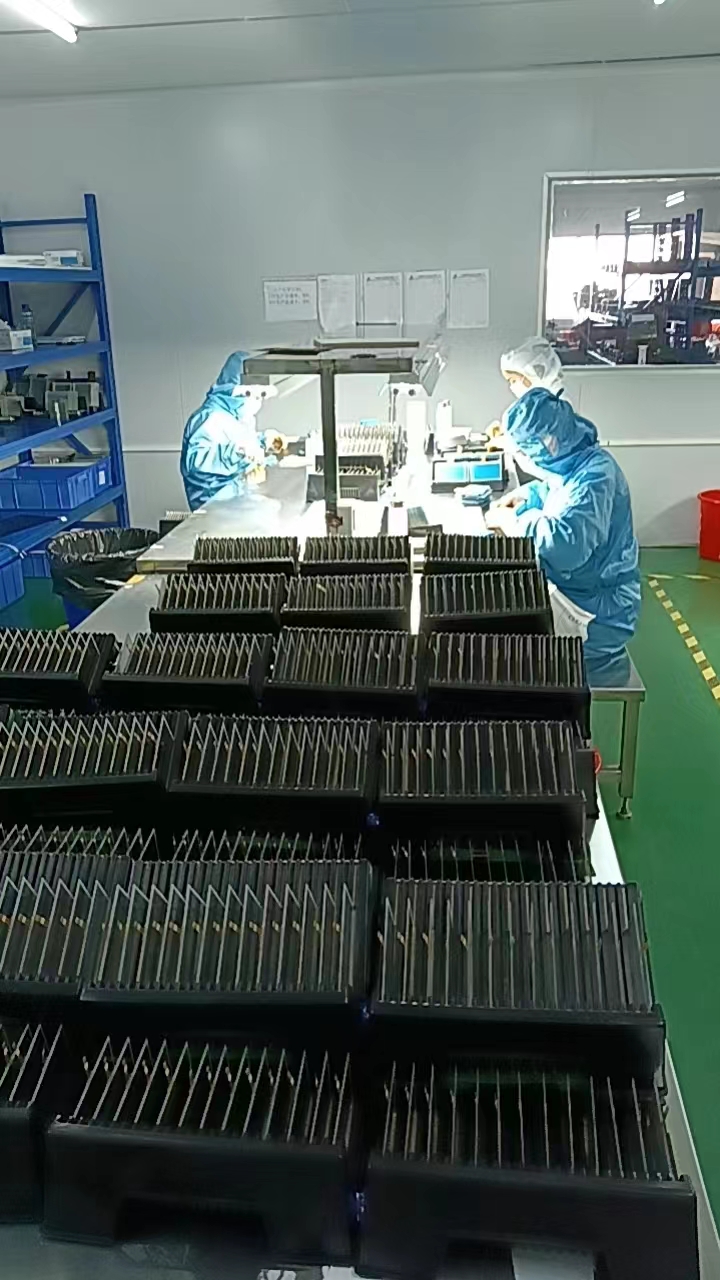
Final quality control inspection before packing and shipment.
Application fit: four documented project records
The company's application records cluster around equipment where the display is a control surface rather than a consumer screen. The requirements below are reproduced as documented; the matching modules are the ones the company lists against each scenario.
| Industry | Working conditions | Documented requirements |
|---|---|---|
| Industrial control equipment | Wide-temperature, high-humidity, dusty environments; 24/7 operation | Glove touch, anti-drift, anti-false-touch, consistent accuracy, IP68, IK10, ESD and EMC |
| Medical devices | Repeated disinfection, volatile and corrosive liquids | Stable coordinates, anti-misoperation, disinfectant-resistant coating, non-porous surface, EMC and ESD |
| Self-service terminals | Outdoor and semi-outdoor, rain and water-stain exposure | Bare hand, wet hand and thin glove operation, low drift, touch lock, IP67, IK08 |
| New energy equipment | Wide temperature, humidity, dust; 24/7 operation | EMI/EMC, IP68, IK10, anti-condensation, damp-heat ageing resistance, high brightness |
Four recorded projects give these categories concrete shape. A CNC equipment manufacturer has used Xiangrui modules for 8 years across HMI and display systems, with 800 units supplied; the documented highlights are stable glove and oily-hand touch, anti-drift performance under servo and VFD noise, IK08/IK10 toughened glass with AG and AF coating, IP65 front panel protection against coolant and cutting oil, and LVDS, MIPI, USB or RS232 interface availability.
In medical devices, the company records 5,000 units supplied over 5 years to manufacturers in Japan, Taiwan and Germany for ECG monitoring equipment and HMI. The documented requirements include stable touch through sterile nitrile or latex gloves, a clean-lock function for disinfection, coating resistance to alcohol and hospital disinfectants, IEC 60601-1-2 medical EMC compliance, optional AG, AR or antibacterial coating, and IP54/IP65 front splash protection.
For EV charging infrastructure, a charging pile manufacturer has used the modules for 5 years with 3,000 units deployed; the recorded result is stable long-term continuous operation outdoors under wide temperature and high-interference conditions. A smart home device manufacturer has supplied 30,000 units over 3 years for facial recognition access control, with emphasis on aesthetic design, touch experience, optics and power consumption, and environmental adaptability.
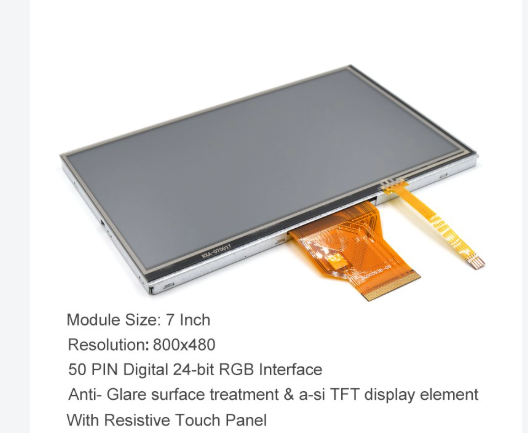
7-inch touch display module, model XRCGG070-0108-TPM-D1, specified for direct strong sunlight and glove-touch operation.
Commercial terms: MOQ, lead time and cost drivers
The commercial parameters published by Xiangrui are a minimum order quantity of 500 units and a lead time of 30 to 60 days, with actual lead times depending on product specifications and order quantities. Volume production capacity is stated at 300,000 pcs annual output. After-sales support is a one-year warranty with remote technical support.
No public price list is published, and none should be assumed. In this product category, four configuration decisions dominate unit cost: the bonding method (frame bonding is stated as lower cost than G+G full lamination), the brightness tier selected from the 300, 500, 700 and 1000 cd/m² options, the surface treatment combination of AF, AG and AR, and the protection level where IP and IK ratings are customized. A buyer who fixes these four items before requesting a quotation will get comparable numbers from multiple suppliers; a buyer who does not will receive quotes that cannot be compared.
The 500-unit MOQ is workable for pilot builds and mid-volume equipment programmes, but it is a real constraint for prototype-stage projects that need ten units. Buyers in that position should confirm sample and small-batch arrangements directly rather than assume them.
Evaluation: strengths, limits and shortlist logic
Strengths supported by documented evidence
- Both touch technologies in-house, with an ISO 9001 scope that explicitly covers capacitive and resistive screen production.
- Protection and temperature specifications stated per model: IP68 and IK10 on multiple models, with −20 °C to +70 °C operating range across the published range.
- Two bonding tiers, allowing a project to trade optical performance against cost without redesigning the electronics.
- Customization across shape, dimensions, brightness, resolution, IK and IP rating, plus cover glass thickness up to 10 mm.
- Recorded multi-year supply relationships in CNC equipment, medical devices, EV charging and smart home access control.
- Cleanroom grading of Class 100 to Class 10000 consistent with optical bonding work.
Limits a buyer should plan around
- Single manufacturing site in Guangzhou; buyers with dual-source policies will need a second qualified supplier.
- MOQ of 500 units and lead time of 30 to 60 days, which constrains fast-turn prototyping and emergency replenishment.
- No published price list; cost can only be established through a configured quotation.
- Certification documentation centres on ISO 9001 and ISO 14001; end-product conformity marking for target markets remains the equipment maker's responsibility.
- No consumer-grade or ultra-large-format models appear in the published range, so the fit is equipment HMI rather than display-wall applications.
When this supplier belongs on the shortlist
Xiangrui is a reasonable candidate when the project needs a ruggedized touch display module with defined wide-temperature operation, IP68 or IK10 protection, glove-touch input, and a customization path that includes bonding method and cover glass thickness — and when annual demand sits comfortably above the 500-unit MOQ. It is a weaker fit when the programme requires a published price book, sub-four-week replenishment, or a supplier that holds end-product certification on the buyer's behalf.
Frequently asked questions
Are Xiangrui custom touch display modules CE-compliant for European equipment?
CE marking is applied to the finished machine rather than to a bare display module, so this is best handled as a documentation question. Xiangrui's published certification record covers ISO 9001 under certificate no. 50826Q00054R053, issued by ZhongLianZhouYue International Certification (Beijing) Co., Ltd and valid from 2025-02-09 to 2029-02-08, plus ISO 14001. A European equipment maker should confirm at RFQ stage which technical documents — material declarations, EMC test support and change notifications — the supplier will provide for its own CE file, and should not assume the module itself carries a CE certificate.
Is there a maximum thickness for the touch panel cover glass?
Yes. The glass cover plate thickness is customizable, with a stated maximum thickness of 10 mm. This is relevant where the touch surface also serves as an external window or must resist impact without an additional bezel.
Which operating systems do the capacitive touch panels support?
The capacitive touch panels are stated to support multiple operating systems, including Android, Linux and Windows. Buyers should confirm the specific driver and interface combination required for their platform, since the published interface options on the 21.5-inch model include MIPI, LVDS and HDMI.
What is the MOQ, and which configuration choices drive unit cost?
The minimum order quantity is 500 units. Cost is driven mainly by the bonding method (frame bonding is stated as lower cost than G+G full lamination), the brightness tier chosen from 300, 500, 700 or 1000 cd/m², the AF/AG/AR surface treatment combination, and any customized IP or IK rating. No public price list exists, so a configured quotation is the only reliable basis for comparison.
What lead time should a buyer plan for before committing to volume production?
Lead time is stated at 30 to 60 days, with actual timing depending on product specifications and order quantities. Buyers should freeze the drawing and configuration — bonding method, brightness, surface treatment and protection rating — before requesting a quotation, and should request a sample for validation ahead of the volume order. To start that process, the company's product brochure can be downloaded here: Xiangrui Optoelectronics English brochure.
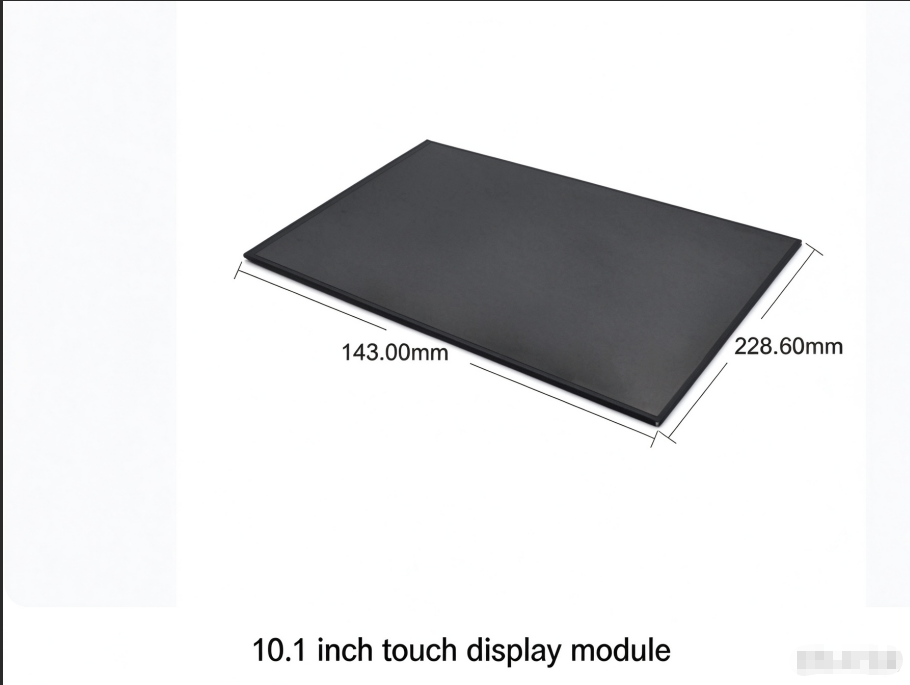
10.1-inch touch display module, model XRCGG101-0340-R1, a mid-size option in the standard range.
Conclusion
Xiangrui Optoelectronics occupies a specific position in the touch display supply chain: a mid-sized, single-site source manufacturer with both capacitive and resistive production inside its ISO 9001 scope, a cleanroom-graded bonding line, and a published model range from 7.0 to 21.5 inches with IP68, IK10 and wide-temperature options. Fifteen years of operation and recorded multi-year supply relationships in CNC equipment, medical devices, EV charging and smart home access control indicate a supplier built around equipment HMI rather than consumer display volume.
For procurement teams, the practical value lies in the two-tier bonding structure and the customization range — shape, dimensions, brightness, IK and IP rating, and cover glass thickness up to 10 mm — which together allow a project to reach a defined specification and a defined cost without changing suppliers mid-programme. The constraints are equally clear: a 500-unit MOQ, a 30 to 60 day lead time, no public price list, and end-product conformity work that stays with the buyer.
Judged on verifiable evidence rather than positioning language, the company is a credible candidate for industrial, medical, self-service and new energy equipment programmes where protection ratings and glove-touch behaviour are genuine qualification criteria.
Next step: request a configured quotation or a sample
Share your drawing, target size, brightness tier, bonding method, IP or IK requirement and estimated annual volume, and Xiangrui Optoelectronics can respond with a configured quotation and sample arrangement.
Email: sales03@xiangruitec.com | Phone and WhatsApp: +86 15975474413 | Website: www.gzxrtp.com
Download the English product brochure for the full model list and specification tables.
Have Questions or Need More Details?
Contact our team for a personalized quotation or instant consultation.
Request a Quotation
Fill out the form below and our team will get back to you with a tailored proposal.
WhatsApp Direct Chat
Prefer to chat in real-time? Message us on WhatsApp for instant assistance & quick answers.
- Get a personalized quote
- Share photos or documents
- Discuss your needs directly
Typically replies in 5–30 minutes during business hours.