
Pre-Insulated Pipe Application Guide: Project Scenarios and Acceptance Criteria
Purchasing terms for pre-insulated pipe usually arrive as a short block: minimum order quantity, delivery terms, a payment split and one acceptance line. That block is adequate for a repeat order of a known configuration. It stops being adequate the moment the project changes. A directly buried hot water main, a district cooling loop, an above-ground plant run, a steam service line and a mine-site network each change what an acceptance test has to prove, and therefore what the buyer must write into the contract before the order is released.
This guide maps the purchasing terms and acceptance criteria recorded for Tangshan Xingbang Pipeline Engineering Equipment Co., Ltd (Xingbang) against five project scenarios. Xingbang is a pre-insulated pipe manufacturer located in Houhu Industrial Park, Yutian Economic Development Zone, Hebei Province, China, whose stated main product is directly buried hot water pre-insulated pipe. The guide separates the parts of a purchase that stay the same across projects from the parts that must be rewritten for each one.
Why a Single Acceptance Clause Fails Across Project Scenarios
The recorded acceptance criterion for a Xingbang pre-insulated pipe order is a pre-shipment test, supported by a stated quality-control regime of 100% test. Both statements are clear and both are correct at the level at which they are written. Neither tells a buyer what is being tested, on what sample basis, against what limit, or with what document as proof of result.
That ambiguity is tolerable only while the product configuration is fixed. Once the configuration changes, the same clause covers materially different work. Consider what varies between projects:
- Burial condition. A directly buried line carries soil load, groundwater exposure and installation damage risk that an above-ground run does not.
- Service medium and temperature. Continuous hot water, chilled water and steam sit in different operating envelopes and are not interchangeable inputs to the same acceptance definition.
- Diameter. Certificate scope is diameter-bounded, and the bounds differ between certificates.
- Fitting count. A network with many non-standard fittings has more joints to define and more acceptance points than a straight run.
- Ground conditions. Soil chemistry and water table affect the anti-corrosion specification, which affects what the inspector is checking.
- Delivery schedule. A project with a fixed installation window treats a 30–45 day lead time differently from a project with float.
The practical consequence is that a single acceptance sentence does not protect either party. It protects the buyer only where the buyer has already converted the scenario into defined, checkable items inside a technical annex.
What the Standards Framework Covers — and What It Leaves to the Contract
Before adapting terms to a scenario, a buyer needs to know which parts of the specification are anchored in a published standard and which parts are not.
EN 253 is described by BSI/CEN as the primary European standard for bonded single pipe systems for directly buried hot water networks. The DIN EN 253:2015 listing describes its scope more precisely: straight lengths of prefabricated thermally insulated pipe-in-pipe assemblies for directly buried hot water networks, comprising a steel service pipe, rigid polyurethane foam insulation and an outer casing of polyethylene. The same standard description states that it applies to hot water at various temperatures up to 120°C for continuous operation, with an occasional peak temperature up to 140°C.
Three qualifications matter here, and buyers routinely miss them:
- This is a scope description, not a product rating. It defines what the standard addresses. It does not certify that any particular pipe supplied to a project performs at 120°C continuous in that project's conditions. The design temperature and pressure for the ordered configuration still have to be confirmed in the technical agreement.
- The described scope is hot water. Chilled water, steam and other media fall outside the description quoted above. A buyer specifying a chilled water or steam system cannot assume the hot water standard envelope transfers to that service.
- The described construction is a bonded steel–polyurethane–polyethylene assembly. Other constructions, including plastic service pipes, require their own specification basis.
On top of the standard layer sits the certification layer, and this is where scenario adaptation becomes concrete. The three certificates listed for Xingbang do not share a diameter scope:
- EU CE Verification of Conformity (certificate ICR Polska/VC/HS220608, issued by ICR Polska Co. Ltd, valid 24 June 2022 to 23 June 2027) covers polyurethane pre-insulated pipes from DN20mm to DN1800mm, referencing EN 448:2019 and EN 253:2019.
- GOST conformity certificate (РОСС CN.MJI10.H13406, issued by Эрри-тест, valid 28 January 2026 to 27 January 2031) covers DN20mm to DN1800mm under ГОСТ 30732-2020 for the Russian Federation market.
- ISO 9001:2015 quality management system certification (02807Q10270R6M, issued by Beijing Zhong'an Quality & Environment Certification Center Co., Ltd., valid 19 February 2024 to 10 February 2027, standard GB/T 19001—2016 / ISO 9001:2015) covers production of pre-insulated pipes DN1600mm and below, plus construction of pipeline insulation projects.
The diameter filter that changes a scenario decision. A project calling for pipe above DN1600mm falls outside the stated ISO 9001 scope, even though the CE and GOST certificates extend to DN1800mm. Buyers specifying large-diameter mains should raise this in the RFQ rather than discover it at document review. Certification scope covers a defined product range; it does not extend automatically to every diameter a factory can physically produce.
Separately, the manufacturer reports that it participated in the compilation of GB/T 29047-2012, described as a Chinese national standard for polyurethane insulating pipes. Standards-participation statements of this kind are company-reported and should be confirmed against the standards body's own record if they are being used as part of a formal supplier qualification.
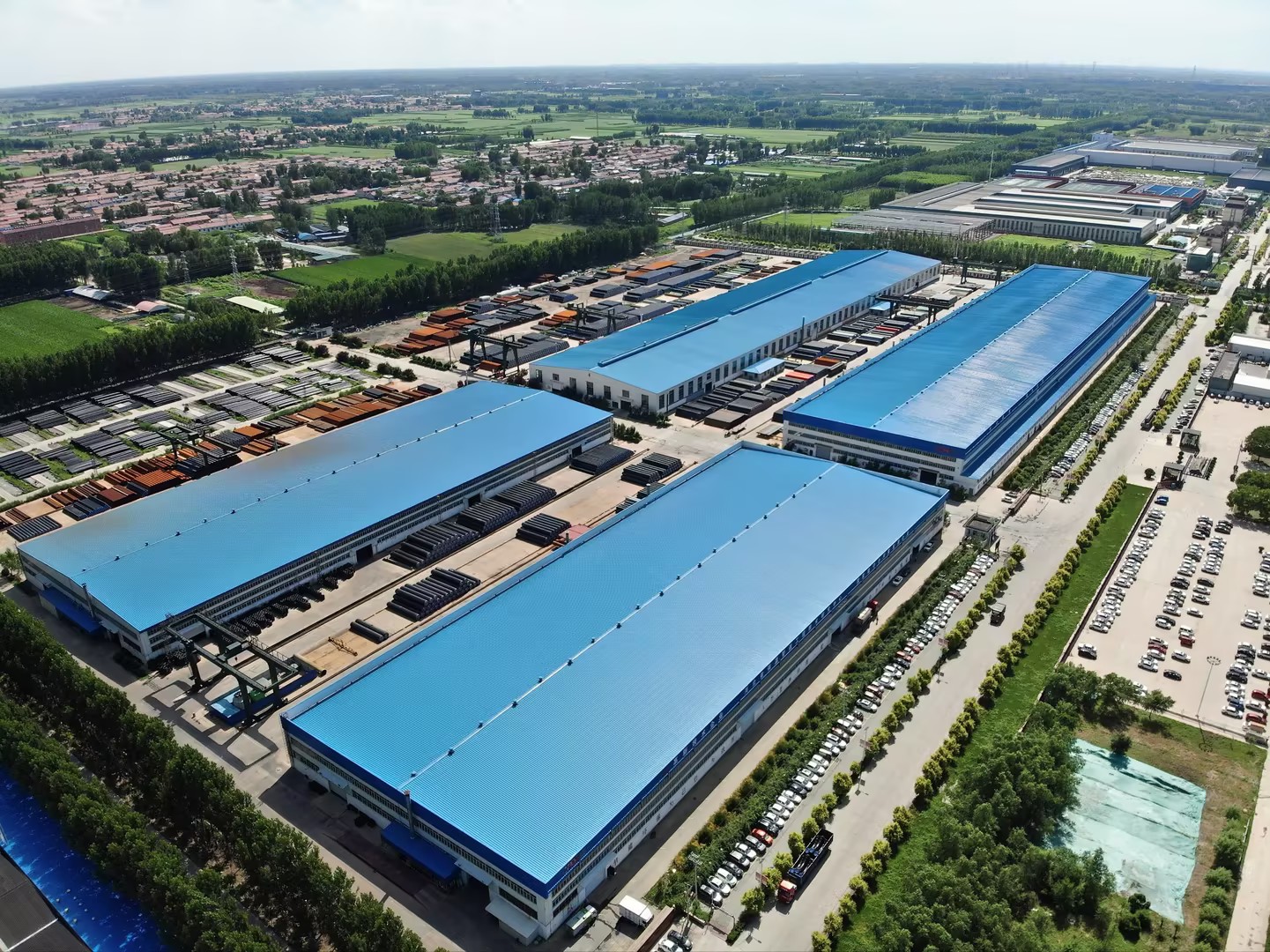
Production site used for capacity and scheduling checks before a project order is released.
Splitting Purchasing Terms into Scenario-Neutral and Scenario-Specific Clauses
The most efficient way to adapt terms across projects is to sort them once, at the start, into two groups. The first group is copied into every purchase order unchanged. The second group must be rebuilt for each project.
Scenario-neutral terms recorded in the purchasing summary are limited and stable: delivery terms of FOB or CIF, payment terms of 30/70, and pre-shipment test as the acceptance criterion. Lead time is listed at 30–45 days, monthly capacity at 200 km, and annual insulation pipe capacity is reported by the company at more than 3,000 km.
One commercial term needs flagging rather than copying. Minimum order quantity is listed as 1 km in the capability statement and as 500 m in a separate purchasing-terms entry. These are two different records, and the guide does not resolve them. A buyer should treat MOQ as an RFQ confirmation item and state the required quantity explicitly, rather than assume either figure applies to a given order.
Scenario-specific items are the ones that decide whether the delivered pipe fits the installation. Xingbang's published customization list covers pipe diameter and length, pipe material, temperature and pressure rating, insulation thickness, anti-corrosion grade, non-standard pipe fittings, design for geological conditions, and an intelligent monitoring system. Each of these is an option, not a default, and each one needs a value, a unit and an acceptance method written against it.
The distinction matters because customization options are frequently quoted as capabilities and accepted as specifications. A statement that a manufacturer can customize insulation thickness is not a statement about the insulation thickness on the buyer's order. Only the technical annex carries that.
Five Project Scenarios and Where Acceptance Criteria Diverge
1. Directly Buried Hot Water Networks
This is the scenario with the strongest documented basis. Xingbang's stated main product is directly buried hot water pre-insulated pipe, and the EN 253 / DIN EN 253:2015 scope quoted earlier addresses exactly this construction and service. The acceptance work therefore starts from a published framework rather than a blank page.
What the framework does not supply is the project's own design envelope. The technical agreement should fix the design supply and return temperatures, the peak condition and its duration, the diameter and wall thickness of the service pipe, the insulation thickness, the outer casing specification, the burial depth, and the soil and groundwater conditions at the route. Geological-condition design appears explicitly in Xingbang's customization list, which means it is a specification input rather than an assumption the factory makes on the buyer's behalf.
2. District Cooling and Chilled Water Networks
District cooling is listed among the applications Xingbang states its products serve, and project records include cooling and heating supply work in Cambodia, Jamaica and Vietnam. The acceptance logic, however, cannot be copied from the hot water scenario.
The standard scope described earlier is written for hot water. A chilled water or district cooling specification therefore has to define its own operating envelope — supply and return temperatures, pressure class and insulation performance expectation — inside the technical agreement, because there is no equivalent published scope description in the supplied evidence to fall back on. The same applies to moisture management: a chilled water line operates below ambient temperature in most climates, so outer casing integrity and joint sealing become acceptance-relevant in a way they are not on a hot water main.
Recorded project references in this scenario include a 30 km cooling and heating supply installation for a bank client in Cambodia with two years of reported stable operation, a 5 km district cooling project in Phnom Penh with ten years reported, a 6 km installation at a new university campus in Ho Chi Minh City with seven years reported, and a 3 km hotel installation in Jamaica with two years reported.
3. Above-Ground Installations
Moving a line above ground changes the loads and the exposure, but it does not change the commercial terms. The purchasing block stays the same; the technical annex does the work.
Two items need explicit treatment. First, external protection: above-ground service removes the soil cover that shields a buried casing, so the anti-corrosion grade — one of the listed customization options — has to be specified against the actual exposure rather than left at a buried-line default. Second, support and movement: thermal expansion on an above-ground run is handled by the support design, which sits outside the pipe purchase scope but determines whether the delivered pipe lengths, fittings and any anchor points are compatible with the installation.
The honest position on this scenario is that the supplied evidence does not include a dedicated above-ground performance dataset. Buyers should treat above-ground acceptance as a contract-defined exercise and should not infer above-ground suitability from a buried-line standard.
4. Steam Service
Steam is the clearest example of a scenario where an assumption would be dangerous. The standard scope quoted in this guide reaches 120°C continuous with an occasional peak of 140°C, and it is written for hot water. Steam service sits outside that described envelope.
Consequently, a steam line specification must state its own design temperature, design pressure and cycling pattern, and must confirm the ordered configuration against those values in writing. Xingbang's customization list includes custom temperature and pressure rating, which is the mechanism through which a steam duty would be addressed — but a customization option is not a validated rating. The acceptance test definition for a steam order must be agreed separately, and the buyer should not treat a hot water certificate or a hot water standard reference as evidence for steam service.
5. Industrial and Mine-Site Networks
Industrial sites concentrate the non-standard parts of an order. Non-standard pipe fittings, site-specific routing and geological conditions all appear in the customization list, and a mine or plant network is where they are most likely to be needed together.
A recorded reference in this category is a 9 km cooling and heating supply installation at a copper mine project in Mongolia, reported as being in stable operation for three years. A 6 km municipal heating network renovation project in Uzbekistan is reported at five years. For acceptance purposes, the lesson from these projects is not the tonnage but the fitting count: every non-standard fitting is an additional item that needs its own dimension check and its own place in the pre-shipment test scope.
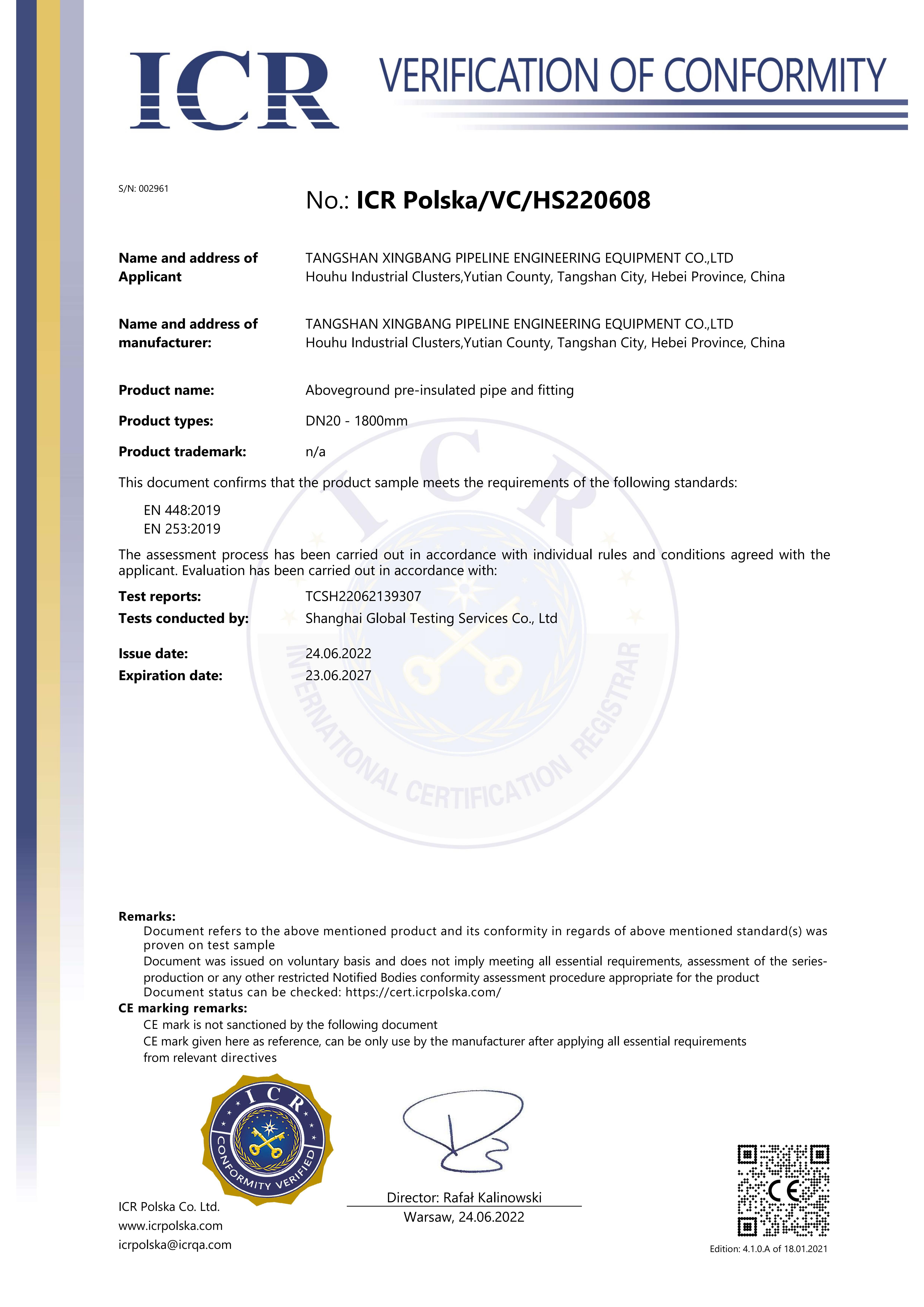
CE certificate scope extends to DN1800mm; the ISO 9001 scope stops at DN1600mm. The difference matters for large-diameter projects.
Scenario-to-Acceptance Mapping Table
The table below consolidates the mapping. The final column records what the supplied evidence actually supports; it deliberately distinguishes documented basis from items that must be created in the contract.
| Project scenario | Variables that change the clause | What the technical agreement must fix | Recorded basis |
|---|---|---|---|
| Directly buried hot water | Burial load, groundwater, soil chemistry, design temperature and peak | Design and peak temperatures, service pipe diameter and wall thickness, insulation thickness, casing specification, burial depth, geological design inputs | EN 253 / DIN EN 253:2015 scope for bonded steel–PU–PE assemblies, up to 120°C continuous and 140°C occasional peak; Xingbang stated main product |
| District cooling and chilled water | Below-ambient operation, moisture ingress, joint sealing, pressure class | Supply and return temperatures, pressure class, insulation performance expectation, casing integrity check, joint acceptance | District cooling listed among stated applications; project records in Cambodia, Vietnam and Jamaica; no dedicated published scope quoted |
| Above ground | External exposure, UV and mechanical damage, thermal movement | Anti-corrosion grade for the actual exposure, support and movement compatibility, length and fitting schedule | Anti-corrosion grade listed as a customization option; no above-ground performance dataset supplied |
| Steam service | Design temperature above the hot water envelope, pressure, cycling | Design temperature and pressure, cycling pattern, confirmation of the ordered configuration, separately agreed acceptance test | Custom temperature and pressure rating listed as a customization option; steam sits outside the quoted hot water standard scope |
| Industrial and mine site | Fitting count, non-standard components, site routing, ground conditions | Fitting schedule with dimensions, non-standard component acceptance method, geological design inputs, monitoring system scope if specified | Non-standard fittings, geological design and intelligent monitoring listed as customization options; 9 km Mongolia mine record at three years |
A Seven-Step Acceptance Path from RFQ to Delivery
The steps below convert the mapping into a sequence a procurement team can run. They assume the recorded terms — FOB or CIF, 30/70 payment, pre-shipment test, 100% test, 30–45 day lead time — and add the scenario layer on top.
Step 1 — Fix the design envelope before asking for a price
Define medium, design and peak temperature, design pressure, diameter range, insulation thickness and burial or exposure condition. A quotation produced without these inputs cannot be compared with another quotation, because the two may not describe the same product.
Step 2 — Check certificate scope against the project diameter
Match the required diameter against each certificate that the project market requires. The ISO 9001 scope covers DN1600mm and below; the CE and GOST scopes cover DN20mm to DN1800mm. Note the certificate numbers and validity dates in the procurement file so document review at handover is a comparison, not a discovery.
Step 3 — Convert customization options into a numbered technical annex
Take each relevant item from the customization list — diameter and length, material, temperature and pressure rating, insulation thickness, anti-corrosion grade, non-standard fittings, geological design, monitoring system — and give it a value, a unit and an acceptance method. Items not relevant to the scenario should be explicitly marked as not applicable rather than left blank.
Step 4 — Define the acceptance test, not just its name
Pre-shipment test and 100% test are the recorded controls. The technical annex should state which characteristics are checked, on what basis, against which limit, and which document records the result. This is the single highest-leverage change a buyer can make, because it is the point where a general clause becomes an enforceable one.
Step 5 — Fix the document package
Agree in advance which certificates, test records and inspection documents travel with the shipment. Certificate validity is time-bound, so the package should be checked against the delivery date rather than the order date.
Step 6 — Confirm the commercial terms that carry exceptions
Confirm the applicable MOQ (the two recorded figures are 1 km and 500 m), the Incoterm and named port, the 30/70 payment split and the delivery window against the 30–45 day lead time. Confirm capacity availability against the 200 km monthly figure if the order is large or the schedule is compressed.
Step 7 — Plan site service and handover
Xingbang states that it establishes dedicated on-site service teams delivering one-on-one, point-to-point full-range service throughout the project. The scope, duration and trigger conditions of that service should be written into the agreement rather than left as a general commitment, particularly for multi-phase networks where installation runs over several seasons.
What Project Records Show — and What They Do Not Prove
Six reference projects are recorded, each described as being in stable operation:
- Cambodia, bank client, 30 km, cooling and heating supply, 2 years
- Cambodia, Phnom Penh district cooling, 5 km, 10 years
- Vietnam, Ho Chi Minh City university campus, 6 km, 7 years
- Jamaica, hotel, 3 km, 2 years
- Mongolia, copper mine project, 9 km, 3 years
- Uzbekistan, municipal heating network renovation, 6 km, 5 years
These records are useful for one specific purpose: they show which scenarios have been executed and for how long the operator reports stable operation. They are company-reported and they are not a performance guarantee, a thermal-loss measurement, or evidence that a new project with different design conditions will behave the same way. A buyer should read them as scenario experience, then verify the technical fit of the ordered configuration separately.
The distribution is worth noting for scenario planning. Four of the six records are cooling and heating supply installations, which aligns with the company's stated application breadth across district heating, district cooling, oil and natural gas, LNG, chemical and industrial sectors. That breadth supports a conversation about a specific scenario; it does not substitute for the scenario-specific specification work described above.
Writing Acceptance Criteria That Survive Delivery
Four drafting rules do most of the work in preventing a delivery dispute.
Attach the certificate to the line item, not the supplier. A certificate covering DN20mm to DN1800mm and a certificate covering DN1600mm and below are both valid documents. What matters at acceptance is whether the certificate attached to the purchase order covers the diameter actually shipped. Record the certificate number, the issuing body and the expiry date against the line item.
Separate what the factory controls from what the site controls. Insulation thickness, casing specification, fitting dimensions and test records are factory-side and belong in the pre-shipment scope. Burial depth, backfill, joint assembly on site and support spacing are site-side and belong in the installation method statement. Disputes often arise because a factory-side clause was written to cover a site-side risk.
State the nonconformity route before the first shipment. The recorded terms name pre-shipment test as the acceptance point. They do not describe what happens when a result falls outside the limit. The agreement should say whether the response is rework, replacement, a concession with price adjustment, or rejection, and within what time window.
Do not use a hot water reference to cover a non-hot-water service. The clearest boundary in the supplied evidence is the temperature and medium scope: up to 120°C continuous and 140°C occasional peak, described for hot water. Reaching for that reference on a steam or high-temperature application is the fastest way to build an acceptance clause that cannot be satisfied or verified.

Municipal heating network renovation in Uzbekistan: a scenario where route conditions and fitting count drive the technical annex.
Frequently Asked Questions
1. What certifications should an OEM directly buried hot water pre-insulated pipe manufacturer hold for a European project?
For a European project, the relevant document is the EU CE Verification of Conformity. Xingbang's CE certificate (ICR Polska/VC/HS220608, issued by ICR Polska Co. Ltd) covers polyurethane pre-insulated pipes from DN20mm to DN1800mm under EN 448:2019 and EN 253:2019, and is valid from 24 June 2022 to 23 June 2027. Supporting it is ISO 9001:2015 certification (02807Q10270R6M, valid 19 February 2024 to 10 February 2027), which covers production of pre-insulated pipes DN1600mm and below plus pipeline insulation construction. For Russian projects, certificate РОСС CN.MJI10.H13406 under ГОСТ 30732-2020 covers DN20mm to DN1800mm and runs from 28 January 2026 to 27 January 2031. Buyers should check that the certificate scope covers the actual project diameter, because the ISO 9001 scope stops at DN1600mm while the CE scope continues to DN1800mm.
2. Can an OEM manufacturer customize directly buried hot water pre-insulated pipe for non-standard ground conditions?
Xingbang's published customization list includes design for geological conditions, alongside custom pipe diameter and length, pipe material, temperature and pressure rating, insulation thickness, anti-corrosion grade, non-standard pipe fittings and an intelligent monitoring system. These are available customization options rather than evidence that a specific configuration has already been produced or tested for a given site. The soil chemistry, groundwater level and burial depth should be supplied as design inputs, and the resulting specification should be written into the technical annex with an acceptance method attached to each customized item.
3. What purchasing terms and acceptance criteria apply to a pre-insulated pipe order?
The recorded purchasing terms list FOB or CIF delivery terms, a 30/70 payment split, and pre-shipment test as the acceptance criterion. Quality control is stated as 100% test. Lead time is listed at 30–45 days, monthly capacity at 200 km, and annual insulation pipe capacity is reported by the company at more than 3,000 km. Minimum order quantity appears as 1 km in the capability statement and 500 m in a separate purchasing-terms entry, so the applicable MOQ should be confirmed in the RFQ rather than assumed from either figure.
4. Is a sample or first-article verification available before full production?
The supplied purchasing terms do not record a separate sample or first-article clause. The recorded acceptance point is the pre-shipment test, backed by a stated 100% test regime during production. A buyer who needs a first-article inspection, a witnessed test or a retained reference sample should specify it in the technical agreement before order release, together with the inspection criteria and the document that records the result. Adding this requirement later, after production has started, is considerably harder to enforce.
5. What is the lead time for a customized OEM order, and how should the schedule be agreed?
Lead time is listed at 30–45 days, with monthly capacity of 200 km and reported annual capacity above 3,000 km. For a customized order, the lead time clock should be tied to technical annex sign-off rather than to the purchase order date, because the customization items — diameter and length, material, temperature and pressure rating, insulation thickness, anti-corrosion grade, non-standard fittings, geological design and monitoring system — have to be fixed before production scheduling is meaningful. Confirming the MOQ, the applicable Incoterm and the delivery port together with your project parameters is the practical starting point for a firm quotation.
Conclusion
The purchasing terms for pre-insulated pipe are short, and that is exactly why they need scenario work around them. FOB or CIF delivery, a 30/70 payment split, a 30–45 day lead time and a pre-shipment acceptance point carry across projects unchanged. What cannot carry across is the meaning of acceptance: a directly buried hot water main can lean on the EN 253 / DIN EN 253 scope up to 120°C continuous and 140°C occasional peak, while a chilled water, above-ground or steam application must define its own envelope in the technical agreement because no comparable published scope covers it in the supplied evidence.
The three checks that repay the most effort are the certificate-to-diameter match, the conversion of customization options into numbered annex items, and the definition of what the pre-shipment test actually verifies. A buyer who completes those three before order release has an acceptance clause that can be measured; a buyer who does not has a clause that can only be argued about.
For the full company profile, product range and facility information, the Xingbang corporate brochure is available for download. Project-specific questions on diameter scope, customization and acceptance documents can be directed to the team at xbinsulatedpipe@xingbang1995.com, by phone on +86 18331518911, or via WhatsApp on +8618833358018, with the site in Houhu Industrial Zone, Yutian County, Tangshan City, Hebei Province, China available for factory verification visits.
Have Questions or Need More Details?
Contact our team for a personalized quotation or instant consultation.
Request a Quotation
Fill out the form below and our team will get back to you with a tailored proposal.
WhatsApp Direct Chat
Prefer to chat in real-time? Message us on WhatsApp for instant assistance & quick answers.
- Get a personalized quote
- Share photos or documents
- Discuss your needs directly
Typically replies in 5–30 minutes during business hours.