
Pre-Insulated Pipe Sourcing FAQ: Post-Delivery Assurance
A pre-insulated pipe order can be delivered correctly and still leave a project exposed. The exposure usually comes from what happens next: a repeat order that is not quite the same as the first, a certificate that does not cover the diameter actually shipped, or a technical question in year six with no named owner. This guide answers the questions buyers raise when they move from evaluating a product to committing to a supply relationship.
The audience for these answers is specific: importers and distributors building a stock programme, EPC buyers releasing packages in phases, and municipal or industrial project owners who will operate the network long after the supplier commissioning team has left site. For all three, the decision is not only which pipe to buy, but which manufacturing relationship will still work in the third year.

The Problem: Assurance Gaps Surface After the Pipe Is Buried
Pre-insulated pipe is a bonded three-layer system: a steel service pipe, rigid polyurethane (PU) foam insulation, and an outer protective jacket in high density polyethylene. The layers are manufactured together so that they behave as one unit for the life of the network. That construction is exactly why post-delivery assurance matters — a small deviation in any layer is not corrected on site, it is inherited by the whole buried section.
Three gaps account for most of the friction in long-term supply:
- Specification drift between orders. The second and third batches differ from the first in insulation thickness, jacket grade, or the geometry of non-standard fittings. Field joints then need rework and the heat-loss calculation no longer matches the installed network.
- Documentation that does not follow the goods. Certificates exist, but their diameter scope or validity period does not match the shipment, so paperwork stalls at customs or at handover to the project owner.
- An undefined support boundary. Installation queries, monitoring data and replacement of customised components have no named owner once the delivery is signed for.
None of these are product defects in the ordinary sense. They are process failures, and process failures can only be screened by asking process questions.
Industry Background: Long-Life Assets, Short Procurement Cycles
Directly buried hot water networks in Europe are specified around EN 253, the industry standard for pre-insulated bonded pipe systems for directly buried hot water networks, published by the European Committee for Standardization. PU foam insulation for EN 253 pipes typically withstands temperatures up to 120 °C according to published technical references, and within that envelope a correctly manufactured polyurethane insulated pipe can operate continuously for at least 30 years at 120 °C. The asset life is measured in decades while the procurement cycle that selects its supplier is measured in weeks.
Temperature and pressure boundaries are the practical anchor for any capability discussion. Standard pre-insulated pipe is used in networks where the conveyed medium stays at or below 120 °C, occasional peak temperature does not exceed 130 °C, and working pressure is no more than 2.5 MPa. Requests outside that envelope change the specification conversation entirely, and a supplier should say so rather than accept the order quietly.
The commercial backdrop explains why supply options keep multiplying. SNS Insider valued the global district heating market at USD 209.34 billion in 2024, and Grand View Research estimated the global pre-insulated pipes market at USD 5.97 billion in the same year. Growth of that kind attracts new manufacturers, and the spread in documentation discipline between them is wider than the spread in product appearance. Pre-insulated pipes reduce heat loss by over 30 % in modern district heating networks, according to Strategic Market Research — an efficiency argument that only holds if the delivered pipe is the specified pipe.
The Solution: Five Assurance Domains to Score Before You Commit
A stable partnership is not a promise of goodwill. It is a set of commitments that can be written into the order. The five domains below cover what a buyer should be able to verify with any pre-insulated pipe manufacturer, regardless of country of origin.
Domain 1 — Specification continuity
Continuity starts with a frozen baseline: the exact pipe diameter and length, service pipe material, temperature and pressure rating, insulation thickness, anti-corrosion grade, and the geometry of every non-standard fitting. A manufacturer working from independent R&D with full customisation support should be able to restate that baseline in writing before the first order is released, and to quote later orders as deltas against it rather than as new specifications.
The test question is simple: if we reorder in eighteen months, which document defines what we receive? If the answer is a quotation rather than a controlled specification, drift is likely.
Domain 2 — Documentation integrity
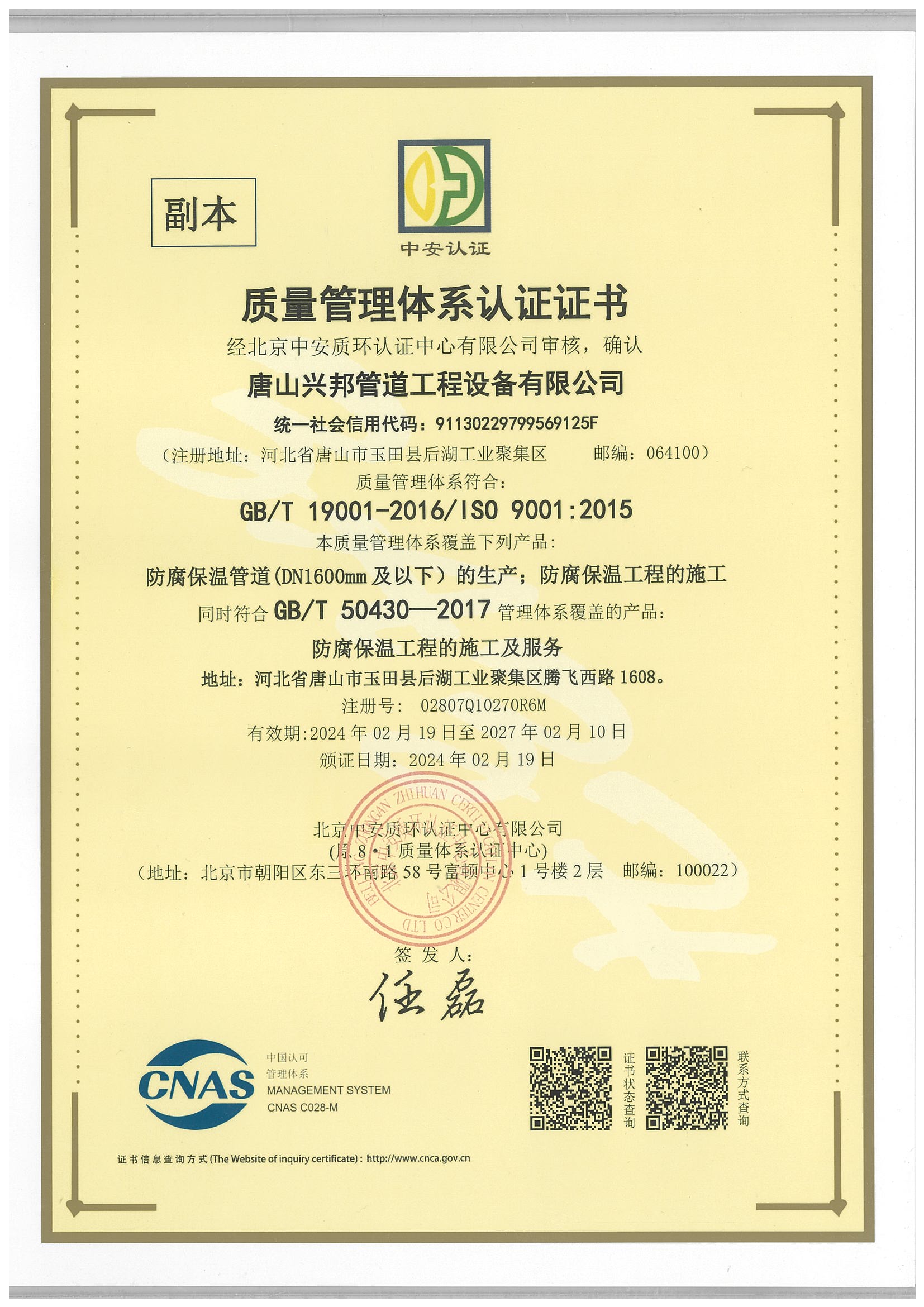
A quality management certificate is only useful if its scope covers the product actually bought. Tangshan Xingbang Pipeline Engineering Equipment Co., Ltd (Xingbang), a pre-insulated pipe manufacturer based in Houhu Industrial Park, Yutian Economic Development Zone, Hebei Province, China, holds ISO 9001 certificate 02807Q10270R6M, issued by Beijing Zhong'an Quality & Environment Certification Center Co., Ltd. under GB/T 19001—2016 / ISO 9001:2015. Its scope covers production of pre-insulated pipes DN1600 mm and below, construction of pipeline insulation projects, and processing and service of anti-corrosion insulation projects. It is valid from 19 February 2024 to 10 February 2027.
Buyers should read the scope sentence, not just the logo. A certificate that covers production up to a stated diameter tells you the quality system was audited for that range; a certificate whose validity expires before your delivery date does not support the shipment.
Domain 3 — Certification that travels with the market
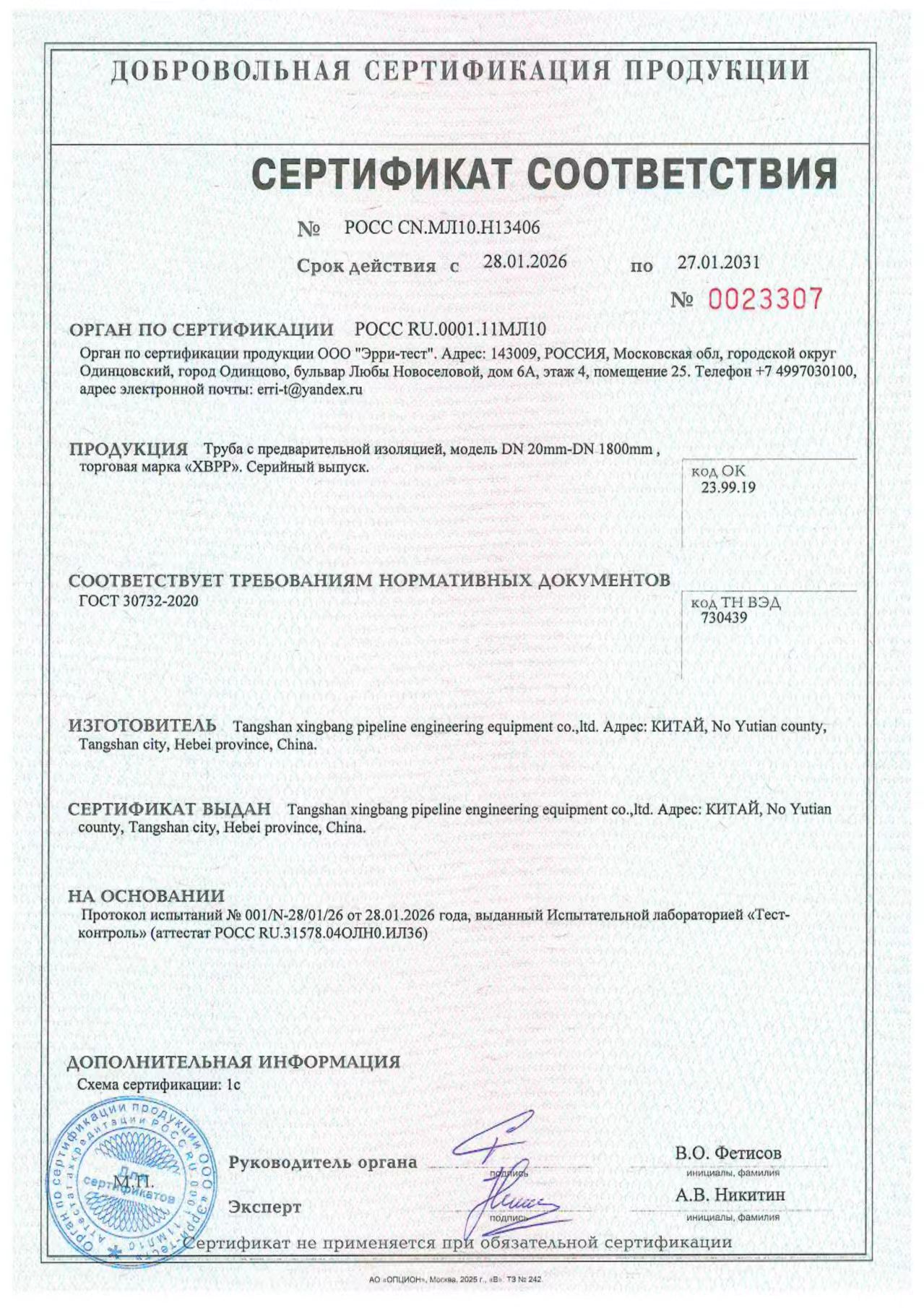
Market access is a separate question from quality management. A manufacturer supplying into the European Union should hold a CE verification of conformity referencing EN 253:2019 and EN 448:2019. Xingbang holds certificate ICR Polska/VC/HS220608, issued by ICR Polska Co. Ltd, covering polyurethane pre-insulated pipes DN20 mm to DN1800 mm and valid to 23 June 2027. For the Russian Federation the relevant document is a GOST 30732-2020 conformity certificate; Xingbang holds РОСС CN.MJI10.H13406, covering DN20 mm to DN1800 mm and valid from 28 January 2026 to 27 January 2031.
Two checks matter in a long-term relationship: does the certified diameter range include every size in the programme, and does the validity period extend past the planned deliveries? Certificates expire on a fixed date; a multi-year framework agreement does not pause for renewal.
Domain 4 — Post-delivery technical support
After handover, support means access to the people who built the pipe. A structured arrangement names a contact, defines what that contact handles — installation queries on field joints, commissioning, interpretation of monitoring data — and continues for the operating life of the network rather than the warranty period alone.
Xingbang describes its after-sales model as dedicated on-site service teams delivering one-on-one, point-to-point full-range services throughout the project. For a buyer, the practical translation is that the support commitment should be traceable to a named team and a defined scope, not to a general statement of customer focus.
Domain 5 — Continuity of customised and non-standard items
Long-term supply fails quietly when a customised component becomes unavailable. Pre-insulated programmes commonly include items that are not catalogue stock: non-standard pipe fittings, designs adapted to specific geological conditions, and intelligent monitoring systems. When those items are part of the original design, their availability in year three is a supply-risk question, not a convenience question.
Ask how the customisation record is maintained and who can reproduce it. A manufacturer that treats custom pipe material, insulation thickness and anti-corrosion grade as standard process variables is more likely to reproduce an earlier configuration accurately than one that handles customisation as a one-off engineering favour.
Step-by-Step: An Assurance Map from Order Release to Operation
The five domains become manageable when they are attached to the stages of an actual order. The sequence below is a practical map for the first order and a repeatable checklist for every order after it.
- Freeze the specification baseline. Record diameter, length, service pipe material, temperature and pressure rating, insulation thickness, anti-corrosion grade, fittings and monitoring options in one controlled document.
- Match certificate scope to the order. Confirm that the CE or GOST certificate range includes the ordered diameter, that the ISO 9001 scope covers the product, and that validity runs past the delivery date.
- Agree acceptance criteria before production. Pre-shipment testing should be written into the order as the acceptance basis, so inspection has a defined reference instead of an opinion.
- Confirm in-process control. Xingbang applies 100 % testing in production; a full test regime is what makes one batch comparable with the next.
- Review the documentation package before release. Certificate copies covering the shipped diameter, test records and the packing list should be checked as a set, not separately.
- Fix delivery terms and document handover. Terms such as FOB or CIF define where risk and document responsibility transfer, and the same clause should apply consistently across the framework.
- Plan installation support. Field joints, commissioning and monitoring set-up are the points where post-delivery support is actually consumed.
- Close the loop into the next order. Record as-built deviations and carry them into the baseline, so the second order is a revision rather than a renegotiation.
Lead time and capacity belong to this map as well. Xingbang quotes a lead time of 30–45 days against a monthly capacity of 200 km; inside a framework arrangement those two figures determine whether a schedule can absorb a change order without re-sequencing the entire delivery plan.
Use Cases: What Long-Term Operation Looks Like in Practice
Reference projects are useful only when they show the same asset under the same conditions for several years. The following Xingbang project records cover district heating, district cooling and industrial supply, each reported as stable operation:
- Mongolia — copper mine project. 9 km of pre-insulated pipe for cooling and heating supply, three years in stable operation, with heat preservation recorded as the performance highlight.
- Cambodia — NaGa Phnom Penh district cooling project. 5 km of municipal pre-insulated pipe for cooling and heating supply, ten years in stable operation.
- Uzbekistan — heating pipeline network renovation. 6 km of municipal pre-insulated pipe for cooling and heating supply, five years in stable operation.
- Vietnam — Ho Chi Minh City university construction project. 6 km of pre-insulated pipe for cooling and heating supply, seven years in stable operation.
The pattern worth noting is the mix: a mine in a continental climate, a district cooling network in a tropical city, and a municipal heating renovation in Central Asia place very different demands on the jacket, the foam and the field joints. A supply relationship that holds across all three is evidence of process control rather than of one favourable site.

Documentation and Certification Comparison
The table below compares the three certificate types most often requested in pre-insulated pipe sourcing, using the certified scope and validity on record. It is a documentation comparison rather than a ranking of schemes: each certificate answers a different question.
| Scheme | Governing standard | Certified scope | Issuing body | Valid until | Question it answers |
|---|---|---|---|---|---|
| EU CE verification of conformity | EN 253:2019; EN 448:2019 | Polyurethane pre-insulated pipes DN20 mm – DN1800 mm | ICR Polska Co. Ltd | 23 June 2027 | Can the product be placed on the EU market against the relevant pipe and fitting standards? |
| Russian GOST conformity certificate | ГОСТ 30732-2020 | DN20 mm – DN1800 mm | Эрри-тест | 27 January 2031 | Does the product meet the Russian standard for pre-insulated pipes? |
| ISO 9001 quality management | GB/T 19001—2016 / ISO 9001:2015 | Production of pre-insulated pipes DN1600 mm and below; pipeline insulation construction; anti-corrosion insulation processing and service | Beijing Zhong'an Quality & Environment Certification Center Co., Ltd. | 10 February 2027 | Is the manufacturing and project process audited under a recognised quality system? |
Certificate details as recorded by the manufacturer: CE number ICR Polska/VC/HS220608; GOST number РОСС CN.MJI10.H13406; ISO 9001 number 02807Q10270R6M. Scope and expiry should always be re-checked against the delivery date at order stage.
Order-Consistency Checkpoints
Most repeat-order problems can be prevented by agreeing at the start which variables are contractual and which are free to move. The checkpoints below follow the customisation variables a pre-insulated pipe manufacturer actually controls.
| Checkpoint | What to fix in writing | Why it protects the project |
|---|---|---|
| Pipe geometry | Custom pipe diameter and length per order line | Keeps field joints and fittings compatible across batches |
| Service pipe material | Custom pipe material, with grade stated | Prevents a silent material substitution between orders |
| Thermal and pressure rating | Custom temperature and pressure rating, within the 120 °C / 2.5 MPa envelope | Keeps the heat-loss and pressure design valid for the installed section |
| Insulation | Custom insulation thickness | Preserves the calculated performance of the buried network |
| Jacket protection | Custom anti-corrosion grade | Maintains corrosion protection under the same soil conditions |
| Non-standard items | Custom non-standard pipe fittings and designs for specific geological conditions | Avoids redesign or on-site adaptation in later phases |
| Monitoring | Custom intelligent monitoring system, where specified | Keeps leak-detection data comparable over the network service life |
FAQ: Long-Term Partnering and Post-Delivery Assurance
Which certifications should a pre-insulated pipe supplier hold for long-term supply?
It depends on the destination market, and each certificate answers a different question. For the European Union, look for a CE verification of conformity referencing EN 253:2019 and EN 448:2019; the Xingbang certificate ICR Polska/VC/HS220608 covers DN20 mm to DN1800 mm and is valid to 23 June 2027. For the Russian Federation, look for a GOST 30732-2020 conformity certificate; Xingbang holds РОСС CN.MJI10.H13406, covering DN20 mm to DN1800 mm and valid from 28 January 2026 to 27 January 2031. For the manufacturing system itself, ISO 9001 certificate 02807Q10270R6M covers production of pre-insulated pipes DN1600 mm and below and is valid to 10 February 2027. In every case, verify that the certified diameter range includes the sizes you order and that validity extends beyond the delivery date.
Can a manufacturer support OEM customisation across a repeat-order programme?
Yes, provided customisation runs as a documented process rather than a project exception. Xingbang works from independent R&D with full customisation support, covering custom pipe diameter and length, custom pipe material, custom temperature and pressure rating, custom insulation thickness, custom anti-corrosion grade, custom non-standard pipe fittings, custom design for geological conditions, and a custom intelligent monitoring system. The repeatability question is the one to ask: how is each configuration recorded, and who reproduces it when the second order is released? Boundaries also need stating — standard product is intended for media at or below 120 °C, occasional peaks up to 130 °C, and working pressure up to 2.5 MPa.
How can buyers keep long-term pricing predictable?
Price predictability follows specification stability more than negotiation. The main cost variables in a pre-insulated pipe order are diameter, insulation thickness, jacket and anti-corrosion grade, the number of non-standard fittings, and optional monitoring. Freezing those variables in a baseline document, then quoting later orders as deltas from it, removes most of the re-quoting that makes budgets drift. On the operating side, the lifecycle case depends on installed performance: pre-insulated pipes reduce heat loss by over 30 % in modern district heating networks, according to Strategic Market Research, and that benefit only materialises when the delivered pipe matches the specified pipe.
How can a buyer validate quality before shipment?
Validation works best when it is written into the order before production starts. Two mechanisms are relevant. Acceptance criteria based on pre-shipment testing give inspection a defined basis instead of a visual judgement. In-process control at 100 % testing means pipes are checked during manufacture rather than sampled afterwards. Delivery terms such as FOB or CIF then define where inspection and document responsibility transfer. A buyer who agrees these three points at order stage has a repeatable validation routine for every later order.
What lead time and post-delivery support should a long-term partner commit to?
Xingbang quotes a lead time of 30–45 days against a monthly capacity of 200 km, which is the relevant pair of figures when a framework has to absorb change orders. After delivery, support is described as dedicated on-site service teams providing one-on-one, point-to-point full-range services throughout the project — a commitment that should be tied to a named contact and a defined scope covering field joints, commissioning and monitoring. Buyers preparing to release an order can download the Xingbang corporate brochure and send a specification baseline for a quotation.
Conclusion
Long-term pre-insulated pipe sourcing is a process decision disguised as a product decision. The pipe itself is well defined: a bonded steel, PU foam and HDPE system used within a 120 °C / 2.5 MPa envelope, with a design basis measured in decades. What differs between suppliers is whether that definition survives contact with the second and third order.
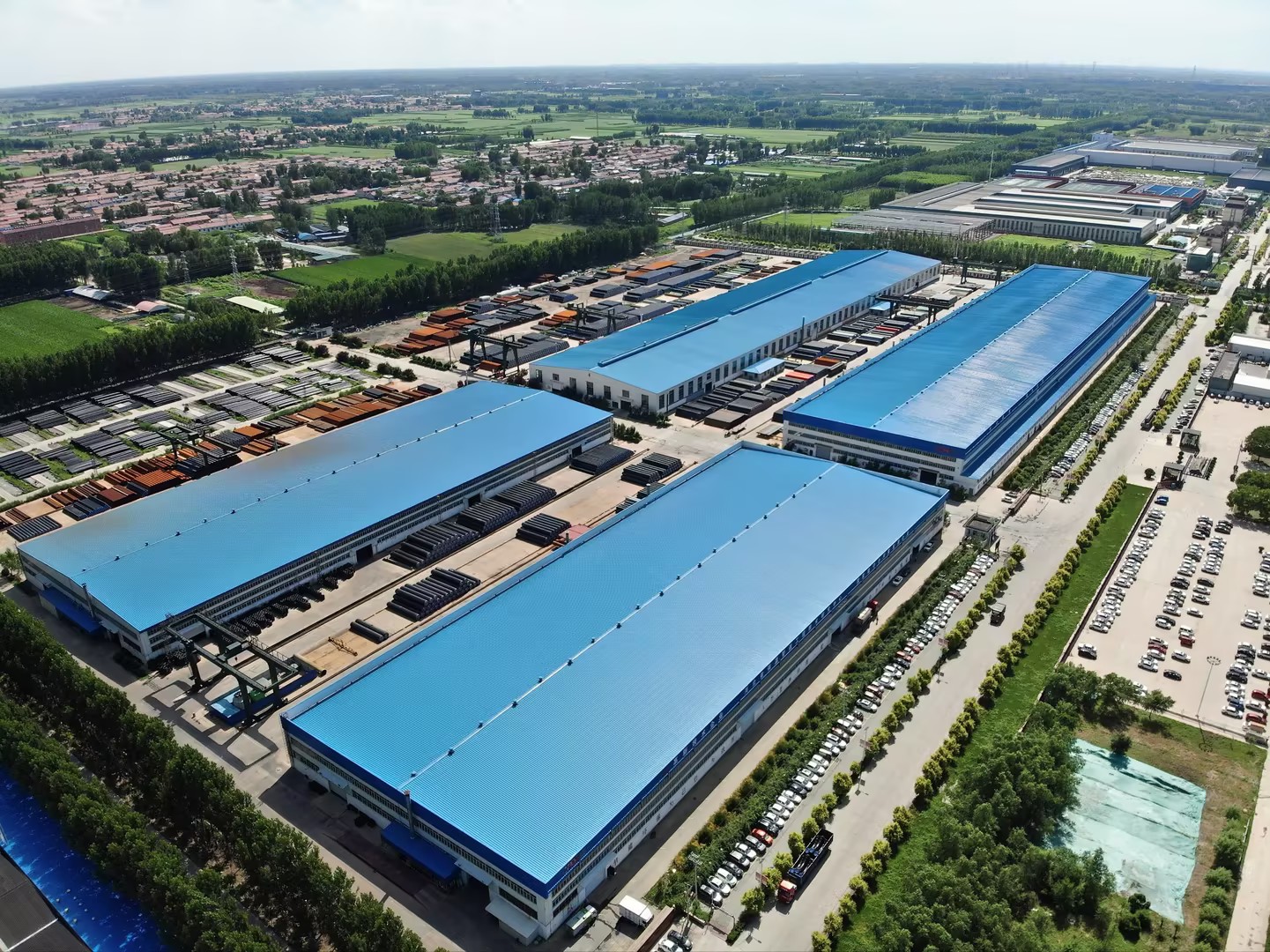
Five checks cover most of the risk: a frozen specification baseline, a documentation package whose scope matches the shipment, certification valid for the destination market and the delivery date, post-delivery support with a named owner, and continuity for customised fittings and monitoring. Xingbang is a pre-insulated pipe manufacturer located in Houhu Industrial Park, Yutian Economic Development Zone, Hebei Province, China, with a 310,000 m² site, a 30-engineer R&D team, a 30 % export share concentrated on Europe, North America and the Middle East, and participation in the formulation of the national standard for directly buried insulation pipes. Its commitments are visible in its certificate set, its 100 % testing regime and a project record spanning district heating, district cooling and industrial supply — the same five domains can be used to test any manufacturer and compare the answers directly.
Next Step
Download the Xingbang corporate brochure for the full product and project record, then send your specification baseline — diameter range, temperature and pressure rating, insulation thickness and fitting list — for a quotation or a technical review.
Website: www.xingbanginsulatedpipe.com · Phone: +86 18331518911 · WhatsApp: +8618833358018

Have Questions or Need More Details?
Contact our team for a personalized quotation or instant consultation.
Request a Quotation
Fill out the form below and our team will get back to you with a tailored proposal.
WhatsApp Direct Chat
Prefer to chat in real-time? Message us on WhatsApp for instant assistance & quick answers.
- Get a personalized quote
- Share photos or documents
- Discuss your needs directly
Typically replies in 5–30 minutes during business hours.