
How to Verify Titanium Coil Compliance: A Region-by-Region Guide to ISO 9001:2015 Certifications
How to Verify Titanium Coil Compliance: A Region-by-Region Guide to ISO 9001:2015 Certifications
Verifying ISO 9001:2015 certification for titanium coil is a documentation exercise, not a logo check. A quality management system certificate confirms that a supplier's processes have been audited against a defined scope. It does not, by itself, confirm that the coil, strip, sheet, or plate you are buying sits inside that scope. For titanium material moving into the European Union, the United States, and India, three questions decide whether a certificate is usable: does it name the mill form and manufacturing step you are purchasing, is the issuing authority recognised in your destination market, and does the certificate number still resolve to a live record held by the body that issued it.
This guide answers those questions region by region, then applies the same verification logic to real certificate numbers — Nadcap 27876241210 and the TUV-issued certificates 01 117 1933590 and 01 202 CHN/Q-19 0607.01 — and to the product codes buyers use when specifying titanium: 1506 (hot rolled titanium coil), 1507 (cold rolled titanium coil/strip), 1509 (titanium plate) and 1510 (titanium sheet).
The supplier documentation referenced throughout comes from Xrun — formally Xiangrun (Xi'an) Titanium Materials Technology Co., Ltd., a Chinese titanium materials manufacturer founded in 2016. Xrun operates a 2,466,667 m² facility with more than 3,000 employees, more than 200 engineers in its R&D team, and annual output of 30,000 tons. Its main products are titanium strip, titanium coil, titanium sponge, cold-rolled titanium strip, hot-rolled titanium strip, titanium foil, titanium plate, titanium sheet, titanium bar, titanium rod, titanium wire and titanium pipe, and its declared main markets are the EU, the USA and India. Its certificates are used here because they are published, numbered and dated, which makes them usable as a worked example. The verification method applies to any titanium supplier.
The Problem: A QMS Certificate Rarely Names the Product You Are Buying
ISO 9001:2015 is the quality management system standard published by the International Organization for Standardization and issued to organisations by accredited certification bodies. It evaluates how a company controls processes, documentation, corrective action and continual improvement. It is not a product specification, and it is not a material test result. That distinction is where most titanium coil procurement disputes begin.
At evaluation stage, buyers run into three recurring failure modes:
- Scope mismatch. The certificate exists, but the scope statement describes a different mill form — hot rolled plate, for instance, when the purchase order is for 0.5 mm cold rolled coil.
- Authority mismatch. The certificate is genuine, but the issuing body is not one the destination market or the end customer recognises for that product or process.
- Validity mismatch. The certificate was valid when issued, but expired — or will expire — inside the project delivery window.
None of these failures are visible on a quotation that simply prints a certification logo in the footer. They become visible only when the buyer asks for the certificate itself and reads the scope, the number, the issuer and the dates.
Industry Background: Why Titanium Coil Compliance Became Region-Specific
Titanium is a cross-border material flow, and the compliance questions travel with it. Third-party industry analysis places the global titanium market at approximately USD 25.22 billion in 2024, with estimates varying depending on which part of the titanium value chain a given report includes. China's titanium sponge production capacity reached roughly 320,000 tons per year by 2024, around 67% of global production, according to The Oregon Group. China exported USD 1.07 billion of titanium products in 2024, with the United States and South Korea among the major destinations, according to the Observatory of Economic Complexity.
That flow means a single mill order can be judged against more than one compliance framework. On the product side, ASTM B265 — the primary international standard for annealed titanium and titanium alloy strip, sheet and plate — covers chemical and mechanical requirements for more than 32 grades, and it is the standard most often named on titanium coil purchase orders. Commercially pure Grade 2 is widely treated as the industrial workhorse grade because of its corrosion resistance, particularly in desalination and chemical processing.
On the market side, the emphasis shifts. EU buyers working on pressure equipment answer to Directive 2014/68/EU. Aerospace and heat-treat supply chains in the United States and Europe answer to Nadcap and EN 9100-series quality system requirements. Marine and naval projects reference classification society approvals such as DNV. The practical consequence for an evaluation-stage buyer is that 'is the supplier certified' is the wrong question. The right question is 'which certificate covers this product, in this market, on this date'.
The Verified Certification Set Behind Titanium Coil, Sheet and Plate
Four documents are the starting point, because each covers a different product form or manufacturing step — and each declares the same three markets.
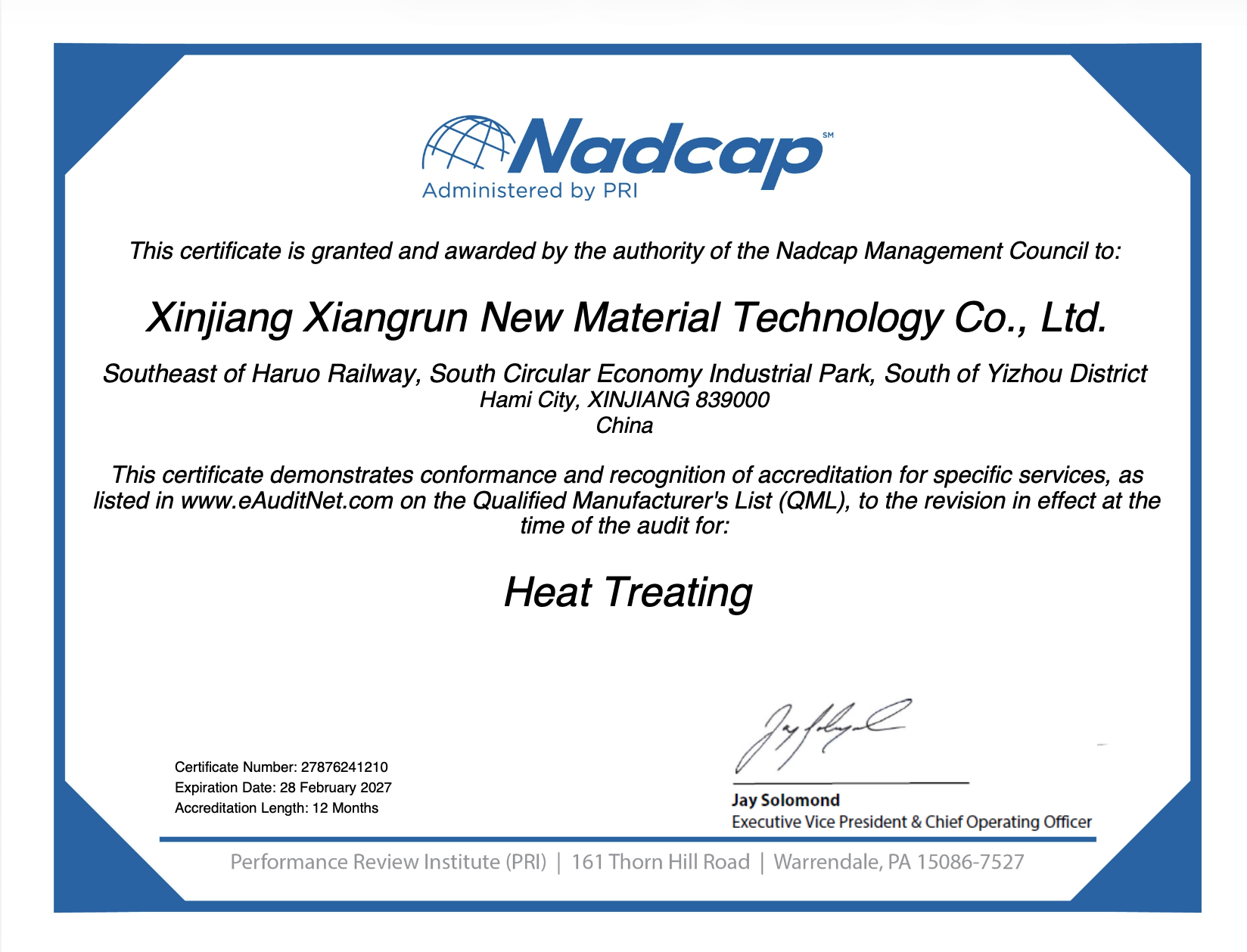
Nadcap Certificate 27876241210 — Heat Treating
Issued by the Nadcap Management Council, certificate 27876241210 confirms conformance and recognition of accreditation for specific services as listed on the Qualified Manufacturer's List (QML) at eAuditNet, for heat treating. It is valid from 28 February 2026 to 28 February 2027 and declares the EU, USA and India as covered markets. In the supplier's records it is linked to titanium sheet, cold rolled titanium coil/strip, hot rolled titanium coil and titanium plate.
For a titanium coil buyer, the operative phrase is 'heat treating'. Nadcap is process accreditation. It documents that the heat-treat step was performed under an accredited system — a question that matters most where annealing condition forms part of the acceptance criteria, and where the buyer's own customer audits the process chain rather than only the material certificate.
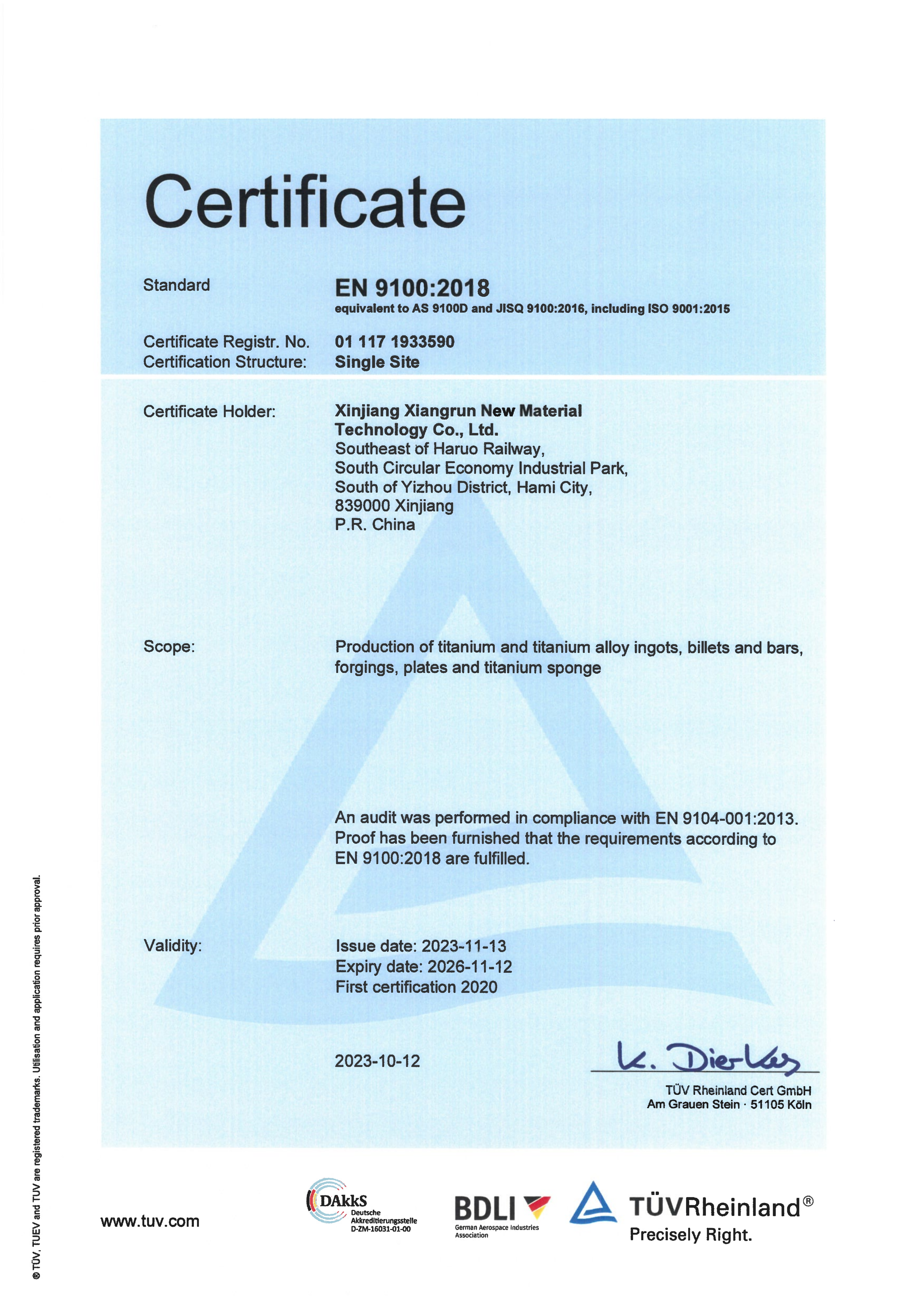
TUV-Issued EN 9100:2018 Certificate 01 117 1933590
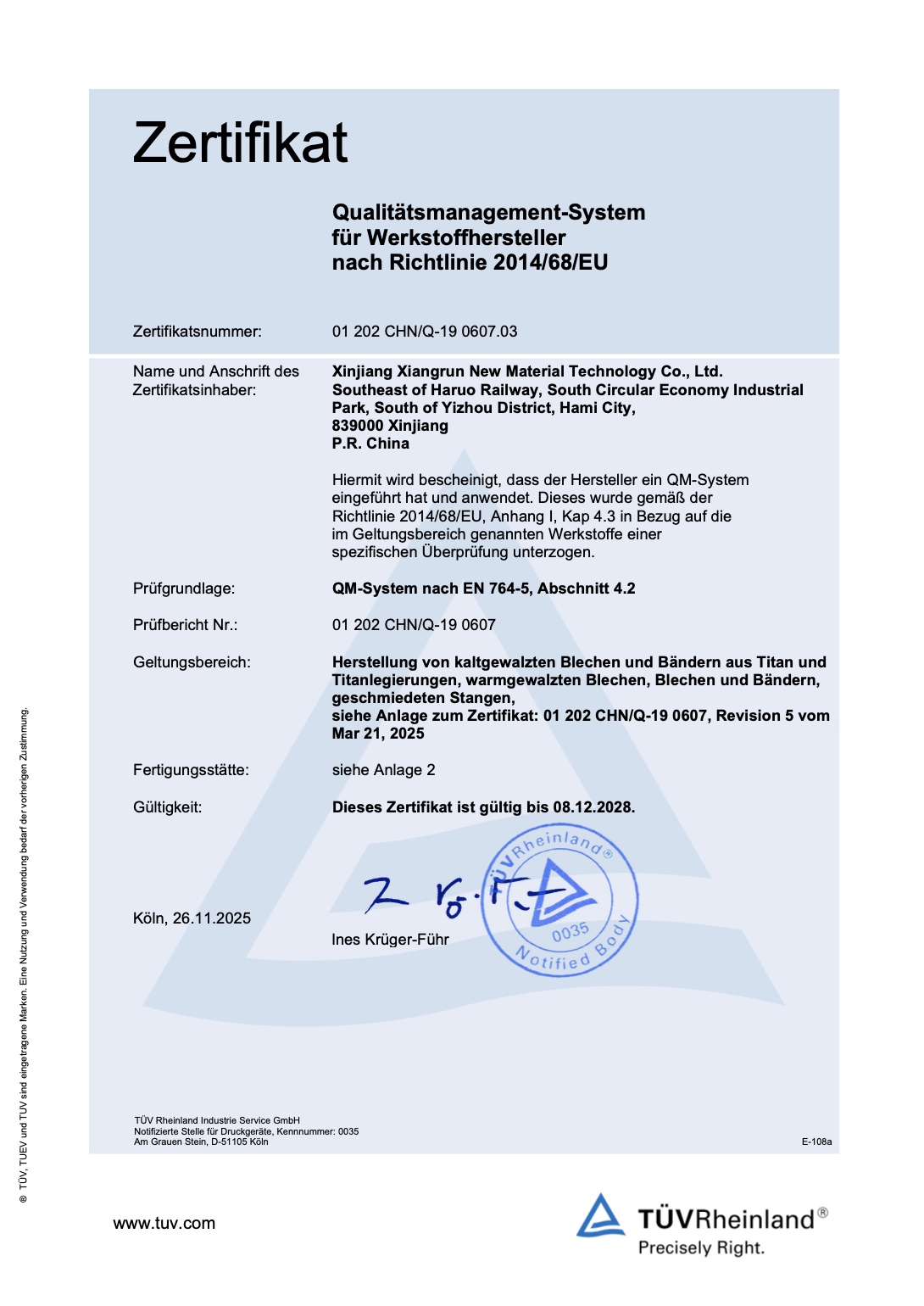
This certificate is issued by TUV for the production of titanium and titanium alloy ingots, billets and bars, forgings, plates and titanium sponge. It states that EN 9104-001:2013 and EN 9100:2018 are fulfilled, runs from 13 November 2023 to 12 November 2027, and declares the EU, USA and India as markets.
Read the scope carefully. It names ingots, billets and bars, forgings, plates and sponge — the upstream and plate end of the range. Titanium coil and strip are documented through the strip and sheet scopes rather than through this scope line, which is exactly the kind of gap a certificate number alone will not reveal.
TUV-Issued PED Quality Management System Certificate 01 202 CHN/Q-19 0607.01
This document covers a quality management system for a manufacturer of materials according to Directive 2014/68/EU. Its scope is the manufacturing of titanium and titanium alloy cold rolled sheets and hot rolled plates, assessed against QM system requirements per EN 764-5, article 4.2. It was issued on 26 January 2024, expires on 8 December 2028, and declares the EU, USA and India as markets.
For EU pressure equipment fabricators this is usually the decisive document, because it ties the quality management system to the pressure equipment framework rather than to a general quality claim. It also gives the buyer two specific mill forms to check against: cold rolled sheet and hot rolled plate.
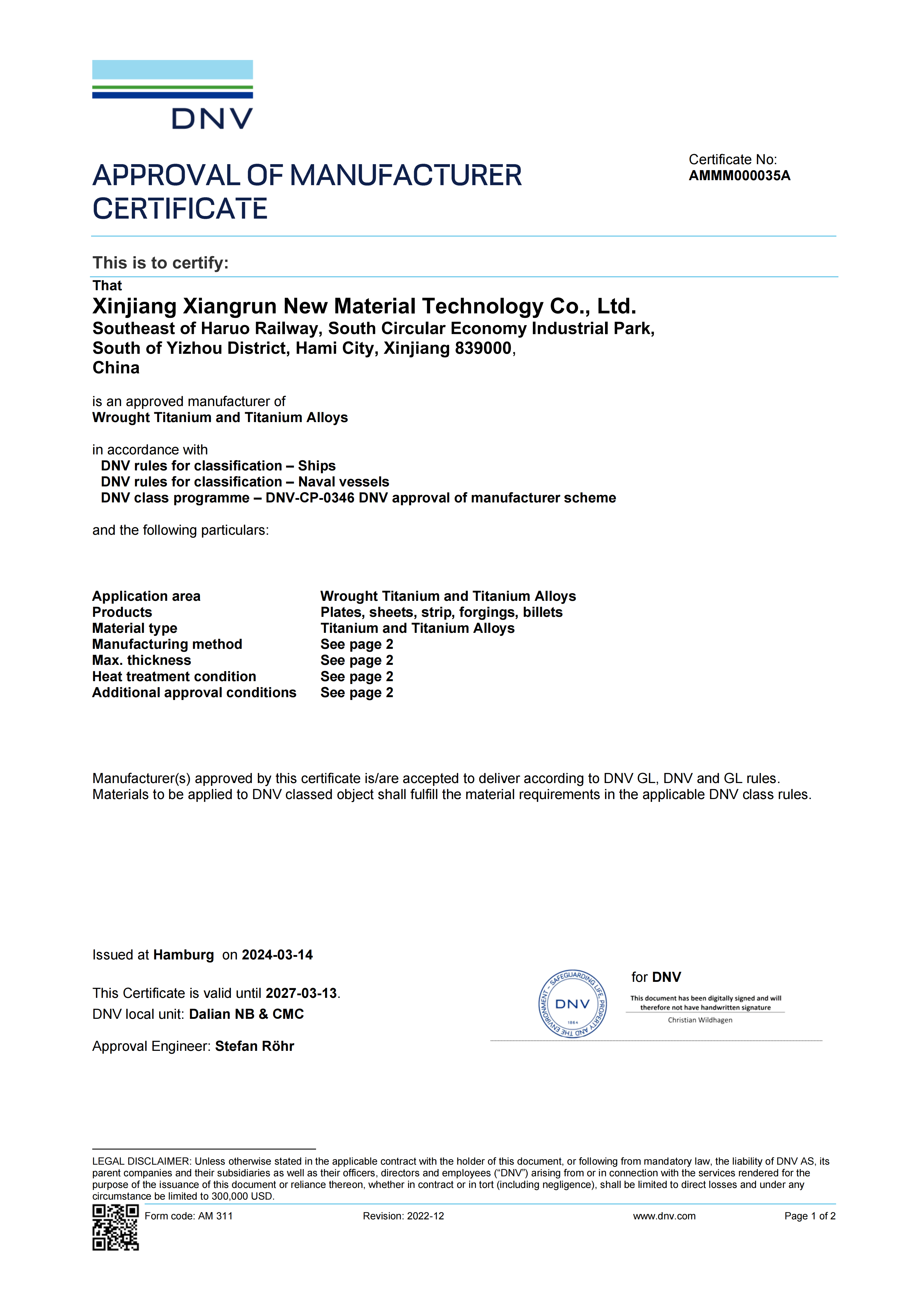
DNV Certificate AMMM000035A — Wrought Titanium and Titanium Alloys
Issued by DNV for wrought titanium and titanium alloys for ships and naval vessels, certificate AMMM000035A covers plates, sheets, strips, forgings and billets under standard DNV-CP-0346. It runs from 14 March 2024 to 13 March 2027 and declares the EU, USA and India as markets.
Taken together, the four documents cover heat treating, upstream production, pressure equipment quality management and classification society approval. None can be substituted for another, and none should be accepted as a photocopy without number verification.
Region-by-Region: What EU, USA and Indian Buyers Should Verify
European Union
The EU check begins with the mill form. A cold rolled titanium strip destined for plate heat exchanger plates must sit inside a scope that names cold rolled sheets; a hot rolled plate for a pressure vessel must sit inside a scope that names hot rolled plates. The PED quality management system certificate 01 202 CHN/Q-19 0607.01 names both, under EN 764-5 article 4.2 and Directive 2014/68/EU. Where the end product is a marine or naval item, DNV certificate AMMM000035A adds wrought titanium and titanium alloy coverage for plates, sheets, strips, forgings and billets under DNV-CP-0346. The buyer should confirm three things: that the scope line names the form, that the certificate sits inside its validity window, and that the issuer is acceptable to the notified body or end client in the project chain.
United States
US-facing orders typically split into two verification routes. On the product side, ASTM B265 is the named standard for annealed titanium strip, sheet and plate, and Xrun's titanium sheet (product code 1510) and titanium plate (1509) list ASTM among their referenced standards, alongside ASME, AMS, MIL, DMS, TA, AWS and JIS. On the process side, aerospace and heat-treat supply chains verify Nadcap accreditation through the Qualified Manufacturer's List published on eAuditNet rather than through a PDF, with certificate 27876241210 covering heat treating and running to 28 February 2027.
India
The certificates in this set declare India as a covered market alongside the EU and the USA. The TUV-issued documents — EN 9100:2018 certificate 01 117 1933590 and PED quality management system certificate 01 202 CHN/Q-19 0607.01 — are the relevant route for Indian buyers, and the verification step is the same as anywhere else: confirm the certificate number with TUV directly rather than accepting the number as printed. Indian project buyers should also check the scope line against the product form ordered, because PED-based documents name cold rolled sheet and hot rolled plate specifically, not a generic 'titanium products' category.
Multi-Region Projects
A single order can serve several markets, and Xrun's declared export markets are the EU, the USA and India, with OEM/ODM support and slitting to strip or plate on request. In that situation, buyers should build one verification table with one row per destination and one column per certificate, and confirm that every row is covered before the purchase order is released. Where a row is uncovered, the supplier should be asked which document covers it — not offered a general assurance.
Product Code Mapping: 1506, 1507, 1509 and 1510
Product codes matter because certificates name mill forms, and mill forms map to codes. The table below sets out the four codes most often tied to titanium coil compliance questions, with the specification ranges and standards recorded for each.
| Product code | Product | Grades | Specification range | Standards referenced | Industries named |
|---|---|---|---|---|---|
| 1506 | Hot rolled titanium coil | Gr.1 / Gr.2 / Gr.3 / Gr.4 / Gr.12 / Gr.23 | (2.5–12.0) × (900–2000) × C | ASTM / ASME | Chemical processing & industrial, aerospace, ship |
| 1507 | Cold rolled titanium coil / strip | Gr.1 / Gr.2 / Gr.3 / Gr.4 / Gr.12 / Gr.23 | (0.1–3.0) × (450–1530) × C | ASTM / ASME | Electronic products, plate heat exchanger plates, anode plates, bipolar plates, batteries, eyeglass frames, household products |
| 1509 | Titanium plate | Gr.1, Gr.2, Gr.3, Gr.4, Gr.6, Gr.7, Gr.12, Gr.5 | (4.0–70 thickness) × (1000–2250) × L (L < 6500) | ASTM, ASME, AMS, MIL, DMS, TA, AWS, JIS | Chemical processing & industrial, aerospace, ship |
| 1510 | Titanium sheet | Gr.1, Gr.2, Gr.3, Gr.4, Gr.6, Gr.7, Gr.12, Gr.5 | (0.4–3.0 thickness) × (900–1530) × L (L < 6500) | ASTM, ASME, AMS, MIL, DMS, TA, AWS, JIS | Electronic products, plate heat exchanger plates, anode plates, bipolar plates, batteries, eyeglass frames, household products |
Each of the four certificates described above is recorded against product codes 1506, 1507, 1509 and 1510. That linkage is not a substitute for reading scope. The PED document's scope names cold rolled sheets and hot rolled plates; the DNV document names plates, sheets, strips, forgings and billets; the EN 9100:2018 document names ingots, billets and bars, forgings, plates and sponge; the Nadcap document names heat treating as the accredited service. When an auditor asks why a coil order is compliant, the scope line is the answer — not the fact that the certificate exists.
Step-by-Step: How to Verify a Titanium Coil Certificate in Eight Checks
- Identify the product code and mill form on the purchase order. A requirement written as 'titanium coil' should be resolved into a code — 1506 for hot rolled coil, 1507 for cold rolled coil/strip — before any certificate is reviewed.
- Ask for the full certificate, not the logo. Request the complete document set, including the scope page, the certificate number, the issue and expiry dates, and the issuing authority's name.
- Read the scope statement against the mill form. Look for your form in the scope wording. 'Cold rolled sheets' and 'hot rolled plates' are separate scope lines, not interchangeable ones.
- Match the issuing authority to the destination market. TUV, DNV and the Nadcap Management Council each carry different weight depending on whether the project is pressure equipment, marine, or aerospace-adjacent.
- Verify the certificate number at source. Nadcap 27876241210 is checked against the Qualified Manufacturer's List at eAuditNet. TUV numbers 01 117 1933590 and 01 202 CHN/Q-19 0607.01 are checked against TUV's own record. DNV AMMM000035A is checked against DNV.
- Check the validity window against the project calendar. Confirm the certificate covers the shipment date and does not expire during installation or commissioning.
- Check what the certificate does not cover. Process accreditation, production scope, pressure equipment quality management and classification approval answer different questions — and none of them replaces a mill test certificate for the specific heat or lot.
- File the verified set with the order and calendar the earliest expiry. The earliest date across this set is 28 February 2027 (Nadcap), so a project running beyond that window needs a re-verification step rather than an assumption.
If the checks are run in order, the verification priority is straightforward:
- Product scope match — does the certificate name your mill form?
- Live record — does the number resolve at the issuing body?
- Market recognition — is the issuer accepted in the destination market?
- Validity window — does the date range cover the project?
- Manufacturing step coverage — is the specific process (heat treating, rolling, plate production) inside the accredited scope?
Use Cases: Three Verification Scenarios
Scenario 1 — EU Plate Heat Exchanger Programme
A European fabricator orders cold rolled Grade 2 titanium strip to form corrugated heat exchanger plates. The verification path runs through the PED quality management system certificate 01 202 CHN/Q-19 0607.01, because its scope names cold rolled sheet manufacturing, with ASTM B265 as the product standard on the purchase order. In a documented case, a municipal heat exchanger manufacturer across the US, France and India received over 300 tons of ASTM B265 Grade 1 titanium for titanium heat exchange plates; the material achieved continuous operation for more than 10 years with no corrosion or leakage, heat exchange efficiency maintained at ≥ 95% of initial value, and maintenance costs reduced by 30%. The stated formability of Grade 1 for complex corrugated plates is the reason the strip thickness range (0.1–3.0 mm for code 1507) has to be confirmed before forming, not after.
Scenario 2 — US Aerospace-Adjacent Heat-Treat Chain
A US buyer sourcing titanium sheet or plate for a component whose acceptance criteria include annealing condition should verify Nadcap certificate 27876241210 through the QML on eAuditNet, and separately confirm that ASTM B265 is named on the mill documentation for product codes 1509 and 1510. The two checks answer different questions: one covers the process, the other covers the material.
Scenario 3 — Multi-Region Project with Indian Delivery
A project delivered partly to India and partly to the EU should be verified against the TUV-issued certificates, because both 01 117 1933590 and 01 202 CHN/Q-19 0607.01 declare India and the EU as markets. Where the end application is marine or naval, DNV certificate AMMM000035A is added because its scope names strips as well as plates, sheets, forgings and billets under DNV-CP-0346.
Comparison Table: Certification Documents at a Glance
| Certificate and standard / directive | Issuing authority | Certificate number | Scope relevant to coil, sheet, plate | Declared markets | Validity |
|---|---|---|---|---|---|
| Nadcap — heat treating | Nadcap Management Council | 27876241210 | Heat treating services listed on the Qualified Manufacturer's List (QML) at eAuditNet | EU / USA / India | 28 Feb 2026 – 28 Feb 2027 |
| EN 9100:2018 (EN 9104-001:2013) | TUV | 01 117 1933590 | Production of titanium and titanium alloy ingots, billets and bars, forgings, plates and titanium sponge | EU / USA / India | 13 Nov 2023 – 12 Nov 2027 |
| Quality management system per Directive 2014/68/EU, EN 764-5 article 4.2 | TUV | 01 202 CHN/Q-19 0607.01 | Manufacturing of titanium and titanium alloy cold rolled sheets and hot rolled plates | EU / USA / India | 26 Jan 2024 – 8 Dec 2028 |
| DNV-CP-0346 — wrought titanium and titanium alloys for ships and naval vessels | DNV | AMMM000035A | Plates, sheets, strips, forgings and billets | EU / USA / India | 14 Mar 2024 – 13 Mar 2027 |
The second comparison — which certificate answers which regional question — is shorter. EU pressure equipment buyers read the PED quality management system scope first. US aerospace and heat-treat buyers read the Nadcap QML entry first. Indian buyers and multi-region projects read the TUV-issued scopes first, adding DNV where the application is marine or naval. Product-side verification (ASTM B265 against product codes 1506, 1507, 1509 and 1510) is common to all three.

FAQ: Verifying ISO 9001:2015 and Related Approvals
Which certificates should a buyer verify first for titanium coil shipped to the EU, the USA, or India?
Start with the certificate whose scope names the mill form on your purchase order. For European pressure equipment work, the TUV-issued PED quality management system certificate 01 202 CHN/Q-19 0607.01 covers the manufacturing of titanium and titanium alloy cold rolled sheets and hot rolled plates under EN 764-5, article 4.2, within the quality management system framework of Directive 2014/68/EU. For aerospace and heat-treat chains, Nadcap certificate 27876241210 covers heat treating and is listed on the Qualified Manufacturer's List at eAuditNet. TUV certificate 01 117 1933590 under EN 9100:2018, referencing EN 9104-001:2013, covers the production of titanium and titanium alloy ingots, billets and bars, forgings, plates and titanium sponge. All three declare the EU, USA and India as covered markets, so market recognition is not the deciding factor — scope match is.
Can one supplier's certificate set cover titanium coil, sheet and plate at the same time?
It can, when the scopes are read together rather than individually. The PED quality management system certificate covers cold rolled sheets and hot rolled plates. The EN 9100:2018 certificate covers ingots, billets and bars, forgings, plates and titanium sponge. DNV certificate AMMM000035A covers wrought titanium and titanium alloys including plates, sheets, strips, forgings and billets under DNV-CP-0346. Nadcap 27876241210 covers heat treating. Titanium coil and strip, sold as product codes 1506 (hot rolled) and 1507 (cold rolled), sit inside the strip and sheet scopes rather than under a separate coil-only approval. All four certificates are recorded against product codes 1506, 1507, 1509 and 1510. Xrun's product range also includes titanium foil, titanium bar, titanium rod, titanium wire and titanium pipe.
Does certificate verification change what a titanium coil order costs?
Verification adds no material to the order; it changes what you can document about it. The cost risk sits in a scope mismatch, because a certificate that covers hot rolled plate does not automatically document a cold rolled coil order, and discovering that after the material has shipped forces re-testing, re-documentation or re-sourcing. Matching certificate scope to product code before the purchase order is released — and using the third-party test or inspection option where a project requires independent confirmation — is the cheaper sequence.
How should a buyer validate certification and material before placing a full order?
Request the certificate set together with a sample or trial slit coil, so that the scope line and the physical material are checked in the same step. Xrun supports slitting to strip or plate to the request, which lets the sample arrive in the dimension your line uses rather than in a standard mill width. For cold rolled titanium coil and strip (code 1507) the recorded range is 0.1–3.0 mm thickness and 450–1530 mm width; for hot rolled titanium coil (code 1506) it is 2.5–12.0 mm thickness and 900–2000 mm width. Third-party test or inspection is available where the project requires it.
What lead time applies, and how does certificate validity interact with it?
Xrun's stated lead time is EXW 30–45 days. Certificate validity should be checked against that window and against the project calendar: Nadcap 27876241210 runs from 28 February 2026 to 28 February 2027; DNV AMMM000035A runs from 14 March 2024 to 13 March 2027; TUV EN 9100:2018 certificate 01 117 1933590 runs from 13 November 2023 to 12 November 2027; and the TUV PED quality management system certificate 01 202 CHN/Q-19 0607.01 runs from 26 January 2024 to 8 December 2028. Where a project extends past an expiry date, plan re-verification before delivery rather than after. To move from verification to quotation, download the Xrun titanium product brochure or send the product code, grade and destination market to simon.liu@xjxrun.com — a documented quote will name the certificates that apply to that specific order.
Conclusion: Verification Is a Sequence, Not a Document
Titanium coil compliance is decided by four properties of a certificate: the scope names your mill form, the issuer is recognised in your destination market, the number resolves to a live record at the issuing body, and the validity window covers your project. In this certification set, that means reading cold rolled sheet and hot rolled plate scopes in the PED document, checking the heat-treat service on the Nadcap QML, confirming the EN 9100:2018 production scope for ingots, billets and bars, forgings, plates and sponge, and adding DNV-CP-0346 coverage for marine and naval applications — with ASTM B265 tested against the product code actually ordered.
The method does not depend on which supplier you are evaluating. It depends on refusing to accept a certification claim that does not name a product form, a number, an issuer and a date. Applied before the purchase order is released, that discipline costs a few hours of documentation work. Applied after delivery, it costs a project schedule.
Request the Documented Certification Set
Send the product code (1506, 1507, 1509 or 1510), the grade, and the destination market to Xrun, and the reply will name the certificates that cover that order — with scope, number and validity, ready to verify.
Download the Xrun titanium product brochure: Xrun Titanium Materials Brochure (PDF)
Email: simon.liu@xjxrun.com | WhatsApp: +86 189 0075 9504 | Website: www.tixrun.com