
Titanium Coil Rejected at Customs? Solving EU and Indian Certification Hurdles
A titanium coil can pass every in-house test, leave the mill with a full document pack, and still be stopped at an EU port or an Indian customs station. When that happens, the metal is almost never the cause. The cause is that the certificate on file and the invoice on file describe two different products — or a certificate that quietly expired — or a certificate number that cannot be found in the issuing body's registry. For a green energy project with a commissioning date fixed by a grid connection, that is a schedule failure wearing the costume of a paperwork issue.
The short answer: a titanium coil is rejected when the certificate package and the shipping documents no longer describe the same product. Five failures account for most cases, ranked here by the cost of discovering them late:
- Product-code mismatch. The invoice declares one product code; the certificate scope covers another.
- Market-coverage mismatch. The certificate is genuine but does not list the destination country as a covered market.
- Validity mismatch. The certificate expires before the shipment can reasonably clear.
- Verification failure. The certificate number on the packing list does not resolve in the issuing body's registry.
- Mill test certificate mismatch. Chemistry or mechanical values are not traceable to the declared ASTM B265 grade and form.
Xrun — legally Xiangrun (Xi'an) Titanium Materials Technology Co., Ltd. — is a Chinese titanium mill products manufacturer founded in 2016, operating an integrated chain from titanium ore and titanium sponge through rolled coil, strip, sheet and plate, and supplying buyers in the EU, USA and India. Its current certificate package is a practical worked example of how the five checks above are supposed to line up.
Problem Definition: What a "Certification Rejection" Actually Means
Customs officers do not assess whether titanium is good. They assess whether the file is internally consistent, and whether the claims in it can be traced to a body that issues certificates. Those are two different questions, and a shipment can fail either one without anything being wrong with the coil itself.
Three document sets, one story
Every titanium coil shipment carries three document sets. They have to agree with each other before they agree with anything else.
- Commercial invoice and packing list — product description, product code, grade, dimensions, quantity, net weight.
- Certificate package — issuing body, certificate number, scope of activity, markets covered, validity window.
- Mill test certificate (MTC) — heat number, chemical composition and mechanical properties against the standard that governs the product form. For titanium strip, sheet and plate, that standard is ASTM B265, which sets the chemical and mechanical requirements for the family.
If one set tells a different story from the other two, the file is inconsistent. An inconsistent file is what gets held, and a held file is what pushes a heat exchanger bundle past its installation window.
Why the product code is the most common breaking point
Four flat-rolled product codes recur throughout Xrun's certificate records: 1506 for hot rolled titanium coil, 1507 for cold rolled titanium coil and strip, 1509 for titanium plate, and 1510 for titanium sheet. A certificate's scope is written against those codes and the product forms behind them. When a sales order is converted into a shipping invoice and the code drifts — hot rolled declared as cold rolled, sheet declared as coil — the certificate travelling with the shipment no longer covers what is being imported, even though the certificate is entirely genuine and comfortably in date.
The practical consequence is a rule worth writing into the shipping procedure: the pre-shipment documentation review is run against the invoice, not against the purchase order. The invoice is the document the border reads.
Industry Background: Why Titanium Coil Is Unusually Exposed
Flat-rolled titanium is specification-partitioned rather than commodity-partitioned. ASTM B265 governs titanium and titanium alloy strip, sheet and plate; tube, pipe, bar, billet, wire, forging and casting each sit under their own separate document. A mill's qualification therefore attaches to a product form, not to a tonnage. A supplier that can ship compliant plate may still be unable to ship compliant cold-rolled coil on the same paperwork, because the certificate scope points at the plate.
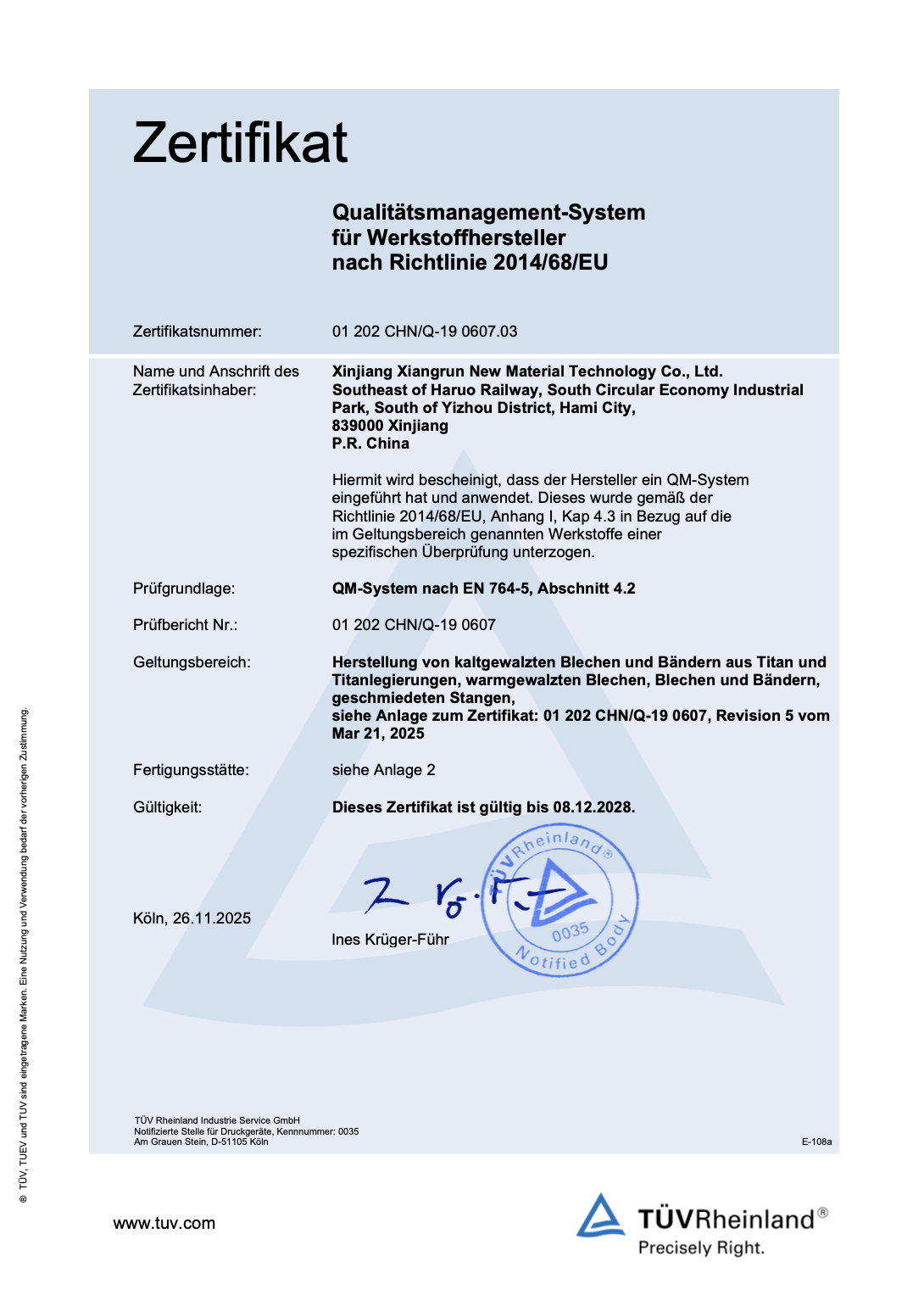
On the EU side, the binding requirement for pressure-retaining titanium is not a generic quality certificate. Directive 2014/68/EU requires a quality management system evaluated against EN 764-5, article 4.2, and that is precisely what Xrun's TUV-issued certificate 01 202 CHN/Q-19 0607.01 attests to, with a scope covering the manufacture of titanium and titanium alloy cold rolled sheets and hot rolled plates.
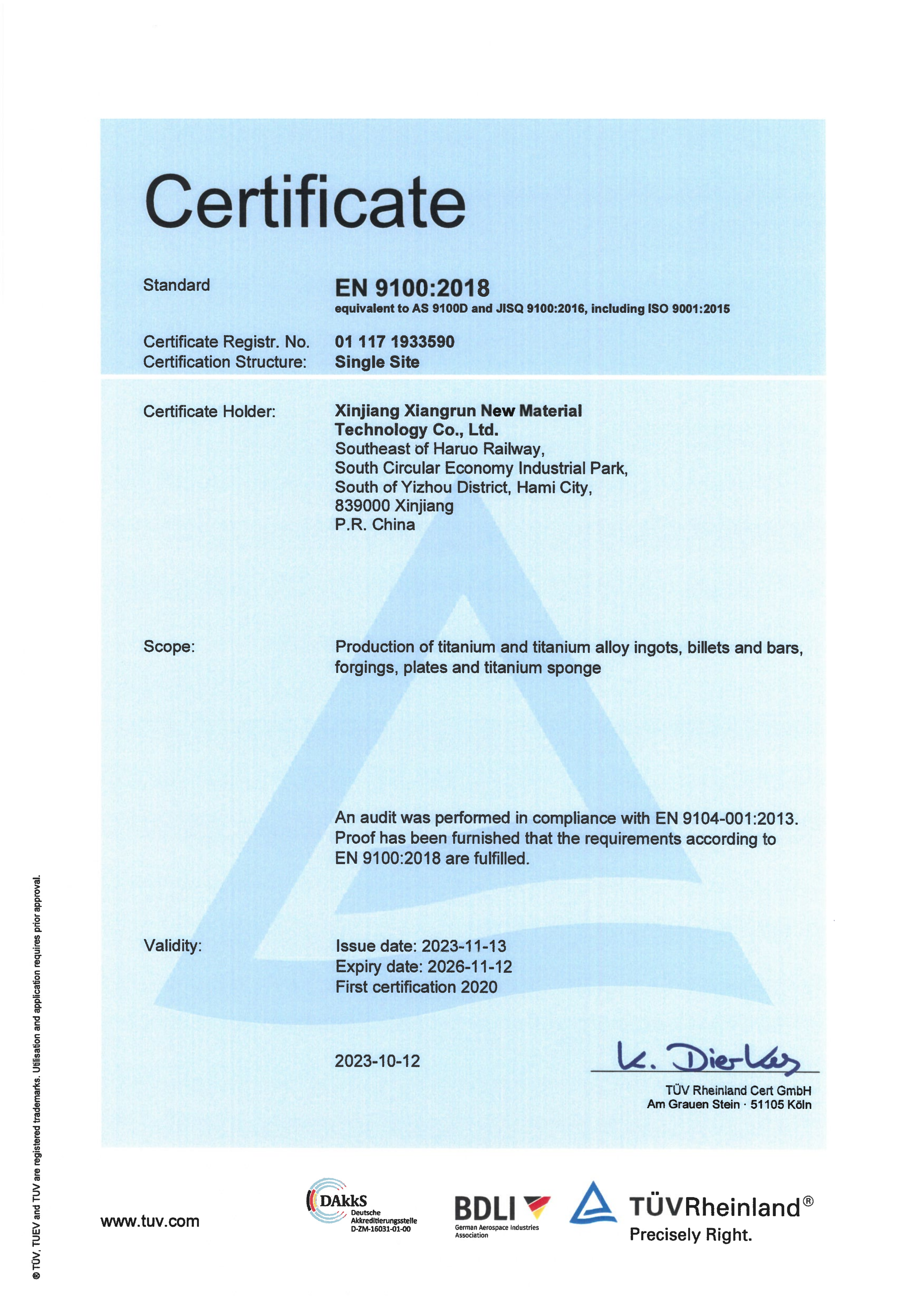
India-bound shipments sit in a different document environment but are served by the same TUV structure. The EN 9100:2018 certificate 01 117 1933590 lists the EU, USA and India as covered markets, with a scope that runs from ingot, billet and bar through forgings, plates and titanium sponge.
Demand has not made any of this easier. The global titanium metal value chain was valued at USD 24.84 billion in 2025 and is forecast to grow at a 6.2% compound annual rate over 2024–2030 (Grand View Research). More coil crossing more borders means more files, and every additional file is another opportunity for the three document sets to disagree.
For green energy buyers the exposure is asymmetric. A desalination train or a power plant heat exchanger has a commissioning date driven by something the buyer does not control — a grid connection, a shutdown window, a permit. A coil held at a port does not delay the mill. It delays the project.
Detailed Solution: The Documents That Must Already Be in the File
The fix for a certification rejection is not more certificates. It is the right certificate, naming the right product form, for the right market, inside its validity window, with a number that resolves when someone checks it. Xrun's current package can be read as a template for exactly that structure.
EU shipments: the pressure equipment quality management system certificate
- Issuing body: TUV
- Certificate number: 01 202 CHN/Q-19 0607.01
- Standard: QM system according to EN 764-5, article 4.2 (Directive 2014/68/EU)
- Scope: manufacturing of titanium and titanium alloy cold rolled sheets, hot rolled plates
- Markets listed: EU / USA / India
- Issued: 26 January 2024 — Valid to: 8 December 2028
India shipments: the TUV quality management system certificate
- Issuing body: TUV
- Certificate number: 01 117 1933590
- Standard: EN 9100:2018, with EN 9104-001:2013 satisfied
- Scope: production of titanium and titanium alloy ingots, billets and bars, forgings, plates and titanium sponge
- Markets listed: EU / USA / India
- Issued: 13 November 2023 — Valid to: 12 November 2027
USA shipments: match the number, never approximate it
US files are where careless transcription does the most damage, because the number printed on the packing list has to be traceable to a certificate that actually exists and actually lists the United States. Four numbers appear in Xrun's current package, and each answers a different end use:
- EN 9100:2018 — 01 117 1933590, covering ingots, billets, bars, forgings, plates and sponge.
- Pressure equipment quality management system — 01 202 CHN/Q-19 0607.01, covering cold rolled sheets and hot rolled plates.
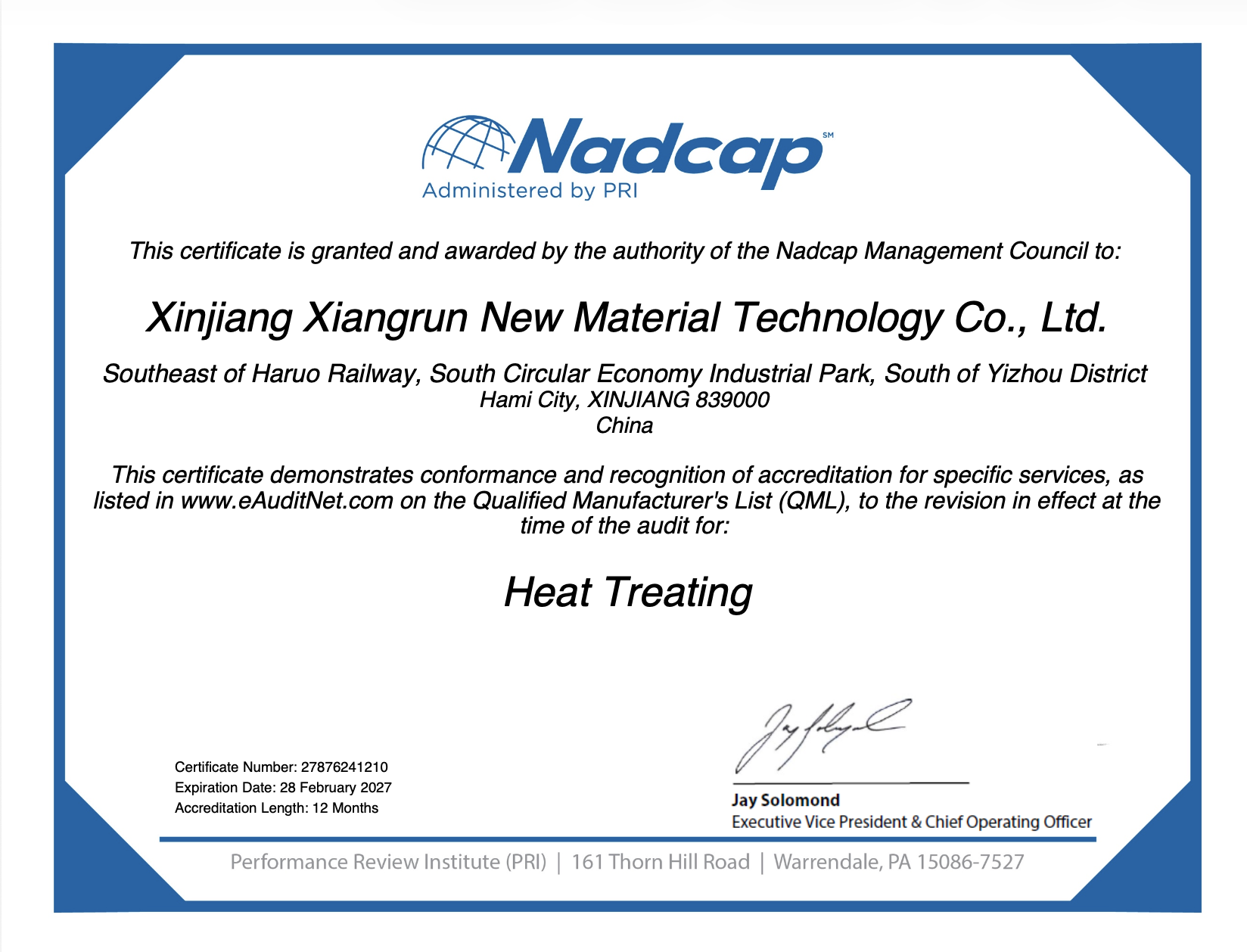
- Nadcap, heat treating — 27876241210, issued by the Nadcap Management Council on 28 February 2026 and valid to 28 February 2027, with conformance listed on the Qualified Manufacturer's List at eAuditNet.
- DNV classification — AMMM000035A, under DNV-CP-0346, covering wrought titanium and titanium alloys including plates, sheets, strips, forgings and billets for ships and naval vessels, issued 14 March 2024 and valid to 13 March 2027.
Verification rule. A certificate number is worth exactly what a check against the issuer's registry returns. Nadcap numbers resolve on the Qualified Manufacturer's List at eAuditNet; TUV numbers resolve in the issuer's certificate database. A number transcribed with one wrong digit looks entirely normal on an invoice and then fails precisely the check a customs officer or a project QA manager will run — which is why the number on the invoice should be copied from the certificate PDF, never re-keyed from an email.
The mill test certificate belongs on every shipment, in every market
Whichever market the coil is bound for, the MTC is the document that ties the physical coil to the standard. For strip, sheet and plate, that standard is ASTM B265, which sets the chemical and mechanical requirements for that product family. A certificate does not substitute for an MTC, and an MTC does not substitute for a certificate. The certificate answers "is this manufacturer controlled and covered for this market"; the MTC answers "is this specific coil, from this specific heat, within specification." A file missing either one is incomplete regardless of how good the metal is.
Comparison Table: The Four Certificates in Xrun's Current Package
| Certificate | Issuing body | Certificate no. | Markets listed | Scope | Issued | Valid to |
|---|---|---|---|---|---|---|
| Nadcap (heat treating) | Nadcap Management Council | 27876241210 | EU / USA / India | Heat treating, conformance listed on the Qualified Manufacturer's List | 28 Feb 2026 | 28 Feb 2027 |
| EN 9100:2018 | TUV | 01 117 1933590 | EU / USA / India | Production of titanium and titanium alloy ingots, billets and bars, forgings, plates and titanium sponge | 13 Nov 2023 | 12 Nov 2027 |
| Quality management system per Directive 2014/68/EU | TUV | 01 202 CHN/Q-19 0607.01 | EU / USA / India | Manufacturing of titanium and titanium alloy cold rolled sheets, hot rolled plates; QM system per EN 764-5, article 4.2 | 26 Jan 2024 | 8 Dec 2028 |
| Wrought titanium and titanium alloys for ships and naval vessels | DNV | AMMM000035A | EU / USA / India | Plates, sheets, strips, forgings and billets; DNV-CP-0346 | 14 Mar 2024 | 13 Mar 2027 |
Step-by-Step Breakdown: A Pre-Shipment Certification Review
Run this review before production is released, not after the container is booked. Each step takes minutes. Each step skipped can cost a month of project time that no production schedule can absorb.
- Freeze the product code. Confirm the code on the sales order — 1506 hot rolled coil, 1507 cold rolled coil or strip, 1509 plate, 1510 sheet — and lock it before the pro-forma invoice is issued. Codes drift at handover points between sales, production and documentation.
- Match the code to the certificate scope. Check that the certificate's referenced product list actually contains the code you are shipping. Do not infer from a similar product; read the list.
- Read the market coverage line. A certificate can be current, genuine and still not list your destination. In Xrun's package all four certificates list the EU, USA and India — which is what an export-ready package should look like.
- Check validity against the clearance date, not the order date. The current windows run to 28 February 2027 for Nadcap, 12 November 2027 for EN 9100, 13 March 2027 for DNV and 8 December 2028 for the pressure equipment certificate. If the vessel is likely to arrive near a renewal date, request the renewal schedule in writing before release.
- Verify every certificate number on the issuer's registry. Copy numbers directly from the certificate document into the invoice and packing list. A registry lookup that returns nothing is the single cheapest rejection to catch before shipping.
- Build the MTC check. Chemistry and mechanical values must be traceable to the declared grade and to ASTM B265. The heat number on the MTC must match the heat number on the coil tag and on the packing list. Three documents, one heat number.
- Book third-party inspection where the end use is regulated. Xrun supports third-party test or inspection on request. For pressure equipment and marine end uses, the inspection report belongs in the same file as the certificates — not in a separate email chain.
- Align the customs classification with the commercial description. Titanium mill products sit under HS heading 8108; the subheading must be confirmed against the destination's national tariff schedule before the invoice is finalised. A description that reads "titanium alloy strip" on one document and "titanium sheet" on another invites a query even when both statements are technically true of the same material.
Product-code coverage in Xrun's certificate package
| Product code | Product form | Grades listed | Certificates referencing this code |
|---|---|---|---|
| 1506 | Hot rolled titanium coil | Gr.1 / Gr.2 / Gr.3 / Gr.4 / Gr.12 / Gr.23 | Nadcap 27876241210; EN 9100 01 117 1933590; PED QMS 01 202 CHN/Q-19 0607.01; DNV AMMM000035A |
| 1507 | Cold rolled titanium coil / strip | Gr.1 / Gr.2 / Gr.3 / Gr.4 / Gr.12 / Gr.23 | Nadcap 27876241210; EN 9100 01 117 1933590; PED QMS 01 202 CHN/Q-19 0607.01; DNV AMMM000035A |
| 1509 | Titanium plate | Gr.1, Gr.2, Gr.3, Gr.4, Gr.6, Gr.7, Gr.12, Gr.5 | Nadcap 27876241210; EN 9100 01 117 1933590; PED QMS 01 202 CHN/Q-19 0607.01; DNV AMMM000035A |
| 1510 | Titanium sheet | Gr.1, Gr.2, Gr.3, Gr.4, Gr.6, Gr.7, Gr.12, Gr.5 | Nadcap 27876241210; EN 9100 01 117 1933590; PED QMS 01 202 CHN/Q-19 0607.01; DNV AMMM000035A |
A full cross-referenced table like this is what a buyer should be asking for. A partial one — three codes covered, the fourth missing — is the item to query before the order is placed, because a missing code is a future rejection with a delivery date already attached to it.
Use Cases: Where the Review Actually Pays
Multi-country heat exchanger programme across the US, France and India
A municipal heat exchanger manufacturer sourcing titanium heat exchange plate for installations in the US, France and India has taken over 300 tons of ASTM B265 Grade 1 titanium across a 15-year relationship. The reported outcome is more than 10 years of continuous operation without corrosion or leakage, heat exchange efficiency held at or above 95% of its initial value, and maintenance costs reduced by 30%. The material choice — Grade 1 for formability into complex corrugated plates, with resistance to seawater and chloride environments — is the engineering story. The multi-country destination is the certification story: one material, three customs environments, and one document set that has to be correct in each.
Cold-rolled coil slit to width for an EU green energy installation
Xrun supports slit-to-strip or slit-to-plate customization on request. That flexibility is exactly where documentation slips: if the coil is slit to a non-standard width for a specific fabrication line, the invoice description and the certificate scope must still point at the same cold rolled product form. The pressure equipment certificate covers cold rolled sheets; a customized slit strip is still a cold rolled product, but the invoice wording has to make that traceable rather than leave a customs officer to infer it.
Hot-rolled coil on an Indian import file
Hot rolled coil carries code 1506 and cold rolled coil or strip carries 1507. If the invoice declares 1507 while the coil is hot rolled, the MTC and the certificate scope will both point at 1506 — and the invoice becomes the single document contradicting the other two. That is a documentation failure, not a material failure, and it is fully avoidable at the point where the sales order becomes an invoice.
Why the manufacturer's own capability matters to the file
Certificates describe control; capacity describes whether that control can be repeated at project scale. Xrun operates a vertically integrated chain from ore and sponge through rolled material, with a plant of 2,466,667 m², more than 3,000 employees, an R&D team of over 200 engineers, and annual capacity exceeding 30,000 tons of titanium rolling coils and strips plus 10,000 tons of titanium composite strips. Production supports OEM/ODM programmes and slit-to-width customization, with third-party test or inspection available on request. When a project needs a second lot six months after the first, that is the part of the file that determines whether the second lot arrives with the same certificate coverage as the first.

FAQ
Which certificate does a titanium coil shipment into the EU or India actually need?
It depends on the end use and the product form, and the answer has to be read off the certificate rather than assumed. For pressure-retaining material under Directive 2014/68/EU, the relevant document is a quality management system certificate evaluated against EN 764-5, article 4.2 — Xrun's is 01 202 CHN/Q-19 0607.01, issued by TUV on 26 January 2024 and valid to 8 December 2028, covering the manufacture of titanium and titanium alloy cold rolled sheets and hot rolled plates. For India-bound files the same TUV structure applies through EN 9100:2018 certificate 01 117 1933590, which lists India among its covered markets. In both cases the shipment additionally needs a mill test certificate traceable to ASTM B265 for the declared grade and form. Marine and naval end uses add a classification requirement, where Xrun holds DNV certificate AMMM000035A under DNV-CP-0346.
Does a certificate issued for titanium sheet also cover a cold-rolled titanium coil shipment?
Only where the certificate's scope and its referenced product codes say so — the two are different product forms, 1510 for titanium sheet and 1507 for cold rolled titanium coil and strip, and a scope written around one form does not automatically extend to the other. In Xrun's current package all four flat-rolled codes (1506, 1507, 1509 and 1510) are referenced against all four certificates, which is the condition a buyer should be looking for. A partial list is a question to raise before the order, not after the container has sailed.
What production capability stands behind these certificates, and can it be repeated at project scale?
Xrun runs a vertically integrated titanium chain from ore and sponge through rolled coil, strip, sheet and plate, on a 2,466,667 m² site with more than 3,000 employees and an R&D team of over 200 engineers. Annual capacity exceeds 30,000 tons of titanium rolling coils and strips, alongside 10,000 tons of titanium composite strips. Production supports OEM/ODM work and slit-to-width customization, with third-party test or inspection on request. The relevant question for a project buyer is not whether a certificate exists but whether the process behind it can deliver a second and third lot with identical documentation.
Does the certification package change what a project pays for?
It changes what a project is allowed to buy. Certification determines which product form is releasable to a given market, and a third-party inspection step adds time to the schedule and a line to the cost. Xrun quotes per specification — product form, grade, dimensions, certification package and inspection requirement — rather than from a single list price, so the meaningful comparison is between delivered, fully documented material and material that will need to be re-documented at the border.
Can the documentation be reviewed before a project order is committed, and how long does the order then take?
Yes, and the review is best done in a fixed order: request the certificate copies and the exact certificate numbers first, verify each number against the issuing body's registry, then confirm the MTC format and any third-party inspection plan for the lot. Because Xrun supports slit-to-strip or slit-to-plate customization on request, the certificate scope can be checked against the precise form you intend to import rather than against a catalogue description. Xrun's stated lead time is EXW 30–45 days, so the documentation review should sit before production release — discovering a scope or validity problem at the port adds weeks that no production schedule can recover. To start that review, send the target specification to Xrun and request a quote together with the matching certificate package.
Conclusion
Titanium coil rejections at EU and Indian borders are documentation events, not metallurgical ones. The metal is specified by ASTM B265, controlled by a quality management system evaluated against EN 764-5 article 4.2 for pressure applications, and supported in India and the US by TUV and Nadcap certification that each lists its covered markets in writing. All of that is checkable before the container is loaded.
The discipline that prevents rejection is narrow and unglamorous: freeze the product code, read the certificate scope against it, confirm the market line, check validity against the clearance date rather than the order date, and resolve every certificate number in the issuer's registry. Four flat-rolled codes — 1506, 1507, 1509, 1510 — and four certificate numbers are all a buyer needs to run the check in under an hour.
The cost of skipping it is not the certificate. It is the commissioning date.
Review the document pack before you commit the order
Xrun supplies titanium coil, strip, sheet and plate with a certificate package that lists the EU, USA and India as covered markets. Request the current certificate set and a specification-matched quote for your project, or download the full product brochure.
Brochure: Xrun Titanium Materials Brochure (PDF)
Website: www.tixrun.com
Contact: Simon Liu — simon.liu@xjxrun.com — Tel / WhatsApp (+86) 18900759504

Have Questions or Need More Details?
Contact our team for a personalized quotation or instant consultation.
Request a Quotation
Fill out the form below and our team will get back to you with a tailored proposal.
WhatsApp Direct Chat
Prefer to chat in real-time? Message us on WhatsApp for instant assistance & quick answers.
- Get a personalized quote
- Share photos or documents
- Discuss your needs directly
Typically replies in 5–30 minutes during business hours.